


1 Kings 11:16
Bible text: King James Version (1769 Blayney text) · Public domain
Bible text: Berean Standard Bible · Public domain
Bible text: American Standard Version (1901) · Public domain
Bible text: World English Bible, Messianic edition · Public domain
Bible text: Geneva Bible (1599) · Public domain
Bible text: Young's Literal Translation · Public domain
- כִּיkiforH3588PrtParticle Conditional
- שֵׁשֶׁתShe·shetsixH8337N-cscNoun Singular common gender Construct
- חֳדָשִׁיםcho·da·ShimmonthsH2320N-mpNoun Plural Masculine Absolute
- יָשַׁבya·shavhe remainedH3427V-Qal-Perf-3msVerb Qal Perfect 3rd Singular Masculine
- שָׁםshamthereH8033AdvAdverb
- יוֹאָבyo·'AvJoabH3097N-proper-mNoun Proper Masculine
- וְכָלve·kholand allH3605Conj-w ¦ N-mscNoun Singular Masculine Constructוְandכָלall
- יִשְׂרָאֵלYis·ra·'ElIsraelH3478N-properNoun Proper Location
- עַד'aduntilH5704PrepPreposition
- הִכְרִיתhikh·Rithe had cut offH3772V-Hiphil-Perf-3msVerb Hiphil Perfect 3rd Singular Masculine
- כָּלkoleveryH3605N-msNoun Singular Masculine Absolute
- זָכָרza·KharmaleH2145Adj-msAdjective Singular Masculine Absolute
- בֶּאֱדוֹםbe·'e·Domin EdomH123Prep-b ¦ N-proper-mNoun Proper MasculineבֶּinאֱדוֹםEdom
English is a literal word-by-word gloss of the Hebrew, not the KJV's wording. Why?
This is the original text the KJV's translators worked from — each Hebrew word with its own literal English meaning in this verse, prepared by scholars at Tyndale House, Cambridge. The KJV translates whole sentences, not word by word, so its wording differs: one Hebrew word can become several English words, and the KJV may choose “the LORD” where the gloss reads “Yahweh”. Both are faithful — they answer different questions. For the KJV's own rendering, switch to the KJV text.
Details
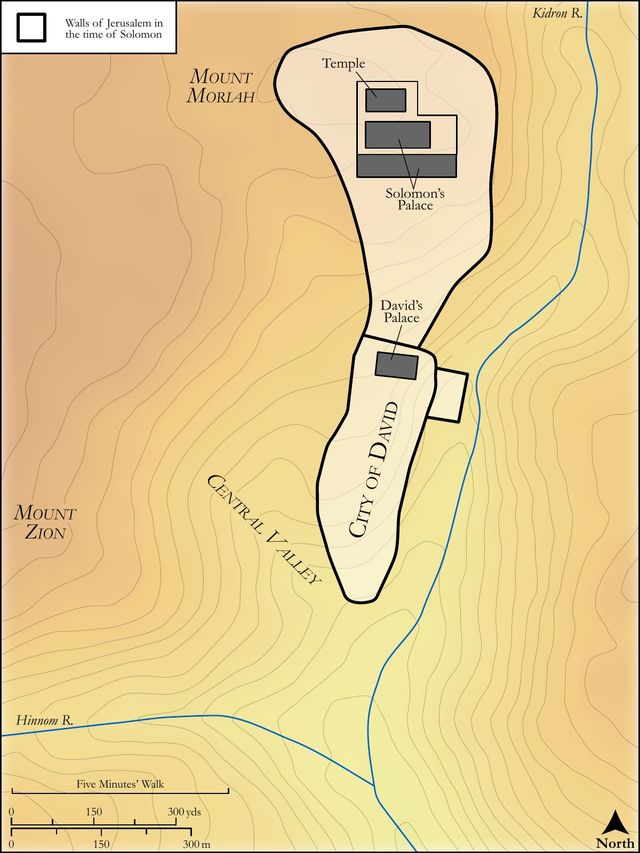
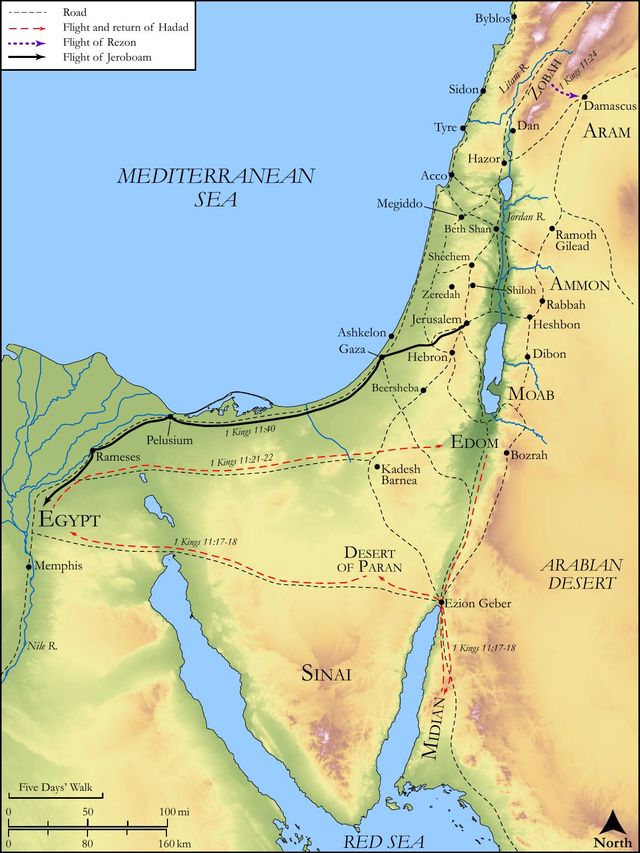
See on the biblical-era maps
Study this verse
Public-domain commentary
Matthew Henry
From his Commentary on the Whole Bible. Henry comments on passages, not single verses — this entry covers 1 Kings 11:14–25. His three-level outline is real structure in the source text, so it is rendered as structure.
While Solomon kept closely to God and to his duty there was no adversary nor evil occurrent (Kg1 5:4), nothing to create him any disturbance or uneasiness in the least; but here we have an account of two adversaries that appeared against him, inconsiderable, and that could not have done any thing worth taking notice of if Solomon had not first made God his enemy. What hurt could Hadad or Rezon have done to so great and powerful a king as Solomon was if he had not, by sin, made himself mean and weak? And then those little people menace and insult him. If God be on our side, we need not fear the greatest adversary; but, if he be against us, he can made us fear the least, and the very grasshopper shall be a burden. Observe,
I.Both these adversaries God stirred up, Kg1 11:14, Kg1 11:23.
Though they themselves were moved by principles of ambition or revenge, God made use of them to serve his design of correcting Solomon. The principal judgment threatened was deferred, namely, the rending of the kingdom from him, but he himself was made to fee the smart of the rod, for his greater humiliation. Note, Whoever are, in any way, adversaries to us, we must take notice of the hand of God stirring them up to be so, as he bade Shimei curse David; we must look through the instruments of our trouble to the author of it and hear the Lord's controversy in it.
II.Both these adversaries had the origin of their enmity to Solomon and Israel laid in David's time, and in his conquests of their respective countries, Kg1 11:15, Kg1 11:24. Solomon had the benefit and advantage of his father's successes both in the enlargement of his dominion and the increase of his treasure, and would never have known any thing but the benefit of them if he had kept closely to God; but now he finds evils to balance the advantages, and that David had made himself enemies, who were thorns in his sides. Those that are too free in giving provocation ought to consider that perhaps it may be remembered in time to come and returned with interest to theirs after them; having so few friends in this world, it is our wisdom not to make ourselves more enemies than we needs must.
1.Hadad, an Edomite, was an adversary to Solomon. We are not told what he did against him, nor which way he gave him disturbance, only, in general, that he was an adversary to him: but we are told,
(1.)What induced him to bear Solomon a grudge. David had conquered Edom, Sa2 8:14. Joab put all the males to the sword, Kg1 11:15, Kg1 11:16. A terrible execution he made, avenging on Edom their old enmity to Israel, yet perhaps with too great a severity. From this general slaughter, while Joab was burying the slain (for he left not any alive of their own people to bury them, and buried they must be, or they would be an annoyance to the country, Eze 39:12), Hadad, a branch of the royal family, then a little child, was taken and preserved by some of the king's servants, and conveyed to Egypt, Kg1 11:17. They halted by the way, in Midian first, and then in Paran, where they furnished themselves with men, not to fight for them or force their passage, but to attend them, that their young master might go into Egypt with an equipage agreeable to his quality. There he was kindly sheltered and entertained by Pharaoh, as a distressed prince, as well provided for, and so recommended himself that, in process of time, he married the queen's sister (Kg1 11:19), and by her had a child, which the queen herself conceived such a kindness for that she brought him up in Pharaoh's house, among the king's children.
(2.)What enabled him to do Solomon a mischief. Upon the death of David and Joab, he returned to his own country, in which, it should seem, he settled and remained quiet while Solomon continued wise and watchful for the public good, but from which he had opportunity of making inroads upon Israel when Solomon, having sinned away his wisdom as Samson did his strength (and in the same way), grew careless of public affairs, was off his guard himself, and had forfeited the divine protection. What vexation Hadad gave to Solomon we are not here told, but only how loth Pharaoh was to part with him and how earnestly he solicited his stay (Kg1 11:22): What hast thou lacked with me? "Nothing," says Hadad; "but let me go to my own country, my native air, my native soil." Peter Martyr has a pious reflection upon this: "Heaven is our home, and we ought to keep up a holy affection to that, and desire towards it, even when the world, the place of our banishment, smiles most upon us." Does it ask, What have you lacked, that you are so willing to be gone? We may answer, "Nothing that the world can do for us; but still let us go thither, where our hope, and honour, and treasure are."
2.Rezon, a Syrian, was another adversary to Solomon. When David conquered the Syrians, he headed the remains, lived at large by spoil and rapine, till Solomon grew careless, and then he got possession of Damascus, reigned there (Kg1 11:24) and over the country about (Kg1 11:25), and he created troubles to Israel, probably in conjunction with Hadad, all the days of Solomon (namely, after his apostasy), or he was an enemy to Israel during all Solomon's reign, and upon all occasions vented his then impotent malice against them, but till Solomon's revolt, when his defence had departed from him, he could not do them any mischief. It is said of him that he abhorred Israel. Other princes loved and admired Israel and Solomon, and courted their friendship, but here was one that abhorred them. The greatest and best of princes and people, however much they may in general be respected, will yet perhaps be hated and abhorred by some.
Continue studying 1 Kings 11:16 across the web’s major study libraries — every link below opens this exact verse, chapter, or book on the destination site.
Read & Compare
 BibleGatewayThis verse in more than 200 translations and 70 languages.
 Bible.comThe YouVersion reader — hundreds of translations, reading plans, and highlights.
 ESV.orgCrossway's official English Standard Version reader.
 NET BibleThe NET translation with 60,000+ translators' notes on every rendering decision.
 STEP BibleTyndale House's free study tool — original text, vocabulary, and scholarly resources.
 BibliaLogos Bible Software's free web reader.
 USCCBThe New American Bible (Revised Edition) with the U.S. bishops' study notes.
Commentaries
 BibleHub CommentariesDozens of classic commentaries on this verse, gathered on one page.
 StudyLightMore than 100 commentary sets — the largest collection on the web.
 BibleRefPlain-English commentary on what this verse means, verse by verse.
 Enduring WordDavid Guzik's free commentary on this chapter, widely used by Bible teachers.
 Bible Study ToolsVerse commentary alongside Greek and Hebrew study aids.
Original Language & Research
- BibleHub InterlinearThe verse word by word — original language, transliteration, and English.
- BibleHub LexiconEvery word's original-language definition and Strong's entry.
 Blue Letter BibleDeep-study tools — Strong's numbers, concordance, and word studies.
 SefariaThe Hebrew text with Rashi and centuries of Jewish commentary.
Sermons, Hymns & Audio


TrulyRandomVerse is not affiliated with these sites and doesn’t control their content. They’re linked because they’re genuinely useful.
Summary
This verse serves as a critical parenthetical interjection within the narrative of King Solomon's reign, providing essential historical context for Hadad the Edomite, one of the adversaries God raised against Solomon. It vividly recounts a brutal and prolonged military campaign led by Joab, King David's formidable commander, during David's earlier subjugation of Edom. For a period of six months, Joab and the entire Israelite army systematically worked to eliminate the male population of Edom, a severe act of total war intended to utterly break the nation's capacity for resistance and ensure its complete subjugation under Israelite dominion. This detail not only highlights the ruthless efficiency of David's military apparatus but also underscores the deep-seated and often violent historical animosity between Israel and Edom, setting the stage for Hadad's later role in divine judgment.
Context
ShowHideLiterary Context
This verse, 1 Kings 11:16, functions as a crucial explanatory aside, interrupting the main narrative flow concerning King Solomon's decline and God's judgment upon him. It is specifically introduced to provide the background for Hadad the Edomite, who is presented in 1 Kings 11:14 as a divinely appointed adversary against Solomon. The preceding verses detail Solomon's profound apostasy, marked by his numerous foreign wives and their idolatrous practices, which provoked God's wrath. The author strategically inserts this historical flashback to explain how Hadad, an Edomite royal, survived the devastating Israelite conquest under David and Joab, thereby setting the stage for his later opposition to Solomon. This parenthetical structure effectively draws the reader's attention to a past event that directly impacts the present narrative, illustrating the long-term consequences of historical conflicts and the unfolding of divine providence.
Historical & Cultural Context
The events described in 1 Kings 11:16 refer to a campaign conducted during the reign of King David, specifically following his decisive victory over Edom, as recounted in 2 Samuel 8:13-14 and 1 Chronicles 18:12-13. Edom, located southeast of the Dead Sea, shared a tumultuous history with Israel, tracing their lineage back to Esau, Jacob's brother, a relationship often characterized by hostility (e.g., Edom's refusal of passage during the Exodus in Numbers 20:18-21). Joab's six-month campaign reflects the harsh realities of warfare in that day, where the systematic elimination of a defeated enemy's male population, though extreme, was a recognized, albeit brutal, strategy. Such actions aimed to prevent future insurrections, secure absolute dominance, and ensure the lasting subjugation of a conquered territory, reflecting the prevailing military and political norms of the era focused on total pacification and control.
Key Themes
ShowHideThis verse powerfully contributes to several overarching themes within the book of Kings and the broader Old Testament narrative. Firstly, it highlights the severity and brutality of ancient warfare, particularly the extreme measures employed to secure dominance and prevent future rebellion. The phrase "cut off every male" underscores the thoroughness of the campaign, aimed at dismantling the enemy's capacity for resistance. Secondly, it exemplifies Joab's ruthless efficiency and unwavering loyalty as King David's chief military commander. His prolonged, systematic campaign demonstrates his strategic determination and capacity to execute David's commands, ensuring the security and expansion of the Davidic kingdom. Lastly, and most significantly in the context of 1 Kings 11, the verse reinforces the theme of divine judgment and the unfolding of God's sovereign plan, even through human conflict. While the immediate context is a human military action, the larger narrative reveals that Hadad's survival and subsequent opposition to Solomon are part of God's orchestrated judgment against Solomon's apostasy, demonstrating how God can use even the remnants of past conflicts to fulfill His righteous purposes.
Exposition and Analysis
ShowHideKey Word Analysis
ShowHideThis verb (H3772) is profoundly significant in biblical Hebrew, carrying meanings such as "to cut off," "to cut down," "to destroy," or "to exterminate." While it can also refer to "cutting a covenant" (making a covenant), in this military context, particularly in the Hiphil stem (causative), it denotes a decisive, complete, and intentional act of annihilation. Its use here signifies a thorough and systematic eradication of the male population, implying a strategic objective to prevent any future generation from rising to challenge Israelite authority. It conveys a sense of absolute finality in the context of military conquest, aiming for total subjugation.
This term (H2145) specifically refers to the male gender, derived from a root meaning "remembered" or "noteworthy," often implying the more prominent or active sex. In ancient patriarchal societies, males were the primary warriors, leaders, and progenitors of future generations. The deliberate targeting of "every male" was a strategic military objective aimed at dismantling the enemy's capacity for future resistance, leadership, and reproduction, thereby ensuring the complete and lasting subjugation of the Edomite nation. This was not merely a battle but a campaign of demographic and political control.
Verse Breakdown
ShowHide"(For six months did Joab remain there with all Israel,"
This opening parenthetical clause provides critical details regarding the duration and scale of the military operation. The "six months" indicates a prolonged, systematic campaign rather than a swift, decisive battle, underscoring a thorough and deliberate effort to pacify Edom. The phrase "with all Israel" suggests that a significant portion, if not the entirety, of the Israelite army was deployed, highlighting the importance and intensity of this mission under Joab's command. This reflects King David's commitment to securing his kingdom's borders and eliminating potential threats, demonstrating a full-scale national effort.
"until he had cut off every male in Edom:)"
This concluding phrase states the brutal objective and the successful, albeit horrifying, outcome of Joab's prolonged campaign. The phrase "cut off every male" signifies a policy of extreme severity, aimed at the complete eradication of the male population in Edom. This was intended to break the Edomite spirit, prevent future rebellion by eliminating potential warriors and leaders, and ensure the lasting subjugation of the territory. The completion of this task, indicated by "until he had cut off," emphasizes Joab's ruthless efficiency, unwavering determination, and the comprehensive nature of his execution of David's command.
Literary Devices
ShowHideThe primary literary device at play in 1 Kings 11:16 is Parenthesis. The verse functions as an explanatory aside, interrupting the main narrative flow of Solomon's reign to provide crucial background information about Hadad the Edomite. This technique allows the biblical author to insert vital historical context without disrupting the chronological progression of Solomon's story, effectively explaining why Hadad was a threat and how he survived a prior devastating campaign. Additionally, the phrase "cut off every male" can be understood as a form of Hyperbole, a deliberate exaggeration for emphasis. While it signifies a comprehensive and devastating military action aimed at eliminating the capacity for future resistance, it is unlikely to mean the literal extermination of every single Edomite male without exception, as Hadad's survival (and the later continued presence of Edomites/Idumeans) demonstrates. Rather, it powerfully conveys the thoroughness and brutality of Joab's campaign, emphasizing the complete subjugation of Edom. The verse also serves as a subtle form of Foreshadowing, hinting at the long-term consequences of past conflicts and the divine orchestration of events, as Hadad's survival ultimately plays a role in God's judgment against Solomon's apostasy.
Theological and Thematic Connections
ShowHideThis verse, though stark in its depiction of ancient warfare, is deeply interwoven with the theological tapestry of the Old Testament. It highlights the severe consequences of persistent opposition to God's chosen people, reflecting a recurring pattern throughout Israel's history where nations that actively resisted or oppressed Israel often faced divine judgment, sometimes executed through Israel's military might. While the brutality is undeniable, the biblical narrative often presents such conquests as part of God's sovereign plan to establish and secure His covenant people and their promised land. This particular event underscores the seriousness of God's covenant with David, where the security of his kingdom was paramount. It also implicitly raises profound questions about divine justice and human agency in warfare, prompting reflection on how God works through human actions, even those that are difficult to reconcile with later ethical sensibilities. The narrative ultimately points to God's unwavering commitment to His covenant purposes, even when implemented through harsh means in a fallen world.
Reflection and Application
ShowHideThe brutal reality described in 1 Kings 11:16 challenges modern readers, prompting us to grapple with the complexities of biblical historical narratives. While the actions of Joab and the Israelite army are horrifying by contemporary standards, understanding this context requires us to interpret the Bible within its own historical and cultural framework, acknowledging the realities of warfare in that day. This verse reminds us that the Bible faithfully records human history, including its darkest chapters, not to endorse such violence, but to reveal the consequences of sin, the nature of ancient conflict, and God's sovereign involvement in the rise and fall of nations. For believers, it invites reflection on the profound theological truth that God's purposes unfold even amidst human violence and geopolitical struggles. It underscores the severity of judgment against those who persistently oppose God's people and His divine plan, while also calling us to appreciate the radical shift in the New Covenant towards mercy, reconciliation, and spiritual warfare. Ultimately, this passage should lead us to a deeper appreciation for the peace and grace offered in Christ, contrasting the harshness of ancient warfare with the spiritual victory and transformative power of the Gospel.
Questions for Reflection
ShowHideFAQ
ShowHideWas the phrase "cut off every male" meant to be taken literally, implying the complete extermination of every single Edomite male?
ShowHideWhile the phrase "cut off every male" (Hebrew: hikrit kol zakar) signifies an extremely thorough and devastating military action aimed at dismantling the enemy's capacity for future resistance and reproduction, it is generally understood by scholars as a hyperbolic expression. This hyperbole indicates a comprehensive and decisive defeat rather than the literal extermination of every single male individual. The survival of Hadad the Edomite, who escaped as a young boy as detailed in 1 Kings 11:17, and the continued existence of the Edomite people throughout biblical history (e.g., in the time of the prophets and even into the New Testament era as the Idumeans), strongly suggest that the phrase denotes a military policy of total subjugation and the elimination of the fighting force, rather than absolute genocide. It emphasizes the severity and effectiveness of Joab's campaign in breaking Edomite power and preventing immediate future rebellion against the Davidic kingdom.
Why is this brutal detail about Joab's campaign included in the book of 1 Kings, especially in the context of Solomon's reign?
ShowHideThis detail is included as a crucial parenthetical explanation to provide necessary background for Hadad the Edomite, who is introduced in 1 Kings 11:14 as one of the adversaries God raised against King Solomon due to Solomon's apostasy. The author of Kings strategically inserts this historical flashback to explain how Hadad, a member of the Edomite royal family, survived the devastating Israelite conquest under King David and Joab. His escape, journey to Egypt, and eventual return to trouble Solomon are all presented as part of God's righteous judgment on Solomon's disobedience. This seemingly tangential detail serves to underscore the profound theological point that God is sovereign and can use even the remnants of past conflicts and the survival of individuals to fulfill His divine purposes, demonstrating that His judgment is precise, far-reaching, and meticulously orchestrated.
Christ-Centered Fulfillment
ShowHideThe harsh realities of 1 Kings 11:16, detailing Joab's brutal campaign to "cut off every male in Edom," find their ultimate Christ-centered fulfillment not in physical extermination, but in the decisive spiritual victory of Jesus Christ over the forces of sin, death, and evil. While the Old Testament depicts God's judgment against nations through physical warfare to establish His earthly kingdom and secure His covenant people, the New Testament reveals a new kind of warfare and a new kind of kingdom. Jesus, the true Son of David, did not come to conquer nations with a sword, but to conquer the spiritual enemies that hold humanity captive. His death on the cross was the ultimate "cutting off" – not of human lives, but of the power of sin (Romans 6:6) and the sting of death (1 Corinthians 15:55-57). Through His resurrection, He decisively disarmed the spiritual rulers and authorities, triumphing over them (Colossians 2:15). Believers are now called to engage in spiritual warfare, not against flesh and blood, but against spiritual forces of evil (Ephesians 6:12), armed with the armor of God. Thus, the thoroughness and finality of Joab's ancient campaign foreshadow the absolute and complete victory of Christ, who utterly vanquishes our true adversaries, establishing a spiritual kingdom that knows no end (Luke 1:33) and offering eternal peace and reconciliation rather than temporal subjugation.