


Judges 6:33
Bible text: King James Version (1769 Blayney text) · Public domain
Bible text: King James Version with Strong's numbers · Public domain
Bible text: Berean Standard Bible · Public domain
Bible text: American Standard Version (1901) · Public domain
Bible text: World English Bible, Messianic edition · Public domain
Bible text: Geneva Bible (1599) · Public domain
Bible text: Young's Literal Translation · Public domain
- וְכָלve·kholand allH3605Conj-w ¦ N-mscNoun Singular Masculine Constructוְandכָלall
- מִדְיָןmid·YanMidianH4080N-properNoun Proper Location
- וַעֲמָלֵקva·'a·ma·Lekand AmalekH6002Conj-w ¦ N-properNoun Proper LocationוַandעֲמָלֵקAmalek
- וּבְנֵיu·ve·neiand [the] people ofH1121Conj-w ¦ N-mpcNoun Plural Masculine Constructוּandבְנֵי[the] people of
- קֶדֶםKe·dem[the] eastH6924N-msNoun Singular Masculine Absolute
- נֶאֶסְפוּne·'es·Futhey gatheredH622V-Niphal-Perf-3cpVerb Niphal Perfect 3rd Plural common gender
- יַחְדָּוyach·DavtogetherH3162AdvAdverb
- וַיַּעַבְרוּvai·ya·'av·Ruand they passed overH5674Conj-w ¦ V-Qal-ConsecImperf-3mpVerb Qal Consecutive Imperfect 3rd Plural Masculineוַandיַּעַבְרוּthey passed over
- וַיַּחֲנוּvai·ya·cha·Nuand they encampedH2583Conj-w ¦ V-Qal-ConsecImperf-3mpVerb Qal Consecutive Imperfect 3rd Plural Masculineוַandיַּחֲנוּthey encamped
- בְּעֵמֶקbe·'E·mekin [the] valley ofH6010Prep-b ¦ N-mscNoun Singular Masculine Constructבְּinעֵמֶק[the] valley of
- יִזְרְעֶאלyiz·re·'ElJezreelH3157N-properNoun Proper Location
English is a literal word-by-word gloss of the Hebrew, not the KJV's wording. Why?
This is the original text the KJV's translators worked from — each Hebrew word with its own literal English meaning in this verse, prepared by scholars at Tyndale House, Cambridge. The KJV translates whole sentences, not word by word, so its wording differs: one Hebrew word can become several English words, and the KJV may choose “the LORD” where the gloss reads “Yahweh”. Both are faithful — they answer different questions. For the KJV's own rendering, switch to the KJV text.
Details
See on the biblical-era maps

Study this verse
Public-domain commentary
Matthew Henry
From his Commentary on the Whole Bible. Henry comments on passages, not single verses — this entry covers Judges 6:33–40. His three-level outline is real structure in the source text, so it is rendered as structure.
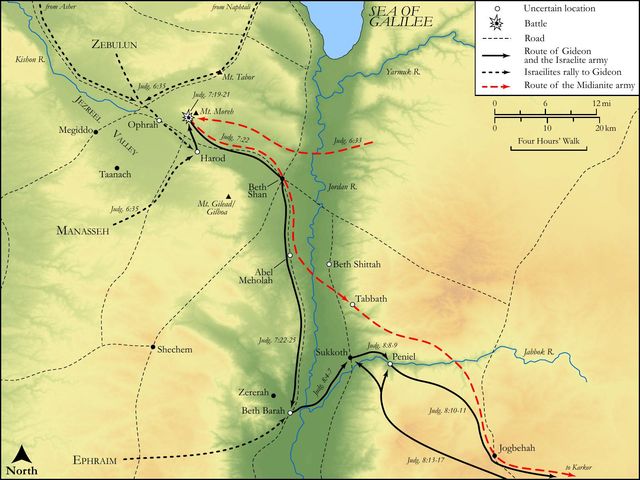
Here we have, I. The descent which the enemies of Israel made upon them, Jdg 6:33. A vast number of Midianites, Amalekites, and Arabians, got together, and came over Jordan, none either caring or daring to guard that important and advantageous pass against them, and they made their headquarters in the valley of Jezreel, in the heart of Manasseh's tribe, not far from Gideon's city. Some think that the notice they had of Gideon's destroying Baal's altar brought them over, and that they came to plead for Baal and to make that a pretence for quarrelling with Israel; but it is more likely that it was now harvest-time, when they had been wont each year to make such a visit as this (Jdg 6:3), and that they were expected when Gideon was threshing, Jdg 6:11. God raised up Gideon to be ready against this terrible blow came. Their success so many years in these incursions, the little opposition they had met with and the great booty they had carried off, made them now both very eager and very confident. But it proved that the measure of their iniquity was full and the year of recompence had come; they must now make an end to spoil and must be spoiled, and they are gathered as sheaves to the floor (Mic 4:12, Mic 4:13), for Gideon to thresh.
II.The preparation which Gideon makes to attack them in their camp, Jdg 6:34, Jdg 6:35.
1.God by his Spirit put life into Gideon: The Spirit of the Lord clothes Gideon (so the word is), clothed him as a robe, to put honour upon him, clothed him as a coat of mail, to put defence upon him. Those are well clad that are thus clothed. A spirit of fortitude from before the Lord clothed Gideon; so the Chaldee. He was of himself a mighty man of valour; yet personal strength and courage, though vigorously exerted, would not suffice for this great action; he must have the armour of God upon him, and this is what he must depend upon: The Spirit of the Lord clothed him in an extraordinary manner. Whom God calls to his work he will qualify and animate for it.
2.Gideon with his trumpet put life into his neighbours, God working with him; he blew a trumpet, to call in volunteers, and more came in than perhaps he expected.
(1.)The men of Abiezer, though lately enraged against him for throwing down the altar of Baal, and though they had condemned him to death as a criminal, were now convinced of their error, bravely came in to his assistance, and submitted to him as their general: Abiezer was gathered after him, Jdg 6:34. So suddenly can God turn the hearts even of idolaters and persecutors.
(2.)Distant tribes, even Asher and Naphtali, which lay most remote, though strangers to him, obeyed his summons, and sent him in the best of their forces, Jdg 6:35. Though they lay furthest from the danger, yet, considering that if their neighbours were over-run by the Midianites their own turn would be next, they were forward to join against a common enemy.
III.The signs which God gratified him with, for the confirming both of his own faith and that of his followers; and perhaps it was more for their sakes than for his own that he desired them. Or, perhaps, he desired by these to be satisfied whether this was the time of his conquering the Midianites, or whether he was to wait for some other opportunity. Observe,
1.His request for a sign (Jdg 6:36, Jdg 6:37): "Let me by this know that thou wilt save Israel by my hand, let a fleece of wool, spread in the open air, be wet with the dew, and let the ground about it be dry." The purport of this is, Lord, I believe, help thou my unbelief. He found his own faith weak and wavering, and therefore begged of God by this sign to perfect what was lacking in it. We may suppose that God, who intended to give him these signs, for the glorifying of his own power and goodness, put it into his heart to ask them. Yet, when he repeated his request for a second sign, the reverse of the former, he did it with a very humble apology, deprecating God's displeasure, because it looked so like a peevish humoursome distrust of God and dissatisfaction with the many assurances he had already given him (Jdg 6:39): Let not thy anger be hot against me. Though he took the boldness to ask another sign, yet he did it with such fear and trembling as showed that the familiarity God had graciously admitted him to did not breed any contempt of God's glory, nor presumption on God's goodness. Abraham had given him an example of this, when God gave him leave to be very free with him (Gen 18:30, Gen 18:32), O let not the Lord be angry, and I will speak. God's favour must be sought with great reverence, a due sense of our distance, and a religious fear of his wrath.
2.God's gracious grant of his request. See how tender God is of true believers though they be weak, and how ready to condescend to their infirmities, that the bruised reed may not be broken nor the smoking flax quenched. Gideon would have the fleece wet and the ground dry; but then, lest any should object, "It is natural for wool, if ever so little moisture fall, to drink it in and retain it, and therefore there was nothing extraordinary in this," though the quantity wrung out was sufficient to obviate such an objection, yet he desires that next night the ground might be wet and the fleece dry, and it is done, so willing is God to give to the heirs of promise strong consolation (Heb 6:17, Heb 6:18), even by two immutable things. He suffers himself, not only to be prevailed with by their importunities, but even to be prescribed to by their doubts and dissatisfactions. These signs were,
(1.)Truly miraculous, and therefore abundantly serving to confirm his commission. It is said of the dew that it is from the Lord, and tarrieth not for man, nor waiteth for the sons of men (Mic 5:7); and yet God here in this matter hearkened to the voice of a man; as to Joshua, in directing the course of the sun, so to Gideon in directing that of the dew, by which it appears that it falls not by chance, but by providence. The latter sign inverted the former, and, to please Gideon, it was wrought backward and forward, whence Dr. Fuller observes that heaven's real miracles will endure turning, being inside and outside both alike.
(2.)Very significant. He and his men were going to engage the Midianites; could God distinguish between a small fleece of Israel and the vast floor of Midian? Yes, by this he is made to know that he can. Is Gideon desirous that the dew of divine grace might descend upon himself in particular? He sees the fleece wet with dew to assure him of it. Does he desire that God will be as the dew to all Israel? Behold, all the ground is wet. Some make this fleece an emblem of the Jewish nation, which, when time was, was wet with the dew of God's word and ordinances, while the rest of the world was dry; but since the rejection of Christ and his gospel they are dry as the heath in the wilderness, while the nations about are as a watered garden.
Continue studying Judges 6:33 across the web’s major study libraries — every link below opens this exact verse, chapter, or book on the destination site.
Read & Compare
 BibleGatewayThis verse in more than 200 translations and 70 languages.
 Bible.comThe YouVersion reader — hundreds of translations, reading plans, and highlights.
 ESV.orgCrossway's official English Standard Version reader.
 NET BibleThe NET translation with 60,000+ translators' notes on every rendering decision.
 STEP BibleTyndale House's free study tool — original text, vocabulary, and scholarly resources.
 BibliaLogos Bible Software's free web reader.
 USCCBThe New American Bible (Revised Edition) with the U.S. bishops' study notes.
Commentaries
 BibleHub CommentariesDozens of classic commentaries on this verse, gathered on one page.
 StudyLightMore than 100 commentary sets — the largest collection on the web.
 BibleRefPlain-English commentary on what this verse means, verse by verse.
 Enduring WordDavid Guzik's free commentary on this chapter, widely used by Bible teachers.
 Bible Study ToolsVerse commentary alongside Greek and Hebrew study aids.
Original Language & Research
- BibleHub InterlinearThe verse word by word — original language, transliteration, and English.
- BibleHub LexiconEvery word's original-language definition and Strong's entry.
 Blue Letter BibleDeep-study tools — Strong's numbers, concordance, and word studies.
 SefariaThe Hebrew text with Rashi and centuries of Jewish commentary.
Sermons, Hymns & Audio


TrulyRandomVerse is not affiliated with these sites and doesn’t control their content. They’re linked because they’re genuinely useful.
Summary
Judges 6:33 vividly portrays the formidable assembly of Israel's oppressors—the Midianites, Amalekites, and various "children of the east"—as they converge in the strategically vital Valley of Jezreel. This verse dramatically escalates the tension, setting the stage for the impending confrontation by highlighting the overwhelming numerical superiority of the enemy forces. It underscores the immense challenge confronting Gideon and the Israelites, thereby serving as a crucial prelude to God's miraculous intervention and His demonstration of power through seemingly impossible circumstances.
Context
ShowHideLiterary Context
Judges 6:33 appears at a critical juncture, immediately following God's repeated confirmations of Gideon's divine call to deliver Israel from Midianite oppression. Prior to this, Israel had suffered seven years of severe economic devastation and terror due to their idolatry and abandonment of Yahweh. Gideon, initially hesitant and seeking multiple signs, has just obeyed God's command to destroy his father's altar to Baal and build an altar to the Lord, signaling a nascent return to faithfulness. The gathering of this vast enemy coalition in the Valley of Jezreel is the direct response to the Israelites' stirrings of resistance, establishing the physical parameters for the miraculous, divinely orchestrated victory that will unfold in the subsequent chapters, particularly Judges 7. This verse effectively transitions the narrative from Gideon's personal call and testing to the grand, national confrontation, emphasizing the overwhelming odds God is about to overcome.
Historical & Cultural Context
The period of the Judges (approximately 1200-1000 BC) was a tumultuous era characterized by a cyclical pattern of Israelite apostasy, divine judgment through foreign oppression, the people's cry for help, and God raising up a deliverer (a "judge"). The Midianites and Amalekites were nomadic, desert-dwelling peoples renowned for their swift, devastating raids on Israelite agricultural settlements, especially during harvest times. These incursions, often conducted with camels, led to widespread famine and destitution, as described in Judges 6:3-6. The "children of the east" (Hebrew: bene qedem) was a broader term encompassing various tribal groups from the Arabian and Syrian deserts, indicating a vast, composite confederation. The Valley of Jezreel, also known as the Plain of Esdraelon, was an exceptionally fertile and strategically crucial region in northern Israel, serving as a natural corridor for trade and military movements. Its expansive, open terrain made it an ideal location for large armies to muster, making the enemy's choice of this valley a clear declaration of their intent to decisively crush Israel.
Key Themes
ShowHideJudges 6:33 powerfully contributes to several overarching themes within the book of Judges and broader biblical theology. Firstly, it profoundly emphasizes the theme of Divine Deliverance Amidst Overwhelming Odds. The sheer scale of the enemy forces gathered in Jezreel magnifies the desperation of Israel's situation, thereby highlighting God's power as the sole source of victory, not human strength or numbers. This sets the stage for God's dramatic reduction of Gideon's army in Judges 7:2-7, ensuring that "Israel might not boast against Me, saying, ‘My own hand has saved me'" (Judges 7:2). Secondly, it reinforces the theme of God's Faithfulness to His Covenant, even when His people are unfaithful. Despite Israel's repeated sin and idolatry, God hears their cries and initiates their rescue, demonstrating His unwavering commitment to His covenant promises. Thirdly, the strategic location in the Valley of Jezreel underscores the theme of Geographical Significance in Redemptive History, as this valley would become a recurring battleground and symbol of decisive conflict throughout Israel's history, foreshadowing even eschatological battles (e.g., Revelation 16:16).
Exposition and Analysis
ShowHideKey Word Analysis
ShowHideThe same as מִדְיָן; Midjan, a son of Abraham; also his country and (collectively) his descendants; Midian, Midianite. These were a nomadic people, descendants of Abraham through Keturah (Genesis 25:2). They were frequent adversaries of Israel, known for their devastating camel-borne raids that impoverished the land.
Probably of foreign origin; Amalek, a descendant of Esau; also his posterity and their country; Amalek. Descendants of Amalek, a grandson of Esau (Genesis 36:12). This fierce, predatory nomadic tribe was a perennial enemy of Israel, having attacked them immediately after the Exodus (Exodus 17:8-16), leading to God's command for their utter destruction due to their persistent hostility (Deuteronomy 25:17-19).
A primitive root; properly, to incline; by implication, to decline (of the slanting rays of evening); specifically, to pitch a tent; generally to encamp (for abode or siege); abide (in tents), camp, dwell, encamp, grow to an end, lie, pitch (tent), rest in tent. This verb denotes the act of setting up a military camp, implying a deliberate establishment of a base for an extended stay or for launching an attack. It conveys the enemy's intent to consolidate their forces and prepare for a decisive engagement.
From זָרַע and אֵל; God will sow; Jizreel, the name of two places in Palestine and of two Israelites; Jezreel. This fertile valley, also known as the Plain of Esdraelon, was a strategically vital and frequently contested battleground in ancient Israel. Its wide, open spaces were ideal for large armies to gather and maneuver, making it a logical choice for the vast Midianite-Amalekite coalition to consolidate their forces before engaging Israel. The name itself, "God will sow," carries a double meaning, hinting at both the sowing of judgment upon the enemies and the scattering of their forces by God.
Verse Breakdown
ShowHide"Then all the Midianites and the Amalekites and the children of the east"
This initial clause immediately establishes the vast, composite, and overwhelming nature of the enemy coalition. The use of "all" emphasizes a comprehensive gathering, leaving no doubt about the immense numerical superiority and combined strength arrayed against Israel. "The children of the east" refers to a broad array of nomadic tribes from the Transjordanian and Arabian desert regions, further expanding the perceived threat beyond the more familiar Midianites and Amalekites, signifying a truly massive and diverse confederation.
"were gathered together, and went over"
This phrase describes the enemy's coordinated movement and consolidation of forces. "Were gathered together" (Hebrew: 'asaph yachad) indicates a deliberate act of massing forces, suggesting a unified and strategic intent to crush Israel. "Went over" (Hebrew: 'abar) likely refers to their crossing the Jordan River from the eastern desert regions into the heartland of Israel, signifying a deep invasion into Israelite territory and a direct threat to their settlements and agricultural lands.
"and pitched in the valley of Jezreel"
This final clause specifies the precise and strategic location chosen for the enemy encampment. To "pitch" (Hebrew: chanah) implies setting up a military camp, establishing a base of operations. The Valley of Jezreel, known for its strategic importance and open terrain, was an ideal site for such a large army to muster, indicating their readiness for a decisive battle and their intent to dominate the region. Their presence there was a direct challenge to Israel's sovereignty and a clear declaration of war.
Literary Devices
ShowHideJudges 6:33 masterfully employs several potent literary devices to heighten the narrative's tension and underscore its profound theological message. Hyperbole is subtly present in the phrase "all the Midianites and the Amalekites and the children of the east," which, while indicating a genuinely vast force, emphasizes the perceived overwhelming nature of the enemy from Israel's perspective, making God's subsequent, miraculous victory all the more dramatic and undeniable. Foreshadowing is a primary device, as the massing of these formidable forces directly sets the stage for the divinely orchestrated battle in Judges 7, building intense anticipation for God's powerful intervention. The specific mention of the Valley of Jezreel serves as a form of Geographical Symbolism, as this location was a recurring battleground throughout Israelite history, evoking a sense of historical significance and impending, decisive conflict. The sheer vastness and combined strength of the enemy forces, juxtaposed against Israel's weakness and despair, creates a stark Contrast, preparing the reader for a demonstration of divine power rather than reliance on human might.
Theological and Thematic Connections
ShowHideJudges 6:33 serves as a powerful theological statement about God's sovereignty and His unique method of deliverance. By presenting an overwhelmingly superior enemy, the text magnifies the glory of God's subsequent victory. It teaches a foundational biblical principle: human strength, numerical advantage, or strategic prowess are utterly irrelevant when God chooses to act. This principle is central to understanding God's work throughout Scripture, where He consistently uses the weak, the few, or the seemingly insignificant to accomplish His mighty purposes, ensuring that all glory redounds to Him alone. This dramatic setup prepares the reader for the subsequent narrative of Gideon's army being drastically reduced, making it undeniably clear that the victory is entirely God's, not a result of Israel's strength or military might.
Reflection and Application
ShowHideThe scene depicted in Judges 6:33, with an overwhelming enemy force arrayed against a vulnerable Israel, resonates deeply with the challenges believers face in every generation. We often encounter "giants" in our lives—be they spiritual battles, seemingly insurmountable personal struggles, pervasive societal pressures, or even the sheer weight of our own perceived inadequacies. This verse serves as a profound reminder that the size and apparent strength of our opposition do not dictate the outcome when the omnipotent God is involved. It calls us to shift our gaze from the formidable enemy to the all-powerful God who delights in demonstrating His strength in our weakness. Just as God deliberately allowed the Midianite-Amalekite coalition to gather in full force to demonstrate His power through Gideon, He often allows us to face seemingly impossible situations so that His strength might be perfected in our weakness. Our response should not be despair or self-reliance, but a renewed trust in the God who delights in delivering His people against all odds, reminding us that the victory is ultimately His, not ours.
Questions for Reflection
ShowHideFAQ
ShowHideWho were "the children of the east" mentioned alongside the Midianites and Amalekites?
ShowHide"The children of the east" (Hebrew: bene qedem) was a general term used in ancient Israel to refer to various nomadic tribes and peoples inhabiting the desert regions to the east of the Jordan River, primarily in what is modern-day Syria, Jordan, and Saudi Arabia. These groups were typically pastoralists and raiders, known for their swift and destructive incursions into settled agricultural lands. In the context of Judges 6:33, their inclusion signifies a vast and diverse confederation of hostile forces, emphasizing the overwhelming numerical superiority of the enemy arrayed against Israel. They were often allied with or comprised similar groups to the Midianites and Amalekites, all of whom posed a significant threat to Israel's agricultural economy and national security through their devastating raids, as graphically described earlier in Judges 6:3-6.
Christ-Centered Fulfillment
ShowHideJudges 6:33, depicting the massing of an overwhelming enemy force against a vulnerable Israel, finds its ultimate Christ-centered fulfillment in the spiritual battle waged by Jesus Christ on behalf of humanity. Just as the Midianites, Amalekites, and children of the east represented a formidable, seemingly insurmountable physical threat to Israel, humanity faced an even greater, spiritual enemy in the combined forces of sin, death, and the devil. This spiritual foe had enslaved humanity, plundering lives and leaving a wake of devastation, much like the Midianites impoverished Israel. However, the true Deliverer, Jesus Christ, entered the "valley" of human existence, not to gather an army, but to confront these spiritual adversaries head-on through His own sacrificial life and death. His crucifixion, though appearing as a defeat to human eyes, was the decisive battle where He "disarmed the powers and authorities, he made a public spectacle of them, triumphing over them by the cross" (Colossians 2:15). Through His glorious resurrection, Christ utterly vanquished death and sin, ensuring that the victory was not by human might or numbers, but by divine power, echoing the principle established in Gideon's narrative where God alone secures the triumph. Believers, united with Christ, now share in this victory, no longer slaves to the overwhelming spiritual forces that once held them captive, as promised in Romans 8:37-39, for in Him, we are more than conquerors.