


Romans 8:39
- οὔτεoutenorG3777CONJ-NConjunction Negative
- ὕψωμαhupsōmaheightG5313N-NSNNoun Nominative Singular Neuter
- οὔτεoutenorG3777CONJ-NConjunction Negative
- βάθοςbathosdepthG899N-NSNNoun Nominative Singular Neuter
- οὔτεoutenorG3777CONJ-NConjunction Negative
- τιςtisanyG5100X-NSFIndefinite pronoun Nominative Singular Feminine
- κτίσιςktisiscreated thingG2937N-NSFNoun Nominative Singular Feminine
- ἑτέραheteraotherG2087A-NSFAdjective Nominative Singular Feminine
- δυνήσεταιdunēsetaiwill be ableG1410V-FDI-3SVerb Future Middle Deponent Indicative 3rd Singular
- ἡμᾶςhēmasusG3165P-1APPersonal pronoun Accusative 1st Plural
- χωρίσαιchōrisaito separateG5563V-AANVerb Aorist Active Infinitive
- ἀπὸapofromG575PREPPreposition
- τῆςtēstheG3588T-GSFDefinite article Genitive Singular Feminine
- ἀγάπηςagapēsloveG26N-GSFNoun Genitive Singular Feminine
- τοῦtou<the>G3588T-GSMDefinite article Genitive Singular Masculine
- θεοῦtheouof GodG2316N-GSM-TNoun Genitive Singular Masculine Title
- τῆςtēs<the>G3588T-GSFDefinite article Genitive Singular Feminine
- ἐνeninG1722PREPPreposition
- ΧριστῷChristōChristG5547N-DSM-TNoun Dative Singular Masculine Title
- ἸησοῦIēsouJesusG2424N-DSM-PNoun Dative Singular Masculine Individual
- τῷtōtheG3588T-DSMDefinite article Dative Singular Masculine
- κυρίῳkuriōLordG2962N-DSM-TNoun Dative Singular Masculine Title
- ἡμῶνhēmōnof usG3165P-1GPPersonal pronoun Genitive 1st Plural
English is a literal word-by-word gloss of the Greek, not the KJV's wording. Why?
This is the original text the KJV's translators worked from — each Greek word with its own literal English meaning in this verse, prepared by scholars at Tyndale House, Cambridge. The KJV translates whole sentences, not word by word, so its wording differs: one Greek word can become several English words, and the KJV may choose “charity” where the gloss reads “love”. Both are faithful — they answer different questions. For the KJV's own rendering, switch to the KJV text.
Details
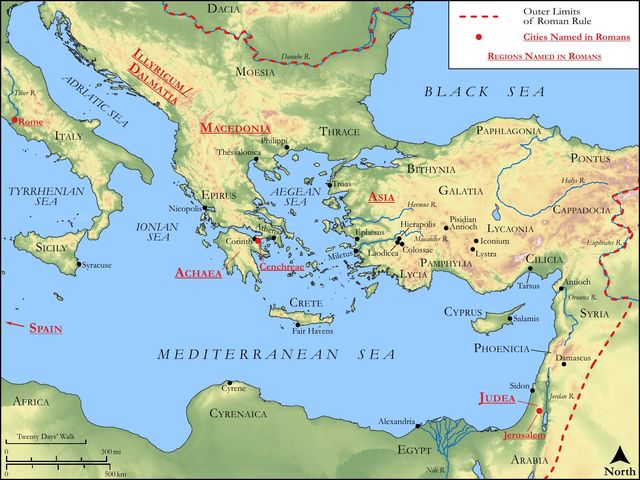
See on the biblical-era map

Study this verse
Public-domain commentary
Matthew Henry
From his Commentary on the Whole Bible. Henry comments on passages, not single verses — this entry covers Romans 8:31–39. His four-level outline is real structure in the source text, so it is rendered as structure.
The apostle closes this excellent discourse upon the privileges of believers with a holy triumph, in the name of all the saints. Having largely set forth the mystery of God's love to us in Christ, and the exceedingly great and precious privileges we enjoy by him, he concludes like an orator: What shall we then say to these things? What use shall we make of all that has been said? He speaks as one amazed and swallowed up with the contemplation and admiration of it, wondering at the height and depth, and length and breadth, of the love of Christ, which passeth knowledge. The more we know of other things the less we wonder at them; but the further we are led into an acquaintance with gospel mysteries the more we are affected with the admiration of them. If Paul was at a loss what to say to these things, no marvel if we be. And what does he say? Why, if ever Paul rode in a triumphant chariot on this side of heaven, here it was: with such a holy height and bravery of spirit, with such a fluency and copiousness of expression, does he here comfort himself and all the people of God, upon the consideration of these privileges. In general, he here makes a challenge, throws down the gauntlet, as it were, dares all the enemies of the saints to do their worst: If God be for us, who can be against us? The ground of the challenge is God's being for us; in this he sums up all our privileges. This includes all, that God is for us; not only reconciled to us, and so not against us, but in covenant with us, and so engaged for us - all his attributes for us, his promises for us. All that he is, and has, and does, is for his people. He performs all things for them. He is for them, even when he seems to act against them. And, if so, who can be against us, so as to prevail against us, so as to hinder our happiness? Be they ever so great and strong, ever so many, ever so might, ever so malicious, what can they do? While God is for us, and we keep in his love, we may with a holy boldness defy all the powers of darkness. Let Satan do his worst, he is chained; let the world do its worst, it is conquered: principalities and powers are spoiled and disarmed, and triumphed over, in the cross of Christ. Who then dares fight against us, while God himself is fighting for us? And this we say to these things, this is the inference we draw from these premises. More particularly.
I.We have supplies ready in all our wants (Rom 8:32):
He that spared, etc. Who can be against us, to strip us, to deprive us of our comforts? Who can cut off our streams, while we have a fountain to go to?
1.Observe what God has done for us, on which our hopes are built: He spared not his own Son. When he was to undertake our salvation, the Father was willing to part with him, did not think him too precious a gift to bestow for the salvation of poor souls; now we may know that he loves us, in that he hath not withheld his Son, his own Son, his only Son, from us, as he said of Abraham, Gen 22:12. If nothing less will save man, rather than man shall perish let him go, though it were out of his bosom. Thus did he deliver him up for us all, that is, for all the elect; for us all, not only for our good, but in our stead, as a sacrifice of atonement to be a propitiation for sin. When he had undertaken it, he did not spare him. Though he was his own Son, yet, being made sin for us, it pleased the Lord to bruise him. Ouk epheisato - he did not abate him a farthing of that great debt, but charged it home. Awake, O sword. He did not spare his own Son that served him, that he might spare us, though we have done him so much disservice.
2.What we may therefore expect he will do: He will with him freely give us all things.
(1.)It is implied that he will give us Christ, for other things are bestowed with him: not only with him given for us, but with him given to us. He that put himself to so much charge to make the purchase for us surely will not hesitate at making the application to us.
(2.)He will with him freely give us all things, all things that he sees to be needful and necessary for us, all good things, and more we should not desire, Psa 34:10. And Infinite Wisdom shall be the judge whether it be good for us and needful for us or no. Freely give - freely, without reluctancy; he is ready to give, meets us with his favours; - and freely, without recompence, without money, and without price. How shall he not? Can it be imagined that he should do the greater and not do the less? that he should give so great a gift for us when we were enemies, and should deny us any good thing, now that through him we are friends and children? Thus may we by faith argue against our fears of want. he that hath prepared a crown and kingdom for us will be sure to give us enough to bear our charges in the way to it. He that hath designed us for the inheritance of sons when we come to age will not let us want necessaries in the mean time.
II.We have an answer ready to all accusations and a security against all condemnations (Rom 8:33, Rom 8:34):
Who shall lay any thing? Doth the law accuse them? Do their own consciences accuse them? Is the devil, the accuser of the brethren, accusing them before our God day and night? This is enough to answer all those accusations, It is God that justifieth. Men may justify themselves, as the Pharisees did, and yet the accusations may be in full force against them; but, if God justifies, this answers all. He is the judge, the king, the party offended, and his judgment is according to truth, and sooner or later all the world will be brought to be of his mind; so that we may challenge all our accusers to come and put in their charge. This overthrows them all; it is God, the righteous faithful God, that justifieth. Who is he that condemneth? Though they cannot make good the charge yet they will be ready to condemn; but we have a plea ready to move in arrest of judgment, a plea which cannot be overruled. It is Christ that died, etc. It is by virtue of our interest in Christ, our relation to him, and our union with him, that we are thus secured.
1.His death: It is Christ that died. By the merit of his death he paid our debt; and the surety's payment is a good plea to an action of debt. It is Christ, an able all-sufficient Saviour.
2.His resurrection: Yea, rather, that has risen again. This is a much greater encouragement, for it is a convincing evidence that divine justice was satisfied by the merit of his death. His resurrection was his acquittance, it was a legal discharge. Therefore the apostle mentions it with a yea, rather. If he had died, and not risen again, we had been where we were.
3.His sitting at the right hand of God: He is even at the right hand of God - a further evidence that he has done his work, and a mighty encouragement to us in reference to all accusations, that we have a friend, such a friend, in court. At the right hand of God, which denotes that he is ready there - always at hand; and that he is ruling there - all power is given to him. Our friend is himself the judge.
4.The intercession which he makes there. He is there, not unconcerned about us, not forgetful of us, but making intercession. He is agent for us there, an advocate for us, to answer all accusations, to put in our plea, and to prosecute it with effect, to appear for us and to present our petitions. And is not this abundant matter for comfort? What shall we say to these things? Is this the manner of men, O Lord God? What room is left for doubting and disquietment? Why art thou cast down, O my soul? Some understand the accusation and condemnation here spoken of of that which the suffering saints met with from men. The primitive Christians had many black crimes laid to their charge - heresy, sedition, rebellion, and what not? For these the ruling powers condemned them: "But no matter for that" (says the apostle); "while we stand right at God's bar it is of no great moment how we stand at men's. To all the hard censures, the malicious calumnies, and the unjust and unrighteous sentences of men, we may with comfort oppose our justification before God through Christ Jesus as that which doth abundantly countervail," Co1 4:3, Co1 4:4.
III.We have good assurance of our preservation and continuance in this blessed state, Rom 8:35, to the end.
The fears of the saints lest they should lose their hold of Christ are often very discouraging and disquieting, and create them a great deal of disturbance; but here is that which may silence their fears, and still such storms, that nothing can separate them. We have here from the apostle,
1.A daring challenge to all the enemies of the saints to separate them, if they could, from the love of Christ. Who shall? None shall, Rom 8:35-37. God having manifested his love in giving his own Son for us, and not hesitating at that, can we imagine that any thing else should divert or dissolve that love? Observe here,
(1.)The present calamities of Christ's beloved ones supposed - that they meet with tribulation on all hands, are in distress, know not which way to look for any succour and relief in this world, are followed with persecution from an angry malicious world that always hated those whom Christ loved, pinched with famine, and starved with nakedness, when stripped of all creature-comforts, exposed to the greatest perils, the sword of the magistrate drawn against them, ready to be sheathed in their bowels, bathed in their blood. Can a case be supposed more black and dismal? It is illustrated (Rom 8:36) by a passage quoted from Psa 44:22, For thy sake we are killed all the day long, which intimates that we are not to think strange, no not concerning the fiery bloody trial. We see the Old Testament saints had the same lot; so persecuted they the prophets that were before us. Killed all the day long, that is, continually exposed to and expecting the fatal stroke. There is still every day, and all the day long, one or other of the people of God bleeding and dying under the rage of persecuting enemies. Accounted as sheep for the slaughter; they make no more of killing a Christian than of butchering a sheep. Sheep are killed, not because they are hurtful while they live, but because they are useful when they are dead. They kill the Christians to please themselves, to be food to their malice. They eat up my people as they eat bread, Psa 14:4.
(2.)The inability of all these things to separate us from the love of Christ. Shall they, can they, do it? No, by no means. All this will not cut the bond of love and friendship that is between Christ and true believers.
[1.]Christ doth not, will not, love us the less for all this. All these troubles are very consistent with the strong and constant love of the Lord Jesus. They are neither a cause nor an evidence of the abatement of his love. When Paul was whipped, and beaten, and imprisoned, and stoned, did Christ love him ever the less? Were his favours intermitted? his smiles any whit suspended? his visits more shy? By no means, but the contrary. These things separate us from the love of other friends. When Paul was brought before Nero all men forsook him, but then the Lord stood by him, Ti2 4:16, Ti2 4:17. Whatever persecuting enemies may rob us of, they cannot rob us of the love of Christ, they cannot intercept his love-tokens, they cannot interrupt nor exclude his visits: and therefore, let them do their worst, they cannot make a true believer miserable.
[2.]We do not, will not, love him the less for this; and that for this reason, because we do not think that he loves us the less. Charity thinks no evil, entertains no misgiving thoughts, makes no hard conclusions, no unkind constructions, takes all in good part that comes from love. A true Christian loves Christ never the less though he suffer for him, thinks never the worse of Christ through he lose all for him.
(3.)The triumph of believers in this (Rom 8:37): Nay, in all these things we are more than conquerors.
[1.]We are conquerors: though killed all the day long, yet conquerors. A strange way of conquering, but it was Christ's way; thus he triumphed over principalities and powers in his cross. It is a surer and a nobler way of conquest by faith and patience than by fire and sword. The enemies have sometimes confessed themselves baffled and overcome by the invincible courage and constancy of the martyrs, who thus overcame the most victorious princes by not loving their lives to the death, Rev 12:11.
[2.]We are more than conquerors. In our patiently bearing these trials we are not only conquerors, but more than conquerors, that is, triumphers. Those are more than conquerors that conquer, First, With little loss. Many conquests are dearly bought; but what do the suffering saints lose? Why, they lose that which the gold loses in the furnace, nothing but the dross. It is no great loss to lose things which are not - a body that is of the earth, earthy. Secondly, With great gain. The spoils are exceedingly rich; glory, honour, and peace, a crown of righteousness that fades not away. In this the suffering saints have triumphed; not only have not been separated from the love of Christ, but have been taken into the most sensible endearments and embraces of it. As afflictions abound, consolations much more abound, Co2 1:5. There is one more than a conqueror, when pressed above measure. He that embraced the stake, and said, "Welcome the cross of Christ, welcome everlasting life," - he that dated his letter from the delectable orchard of the Leonine prison, - he that said, "In these flames I feel no more pain than if I were upon a bed of down," - she who, a little before her martyrdom, being asked how she did, said, "Well and merry, and going to heaven," - those that have gone smiling to the stake, and stood singing in the flames - these were more than conquerors.
[3.]It is only through Christ that loved us, the merit of his death taking the sting out of all these troubles, the Spirit of his grace strengthening us, and enabling us to bear them with holy courage and constancy, and coming in with special comforts and supports. Thus we are conquerors, not in our own strength, but in the grace that is in Christ Jesus. We are conquerors by virtue of our interest in Christ's victory. He hath overcome the world for us (Joh 16:33), both the good things and the evil things of it; so that we have nothing to do but to pursue the victory, and to divide the spoil, and so are more than conquerors.
2.A direct and positive conclusion of the whole matter: For I am persuaded, Rom 8:38, Rom 8:39. It denotes a full, and strong, and affectionate persuasion, arising from the experience of the strength and sweetness of the divine love. And here he enumerates all those things which might be supposed likely to separate between Christ and believers, and concludes that it could not be done.
(1.)Neither death nor life - neither the terrors of death on the one hand nor the comforts and pleasures of life on the other, neither the fear of death nor the hope of life. Or, We shall not be separated from that love either in death or in life.
(2.)Nor angels, nor principalities, nor powers. Both the good angels and the bad are called principalities and powers: the good, Eph 1:21; Col 1:16; the bad, Eph 6:12; Col 2:15. And neither shall do it. The good angels will not, the bad shall not; and neither can. The good angels are engaged friends, the bad are restrained enemies.
(3.)Nor things present, nor things to come - neither the sense of troubles present nor the fear of troubles to come. Time shall not separate us, eternity shall not. Things present separate us from things to come, and things to come separate and cut us off from things present; but neither from the love of Christ, whose favour is twisted in with both present things and things to come.
(4.)Nor height, nor depth - neither the height of prosperity and preferment, nor the depth of adversity and disgrace; nothing from heaven above, no storms, no tempests; nothing on earth below, no rocks, no seas, no dungeons.
(5.)Nor any other creature - any thing that can be named or thought of. It will not, it cannot, separate us from the love of God, which is in Christ Jesus our Lord. It cannot cut off or impair our love to God, or God's to us; nothing does it, can do it, but sin. Observe, The love that exists between God and true believers is through Christ. He is the Mediator of our love: it is in and through him that God can love us and that we dare love God. This is the ground of the stedfastness of the love; therefore God rests in his love (Zep 3:17), because Jesus Christ, in whom he loves us, is the same yesterday, today, and for ever.
Mr. Hugh Kennedy, an eminent Christian of Ayr, in Scotland, when he was dying, called for a Bible; but, finding his sight gone, he said, "Turn me to the eighty of the Romans, and set my finger at these words, I am persuaded that neither death nor life," etc. "Now," said he, "is my finger upon them?" And, when they told him it was, without speaking any more, he said, "Now, God be with you, my children; I have breakfasted with you, and shall sup with my Lord Jesus Christ this night;" and so departed.
Historical interpretation
Three Centuries of Reception
6 surviving comments on this verse. Each one is dated, so this reads as a timeline rather than a list.
Select a marker to jump to its quote. Markers stagger vertically where authors wrote within a few decades of each other.
“Height” and “depth” attack us, as David said: “Many fight against me from on high,” and “Out of the deep have I called unto thee, O Lord.”
Human nature cannot by itself maintain the struggle against angels and heights and depths and any other creature; but when it has felt the Lord to be present and dwelling within, it will say in the confidence of receiving divine help: “The Lord is my light and my salvation; whom shall I fear?”
"For I am persuaded, that neither death nor life, nor angels, nor principalities, nor powers, nor things present, nor things to come, nor height, nor depth, nor any other creature, shall be able to separate us from the love of God, which is in Christ Jesus our Lord." And here the words he uses are high-wrought and exceedingly warm, to show his love. And what he means is somewhat as follows. Why speak, he means, of things present, and evils inherited in this life? For even if a person were to tell me of things to come, and of powers; of things, such as death and life; of powers, such as angels and archangels, and all the superior orders of beings; even these would be little to me compared with the love of Christ.
For even if a person were to threaten me with that future death to which there is no death, to separate me from Christ, nor if he promised the life without end, would I agree to it. Why mention kings here below and consuls? and this one or that? for if you tell me of angels, or all the powers above, or all existing things, or all that are to come, they are all small to me, both those in the earth, and those in heaven, and those under the earth, and those above heaven, compared to this charm.
Then as though these were not enough to set before them the strong desire which he had, he gives a being to others again of like magnitude, and says, "nor any other creation." And what he means is nearly this, even if there were any other creation as great as the visible, and as great as the intelligible, none of them could part me from that love. This he says not as if the Angels attempted it, or the other Powers, far from it, but as wishing to show quite to the utmost the charm he had toward Christ. For Christ he loved not for the things of Christ, but for His sake the things that were His, and to Him alone he looked, and one thing he feared, and that was falling from his love for Him. For this thing was in itself more dreadful than hell, as to abide in it was more desirable than the Kingdom.
I am sure that even if someone threatens us with death, or promises life, or says he is an angel sent from the Lord, or pretends to be the prince of the angels, or gives us some honor in this present life, or holds out the glory of things to come, or works wonders, or promises heaven and staves off hell, or tries to persuade us with deep learning—I am sure that he will never be able to cut us off from the love of Christ.Paul loved God in Christ. Love for Christ means keeping his commandments. Christ established that brotherly love is an imitation of his own love when he said: “By this will all men know that you are my disciples, if you love one another.” So John also says: “If you do not love a brother whom you see, how can you love God, whom you do not see?”
Often vain curiosity about things which are unknowable … whether in heaven or in hell separates us from God, unless love triumphs. For love calls us to certain spiritual knowledge not by the vanity of external things but by an inner light.“Nor anything else in all creation” can be understood in two ways. First, as a visible creature.… By this interpretation Paul means that no other creature, i.e., no love of bodies, separates us from God. Or surely it may also mean that no other creature … stands between us and God, opposing us and keeping us from God’s embrace. For beyond human minds, which are rational, there is no other creature—only God himself.
Spiritual souls are not separated from Christ by torments, but carnal souls are sometimes separated by idle gossip. The cruel sword cannot separate the former, but carnal affections remove the latter. Nothing hard breaks down spiritual men, but even flattering words corrupt the carnal.
Continue studying Romans 8:39 across the web’s major study libraries — every link below opens this exact verse, chapter, or book on the destination site.
Read & Compare
 BibleGatewayThis verse in more than 200 translations and 70 languages.
 Bible.comThe YouVersion reader — hundreds of translations, reading plans, and highlights.
 ESV.orgCrossway's official English Standard Version reader.
 NET BibleThe NET translation with 60,000+ translators' notes on every rendering decision.
 STEP BibleTyndale House's free study tool — original text, vocabulary, and scholarly resources.
 BibliaLogos Bible Software's free web reader.
 USCCBThe New American Bible (Revised Edition) with the U.S. bishops' study notes.
Commentaries
 BibleHub CommentariesDozens of classic commentaries on this verse, gathered on one page.
 StudyLightMore than 100 commentary sets — the largest collection on the web.
 BibleRefPlain-English commentary on what this verse means, verse by verse.
 Enduring WordDavid Guzik's free commentary on this chapter, widely used by Bible teachers.
 Bible Study ToolsVerse commentary alongside Greek and Hebrew study aids.
Original Language & Research
- BibleHub InterlinearThe verse word by word — original language, transliteration, and English.
- BibleHub LexiconEvery word's original-language definition and Strong's entry.
 Blue Letter BibleDeep-study tools — Strong's numbers, concordance, and word studies.
 CNTR CollationThe earliest Greek manuscripts of this verse, collated letter by letter.
Sermons, Hymns & Audio


TrulyRandomVerse is not affiliated with these sites and doesn’t control their content. They’re linked because they’re genuinely useful.
Summary
Romans 8:39 stands as a triumphant declaration of the absolute and unshakeable security believers possess in God's boundless love. As the climactic assurance in Paul's magnificent discourse on Christian hope, this verse powerfully asserts that no force, no condition, and no created thing in the entire cosmos possesses the power to sever the unbreakable bond between God and His children, a profound relationship eternally established and meticulously maintained through the saving work of Christ Jesus our Lord.
Context
ShowHideLiterary Context
Romans 8:39 serves as the glorious crescendo of Paul's argument for the believer's ultimate security in Christ, concluding a chapter brimming with themes of freedom from condemnation, the indwelling Spirit's work, and the hope of future glory. Beginning with the foundational declaration that "there is therefore now no condemnation for them which are in Christ Jesus" Romans 8:1, Paul systematically builds his case. He transitions from the Spirit's empowering work to the believer's adoption as children of God, joint heirs with Christ, and the certainty of future glory despite present suffering. The immediate context, Romans 8:31-39, presents a series of rhetorical questions that anticipate and dismantle every conceivable threat to a believer's standing with God. Paul challenges whether anything can be "against us" if God is "for us" Romans 8:31, or who can bring a charge against God's elect Romans 8:33. He then lists a comprehensive array of adversities—tribulation, distress, persecution, famine, nakedness, peril, or sword—only to declare that "in all these things we are more than conquerors through him that loved us" Romans 8:37. Verses 38 and 39 meticulously expand this list to encompass all dimensions of existence, culminating in the definitive statement that nothing in creation can separate believers from God's love.
Historical & Cultural Context
Paul wrote his Epistle to the Romans to a diverse Christian community in the heart of the Roman Empire, a city of immense power, varied philosophical schools, and a complex social hierarchy. Believers in Rome, like Christians elsewhere, faced various pressures: potential persecution from Roman authorities (though widespread state-sponsored persecution was yet to fully materialize, local suspicions and sporadic arrests were common), social ostracization, and internal tensions between Jewish and Gentile converts. The concepts of "height" and "depth" in the ancient world could evoke various fears. In some Hellenistic thought, these terms might refer to astrological forces or spiritual powers (principalities and powers) believed to reside in celestial or subterranean realms, capable of influencing human destiny. Paul's emphatic denial that such forces could separate believers from God's love directly counters any pagan or superstitious anxieties. Furthermore, in a world where security often depended on political allegiance or social standing, Paul's declaration offered a radical alternative: ultimate security found not in human power structures but in the transcendent, unchangeable love of the sovereign God. This message would have been profoundly counter-cultural and liberating for a community navigating a hostile and uncertain environment.
Key Themes
ShowHideThis verse powerfully encapsulates several overarching themes prevalent in Romans 8:
Divine Assurance and Security
The primary theme is the absolute certainty of the believer's salvation and standing before God. Paul systematically dismantles every potential source of doubt or fear, culminating in the declaration that God's love is an impenetrable fortress. This assurance is not based on human merit or performance but entirely on God's initiative and faithfulness.
The Unconditional Nature of God's Love (Agapē)
The "love of God" (G26 agápē) highlighted here is a central concept throughout Paul's writings. It is a self-giving, steadfast, and benevolent love that God unilaterally extends to humanity, particularly to those who are "in Christ." This love is the ultimate guarantee of the believer's security, transcending all circumstances and challenges, as seen in passages like Romans 5:8.
Union with Christ
The concluding phrase, "which is in Christ Jesus our Lord," is profoundly significant. It underscores that this unbreakable love and the resulting security are not abstract concepts but are concretely realized through the believer's spiritual union with Jesus Christ. Our identity "in Christ" is the foundation for our relationship with God and the guarantee of His enduring love, echoing the themes of identification with Christ's death and resurrection found earlier in Romans 6.
Exposition and Analysis
ShowHideKey Word Analysis
ShowHideThis word signifies a profound, unconditional, and benevolent affection. Unlike human love, which can be fickle or conditional, God's agápē is a steadfast, self-sacrificing, and active love that seeks the highest good of the beloved. In this context, it refers to God's divine, unwavering affection for His people, which is the ultimate source of their security.
This verb means "to place room between," "to part," or "to put asunder." It conveys the idea of a complete severing or breaking apart of a connection. Paul's use of this word emphatically denies any possibility of such a rupture in the relationship between God and His chosen ones, highlighting the permanence and invincibility of their bond.
This term refers to "original formation," "the act of creation," or "the thing created." In this verse, it is an all-encompassing term for anything that has been brought into existence by God. By stating that "any other creature" cannot separate believers from God's love, Paul emphasizes that nothing within the created order—whether visible or invisible, material or spiritual—possesses the power to undo God's saving work or His bond of love with humanity.
Verse Breakdown
ShowHide"Nor height, nor depth, nor any other creature,"
This opening clause presents a comprehensive list of potential threats, covering all conceivable dimensions of existence. "Height" (G5313 hýpsōma) and "depth" (G899 báthos) are often understood metaphorically. They can represent the extremes of human experience (the highest joys or deepest sorrows), cosmic forces (celestial or subterranean powers, astrological influences), or even spiritual principalities and powers. The addition of "nor any other creature" (G2937 ktísis) is an all-encompassing phrase, ensuring that absolutely nothing within the created order, known or unknown, is excluded from this declaration of powerlessness against God's love.
"shall be able to separate us"
This phrase asserts the utter inability of the previously listed entities to effect a division. The Greek word for "be able" (G1410 dýnamai) implies power or capacity. Paul emphatically states that none of these forces possess the power or authority to "separate" (G5563 chōrízō) believers from God. The "us" (G2248 hēmâs) refers to those who are "in Christ Jesus," the elect of God.
"from the love of God,"
This identifies the precious and inviolable bond from which believers cannot be separated. It is not merely a general benevolence but the specific, active, and steadfast love (G26 agápē) that God has for His people. This love is the foundation and guarantee of their security, rooted in God's unchanging character and His saving work.
"which is in Christ Jesus our Lord."
This concluding phrase is crucial, defining the nature and locus of this unbreakable love. The preposition "in" (G1722 en) signifies a fixed position, state, or intimate union. God's love for us is not an abstract concept but is concretely experienced, mediated, and secured through our union with "Christ Jesus" (G5547 Christós, G2424 Iēsoûs), who is "our Lord" (G2257 hēmōn, G2962 kýrios). Our identity and security are inextricably linked to Him, making His finished work the bedrock of our eternal assurance.
Literary Devices
ShowHideRomans 8:39 employs several powerful literary devices to convey its profound message of assurance. The most prominent is Hyperbole, where Paul uses extreme and all-encompassing language ("nor height, nor depth, nor any other creature") to emphasize the absolute and comprehensive nature of God's love and the believer's security. This is not meant to be taken literally as an exhaustive list, but rather to convey that nothing imaginable, from the highest heavens to the deepest abyss, can overcome this divine bond. Anaphora is also present in the repeated "nor" (G3777 oúte), which creates a rhythmic, emphatic negation, building a cumulative sense of invincibility against all odds. Furthermore, the verse functions as a powerful Climax to the entire chapter, bringing Paul's argument for Christian assurance to its ultimate, triumphant conclusion. The use of Antithesis between the vastness of "height" and "depth" highlights the comprehensive scope of God's protective love, covering all extremes. Finally, the entire passage is a profound declaration of Assurance, designed to instill unwavering confidence and peace in the hearts of believers.
Theological and Thematic Connections
ShowHideRomans 8:39 stands as a cornerstone of Christian theology, particularly concerning the doctrine of eternal security, often referred to as the "perseverance of the saints." It teaches that God's love for His elect, rooted in His unchangeable character and secured through Christ's finished work, is utterly invincible. This is not a license for careless living, but rather a profound source of peace and motivation for faithful obedience, knowing that our salvation is not dependent on our fluctuating performance but on God's steadfast faithfulness. This divine love is the ultimate guarantee that those whom God has called, justified, and glorified will remain in His loving embrace forever. It underscores the sovereignty of God in salvation and the efficacy of Christ's atonement, providing a firm foundation for hope in the face of any earthly trial or spiritual opposition.
Reflection and Application
ShowHideRomans 8:39 offers profound comfort and strength for every believer navigating the complexities and challenges of life. In moments of doubt, fear, or spiritual struggle, this verse serves as an unshakable anchor, reminding us that our security is not rooted in our own strength, faithfulness, or performance, but entirely in the unchangeable character and boundless love of God, which is perfectly expressed and secured in Christ Jesus. This truth liberates us from the anxiety of losing our salvation and empowers us to face tribulations, temptations, and even death with courageous confidence. It calls us to live lives of gratitude and bold service, knowing that we are eternally held in the grip of divine love, a love that transcends all earthly circumstances and spiritual opposition. This assurance should foster deep humility and profound worship, as we recognize the incomprehensible grace that secures us forever.
Questions for Reflection
ShowHideFAQ
ShowHideWhat does "height, nor depth" refer to in this verse?
ShowHideWhile the terms "height" (G5313 hýpsōma) and "depth" (G899 báthos) can literally refer to physical dimensions, in the context of Romans 8:39, they are almost universally interpreted metaphorically. They represent the full spectrum of human experience and cosmic forces. "Height" might symbolize the peaks of success, prosperity, pride, or even celestial powers (like angels or spiritual principalities). "Depth" could represent the lowest valleys of suffering, despair, sin, or even the forces of the underworld (demonic powers). Paul's inclusion of these terms, alongside "any other creature," is an expansive rhetorical device to assure believers that absolutely nothing, from the highest spiritual realm to the deepest human experience or any created entity, can sever their bond with God's love. It's a comprehensive statement of security, leaving no stone unturned in addressing potential threats.
Christ-Centered Fulfillment
ShowHideRomans 8:39 finds its ultimate fulfillment and meaning in the person and work of Jesus Christ. The very "love of God" from which nothing can separate us is explicitly stated to be "in Christ Jesus our Lord." This is not a general, abstract love, but a love that is concretely demonstrated and secured through Christ's redemptive actions. It was Christ's incarnation, His perfect obedience, His sacrificial death on the cross as the Lamb of God who takes away the sin of the world, and His triumphant resurrection that fully manifested God's love and provided the means for humanity's reconciliation. Our union with Christ, established by grace through faith, means that we are identified with His death to sin and His new life in righteousness, as profoundly articulated in Romans 6:3-11. Because Christ has conquered sin, death, and all the powers of darkness (as affirmed in Colossians 2:15), those who are "in Him" share in His victory. Therefore, the security promised in Romans 8:39 is not merely a theological concept but a living reality grounded in Christ's finished work, His ongoing intercession for us at the right hand of God Romans 8:34, and His promised return. He is the anchor of our souls, the guarantee that God's love will hold us fast through all eternity.