


2 Corinthians 11:27
- ἐνeninG1722PREPPreposition
- κόπῳkopōlaborG2873N-DSMNoun Dative Singular Masculine
- καὶkaiandG2532CONJConjunction
- μόχθῳmochthōtoilG3449N-DSMNoun Dative Singular Masculine
- ἐνeninG1722PREPPreposition
- ἀγρυπνίαιςagrupniaiswatchingsG70N-DPFNoun Dative Plural Feminine
- πολλάκιςpollakisoftenG4178ADVAdverb
- ἐνeninG1722PREPPreposition
- λιμῷlimōhungerG3042N-DSMNoun Dative Singular Masculine
- καὶkaiandG2532CONJConjunction
- δίψειdipseithirstG1373N-DSNNoun Dative Singular Neuter
- ἐνeninG1722PREPPreposition
- νηστείαιςnēsteiaisfastingsG3521N-DPFNoun Dative Plural Feminine
- πολλάκιςpollakisoftenG4178ADVAdverb
- ἐνeninG1722PREPPreposition
- ψύχειpsucheicoldG5592N-DSNNoun Dative Singular Neuter
- καὶkaiandG2532CONJConjunction
- γυμνότητι·gumnotētinakednessG1132N-DSFNoun Dative Singular Feminine
English is a literal word-by-word gloss of the Greek, not the KJV's wording. Why?
This is the original text the KJV's translators worked from — each Greek word with its own literal English meaning in this verse, prepared by scholars at Tyndale House, Cambridge. The KJV translates whole sentences, not word by word, so its wording differs: one Greek word can become several English words, and the KJV may choose “charity” where the gloss reads “love”. Both are faithful — they answer different questions. For the KJV's own rendering, switch to the KJV text.
Details
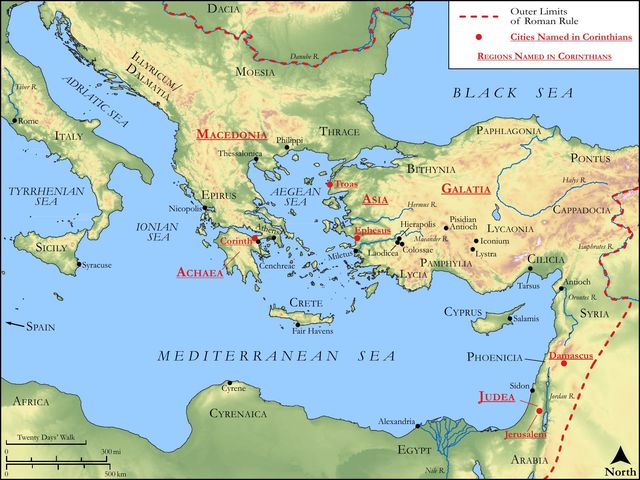
See on the biblical-era map

Study this verse
Public-domain commentary
Matthew Henry
From his Commentary on the Whole Bible. Henry comments on passages, not single verses — this entry covers 2 Corinthians 11:22–33.
Here the apostle gives a large account of his own qualifications, labours, and sufferings (not out of pride or vain-glory, but to the honour of God, who had enabled him to do and suffer so much for the cause of Christ), and wherein he excelled the false apostles, who would lessen his character and usefulness among the Corinthians. Observe,
I.He mentions the privileges of his birth (Co2 11:22), which were equal to any they could pretend to.
He was a Hebrew of the Hebrews; of a family among the Jews that never intermarried with the Gentiles. He was also an Israelite, and could boast of his being descended from the beloved Jacob as well as they, and was also of the seed of Abraham, and not of the proselytes. It should seem from this that the false apostles were of the Jewish race, who gave disturbance to the Gentile converts.
II.He makes mention also of his apostleship, that he was more than an ordinary minister of Christ, Co2 11:23.
God had counted him faithful, and had put him into the ministry. He had been a useful minister of Christ unto them; they had found full proofs of his ministry: Are they ministers of Christ? I am more so.
III.He chiefly insists upon this, that he had been an extraordinary sufferer for Christ; and this was what he gloried in, or rather he gloried in the grace of God that had enabled him to be more abundant in labours, and to endure very great sufferings, such as stripes above measure, frequent imprisonments, and often the dangers of death, Co2 11:23. Note, When the apostle would prove himself an extraordinary minister, he proves that he had been an extraordinary sufferer. Paul was the apostle of the Gentiles, and for that reason was hated of the Jews. They did all they could against him; and among the Gentiles also he met with hard usage. Bonds and imprisonments were familiar to him; never was the most notorious malefactor more frequently in the hands of public justice than Paul was for righteousness' sake. The jail and the whipping-post, and all other hard usages of those who are accounted the worst of men, were what he was accustomed to. As to the Jews, whenever he fell into their hands, they never spared him. Five times he fell under their lash, and received forty stripes save one, Co2 11:24. Forty stripes was the utmost their law allowed (Deu 25:3), but it was usual with them, that they might not exceed, to abate one at least of that number. And to have the abatement of one only was all the favour that ever Paul received from them. The Gentiles were not tied up to that moderation, and among them he was thrice beaten with rods, of which we may suppose once was at Philippi, Act 16:22. Once he was stoned in a popular tumult, and was taken up for dead, Act 14:19. He says that thrice he suffered shipwreck; and we may believe him, though the sacred history gives a relation but of one. A night and a day he had been in the deep (Co2 11:25), in some deep dungeon or other, shut up as a prisoner. Thus he was all his days a constant confessor; perhaps scarcely a year of his life, after his conversion, passed without suffering some hardship or other for his religion; yet this was not all, for, wherever he went, he went in perils; he was exposed to perils of all sorts. If he journeyed by land, or voyaged by sea, he was in perils of robbers, or enemies of some sort; the Jews, his own countrymen, sought to kill him, or do him a mischief; the heathen, to whom he was sent, were not more kind to him, for among them he was in peril. If he was in the city, or in the wilderness, still he was in peril. He was in peril not only among avowed enemies, but among those also who called themselves brethren, but were false brethren, Co2 11:26. Besides all this, he had great weariness and painfulness in his ministerial labours, and these are things that will come into account shortly, and people will be reckoned with for all the care and pains of their ministers concerning them. Paul was a stranger to wealth and plenty, power and pleasure, preferment and ease; he was in watchings often, and exposed to hunger and thirst; in fastings often, it may be out of necessity; and endured cold and nakedness, Co2 11:27. Thus was he, who was one of the greatest blessings of the age, used as if he had been the burden of the earth, and the plague of his generation. And yet this is not all; for, as an apostle, the care of all the churches lay on him, Co2 11:28. He mentions this last, as if this lay the heaviest upon him, and as if he could better bear all the persecutions of his enemies than the scandals that were to be found in the churches he had the oversight of. Who is weak, and I am not weak? Who is offended, and I burn not? Co2 11:29. There was not a weak Christian with whom he did not sympathize, nor any one scandalized, but he was affected therewith. See what little reason we have to be in love with the pomp and plenty of this world, when this blessed apostle, one of the best of men that ever lived, excepting Jesus Christ, felt so much hardship in it. Nor was he ashamed of all this, but, on the contrary, it was what he accounted his honour; and therefore, much against the grain as it was with him to glory, yet, says he, if I must needs glory, if my adversaries will oblige me to it in my own necessary vindication, I will glory in these my infirmities, Co2 11:30. Note, Sufferings for righteousness' sake will, the most of any thing, redound to our honour.
In the last two verses, he mentions one particular part of his sufferings out of its place, as if he had forgotten it before, or because the deliverance God wrought for him was most remarkable; namely, the danger he was in at Damascus, soon after he was converted, and not settled in Christianity, at least in the ministry and apostleship. This is recorded, Act 9:24, Act 9:25. This was his first great danger and difficulty, and the rest of his life was a piece with this. And it is observable that, lest it should be thought he spoke more than was true, the apostle confirms this narrative with a solemn oath, or appeal to the omniscience of God, Co2 11:31. It is a great comfort to a good man that the God and Father of our Lord Jesus Christ, who is an omniscient God, knows the truth of all he says, and knows all he does and all he suffers for his sake.
Historical interpretation
Two Centuries of Reception
5 surviving comments on this verse. Each one is dated, so this reads as a timeline rather than a list.
Select a marker to jump to its quote. Markers stagger vertically where authors wrote within a few decades of each other.
Thereafter He prescribed to fasts a law-that they are to be performed "without sadness: " for why should what is salutary be sad? He taught likewise that fasts are to be the weapons for battling with the more direful demons: for what wonder if the same operation is the instrument of the iniquitous spirit's egress as of the Holy Spirit's ingress? Finally, granting that upon the centurion Cornelius, even before baptism, the honourable gift of the Holy Spirit, together with the gift of prophecy besides, had hastened to descend, we see that his fasts had been heard, I think, moreover, that the apostle too, in the Second of Corinthians, among his labours, and perils, and hardships, after "hunger and thirst," enumerates "fasts" also "very many"
Such exertion is beneficial not only for bringing the body into subjection but also for showing charity to our neighbor, so that through us God might grant sufficiency to the weak among us.
Some of Paul’s sleepless nights were voluntary, but others were forced on him. When he was in dire straits, he had to stay awake and seek God’s help. Furthermore he taught not only in the daytime but at night as well. He was cold and exposed when he was shipwrecked on the island of Malta, where the local people came to his rescue..
Was Paul in poverty or in wealth? did he suffer hunger, or did he not? You may hear himself saying, "In hunger and thirst." Did the prophets suffer hunger, or did they not? They too had a hard time of it. "Again, you fetch up Paul to me, again the prophets, some ten or twenty men." But whence shall I bring examples? "Show me from the many some who bear ills nobly." But the rare is ever such: however, if you will, let us examine the matter as it is in itself.
"In labor and travail." Perils succeed to labors, labors to perils, one upon other and unintermitted, and allowed him not to take breath even for a little.
Continue studying 2 Corinthians 11:27 across the web’s major study libraries — every link below opens this exact verse, chapter, or book on the destination site.
Read & Compare
 BibleGatewayThis verse in more than 200 translations and 70 languages.
 Bible.comThe YouVersion reader — hundreds of translations, reading plans, and highlights.
 ESV.orgCrossway's official English Standard Version reader.
 NET BibleThe NET translation with 60,000+ translators' notes on every rendering decision.
 STEP BibleTyndale House's free study tool — original text, vocabulary, and scholarly resources.
 BibliaLogos Bible Software's free web reader.
 USCCBThe New American Bible (Revised Edition) with the U.S. bishops' study notes.
Commentaries
 BibleHub CommentariesDozens of classic commentaries on this verse, gathered on one page.
 StudyLightMore than 100 commentary sets — the largest collection on the web.
 BibleRefPlain-English commentary on what this verse means, verse by verse.
 Enduring WordDavid Guzik's free commentary on this chapter, widely used by Bible teachers.
 Bible Study ToolsVerse commentary alongside Greek and Hebrew study aids.
Original Language & Research
- BibleHub InterlinearThe verse word by word — original language, transliteration, and English.
- BibleHub LexiconEvery word's original-language definition and Strong's entry.
 Blue Letter BibleDeep-study tools — Strong's numbers, concordance, and word studies.
 CNTR CollationThe earliest Greek manuscripts of this verse, collated letter by letter.
Sermons, Hymns & Audio


TrulyRandomVerse is not affiliated with these sites and doesn’t control their content. They’re linked because they’re genuinely useful.
Summary
In 2 Corinthians 11:27, the Apostle Paul continues his reluctant "fool's speech," cataloging a litany of intense physical deprivations and hardships endured for the sake of the Gospel. This verse specifically highlights his constant state of exhaustion, lack of rest, hunger, thirst, frequent fasting, and exposure to the elements without adequate provision, all serving as undeniable marks of his authentic apostolic ministry and profound commitment to Christ, contrasting sharply with the self-serving ease of the false apostles.
Context
ShowHideLiterary Context
This verse is an integral part of Paul's impassioned defense of his apostolic authority and integrity, found in 2 Corinthians 10-13. Specifically, it falls within a section often called his "fool's speech" (starting around 2 Corinthians 11:16). He is forced to do this because false apostles in Corinth were undermining his ministry by touting their own eloquence, worldly wisdom, and apparent success. Paul counters their superficial claims by presenting his own life as a testament to genuine apostolic service, which, unlike theirs, was characterized by immense sacrifice and hardship for the sake of the Corinthians and the Gospel. The preceding verses (2 Corinthians 11:23-26) enumerate a staggering list of beatings, imprisonments, shipwrecks, and dangers, with 2 Corinthians 11:27 focusing on the relentless physical deprivations that were a constant feature of his missionary life.
Historical & Cultural Context
Paul's ministry took place in the Roman Empire, a vast and often dangerous world for travelers. Long journeys were typically undertaken on foot or by sea, exposing individuals to the elements, bandits, and unpredictable conditions. There were no established inns or reliable supply chains for itinerant preachers. Furthermore, early Christian missionaries often lacked financial support, relying on the hospitality of new converts or their own tentmaking skills (Acts 18:3) to sustain themselves. The "false apostles" Paul contended with were likely sophisticated rhetoricians, possibly Jewish-Christian teachers, who emphasized outward appearances, rhetorical skill, and perhaps even boasted of spiritual experiences or visions, presenting a stark contrast to Paul's unglamorous, suffering-laden ministry. Paul's list of sufferings would have been understood by his audience as extreme, demonstrating a level of commitment far beyond what was typical, even for a dedicated traveler or philosopher.
Key Themes
ShowHideThis verse powerfully contributes to several overarching themes in 2 Corinthians and Paul's theology. Firstly, it underscores the theme of Apostolic Authenticity Through Suffering. Paul argues that his hardships, far from being a sign of God's disfavor, are actually the authentic "marks of a true apostle" (2 Corinthians 12:12). This contrasts sharply with the false apostles who sought comfort and worldly affirmation. Secondly, it highlights The Cost of Discipleship and Ministry, vividly illustrating that fervent service to Christ often involves significant personal sacrifice and deprivation, echoing Jesus' call for His followers to "take up their cross daily" (Luke 9:23). Thirdly, the verse exemplifies Endurance and Perseverance in the face of overwhelming adversity. Despite these profound physical challenges, Paul continued his mission, demonstrating the resilience empowered by faith and divine strength, a theme further explored in 2 Corinthians 12:9-10.
Exposition and Analysis
ShowHideKey Word Analysis
ShowHideThis term (G2873) denotes intense labor or toil that results in exhaustion, often implying effort that causes fatigue. It speaks to the strenuous physical demands of Paul's ministry, not just simple tiredness, but a deep, bone-weary fatigue born from relentless exertion and effort for the Gospel.
This word (G3449) signifies hardship, struggle, or painful exertion, often implying a sense of distress or anguish associated with the labor. It suggests not just physical tiredness, but the actual physical pain, suffering, and emotional toll associated with his arduous labors and trials.
This term (G1132) refers to nudity, either absolute or comparative. In this context, it signifies a severe lack of adequate clothing or shelter, implying exposure to the elements, extreme poverty, and vulnerability, rather than complete physical nakedness. It highlights his destitution and lack of basic provisions.
Verse Breakdown
ShowHide"In weariness and painfulness"
Paul begins by describing the constant physical and mental toll of his ministry. "Weariness" (kópos) points to the sheer exhaustion from relentless travel, manual labor (like tentmaking), and the demands of preaching and teaching. "Painfulness" (móchthos) adds a layer of struggle and hardship, suggesting not just fatigue but actual physical distress and the arduous nature of his work. These were not occasional experiences but a persistent state.
"in watchings often"
This phrase refers to frequent sleepless nights. These could be due to long journeys, guarding against dangers, intense prayer, or simply the lack of a safe place to rest. It underscores the constant vigilance and lack of restorative sleep that characterized his life on the road and in ministry.
"in hunger and thirst"
These are fundamental human needs often unmet for Paul. Whether due to poverty, lack of provisions during travel, or the inability to find food and water in hostile environments, Paul frequently experienced the gnawing pain of an empty stomach and parched throat.
"in fastings often"
This phrase could refer to involuntary hunger (as mentioned just before) or, more likely, to voluntary spiritual disciplines of fasting. If voluntary, it shows Paul's dedication to spiritual practices even amidst other deprivations, further contributing to his physical depletion for the sake of deeper communion with God and effectiveness in ministry.
"in cold and nakedness"
This final pair vividly portrays Paul's extreme vulnerability and lack of basic necessities. "Cold" indicates exposure to harsh weather conditions without adequate warmth. "Nakedness" (gymnótēs) implies a severe lack of proper clothing or shelter, leaving him exposed and unprotected from the elements, a clear sign of destitution and hardship.
Literary Devices
ShowHidePaul employs several powerful literary devices in this verse to emphasize the profound extent of his suffering. The most prominent is Anaphora, the repetition of the preposition "in" at the beginning of each clause ("In weariness... in watchings... in hunger... in fastings... in cold..."). This creates a rhythmic, almost relentless, cadence that underscores the continuous and pervasive nature of his hardships. The verse also utilizes Asyndeton, the omission of conjunctions between parts of a sentence, creating a rapid, impactful succession of deprivations that overwhelms the reader with the sheer volume of Paul's trials. Each item in the list functions as a vivid Imagery, painting a stark picture of physical discomfort and destitution, making Paul's experiences tangible and relatable. The cumulative effect of these specific, concrete examples of suffering serves as a powerful form of Pathos, appealing to the emotions of the Corinthian readers and highlighting the authenticity of Paul's self-sacrificial ministry in contrast to the superficiality of his opponents.
Theological and Thematic Connections
ShowHidePaul's catalog of sufferings in 2 Corinthians 11:27 is not a mere complaint but a profound theological statement. It redefines what true spiritual authority and success look like from a divine perspective, challenging worldly notions that equate blessing with comfort and ease. For Paul, suffering was not an obstacle to ministry but an intrinsic part of it, a means by which the power of Christ was made manifest through his weakness. This perspective aligns with the broader New Testament teaching that participation in Christ's sufferings is a mark of genuine discipleship and a precursor to sharing in His glory. His endurance in such extreme conditions testifies to a supernatural strength, not his own, but God's, enabling him to persevere for the advancement of the Gospel and the spiritual well-being of the churches he served. This passage profoundly connects the authenticity of one's calling to their willingness to suffer for the sake of Christ and His Kingdom.
Reflection and Application
ShowHidePaul's raw and honest account of his physical deprivations in 2 Corinthians 11:27 serves as a powerful mirror for contemporary believers, challenging our often-comfortable understanding of faith and ministry. It compels us to reassess what we truly value in spiritual leadership and our own walk with Christ. In a world that often equates success with ease, wealth, and popularity, Paul's life reminds us that authentic, impactful service for the Kingdom frequently involves profound sacrifice, discomfort, and a willingness to endure hardship. This verse invites us to cultivate a deeper empathy for those who serve in challenging circumstances, whether missionaries in hostile lands, pastors in struggling communities, or believers facing persecution for their faith. Moreover, for each of us, it offers profound encouragement: our own "weariness and painfulness" in following Christ are not signs of failure, but often the very crucible in which God's strength is perfected and our faith refined. It prompts us to ask if we are willing to embrace the cost of discipleship, finding our sufficiency not in worldly comforts, but in the sustaining power of God amidst our weaknesses.
Questions for Reflection
ShowHideFAQ
ShowHideWhat is the significance of Paul listing these physical hardships in 2 Corinthians 11:27?
ShowHidePaul's listing of these physical hardships is highly significant because it serves as a powerful counter-argument to the false apostles who were undermining his authority in Corinth. While they boasted of their eloquence, worldly wisdom, or spiritual experiences, Paul presented his suffering as the true "marks of a true apostle" (2 Corinthians 12:12). This list demonstrates his genuine commitment, self-sacrifice, and reliance on God, proving that his ministry was authentic and costly, unlike the self-serving and comfortable ministries of his opponents. It underscores the New Testament principle that true spiritual authority is often found in weakness and vulnerability, not worldly power or prestige, and that the Gospel advances through the suffering of its heralds.
Christ-Centered Fulfillment
ShowHideWhile 2 Corinthians 11:27 describes Paul's personal sufferings, these deprivations find their ultimate meaning and redemptive power in the person and work of Jesus Christ. Paul's "weariness and painfulness," his hunger, thirst, and exposure, echo the profound suffering of Christ Himself, who "had nowhere to lay his head" (Matthew 8:20) and endured the ultimate deprivation on the cross. Paul's willingness to suffer for the Gospel is a direct outworking of his identification with Christ's suffering, a theme he articulates elsewhere, desiring to "know Christ and the power of his resurrection and the fellowship of his sufferings" (Philippians 3:10). In his weakness and physical vulnerability, Paul experienced the very strength of Christ, demonstrating that God's "power is made perfect in weakness" (2 Corinthians 12:9). Thus, Paul's hardships are not merely a testament to his human endurance but a living embodiment of the Christ-like pattern of self-sacrifice, where the Gospel advances not through human strength or comfort, but through the humble and suffering servant, mirroring the Lamb of God who suffered to redeem humanity.