


1 Corinthians 7:5
Bible text: King James Version (1769 Blayney text) · Public domain
Bible text: King James Version with Strong's numbers · Public domain
Bible text: Berean Standard Bible · Public domain
Bible text: American Standard Version (1901) · Public domain
Bible text: World English Bible, Messianic edition · Public domain
Bible text: Geneva Bible (1599) · Public domain
Bible text: Young's Literal Translation · Public domain
- μὴmēNotG3361PRT-NNegative Particle Negative
- ἀποστερεῖτεapostereitedo depriveG650V-PAM-2PVerb Present Active Imperative 2nd Plural
- ἀλλήλουςallēlousone anotherG240C-APMReciprocal pronoun Accusative Plural Masculine
- εἰeiifG1487CONDConjunction
- μήτιmētisurely evenG3385PRT-NNegative Particle Negative
- ἂνanwhenG302PRTParticle or Disjunctive
- ἐκekbyG1537PREPPreposition
- συμφώνουsumphōnoumutual agreementG4859A-GSNAdjective Genitive Singular Neuter
- πρὸςprosforG4314PREPPreposition
- καιρόνkairona timeG2540N-ASMNoun Accusative Singular Masculine
- ἵναinathatG2443CONJConjunction
- σχολάσητεscholasēteyou may be devotedG4980V-AAS-2PVerb Aorist Active Subjunctive 2nd Plural
- τῇtēa<the>G3588T-DSFDefinite article Dative Singular Feminine
- νηστείᾳnēsteiato fastingsG3521N-DSFNoun Dative Singular Feminine
- καὶkaiandG2532CONJConjunction
- τῇtēa<the>G3588T-DSFDefinite article Dative Singular Feminine
- προσευχῇproseuchēato prayerG4335N-DSFNoun Dative Singular Feminine
- καὶkaiandG2532CONJConjunction
- πάλινpalinagainG3825ADVAdverb
- ἐπὶepitogetherG1909PREPPreposition
- τὸtotheG3588T-ASNDefinite article Accusative Singular Neuter
- αὐτὸautosameG846P-ASNPersonal pronoun Accusative Singular Neuter
- ἦτεētemay beG1510V-PAS-2PVerb Present Active Subjunctive 2nd Plural
- ἵναinaso thatG2443CONJConjunction
- μὴmēnotG3361PRT-NNegative Particle Negative
- πειράζῃpeirazēmay temptG3985V-PAS-3SVerb Present Active Subjunctive 3rd Singular
- ὑμᾶςhumasyouG4771P-2APPersonal pronoun Accusative 2nd Plural
- ὁho<the>G3588T-NSMDefinite article Nominative Singular Masculine
- σατανᾶςsatanasSatanG4567N-NSM-TNoun Nominative Singular Masculine Title
- διὰdiathroughG1223PREPPreposition
- τὴνtēntheG3588T-ASFDefinite article Accusative Singular Feminine
- ἀκρασίανakrasianlack of self-controlG192N-ASFNoun Accusative Singular Feminine
- ὑμῶνhumōnof youG4771P-2GPPersonal pronoun Genitive 2nd Plural
English is a literal word-by-word gloss of the Greek, not the KJV's wording. Why?
This is the original text the KJV's translators worked from — each Greek word with its own literal English meaning in this verse, prepared by scholars at Tyndale House, Cambridge. The KJV translates whole sentences, not word by word, so its wording differs: one Greek word can become several English words, and the KJV may choose “charity” where the gloss reads “love”. Both are faithful — they answer different questions. For the KJV's own rendering, switch to the KJV text.
Details
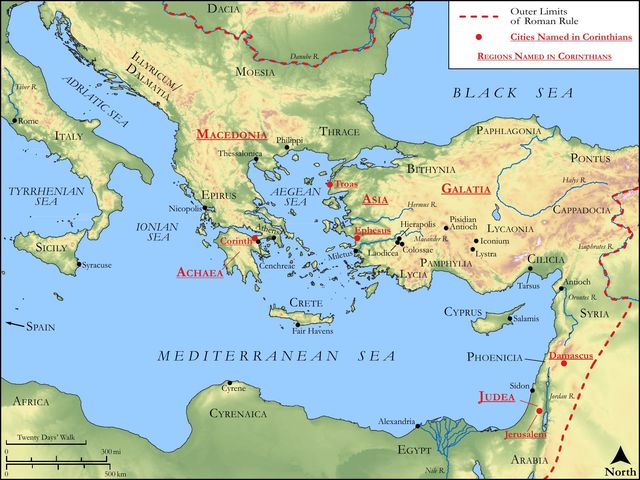
See on the biblical-era maps

Study this verse
Public-domain commentary
Matthew Henry
From his Commentary on the Whole Bible. Henry comments on passages, not single verses — this entry covers 1 Corinthians 7:1–9.
The apostle comes now, as a faithful and skilful casuist, to answer some cases of conscience which the Corinthians had proposed to him. Those were things whereof they wrote to him, Co1 7:1. As the lips of ministers should keep knowledge, so the people should ask the law at their mouths. The apostle was as ready to resolve as they were to propose their doubts. In the former chapter, he warns them to avoid fornication; here he gives some directions about marriage, the remedy God had appointed for it. He tells them in general,
I.That it was good, in that juncture of time at least, to abstain from marriage altogether:
It is good for a man not to touch a woman (not to take her to wife), by good here not understanding what is so conformable to the mind and will of God as if to do otherwise were sin, an extreme into which many of the ancients have run in favour of celibacy and virginity. Should the apostle be understood in this sense, he would contradict much of the rest of his discourse. But it is good, that is, either abstracting from circumstances there are many things in which the state of celibacy has the advantage above the marriage state; or else at this juncture, by reason of the distress of the Christian church, it would be a convenience for Christians to keep themselves single, provided they have the gift of continency, and at the same time can keep themselves chaste. The expression also may carry in it an intimation that Christians must avoid all occasions of this sin, and flee all fleshly lusts, and incentives to them; must neither look on nor touch a woman, so as to provoke lustful inclinations. Yet,
II.He informs them that marriage, and the comforts and satisfactions of that state, are by divine wisdom prescribed for preventing fornication (Co1 7:2), Porneias - Fornications, all sorts of lawless lust. To avoid these, Let every man, says he, have his own wife, and every woman her own husband; that is, marry, and confine themselves to their own mates. And, when they are married, let each render the other due benevolence (Co1 7:3), consider the disposition and exigency of each other, and render conjugal duty, which is owing to each other. For, as the apostle argues (Co1 7:4), in the married state neither person has power over his own body, but has delivered it into the power of the other, the wife hers into the power of the husband, the husband his into the power of the wife. Note, Polygamy, or the marriage of more persons than one, as well as adultery, must be a breach of marriage-covenants, and a violation of the partner's rights. And therefore they should not defraud one another of the use of their bodies, nor any other of the comforts of the conjugal state, appointed of God for keeping the vessel in sanctification and honour, and preventing the lusts of uncleanness, except it be with mutual consent (Co1 7:5) and for a time only, while they employ themselves in some extraordinary duties of religion, or give themselves to fasting and prayer. Note, Seasons of deep humiliation require abstinence from lawful pleasures. But this separation between husband and wife must not be for a continuance, lest they expose themselves to Satan's temptations, by reason of their incontinence, or inability to contain. Note, Persons expose themselves to great danger by attempting to perform what is above their strength, and at the same time not bound upon them by any law of God. If they abstain from lawful enjoyments, they may be ensnared into unlawful ones. The remedies God hath provided against sinful inclinations are certainly best.
III.The apostle limits what he had said about every man's having his own wife, etc.
(Co1 7:2): I speak this by permission, not of command. He did not lay it as an injunction upon every man to marry without exception. Any man might marry. No law of God prohibited the thing. But, on the other hand, not law bound a man to marry so that he sinned if he did not; I mean, unless his circumstances required it for preventing the lust of uncleanness. It was a thing in which men, by the laws of God, were in a great measure left at liberty. And therefore Paul did not bind every man to marry, though every man had an allowance. No, he could wish all men were as himself (Co1 7:7), that is, single, and capable of living continently in that state. There were several conveniences in it, which at that season, if not at others, made it more eligible in itself. Note, It is a mark of true goodness to wish all men as happy as ourselves. But it did not answer the intentions of divine Providence as well for all men to have as much command of this appetite as Paul had. It was a gift vouchsafed to such persons as Infinite Wisdom thought proper: Every one hath his proper gift of God, one after this manner and another after that. Natural constitutions vary; and, where there may not be much difference in the constitution, different degrees of grace are vouchsafed, which may give some a greater victory over natural inclination than others. Note, The gifts of God, both in nature and grace, are variously distributed. Some have them after this manner and some after that. Paul could wish all men were as himself, but all men cannot receive such a saying, save those to whom it is given, Mat 19:11.
IV.He sums up his sense on this head (Co1 7:9, Co1 7:10):
I say therefore to the unmarried and widows, to those in a state of virginity or widowhood, It is good for them if they abide even as I. There are many conveniences, and especially at this juncture, in a single state, to render it preferable to a married one. It is convenient therefore that the unmarried abide as I, which plainly implies that Paul was at that time unmarried. But, if they cannot contain, let them marry; for it is better to marry than to burn. This is God's remedy for lust. The fire may be quenched by the means he has appointed. And marriage, with all its inconveniences, is much better than to burn with impure and lustful desires. Marriage is honourable in all; but it is a duty in those who cannot contain nor conquer those inclinations.
Historical interpretation
Three Centuries of Reception
10 surviving comments on this verse. Each one is dated, so this reads as a timeline rather than a list.
Select a marker to jump to its quote. Markers stagger vertically where authors wrote within a few decades of each other.
But further, in another place he says: "That Satan tempt you not for your incontinence."
For is not continence withal superior to virginity, whether it be the continence of the widowed, or of those who, by consent, have already renounced the common disgrace (which matrimony involves)? For constancy of virginity is maintained by grace; of continence, by virtue.
The first species is, virginity from one's birth: the second, virginity from one's birth, that is, from the font; which (second virginity) either in the marriage state keeps (its subject) pure by mutual compact, or else perseveres in widowhood from choice: a third grade remains, monogamy, when, after the interception of a marriage once contracted, there is thereafter a renunciation of sexual connection.
Accordingly, the apostle added (the recommendation of) a temporary abstinence for the sake of adding an efficacy to prayers, that we might know that what is profitable "for a time" should be always practised by us, that it may be always profitable.
The mysteries of marriage ought to be performed with holiness, deliberately and without disorderly passions.
Moreover, those who are competent, and who are advanced in years, ought to be judges of themselves in these matters. For that it is proper to abstain from each other by consent, in order that they may be free for a season to give themselves to prayer, and then come together again, they have heard from Paul in his epistle.
What then can this mean? "Let not the wife," says he, "exercise continence, if the husband be unwilling; nor yet the husband without the wife's consent." Why so? Because great evils spring from this sort of continence. For adulteries and fornications and the ruin of families have often arisen from hence. For if when men have their own wives they commit fornication, much more if you defraud them of this consolation. And well says he, "Defraud not; fraud" here, and "debt" above, that he might shew the strictness of the right of dominion in question. For that one should practice continence against the will of the other is "defrauding;" but not so, with the other's consent: any more than I count myself defrauded, if after persuading me you take away any thing of mine. Since only he defrauds who takes against another's will and by force. A thing which many women do, working sin rather than righteousness, and thereby becoming accountable for the husband's uncleanness, and rending all asunder. Whereas they should value concord above all things, since this is more important than all beside.
We will, if you please, consider it with a view to actual cases. Thus, suppose a wife and husband, and let the wife be continent, without consent of her husband; well then, if hereupon he commit fornication, or though abstaining from fornication fret and grow restless and be heated and quarrel and give all kind of trouble to his wife; where is all the gain of the fasting and the continence, a breach being made in love? There is none. For what strange reproaches, how much trouble, how great a war must of course arise! since when in an house man and wife are at variance, the house will be no better off than a ship in a storm when the master is upon ill terms with the man at the head. Wherefore he saith, "Defraud not one another, unless it be by consent for a season, that ye may give yourselves unto prayer." It is prayer with unusual earnestness which he here means. For if he is forbidding those who have intercourse with one another to pray, how could "pray without ceasing" have any place? It is possible then to live with a wife and yet give heed unto prayer. But by continence prayer is made more perfect. For he did not say merely, "That ye may pray;" but, "That ye may give yourselves unto it;" as though what he speaks of might cause not uncleanness but much occupation.
"And may be together again, that Satan tempt you not." Thus lest it should seem to be a matter of express enactment, he adds the reason. And what is it? "That Satan tempt you not." And that you may understand that it is not the devil only who causeth this crime, I mean adultery, he adds, "because of your incontinency."
According to this, if he had wished to practice continence but you had not, he would have been obliged to give in to you, and God would have given him credit for continence for not refusing intercourse out of consideration for your weakness, not his own, in order to prevent you from committing adultery. How much better would it have been for you, for whom subjection was more appropriate, to yield to his will in rendering him the debt, since God would have taken account of your intention to observe continence, which you gave up in order to save your husband from destruction.
It is not arduous and difficult for faithful married people to do for a few days what holy widows have undertaken and which holy virgins do throughout their lives. So let devotion be kindled and self-gratification be checked.
If a woman stays away from her husband, she will make him angry, and vice versa. That is why Paul insists that it must be by mutual consent.
Continue studying 1 Corinthians 7:5 across the web’s major study libraries — every link below opens this exact verse, chapter, or book on the destination site.
Read & Compare
 BibleGatewayThis verse in more than 200 translations and 70 languages.
 Bible.comThe YouVersion reader — hundreds of translations, reading plans, and highlights.
 ESV.orgCrossway's official English Standard Version reader.
 NET BibleThe NET translation with 60,000+ translators' notes on every rendering decision.
 STEP BibleTyndale House's free study tool — original text, vocabulary, and scholarly resources.
 BibliaLogos Bible Software's free web reader.
 USCCBThe New American Bible (Revised Edition) with the U.S. bishops' study notes.
Commentaries
 BibleHub CommentariesDozens of classic commentaries on this verse, gathered on one page.
 StudyLightMore than 100 commentary sets — the largest collection on the web.
 BibleRefPlain-English commentary on what this verse means, verse by verse.
 Enduring WordDavid Guzik's free commentary on this chapter, widely used by Bible teachers.
 Bible Study ToolsVerse commentary alongside Greek and Hebrew study aids.
Original Language & Research
- BibleHub InterlinearThe verse word by word — original language, transliteration, and English.
- BibleHub LexiconEvery word's original-language definition and Strong's entry.
 Blue Letter BibleDeep-study tools — Strong's numbers, concordance, and word studies.
 CNTR CollationThe earliest Greek manuscripts of this verse, collated letter by letter.
Sermons, Hymns & Audio


TrulyRandomVerse is not affiliated with these sites and doesn’t control their content. They’re linked because they’re genuinely useful.
Summary
1 Corinthians 7:5 provides crucial apostolic instruction regarding sexual intimacy within Christian marriage, emphasizing that spouses should not deprive one another of physical union. It permits a temporary cessation of intimacy only by mutual consent and for a specific, limited period, primarily to facilitate intensified spiritual disciplines like fasting and prayer. The verse then mandates the resumption of marital relations, underscoring the practical necessity of such intimacy as a safeguard against the temptations of Satan, which exploit human weakness and lack of self-control.
Context
ShowHideLiterary Context
This verse is deeply embedded within Paul's extensive discourse on marriage, singleness, and celibacy in 1 Corinthians 7. The chapter opens with Paul addressing specific questions from the Corinthian church, likely posed in a letter (1 Corinthians 7:1). Paul's initial response establishes the principle of mutual marital duty, stating that the husband has authority over the wife's body, and the wife over the husband's (1 Corinthians 7:3-4). Verse 5 directly builds upon this foundational principle by introducing a specific exception to the general rule of mutual sexual obligation, immediately followed by the rationale and conditions for this exception. The flow demonstrates Paul's balanced approach, affirming the goodness of marital intimacy while also acknowledging the spiritual benefits of temporary, consensual abstinence.
Historical & Cultural Context
Corinth was a bustling port city, notorious for its moral laxity and diverse religious practices, including the worship of Aphrodite, which involved temple prostitution. This environment presented unique challenges for early Christians striving for purity and holiness. Within the Corinthian church itself, there appear to have been various views on sexuality, ranging from libertinism (believing all things are permissible, cf. 1 Corinthians 6:12) to asceticism (believing that spiritual purity required abstaining from physical pleasures, including marriage, cf. 1 Corinthians 7:1). Paul navigates these extremes by affirming the sanctity of marriage and its physical expression, while also providing practical guidance to prevent spiritual vulnerability in a morally charged setting. His advice counters both the overemphasis on physical indulgence and the unbiblical rejection of marital intimacy.
Key Themes
ShowHide1 Corinthians 7 is rich with themes relevant to this verse. One prominent theme is Mutual Sexual Obligation and Authority within marriage, as articulated in 1 Corinthians 7:3-4. This establishes that physical intimacy is a debt owed and a right enjoyed by both spouses, not a unilateral privilege. Another key theme is the Primacy of Spiritual Disciplines, where Paul acknowledges that certain spiritual pursuits, like intense prayer and fasting, may, by mutual agreement, temporarily take precedence over other good things, including marital relations. Finally, the theme of Protection Against Temptation is central, as Paul explicitly links the resumption of marital intimacy to safeguarding spouses from Satan's schemes, particularly those exploiting human weakness or "incontinency." This highlights a practical theology of marriage as a divinely ordained institution designed, in part, to promote purity and prevent sexual sin, echoing warnings found in passages like Ephesians 6:11.
Exposition and Analysis
ShowHideKey Word Analysis
ShowHideThis word (G650) means "to despoil," "to deprive," or "to withhold what is due." In the context of 1 Corinthians 7:5, it implies that sexual intimacy is not merely an option but a mutual right and obligation within marriage. To "defraud" one's spouse is to unjustly withhold this due, akin to withholding wages or property that rightfully belongs to another. Paul uses a strong term to underscore the seriousness of denying marital intimacy without proper cause or consent.
Derived from sýn (together) and phōnḗ (sound), this word (G4859) literally means "sounding together" or "accordant." Figuratively, it denotes agreement or harmony. Its inclusion here is crucial, emphasizing that any temporary cessation of marital relations must be a mutually agreed-upon decision, not a unilateral one imposed by one spouse upon the other. This highlights the importance of open communication, respect, and unity in the marital relationship.
This term (G192) signifies "want of self-restraint," "lack of self-control," or "excess," particularly in sensual matters. Paul uses it to describe the human vulnerability to sexual temptation when legitimate outlets for intimacy are absent or neglected. It points to the reality of human weakness and the potential for sinful desires to arise if not properly managed within the boundaries God has established, which includes the marital relationship.
Verse Breakdown
ShowHide"Defraud ye not one the other"
This serves as a direct, negative imperative, forbidding spouses from withholding sexual intimacy from each other. It establishes the baseline expectation for physical relations in marriage, underscoring that intimacy is a mutual right and responsibility, not a tool for manipulation or a privilege to be unilaterally denied. This command reinforces the concept of mutual ownership of bodies introduced in 1 Corinthians 7:4.
"except [it be] with consent for a time"
This introduces the sole, conditional exception to the preceding command. Any abstinence must be by mutual agreement ("with consent," G4859) and for a clearly defined, limited period ("for a time," G2540). This clause prevents arbitrary or indefinite withholding of intimacy, ensuring that the exception is a shared decision aimed at a specific, temporary purpose.
"that ye may give yourselves to fasting and prayer"
This purpose clause (introduced by hína, G2443) explains the legitimate reason for temporary abstinence. The phrase "give yourselves" (G4980, scholázō) implies being at leisure for or devoting oneself wholly to something. Here, it is to intensify spiritual disciplines – specifically fasting (G3521) and prayer (G4335). This shows that while marital intimacy is good, there can be seasons where a couple collectively prioritizes a heightened focus on God through these means.
"and come together again"
This is a second imperative, following the temporary period of abstinence. It explicitly commands the resumption of marital intimacy, indicating that the period of separation is not to become permanent or extended indefinitely. This command reinforces the ongoing nature of the marital covenant and the importance of regular physical union within it.
"that Satan tempt you not for your incontinency"
This final purpose clause (introduced by hína mḗ, G3363) provides the crucial practical and spiritual rationale for both the temporary nature of abstinence and the command to reunite. Paul recognizes Satan's (G4567) strategy to exploit human weakness, particularly the lack of self-control (akrasía, G192) in sexual matters. Marital intimacy, therefore, is presented not only as a right and duty but also as a God-ordained safeguard against sexual sin and temptation, protecting the couple from the devil's schemes.
Literary Devices
ShowHidePaul employs several effective literary devices in this verse. The primary structure is an Imperative Mood ("Defraud ye not," "come together again"), which conveys a direct command or instruction, emphasizing the authoritative nature of his guidance. This is immediately followed by a Conditional Clause ("except [it be] with consent for a time"), which sets a precise boundary for the exception, highlighting the importance of mutual agreement and temporality. Two distinct Purpose Clauses (introduced by "that ye may" and "that Satan tempt you not") clearly articulate the dual reasons for the instruction: first, spiritual devotion, and second, protection from temptation. This use of purpose clauses not only explains the "why" but also reveals Paul's pastoral wisdom. Furthermore, there is an underlying Antithesis between the "defrauding" (denial of intimacy) and the "coming together again" (resumption of intimacy), which serves to prevent "incontinency" and the resultant temptation from Satan. This stark contrast underscores the spiritual and practical dangers of neglecting marital duties.
Theological and Thematic Connections
ShowHideThis verse profoundly shapes a biblical theology of marriage, presenting marital intimacy as a sacred duty and a protective blessing, rather than a mere physical act. It elevates the physical union within marriage to a realm of spiritual significance, demonstrating that it is intended by God not only for procreation and pleasure but also for mutual sanctification and protection against sin. The principle of mutual consent underscores the covenantal nature of marriage, where both partners are equally responsible and accountable to one another and to God. The allowance for temporary abstinence for spiritual focus highlights a biblical understanding of spiritual priorities, where even good things can be temporarily set aside for greater devotion, but always with wisdom and mutual agreement to prevent unintended spiritual harm.
Reflection and Application
ShowHide1 Corinthians 7:5 offers profound and practical wisdom for Christian marriages in any era. It calls couples to a high standard of mutual respect, open communication, and spiritual vigilance. The command not to "defraud" one another reminds spouses that physical intimacy is a vital component of the marital covenant, a gift from God intended for unity, pleasure, and protection. It challenges any notion that one spouse has unilateral control over the other's body or that intimacy is merely optional. The allowance for temporary abstinence for prayer and fasting, always by mutual consent, highlights the importance of prioritizing spiritual growth and seeking God together, demonstrating that even good things can be surrendered for a season for a higher purpose. Critically, the verse provides a sobering reminder of spiritual warfare, urging couples to recognize the devil's tactics and to use the God-given gift of marital intimacy as a defense against temptation and immorality. This necessitates ongoing dialogue, empathy, and a shared commitment to holiness within the marriage, ensuring that neither partner is left vulnerable to sin due to neglect or misunderstanding.
Questions for Reflection
ShowHideFAQ
ShowHideDoes this verse mean Christian couples must always engage in sexual relations unless they are fasting and praying?
ShowHideNot necessarily "always," but it establishes a strong presumption for regular marital intimacy as a mutual obligation and a safeguard. Paul's primary instruction is "Defraud ye not one the other," meaning spouses should not unilaterally or indefinitely withhold intimacy. The allowance for temporary abstinence is a specific, limited exception, requiring mutual consent and a clear spiritual purpose (fasting and prayer). The immediate command to "come together again" emphasizes that this abstinence is temporary, designed to prevent vulnerability to temptation. Therefore, while it doesn't prescribe a rigid schedule, it strongly encourages consistent, consensual intimacy as a norm within Christian marriage, viewing it as a protective and unifying aspect of the covenant, rather than something to be neglected or used manipulatively.
What does "incontinency" specifically refer to in this context?
ShowHideIn this context, "incontinency" (Greek: akrasía, G192) refers to a lack of self-control, specifically in the realm of sexual desire. Paul uses it to describe a state where an individual struggles to control their sexual impulses, making them vulnerable to temptation and sin. By commanding spouses to "come together again" after a period of consensual abstinence, Paul acknowledges the reality of human sexual drives and the devil's strategic attempts to exploit these natural desires when they are not met within the God-ordained boundaries of marriage. Therefore, regular and healthy marital intimacy is presented as a practical, God-given means to exercise self-control and avoid sexual immorality, protecting both spouses from sinful thoughts or actions outside the marriage covenant.
Christ-Centered Fulfillment
ShowHideWhile 1 Corinthians 7:5 directly addresses practical marital conduct, its underlying principles find profound Christ-centered fulfillment. The mutual submission and self-giving described in the verse, where spouses' bodies belong to one another, beautifully foreshadow the ultimate self-giving of Christ for His bride, the Church. Just as Christ did not "defraud" His Church of His love and sacrifice, but fully gave Himself up for her (Ephesians 5:25), so too are spouses called to a similar posture of sacrificial love and generosity in their intimacy. Furthermore, the verse's emphasis on guarding against Satan's temptations for "incontinency" points to Christ as the victorious One who overcame all temptation, including those related to the flesh (Matthew 4:1-11). Through Christ, believers are empowered by the Holy Spirit to exercise self-control (enkrateia, a fruit of the Spirit, Galatians 5:23) over their desires, finding their ultimate satisfaction and purity not merely in marital intimacy, but in their union with Him. The marital covenant, therefore, becomes a living parable of Christ's unwavering faithfulness to His Church, a relationship founded on mutual love, purity, and protection from the schemes of the evil one (John 17:15).