


Joel 2:16
Bible text: King James Version (1769 Blayney text) · Public domain
Bible text: King James Version with Strong's numbers · Public domain
Bible text: Berean Standard Bible · Public domain
Bible text: American Standard Version (1901) · Public domain
Bible text: World English Bible, Messianic edition · Public domain
Bible text: Geneva Bible (1599) · Public domain
Bible text: Young's Literal Translation · Public domain
- אִסְפוּ'is·fugatherH622V-Qal-Imp-2mpVerb Qal Imperative 2nd Plural Masculine
- עָם'am[the] peopleH5971N-msNoun Singular Masculine Absolute
- קַדְּשׁוּka·de·ShuconsecrateH6942V-Piel-Imp-2mpVerb Piel Imperative 2nd Plural Masculine
- קָהָלka·Halan assemblyH6951N-msNoun Singular Masculine Absolute
- קִבְצוּkiv·TzugatherH6908V-Qal-Imp-2mpVerb Qal Imperative 2nd Plural Masculine
- זְקֵנִיםze·ke·Nim[the] eldersH2205Adj-mpAdjective Plural Masculine Absolute
- אִסְפוּ'is·FugatherH622V-Qal-Imp-2mpVerb Qal Imperative 2nd Plural Masculine
- עוֹלָלִיםo·la·LimchildrenH5768N-mpNoun Plural Masculine Absolute
- וְיֹנְקֵיve·yo·ne·Keiand suckling-children ofH3243Conj-w ¦ N-mpcNoun Plural Masculine Constructוְandיֹנְקֵיsuckling-children of
- שָׁדָיִםsha·Da·yimbreastsH7699N-mdNoun Dual Masculine Absolute
- יֵצֵאye·Tze'let him go outH3318V-Qal-Imperf-3msVerb Qal Imperfect 3rd Singular Masculine
- חָתָןcha·Tan[the] bridegroomH2860N-msNoun Singular Masculine Absolute
- מֵחֶדְרוֹme·ched·Rofrom his roomH2315Prep-m ¦ N-msc ¦ 3msNoun Singular Masculine Constructמֵfromחֶדְרroomוֹhis
- וְכַלָּהve·kha·Lahand [the] brideH3618Conj-w ¦ N-fsNoun Singular Feminine Absoluteוְandכַלָּה[the] bride
- מֵחֻפָּתָהּme·chu·pa·Tahfrom her chamberH2646Prep-m ¦ N-fsc ¦ 3fsNoun Singular Feminine Constructמֵfromחֻפָּתָchamberהּher
English is a literal word-by-word gloss of the Hebrew, not the KJV's wording. Why?
This is the original text the KJV's translators worked from — each Hebrew word with its own literal English meaning in this verse, prepared by scholars at Tyndale House, Cambridge. The KJV translates whole sentences, not word by word, so its wording differs: one Hebrew word can become several English words, and the KJV may choose “the LORD” where the gloss reads “Yahweh”. Both are faithful — they answer different questions. For the KJV's own rendering, switch to the KJV text.
Details
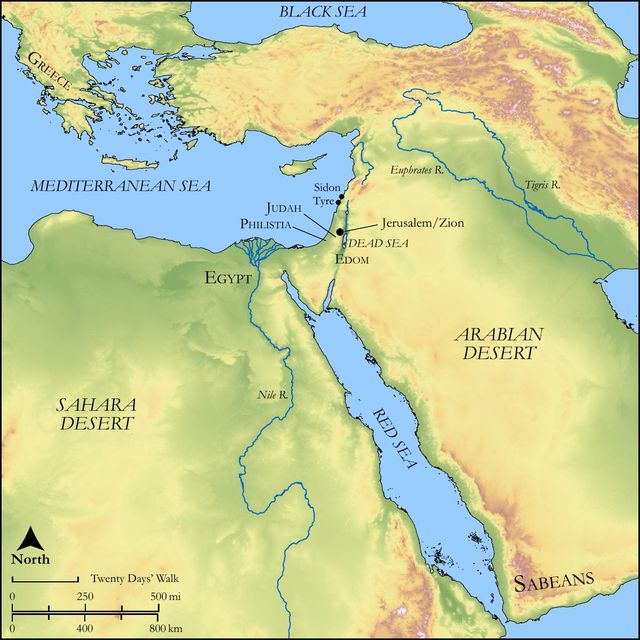
See on the biblical-era map
Study this verse
Public-domain commentary
Matthew Henry
From his Commentary on the Whole Bible. Henry comments on passages, not single verses — this entry covers Joel 2:12–17. His four-level outline is real structure in the source text, so it is rendered as structure.
We have here an earnest exhortation to repentance, inferred from that desolating judgment described and threatened in the foregoing verses: Therefore now turn you to the Lord. 1. "Thus you must answer the end and intention of the judgment; for it was sent for this end, to convince you of your sins, to humble you for them, to reduce you to your right minds and to your allegiance." God brings us into straits, that he may bring us to repentance and so bring us to himself. 2. "Thus you may stay the progress of the judgment. Things are bad with you, but thus you may prevent their growing worse; nay, if you take this course, they will soon grow better." Here is a gracious invitation,
I.To a personal repentance, exercised in the soul, every family apart, and their wives apart, Zac 12:12.
When the judgments of God are abroad, each person is concerned to contribute his quota to the common supplications, having contributed to the common guilt. Every one must mend one and mourn for one, and then we should all be mended and all found among God's mourners. Observe,
1.What we are here called to, which will teach us what it is to repent, for it is the same that the Lord our God still requires of us, we having all made work for repentance.
(1.)We must be truly humbled for our sins, must be sorry we have by sin offended God, and ashamed we have by sin wronged ourselves, both wronged our judgments and wronged our interests. There must be outward expressions of sorrow and shame, fasting, and weeping, and mourning; tears for the sin that procured it. But what will the outward expressions of sorrow avail if the inward impressions be not agreeable, and not only accompany them, but be the root and spring of them, and give rise to them? And therefore it follows, Rend your heart, and not your garments; not but that, according to the custom of that age, it was proper for them to rend their garments, in token of great grief for their sins and a holy indignation against themselves for their folly; but, "Rest not in the doing of that, as if that were sufficient, but be more in care to accommodate your spirits than to accommodate your dress to a day of fasting and humiliation; nay, rend not your garments at all, unless withal you rend your hearts, for the sign without the thing signified is but a jest and a mockery, and an affront to God." Rending the heart is that which God looks for and requires; that is the broken and contrite heart which he will not despise, Psa 51:17. When we are greatly grieved in soul for sin, so that it even cuts us to the heart to think how we have dishonoured God and disparaged ourselves by it, when we conceive an aversion to sin, and earnestly desire and endeavor to get clear of the principles of it and never to return to the practice of it, then we rend our hearts for it, and then will God rend the heavens and come down to us with mercy.
(2.)We must be thoroughly converted to our God, and come home to him when we fall out with sin. Turn you even to me, said the Lord (Joe 2:12), and again (Joe 2:13), Turn unto the Lord your God. Our fasting and weeping are worth nothing if we do not with them turn to God as our God. When we are fully convinced that it is our duty and interest to keep in with him, and are heartily sorry we have ever turned the back upon him, and thereupon, by a firm and fixed resolution, make his glory our end, his will our rule, and his favour our felicity, then we return to the Lord our God, and this we are all commanded and invited to do, and to do it quickly.
2.What arguments are here used to persuade this people thus to turn to the Lord, and to turn to him with all their hearts. When the heart is rent for sin, and rent from it, then it is prepared to turn entirely to God, and to be devoted entirely to him, and he will have it all or none. Now, to bring ourselves to this, let us consider,
(1.)We are sure that he is, in general, a good God. We must turn to the Lord our God, not only because he has been just and righteous in punishing us for our sins, the fear of which should drive us to him, but because he is gracious and merciful, in receiving upon us our repentance, the hope of which should draw us to him. He is gracious and merciful, delights not in the death of sinners, but desires that they may turn and live. He is slow to anger against those that offend him, but of great kindness towards those that desire to please him. These very expressions are used in God's proclamation of his name when he caused his goodness, and with it all his glory, to pass before Moses, Exo 34:6, Exo 34:7. He repents him of the evil, not that he changes his mind, but, when the sinner's mind is changed, God's way towards him is changed; the sentence is reversed, and the curse of the law is taken off. Note, That is genuine, ingenuous, and evangelical repentance, which arises from a firm belief of the mercy of God, which we have sinned against, and yet are not in despair. Repent, for the kingdom of heaven is at hand. The goodness of God, if it be rightly understood, instead of emboldening us to go on in sin, will be the most powerful inducement to repentance, Psa 130:4. The act of indemnity brings those to God whom the act of attainder frightened from him.
(2.)We have reason to hope that he will, upon our repentance, give us that good which by sin we have forfeited and deprived ourselves of (Joe 2:14), that he will return and repent, that he will not proceed against us as he has done, but will act in favour of us. Therefore let us repent of our sins against him, and return to him in a way of duty, because then we may hope that he will repent of his judgments against us and return to us in a way of mercy. Now observe,
[1.]The manner of expectation is very humble and modest: Who knows if he will? Some think it is expressed thus doubtfully to check the presumption and security of the people, and to quicken them to a holy carefulness and liveliness in their repentance, as Jos 24:19. Or, rather, it is expressed doubtfully because it is the removal of a temporal judgment that they here promise themselves, of which we cannot be so confident as we can that, in general, God is gracious and merciful. There is no question at all to be made but that if we truly repent of our sins God will forgive them, and be reconciled to us; but whether he will remove this or the other affliction which we are under may well be questioned, and yet the probability of it should encourage us to repent. Promises of temporal good things are often made with a peradventure. It may be, you shall be hid, Zep 2:3. David's sin is pardoned, and yet the child shall die, and, when David prayed for its life, he said, as here, Who can tell whether God will begracious to me in this matter likewise? Sa2 12:22. The Ninevites repented and reformed upon such a consideration as this, Jon 3:9.
[2.]The matter of expectation is very pious. They hope God will return and repent, and leave a blessing behind him, not as if he were about to go from them, and they could be content with any blessing in lieu of his presence, but behind him, that is, "After he has ceased his controversy with us, he will bestow a blessing upon us;" and what is it? It is a meat-offering and a drink-offering to the Lord our God. The fruits of the earth are called a blessing (Isa 45:8) because they depend upon God's blessing and are necessary blessings to us. They had been deprived of these, and that which grieved them most while they were so was that God's altar was deprived of its offerings and God's priests of their maintenance; that therefore which they comfort themselves with the prospect of in their return of plenty is that then there shall be meat-offerings and drink-offerings in abundance brought to God's altar, which they more desired than to see the wonted abundance of meat and drink brought to their own tables. Thus when Hezekiah was in hopes that he should recover of his sickness he asked, What is the sign that I shall go up, not to the thrones of judgment, or to the councilboard, but to the house of the Lord? Isa 38:22. Note, The plentiful enjoyment of God's ordinances in their power and purity is the most valuable instance of a nation's prosperity and the greatest blessing that can be desired. If God give the blessing of meat-offering and the drink-offering, that will bring along with it other blessings, will sanctify them, sweeten them, and secure them.
II.They are here called to a public national repentance, to be exercised in the solemn assembly, as a national act, for the glory of God and the excitement of one another, and that the neighbouring nations might know and observe what it was that qualified them for God's gracious returns in mercy to them, which they would be the admiring witnesses of. Let us see here,
1.How the congregation must be called together, Joe 2:15, Joe 2:16. The trumpet was blown (Joe 2:1), to sound an alarm of war; but now it must be blown in order to a treaty of peace. God is willing to show mercy to his people if he do but find them in a frame fit for it; and therefore, Call them together; sanctify a fast. By the law many annual feasts were appointed, but only one day in the year was to be observed as a fast, the day of atonement, a day to afflict the soul; and, if they had kept close to God and their duty, there would have been no occasion to observe any more; but now that they had by sin brought the judgments of God upon them they are often called to fasting. What was said Joe 1:14 is here repeated: "Call a solemn assembly; gather the people (press them to come together upon this errand); sanctify the congregation; appoint a time for solemn preparation beforehand and put them in mind to prepare themselves. Let not the greatest be excused, but assemble the elders, the judges and magistrates. Let not the meanest be passed by, but gather the children, and those that suck the breasts." It is good to bring little children, as soon as they are capable of understanding any thing, to religious assemblies, that they may be trained up betimes in the way wherein they should go; but these were brought even when they were at the breast and were kept fasting, that by their cries for the breast the hearts of the parents might be moved to repent of sin, which God might justly so visit upon their children that the tongue of the sucking child might cleave to the roof of his mouth (Lam 4:4), and that on them God might have compassion, as he had on the infants of Nineveh, Jon 4:11. New-married people must not be exempted: Let the bridegroom go forth of his chamber and the bride out of her closet; let them not take state upon them as usual, not put on their ornaments, nor indulge themselves in mirth, but address themselves to the duties of the public fast with as much gravity and sadness as any of their neighbours. Note, Private joys must always give way to public sorrows, both those for affliction and those for sin.
2.How the work of the day must be carried on, Joe 2:17.
(1.)The priests, the Lord's ministers, must preside in the congregation, and be God's mouth to the people, and theirs to God; who should stand in the gap to turn away the wrath of God but those whose business it was to make intercession upon ordinary occasions?
(2.)They must officiate between the porch and the altar. There they used to attend about the sacrifices, and therefore now that they have no sacrifices to offer, or next to none, there they must offer up spiritual sacrifices. There the people must see them weeping and wrestling, like their father Jacob, and be helped into the same devout frame. Ministers must themselves be affected with those things wherewith they desire to affect others. It was between the porch and the altar that Zechariah the son of Jehoiada was put to death for his faithfulness; that precious blood God would require at their hands, and therefore, to turn away the judgment threatened for it, there they must weep.
(3.)They must pray. Words here are put into their mouths, which they might in their prayers enlarge upon. Their petition must be, Spare thy people, O Lord! God's people, when they are in distress, can expect no relief against God's justice but what comes from his mercy. They cannot say, Lord, right us, but, Lord, spare us. We deserve the correction; we need it; but, Lord, mitigate it. The sinner's supplication is, Spare us, good Lord. Their plea must be taken from the relation wherein they stand to God ("They are thy people, and thy heritage, therefore have compassion on them"), but especially from the concern of God's glory in their trouble - "Lord, give not thy heritage to reproach, to the reproach of famine; let not the land of Canaan, that has so long been celebrated as the glory of all lands, now be made the scorn of all lands; let not the heathen rule over them, as they will easily do when thy heritage is thus impoverished and disabled to subsist. Let not the heathen make them a proverb, or a by-word" (so some read it); "let it never be said, As poor and beggarly as an Israelite." Note, The maintaining of the credit of the nation among its neighbours is a blessing to be desired and prayed for by all that wish well to it. But that reproach of the church is especially to be dreaded and deprecated which reflects upon God: "Let them not say among the people, Where is their God - that God who has promised to help them, whom they have boasted so much of and put such a confidence in?" If God's heritage be destroyed, the neighbours will say, "God was either weak and could not relieve them or unkind and would not." Deu 32:37, Where are now their gods in whom they trusted? And Sennacherib thus triumphs over them. Where are they gods of Hamath and Arpad? But it must by no means be suffered that they should say of Israel, Where is their God? For we are sure that our God is in the heavens (Psa 115:2, Psa 115:3), is in his temple, Psa 11:4.
Historical interpretation
Historical reception
3 surviving comments on this verse. Each one is dated, so this reads as a timeline rather than a list.
Select a marker to jump to its quote. Markers stagger vertically where authors wrote within a few decades of each other.
(Verse 15 and following) Blow the trumpet in Zion: sanctify a fast, call a solemn assembly, gather the people: sanctify the congregation, assemble the elders, gather the children and those who still nurse at the breast. Let the bridegroom come out of his chamber, and the bride out of her closet: between the porch and the altar let the priests, the ministers of the Lord, weep and say: Spare, O Lord (Vulgate adds, spare), your people, and do not let your heritage become a reproach, that the nations should rule over them. Why do they say among the peoples, 'Where is their God?' LXX: Blow the trumpet in Zion, sanctify a fast, call a solemn assembly, gather the people, sanctify the congregation, assemble the elders, gather the children and nursing babes; let the bridegroom go out from his chamber, and the bride from her dressing room. Between the vestibule and the altar, let the priests, the ministers of the Lord, weep and say: 'Spare Your people, O Lord, and do not give Your heritage to reproach, that the nations should rule over them. Why should they say among the peoples, 'Where is their God?'" } Still he exhorts them to repentance, before the enemy army comes. Above, he said: Blow the trumpet in Zion, wail on my holy mountain, and so on, because the day of the Lord is coming, the day of darkness and gloom, the day of clouds and whirlwinds, announcing to you a numerous and powerful people that will come, which will overthrow your possessions and cities. Now because I am kind and merciful, patient, and abundant in mercy, I again command and say: Blow the trumpet in Zion, and preach repentance to the peoples; sanctify the fasting, preach healing, or gathering, of which we have already spoken: gather the people, so that the one who had sinned by being dispersed, having been gathered, may cease to sin. Sanctify the Church so that no one in the Church is not holy, lest your prayers be hindered and a small amount of yeast corrupts the whole batch (I Cor. V). Unite or choose elders, so that it is not age but holiness that is chosen in them. Also gather little children and those nursing at the breast, so that there is no age that does not turn to the Lord. Little children and infants, of whom we read in the Psalms and in the Gospel: 'From the mouths of infants and nursing babies you have prepared praise' (Psalm VIII, 3; Matthew XXI, 16). Petrus says about those who are nourished with milk without guile or deceit (1 Peter 2), to whom Paul also speaks: I gave you milk to drink, not solid food (1 Corinthians 3:2), whom the Savior also mentions: Do not despise one of these little ones (Matthew 18:10). Let the bridegroom also come out of his chamber, and the bride out of her bridal chamber, so that in the time of fasting, calling, assembly, sanctification of the Church, election of the elders, gathering of the little children and those who suck the breast, the bridegroom and bride do not serve the wedding work, as it is allowed by the Law, not to go to war. Therefore, the Apostle commanded that we should temporarily abstain from sexual relations in order to devote ourselves to prayer (1 Corinthians 7). So, someone who claims to be doing penance through self-discipline, fasting, and almsgiving, promises in vain unless they leave their bed and fulfill chaste repentance with a holy and pure fast. And what follows: 'Between the vestibule and the altar, the priests will weep.' For the vestibule, some have interpreted it as 'seventy steps,' others as 'the porch,' and Theodotion as 'the entrance hall.' It is what we can call the area in front of the temple doors and portico. And note what the (others, that) priests who are ministers of the Lord should do, that they should weep between the temple and the altar, and say with the Apostle: Who is weak, and I am not weak? Who is scandalized, and I am not burned? (II Cor. XI, 29) And: Weep with those who weep. And the suitable place for repentance and confession is the temple and the altar: and it teaches what the priests should say, or rather how to pray to the Lord: Spare, O Lord, your people; when they sinned, they were called not your people: now that they have turned away from vices, they are called your people. And do not give your inheritance into disgrace, so that nations may rule over them. The hidden riddle has been revealed. For that people, numerous and strong, who are described by the names of locusts, and caterpillars, and worms, and rust, are now shown more clearly who they are: So that nations may rule over them, He says. But the inheritance of the Lord is given into disgrace when they have served their enemies and the nations have said: Where is their God, whom they boasted to be their ruler and defender? We can interpret nations and opposing powers, which as long as we do not repent, dominate us, and reproach and say: Where is their God? The Jews refer this place to Gog and Magog, the most savage nations, which they say will come against Israel in the last days, as is more fully written in Ezekiel.
Devout fasting has a very great value for gaining the mercy of God and for strengthening human frailty. We know this from the teaching of holy prophets, dearly beloved. They insist that the arousal of divine justice—which the people of Israel frequently brought upon themselves in punishment for their wickedness—could not be placated except by fasting. Joel the prophet warns us in saying, “The Lord God says these things: ‘Turn to me with all your heart, in fasting, in weeping and in mourning. Rend your hearts, and not your garments. Be converted to the Lord your God, because he is merciful and patient and magnanimous and rich in mercy.’ ” At another point, the same prophet says, “Make a holy fast, preach healing, call together the people, make holy the assembly.” This exhortation, dearly beloved, is what we must embrace in our times also. We must of necessity preach the remedy of this healing, so that Christian devotion in the observance of that ancient means for sanctification might acquire what the Jewish transgression lost.
He addressed them piously. “Have you not read,” he said, “what divine authority has prescribed to a sinful people through the prophet: ‘Be converted to me with all your heart, in fasting and in weeping,’ and a little later: ‘Sanctify a fast,’ he says, ‘call an assembly, gather the congregation,’ and all that follows? Therefore, fulfill with worthy actions what you teach, that you may perhaps escape the evil of the present time. And let nobody, on any account, go out on his field as if he could ward off the locusts by human effort, lest God’s wrath be provoked even more.” Without delay everybody gathered in the church, and they all, each in his place, recited the psalms, as was the custom. Every age and sex, even those who could not yet speak, offered a prayer to God with tears, alms were given unceasingly, and every good work that the present emergency demanded was carried out as had been prescribed by the servant of God. THE LIFE OF ST.
Continue studying Joel 2:16 across the web’s major study libraries — every link below opens this exact verse, chapter, or book on the destination site.
Read & Compare
 BibleGatewayThis verse in more than 200 translations and 70 languages.
 Bible.comThe YouVersion reader — hundreds of translations, reading plans, and highlights.
 ESV.orgCrossway's official English Standard Version reader.
 NET BibleThe NET translation with 60,000+ translators' notes on every rendering decision.
 STEP BibleTyndale House's free study tool — original text, vocabulary, and scholarly resources.
 BibliaLogos Bible Software's free web reader.
 USCCBThe New American Bible (Revised Edition) with the U.S. bishops' study notes.
Commentaries
 BibleHub CommentariesDozens of classic commentaries on this verse, gathered on one page.
 StudyLightMore than 100 commentary sets — the largest collection on the web.
 BibleRefPlain-English commentary on what this verse means, verse by verse.
 Enduring WordDavid Guzik's free commentary on this chapter, widely used by Bible teachers.
 Bible Study ToolsVerse commentary alongside Greek and Hebrew study aids.
Original Language & Research
- BibleHub InterlinearThe verse word by word — original language, transliteration, and English.
- BibleHub LexiconEvery word's original-language definition and Strong's entry.
 Blue Letter BibleDeep-study tools — Strong's numbers, concordance, and word studies.
 SefariaThe Hebrew text with Rashi and centuries of Jewish commentary.
Sermons, Hymns & Audio


TrulyRandomVerse is not affiliated with these sites and doesn’t control their content. They’re linked because they’re genuinely useful.
Summary
Joel 2:16 is a pivotal verse within Joel's urgent prophetic call for national repentance in the face of a devastating locust plague, which he interprets as a harbinger of the impending Day of the Lord. This verse specifically details the prophet's command for an all-encompassing, solemn assembly, emphasizing that every segment of society, from the most vulnerable infants to those in the most intimate stages of life, must participate in a unified act of corporate humility and seeking God's mercy.
Context
ShowHideLiterary Context
Joel 2:16 follows a dramatic description of a locust invasion that functions as a metaphor for divine judgment, heralding the "Day of the Lord" (e.g., Joel 2:1). The prophet then pivots to a fervent plea for repentance, urging the people to "return to the Lord your God with all your heart" (Joel 2:12). Verses Joel 2:15-17 provide the specific instructions for a solemn fast and assembly, with verse 16 elaborating on the universal reach required for this national act of contrition. It underscores that the crisis is so severe that no one is exempt from participation.
Historical & Cultural Context
The book of Joel is set in Judah, an agrarian society highly dependent on rainfall and fertile land. A locust plague, as described in Joel 1:4, would have been a catastrophic event, threatening the very survival of the community. In ancient Israel, solemn assemblies and fasts were common responses to national crises, often initiated by religious leaders to seek divine intervention. Culturally, there was a strong emphasis on corporate identity and responsibility, meaning that the sin or repentance of the community could affect all its members. Furthermore, Jewish law, as seen in Deuteronomy 24:5, granted newlyweds a year of exemption from public duties, including military service, to establish their homes. The command for the bridegroom and bride to leave their chambers in Joel 2:16 dramatically highlights the unprecedented urgency and severity of the situation, overriding even deeply ingrained cultural exemptions.
Key Themes
ShowHideThis verse powerfully contributes to several key themes within Joel and the broader prophetic literature. First, it emphasizes a Universal Call to Repentance, demonstrating that God's demand for a return to Him extends to every demographic, from the most vulnerable (infants) to those typically excused from public life (newlyweds). Second, it highlights the critical importance of Corporate Responsibility and action; while individual repentance is vital, the passage stresses that the entire community must collectively seek God's mercy. This collective action is seen as essential for averting or mitigating divine judgment. Third, the universal reach of the command underscores the Urgency and Gravity of the crisis, conveying that no personal circumstance or societal norm can take precedence over the immediate spiritual need for national humility before God. The prophet's vision is one of a unified people, laying aside all personal concerns for the sake of spiritual survival.
Exposition and Analysis
ShowHideKey Word Analysis
ShowHideA primitive root meaning "to be (causatively, make, pronounce or observe as) clean (ceremonially or morally); appoint, bid, consecrate, dedicate, defile, hallow, (be, keep) holy(-er, place), keep, prepare, proclaim, purify, sanctify(-ied one, self), [idiom] wholly." In Joel 2:16, "sanctify the congregation" implies a ceremonial and spiritual preparation, setting the people apart for a sacred encounter with God. It signifies more than just gathering; it's a call to purify themselves for a holy purpose.
From זָקֵן; "old; aged, ancient (man), elder(-est), old (man, men and...women), senator." The inclusion of elders emphasizes the call to repentance extending to the community's leaders and most respected members. Their participation would lend authority and gravity to the solemn assembly, setting an example for the rest of the people.
From חָפָה; "a canopy; chamber, closet, defence." This term refers to the bridal canopy or the private wedding chamber, a place of intimacy and celebration. The command for the bride to leave her "closet" (or canopy/chamber) underscores the extreme urgency of the situation, demanding that even the most cherished and private joys be momentarily set aside for the sake of national spiritual survival.
Verse Breakdown
ShowHide"Gather the people, sanctify the congregation"
This opening imperative sets the tone for a mandatory, communal response. "Gather the people" (H622, ʼâçaph) implies a comprehensive collection of everyone, while "sanctify the congregation" (H6942, qâdash; H6951, qâhâl) elevates the assembly from a mere gathering to a sacred convocation, requiring spiritual preparation and a holy mindset.
"assemble the elders, gather the children, and those that suck the breasts"
This clause emphasizes the universal reach of the call. "Elders" (H2205, zâqên) represent the wisdom and leadership of the community, while "children" (H5768, ʻôwlêl) and "those that suck the breasts" (H3243, yânaq; H7699, shad) represent the most vulnerable and dependent members. Their inclusion highlights the depth of the crisis, implying that even those typically exempt or unable to comprehend the situation must be present, perhaps as a visual testament to the corporate nature of sin and suffering.
"let the bridegroom go forth of his chamber, and the bride out of her closet"
This striking command underscores the extreme urgency and the "no excuses" policy of the divine summons. The "chamber" (H2315, cheder) and "closet" (H2646, chuppâh) refer to the private, intimate wedding quarters. For a newly married couple to abandon their celebratory seclusion, a period legally protected for a year (Deuteronomy 24:5), signifies that the national crisis has reached a point where all personal joys, comforts, and exemptions must yield to the desperate need for corporate repentance and divine intervention.
Literary Devices
ShowHideJoel 2:16 employs several powerful literary devices to convey the gravity and universality of the call to repentance. Merism is prominently featured through the comprehensive listing of societal groups, from "elders" to "children, and those that suck the breasts," and from "bridegroom" to "bride." This device, which names two extremes to encompass everything in between, emphasizes that everyone without exception is called to participate. The inclusion of infants and newlyweds also functions as Hyperbole, an exaggeration not meant to be taken literally (as infants cannot repent) but to underscore the extreme urgency and the all-encompassing nature of the crisis. It vividly portrays that the situation is so dire that even those typically excused or incapable of active participation must be present, symbolizing the entire community's corporate responsibility. Finally, Symbolism is evident in the "chamber" and "closet" of the bride and bridegroom. These private spaces symbolize personal joy, intimacy, and the sanctity of new beginnings. Their abandonment signifies that even the most cherished personal blessings and private moments must be sacrificed or postponed in the face of a national spiritual emergency, highlighting the ultimate priority of seeking God's face.
Theological and Thematic Connections
ShowHideJoel 2:16 powerfully illustrates several profound theological truths. It underscores God's absolute sovereignty over creation and judgment, as the locust plague is not a random event but a divine instrument to call His people to account. The call for a universal, corporate assembly highlights the biblical principle of communal responsibility, where the actions and spiritual state of the collective impact every individual. It teaches that repentance is not merely an individual act but can also be a corporate turning to God, essential for national healing and restoration. The severity of the command to include even infants and newlyweds emphasizes the depth of God's desire for a complete and unreserved return to Him, demonstrating that no one is too insignificant or too privileged to be part of this vital spiritual response. This passage ultimately points to God's justice in judgment and His mercy in offering a path to restoration through genuine humility and repentance.
Reflection and Application
ShowHideJoel 2:16 offers timeless wisdom for individuals and communities facing crises, urging a profound re-evaluation of priorities and a unified response to spiritual challenges. It compels us to consider the depth of our commitment to God when personal comforts or societal norms might otherwise excuse us. The call for everyone, from the youngest to the most intimate, to participate in seeking God's face reminds us that true spiritual devotion often requires setting aside personal agendas for the greater good of the community and for the sake of honoring God. In times of individual or collective distress, this verse challenges believers to prioritize corporate prayer, humble confession, and a unified turning to God, recognizing that our spiritual health and the well-being of our communities are inextricably linked to our collective posture before Him. It's a powerful reminder that genuine repentance is all-encompassing, affecting every aspect of life and every member of the body.
Questions for Reflection
ShowHideFAQ
ShowHideWhy are infants and very young children included in this solemn assembly?
ShowHideThe inclusion of "children, and those that suck the breasts" (infants) in the solemn assembly in Joel 2:16 serves primarily to emphasize the absolute and unprecedented urgency and gravity of the national crisis. While infants cannot consciously repent, their presence symbolizes the corporate nature of the community's sin and suffering. It highlights that the judgment affects everyone, regardless of age or personal responsibility, and that the entire community, from the youngest to the oldest, must present itself before God in a posture of humility and desperation. It is a visual plea for God's mercy, demonstrating that the people are holding nothing back in their cry for deliverance, even bringing those who are most vulnerable and dependent. This extreme universal reach underscores the depth of the national calamity and the all-encompassing nature of the call to repentance.
What is the significance of the bridegroom and bride leaving their private chambers?
ShowHideThe command for the bridegroom to leave his "chamber" and the bride her "closet" is highly significant because it overrides a deeply ingrained cultural and legal exemption. According to Deuteronomy 24:5, a newly married man was exempt from military service and other public duties for a full year to establish his home and bring joy to his wife. Their "chamber" and "closet" refer to their private, intimate wedding quarters, symbolizing a period of celebration and personal joy. Joel's command for them to abandon this sacred and protected time signifies that the national crisis is so severe that no personal joy, comfort, or legal exemption can take precedence over the urgent need for corporate repentance and seeking God's mercy. It underscores the "no excuses" policy of the divine summons and the radical prioritization required in the face of impending judgment.
Is corporate repentance still relevant for believers today?
ShowHideYes, corporate repentance remains profoundly relevant for believers today. While individual repentance for personal sin is always essential, Joel 2:16 reminds us that communities, churches, and even nations can collectively drift from God or engage in practices that displease Him. In such instances, a corporate turning to God, acknowledging shared failures, and seeking His mercy is vital. This can manifest in communal prayer, fasting, and confession within a church or denomination, or even in national calls for prayer and humility in response to societal ills or crises. The principle is that just as sin can have communal consequences, so too can corporate humility and repentance lead to communal healing and restoration, as seen in passages like 2 Chronicles 7:14.
Christ-Centered Fulfillment
ShowHideJoel's urgent call for a universal, corporate repentance, where every segment of society is summoned to humble itself before God, finds its ultimate fulfillment and deepest meaning in Jesus Christ. While Joel's prophecy anticipates a physical deliverance from a plague and a spiritual restoration for Israel, the New Testament reveals that humanity's greatest plague is sin, and its ultimate deliverance comes through the perfect sacrifice of Christ. The "sanctifying the congregation" that Joel commands points forward to Christ, who "sanctified himself" (John 17:19) and through whom believers are "sanctified through the offering of the body of Jesus Christ once for all" (Hebrews 10:10). The corporate gathering of all people, from infants to elders, foreshadows the universal invitation of the Gospel, where Jesus calls "all who are weary and burdened" (Matthew 11:28) to Himself for rest and salvation. The bridegroom leaving his chamber and the bride her closet, sacrificing personal joy for the sake of national crisis, is a poignant image that resonates with Christ, the ultimate Bridegroom (John 3:29), who "emptied himself, by taking the form of a servant" (Philippians 2:7) and laid down His life, enduring the ultimate sacrifice, to address humanity's deepest spiritual crisis—sin and separation from God. Through His death and resurrection, He provides the only true means of corporate and individual reconciliation with God, establishing a new covenant where all who believe, regardless of age or status, are gathered into His body, the Church, the "bride of Christ" (Revelation 21:2), to live in perpetual communion with Him.