


Exodus 19:22
- וְגַםve·Gamand alsoH1571Conj-w ¦ AdvAdverbוְandגַםalso
- הַכֹּהֲנִיםha·ko·ha·Nimthe priestsH3548Art ¦ N-mpNoun Plural Masculine Absoluteהַtheכֹּהֲנִיםpriests
- הַנִּגָּשִׁיםha·ni·ga·Shimwho draw nearH5066Art ¦ V-Niphal-Prtcpl-mpVerb Niphal Participle Plural Masculine Absoluteהַwhoנִּגָּשִׁיםdraw near
- אֶל'eltoH413PrepPreposition
- יְהוָהYah·wehYahwehH3068N-properNoun Proper Title
- יִתְקַדָּשׁוּyit·ka·Da·shuthey will make themselves holyH6942V-Hithpael-Imperf-3mpVerb Hithpael Imperfect 3rd Plural Masculine
- פֶּןpenlestH6435PrtParticle Conditional
- יִפְרֹץyif·Rotzhe should break outH6555V-Qal-Imperf-3msVerb Qal Imperfect 3rd Singular Masculine
- בָּהֶםba·Hemagainst <the> themPrep-b ¦ 3mpSuffix Personal 3rd Plural Masculineבָּagainst <the>הֶםthem
- יְהוָהYah·wehYahwehH3068N-properNoun Proper Title
English is a literal word-by-word gloss of the Hebrew, not the KJV's wording. Why?
This is the original text the KJV's translators worked from — each Hebrew word with its own literal English meaning in this verse, prepared by scholars at Tyndale House, Cambridge. The KJV translates whole sentences, not word by word, so its wording differs: one Hebrew word can become several English words, and the KJV may choose “the LORD” where the gloss reads “Yahweh”. Both are faithful — they answer different questions. For the KJV's own rendering, switch to the KJV text.
Details
See on the biblical-era map

Study this verse
Public-domain commentary
Matthew Henry
From his Commentary on the Whole Bible. Henry comments on passages, not single verses — this entry covers Exodus 19:16–25. His three-level outline is real structure in the source text, so it is rendered as structure.
Now, at length, comes that memorable day, that terrible day of the Lord, that day of judgment, in which Israel heard the voice of the Lord God speaking to them out of the midst of the fire, and lived, Deu 4:33. Never was there such a sermon preached, before nor since, as this which was here preached to the church in the wilderness. For,
I.The preacher was God himself (Exo 19:18):
The Lord descended in fire, and (Exo 19:20), The Lord came down upon mount Sinai. The shechinah, or glory of the Lord, appeared in the sight of all the people; he shone forth from mount Paran with ten thousands of his saints (Deu 33:2), that is, attended, as the divine Majesty always is, by a multitude of the holy angels, who were both to grace the solemnity and to assist at it. Hence the law is said to be given by the disposition of angels, Act 7:53.
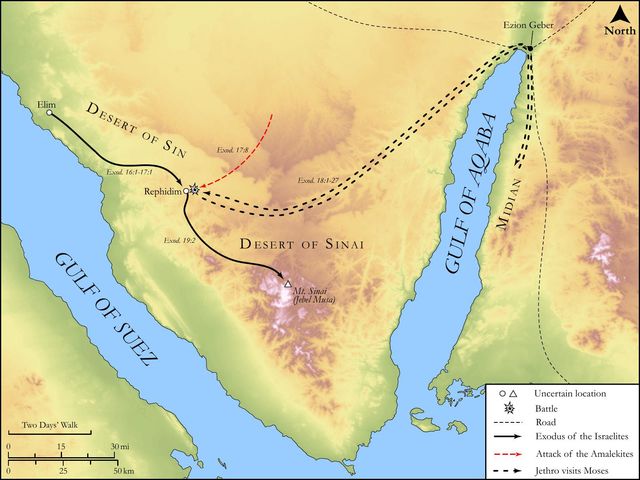
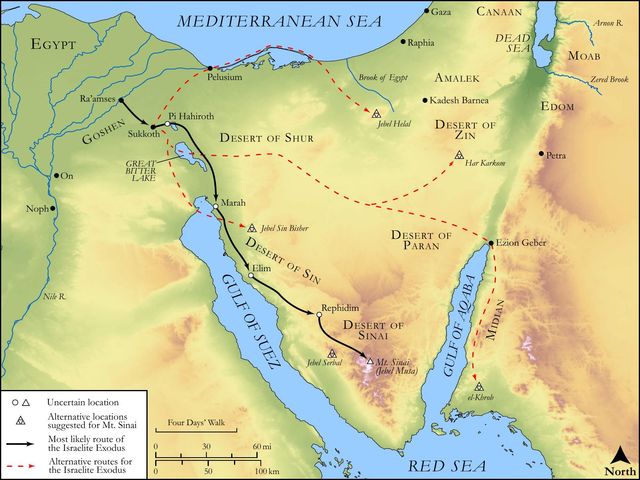
II.The pulpit (or throne rather) was mount Sinai, hung with a thick cloud (Exo 19:16), covered with smoke (Exo 19:18), and made to quake greatly. Now it was that the earth trembled at the presence of the Lord, and the mountains skipped like rams (Psa 114:4, Psa 114:7), that Sinai itself, though rough and rocky, melted from before the Lord God of Israel, Jdg 5:5. Now it was that the mountains saw him, and trembled (Hab 3:10), and were witnesses against a hard-hearted unmoved people, whom nothing would influence.
III.The congregation was called together by the sound of a trumpet, exceedingly loud (Exo 19:16), and waxing louder and louder, Exo 19:19.
This was done by the ministry of the angels, and we read of trumpets sounded by angels, Rev 8:6. It was the sound of the trumpet that made all the people tremble, as those who knew their own guilt, and who had reason to expect that the sound of this trumpet was to them the alarm of war.
IV.Moses brought the hearers to the place of meeting, Exo 19:17.
He that had led them out of the bondage of Egypt now led them to receive the law from God's mouth. Public persons are indeed public blessings when they lay out themselves in their places to promote the public worship of God. Moses, at the head of an assembly worshipping God, was as truly great as Moses at the head of an army in the field.
V.The introductions to the service were thunders and lightnings, Exo 19:16.
These were designed to strike an awe upon the people, and to raise and engage their attention. Were they asleep? The thunders would awaken them. Were they looking another way? The lightnings would engage them to turn their faces towards him that spoke to them. Thunder and lightning have natural causes, but the scripture directs us in a particular manner to take notice of the power of God, and his terror, in them. Thunder is the voice of God, and lightning the fire of God, proper to engage the senses of sight and hearing, those senses by which we receive so much of our information.
VI.Moses is God's minister, who is spoken to, to command silence, and keep the congregation in order:
Moses spoke, Exo 19:19. Some think it was now that he said, I exceedingly fear and quake (Heb 12:21); but God stilled his fear by his distinguishing favour to him, in calling him up to the top of the mount (Exo 19:20), by which also he tried his faith and courage. No sooner had Moses got up a little way towards the top of the mount than he was sent down again to keep the people from breaking through to gaze, Exo 19:21. Even the priests or princes, the heads of the houses of their fathers, who officiated for their respective families, and therefore are said to come near to the Lord at other times, must now keep their distance, and conduct themselves with a great deal of caution. Moses pleads that they needed not to have any further orders given them, effectual care being taken already to prevent any intrusions, Exo 19:23. But God, who knew their wilfulness and presumption, and what was now in the hearts of some of them, hastens him down with this in charge, that neither the priests nor the people should offer to force the lines that were set, to come up unto the Lord, but Moses and Aaron on, the men whom God delighted to honour. Observe,
1.What it was that God forbade them - breaking through to gaze; enough was provided to awaken their consciences, but they were not allowed to gratify their vain curiosity. They might see, but not gaze. Some of them, probably, were desirous to see some similitude, that they might know how to make an image of God, which he took care to prevent, for they saw no manner of similitude, Deu 4:5. Note, In divine things we must not covet to know more than God would have us know; and he has allowed us as much as is good for us. A desire of forbidden knowledge was the ruin of our first parents. Those that would be wise above what is written, and intrude into those things which they have not seen, need this admonition, that they break not through to gaze.
2.Under what penalty it was forbidden: Lest the Lord break forth upon them (Exo 19:22-24), and many of them perish. Note,
(1.)The restraints and warnings of the divine law are all intended for our good, and to keep us out of that danger into which we should otherwise, by our own folly, run ourselves.
(2.)It is at our peril if we break the bounds that God has set us, and intrude upon that which he has not allowed us; the Bethshemites and Uzzah paid dearly for their presumption. And, even when we are called to approach God, we must remember that he is in heaven and we upon earth, and therefore it behoves us to exercise reverence and godly fear.
Continue studying Exodus 19:22 across the web’s major study libraries — every link below opens this exact verse, chapter, or book on the destination site.
Read & Compare
 BibleGatewayThis verse in more than 200 translations and 70 languages.
 Bible.comThe YouVersion reader — hundreds of translations, reading plans, and highlights.
 ESV.orgCrossway's official English Standard Version reader.
 NET BibleThe NET translation with 60,000+ translators' notes on every rendering decision.
 STEP BibleTyndale House's free study tool — original text, vocabulary, and scholarly resources.
 BibliaLogos Bible Software's free web reader.
 USCCBThe New American Bible (Revised Edition) with the U.S. bishops' study notes.
Commentaries
 BibleHub CommentariesDozens of classic commentaries on this verse, gathered on one page.
 StudyLightMore than 100 commentary sets — the largest collection on the web.
 BibleRefPlain-English commentary on what this verse means, verse by verse.
 Enduring WordDavid Guzik's free commentary on this chapter, widely used by Bible teachers.
 Bible Study ToolsVerse commentary alongside Greek and Hebrew study aids.
Original Language & Research
- BibleHub InterlinearThe verse word by word — original language, transliteration, and English.
- BibleHub LexiconEvery word's original-language definition and Strong's entry.
 Blue Letter BibleDeep-study tools — Strong's numbers, concordance, and word studies.
 SefariaThe Hebrew text with Rashi and centuries of Jewish commentary.
Sermons, Hymns & Audio


TrulyRandomVerse is not affiliated with these sites and doesn’t control their content. They’re linked because they’re genuinely useful.
Summary
Exodus 19:22 delivers a grave divine injunction to a specific group identified as "priests" at Mount Sinai, commanding them to meticulously consecrate themselves before daring to approach the LORD. This imperative underscores the absolute and consuming holiness of God, emphasizing that even those with designated access must adhere to rigorous standards of ritual and spiritual purity. Failure to do so would invite a sudden, destructive divine judgment, as the Almighty's unbridled holy power would "break forth" upon them, highlighting the perilous consequences of irreverence in the presence of the Sacred.
Context
ShowHideLiterary Context
This verse is deeply embedded within the climactic narrative of God's covenant initiation at Mount Sinai, following the Israelites' miraculous deliverance from Egypt. The preceding verses, particularly Exodus 19:10-15, detail the comprehensive preparations required of the entire nation: a three-day period of consecration, washing of clothes, and the strict establishment of boundaries around the mountain, punishable by death for transgression. This collective purification sets the stage for God's descent. Exodus 19:22 then introduces a heightened, specific requirement for a particular group identified as "priests," indicating a tiered system of access to the divine presence. This layered instruction reinforces the profound holiness of the moment and the escalating danger associated with closer proximity to God, even as Moses continues to mediate between God and the people in the subsequent verses.
Historical & Cultural Context
At this nascent stage of Israel's history, prior to the formal establishment of the Aaronic priesthood in Exodus 28 and Leviticus 8, the term "priests" (Hebrew: כֹּהֲנִים, kohanim) likely refers to a pre-existing class of individuals. These were probably the firstborn males of each family, who traditionally held a sacred role (as implied in Exodus 24:5), or other prominent tribal leaders who facilitated worship. The concept of ritual purity and consecration was pervasive in ancient Near Eastern cultures, where deities were often considered powerful and dangerous, requiring specific protocols for interaction. However, Israel's understanding was uniquely tied to the absolute, transcendent holiness of Yahweh, distinct from the capricious gods of their neighbors. The awe-inspiring display at Mount Sinai, with its thunder, lightning, thick cloud, and trumpet blast (Exodus 19:16-19), served to instill a profound sense of reverential fear, demonstrating that God was not to be approached casually but with the utmost sanctity and strict obedience to His commands.
Key Themes
ShowHideExodus 19:22 powerfully contributes to several overarching themes within the book of Exodus and the Pentateuch. Foremost is the theme of God's Absolute Holiness and Transcendence. The strict commands for consecration and the severe warnings underscore that Yahweh is utterly set apart from humanity and sin, demanding a holy approach. This verse also develops the theme of Mediated Access to God, illustrating that direct, unmediated access is perilous for sinful humanity, thus necessitating a designated class of individuals (the "priests") to bridge the gap, albeit under stringent conditions. Furthermore, it highlights the theme of Covenant Requirements and Obedience, emphasizing that the blessings of the covenant are contingent upon meticulous adherence to divine stipulations. The danger of God "breaking forth" also introduces the theme of Divine Judgment for Irreverence, foreshadowing later instances where disregard for sacred protocols results in severe consequences, as seen in the narratives of Nadab and Abihu (Leviticus 10:1-2) and Uzzah (2 Samuel 6:7).
Exposition and Analysis
ShowHideKey Word Analysis
ShowHideThis term refers to "one officiating, a priest." In this pre-Aaronic context, it signifies individuals who held a special, recognized role in mediating sacred matters, distinct from the general populace. Their function involved drawing near to God for various purposes, thus necessitating a higher standard of purity and responsibility than the rest of the congregation. The use of this term here highlights an existing, albeit perhaps informal, priestly class before the formal institution of the Levitical priesthood.
This verb means "to be (causatively, make, pronounce or observe as) clean (ceremonially or morally); to set apart, consecrate, or hallow." In this command, it denotes a process of ritual and spiritual purification, making oneself fit to enter a sacred space or interact with a holy entity. This would have involved ceremonial washing, abstaining from defiling activities, and adopting a mental and spiritual posture of reverence. It signifies a necessary transition from the common or profane to the sacred, a prerequisite for approaching the Holy God.
This primitive root means "to break out (in many applications, direct and indirect, literal and figurative); to burst forth, make a breach, or spread." When used in relation to God's action, as here, it conveys a sudden, forceful, and destructive divine intervention or judgment. It implies that God's holiness, if not properly revered, would manifest as an overwhelming and potentially lethal force, akin to a dam bursting or a wall collapsing. This vivid imagery emphasizes the inherent danger of treating God's presence lightly and the immediate, severe consequences of violating His sacred boundaries.
Verse Breakdown
ShowHide"And let the priests also"
This opening phrase indicates an additional, specific command directed at a select group, beyond the general consecration already required of all Israel. It highlights their distinct status and greater responsibility in mediating with the divine, implying a closer proximity to God's presence than the common people.
"which come near to the LORD"
This clause defines the specific function and privilege of these "priests"—they were permitted, or perhaps expected, to draw closer to God's immediate presence than the general populace. This unique access necessitated an even higher standard of purity and reverence, as direct encounter with the divine carried inherent, perilous risks if not properly managed.
"sanctify themselves"
This is the direct, imperative command, reiterating the need for active, intentional self-preparation and purification. It emphasizes that holiness is not merely an attribute of God but a non-negotiable requirement for those who would approach Him, demanding a conscious act of setting oneself apart for sacred service.
"lest the LORD break forth upon them"
This concluding clause presents the dire consequence of failure to comply. The phrase "break forth" vividly portrays God's holy wrath as an uncontrollable, destructive force unleashed upon those who violate His sacred space or disregard His commands. It serves as a potent deterrent, powerfully illustrating the perilous nature of irreverence and presumption in the presence of the Almighty.
Literary Devices
ShowHideExodus 19:22 employs several potent literary devices to convey its urgent and solemn message. The primary device is Divine Imperative, expressed through the direct command "let the priests... sanctify themselves." This imperative highlights God's absolute authority and the non-negotiable nature of His requirements for approaching Him. The verse also utilizes Warning/Admonition, clearly stating the severe consequence ("lest the LORD break forth upon them") if the command is disregarded. This creates a palpable sense of immediate danger and underscores the gravity of the situation, demanding strict obedience. Furthermore, there is an element of Foreshadowing, as this early command regarding priestly purity and the danger of irreverence anticipates later narratives of divine judgment on those who violate sacred protocols, such as Nadab and Abihu (Leviticus 10:1-2) or Uzzah (2 Samuel 6:7). The imagery of God "breaking forth" also functions as Metaphor, portraying God's holy power as a sudden, overwhelming, and destructive force, not unlike a natural disaster, if His boundaries are transgressed. This language instills a profound sense of awe and fear, emphasizing the unapproachable nature of absolute holiness to anything impure.
Theological and Thematic Connections
ShowHideExodus 19:22 profoundly underscores the fundamental theological truth of God's absolute and unapproachable holiness, a theme central to the entire Old Testament. It establishes that access to the divine presence is not a right but a privilege, granted only under specific, divinely ordained conditions and requiring meticulous preparation and reverence. The command for "priests" to "sanctify themselves" highlights the necessity of human purity and consecration to stand before a holy God, demonstrating that sin and impurity create an impassable barrier. The severe warning against God "breaking forth" upon them reveals the inherent danger of irreverence or presumption in the divine presence, emphasizing that God's holiness, while glorious, is also consuming and dangerous to anything unholy. This verse sets the stage for the elaborate purity laws, the sacrificial system, and the carefully regulated tabernacle worship detailed in the Pentateuch, all designed to bridge the chasm between a holy God and an unholy people, albeit temporarily and symbolically, until a greater mediator would come.
Reflection and Application
ShowHideExodus 19:22 serves as a timeless reminder of the profound reverence due to God. While the ritualistic demands of the Old Covenant have been fulfilled and transformed in Christ, the underlying principles of God's unchangeable holiness and the perpetual need for spiritual preparation remain eternally valid. We no longer approach a physical mountain surrounded by fire and smoke, but we draw near to the living God, who is no less holy and majestic. This verse calls us to cultivate a deep sense of awe, humility, and intentionality in every aspect of our spiritual lives—our worship, our prayer, our study of His Word, and our service. It challenges any casualness, presumption, or flippancy in our approach to God, reminding us that true intimacy with Him is predicated on a profound recognition of His majesty and a sincere pursuit of holiness. Our access to God is now by grace through faith in Christ, but this grace does not negate His holiness; rather, it provides the perfect means for us to be made holy and thus truly draw near. We are exhorted to "worship God acceptably with reverence and awe, for our God is a consuming fire" (Hebrews 12:28-29), understanding that our sanctification is an ongoing process of aligning our lives with His divine purity.
Questions for Reflection
ShowHideFAQ
ShowHideWho were these "priests" mentioned in Exodus 19:22, given that the Aaronic priesthood hadn't been formally established yet?
ShowHideAt this early stage in Israel's history, before the formal designation of Aaron and his sons as the Levitical priesthood (which occurs later in Exodus 28 and Leviticus 8), the term "priests" (Hebrew: kohanim) likely refers to a pre-existing class of individuals who served in a priestly capacity. This could have included the firstborn males of each family, who traditionally held a special status and responsibility in worship (Exodus 24:5 mentions "young men of the people of Israel, who offered burnt offerings"), or other tribal leaders or heads of households who had a recognized role in mediating between God and the people. The context suggests they were individuals with a specific, privileged access to sacred matters, distinct from the general congregation, and thus held to a higher standard of purity and accountability.
Why was such a strict warning necessary for those approaching God at Mount Sinai?
ShowHideThe strict warning was absolutely necessary to impress upon the Israelites the profound and dangerous holiness of God. The events at Mount Sinai were a direct, tangible manifestation of God's awesome presence (Exodus 19:16-19), unlike anything they had ever experienced. God's holiness is so pure and absolute that anything unholy or irreverent cannot stand in its presence without being consumed or judged. The warning served multiple purposes: to instill a proper fear and reverence for God, to prevent casual or presumptuous approaches that could lead to immediate death (as seen later with Uzzah in 2 Samuel 6:7 or Nadab and Abihu in Leviticus 10:1-2), and to establish the foundational principle that access to God requires divine initiation and strict adherence to His commands for purity and consecration. It highlighted the immense chasm between a holy God and sinful humanity, a chasm that only God Himself could bridge.
Christ-Centered Fulfillment
ShowHideExodus 19:22, with its stern warning for priests to sanctify themselves lest the LORD "break forth" upon them, finds its ultimate fulfillment and profound transformation in Jesus Christ. Under the Old Covenant, access to God's presence was severely restricted and mediated through a designated, imperfect priesthood, requiring meticulous ritual purity and constant atonement for sin. The danger of divine judgment for irreverence was ever-present, a stark reminder of humanity's inability to stand before a holy God. However, Jesus, as our Great High Priest (Hebrews 4:14), perfectly fulfills and transcends all requirements of sanctification and mediation. He is the holy, blameless, unstained, and separate-from-sinners sacrifice (Hebrews 7:26-27) who, by His single, perfect offering, has forever perfected and sanctified those who are being made holy (Hebrews 10:14). Through His shed blood on the cross, the very veil separating humanity from God's most holy presence was dramatically torn from top to bottom (Matthew 27:51), granting believers direct, confident, and unhindered access to the "throne of grace" (Hebrews 4:16). We, as believers, are now a "royal priesthood" and a "holy nation" (1 Peter 2:9), sanctified not by our own efforts or rituals, but by the Spirit and the precious blood of Jesus Christ (1 Peter 1:2). Thus, the terrifying "breaking forth" of God's wrath, due to sin and irreverence, has been fully absorbed and propitiated by Christ on the cross (Romans 5:9), allowing us to draw near with a true heart in full assurance of faith, having our hearts sprinkled clean from an evil conscience and our bodies washed with pure water (Hebrews 10:22).