


Exodus 19:12
Bible text: King James Version (1769 Blayney text) · Public domain
Bible text: King James Version with Strong's numbers · Public domain
Bible text: Berean Standard Bible · Public domain
Bible text: American Standard Version (1901) · Public domain
Bible text: World English Bible, Messianic edition · Public domain
Bible text: Geneva Bible (1599) · Public domain
Bible text: Young's Literal Translation · Public domain
- וְהִגְבַּלְתָּve·hig·bal·Taand you will set a boundary forH1379Conj-w ¦ V-Hiphil-ConsecPerf-2msVerb Hiphil Consecutive Perfect 2nd Singular Masculineוְandהִגְבַּלְתָּyou will set a boundary for
- אֶת'et<obj.>H853DirObjMParticle Object Indicator
- הָעָםha·'Amthe peopleH5971Art ¦ N-msNoun Singular Masculine Absoluteהָtheעָםpeople
- סָבִיבsa·Vivall aroundH5439N-csNoun Singular common gender Absolute
- לֵאמֹרle·Mor<to> sayingH559Prep-l ¦ V-Qal-InfVerb Qal Infinitive Constructלֵ<to>אמֹרsaying
- הִשָּׁמְרוּhi·sha·me·Rutake heedH8104V-Niphal-Imp-2mpVerb Niphal Imperative 2nd Plural Masculine
- לָכֶםla·Khemto <the> yourselvesPrep-l ¦ 2mpSuffix Personal 2nd Plural Masculineלָto <the>כֶםyourselves
- עֲלוֹתa·Lotto go upH5927V-Qal-InfVerb Qal Infinitive Construct
- בָּהָרba·Haron the mountainH2022Prep-b ¦ N-msNoun Singular Masculine Absoluteבָּon theהָרmountain
- וּנְגֹעַu·ne·Go·a'and to touchH5060Conj-w ¦ V-Qal-InfVerb Qal Infinitive Constructוּandנְגֹעַto touch
- בְּקָצֵהוּbe·ka·Tze·hu<in> its edgeH7097Prep-b ¦ N-msc ¦ 3msNoun Singular Masculine Constructבְּ<in>קָצֵedgeהוּits
- כָּלkoleveryH3605N-msNoun Singular Masculine Absolute
- הַנֹּגֵעַha·no·Ge·a'<the> [one who] touchesH5060Art ¦ V-Qal-Prtcpl-msVerb Qal Participle Singular Masculine Absoluteהַ<the>נֹּגֵעַ[one who] touches
- בָּהָרba·Har<in> the mountainH2022Prep-b ¦ N-msNoun Singular Masculine Absoluteבָּ<in> theהָרmountain
- מוֹתMotcertainly <to die>H4191V-Qal-InfAbsVerb Qal Infinitive Absolute
- יוּמָתyu·Mathe will be put to deathH4191V-Hophal-Imperf-3msVerb Hophal Imperfect 3rd Singular Masculine
English is a literal word-by-word gloss of the Hebrew, not the KJV's wording. Why?
This is the original text the KJV's translators worked from — each Hebrew word with its own literal English meaning in this verse, prepared by scholars at Tyndale House, Cambridge. The KJV translates whole sentences, not word by word, so its wording differs: one Hebrew word can become several English words, and the KJV may choose “the LORD” where the gloss reads “Yahweh”. Both are faithful — they answer different questions. For the KJV's own rendering, switch to the KJV text.
Details
See on the biblical-era maps

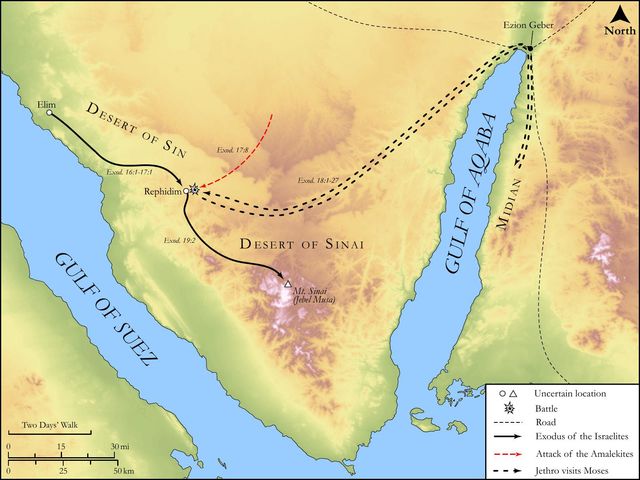
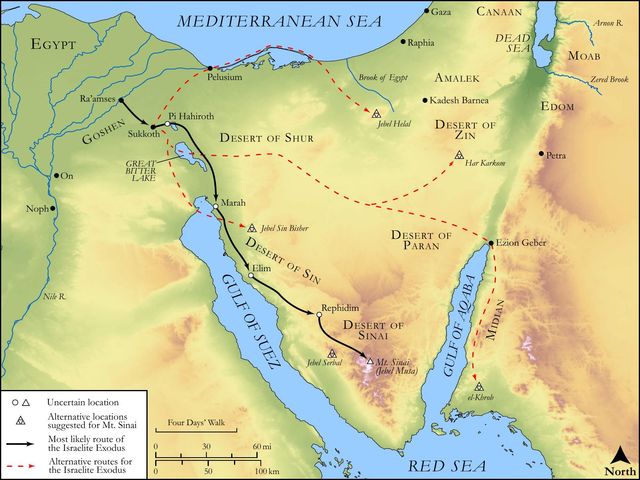
Study this verse
Public-domain commentary
Matthew Henry
From his Commentary on the Whole Bible. Henry comments on passages, not single verses — this entry covers Exodus 19:9–15. His three-level outline is real structure in the source text, so it is rendered as structure.
Here, I. God intimates to Moses his purpose of coming down upon mount Sinai, in some visible appearance of his glory, in a thick cloud (Exo 19:9); for he said that he would dwell in the thick darkness (Ch2 6:1), and make this his pavilion (Psa 18:11), holding back the face of his throne when he set it upon mount Sinai, and spreading a cloud upon it, Job 26:9. This thick cloud was to prohibit curious enquiries into things secret, and to command an awful adoration of that which was revealed. God would come down in the sight of all the people (Exo 19:11); though they should see no manner of similitude, yet they should see so much as would convince them that God was among them of a truth. And so high was the top of mount Sinai that it is supposed that not only the camp of Israel, but even the countries about, might discern some extraordinary appearance of glory upon it, which would strike a terror upon them. It seems also to have been particularly intended to put an honour upon Moses: That they may hear when I speak with thee, and believe thee for ever, Exo 19:9. Thus the correspondence was to be first settled by a sensible appearance of the divine glory, which was afterwards to be carried on more silently by the ministry of Moses. In like manner, the Holy Ghost descended visibly upon Christ at his baptism, and all that were present heard God speak to him (Mat 3:17), that afterwards, without the repetition of such visible tokens, they might believe him. So likewise the Spirit descended in cloven tongues upon the apostles (Act 2:3), that they might be believed. Observe, When the people had declared themselves willing to obey the voice of God, then God promised they should hear his voice; for, if any man be resolved to do his will, he shall know it, Joh 7:17.
II.He orders Moses to make preparation for this great solemnity, giving him two days' time for it.
1.He must sanctify the people (Exo 19:10), as Job, before this, sent and sanctified his sons, Job 1:5. He must raise their expectation by giving them notice what God would do, and assist their preparation by directing them what they must do. "Sanctify them," that is, "Call them off from their worldly business, and call them to religious exercises, meditation and prayer, that they may receive the law from God's mouth with reverence and devotion. Let them be ready," Exo 19:11. Note, When we are to attend upon God in solemn ordinances it concerns us to sanctify ourselves, and to get ready beforehand. Wandering thoughts must be gathered in, impure affections abandoned, disquieting passions suppressed, nay, and all cares about secular business, for the present, dismissed and laid by, that our hearts may be engaged to approach unto God. Two things particularly prescribed as signs and instances of their preparation: - (1.) In token of their cleansing themselves from all sinful pollutions, that they might be holy to God, they must wash their clothes (Exo 19:10), and they did so (Exo 19:14); not that God regards our clothes; but while they were washing their clothes he would have them think of washing their souls by repentance from the sins they had contracted in Egypt and since their deliverance. It becomes us to appear in clean clothes when we wait upon great men; so clean hearts are required in our attendance on the great God, who sees them as plainly as men see our clothes. This is absolutely necessary to our acceptably worshipping God. See Psa 26:6; Isa 1:16-18; Heb 10:22. (2.) In token of their devoting themselves entirely to religious exercises, upon this occasion, they must abstain even from lawful enjoyments during these three days, and not come at their wives, Exo 19:15. See Co1 7:5.
2.He must set bounds about the mountain, Exo 19:12, Exo 19:13. Probably he drew a line, or ditch, round at the foot of the hill, which none were to pass upon pain of death. This was to intimate,
(1.)That humble awful reverence which ought to possess the minds of all those that worship God. We are mean creatures before a great Creator, vile sinners before a holy righteous Judge; and therefore a godly fear and shame well become us, Heb 12:28; Psa 2:11.
(2.)The distance at which worshippers were kept, under that dispensation, which we ought to take notice of, that we may the more value our privilege under the gospel, having boldness to enter into the holiest by the blood of Jesus, Heb 10:19.
3.He must order the people to attend upon the summons that should be given (Exo 19:13): "When the trumpet soundeth long then let them take their places at the foot of the mount, and so sit down at God's feet," as it is explained, Deu 33:3. Never was so great a congregation called together, and preached to, at once, as this was here. No one man's voice could have reached so many, but the voice of God did.
Historical interpretation
Historical reception
1 surviving comment on this verse from the historical church.
In this wonderful agreement there is the very great difference, that in the Old Testament the people is held back by a fearful dread from approaching the place where the law was given; whereas in the New the Holy Spirit comes upon those who were assembled together waiting for his promised coming.
Continue studying Exodus 19:12 across the web’s major study libraries — every link below opens this exact verse, chapter, or book on the destination site.
Read & Compare
 BibleGatewayThis verse in more than 200 translations and 70 languages.
 Bible.comThe YouVersion reader — hundreds of translations, reading plans, and highlights.
 ESV.orgCrossway's official English Standard Version reader.
 NET BibleThe NET translation with 60,000+ translators' notes on every rendering decision.
 STEP BibleTyndale House's free study tool — original text, vocabulary, and scholarly resources.
 BibliaLogos Bible Software's free web reader.
 USCCBThe New American Bible (Revised Edition) with the U.S. bishops' study notes.
Commentaries
 BibleHub CommentariesDozens of classic commentaries on this verse, gathered on one page.
 StudyLightMore than 100 commentary sets — the largest collection on the web.
 BibleRefPlain-English commentary on what this verse means, verse by verse.
 Enduring WordDavid Guzik's free commentary on this chapter, widely used by Bible teachers.
 Bible Study ToolsVerse commentary alongside Greek and Hebrew study aids.
Original Language & Research
- BibleHub InterlinearThe verse word by word — original language, transliteration, and English.
- BibleHub LexiconEvery word's original-language definition and Strong's entry.
 Blue Letter BibleDeep-study tools — Strong's numbers, concordance, and word studies.
 SefariaThe Hebrew text with Rashi and centuries of Jewish commentary.
Sermons, Hymns & Audio


TrulyRandomVerse is not affiliated with these sites and doesn’t control their content. They’re linked because they’re genuinely useful.
Summary
Exodus 19:12 delivers a critical divine command to Moses, establishing strict, non-negotiable boundaries around Mount Sinai as the Israelites prepare for God's momentous covenant revelation. This verse prohibits anyone from ascending the mountain or even touching its perimeter, underscoring the profound, unapproachable holiness and terrifying majesty of Yahweh. The severe penalty for transgression—immediate death—impresses upon the people the absolute gravity of His presence and the sanctity of the impending encounter, setting the stage for the giving of the Law.
Context
ShowHideLiterary Context
This verse is a pivotal command within the broader narrative of Israel's arrival at Mount Sinai in Exodus 19. Following their miraculous deliverance from Egypt and journey through the wilderness, the Israelites have arrived at the mountain where God intends to establish His covenant. Verses Exodus 19:1-8 describe their arrival and God's initial proposal of a covenant, to which the people affirm their willingness to obey. Prior to the dramatic revelation of the Ten Commandments in Exodus 20, God instructs Moses to consecrate the people (Exodus 19:10-11) and, critically, to set physical boundaries around the mountain. Verse 13 specifies that only after the trumpet sounds a long blast may the people approach, indicating a temporary, conditional access, while verse 15 emphasizes a period of ritual purity before the third day. Thus, verse 12 functions as the immediate, absolute restriction that sets the stage for the awe-inspiring, yet terrifying, divine encounter, highlighting the immense gap between a holy God and His people.
Historical & Cultural Context
The setting is the rugged and imposing wilderness of Sinai. For the ancient Israelites, recently freed from Egyptian bondage, encountering their delivering God in such a dramatic fashion was unprecedented. The concept of sacred space and divine presence was common among the Canaanites, where mountains were often considered dwelling places of deities. However, Yahweh's holiness, as demonstrated at Sinai, transcended all pagan notions. The thunder, lightning, and thick cloud described in Exodus 19:16 would have been understood as typical manifestations of divine power, yet uniquely terrifying in their intensity. The establishment of physical boundaries was a tangible way to communicate an abstract theological truth: God's absolute transcendence and holiness required a profound separation from human sinfulness. This was not merely a ceremonial act but a life-or-death imperative, designed to prevent casual or presumptuous approaches to the Holy One, reinforcing the gravity of the covenant relationship about to be forged between God and His chosen people. The boundaries served as a visible representation of the invisible, yet very real, barrier between the divine and the profane.
Key Themes
ShowHideExodus 19:12 powerfully contributes to several overarching themes within the book of Exodus and the Pentateuch. Foremost is the theme of God's Holiness and Transcendence, emphasizing His absolute purity and separation from all that is common or defiled. This verse also highlights the theme of Divine Authority and Sovereignty, as God alone dictates the terms of engagement with His presence. The severe penalty for transgression underscores the theme of Covenant Obedience and its Consequences, establishing that the relationship with Yahweh is founded on strict adherence to His commands, with life and death implications. Furthermore, it introduces the theme of Mediation, as Moses alone is permitted to ascend and interact with God on behalf of the people, foreshadowing the need for an intermediary between God and humanity. The entire dramatic scene at Sinai, including this verse, serves to instill a profound Fear of the Lord, a reverential awe that is foundational to Israel's worship and ethical life, as later wisdom literature would affirm (e.g., Proverbs 9:10).
Exposition and Analysis
ShowHideKey Word Analysis
ShowHideThe Hebrew verb H1379, gâbal, means "to twist as a rope," "to bound (as by a line)," or "to set bounds about." This implies a clear, visible demarcation, likely marked by ropes or stones, that the people could easily discern and respect. The act of "setting bounds" emphasizes God's sovereign authority to define and consecrate space, making it off-limits to the profane. It suggests a deliberate, precise act of drawing a line that must not be crossed.
The Hebrew verb H5060, nâgaʻ, means "to touch," "to strike," or "to reach." Its inclusion here is significant because it indicates that even the slightest, perhaps accidental, physical contact with the mountain's border was forbidden and carried the death penalty. This highlights the extreme sensitivity and sanctity of the mountain due to God's immediate, manifest presence. It underscores that God's holiness is so absolute that even indirect contact with its consecrated space is perilous for the unholy, emphasizing the radical separation required.
This is a Hebrew idiom formed by the infinitive absolute followed by the finite verb (מוּת מוּת, mûwth mûwth), derived from the root H4191, mûwth, meaning "to die" or "to kill." This grammatical construction is used to express absolute certainty and intensity, emphasizing that death is not merely a possibility but an inevitable and certain consequence. It conveys the most emphatic form of "you shall surely die," leaving no room for doubt or leniency regarding the penalty for transgression. This highlights the ultimate, non-negotiable consequence of violating God's sacred space.
Verse Breakdown
ShowHide"And thou shalt set bounds unto the people round about, saying,"
This initial clause directs Moses to act as God's intermediary, establishing the physical perimeter. The command is explicitly from God to Moses, who then communicates it to the people. The "bounds" are not for the mountain itself, but "unto the people," indicating a restriction on their movement, not a limitation on God's presence. The phrase "round about" (H5439, çâbîyb) emphasizes that the boundary was to encircle the entire base of the mountain, leaving no unguarded access point.
"Take heed to yourselves, [that ye] go [not] up into the mount, or touch the border of it:"
This is the core prohibition. The phrase "Take heed to yourselves" (H8104, shâmar) serves as a solemn warning, emphasizing personal responsibility for adherence to the command. It prohibits both ascending the mountain (H5927, ʻâlâh) and even touching its lowest edge or "border" (H7097, qâtseh), reinforcing the absolute sacredness of the entire mountain (H2022, har) as God's temporary dwelling place. The prohibition is comprehensive, leaving no loophole for accidental or intentional transgression, underscoring the complete inaccessibility of God's immediate presence.
"whosoever toucheth the mount shall be surely put to death:"
This clause declares the severe and certain consequence for violating the boundary. The use of the emphatic "surely put to death" (Hebrew: mûwth mûwth) underscores the gravity of the offense. It is not merely a warning but a definitive pronouncement of divine judgment, demonstrating God's unwavering commitment to His own holiness and the sanctity of His presence. This penalty serves as a powerful deterrent, ensuring the people understood the immense danger of approaching God without proper consecration and permission, emphasizing the life-or-death nature of obedience in the face of divine holiness.
Literary Devices
ShowHideExodus 19:12 employs several powerful literary devices to convey its profound message. Symbolism is paramount, with Mount Sinai itself symbolizing God's awesome, unapproachable holiness and transcendent power. The physical "bounds" are a tangible symbol of the spiritual chasm between a holy God and sinful humanity, emphasizing the need for separation, reverence, and the impossibility of casual access. The severe penalty, "whosoever toucheth the mount shall be surely put to death," functions as Hyperbole in its dramatic intensity, not necessarily implying that every single touch would result in instantaneous physical death for every individual, but rather profoundly emphasizing the absolute seriousness of the command and the lethal danger of God's unmediated presence for the unholy. This dramatic pronouncement serves to instill Awe and Fear of the Lord in the people, ensuring they grasp the gravity of the divine encounter. The Repetition inherent in the Hebrew idiom "mûwth mûwth" ("surely put to death") further amplifies the certainty and severity of the consequence, leaving no doubt about the fatal outcome of disobedience. The entire scene is also a form of Theophany, a visible manifestation of God, designed to impress His nature upon His people.
Theological and Thematic Connections
ShowHideExodus 19:12 profoundly establishes the theme of God's absolute holiness and transcendence. It teaches that God is utterly separate from sin and impurity, dwelling in unapproachable light. This separation necessitates a careful, reverent approach, emphasizing that access to God is not a right but a divinely granted privilege, contingent upon His terms. The terrifying display at Sinai was foundational for Israel's understanding of Yahweh's majesty and the seriousness of their covenant obligations. It instilled a deep sense of awe and a healthy fear of the Lord, which is consistently presented in Scripture as the beginning of wisdom and the proper posture before the Almighty. This historical event serves as a stark reminder of the immense gulf between a holy God and sinful humanity, a gap that only God Himself could ultimately bridge.
Reflection and Application
ShowHideFor believers today, Exodus 19:12 serves as an enduring reminder of God's unchanging character: He is holy, just, and majestic. While we no longer approach a physical mountain under threat of death, the principle of reverence and awe before God remains vital. Our access to God in the New Covenant is a privilege purchased by the infinite sacrifice of Jesus Christ, not a casual right. This verse calls us to humility, gratitude, and a profound respect for God's supreme authority and purity. It encourages us to approach Him not with presumption or flippancy, but with a heart of worship, recognizing the immense cost of our reconciliation and the unmerited favor by which we can draw near. It challenges us to consider our own lives: are we living in a way that reflects the holiness of the God we claim to serve? Do we treat His Word, His presence, and His commands with the reverence they deserve? This passage compels us to live lives of intentional holiness, understanding that our freedom to approach God is a gift, not a license for irreverence.
Questions for Reflection
ShowHideFAQ
ShowHideWhy was the punishment for touching the mountain so severe?
ShowHideThe severity of the punishment—"surely put to death"—was a direct consequence of God's absolute holiness and the sanctity of His immediate presence on Mount Sinai. God was manifesting Himself in a tangible way to establish a covenant with His people, and any unauthorized approach or even accidental touch would have profaned this sacred space and challenged God's supreme authority. The extreme penalty was necessary to impress upon the Israelites the profound difference between a holy God and sinful humanity, instilling a deep sense of awe and ensuring that His commands were taken with the utmost seriousness. It was a stark, foundational lesson that God is not to be trifled with, and His holiness demands absolute respect and obedience, preparing a people who were about to receive His law and enter into a unique, binding relationship with Him.
Does this mean God is unapproachable today?
ShowHideNo, the New Testament reveals a profound shift in how humanity can approach God, not because God's holiness has diminished, but because of the redemptive work of Jesus Christ. While the Old Covenant emphasized separation and the danger of direct access (as seen at Mount Sinai), the New Covenant offers a new and living way. Through Christ's sacrifice, the veil separating humanity from God was torn from top to bottom (Matthew 27:51), granting believers direct access to God's presence. The book of Hebrews contrasts the terrifying Mount Sinai with the heavenly Mount Zion, where believers can now "come boldly unto the throne of grace" (Hebrews 4:16) through the blood of Jesus, our great High Priest. This means that while God's holiness remains unchanged, His grace in Christ has opened a way for us to draw near with confidence, yet still with profound reverence and gratitude.
Christ-Centered Fulfillment
ShowHideExodus 19:12, with its stark boundaries and death penalty for transgression, powerfully foreshadows the absolute holiness of God and the impossibility of sinful humanity approaching Him on its own terms. It reveals the terrifying chasm between a perfectly holy God and an impure people, demonstrating that human effort or presumption cannot bridge this gap. This severe restriction at Sinai sets the stage for the ultimate solution found in Jesus Christ. Where the Old Covenant established physical barriers and a system of sacrifices that could only temporarily atone for sin, the New Covenant, inaugurated by Christ, provides permanent and perfect access. Jesus is the new and living way, the ultimate mediator who perfectly fulfills the requirements of God's holiness. His body, broken on the cross, is the "veil" that was torn, granting us direct access to the Father (Hebrews 10:19-20). He is our great High Priest, who, unlike the Levitical priests, offered Himself once for all, securing eternal redemption (Hebrews 9:12). Thus, the fear and separation of Sinai are transformed into the confident, yet reverent, access we now have to God's throne of grace through the blood of the Lamb (Hebrews 4:16). Exodus 19:12, therefore, serves as a vital backdrop, magnifying the incomprehensible grace and love of God revealed in His Son, who made the unapproachable God approachable, not by diminishing His holiness, but by perfectly satisfying its demands on our behalf.