


Acts 2:3
Bible text: King James Version (1769 Blayney text) · Public domain
Bible text: Berean Standard Bible · Public domain
Bible text: American Standard Version (1901) · Public domain
Bible text: World English Bible, Messianic edition · Public domain
Bible text: Geneva Bible (1599) · Public domain
Bible text: Young's Literal Translation · Public domain
- καὶkaiAndG2532CONJConjunction
- ὤφθησανōphthēsanthere appearedG3700V-API-3PVerb Aorist Passive Indicative 3rd Plural
- αὐτοῖςautoisto themG846P-DPMPersonal pronoun Dative Plural Masculine
- διαμεριζόμεναιdiamerizomenaidividingG1266V-PEP-NPFVerb Present Middle Or Passive Participle Nominative Plural Feminine
- γλῶσσαιglōssaitonguesG1100N-NPFNoun Nominative Plural Feminine
- ὡσεὶhōseiasG5616PREPPreposition
- πυρὸςpurosof fireG4442N-GSNNoun Genitive Singular Neuter
- καὶkaiandG2532CONJConjunction
- ἐκάθισενekathisensatG2523V-AAI-3SVerb Aorist Active Indicative 3rd Singular
- ἐφ᾽eph᾽uponG1909PREPPreposition
- ἕναhenaoneG1520A-ASMAdjective Accusative Singular Masculine
- ἕκαστονhekastoneachG1538A-ASMAdjective Accusative Singular Masculine
- αὐτῶνautōnof themG846P-GPMPersonal pronoun Genitive Plural Masculine
English is a literal word-by-word gloss of the Greek, not the KJV's wording. Why?
This is the original text the KJV's translators worked from — each Greek word with its own literal English meaning in this verse, prepared by scholars at Tyndale House, Cambridge. The KJV translates whole sentences, not word by word, so its wording differs: one Greek word can become several English words, and the KJV may choose “charity” where the gloss reads “love”. Both are faithful — they answer different questions. For the KJV's own rendering, switch to the KJV text.
Details
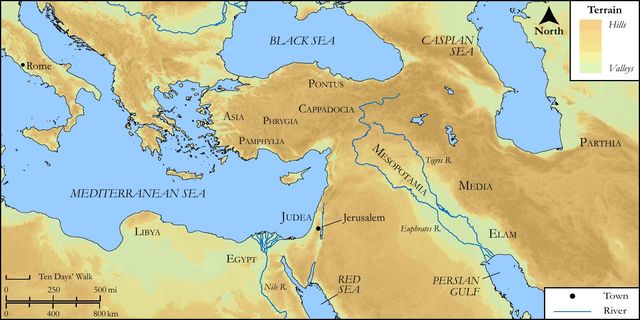
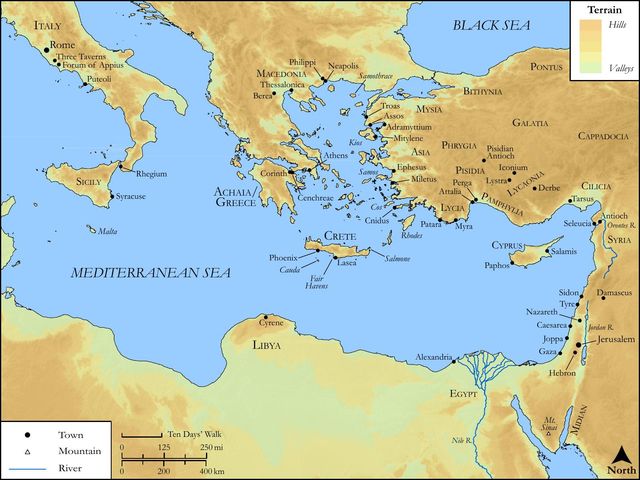
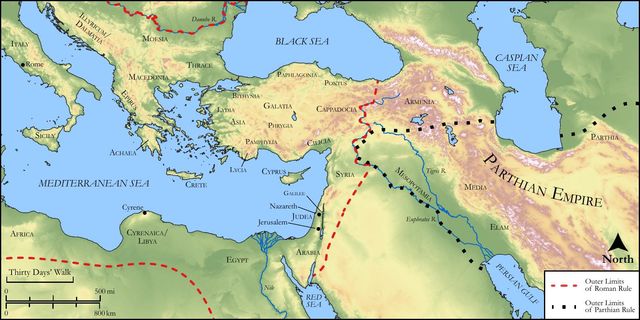
See on the biblical-era maps
Study this verse
Public-domain commentary
Matthew Henry
From his Commentary on the Whole Bible. Henry comments on passages, not single verses — this entry covers Acts 2:1–4. His four-level outline is real structure in the source text, so it is rendered as structure.
We have here an account of the descent of the Holy Ghost upon the disciples of Christ. Observe,
I.When, and where, this was done, which are particularly noted, for the greater certainty of the thing.
1.It was when the day of pentecost was fully come, in which there seems to be a reference to the manner of the expression in the institution of this feast, where it is said (Lev 23:15), You shall count unto you seven sabbaths complete, from the day of the offering of the first-fruits, which was the next day but one after the passover, the sixteenth day of the month Abib, which was the day that Christ arose. This day was fully come, that is, the night preceding, with a part of the day, was fully past.
(1.)The Holy Ghost came down at the time of a solemn feast, because there was then a great concourse of people to Jerusalem from all parts of the country, and the proselytes from other countries, which would make it the more public, and the fame of it to be spread the sooner and further, which would contribute much to the propagating of the gospel into all nations. Thus now, as before at the passover, the Jewish feasts served to toll the bell for gospel services and entertainments.
(2.)This feast of pentecost was kept in remembrance of the giving of the law upon mount Sinai, whence the incorporating of the Jewish church was to be dated, which Dr. Lightfoot reckons to be just one thousand four hundred and forty-seven years before this. Fitly, therefore, is the Holy Ghost given at that feast, in fire and in tongues, for the promulgation of the evangelical law, not as that to one nation, but to every creature.
(3.)This feast of pentecost happened on the first day of the week, which was an additional honour put on that day, and a confirmation of it to be the Christian sabbath, the day which the Lord hath made, to be a standing memorial in his church of those two great blessings - the resurrection of Christ, and the pouring out of the Spirit, both on that day of the week. This serves not only to justify us in observing that day under the style and title of the Lord's day, but to direct us in the sanctifying of it to give God praise particularly for those two great blessings; every Lord's day in the year, I think, there should be a full and particular notice taken in our prayers and praises of these two, as there is by some churches of the one once a year, upon Easter-day, and of the other once a year, upon Whit-sunday. Oh! that we may do it with suitable affections!
2.It was when they were all with one accord in one place. What place it was we are not told particularly, whether in the temple, where they attended at public times (Luk 24:53), or whether in their own upper room, where they met at other times. But it was at Jerusalem, because this had been the place which God chose, to put his name there, and the prophecy was that thence the word of the Lord should go forth to all nations, Isa 2:3. It was now the place of the general rendezvous of all devout people: here God had promised to meet them and bless them; here therefore he meets them with this blessing of blessings. Though Jerusalem had done the utmost dishonour imaginable to Christ, yet he did this honour to Jerusalem, to teach his remnant in all places; he had this in Jerusalem. Here the disciples were in one place, and they were not as yet so many but that one place, and no large one, would hold them all. And here they were with one accord. We cannot forget how often, while their Master was with them, there were strifes among them, who should be the greatest; but now all these strifes were at an end, we hear no more of them. What they had received already of the Holy Ghost, when Christ breathed on them, had in a good measure rectified the mistakes upon which those contests were grounded, and had disposed them to holy love. They had prayed more together of late than usual (Act 1:14), and this made them love one another better. By his grace he thus prepared them for the gift of the Holy Ghost; for that blessed dove comes not where there is noise and clamour, but moves upon the face of the still waters, not the rugged ones. Would we have the Spirit poured out upon us from on high? Let us be all of one accord, and, notwithstanding variety of sentiments and interests, as no doubt there was among those disciples, let us agree to love one another; for, where brethren dwell together in unity, there it is that the Lord commands his blessing.
II.How, and in what manner, the Holy Ghost came upon them.
We often read in the old Testament of God's coming down in a cloud; as when he took possession first of the tabernacle, and afterwards of the temple, which intimates the darkness of that dispensation. And Christ went up to heaven in a cloud, to intimate how much we are kept in the dark concerning the upper world. But the Holy Ghost did not descend in a cloud; for he was to dispel and scatter the clouds that overspread men's minds, and to bring light into the world.
1.Here is an audible summons given them to awaken their expectations of something great, Act 2:2. It is here said,
(1.)That it came suddenly, did not rise gradually, as common winds do, but was at the height immediately. It came sooner than they expected, and startled even those that were now together waiting, and probably employed in some religious exercises.
(2.)It was a sound from heaven, like a thunder-clap, Rev 6:1. God is said to bring the winds out of his treasuries (Psa 135:7), and to gather them in his hands, Pro 30:4. From him this sound came, like the voice of one crying, Prepare ye the way of the Lord.
(3.)It was the sound of a wind, for the way of the Spirit is like that of the wind (Joh 3:3), thou hearest the sound thereof, but canst not tell whence it comes nor whither it goes. When the Spirit of life is to enter into the dry bones, the prophet is told to prophecy unto the wind: Come from the four winds, O breath, Eze 37:9. And though it was not in the wind that the Lord came to Elijah, yet this prepared him to receive his discovery of himself in the still small voice, Kg1 19:11, Kg1 19:12. God's way is in the whirlwind and the storm (Nah 1:3), and out of the whirlwind he spoke to Job.
(4.)It was a rushing mighty wind; it was strong and violent, and came not only with a great noise, but with great force, as if it would bear down all before it. This was to signify the powerful influences and operations of the Spirit of God upon the minds of men, and thereby upon the world, that they should be mighty through God, to the casting down of imaginations.
(5.)It filled not only the room, but all the house where they were sitting. Probably it alarmed the whole city, but, to show that it was supernatural, presently fixed upon that particular house: as some think the wind that was sent to arrest Jonah affected only the ship that he was in (Jon 1:4), and as the wise men's star stood over the house where the child was. This would direct the people who observed it whither to go to enquire the meaning of it. This wind filling the house would strike an awe upon the disciples, and help to put them into a very serious, reverent, and composed frame, for the receiving of the Holy Ghost. Thus the convictions of the Spirit make way for his comforts; and the rough blasts of that blessed wind prepare the soul for its soft and gentle gales.
2.Here is a visible sign of the gift they were to receive. They saw cloven tongues, like as of fire (Act 2:3), and it sat - ekathise, not they sat, those cloven tongues, but he, that is the Spirit (signified thereby), rested upon each of them, as he is said to rest upon the prophets of old. Or, as Dr. Hammond describes it, "There was an appearance of something like flaming fire lighting on every one of them, which divided asunder, and so formed the resemblance of tongues, with that part of them that was next their heads divided or cloven." The flame of a candle is somewhat like a tongue; and there is a meteor which naturalists call ignis lambens - a gentle flame, not a devouring fire; such was this. Observe,
(1.)There was an outward sensible sign, for the confirming of the faith of the disciples themselves, and for the convincing of others. Thus the prophets of old had frequently their first mission confirmed by signs, that all Israel might know them to be established prophets.
(2.)The sign given was fire, that John Baptist's saying concerning Christ might be fulfilled, He shall baptize you with the Holy Ghost and with fire; with the Holy Ghost as with fire. They were now, in the feast of pentecost, celebrating the memorial of the giving of the law upon mount Sinai; and as that was given in fire, and therefore is called a fiery law, so is the gospel. Ezekiel's mission was confirmed by a vision of burning coals of fire (Eze 1:13), and Isaiah's by a coal of fire touching his lips, Isa 6:7. The Spirit, like fire, melts the heart, separates and burns up the dross, and kindles pious and devout affections in the soul, in which, as in the fire upon the altar, the spiritual sacrifices are offered up. This is that fire which Christ came to send upon the earth. Luk 12:49.
(3.)This fire appeared in cloven tongues. The operations of the Spirit were many; that of speaking with divers tongues was one, and was singled out to be the first indication of the gift of the Holy Ghost, and to that this sign had a reference.
[1.]They were tongues; for from the Spirit we have the word of God, and by him Christ would speak to the world, and he gave the Spirit to the disciples, not only to endue them with knowledge, but to endue them with a power to publish and proclaim to the world what they knew; for the dispensation of the Spirit is given to every man to profit withal.
[2.]These tongues were cloven, to signify that God would hereby divide unto all nations the knowledge of his grace, as he is said to have divided to them by his providence the light of the heavenly bodies, Deu 4:19. The tongues were divided, and yet they still continued all of one accord; for there may be a sincere unity of affections where yet there is a diversity of expression. Dr. Lightfoot observes that the dividing of tongues at Babel was the casting off of the heathen; for when they had lost the language in which alone God was spoken of and preached, they utterly lost the knowledge of God and religion, and fell into idolatry. But now, after above two thousand years, God, by another dividing of tongues, restores the knowledge of himself to the nations.
(4.)This fire sat upon them for some time, to denote the constant residence of the Holy Ghost with them. The prophetic gifts of old were conferred sparingly and but at some times, but the disciples of Christ had the gifts of the Spirit always with them, though the sign, we may suppose, soon disappeared. Whether these flames of fire passed from one to another, or whether there were as many flames as there were persons, is not certain. But they must be strong and bright flames that would be visible in the day-light, as it now was, for the day was fully come.
III.What was the immediate effect of this?
1.They were all filled with the Holy Ghost, more plentifully and powerfully than they were before. They were filled with the graces of the Spirit, and were more than ever under his sanctifying influences - were now holy, and heavenly, and spiritual, more weaned from this world and better acquainted with the other. They were more filled with the comforts of the Spirit, rejoiced more than ever in the love of Christ and the hope of heaven, and in it all their griefs and fears were swallowed up. They were also, for the proof of this, filled with the gifts of the Holy Ghost, which are especially meant here; they were endued with miraculous powers for the furtherance of the gospel. It seems evident to me that not only the twelve apostles, but all the hundred and twenty disciples were filled with the Holy Ghost alike at this time - all the seventy disciples, who were apostolic men, and employed in the same work, and all the rest too that were to preach the gospel; for it is said expressly (Eph 4:8, Eph 4:11), When Christ ascended on high (which refers to this, Act 2:33), he gave gifts unto men, not only some apostles (such were the twelve), but some prophets and some evangelists (such were many of the seventy disciples, itinerant preachers), and some pastors and teachers settled in particular churches, as we may suppose some of these afterwards were. The all here must refer to the all that were together, Act 2:1; Act 1:14, Act 1:15.
2.They began to speak with other tongues, besides their native language, though they had never learned any other. They spoke not matters of common conversation, but the word of God, and the praises of his name, as the Spirit gave them utterance, or gave them to speak apophthengesthai - apophthegms, substantial and weighty sayings, worthy to be had in remembrance. It is probable that it was not only one that was enabled to speak one language, and another another (as it was with the several families that were dispersed from Babel), but that every one was enabled to speak divers languages, as he should have occasion to use them. And we may suppose that they understood not only themselves but one another too, which the builders of Babel did not, Gen 11:7. They did not speak here and there a word of another tongue, or stammer out some broken sentences, but spoke it as readily, properly, and elegantly, as if it had been their mother-tongue; for whatever was produced by miracle was the best of the kind. They spoke not from any previous thought or meditation, but as the Spirit gave them utterance; he furnished them with the matter as well as the language. Now this was,
(1.)A very great miracle; it was a miracle upon the mind (and so had most of the nature of a gospel miracle), for in the mind words are framed. They had not only never learned these languages, but had never learned any foreign tongue, which might have facilitated these; nay, for aught that appears, they had never so much as heard these languages spoken, nor had any idea of them. They were neither scholars nor travellers, nor had had any opportunity of learning languages either by books or conversation. Peter indeed was forward enough to speak in his own tongue, but the rest of them were no spokesmen, nor were they quick of apprehension; yet now not only the heart of the rash understands knowledge, but the tongue of the stammerers is ready to speak eloquently, Isa 32:4. When Moses complained, I am slow of speech, God said, I will be with thy mouth, and Aaron shall be thy spokesman. But he did more for these messengers of his: he that made man's mouth new-made theirs.
(2.)A very proper, needful, and serviceable miracle. The language the disciples spoke was Syriac, a dialect of the Hebrew; so that it was necessary that they should be endued with the gift, for the understanding both of the original Hebrew of the Old Testament, in which it was written, and of the original Greek of the New Testament, in which it was to be written. But this was not all; they were commissioned to preach the gospel to every creature, to disciple all nations. But here is an insuperable difficulty at the threshold. How shall they master the several languages so as to speak intelligibly to all nations? It will be the work of a man's life to learn their languages. And therefore, to prove that Christ could give authority to preach to the nations, he gives ability to preach to them in their own language. And it should seem that this was the accomplishment of that promise which Christ made to his disciples (Joh 14:12), Greater works than these shall you do. For this may well be reckoned, all things considered, a greater work than the miraculous cures Christ wrought. Christ himself did not speak with other tongues, nor did he enable his disciples to do so while he was with them: but it was the first effect of the pouring out of the Spirit upon them. And archbishop Tillotson thinks it probable that if the conversion of infidels to Christianity were now sincerely and vigorously attempted, by men of honest minds, God would extraordinarily countenance such an attempt with all fitting assistance, as he did the first publication of the gospel.
Historical interpretation
Five Centuries of Reception
11 surviving comments on this verse. Each one is dated, so this reads as a timeline rather than a list.
Select a marker to jump to its quote. Markers stagger vertically where authors wrote within a few decades of each other.
This is the Spirit that was given to the apostles in the form of fiery tongues.
They partook of fire, not of burning but of saving fire. This is a fire that consumes the thorns of sins but gives luster to the soul. This is now coming upon you also in order to strip away and consume your sins, which are like thorns, and to brighten yet more that precious possession of your souls, and to give you grace, the same given then to the apostles. The Spirit descended upon them in the form of fiery tongues, that they might crown themselves with new and spiritual diadems by fiery tongues upon their heads. As a fiery sword had barred of old the gates of paradise, a fiery tongue that brought salvation restored the gift.
The roll of a book is given him, and Ezekiel ate what he was about to utter. "And it became in his mouth," it is said, "as honey for sweetness." And again the hand of God touches the tongue of another Prophet; but here it is the Holy Ghost Himself: so equal is He in honor with the Father and the Son. And again, on the other hand, Ezekiel calls it "Lamentations, and mourning, and woe." To them it might well be in the form of a book; for they still needed similitudes. Those had to deal with only one nation, and with their own people; but these with the whole world, and with men whom they never knew. Also Elisha receives the grace through the medium of a mantle; another by oil, as David; and Moses by fire, as we read of him at the bush. But in the present case it is not so; for the fire itself sat upon them. But the story shows, that it is the same here as there. For you are not to stop at this, that "there appeared unto them cloven tongues" but note that they were "of fire." Such a fire as this is able to kindle infinite fuel. Also, it is well said, Cloven, for they were from one root; that you may learn, that it was an operation sent from the Comforter.
"And there appeared unto them," it says, "cloven tongues like as of fire." Observe how it is always, "like as;" and rightly: that you may have no gross sensible notions of the Spirit. Also, "as it were of a blast:" therefore it was not a wind. "Like as of fire." For when the Spirit was to be made known to John, then it came upon the head of Christ as in the form of a dove: but now, when a whole multitude was to be converted, it is "like as of fire. And it sat upon each of them." This means, that it remained and rested upon them. For the sitting is significant of settledness and continuance.
Therefore, when he sent the Holy Spirit he manifested him visibly in two ways—by a dove and by fire: by a dove upon the Lord when he was baptized, by fire upon the disciples when they were gathered together.… The dove shows that those who are sanctified by the Spirit should be without guile. That their simplicity should not continue cold is shown us by the fire. Nor let it trouble you that the tongues were divided; for tongues are diverse, therefore the appearance was that of cloven tongues. “Cloven tongues,” it said, “as of fire, and it sat upon each of them.” There is a diversity of tongues, but the diversity of tongues does not imply schisms. Do not be afraid of separation in the cloven tongues, but in the dove recognize unity.
And there appeared to them separate tongues:
So then, the thorns were consumed, that is, the transgression from Adam was consumed.
A matter of greatest importance compels [me] not to keep silent long as to why it is that the fostering Spirit is given to them as flame [but] at the River Jordan as a dove; I shall fitly sing this [mystery], and I shall fulfill the promises owed if [the Spirit] brings his gifts. These two signs are allegories that there should be simplicity, which very appropriately [this] bird loves, [and] that, lest [this simplicity] be sluggish [and] grow lukewarm without the fire of doctrine, there should also be faith that has been kindled. There [in the Jordan] he appointed by means of the waters [that they be] of one mind; here [with fire] he bids that they teach with flaming words. Love presses hard upon their minds; zeal burns in their words.
For you have heard that the Holy Spirit appeared upon the disciples in tongues of fire and gave them knowledge of all languages. What indeed was signified by this miracle, except that the holy Church, filled with the same Spirit, would speak with the voice of all nations? Those who attempted to build a tower against God lost the communion of one language, but in these who humbly feared God all languages were united. Here therefore humility merited virtue; there pride earned confusion.
But we must ask why the Holy Spirit, coeternal with the Father and the Son, appeared in fire; why in fire and tongues together; why He is shown sometimes in a dove, sometimes in fire; why He appeared over the only-begotten Son in the form of a dove, and over the disciples in fire—so that He neither came upon the Lord in fire nor was shown over the disciples in a dove. Let us therefore return by solving these four questions we have proposed. For the Spirit, coeternal with the Father and Son, is shown in fire because God is incorporeal, ineffable, and invisible fire, as Paul attests: "Our God is a consuming fire." God is indeed called fire because through Him the rust of sins is consumed. Of this fire the Truth says: "I came to cast fire upon the earth, and what do I desire except that it burn?" For earthly hearts are called earth, which, while they always heap up base thoughts within themselves, are trampled by malignant spirits. But the Lord casts fire upon the earth when He kindles the hearts of carnal people with the breath of the Holy Spirit. And the earth burns when the carnal heart, cold in its wicked pleasures, abandons the desires of the present age and is set ablaze with love of God. Rightly therefore the Spirit appeared in fire, since from every heart He fills He shakes off the torpor of coldness and kindles it with desire for His eternity. Moreover He was shown in tongues of fire because the same Spirit is coeternal with the Son, and tongue has the greatest kinship with word. For the Son is the Word of the Father. And because the Spirit and the Word are of one substance, the same Spirit had to be shown in a tongue. Or certainly, because word proceeds through the tongue, the Spirit appeared in tongues because whoever is touched by the Holy Spirit confesses God's Word, that is, the only-begotten Son, and cannot deny God's Word because he now has the tongue of the Holy Spirit. Or certainly the Spirit appeared in tongues of fire because all whom He fills He makes both burning and speaking at once. Teachers have tongues of fire because, when they preach that God is to be loved, they set the hearts of their hearers aflame. For the speech of a teacher is idle if it cannot provide the fire of love.
And there appeared to them divided tongues as of fire. For the Holy Spirit appeared in fire and tongues, because all whom He fills He makes both burning and speaking. Burning indeed from themselves, and speaking about themselves. At the same time, indicating that the holy Church, extended to the ends of the world, was to speak with the voice of all nations.
And there appeared to them divided tongues as of fire, and one sat upon each of them, etc. This fire, not this fire. For in Greek it is πυρὸς, not πῦρ. This distinction would be easier to see if, adding a word, it were said: Divided tongues appeared as if of burning fire, or as if of shining fire, so that it may be understood that the tongues were divided in the appearance of fire.
And it sat upon each of them. What is said to have sat is an indication of royal power. Or certainly because His rest is indicated in the saints.
Continue studying Acts 2:3 across the web’s major study libraries — every link below opens this exact verse, chapter, or book on the destination site.
Read & Compare
 BibleGatewayThis verse in more than 200 translations and 70 languages.
 Bible.comThe YouVersion reader — hundreds of translations, reading plans, and highlights.
 ESV.orgCrossway's official English Standard Version reader.
 NET BibleThe NET translation with 60,000+ translators' notes on every rendering decision.
 STEP BibleTyndale House's free study tool — original text, vocabulary, and scholarly resources.
 BibliaLogos Bible Software's free web reader.
 USCCBThe New American Bible (Revised Edition) with the U.S. bishops' study notes.
Commentaries
 BibleHub CommentariesDozens of classic commentaries on this verse, gathered on one page.
 StudyLightMore than 100 commentary sets — the largest collection on the web.
 BibleRefPlain-English commentary on what this verse means, verse by verse.
 Enduring WordDavid Guzik's free commentary on this chapter, widely used by Bible teachers.
 Bible Study ToolsVerse commentary alongside Greek and Hebrew study aids.
Original Language & Research
- BibleHub InterlinearThe verse word by word — original language, transliteration, and English.
- BibleHub LexiconEvery word's original-language definition and Strong's entry.
 Blue Letter BibleDeep-study tools — Strong's numbers, concordance, and word studies.
 CNTR CollationThe earliest Greek manuscripts of this verse, collated letter by letter.
Sermons, Hymns & Audio


TrulyRandomVerse is not affiliated with these sites and doesn’t control their content. They’re linked because they’re genuinely useful.
Summary
Acts 2:3 vividly describes the dramatic, visible manifestation of the Holy Spirit's arrival on the Day of Pentecost, marking a foundational moment for the early church. As the disciples were gathered, they witnessed what appeared to be "cloven tongues like as of fire" distributing and settling upon each individual present, signifying the Spirit's personal indwelling and empowering presence, thereby fulfilling ancient prophecies and Jesus's promise to His followers.
Context
ShowHideLiterary Context
Acts 2:3 is the climactic moment following the disciples' obedience to Jesus's command to wait in Jerusalem for the "promise of the Father" (Acts 1:4). Having witnessed Jesus's ascension and chosen Matthias to replace Judas (Acts 1:9-26), the 120 believers were "all with one accord in one place" (Acts 2:1), anticipating the promised power to become His witnesses (Acts 1:8). This verse immediately precedes the Spirit-empowered speaking in other tongues (Acts 2:4) and Peter's powerful sermon, which led to the conversion of thousands (Acts 2:14-41), establishing the church's initial growth and mission.
Historical & Cultural Context
The event takes place on the Jewish Feast of Pentecost (Shavuot), one of the three annual pilgrimage festivals, which occurred fifty days after Passover. This festival celebrated the wheat harvest and, later, the giving of the Law at Mount Sinai. Jerusalem would have been bustling with devout Jews from "every nation under heaven" (Acts 2:5), making it an ideal setting for the Spirit's global manifestation and the proclamation of the Gospel in multiple languages. The imagery of fire would have resonated deeply with Jewish audiences, recalling the fiery presence of God at the burning bush (Exodus 3:2), atop Mount Sinai (Exodus 19:18), and in the pillar of fire guiding Israel (Exodus 13:21).
Key Themes
ShowHideActs 2:3 contributes significantly to several key themes in the book of Acts and broader New Testament theology. Firstly, it underscores the visible manifestation of the Holy Spirit, providing undeniable evidence of His arrival and divine power, fulfilling prophecies like that of Joel 2:28-29. Secondly, the imagery of "tongues" and the subsequent speaking in other languages emphasizes empowerment for global proclamation, highlighting the Spirit's role in enabling the church's mission to bear witness to Christ "unto the uttermost part of the earth" (Acts 1:8). Finally, the phrase "it sat upon each of them" powerfully conveys the theme of personal indwelling, signifying that the Holy Spirit was not merely poured out generally, but intimately and individually gifted to every believer, inaugurating the New Covenant era where God's Spirit dwells within His people (Jeremiah 31:33).
Exposition and Analysis
ShowHideKey Word Analysis
ShowHideThis word, derived from δια (dia, "through") and μερίζω (merizō, "to divide"), means "to partition thoroughly" or "to distribute." In the context of "tongues," it indicates that the fiery appearance was not a single, unified flame that then split, but rather distinct, individual manifestations that were distributed or apportioned to each person present. This emphasizes the individual reception of the Spirit.
While literally meaning the physical organ of the mouth, glōssa also refers to "a language," particularly one "naturally unacquired." Here, in conjunction with "cloven" and the subsequent events of speaking in various languages (Acts 2:4), it strongly signifies the capacity for speech and communication, particularly in diverse languages, as a direct empowerment for the global spread of the Gospel.
This primary word denotes "fire" literally or figuratively. In this context, the appearance was "like as of fire," indicating a visual resemblance rather than literal burning. Fire in biblical imagery often symbolizes the presence of God, purification, judgment, zeal, and divine illumination or revelation. Its appearance here signifies the powerful, purifying, and zealous nature of the Holy Spirit's advent.
Verse Breakdown
ShowHide"And there appeared unto them cloven tongues like as of fire"
This phrase describes the initial, astonishing visual phenomenon. The disciples witnessed something that resembled "tongues" (shapes associated with speech) that were "cloven" or distributed, and these forms had the appearance "like as of fire." This imagery conveys a supernatural, divine manifestation that was both distinct and universally observed by those gathered, signaling the arrival of a powerful, purifying, and communicative presence.
"and it sat upon each of them"
This second clause describes the culmination of the phenomenon, emphasizing the personal and individual nature of the Spirit's indwelling. The singular "it" (referring to the manifestation, or implicitly the Spirit) "sat" or "settled" upon "each" person. This signifies not a general outpouring that merely hovered over the group, but a specific, personal endowment of the Holy Spirit to every single believer present, marking the beginning of the New Covenant reality where the Spirit indwells all believers.
Literary Devices
ShowHideActs 2:3 employs several powerful literary devices to convey the significance of the Holy Spirit's arrival. Simile is prominently used in the phrase "like as of fire," comparing the appearance of the tongues to fire without asserting they were literal flames. This allows for the rich symbolic associations of fire (divine presence, purification, zeal, judgment) to be invoked without implying physical combustion. Symbolism is central, with "tongues" representing speech, communication, and the diverse languages through which the Gospel would be proclaimed, while "fire" symbolizes the powerful, purifying, and zealous nature of the Holy Spirit. The act of "it sat upon each of them" can be seen as a form of subtle Personification, as an abstract or divine entity (the Holy Spirit, or its visible manifestation) is described as performing an action typically associated with a person or living being (sitting or settling), underscoring the Spirit's personal and intentional indwelling.
Theological and Thematic Connections
ShowHideActs 2:3 is a foundational text for understanding the nature and work of the Holy Spirit in the New Covenant era. It marks the dramatic fulfillment of God's ancient promises to pour out His Spirit upon all flesh, signifying a radical shift from the Spirit's selective empowerment in the Old Testament to His universal indwelling of believers. This event inaugurates the church's mission, empowering ordinary people with supernatural abilities for witness and service. The visible manifestation of "cloven tongues like as of fire" underscores the Spirit's active, dynamic, and transformative presence, equipping believers not just for personal piety but for corporate proclamation and the expansion of God's kingdom.
Reflection and Application
ShowHideThe breathtaking scene in Acts 2:3 serves as a profound reminder of the Holy Spirit's active and personal presence in the lives of believers today. Just as the Spirit visibly and powerfully descended upon each disciple, He continues to indwell, empower, and equip every follower of Christ for their unique calling and for the collective mission of the church. This verse encourages us to recognize that the same divine power that launched the early church resides within us, enabling us to live lives of holiness, boldness in witness, and effective service. It challenges us to cultivate a deeper reliance on the Spirit, to discern His promptings, and to utilize the spiritual gifts He bestows, knowing that His presence is not merely a historical event but a living reality that transforms us and empowers us to participate in God's ongoing work in the world.
Questions for Reflection
ShowHideFAQ
ShowHideWhat does "cloven tongues" mean in Acts 2:3?
ShowHideThe phrase "cloven tongues" (from the Greek diamerízō and glōssa) signifies that what appeared was not a single, unified tongue of fire that then split, but rather distinct, individual, tongue-shaped manifestations that were distributed or apportioned to each person present. It emphasizes the individual reception of the Holy Spirit by every believer in the room, rather than a general, undifferentiated outpouring. These "tongues" were symbolic of speech and language, foreshadowing the miraculous speaking in other languages that immediately followed in Acts 2:4.
Why is the Holy Spirit described as being "like as of fire"?
ShowHideThe description "like as of fire" (Greek hōseí pŷr) indicates a visual resemblance rather than literal burning. Fire is a powerful biblical symbol frequently associated with the presence of God, as seen in the burning bush (Exodus 3:2) or on Mount Sinai (Exodus 19:18). In this context, the fiery appearance symbolizes the Holy Spirit's purifying power, His zealous and consuming nature, His illuminating presence, and His role in empowering and energizing believers for divine service. It conveys the intensity and transformative power of His arrival.
What is the significance of "it sat upon each of them"?
ShowHideThis phrase is profoundly significant because it highlights the personal and individual indwelling of the Holy Spirit in every believer. Unlike the Old Testament, where the Spirit might "come upon" or "fill" select individuals for specific tasks (e.g., prophets, kings, craftsmen), the Pentecost event marks a new era where the Spirit permanently "sits upon" or "settles" within every follower of Christ. This signifies an intimate, personal, and abiding relationship, fulfilling Jesus's promise that the Helper would "abide with you forever" and "be in you" (John 14:16-17). It underscores that every believer is personally empowered and gifted by the Spirit for life and ministry within the body of Christ.
Christ-Centered Fulfillment
ShowHideActs 2:3, depicting the visible descent of the Holy Spirit, represents the glorious Christ-centered fulfillment of God's redemptive plan. This event is not merely an isolated miracle but the promised consequence of Jesus's completed work on the cross and His triumphant ascension. Before His departure, Jesus explicitly commanded His disciples to wait for the "promise of the Father," which He identified as the Holy Spirit, whom He would send from the Father (Luke 24:49; John 15:26). The "cloven tongues like as of fire" settling "upon each of them" is the tangible evidence that Christ, now glorified at the right hand of God, has poured out the Spirit, thereby inaugurating the new covenant age and establishing His church. The Spirit's arrival empowers believers to be Christ's witnesses "unto the uttermost part of the earth" (Acts 1:8), enabling them to proclaim the Gospel of His death and resurrection. Thus, the Pentecost event in Acts 2 is the indispensable fulfillment of Christ's promise, ensuring His continued presence and power through the Spirit within His body, the church, until His return (John 14:18).