


Nahum 1:3
- יְהֹוָהYah·wehYahwehH3068N-properNoun Proper Title
- אֶרֶךְ'E·rekh[is] long ofH750Adj-mscAdjective Singular Masculine Construct
- אַפַּיִם'a·Pa·yimanger<s>H639N-mdNoun Dual Masculine Absolute
- וּגְדָלu·ge·doland great ofH1419Conj-w ¦ Adj-mscAdjective Singular Masculine Constructוּandגְדָלgreat of
- כֹּחַKo·achpowerH3581N-msNoun Singular Masculine Absolute
- וְנַקֵּהve·na·Kehand certainly <to leave unpunished>H5352Conj-w ¦ V-Piel-InfAbsVerb Piel Infinitive Absoluteוְandנַקֵּהcertainly <to leave unpunished>
- לֹאlo'notH3808NegParticle Negative
- יְנַקֶּהye·na·Kehhe will leave unpunishedH5352V-Piel-Imperf-3msVerb Piel Imperfect 3rd Singular Masculine
- יְהוָהYah·wehYahwehH3068N-properNoun Proper Title
- בְּסוּפָהbe·su·Fah[is] in storm-windH5492Prep-b ¦ N-fsNoun Singular Feminine Absoluteבְּ[is] inסוּפָהstorm-wind
- וּבִשְׂעָרָהu·vis·'a·Rahand in stormH8183Conj-w ¦ Prep-b ¦ N-fsNoun Singular Feminine Absoluteוּandבִinשְׂעָרָהstorm
- דַּרְכּוֹdar·Kohis wayH1870N-csc ¦ 3msNoun Singular common gender Constructדַּרְכּwayוֹhis
- וְעָנָןve·'a·Nanand [is] cloudH6051Conj-w ¦ N-msNoun Singular Masculine Absoluteוְandעָנָן[is] cloud
- אֲבַק'a·Vak[the] dust ofH80N-mscNoun Singular Masculine Construct
- רַגְלָיוrag·Lavhis feetH7272N-fdc ¦ 3msNoun Dual Feminine Constructרַגְלָיfeetוhis
English is a literal word-by-word gloss of the Hebrew, not the KJV's wording. Why?
This is the original text the KJV's translators worked from — each Hebrew word with its own literal English meaning in this verse, prepared by scholars at Tyndale House, Cambridge. The KJV translates whole sentences, not word by word, so its wording differs: one Hebrew word can become several English words, and the KJV may choose “the LORD” where the gloss reads “Yahweh”. Both are faithful — they answer different questions. For the KJV's own rendering, switch to the KJV text.
Details
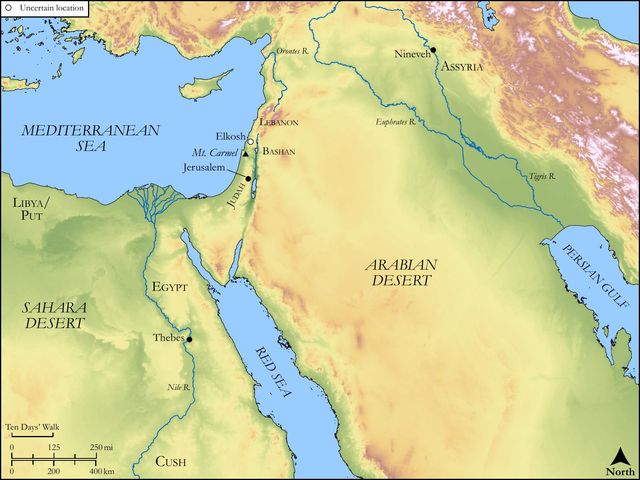
See on the biblical-era map
Study this verse
Public-domain commentary
Matthew Henry
From his Commentary on the Whole Bible. Henry comments on passages, not single verses — this entry covers Nahum 1:2–8. His four-level outline is real structure in the source text, so it is rendered as structure.
Nineveh knows not God, that God that contends with her, and therefore is here told what a God he is; and it is good for us all to mix faith with that which is here said concerning him, which speaks a great deal of terror to the wicked and comfort to good people; for this glorious description of the Sovereign of the world, like the pillar of cloud and fire, has a bright side towards Israel and a dark side towards the Egyptians. Let each take his portion from it; let sinners read it and tremble; let saints read it and triumph. The wrath of God is here revealed from heaven against him enemies, his favour and mercy are here assured to his faithful loyal subjects, and his almighty power in both, making his wrath very terrible and his favour very desirable.
I.He is a God of inflexible justice, a jealous God, and will take vengeance on his enemies; let Nineveh know this, and tremble before him.
Their idols are insignificant things; there is nothing formidable in them. But the God of Israel is greatly to be feared; for,
1.He resents the affronts and indignities done him by those that deny his being or any of his perfections, that set up other gods in competition with him, that destroy his laws, arraign his proceedings, ridicule his word, or are abusive to his people. Let such know that Jehovah, the one only living and true God, is a jealous God, and a revenger; he is jealous for the comfort of his worshippers, jealous for his land (Joe 2:18), and will not have that injured. He is a revenger, and he is furious; he has fury (so the word is), not as man has it, in whom it is an ungoverned passion (so he has said, Fury is not in me, Isa 27:4), but he has it in such a way as becomes the righteous God, to put an edge upon his justice, and to make it appear more terrible to those who otherwise would stand in no awe of it. He is Lord of anger (so the Hebrew phrase is for that which we read, he is furious); he has anger, but he has it at command and under government. Our anger is often lord over us, as theirs that have no rule over their own spirits, but God is always Lord of his anger and weighs a path to it, Psa 78:50.
2.He resolves to reckon with those that put those affronts upon him. We are told here, not only that he is a revenger, but that he will take vengeance; he has said he will, he has sworn it, Deu 32:40, Deu 32:41. Whoever are his adversaries and enemies among men, he will make them feel his resentments; and, though the sentence against his enemies is not executed speedily, yet he reserves wrath for them and reserves them for it in the day of wrath. Against his own people, who repent and humble themselves before him, he keeps not his anger for ever, but against his enemies he will for ever let out his anger. He will not at all acquit the wicked that sin, and stand to it, and do not repent, Nah 1:3. Those wickedly depart from their God that depart, and never return (Psa 18:21), and these he will not acquit. Humble supplicants will find him gracious, but scornful beggars will not find him easy, or that the door of mercy will be opened to a loud, but late, Lord, Lord. This revelation of the wrath of God against his enemies is applied to Nineveh (Nah 1:8), and should be applied by all those to themselves who go on still in their trespasses: With an over-running flood he will make an utter end of the place thereof. The army of the Chaldeans shall overrun the country of the Assyrians, and lay it all waste. God's judgments, when they come with commission, are like a deluge to any people, which they cannot keep off nor make head against. Darkness shall pursue his enemies; terror and trouble shall follow them, whitersoever they go, shall pursue them to utter darkness; if they think to flee from the darkness which pursues them they will but fall into that which is before them.
II.He is a God of irresistible power, and is able to deal with his enemies, be they ever so many, ever so mighty, ever so hardy.
He is great in power (Nah 1:3), and therefore it is good having him our friend and bad having him our enemy. Now here,
1.The power of God is asserted and proved by divers instances of it in the kingdom of nature, where we always find its visible effects in the ordinary course of nature, and sometimes in the surprising alterations of that course.
(1.)If we look up into the regions of the air, there we shall find proofs of his power, for he has his ways in the whirlwind and the storm. Which way soever God goes he carries a whirlwind and a storm along with him, for the terror of his enemies, Psa 18:9, etc. And, wherever there is a whirlwind and a storm, God has the command of it, the control of it, makes his way through it, goes on his way in it, and serves his own purposes by it. He spoke to Job out of the whirlwind, and even stormy winds fulfil his word. He has his way in the whirlwind, that is, he goes on undiscerned, and the methods of his providence are to us unaccountable; as it is said, His way is in the sea. The clouds are the dust of his feet; he treads on them, walks on them, raises them when he pleases, as a man with his feet raises a cloud of dust. It is but by permission, or usurpation rather, that the devil is the prince of the power of the air, for that power is in God's hand.
(2.)If we cast our eye upon the great deeps, there we find that the sea is his, for he made it; for, when he pleases, he rebukes the sea and makes it dry, by drying up all the rivers with which it is continually supplied. He gave those proofs of his power when he divided the Red Sea and Jordan, and can do the same again whenever he pleases.
(3.)If we look round us on this earth, we find proofs of his power, when, either by the extreme heat and drought of summer or the cold and frost of winter, Bashan languishes, and Carmel, and the flower of Lebanon languishes, the choicest and strongest flower languishes. His power is often seen in earthquakes, which shake the mountains (Nah 1:5), melt the hills, and melt them down, and level them with the plains. When he pleases the earth is burnt at his presence by the scorching heat of the sun, and he could burn it with fire from heaven, as he did Sodom, and at the end of time he will burn the world and all that dwell therein. The earth, and all the works that are therein, shall be burnt up. Thus great is the Lord and of great power.
2.This is particularly applied to his anger. If God be an almighty God, we may thence infer (Nah 1:6), Who can stand before his indignation? The Ninevites had once found God slow to anger (as he says Nah 1:3), and perhaps presumed upon the mercy they had then had experience of, and thought they might make bold with him; but they will find he is just and jealous as well as merciful and gracious, and, having shown the justice of his wrath, in the next he shows the power of it, and the utter insufficiency of his enemies to contend with him. It is in vain for the stoutest and strongest of sinners to think to make their part good against the power of God's anger.
(1.)See God here as a consuming fire, terrible and mighty. Here is his indignation against sin, and the fierceness of his anger, his fury poured out, not like water, but like fire, like the fire and brimstone rained on Sodom, Psa 11:6. Hell is the fierceness of God's anger, Rev 16:19. God's anger is so fierce that it beats down all before it: The rocks are thrown down by him, which seemed immovable. Rocks have sometimes been rent by the eruption of subterraneous fires, which is a faint resemblance of the fierceness of God's anger against sinners whose hearts are rocky, for none ever hardened their hearts against him and prospered.
(2.)See sinners here are stubble before the fire, weak and impotent, and a very unequal match for the wrath of God.
[1.]They are utterly unable to bear up against it, so as to resist it, and put by the strokes of it: Who can stand before his indignation? Not the proudest and most daring sinner; not the world of the ungodly; no, not the angels that sinned.
[2.]They are utterly unable to bear up under it so as to keep up their spirits, and preserve any enjoyment of themselves: Who can abide in the fierceness of his anger? As it is irresistible, so it is intolerable. Some of the effects of God's displeasure in this world a man may bear up under, but the fierceness of his anger, when it fastens immediately upon the soul, who can bear? Let us therefore fear before him; let us stand in awe, and not sin.
III.He is a God of infinite mercy; and in the midst of all this wrath mercy is remembered.
Let the sinners in Zion be afraid, that go on still in their transgressions, but let not those that trust in God tremble before him. For,
1.He is slow to anger (Nah 1:3), not easily provoked, but ready to show mercy to those who have offended him and to receive them into favour upon their repentance.
2.When the tokens of his rage against the wicked are abroad he takes care for the safety and comfort of his own people (Nah 1:7): The Lord is good to those that are good, and to them he will be a stronghold in the day of trouble. Note, The same almighty power that is exerted for the terror and destruction of the wicked is engaged, and shall be employed, for the protection and satisfaction of his own people; he is able both to save and to destroy. In the day of public trouble, when God's judgments are in the earth, laying all waste, he will be a place of defence to those that by faith put themselves under his protection, those that trust in him in the way of their duty, that live a life of dependence upon him, and devotedness to him; he knows them, he owns them for his, he takes cognizance of their case, knows what is best for them, and what course to take most effectually for their relief. They are perhaps obscure and little regarded in the world, but the Lord knows them, Psa 1:6.
Historical interpretation
Historical reception
4 surviving comments on this verse. Each one is dated, so this reads as a timeline rather than a list.
Select a marker to jump to its quote. Markers stagger vertically where authors wrote within a few decades of each other.
And again: “I will reestablish my covenant with you, and you shall know that I am Lord, that you may remember and be confounded and may no more open your mouth because of your confusion, when I shall be pacified toward you for all that you have done, says the Lord God.” Thus it is clearly indicated by these divine words what was meant in another place by the statement “And though cleansing you he shall not make you innocent.” Even the just, being restored to their former state after committing sin, do not dare open their mouth but say with the apostle, “I am not worthy to be called an apostle, because I persecuted the church of God.”
(Verse 3) The Lord is in the storm and the whirlwind of his life, and the clouds are the dust of his feet. For the storm and the whirlwind, the Septuagint translated it as consummation and commotion: although in the place where we have positioned ourselves, it is written in Hebrew as Basupha (), which can also be understood as commotion. However, this signifies that at the end of the world everything will be moved, according to what is written in Haggai: 'Yet once more I will shake not only the earth but also the heavens.' (Haggai 2:7) And when all things are shaken (so that the ways of the Lord may be believed, as he says in the Gospel: 'I am the way, and the truth, and the life.' (John 14:6); and in Mark: 'When the Son of Man comes with the clouds, as it is commanded in Isaiah' (Chapter 5), so that the rain may not fall on the vineyard, and to which the truth of God has come, as the Psalmist says: 'Your truth reaches to the clouds.' (Psalm 36:6)), then even the clouds themselves, namely the prophets and the souls of the saints, who were previously burdened by the connection of the flesh, will be elevated to the heights, becoming of a more refined substance, and brought down as a footstool of God, and will minister to angelic duties in various places. Indeed, the previous and ancient things that pertain to the head cannot be known. On the other hand, another cloud will receive in the opposite direction, which always disturbs the clear and bright light of the sun and the stars with its darkness, and which afterwards reduces the subject to the power of the Lord to dust and nothingness, and dissolves the earth in those things which are rich.
The Lord's way is in destruction and in shaking, and clouds are the dust of his feet. As the Prophet is about to proclaim beforehand the capture of Nineveh for the comfort of those who have suffered, and to make clear to the wronged that it will be shaken down by God, he usefully recounts first the all-powerful nature of the divine, and that for it, when it chooses to accomplish anything whatsoever, there is nothing that resists, but rather everything follows easily, and what seems good to it will prevail, even if some earthly matter seems difficult for us and for those like us to accomplish. For the Jews thought that the Babylonians would be most difficult to capture, and possessed a hand so invincible, that not even if God wished it, could they be weak against their enemies. For I think the things dared by them cruelly and savagely throughout their whole country called them to this despair. Therefore, so that they might know that they will lie down without a struggle when the wrath of God rises up against them, and they will be captured, and very easily, he necessarily says, The Lord's way is in destruction and in shaking, and clouds are the dust of his feet. For if, he says, you should plan against some—for this is the way—it will surely run down upon them as in an earthquake. An earthquake and destruction are an invincible and altogether inescapable thing, and in addition to these, clouds flying like dust and covering the sky. And the Prophet seems to be bringing them to the remembrance of the flood that happened against the whole race of men in the time of Noah, for then God went forth, as it were, in destruction and in an earthquake against all, raising up clouds and, as the sacred scripture says, opening the floodgates of heaven, and inundating the world under heaven with irresistible rains.
“The Lord is longsuffering, great is his power, and he will certainly not clear the guilty.” He does not suddenly and all at once inflict punishment, but only after exercising extreme longsuffering. You Ninevites are witnesses to this, practicing repentance and finding salvation, and then guilty of extreme wickedness and for a time not paying the penalty for it. But after putting up with people’s wickedness for a long time, he is accustomed to inflict punishment on the unrepentant (the meaning of “he will certainly not clear the guilty,” that is, he will not exempt from retribution the person whose sins deserve punishment).
Continue studying Nahum 1:3 across the web’s major study libraries — every link below opens this exact verse, chapter, or book on the destination site.
Read & Compare
 BibleGatewayThis verse in more than 200 translations and 70 languages.
 Bible.comThe YouVersion reader — hundreds of translations, reading plans, and highlights.
 ESV.orgCrossway's official English Standard Version reader.
 NET BibleThe NET translation with 60,000+ translators' notes on every rendering decision.
 STEP BibleTyndale House's free study tool — original text, vocabulary, and scholarly resources.
 BibliaLogos Bible Software's free web reader.
 USCCBThe New American Bible (Revised Edition) with the U.S. bishops' study notes.
Commentaries
 BibleHub CommentariesDozens of classic commentaries on this verse, gathered on one page.
 StudyLightMore than 100 commentary sets — the largest collection on the web.
 BibleRefPlain-English commentary on what this verse means, verse by verse.
 Enduring WordDavid Guzik's free commentary on this chapter, widely used by Bible teachers.
 Bible Study ToolsVerse commentary alongside Greek and Hebrew study aids.
Original Language & Research
- BibleHub InterlinearThe verse word by word — original language, transliteration, and English.
- BibleHub LexiconEvery word's original-language definition and Strong's entry.
 Blue Letter BibleDeep-study tools — Strong's numbers, concordance, and word studies.
 SefariaThe Hebrew text with Rashi and centuries of Jewish commentary.
Sermons, Hymns & Audio


TrulyRandomVerse is not affiliated with these sites and doesn’t control their content. They’re linked because they’re genuinely useful.
Summary
Nahum 1:3 presents a profound declaration of God's multifaceted character, revealing His patient forbearance alongside His absolute power and unwavering commitment to justice. It asserts that while the LORD is slow to anger, His omnipotence ensures that He will never leave the wicked unpunished, demonstrating His sovereign control over all creation, even the most chaotic elements, to execute His divine will.
Context
ShowHideLiterary Context
Nahum 1:3 is an integral part of the introductory acrostic poem (Nahum 1:2-8) that sets the stage for the entire prophetic book. This opening section functions as a theological preamble, establishing the character of the God who is about to pronounce and execute judgment upon Nineveh, the capital of Assyria. The verse immediately follows a declaration of God's jealous and avenging nature, providing a necessary balance by emphasizing His patience before His inevitable wrath. It transitions from a general statement of divine attributes to a vivid portrayal of God's majestic power over nature, preparing the reader for the devastating judgment that will unfold against Nineveh in subsequent chapters.
Historical & Cultural Context
The book of Nahum is dated to the mid-seventh century BC, likely after the Assyrian destruction of Thebes (Nahum 3:8-10) in 663 BC, but before the fall of Nineveh in 612 BC. Nineveh was the formidable capital of the Neo-Assyrian Empire, known for its brutal military campaigns, idolatry, and oppression of other nations, including Judah. While God had previously spared Nineveh through the prophet Jonah's preaching (approximately 150 years prior), their repentance was temporary, and they reverted to their violent ways. Nahum's prophecy, therefore, speaks into a context where Assyria was at the height of its power, yet God declares their impending downfall, demonstrating His sovereignty over even the most dominant world empires. The imagery of storms and whirlwinds resonates with ancient Near Eastern perceptions of divine power, often associated with storm gods, but here it is explicitly attributed to Yahweh, the God of Israel, asserting His unique and supreme authority.
Key Themes
ShowHideThis verse contributes significantly to several key themes within Nahum and broader biblical theology. Firstly, it highlights the Divine Attributes of God, particularly His patience ("slow to anger") and His justice ("will not at all acquit the wicked"). This dual nature is a consistent biblical theme, seen in passages like Exodus 34:6-7 and Psalm 103:8. Secondly, it underscores God's Omnipotence and Sovereignty, depicting Him as having absolute control over the most powerful natural phenomena. The imagery of the whirlwind and storm as His "way" and clouds as "the dust of his feet" emphasizes His supreme authority over creation, which He employs to execute His righteous judgments. This theme of God's control over nature as a demonstration of His power and judgment is also evident in Job 38:1 and Psalm 29. Finally, the verse subtly introduces the theme of Divine Retribution, establishing the theological basis for Nineveh's destruction: God's justice demands accountability for wickedness, and His patience has a limit.
Exposition and Analysis
ShowHideKey Word Analysis
ShowHideProperly, the nose or nostril; hence, the face, and occasionally a person; also (from the rapid breathing in passion) ire. In the phrase "slow to anger" (literally "long of nostrils"), it signifies the capacity for wrath, which God restrains due to His patience. This idiom emphasizes God's forbearance, indicating that He does not quickly or impulsively unleash His righteous indignation, allowing time for repentance.
Vigor, literally (force, in a good or a bad sense) or figuratively (capacity, means, produce). This word denotes God's inherent strength, might, and ability to effect His will. When stated that the LORD is "great in power," it underscores His omnipotence, His limitless capacity to act and to control all things, including the forces of nature and the destinies of nations.
A primitive root meaning to be (or make) clean (literally or figuratively); by implication (in an adverse sense) to be bare, i.e., extirpated; to be blameless, clear, guiltless, or unpunished. The strong negation "will not at all acquit" (a Hebrew infinitive absolute construction for emphasis) powerfully asserts that God will never declare the guilty innocent or allow their transgressions to go unpunished. This highlights His absolute righteousness and justice, which demands accountability for sin.
Verse Breakdown
ShowHide"The LORD [is] slow to anger"
This foundational statement reveals God's patient and forbearing nature. Despite humanity's sin and rebellion, God does not immediately unleash His wrath. This "slowness" is not weakness or indifference, but a deliberate act of grace, providing opportunity for repentance and demonstrating His mercy.
"and great in power"
This clause immediately balances the previous one, asserting God's omnipotence. His patience is not due to a lack of power, but rather a deliberate choice. He possesses infinite strength and ability to execute His will, whether in judgment or salvation, emphasizing His absolute sovereignty over all creation.
"and will not at all acquit [the wicked]:"
This emphatic declaration underscores God's unwavering justice. While He is patient, His justice is absolute and uncompromised. Sin will not go unpunished; there is no ultimate impunity for those who persist in wickedness. This sets the stage for the coming judgment on Nineveh, confirming that God's character demands accountability.
"the LORD hath his way in the whirlwind and in the storm"
This vivid imagery illustrates God's sovereign control over the most powerful and chaotic elements of nature. The "whirlwind" and "storm" are not random occurrences but are instruments through which God moves and executes His purposes. This demonstrates His majestic power and His ability to harness even destructive forces to achieve His divine will, particularly in judgment.
"and the clouds [are] the dust of his feet."
This powerful anthropomorphism further emphasizes God's immense scale and effortless control. Just as dust is insignificant and easily stirred by a person's feet, so too are the vast and imposing clouds mere "dust" to the Almighty God. This imagery conveys His supreme majesty and the ease with which He commands the heavens, reinforcing His absolute sovereignty and the inevitability of His actions.
Literary Devices
ShowHideNahum 1:3 is rich in literary devices that enhance its theological impact. Anthropomorphism is prominently featured, particularly in the phrase "the clouds [are] the dust of his feet," which attributes human-like physical characteristics (feet, dust) to God to convey His immense power and effortless control over creation. This vivid Imagery of whirlwinds, storms, clouds, and dust evokes a sense of awe and overwhelming power, painting a picture of a God who is utterly transcendent and majestic, capable of commanding the most formidable natural forces. The verse also employs Juxtaposition by placing God's "slowness to anger" directly alongside His declaration that He "will not at all acquit the wicked," highlighting the tension and balance between His mercy and His justice. This creates a powerful and comprehensive portrayal of His character, emphasizing that His patience is not an absence of justice, but a deliberate delay before its certain execution.
Theological and Thematic Connections
ShowHideNahum 1:3 provides a foundational theological statement about God's character, balancing His infinite patience with His unwavering justice and supreme power. This portrayal resonates throughout Scripture, affirming that God's mercy is profound, yet His righteousness demands that sin be addressed. His control over creation, even its most chaotic elements, underscores His absolute sovereignty, ensuring that His purposes, whether in salvation or judgment, will always prevail. This verse serves as a reminder that while God's grace offers opportunity for repentance, His justice is not to be trifled with, and accountability for wickedness is certain.
Reflection and Application
ShowHideNahum 1:3 offers profound insights for personal reflection and application. For those who acknowledge their sin and seek God's mercy, the declaration that the LORD is "slow to anger" is a source of immense comfort and hope. It assures us that God provides ample opportunity for repentance, demonstrating His patience and grace even in the face of our rebellion. This should inspire a deeper trust in His compassionate nature and a willingness to turn from our ways. Conversely, the emphatic statement that He "will not at all acquit the wicked" serves as a solemn warning. It reminds us of the seriousness of sin and the certainty of divine justice for those who stubbornly refuse to repent. This should cultivate a profound reverence for God's holiness and a commitment to living righteously. Recognizing God's "great power" and His sovereign control over all things, even the whirlwind and storm, encourages us to surrender our anxieties and fears to Him, trusting that He is ultimately in control of our circumstances and the course of history. It calls us to live with both humble gratitude for His mercy and reverent awe for His unyielding justice.
Questions for Reflection
ShowHideFAQ
ShowHideWhat does it mean that "The LORD is slow to anger"?
ShowHideThe phrase "slow to anger" (Hebrew: ʼarek ʼappayim) is an idiom meaning "long of nostrils" or "long of face," signifying great patience and forbearance. It means that God does not quickly or impulsively become angry or unleash His wrath. Instead, He is exceedingly patient, providing ample time and opportunity for humanity to repent and turn to Him. This characteristic is a cornerstone of God's covenantal faithfulness and mercy, frequently reiterated throughout Scripture, such as in Exodus 34:6 and Psalm 103:8.
How can God be "slow to anger" but also "not at all acquit the wicked"? Is that a contradiction?
ShowHideNo, it is not a contradiction; rather, it highlights the perfect balance of God's character: His mercy and His justice. Being "slow to anger" demonstrates His patience and desire for people to turn from their wicked ways. He delays judgment, offering grace. However, His holiness and righteousness demand that sin cannot go unpunished indefinitely. The phrase "will not at all acquit the wicked" (an emphatic Hebrew construction) means that He will never declare the guilty innocent or allow their transgressions to be overlooked. Those who persistently reject His grace and stubbornly continue in wickedness will face His righteous judgment. This balance is crucial to understanding God's nature, as seen in Romans 2:4-6.
Christ-Centered Fulfillment
ShowHideNahum 1:3, while declaring God's character in the context of judgment against Nineveh, finds its ultimate and most profound fulfillment in Jesus Christ. The declaration that the LORD is "slow to anger" is perfectly embodied in Christ, who, though fully God, came not to condemn the world immediately but to offer salvation (as seen in John 3:17). His patient forbearance is evident in His earthly ministry, His willingness to suffer for sinners, and His continued offer of grace through the Gospel. Yet, the truth that God "will not at all acquit the wicked" is also fulfilled in Christ. For the wicked to be acquitted, a righteous sacrifice was necessary. Jesus, the sinless Lamb of God, bore the full wrath and judgment for sin on the cross, satisfying divine justice for all who believe (as described in Romans 3:23-26). Thus, God's justice is upheld, and the wicked can be declared righteous, not by their own merit, but by faith in Christ's atoning work. Furthermore, the imagery of the LORD having His "way in the whirlwind and in the storm" and the "clouds [as] the dust of his feet" foreshadows Christ's ultimate authority and power. He is the one who calms storms with a word (Mark 4:39) and who will return in glory on the clouds to execute final judgment and establish His eternal kingdom (Matthew 24:30 and Revelation 19:11-16). In Christ, God's patient grace, unyielding justice, and supreme power are perfectly reconciled and revealed.