


Micah 1:4
- וְנָמַסּוּve·na·Ma·suand they will meltH4549Conj-w ¦ V-Niphal-ConsecPerf-3cpVerb Niphal Consecutive Perfect 3rd Plural common genderוְandנָמַסּוּthey will melt
- הֶהָרִיםhe·ha·Rimthe mountainsH2022Art ¦ N-mpNoun Plural Masculine Absoluteהֶtheהָרִיםmountains
- תַּחְתָּיוtach·Tavunder himH8478N-mpc ¦ 3msNoun Plural Masculine Constructתַּחְתָּיunderוhim
- וְהָעֲמָקִיםve·ha·'a·ma·Kimand the valleysH6010Conj-w ¦ Art ¦ N-mpNoun Plural Masculine Absoluteוְandהָtheעֲמָקִיםvalleys
- יִתְבַּקָּעוּyit·ba·Ka·'uthey will be cleftH1234V-Hithpael-Imperf-3mpVerb Hithpael Imperfect 3rd Plural Masculine
- כַּדּוֹנַגka·do·Naglike <the> waxH1749Prep-k ¦ N-msNoun Singular Masculine Absoluteכַּlike <the>דּוֹנַגwax
- מִפְּנֵיmi·pe·Neifrom beforeH6440Prep-m ¦ N-mpcNoun Plural Masculine Constructמִfromפְּנֵיbefore
- הָאֵשׁha·'Eshthe fireH784Art ¦ N-csNoun Singular common gender Absoluteהָtheאֵשׁfire
- כְּמַיִםke·Ma·yimlike waterH4325Prep-k ¦ N-mpNoun Plural Masculine Absoluteכְּlikeמַיִםwater
- מֻגָּרִיםmu·ga·Rimpoured outH5064V-Hophal-PassPrtcpl-mpVerb Hophal Participle Passive Plural Masculine Absolute
- בְּמוֹרָדbe·mo·Radon a slopeH4174Prep-b ¦ N-msNoun Singular Masculine Absoluteבְּonמוֹרָדa slope
English is a literal word-by-word gloss of the Hebrew, not the KJV's wording. Why?
This is the original text the KJV's translators worked from — each Hebrew word with its own literal English meaning in this verse, prepared by scholars at Tyndale House, Cambridge. The KJV translates whole sentences, not word by word, so its wording differs: one Hebrew word can become several English words, and the KJV may choose “the LORD” where the gloss reads “Yahweh”. Both are faithful — they answer different questions. For the KJV's own rendering, switch to the KJV text.
Details
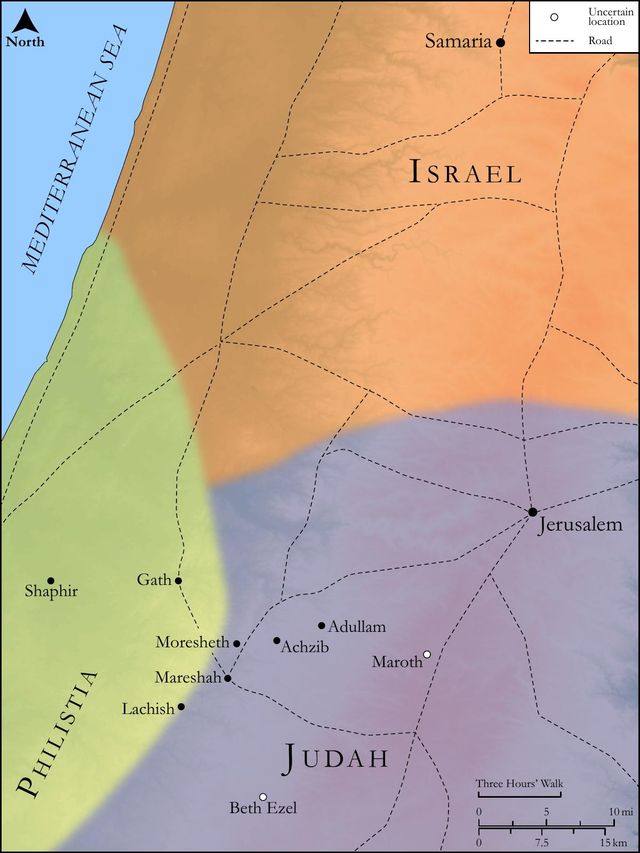
See on the biblical-era map
Study this verse
Public-domain commentary
Matthew Henry
From his Commentary on the Whole Bible. Henry comments on passages, not single verses — this entry covers Micah 1:1–7. His two-level outline is real structure in the source text, so it is rendered as structure.
Here is, I. A general account of this prophet and his prophecy, Mic 1:1. This is prefixed for the satisfaction of all that read and hear the prophecy of this book, who will give the more credit to it when they know the author and his authority. 1. The prophecy is the word of the Lord; it is a divine revelation. Note, What is written in the Bible, and what is preached by the ministers of Christ according to what is written there, must be heard and received, not as the word of dying men, which we may be judges of, but as the word of the living God, which we must be judged by, for so it is. This word of the Lord came to the prophet, came plainly, came powerfully, came in a preventing way, and he saw it, saw the vision in which it was conveyed to him, saw the things themselves which he foretold, with as much clearness and certainty as if they had been already accomplished. 2. The prophet is Micah the Morasthite; his name Micah is a contraction of Micaiah, the name of a prophet some ages before (in Ahab's time, Kg1 22:8); his surname, the Morasthite, signifies that he was born, or lived, at Moresheth, which is mentioned here (Mic 1:14), or Mareshah, which is mentioned Mic 1:15, and Jos 15:44. The place of his abode is mentioned, that any one might enquire in that place, at that time, and might find there was, or had been, such a one there, who was generally reputed to be a prophet. 3. The date of his prophecy is in the reigns of three kings of Judah - Jotham, Ahaz, and Hezekiah. Ahaz was one of the worst of Judah's kings, and Hezekiah one of the best; such variety of times pass over God's ministers, times that frown and times that smile, to each of which they must study to accommodate themselves, and to arm themselves against the temptations of both. The promises and threatenings of this book are interwoven, by which it appears that even in the wicked reign he preached comfort, and said to the righteous then that it should be well with them; and that in the pious reign he preached conviction, and said to the wicked then that it should be ill with them; for, however the times change, the word of the Lord is still the same. 4. The parties concerned in this prophecy; it is concerning Samaria and Jerusalem, the head cities of the two kingdoms of Israel and Judah, under the influence of which the kingdoms themselves were. Though the ten tribes have deserted the houses both of David and Aaron, yet God is pleased to send prophets to them.
II.A very solemn introduction to the following prophecy (Mic 1:2), in which,
1.The people are summoned to draw near and give their attendance, as upon a court of judicature: Hear, all you people, Note, Where God has a mouth to speak we must have an ear to hear; we all must, for we are all concerned in what is delivered. "Hear, you people" (all of them, so the margin reads it), "all you that are now within hearing, and all others that hear it at second hand." It is an unusual construction; but those words with which Micah begins his prophecy are the very same in the original with those wherewith Micaiah ended his, Kg1 22:28.
2.The earth is called upon, with all that therein is, to hear what the prophet has to say: Hearken, O earth! The earth shall be made to shake under the stroke and weight of the judgments coming; sooner will the earth hear than this stupid senseless people; but God will be heard when he pleads. If the church, and those in it, will not hear, the earth, and those in it, shall, and shame them.
3.God himself is appealed to, and his omniscience, power, and justice, are vouched in testimony against this people: "Let the Lord God be witness against you, a witness that you had fair warning given you, that your prophets did their duty faithfully as watchmen, but you would not take the warning; let the accomplishment of the prophecy be a witness against your contempt and disbelief of it, and prove, to your conviction and confusion, that it was the word of God, and no word of his shall fall to the ground." Note, God himself will be a witness, by the judgments of his hand, against those that would not receive his testimony in the judgments of his mouth. He will be a witness from his holy temple in heaven, when he comes down to execute judgment (Mic 1:3) against those that turned a deaf ear to his oracles, wherein he witnessed to them, out of his holy temple at Jerusalem.
III.A terrible prediction of destroying judgments which should come upon Judah and Israel, which had its accomplishment soon after in Israel, and at length in Judah; for it is foretold,
1.That God himself will appear against them, Mic 1:3. They boasted of themselves and their relation to God, as if that would secure them; but, though God never deceives the faith of the upright, he will disappoint the presumption of the hypocrites, for, behold, the Lord comes forth out of his place, quits his mercy-seat, where they thought they had him fast, and prepares his throne for judgment; his glory departs, for they drive it from them. God's way towards this people had long been a way of mercy, but now he changes his way, he comes out of his place, and will come down. He had seemed to retire, as one regardless of what was done, but now he will show himself, he will rend the heavens, and will come down, not as sometimes, in surprising mercies, but in surprising judgments, to do things not for them, but against them, which they looked not for, Isa 64:1; Isa 26:21.
2.That when the Creator appears against them it shall be in vain for any creature to appear for them. He will tread with contempt and disdain upon the high places of the earth, upon all the powers that are advanced in competition with him or in opposition to him; and he will so tread upon them as to tread them down and level them. High places, set up for the worship of idols or for military fortifications, shall all be trodden down and trampled into the dust. Do men trust to the height and strength of the mountains and rocks, as if they were sufficient to bear up their hopes and bear off their fears? They shall be molten under him, melted down as wax before the fire, Psa 68:2. Do they trust to the fruitfulness of the valleys, and their products? They shall be cleft, or rent, with those fiery streams that shall come pouring down from the mountains when they are melted. They shall be ploughed and washed away as the ground is by the waters that are poured down a steep place. God is said to cleave the earth with rivers, Hab 3:9. Neither men of high degree, as the mountains, nor men of low degree, as the valleys, shall be able to secure either themselves or the land from judgments of God, when they are sent with commission to lay all waste, and, like a sweeping rain, to leave no food, Pro 28:3. This is applied particularly to the head city of Israel, which they hoped would be a protection to the kingdom (Mic 1:6.) I will make Samaria, that is now a rich and populous city, as a heap of the field, as a heap of dung laid there to be spread, or as a heap of stones gathered together to be carried away, and as plantings of a vineyard, as hillocks of earth raised to plant vines in. God will make of that city a heap, of that defenced city a ruin, Isa 25:2. Their altars had been as heaps in the furrows of the fields (Hos 12:11) and now their houses shall be so, as ruinous heaps. The stones of the city are poured down into the valley by the fury of the conqueror, who will thus be revenged on those walls that so long held out against him. They shall be quite pulled down, so that the very foundations shall be discovered, that had been covered by the superstructure; and not one stone shall be left upon another.
IV.A charge of sin upon them, as the procuring cause of these desolating judgments (Mic 1:5):
For the transgression of Jacob is all this. If it be asked, "Why is God so angry, and why are Jacob and Israel thus brought to ruin by his anger?" the answer is ready: Sin has done all the mischief; sin has laid all waste; all the calamities of Jacob and Israel are owing to their transgressions; if they had not gone away from God, he would never have appeared thus against them. Note, External privileges and professions will not secure a sinful people from the judgments of God. If sin be found in the house of Israel, if Jacob be guilty of transgression and rebellion, God will not spare them; no, he will punish them first, for their sins are of all others most provoking to him, for they are most reproaching. But it is asked, What is the transgression of Jacob? Note, When we feel the smart of sin it concerns us to enquire what the sin is which we smart for, that we may particularly war against that which wars against us. And what is it?
1.It is idolatry; it is the high places; that is the transgression, the great transgression which reigns in Israel; that is spiritual whoredom, the violation of the marriage-covenant, which merits a divorce. Even the high places of Judah, though not so bad as the transgression of Jacob, were yet offensive enough to God, and a remaining blemish upon some of the good reigns. Howbeit the high places were not taken away.
2.It is the idolatry of Samaria and Jerusalem, the royal cities of those two kingdoms. These were the most populous places, and where there were most people there was most wickedness, and they made one another worse. These were the most pompous places; there men lived most in wealth and pleasure, and they forgot God. These were the places that had the greatest influence upon the country, by authority and example; so that from them idolatry and profaneness went forth throughout all the land, Jer 23:15. Note, Spiritual distempers are most contagious in persons and places that are most conspicuous. If the head city of a kingdom, or the chief family in a parish, be vicious and profane, many will follow their pernicious ways, and write after a bad copy when great ones set it for them. The vices of leaders and rulers are leading ruling vices, and therefore shall be surely and sorely punished. Those have a great deal to answer for indeed that not only sin, but make Israel to sin. Those must expect to be made examples that have been examples of wickedness. If the transgression of Jacob is Samaria, therefore shall Samaria become a heap. Let the ringleaders in sin hear this and fear.
V.The punishment made to answer the sin, in the particular destruction of the idols, Mic 1:7.
1.The gods they worshipped shall be destroyed: The graven images shall be beaten to pieces by the army of the Assyrians, and all the idols shall be laid desolate. Samaria and her idols were ruined together by Sennacherib (Isa 10:11), and their gods cast into the fire, for they were no gods (Isa 37:19); and this was the Lord's doing: I will lay the idols desolate. Note, If the law of God prevail not to make men in authority destroy idols, God will take the work into his own hands, and will do it himself.
2.The gifts that passed between them and their gods shall be destroyed; for all the hires thereof shall be burnt with fire, which may be meant either of the presents they made to their idols for the replenishing of their altars, and the adorning of their statues and temples (these shall become a prey to the victorious army, which shall rifle not only private houses, but the houses of their gods), or of the corn, and wine, and oil, which they called the rewards, or hires, which their idols, their lovers, gave them (Hos 2:12); these shall be taken from them by him whom (by ascribing them to their dear idols) they had defrauded of the honour due to him. Note, That cannot prosper by which men either are hired to sin or hire others to sin; for the wages of sin will be death. She gathered it of the hire of the harlot, and it shall return to the hire of a harlot. They enriched themselves by their leagues with the idolatrous nations, who gave them advantages, to court them into the service of their idols, and their idols' temples were enriched with gifts by those who went a whoring after them. And all this wealth shall become a prey to the idolatrous nations, and so be the hire of a harlot again, wages to an army of idolaters, who shall take it as a reward given them by their gods. It shall be a present to king Jareb, Hos 10:6. What they gave to their idols, and what they thought they got by them, shall be as the hire of a harlot; the curse of God shall be upon it, and it shall never prosper, nor do them any good. It is common that what is squeezed out by one lust is squandered away upon another.
Historical interpretation
Historical reception
3 surviving comments on this verse. Each one is dated, so this reads as a timeline rather than a list.
Select a marker to jump to its quote. Markers stagger vertically where authors wrote within a few decades of each other.
On another occasion when he was sitting by himself some place reading the book of the twelve prophets, he came to the prophet Micah. An angel of the Lord appeared to him and asked him about this verse from Micah: “Like water coming down from its source.” He said to him, “What do you think it means?” While he was still puzzling over it, trying to understand, the angel answered, “Theodore, why do you not perceive its meaning? Is it not obvious that it is the water of the river coming down from paradise?” As soon as the angel had said this, he ceased to see him.
As wax cannot endure the nearness of the fire, and as the waters are carried headlong, so all of the ungodly, when the Lord comes, shall be dissolved and disappear.
(Verse 3, sequence) Because behold the Lord will go out from his place, and he will come down and tread upon the heights of the earth, and the mountains will be consumed beneath him, and the valleys will be split like wax before the fire, like waters flowing down a steep slope. Because of the wickedness of Jacob, all this, and because of the sins of the house of Israel. What wickedness of Jacob? Is it not Samaria? And what heights of Judah? Is it not Jerusalem? LXX: Behold, the Lord will go out from his place, and he will come down, and he will ascend upon the heights of the earth, and the mountains will tremble beneath him, and the valleys will wither like wax before the fire, and like water flowing down: because of the impiety of Jacob, all these things, and because of the sin of the house of Israel. What is the wickedness of the house of Jacob? Is it not Samaria? And what is the sin of the house of Judah? Is it not Jerusalem? O Samaria and Jerusalem, listen, and carefully heed the Lord testifying against you from His temple, and proclaiming whatever He will do. Behold, the Lord will come out from His place. For He who is humble and kind, and whose nature is mercy, is forced for your sake to assume a role of cruelty that He does not possess. And he shall come down and tread upon the high places of the earth. The descent of God is, and his majesty runs down to lower things, to tread upon the earth, and to crush even the powerful. And they shall be consumed, he says, whether the mountains waste away, and the valleys beneath him, whom we understand to be the leaders and the people. And just as nearby fire does not sustain wax, and flowing water is carried headlong: so shall the pride of all the wicked, when the Lord comes, be dissolved and flow away. But all this will happen because of the sins of the ten tribes, which Jacob and Israel called, and because of the transgression of Judah; for in the ten tribes Samaria was the metropolis, and in the kingdom of Judah Jerusalem, idolatry was practiced: this is according to the literal sense. However, the Lord will come out from his place, whom we can understand as either the Son or all the saints. For the Son himself says: I am in the Father, and the Father in me (John 14:10). And of the saints: I will dwell and walk among them, and I will be their God, and they shall be my people (Leviticus 26:12). Therefore, concerning these things, it goes forth, not that He may abandon them; for even concerning the apostles, the word of the Lord went forth to those who heard, and yet He did not abandon them. And such places, that is, those that deserve to have God as a guest, have been raised up, as if resurrected with Christ, and seated with Him in heavenly places. And it is said that he descends to those who cannot hear his teaching on the mountain. And when he descends, he will not ascend to the lowly and those who are in a low position; but those who are called high and who understand the majesty of the coming of the Lord, they will be moved. And although there are mountains, they will still fear the presence of such a charioteer and ascender. But the valleys, that is, souls inserted into earthly bodies, and not rising with the celestial man, will not be able to bear his presence; but whatever is hard in them will be dissolved, and thus flow, just as if flat waters are carried swiftly into the depths. Therefore, the terrible Lord will come to teach, that is, to move mountains, and to dissolve the low things of valleys, because Jacob has committed impiety, and Israel has sinned. The impiety of Jacob is indeed the meeting places of heretics, which are called Samaria. And the sin of Judah, that is, of him who confesses the Lord, is none other than Jerusalem, in which many crimes are found. And as for the fact that the house of Judah refers to Christ, whose Church it is, and as we have often said, let us also consider this for the present: Judah, your brothers will praise you; your hand will be on the neck of your enemies. (Genesis 49:8). It can also be understood in this way, that because of the impieties of Samaria and the crimes of Judah, the Lord went out from his former place, and said to the Jews (Matt. 23:38): Behold, your house will be left desolate for you (Luke 13:35). And he will come down from heaven, and ascend above the heights of the earth, that is, above those who, believing in the humility of the Gentiles, have deserved to be exalted. And the mountains, the doctrines of the philosophers, and the lofty kingdoms were moved, and those who remained humble were consumed and broken by the coming of the Savior and the growing Church, and by the idols falling into the depths when the mountains rose up high. Therefore the Lord has left his place, and the Church has been built among the nations, so that the mountains would tremble under his feet, and the deep valleys would be dissolved, because Jacob acted wickedly, and Israel sinned, and all the tribes denied the Lord.
Continue studying Micah 1:4 across the web’s major study libraries — every link below opens this exact verse, chapter, or book on the destination site.
Read & Compare
 BibleGatewayThis verse in more than 200 translations and 70 languages.
 Bible.comThe YouVersion reader — hundreds of translations, reading plans, and highlights.
 ESV.orgCrossway's official English Standard Version reader.
 NET BibleThe NET translation with 60,000+ translators' notes on every rendering decision.
 STEP BibleTyndale House's free study tool — original text, vocabulary, and scholarly resources.
 BibliaLogos Bible Software's free web reader.
 USCCBThe New American Bible (Revised Edition) with the U.S. bishops' study notes.
Commentaries
 BibleHub CommentariesDozens of classic commentaries on this verse, gathered on one page.
 StudyLightMore than 100 commentary sets — the largest collection on the web.
 BibleRefPlain-English commentary on what this verse means, verse by verse.
 Enduring WordDavid Guzik's free commentary on this chapter, widely used by Bible teachers.
 Bible Study ToolsVerse commentary alongside Greek and Hebrew study aids.
Original Language & Research
- BibleHub InterlinearThe verse word by word — original language, transliteration, and English.
- BibleHub LexiconEvery word's original-language definition and Strong's entry.
 Blue Letter BibleDeep-study tools — Strong's numbers, concordance, and word studies.
 SefariaThe Hebrew text with Rashi and centuries of Jewish commentary.
Sermons, Hymns & Audio


TrulyRandomVerse is not affiliated with these sites and doesn’t control their content. They’re linked because they’re genuinely useful.
Summary
Micah 1:4 vividly portrays the cataclysmic effects of God's majestic and terrifying advent for judgment. Using powerful similes, the verse depicts the most stable elements of creation—mountains and valleys—dissolving and rending under His presence, illustrating the absolute, irresistible power of the Almighty as He comes to confront the widespread idolatry and oppression of Samaria and Jerusalem. This imagery serves as a stark warning of the inescapable and devastating consequences of sin.
Context
ShowHideLiterary Context
Micah 1:4 is an integral part of the prophet's opening oracle concerning Samaria and Jerusalem. It immediately follows the declaration in Micah 1:2-3, where God is depicted as "coming forth out of his place" and "coming down" to "tread upon the high places of the earth." Verse 4 provides the dramatic, visual consequence of this divine descent. It transitions from the announcement of God's arrival to a graphic, almost apocalyptic description of the earth's reaction to His presence, setting a tone of awe and dread that underscores the severity of the judgments to be pronounced against both the Northern and Southern Kingdoms in the subsequent verses. This verse functions as a powerful, poetic overture to the themes of sin and judgment that dominate the book.
Historical & Cultural Context
Micah prophesied during the late 8th century BCE, a tumultuous period for both Israel (Samaria) and Judah (Jerusalem). He ministered during the reigns of Jotham, Ahaz, and Hezekiah in Judah, witnessing the fall of Samaria to Assyria in 722 BCE and the subsequent Assyrian threat to Judah. The cultural landscape was marked by syncretism, with the worship of Baal and other foreign deities flourishing alongside the worship of Yahweh. Injustice was rampant, with the wealthy oppressing the poor, corrupt leaders and judges, and prophets delivering false messages for gain. The imagery of mountains melting and valleys splitting may have resonated with the region's known seismic activity, but Micah elevates it to a divine, supernatural scale, emphasizing that God's judgment transcends mere natural disaster. This was a time when the covenant curses, such as those found in Deuteronomy 28, were being realized due to the nation's persistent rebellion.
Key Themes
ShowHideThis verse powerfully contributes to several overarching themes in Micah and the broader prophetic tradition. Firstly, it highlights God's Overwhelming Power and Sovereignty. The depiction of creation itself dissolving and rending before God's presence underscores that no human power, no fortified city, and no natural barrier can withstand His might. Secondly, it emphasizes the Inevitable and Severe Nature of Divine Judgment. God's coming is not for blessing but for righteous wrath against sin, demonstrating that He is a holy God who will not tolerate unrighteousness indefinitely. This theme is echoed throughout the prophets, as seen in passages like Amos 5:18-20 and Isaiah 2:12-17. Thirdly, the verse points to the Cosmic Impact of Sin and Judgment. The physical upheaval described is a metaphor for the profound spiritual and moral disruption caused by the people's transgressions, illustrating that sin has far-reaching consequences that affect the very fabric of existence, mirroring the lament found in Jeremiah 4:23-26.
Exposition and Analysis
ShowHideKey Word Analysis
ShowHideThis primitive root signifies "to liquefy," "to waste (with disease)," or "to faint (with fatigue, fear, or grief)." In Micah 1:4, it vividly describes the mountains not merely softening, but utterly dissolving and disintegrating, suggesting a complete and helpless surrender to an overwhelming force. It conveys an image of total dissolution and loss of form, emphasizing the absolute power of God's presence.
Meaning "to cleave," "to rend," "to break," "to rip," or "to open," this word denotes a violent tearing apart. The valleys are not gently separated but are forcibly split open, revealing their depths. This imagery reinforces the destructive and transformative power of God's judgment, indicating a fundamental alteration of the earth's stable structures.
Of uncertain derivation, this word simply means "wax." Its inclusion in the simile "as wax before the fire" is crucial. Wax, though seemingly solid, is easily melted and loses its form when exposed to heat. This comparison powerfully illustrates the utter vulnerability and lack of resistance the earth, and by extension, sinful humanity, possesses in the face of God's consuming presence.
Verse Breakdown
ShowHide"And the mountains shall be molten under him"
This clause initiates the dramatic scene, portraying the most enduring and formidable natural structures—mountains—as utterly dissolving. The phrase "under him" signifies that this dissolution is a direct result of God's presence and power, emphasizing His absolute authority over creation.
"and the valleys shall be cleft"
Complementing the melting mountains, the valleys, typically seen as stable depressions, are violently torn open. This parallel imagery underscores the comprehensive nature of the divine judgment, affecting every part of the landscape, leaving no place untouched or secure.
"as wax before the fire"
This is the first of two powerful similes. It compares the melting of the mountains and the splitting of the valleys to wax rapidly dissolving when exposed to intense heat. This simile highlights the complete lack of resistance and the swift, total disintegration that occurs in the presence of God's consuming judgment, emphasizing the earth's utter helplessness.
"and as the waters that are poured down a steep place"
The second simile further intensifies the imagery, comparing the force of God's coming to an unstoppable torrent of water rushing down a steep incline. This conveys the irresistible momentum, overwhelming power, and rapid descent of divine judgment, suggesting that nothing can impede or divert its course.
Literary Devices
ShowHideMicah 1:4 is rich in Imagery, painting a vivid and terrifying picture of cosmic upheaval. The use of sensory details like "molten" and "cleft," combined with the familiar elements of "fire" and "waters," allows the audience to visualize and feel the intensity of God's coming. The verse primarily employs Simile, comparing the earth's reaction to "wax before the fire" and "waters that are poured down a steep place." These comparisons are highly effective, making the abstract concept of divine judgment tangible and emphasizing the irresistible and dissolving power of God. The description also utilizes Hyperbole, exaggerating natural phenomena (mountains melting, valleys splitting) to convey the immense, supernatural scale of God's power and the severity of His wrath. This dramatic overstatement serves to instill awe and fear, underscoring that God's judgment is not merely a human event but a cosmic one. Furthermore, the verse implies a Theophany, a visible manifestation of God, as His "coming forth" (from the preceding verse) directly causes these cataclysmic effects on the physical world.
Theological and Thematic Connections
ShowHideMicah 1:4 profoundly reveals the character of God as both supremely powerful and absolutely just. The imagery of creation itself dissolving and rending before His presence demonstrates His inherent holiness and His intolerance for sin, particularly the idolatry and oppression prevalent in Israel and Judah. This divine response is not arbitrary but is a direct consequence of the covenant unfaithfulness of His people. The verse underscores the theological truth that God's judgment is not merely a punitive act but a necessary expression of His righteous character, bringing order and justice to a world marred by rebellion. It serves as a stark reminder that no one, and nothing, can stand against the Lord when He comes in judgment, compelling a proper reverence for His awesome power and a serious consideration of the consequences of sin.
Reflection and Application
ShowHideMicah 1:4 stands as a timeless and sobering reminder of God's absolute sovereignty and the profound seriousness of sin. For us today, it calls for a deep and abiding reverence for the Lord, recognizing that His power is not merely theoretical but capable of shaking the very foundations of existence. This awe should lead us to examine our own lives, asking if there are areas where we, like ancient Israel, have allowed idolatry (anything that takes God's rightful place) or injustice to take root. The "melting mountains" and "cleft valleys" serve as a potent metaphor for the way unaddressed sin can dissolve our spiritual stability and tear apart the fabric of our lives and communities. This verse compels us to pursue holiness, justice, and faithfulness, understanding that while God is merciful, He is also righteous and will ultimately bring all things into account. For those who walk in obedience, this same overwhelming power of God becomes a source of immense security and hope, knowing that the One who can melt mountains is also the One who is for us, a mighty protector and deliverer.
Questions for Reflection
ShowHideFAQ
ShowHideWhat is the primary purpose of such dramatic imagery in prophetic books like Micah?
ShowHideThe primary purpose of such dramatic, cataclysmic imagery in prophetic books is multifaceted. Firstly, it serves to underscore the absolute and irresistible power of God, demonstrating that no earthly force or human resistance can stand against His will. Secondly, it vividly conveys the profound seriousness of sin and the inevitability of divine judgment. By depicting the very earth reacting to God's presence, the prophets emphasize that sin is not a trivial matter but has cosmic repercussions, warranting a severe response from a holy God. Thirdly, this imagery functions as a powerful rhetorical device, intended to shock the audience into repentance and a renewed reverence for God. It is meant to evoke awe and fear, compelling people to turn from their wicked ways before the full force of God's judgment is unleashed, as seen in other prophetic warnings like Joel 2:1-2.
Christ-Centered Fulfillment
ShowHideWhile Micah 1:4 describes a terrifying divine judgment upon ancient Israel and Judah, its imagery finds profound Christ-centered fulfillment, pointing both to the ultimate authority of Jesus and the final consummation of God's plan. The "coming forth" of the Lord, causing the very earth to melt and cleave, foreshadows the return of Christ, who will come not in humility but in overwhelming power and glory as the ultimate Judge of all the earth. Just as the mountains could not stand before the Lord in Micah's day, so too will every earthly power and rebellious heart dissolve before the majestic presence of the King of kings and Lord of lords. However, for those who are in Christ, this terrifying judgment is transformed into a glorious hope. Jesus, the Lamb of God who takes away the sin of the world, has already borne the full wrath of God on the cross, becoming the substitute for humanity's sin. Therefore, while the earth may indeed melt and the heavens be dissolved at His second coming, as described in 2 Peter 3:10-13, believers are not destined for wrath but for salvation through Him. The One who will cause the mountains to melt is also the One who offers eternal refuge and a new heaven and a new earth, where righteousness dwells.