


Joel 2:2
Bible text: King James Version (1769 Blayney text) · Public domain
Bible text: King James Version with Strong's numbers · Public domain
Bible text: Berean Standard Bible · Public domain
Bible text: American Standard Version (1901) · Public domain
Bible text: World English Bible, Messianic edition · Public domain
Bible text: Geneva Bible (1599) · Public domain
Bible text: Young's Literal Translation · Public domain
- יוֹםYoma day ofH3117N-mscNoun Singular Masculine Construct
- חֹשֶׁךְCho·shekhdarknessH2822N-msNoun Singular Masculine Absolute
- וַאֲפֵלָהva·'a·fe·Lahand gloomH653Conj-w ¦ N-fsNoun Singular Feminine Absoluteוַandאֲפֵלָהgloom
- יוֹםYoma day ofH3117N-mscNoun Singular Masculine Construct
- עָנָן'a·NancloudH6051N-msNoun Singular Masculine Absolute
- וַעֲרָפֶלva·'a·ra·Feland thick darknessH6205Conj-w ¦ N-msNoun Singular Masculine Absoluteוַandעֲרָפֶלthick darkness
- כְּשַׁחַרke·Sha·charlike dawnH7837Prep-k ¦ N-msNoun Singular Masculine Absoluteכְּlikeשַׁחַרdawn
- פָּרֻשׂpa·Russpread outH6566V-Qal-PassPrtcpl-msVerb Qal Participle Passive Singular Masculine Absolute
- עַל'aloverH5921PrepPreposition
- הֶהָרִיםhe·ha·Rimthe mountainsH2022Art ¦ N-mpNoun Plural Masculine Absoluteהֶtheהָרִיםmountains
- עַם'ama peopleH5971N-msNoun Singular Masculine Absolute
- רַבravnumerousH7227Adj-msAdjective Singular Masculine Absolute
- וְעָצוּםve·'a·Tzumand mightyH6099Conj-w ¦ Adj-msAdjective Singular Masculine Absoluteוְandעָצוּםmighty
- כָּמֹהוּka·Mo·hulike itH3644Prep ¦ 3msPrepositionכָּמֹlikeהוּit
- לֹאlo'notH3808NegParticle Negative
- נִהְיָהnih·Yahit has occurredH1961V-Niphal-Perf-3msVerb Niphal Perfect 3rd Singular Masculine
- מִןminsinceH4480PrepPreposition
- הָעוֹלָםha·'o·Lam<the> antiquityH5769Art ¦ N-msNoun Singular Masculine Absoluteהָ<the>עוֹלָםantiquity
- וְאַחֲרָיוve·'a·cha·Ravand after itH310Conj-w ¦ Adj-mpc ¦ 3msAdjective Numerical Plural Masculine Constructוְandאַחֲרָיafterוit
- לֹאlo'notH3808NegParticle Negative
- יוֹסֵףyo·Sefit will repeatH3254V-Hiphil-Imperf-3msVerb Hiphil Imperfect 3rd Singular Masculine
- עַד'aduntilH5704PrepPreposition
- שְׁנֵיshe·Neiyears ofH8141N-mpcNoun Plural Masculine Construct
- דּוֹרDora generationH1755N-msNoun Singular Masculine Absolute
- וָדוֹרva·Dorand a generationH1755Conj-w ¦ N-msNoun Singular Masculine Absoluteוָandדוֹרa generation
English is a literal word-by-word gloss of the Hebrew, not the KJV's wording. Why?
This is the original text the KJV's translators worked from — each Hebrew word with its own literal English meaning in this verse, prepared by scholars at Tyndale House, Cambridge. The KJV translates whole sentences, not word by word, so its wording differs: one Hebrew word can become several English words, and the KJV may choose “the LORD” where the gloss reads “Yahweh”. Both are faithful — they answer different questions. For the KJV's own rendering, switch to the KJV text.
Details
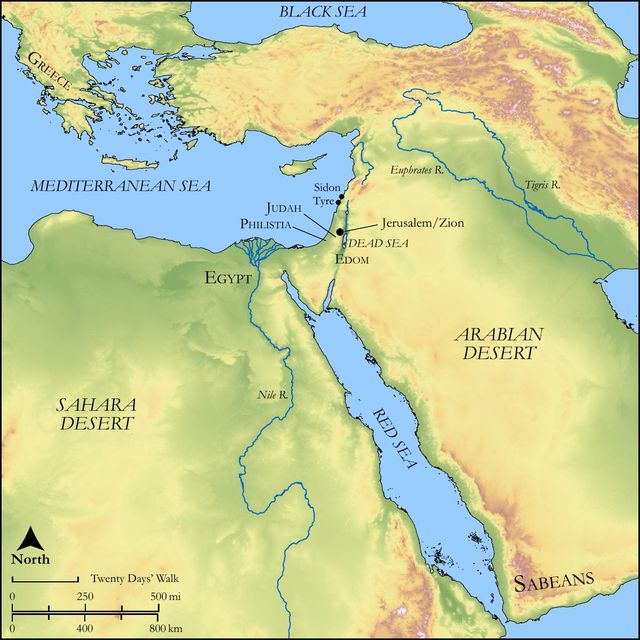
See on the biblical-era map
Study this verse
Public-domain commentary
Matthew Henry
From his Commentary on the Whole Bible. Henry comments on passages, not single verses — this entry covers Joel 2:1–11. His two-level outline is real structure in the source text, so it is rendered as structure.
Here we have God contending with his own professing people for their sins and executing upon them the judgment written in the law (Deu 28:42), The fruit of thy land shall the locust consume, which was one of those diseases of Egypt that God would bring upon them, Deu 28:60.
I.Here is the war proclaimed (Joe 2:1):
Blow the trumpet in Zion, either to call the invading army together, and then the trumpet sounds a charge, or rather to give notice to Judah and Jerusalem of the approach of the judgment, that they might prepare to meet their God in the way of his judgments and might endeavor by prayers and tears, the church's best artillery, to put by the stroke. It was the priests' business to sound the trumpet (Num 10:8), both as an appeal to God in the day of their distress and a summons to the people to come together to seek his face. Note, It is the work of ministers to give warning from the word of God of the fatal consequences of sin, and to reveal his wrath from heaven against the ungodliness and unrighteousness of men. And though it is not the privilege of Zion and Jerusalem to be exempted from the judgments of God, if they provoke him, yet it is their privilege to be warned of them, that they might make their peace with him. Even in the holy mountain the alarm must be sounded, and then it sounds most dreadful, Amo 3:2. Now, shall a trumpet be blown in the city, in the holy city, and the people not be afraid? Surely they will. Amo 3:6. Let all the inhabitants of the land tremble; they shall be made to tremble by the judgment itself; let them therefore tremble at the alarm of it.
II.Here is a general idea given of the day of battle, which cometh, which is nigh at hand, and there is no avoiding it.
It is the day of the Lord, the day of his judgment, in which he will both manifest and magnify himself. It is a day of darkness and gloominess (Joe 2:2), literally so, the swarms of locusts and caterpillars being so large and so thick as to darken the sky (Exo 10:15), or rather figuratively; it will be a melancholy time, a time of grievous affliction. And it will come as the morning spread upon the mountains; the darkness of this day will come as suddenly as the morning light, as irresistibly, will spread as far, and grow upon them as the morning light.
III.Here is the army drawn up in array (Joe 2:2):
They are a great people, and a strong. Any one sees the vast numbers that there shall be of locusts and caterpillars, destroying the land, will say (as we are all apt to be most affected with what is present), "Surely, never was the like before, nor ever will be the like again." Note, Extraordinary judgments are rare things, and seldom happen, which is an instance of God's patience. When God had drowned the world once he promised never to do it again. The army is here describe to be,
1.Very bold and daring: They are as horses, as war-horses, that rush into the battle and are not affrighted (Job 39:22); and as horsemen, carried on with martial fire and fury, so they shall run, Joe 2:4. Some of the ancients have observed that the head of a locust is very like, in shape, to the head of a horse.
2.Very loud and noisy - like the noise of chariots, of many chariots, when driven furiously over rough ground, on the tops of the mountains, Joe 2:5. Hence is borrowed part of the description of the locusts which St. John saw rise out of the bottomless pit. Rev 9:7, Rev 9:9, The shapes of the locusts were like unto horses prepared to the battle; and the sound of their wings was as the sound of chariots, of many horses running to the battle. Historians tell us that the noise made by swarms of locusts in those countries that are infested with them has sometimes been heard six miles off. The noise is likewise compared to that of a roaring fire; it is like the noise of a flame that devours the stubble, which noise is the more terrible because that which it is the indication of is devouring. Note, When God's judgments are abroad they make a great noise; and it is necessary for the awakening of a secure and stupid world that they should do so. (3.) They are very regular, and keep ranks in their march; though numerous and greedy of spoil, yet they are as a strong people set in battle array (Joe 2:5.): They shall march every one on his ways, straight forward, as if they had been trained up by the discipline of war to keep their post and observe their right-hand man. They shall not break their ranks, nor one thrust another, Joe 2:7, Joe 2:8. Their number and swiftness shall breed no confusion. See how God can make creatures to act by rule that have no reason to act by, when he designs to serve his own purposes by them. And see how necessary it is that those who are employed in any service for God should observe order, and keep ranks, should diligently go on in their own work and stand in one another's way. 4. They are very swift; they run like horsemen (Joe 2:4), run like mighty men (Joe 2:7); they run to and fro in the city, and run upon the wall, Joe 2:9. When God sends forth his command on earth his word runs very swiftly, Psa 147:15. Angels have wings, and so have locusts, when God makes use of them.
IV.Here is the terrible execution done by this formidable army,
1.In the country, Joe 2:3. View the army in the front, and you will see a fire devouring before them; they consume all as if they breathed fire. View it in the rear, and you will see those that come behind as furious as the foremost: Behind them a flame burns. When they are gone, then it will appear what destruction they have made. Look upon the fields that they have not yet invaded, and they are as the garden of Eden, pleasant to the eye, and full of good fruits; they are the pride and glory of the country. But look upon the fields that they have eaten up and they are as a desolate wilderness; one would not think that these had ever been like the former, and yet so they were perhaps but the day before, or that those should ever be made like these, and yet so they shall be perhaps by tomorrow night; yea, and nothing shall escape them than can possibly be made food for them. Let none be proud of the beauty of their grounds any more than of their bodies, for God can soon change the face of both.
2.In the city. They shall climb the wall (Joe 2:7), they shall run upon the houses, and enter in at the windows like a thief (Joe 2:9); when Egypt was plagued with locusts, they filled Pharaoh's houses and the houses of his servants, Exo 10:5, Exo 10:6. The locusts out of the bottomless pit, Satan's emissaries, and missionaries of the man of sin, do as these locusts. God's judgments too, when they come with commission, cannot be kept out with bars and bolts; they will find or force their way.
V.The impressions that should hereby be made upon the people.
They shall find it to no purpose to make opposition. These enemies are invulnerable and therefore irresistible: When they fall upon the sword they shall not be wounded, Joe 2:8. And those that cannot be hurt cannot be stopped; and therefore before their faces the people shall be much pained (Joe 2:6), as the merchants are in pain for their trading ships when they hear they are just in the mouth of a squadron of the enemies. "One is in pain for his field, another for his vineyard, and all faces gather blackness," which denotes the utmost consternation imaginable. Men in fear look pale, but men in despair look black; the whiteness of a sudden fright, when it is settled, turns into blackness. What is the matter of our pride and pleasure God can soon make the matter of our pain. The terror that the country should be in is described (Joe 2:10) by figurative expressions: The earth shall quake and the heavens tremble; even the hearts that seemed undaunted, so firm that nothing would frighten them, as immovable as heaven or earth, shall be seized with astonishment. Or when the inhabitants of the land are made to quake it seems to them as if all about them trembled too. Through the prevalency of their fear, or for want of the supports of life which they used to have, their eye shall wax dim and their sight fail them, so that to them the sun and moon shall seem to be dark, and the stars to withdraw their shining. Note, When God frowns upon men the lights of heaven will be small joy to them; for man, by rebelling against his Creator, has forfeited the benefit of all the creatures. But, though this is to be understood figuratively, there is a day coming when it will be accomplished in the letter, when the heavens shall be rolled together like a scroll, and the earth, and all the works that are therein, shall be burnt up. Particular judgments should awaken us to think of the general judgment.
VI.We are here directed to look up both him who is the commander-in-chief of this formidable army, and that is God himself, Joe 2:11.
It is his army; it is his camp. He raised it; he gives it commission; he utters his voice before it, as the general gives orders to his army what to do and makes a speech to animate the soldiers; it is the Lord that gives the word of command to all these animals, which they exactly observe. Some think that with this cloud of locusts God sent terrible thunder, for that is called, The voice of the Lord, and was another of the plagues of Egypt, and this made the heavens and the earth tremble. It is the day of the Lord (as it was called, Joe 2:1), for in this war we are sure he carries the day; it must needs be his, for his camp is great and numerous. Those whom he makes war upon he can, as here, overpower with numbers; and whoever he employs to execute his word, as the minister of his justice, is sure to be made strong and par negotio - equal to what he undertakes; whom God gives commission to he girds with strength for the executing of that commission. And this makes the great day of the Lord very terrible to all those who in that day are to be made the monuments of his justice; for who can abide it? None can escape the arrests of God's wrath, can make head against the force of it, or bear up under the weight of it, Sa1 6:20; Psa 76:7.
Historical interpretation
Fourteen Centuries of Reception
2 surviving comments on this verse. Each one is dated, so this reads as a timeline rather than a list.
Select a marker to jump to its quote. Markers stagger vertically where authors wrote within a few decades of each other.
(Chapter 2 — Verses 1 onwards) Blow the trumpet in Zion; sound the alarm on my holy mountain! Let all the inhabitants of the land tremble, for the day of the Lord is coming; it is near, a day of darkness and gloom, a day of clouds and thick darkness! Like the dawn spreading over the mountains, a large and strong people appears, such as has never been before and will never be again in generations to come. Before them, a devouring fire; behind them, a blazing flame. The land is like the garden of Eden before them, but behind them, it is a desolate wilderness. There is no escape from them. They have the appearance of horses; they gallop along like cavalry. With a sound like that of chariots they leap over the mountaintops, like the crackling of fire consuming stubble, like a mighty army drawn up for battle. Before them, peoples are in anguish; all faces turn pale. They charge like warriors; they scale walls like soldiers. They march each on his way; they do not swerve from their paths. They do not jostle one another; each marches in his own column. They burst through the weapons and are not halted. They run to and fro in the city; they run along the wall; they climb into the houses; they enter through the windows like a thief. But they will also fall through the windows and not be destroyed, they will enter the city, run on the wall, climb the houses, they will enter through the windows like a thief. The earth shook before his face, the heavens were moved, the sun and moon were darkened, and the stars withdrew their brightness, and the Lord gave his voice before his army, for his camps are very numerous, because they are strong and do his word. For the day of the Lord is great and very terrible, and who can endure it? LXX: Blow the trumpet in Zion, and sound an alarm in my holy mountain: let all the inhabitants of the land tremble: for the day of the Lord comes, for it is near at hand; a day of darkness and gloominess, a day of clouds and thick darkness, as the morning spread upon the mountains: a great people and a strong; there has not been ever the like, neither shall be any more after it, even to the years of many generations. Before him a devouring fire, and behind him a flame kindled. As a paradise of pleasure is the land before his face; but his latter end shall be as a barren wilderness, and he shall not be saved. As the appearance of horses, so are they; and as horsemen, so shall they run. As the sound of chariots on the tops of mountains shall they leap, and as the sound of a flame of fire devouring the stubble, as a strong people set in battle array. Before his face the people shall be in anguish; all faces shall be as flames. They shall run like mighty men; they shall climb the wall like men of war; and they shall march every one on his ways, and they shall not break their ranks. Neither shall one thrust another; they shall walk every one in his path. And when they fall upon the sword, they shall not be wounded. They shall run to and fro in the city; they shall run upon the wall; they shall climb up upon the houses; they shall enter in at the windows like a thief. The earth shall quake before them; the heavens shall tremble; the sun and the moon shall be dark, and the stars shall withdraw their shining. The Lord shall utter his voice before his army; for his camp is very great; for he is strong that executeth his word. For the day of the Lord is great and very terrible; and who can abide it? Again, by the metaphor of locusts, the onslaught of the Chaldeans is described, and the prophet is commanded, or rather through the prophet all who can hear the word of God, to exalt their voice like a trumpet, and to proclaim in Zion, and to sound the alarm on his holy mountain, so that the people of Jerusalem may tremble at the noise of the cry and trumpet. And when, he says, you have sung, say this: Surely the day of the Lord will no longer be delayed, that is, the day of vengeance and retribution; the captivity is near, the army has already come forth from its place in Babylon, the day of darkness and distress is close, a day of gloom and cloud and whirlwind, in which all the light of joy (or rather of righteousness) will be taken away, and all things will be overwhelmed by darkness. Just as, he says, the morning and dawn suddenly dispel darkness, and the sunrise illuminates all the mountains, so the Babylonian army will be poured out over your entire land. And do not think that this is a weak crowd, it is a numerous and strong people, unlike any other nation that has existed in the past or will exist in the future: whatever it touches, it will consume like a voracious flame, and it will leave nothing behind; it is like a garden and paradise, all the land that it does not touch: it is like a desert and wasteland, whatever it has plundered, and there will be no one who can escape its grasp. Their appearance is like that of fierce horses, and they run here and there like horsemen. Not that they are to be compared to Babylonian horsemen; but they are called horsemen because they appear to run here and there like locusts in the movement of the enemy: Just as the sound of chariots and horses, so will be the sound of locusts. They will leap over the tops of the mountains, as if to climb every lofty place; and just as quickly as fire consumes straw, so the sound and terror of their voices will lay waste to everything. And what he brings in: just as a strong people prepared for battle, they bring back to the locusts, so that it seems that they are bringing back not as from enemies, but as from locusts; and yet while we read about the locusts, let us think of the Babylonians. Such will be the terror, that all nations around will tremble, both in spirit and in body, indeed they will be tormented: and by the magnitude of fear, the faces of all will be turned into the likeness of pots, which, when burned by fire, show the blackness and soot of a hideous appearance. He says, 'They move about, as it were, like strong men, no doubt locusts; and, as it were, like warriors, they ascend the wall, so that the height of the walls is unable to withstand the attack of the strong, and they do not enter through the gates but rather through the walls. They will go in their own paths and will not deviate from their tracks. We recently saw this in this province. For when the swarms of locusts came and occupied the space between the sky and the earth, they flew in such great order by the arrangement of God's command, as if they were small tiles laid by the hand of a craftsman on the floor, each in its own place, not deviating even by a point, and, so to speak, not even by a single crosswise slit.' And to make the metaphor clear, he said they will fall through the windows and not be destroyed. For locusts have no obstacle, since they can penetrate fields, crops, trees, cities, houses, and the secrets of bedrooms. However, this is said about locusts in order to be understood about enemies. And what we have interpreted as 'they will fall through the windows and not be destroyed,' the LXX translated as 'they will go heavily burdened in their weapons and they will fall through their spears and not be consumed.' But it seems to me that this does not fit with the order of the explanation, but rather that there has been an error in it, because we understood the Hebrew word Sala as 'spears' and not as 'windows.' And he continues the narrative, saying that they enter the city, run through the walls, climb on the houses, and enter through the windows like thieves, not because they have the fear of thieves who are victors; but just as thieves usually enter through windows and secretly steal, so they, with the doors closed, will burst in fully with audacity through the windows without any delay. The earth trembled at the sight of these locusts, and the heavens were moved, let us understand this hyperbolically stated, not because the force of locusts or enemies is so great that it can move the heavens and shake the earth; but because to those enduring adversity, it seems as if the sky is falling and the earth is trembling due to the magnitude of terror. Finally, due to the multitude of locusts covering the sky, the sun and moon will turn into darkness, and the stars will withdraw their splendor. While the light is placed in the midst of the cloud of locusts, it does not allow it to reach the earth. The Lord will also give his voice before the face of such a powerful army, for his camps are many, and the greatness of his power is demonstrated even in small creatures. But these many camps, and countless strong ones, are too numerous and perform his word. By saying this, it is shown that the Babylonians will come by the will of God, and they will obtain their rule. 'It is a great day of the Lord,' he says, 'when Jerusalem must be taken, and it is exceedingly terrible, and no one will be able to endure it, and will necessarily escape captivity or death.' I did not want to divide the connected and coherent passage, lest what was one in meaning be picked apart in different chapters. Let us move on to spiritual understanding, repeating each and every thing. We read of the sound of trumpets and horns not only in the book of Leviticus and Numbers (Num. X), in which it is commanded that Moses make two silver trumpets, to be played on the first day of each month, on the seventh month, on the day of jubilee, and on other festivals, as well as when going to battle, by those who are assigned to this duty; but it is also written that the walls of Jericho fell at the sound of the trumpets (Joshua VI). And the Lord says that he will send an angel with the blast of a trumpet (Matt. XXIV), and the Apostle preaches that the resurrection of the dead will occur at the sound of the trumpet (I Cor. XV). And in the Apocalypse of John, we read that seven angels received seven trumpets, and as they sounded them in order, the events described in Scripture occurred (Apoc. VIII). Therefore, priests and teachers are now commanded to exalt their voices like a trumpet, and fulfill what is written: 'Go up to a high mountain, O herald of good tidings to Zion; lift up your voice with strength, O herald of good tidings to Jerusalem' (Isaiah XLVIII, 9), so that the trumpet may sound in Zion, that is, in the Church, which is interpreted as a watchtower and exalted place. And on the holy mountain of God, which is Christ, let all the inhabitants of the earth be troubled or confounded, and may confusion lead them to salvation. Understand the day of the Lord, the day of judgment, or the day of the departure of each body. For what will happen to everyone on the day of judgment, is fulfilled in each person on the day of death. It is a day of darkness and distress, a day of clouds and whirlwinds; for it is full of punishments and torments. A multitude of strong angelic people will come to render to each according to their deeds; and just as the morning and rising dawn first occupy the mountains, so judgment will begin from on high and the powerful, so that the powerful may endure powerful torments. There was no one like him before, and there will be none after him, for generations and generations (Wisdom 6). For all the evils that are contained in the ancient histories, whether it be the flood of the sea, the overflow of rivers, the plague, diseases, famine, wild beasts, or the devastation of enemies, cannot be compared to the punishments that will be rendered on the day of judgment. Before the face of this people, who is strong and numerous, there will be a devouring and consuming fire, so that it may consume everything in us like hay, wood, and straw. Therefore, it is said about God: God is a consuming fire, and after Him, a burning flame (Deut. IV, 24); so that He may leave nothing without punishment. Whoever this people does not touch, nor comes into contact with the material of combustion, will be likened to the garden of God and the paradise of pleasure, which in Hebrew is called Eden. But whoever shall have burned him, will reduce him to ashes and embers, and there is no one who can escape his fury, whose cruel appearance will resemble the snorting of raging horses, and thus they will rush to torment those whom they have taken into their power, like horsemen flying here and there: their sound will be terrible, like chariots rushing down steep slopes; and they will leap over the tops of mountains, desiring to torment even those placed in high positions on the pinnacle of the Church. And because before their face there is a voracious fire, and consuming, dry things shall be laid waste, even as tow burnt by the flame: so shall they be in the sight of the punishments, that are to come. They shall be swift in running to and fro like sparks among the reeds. They shall devour diverse things as stubble fully dry. They shall devour the earth and her increase as the standing corn, with the stalks thereof, as the grasshoppers. They shall gather together in the cold time, as the creeping things that live in the desert. The spirit of the Lord is their mouth: and his anger shall burn in their wrath, and his words devour: for his spirit is as fire overflowing, that kindleth the wrath of his enemies, and inflameth his advarsaries in a flame. By this shall they be visited from the Lord of hosts with thunder, and with earthquake, and great noise, with whirlwind and tempest, and the flame of devouring fire. But they will also enter through the windows, whether they fall or climb; or they will walk burdened with their weapons, and those whom they receive will fall, to be consumed. These are the windows of which Jeremiah also says: Death will enter through our windows (Jer. VI, 21): for the enemy desires to enter all our senses and take possession of the city of good conscience, to run through our defenses, and to destroy the homes that we have built with good works. But they do all things through the windows, like a thief: for they do not enter freely, so as to shoot straight in the darkness with a straight heart (Psalms 10). From the face of this people, who is many and strong, the earth trembled, and the heavens were moved. For the heavens and the earth will pass away, but the word of the Lord remains forever (Matthew 24). But even the sun and the moon will not be able to see such great punishments of the wicked, and they will mourn, not having the righteousness of their duty, and for the bright light, they will be covered with terrible darkness; even the stars will withhold their brightness, while those who are holy will not see the presence of the Lord without fear. In all these things, the Lord will give his voice, before the face of his army. For just as the Babylonians punishing Jerusalem are called the army of God, so too the wicked angels (of whom it is written: They provoked him with their high places, and moved him to zeal with their graven images - Psalms 78:58), are called the army of God, and are referred to as his camps, while they carry out the will of the Lord. Great is the day of the Lord and terrible, of which it is written elsewhere: Why do you desire the day of the Lord? - Amos 5. And here is darkness, and not light; and very terrible; and rare or none will be able to endure him, without offering himself the material of raging.
A numerous and strong people: The Assyrians, or Chaldeans. Others understand all this of an army of locusts laying waste the land.
Continue studying Joel 2:2 across the web’s major study libraries — every link below opens this exact verse, chapter, or book on the destination site.
Read & Compare
 BibleGatewayThis verse in more than 200 translations and 70 languages.
 Bible.comThe YouVersion reader — hundreds of translations, reading plans, and highlights.
 ESV.orgCrossway's official English Standard Version reader.
 NET BibleThe NET translation with 60,000+ translators' notes on every rendering decision.
 STEP BibleTyndale House's free study tool — original text, vocabulary, and scholarly resources.
 BibliaLogos Bible Software's free web reader.
 USCCBThe New American Bible (Revised Edition) with the U.S. bishops' study notes.
Commentaries
 BibleHub CommentariesDozens of classic commentaries on this verse, gathered on one page.
 StudyLightMore than 100 commentary sets — the largest collection on the web.
 BibleRefPlain-English commentary on what this verse means, verse by verse.
 Enduring WordDavid Guzik's free commentary on this chapter, widely used by Bible teachers.
 Bible Study ToolsVerse commentary alongside Greek and Hebrew study aids.
Original Language & Research
- BibleHub InterlinearThe verse word by word — original language, transliteration, and English.
- BibleHub LexiconEvery word's original-language definition and Strong's entry.
 Blue Letter BibleDeep-study tools — Strong's numbers, concordance, and word studies.
 SefariaThe Hebrew text with Rashi and centuries of Jewish commentary.
Sermons, Hymns & Audio


TrulyRandomVerse is not affiliated with these sites and doesn’t control their content. They’re linked because they’re genuinely useful.
Summary
Joel 2:2 vividly portrays the impending "Day of the Lord" as an epochal event marked by profound, oppressive darkness and the advance of an unparalleled, overwhelming force. This verse establishes a chilling and unique tone, underscoring the severity, pervasiveness, and historical singularity of the divine judgment about to unfold upon Judah, serving as a stark warning of God's formidable power and righteous wrath.
Context
ShowHideLiterary Context
Joel 2:2 immediately follows the prophet's urgent call to sound the alarm on Mount Zion in Joel 2:1, announcing the imminent arrival of the "Day of the Lord." This verse serves to elaborate on the terrifying nature of this day, building upon the vivid imagery of the devastating locust plague described in Joel 1. The locust invasion, in its immediate context, acts as a tangible, terrifying harbinger and a microcosm of the greater, more comprehensive judgment of the "Day of the Lord." Joel 2:2 uses language that initially describes the locusts ("a great people and a strong") but elevates the event to an unprecedented, eschatological scale, setting the stage for the subsequent call to sincere repentance in Joel 2:12-17.
Historical & Cultural Context
The prophet Joel addresses the people of Judah, likely in a period following a severe drought and a catastrophic locust plague. In Judah and among the nations round about, locust invasions were a common, yet utterly devastating, natural disaster capable of stripping entire landscapes bare and causing widespread famine. Such events were often interpreted as direct acts of divine judgment or curses for covenant disobedience, as outlined in passages like Deuteronomy 28:38-42. The concept of the "Day of the Lord" was a well-established prophetic theme, signifying a future time when God would decisively intervene in history, bringing judgment upon His enemies and, at times, upon His own people for their unfaithfulness, as well as salvation for the righteous remnant. The imagery of darkness and an overwhelming force would have resonated deeply with a people familiar with both natural calamities and the threat of powerful invading armies.
Key Themes
ShowHideJoel 2:2 profoundly contributes to several key themes within the book of Joel and broader prophetic literature. Firstly, it emphasizes The Overwhelming Nature of Divine Judgment, portraying the "Day of the Lord" not merely as a temporal event but as a pervasive, terrifying experience of divine wrath, where light and hope seem extinguished. The repeated imagery of "darkness," "gloominess," "clouds," and "thick darkness" underscores the comprehensive and inescapable quality of this judgment. Secondly, the verse highlights the Unprecedented Calamity that is unfolding. The declaration "there hath not been ever the like, neither shall be any more after it, [even] to the years of many generations" powerfully conveys the singular and unparalleled severity of this event, whether referring to the immediate locust plague or the ultimate eschatological judgment. This language sets it apart from all other historical or future calamities. Lastly, the description of "a great people and a strong" vividly portrays An Unstoppable and Pervasive Force, initially referring to the disciplined and destructive swarms of locusts, but expanding to symbolize any overwhelming force God employs for His purposes, including invading armies. The simile "as the morning spread upon the mountains" further illustrates the rapid, inescapable, and all-encompassing advance of this instrument of divine will.
Exposition and Analysis
ShowHideKey Word Analysis
ShowHideDerived from a root meaning "to be dark," this term literally refers to the absence of light. However, as seen in its broader usage, it figuratively denotes misery, destruction, death, ignorance, sorrow, and wickedness. In Joel 2:2, chôshek signifies not merely a lack of sunlight but a profound spiritual and existential gloom, indicative of divine disfavor and the dire consequences of sin.
This word describes a dense, impenetrable gloom, often associated with the awe-inspiring and sometimes terrifying presence of God, as seen at Mount Sinai (e.g., Exodus 20:21). Its inclusion here elevates the described event beyond a mere natural phenomenon, emphasizing the direct, overwhelming, and unapproachable nature of God's intervention in judgment.
This term primarily signifies a "revolution of time," encompassing an age or a generation. When paired with "many generations," it underscores the unparalleled and enduring impact of the event described in Joel 2:2, suggesting that its severity will be remembered and will serve as a benchmark for all subsequent ages, marking it as a truly unique and historically significant judgment.
Verse Breakdown
ShowHide"A day of darkness and of gloominess, a day of clouds and of thick darkness"
This opening phrase immediately establishes the oppressive atmosphere of the "Day of the Lord." The repetition and accumulation of terms for darkness (Hebrew: chôshek, ʼăphêlâh, ʻânân, ʻărâphel) emphasize its pervasive and absolute nature. It is not just a lack of light but a spiritual and physical oppression, symbolizing divine judgment, despair, and the withdrawal of God's favor and blessing. The "clouds" and "thick darkness" further evoke a sense of foreboding and the mysterious, often terrifying, manifestation of God's presence in judgment.
"as the morning spread upon the mountains"
This striking simile illustrates the rapid, inescapable, and pervasive nature of the approaching force. Just as the dawn swiftly and inevitably covers the mountain peaks, so too will this "great people" spread across the land, leaving no place untouched. It conveys a sense of overwhelming speed and an all-encompassing advance that cannot be halted or escaped.
"a great people and a strong"
This phrase identifies the instrument of God's judgment. While immediately referring to the locust swarms, whose immense numbers and destructive power are likened to a disciplined army, it also prophetically foreshadows other formidable forces (like invading armies) that God might employ. The Hebrew words for "great" (rab) and "strong" (ʻâtsûwm) emphasize not only numerical superiority but also inherent might, power, and an unstoppable resolve.
"there hath not been ever the like, neither shall be any more after it, [even] to the years of many generations"
This powerful declaration underscores the unprecedented and singular nature of the calamity. It is an event of such unparalleled severity and impact that it stands alone in history, both past and future. This hyperbole emphasizes the profound and lasting impression this judgment will leave, serving as a stark warning and a unique benchmark for divine intervention.
Literary Devices
ShowHideJoel 2:2 is rich with Imagery, painting a vivid picture of a world plunged into an ominous, suffocating darkness and overrun by an unstoppable force. The recurring terms for darkness—"darkness," "gloominess," "clouds," and "thick darkness"—constitute powerful Repetition and Accumulation, intensifying the sense of dread and emphasizing the comprehensive nature of the impending judgment. The Simile "as the morning spread upon the mountains" is particularly effective, illustrating the overwhelming speed and pervasiveness of the invading force. Just as dawn inevitably covers the landscape, so too will this "great people" engulf everything in its path. The phrase "a great people and a strong" employs Personification or Metaphor, attributing human military characteristics to the locusts, thereby enhancing their terrifying and disciplined nature. Finally, the declaration "there hath not been ever the like, neither shall be any more after it, [even] to the years of many generations" is a clear example of Hyperbole, used to underscore the unparalleled and unique severity of this divine intervention, ensuring its profound and lasting impact on the collective memory.
Theological and Thematic Connections
ShowHideJoel 2:2 stands as a potent reminder of God's absolute sovereignty and His unwavering commitment to justice. The "Day of the Lord" is a recurring prophetic motif, signifying a time when God decisively intervenes in human history to judge sin and bring about His righteous purposes. This verse portrays divine judgment not as a distant or abstract concept, but as a tangible, overwhelming reality, characterized by a profound, almost palpable, darkness that symbolizes the withdrawal of God's favor and the consequences of rebellion. It underscores that God can and does use various instruments—from natural phenomena like locusts to human armies—to execute His will, demonstrating His control over all creation and the affairs of nations. The unparalleled nature of the described event serves to highlight the seriousness of sin and the severity of God's holy wrath, urging humanity to consider their ways and turn to Him in repentance.
Reflection and Application
ShowHideJoel 2:2 serves as a profound and sobering call to spiritual reflection for believers today. The vivid imagery of overwhelming darkness and an unstoppable force compels us to confront the reality of God's righteous judgment and the seriousness of sin. It reminds us that God is not merely a benevolent deity but also a holy and just God who will hold humanity accountable. This understanding should foster a deep sense of humility and urgency, prompting us to examine our own lives and communities for areas of spiritual complacency or disobedience. The unparalleled nature of the described event should impress upon us the unique and decisive interventions of God in history, both past and future, and motivate us to live in a state of spiritual preparedness. Recognizing God's absolute sovereignty over all forces, even destructive ones, encourages us to place our trust fully in Him, knowing that He orchestrates all things for His ultimate purposes, including our sanctification and redemption.
Questions for Reflection
ShowHideFAQ
ShowHideDoes "a great people and a strong" refer to locusts or a human army?
ShowHideIn its immediate context, the phrase "a great people and a strong" (Hebrew: ʻam rab v'atzum) primarily refers to the devastating locust plague that had ravaged Judah, as described in Joel 1. The prophet uses anthropomorphic language to describe the locusts' disciplined, overwhelming, and destructive advance, likening them to a formidable army. However, in prophetic literature, such imagery often has a dual fulfillment or broader symbolic meaning. The locust plague serves as a type or foreshadowing of a greater, more comprehensive "Day of the Lord," which could involve invading human armies (such as the Assyrians or Babylonians, who often served as God's instruments of judgment) or even eschatological forces. Thus, while rooted in the literal locust invasion, the language expands to encompass any overwhelming instrument God might use to execute His judgment.
What is the significance of "darkness" in the "Day of the Lord" as described in Joel 2:2?
ShowHideThe "darkness" in Joel 2:2 is profoundly significant, serving as a multifaceted symbol of divine judgment and its consequences. Firstly, it represents a literal, physical obscuring of the sun and sky, akin to the plague of darkness in Exodus 10:21-23. More deeply, it symbolizes the withdrawal of God's favor and blessing, plunging the land and its people into a state of despair and spiritual gloom. Darkness is often associated with chaos, death, and the absence of life, reflecting the destructive power of God's wrath. Furthermore, the "thick darkness" (Hebrew: ʻărâphel) specifically evokes the terrifying and unapproachable presence of God in judgment, reminiscent of His appearance on Mount Sinai (e.g., Deuteronomy 4:11). Thus, the darkness in Joel 2:2 signifies not just a lack of light, but a pervasive, oppressive manifestation of divine displeasure and the dire consequences of unrepentant sin.
Christ-Centered Fulfillment
ShowHideWhile Joel 2:2 vividly describes a "day of darkness" as a time of terrifying divine judgment, its ultimate fulfillment and spiritual resolution are found in Jesus Christ. The profound darkness that enveloped the land during Christ's crucifixion, from the sixth hour until the ninth hour, as recorded in Matthew 27:45, Mark 15:33, and Luke 23:44, was the ultimate "day of darkness and gloominess" for humanity. On the cross, Christ, the Lamb of God who takes away the sin of the world, bore the full weight of God's judgment against sin, experiencing the spiritual darkness and separation from the Father that our transgressions deserved. He became the "great people and a strong" in the sense that He alone possessed the strength and purity to endure and overcome this unparalleled divine wrath. Through His atoning sacrifice, Christ transformed the "day of darkness" from a condemnation for those who believe into a pathway to light and life. He is the Light of the World, who has come to dispel the spiritual darkness of sin and ignorance, offering an escape from the future "Day of the Lord" that will come as a thief in the night for the unrepentant (1 Thessalonians 5:2-3). Thus, Joel's terrifying vision of judgment ultimately points to the one who endured it for us, providing salvation and eternal light.