


John 14:9
Bible text: King James Version (1769 Blayney text) · Public domain
Bible text: King James Version with Strong's numbers · Public domain
Bible text: Berean Standard Bible · Public domain
Bible text: American Standard Version (1901) · Public domain
Bible text: World English Bible, Messianic edition · Public domain
Bible text: Geneva Bible (1599) · Public domain
Bible text: Young's Literal Translation · Public domain
- λέγειlegeiSaysG3004V-PAI-3SVerb Present Active Indicative 3rd Singular
- αὐτῷautōto himG846P-DSMPersonal pronoun Dative Singular Masculine
- ὁho<the>G3588T-NSMDefinite article Nominative Singular Masculine
- Ἰησοῦς·IēsousJesusG2424N-NSM-PNoun Nominative Singular Masculine Individual
- τοσούτῳtosoutōSo longG5118K-DSMCorrelative pronoun Dative Singular Masculine
- χρόνῳchronōa timeG5550N-DSMNoun Dative Singular Masculine
- μεθ᾽meth᾽withG3326PREPPreposition
- ὑμῶνhumōnyouG4771P-2GPPersonal pronoun Genitive 2nd Plural
- εἰμιeimiam IG1510V-PAI-1SVerb Present Active Indicative 1st Singular
- καὶkaiandG2532CONJConjunction
- οὐκouknotG3756PRT-NNegative Particle Negative
- ἔγνωκάςegnōkasyou have knownG1097V-RAI-2SVerb Perfect Active Indicative 2nd Singular
- μεmeMeG3165P-1ASPersonal pronoun Accusative 1st Singular
- Φίλιππε;PhilippePhilip?G5376N-VSM-PNoun Vocative Singular Masculine Person Gentilic
- ὁhoThe [one]G3588T-NSMDefinite article Nominative Singular Masculine
- ἑωρακὼςhe'ōrakōshaving seenG3708V-RAP-NSMVerb Perfect Active Participle Nominative Singular Masculine
- ἐμὲemeMe myselfG1473P-1ASPersonal pronoun Accusative 1st Singular
- ἑώρακενhe'ōrakenhe has seenG3708V-RAI-3SVerb Perfect Active Indicative 3rd Singular
- τὸνtontheG3588T-ASMDefinite article Accusative Singular Masculine
- πατέρα·pateraFatherG3962N-ASM-TNoun Accusative Singular Masculine Title
- καὶkaiandG2532CONJConjunction
- πῶςpōshowG4459PRT-IInterrogative Particle Interrogative
- σὺsuyou yourselfG4771P-2NSPersonal pronoun Nominative 2nd Singular
- λέγεις·legeissayG3004V-PAI-2SVerb Present Active Indicative 2nd Singular
- δεῖξονdeixondo showG1166V-AAM-2SVerb Aorist Active Imperative 2nd Singular
- ἡμῖνhēminusG3165P-1DPPersonal pronoun Dative 1st Plural
- τὸνtontheG3588T-ASMDefinite article Accusative Singular Masculine
- πατέρα;pateraFather?’G3962N-ASM-TNoun Accusative Singular Masculine Title
English is a literal word-by-word gloss of the Greek, not the KJV's wording. Why?
This is the original text the KJV's translators worked from — each Greek word with its own literal English meaning in this verse, prepared by scholars at Tyndale House, Cambridge. The KJV translates whole sentences, not word by word, so its wording differs: one Greek word can become several English words, and the KJV may choose “charity” where the gloss reads “love”. Both are faithful — they answer different questions. For the KJV's own rendering, switch to the KJV text.
Details
See on the biblical-era maps
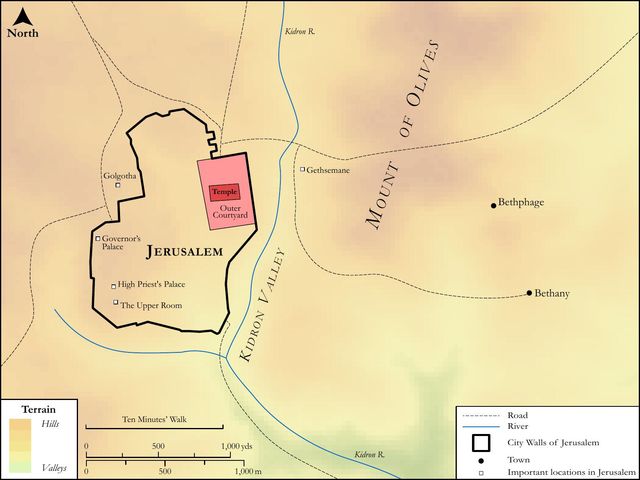
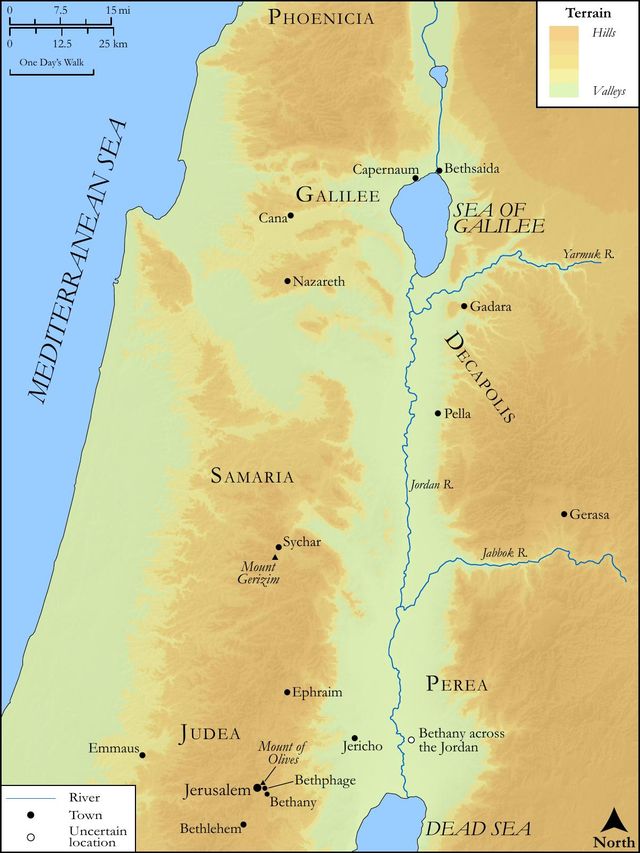
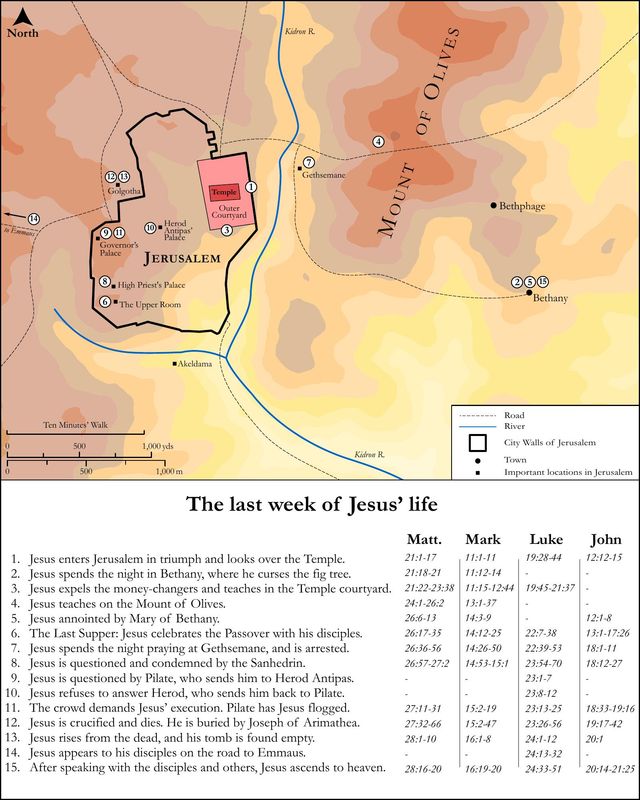
Study this verse
Public-domain commentary
Matthew Henry
From his Commentary on the Whole Bible. Henry comments on passages, not single verses — this entry covers John 14:4–11. His four-level outline is real structure in the source text, so it is rendered as structure.
Christ, having set the happiness of heaven before them as the end, here shows them himself as the way to it, and tells them that they were better acquainted both with the end they were to aim at and with the way they were to walk in than they thought they were: You know, that is, 1. "You may know; it is none of the secret things which belong not to you, but one of the things revealed; you need not ascend into heaven, nor go down into the deep, for the word is nigh you (Rom 10:6-8), level to you." 2. "You do know; you know that which is the home and which is the way, though perhaps not as the home and as the way. You have been told it, and cannot but know, if you would recollect and consider it." Note, Jesus Christ is willing to make the best of his people's knowledge, though they are weak and defective in it. He knows the good that is in them better than they do themselves, and is certain that they have that knowledge, and faith, and love, of which they themselves are not sensible, or not certain.
This word of Christ gave occasion to two of his disciples to address themselves to him, and he answers them both.
I.Thomas enquired concerning the way (Joh 14:5), without any apology for contradicting his Master.
1.He said, "Lord, we know not whither thou goest, to what place or what state, and how can we know the way in which we must follow thee? We can neither guess at it, nor enquire it out, but must still be at a loss." Christ's testimony concerning their knowledge made them more sensible of their ignorance, and more inquisitive after further light. Thomas here shows more modesty than Peter, who thought he could follow Christ now. Peter was the more solicitous to know whither Christ went. Thomas here, though he complains that he did not know this, yet seems more solicitous to know the way. Now,
(1.)His confession of his ignorance was commendable enough. If good men be in the dark, and know but in part, yet they are willing to own their defects. But,
(2.)The cause of his ignorance was culpable. They knew not whither Christ went, because they dreamed of a temporal kingdom in external pomp and power, and doted upon this, notwithstanding what he had said again and again to the contrary. Hence it was that, when Christ spoke of going away and their following him, their fancy ran upon his going to some remarkable city or other, Bethlehem, or Nazareth, or Capernaum, or some of the cities of the Gentiles, as David to Hebron, there to be anointed king, and to restore the kingdom to Israel; and which way this place lay, where these castles in the air were to be built, east, west, north, or south, they could not tell, and therefore knew not the way. Thus still we think ourselves more in the dark than we need be concerning the future state of the church, because we expect its worldly prosperity, whereas it is spiritual advancement that the promise points at. Had Thomas understood, as he might have done, that Christ was going to the invisible world, the world of spirits, to which spiritual things only have a reference, he would not have said, Lord, we do not know the way.
II.Now to this complaint of their ignorance, which included a desire to be taught, Christ gives a full answer, Joh 14:6, Joh 14:7.
Thomas had enquired both whither he went and what was the way, and Christ answers both these enquiries and makes good what he had said, that they would have needed no answer if they had understood themselves aright; for they knew him, and he was the way; they knew the Father, and he was the end; and therefore, whither I go you know, and the way you know. Believe in God as the end, and in me as the way (Joh 14:1), and you do all you should do.
(1.)He speaks of himself as the way, Joh 14:6. Dost thou not know the way? I am the way, and I only, for no man comes to the Father but by me. Great things Christ here saith of himself, showing us,
[1.]The nature of his mediation: He is the way, the truth, and the life.
First, Let us consider these first distinctly. 1. Christ is the way, the highway spoken of, Isa 35:8. Christ was his own way, for by his own blood he entered into the holy place (Heb 9:12), and he is our way, for we enter by him. By his doctrine and example he teaches us our duty, by his merit and intercession he procures our happiness, and so he is the way. In him God and man meet, and are brought together. We could not get to the tree of life in the way of innocency; but Christ is another way to it. By Christ, as the way an intercourse is settled and kept up between heaven and earth; the angels of God ascend and descend; our prayers go to God, and his blessings come to us by him; this is the way that leads to rest, the good old way. The disciples followed him, and Christ tells them that they followed the road, and, while they continued following him, they would never be out of their way. 2. He is the truth. (1.) As truth is opposed to figure and shadow. Christ is the substance of all the Old Testament types, which are therefore said to be figures of the true, Heb 9:24. Christ is the true manna (Joh 6:32), the true tabernacle, Heb 8:2. (2.) As truth is opposed to falsehood and error; the doctrine of Christ is true doctrine. When we enquire for truth, we need learn no more than the truth as it is in Jesus. (3.) As truth is opposed to fallacy and deceit; he is true to all that trust in him, as true as truth itself, Co2 1:20. 3. He is the life; for we are alive unto God only in and through Jesus Christ, Rom 6:11. Christ formed in us is that to our souls which our souls are to our bodies. Christ is the resurrection and the life.
Secondly, Let us consider these jointly, and with reference to each other. Christ is the way, the truth, and the life; that is, 1. He is the beginning, the middle, and the end. In him we must set out, go on, and finish. As the truth, he is the guide of our way; as the life, he is the end of it. 2. He is the true and living way (Heb 10:20); there are truth and life in the way, as well as at the end of it. 3. He is the true way to life, the only true way; other ways may seem right, but the end of them is the way of death.
[2.]The necessity of his mediation: No man cometh to the Father but by me. Fallen man must come to God as a Judge, but cannot come to him as a Father, otherwise than by Christ as Mediator. We cannot perform the duty of coming to God, by repentance and the acts of worship, without the Spirit and grace of Christ, nor obtain the happiness of coming to God as our Father without his merit and righteousness; he is the high priest of our profession, our advocate.
(2.)He speaks of his Father as the end (Joh 14:7): "If you had known me aright, you would have known my Father also; and henceforth, by the glory you have seen in me and the doctrine you have heard from me, you know him and have seen him." Here is,
[1.]A tacit rebuke to them for their dulness and carelessness in not acquainting themselves with Jesus Christ, though they had been his constant followers and associates: If you had known me - . They knew him, and yet did not know him so well as they might and should have known him. They knew him to be the Christ, but did not follow on to know God in him. Christ had said to the Jews (Joh 8:19): If you had known me, you would have known my Father also; and here the same to his disciples; for it is hard to say which is more strange, the wilful ignorance of those that are enemies to the light, or the defects and mistakes of the children of light, that have had such opportunities of knowledge. If they had known Christ aright, they would have known that his kingdom is spiritual, and not of this world; that he came down from heaven, and therefore must return to heaven; and then they would have known his Father also, would have known whither he designed to go, when he said, I go to the Father, to a glory in the other world, not in this. If we knew Christianity better, we should better know natural religion.
[2.]A favourable intimation that he was well satisfied concerning their sincerity, notwithstanding the weakness of their understanding: "And henceforth, from my giving you this hint, which will serve as a key to all the instructions I have given you hitherto, let me tell you, you know him, and have seen him, inasmuch as you know me, and have seen me;" for in the face of Christ we see the glory of God, as we see a father in his son that resembles him. Christ tells his disciples that they were not so ignorant as they seemed to be; for, though little children, yet they had known the Father, Jo1 2:13. Note, Many of the disciples of Christ have more knowledge and more grace than they think they have, and Christ takes notice of, and is well pleased with, that good in them which they themselves are not aware of; for those that know God do not all at once know that they know him, Jo1 2:3.
II.Philip enquired concerning the Father (Joh 14:8), and Christ answered him, Joh 14:9-11, where observe,
1.Philip's request for some extraordinary discovery of the Father. He was not so forward to speak as some others of them were, and yet, from an earnest desire of further light, he cries out, Show us the Father. Philip listened to what Christ said to Thomas, and fastened upon the last words, You have seen him. "Nay," says Philip, "that is what we want, that is what we would have: Show us the Father and it sufficeth us." (1.) This supposes an earnest desire of acquaintance with God as a Father. The petition is, "Show us the Father; give us to know him in that relation to us;" and this he begs, not for himself only, but for the rest of the disciples. The plea is, It sufficeth us. He not only professes it himself, but will pass his word for his fellow-disciples. Grant us but one sight of the Father, and we have enough. Jansenius saith, "Though Philip did not mean it, yet the Holy Ghost, by his mouth, designed here to teach us that the satisfaction and happiness of a soul consist in the vision and fruition of God," Psa 16:11; Psa 17:15. In the knowledge of God the understanding rests, and is at the summit of its ambition; in the knowledge of God as our Father the soul is satisfied; a sight of the Father is a heaven upon earth, fills us with joy unspeakable. (2.) As Philip speaks it here, it intimates that he was not satisfied with such a discovery of the Father as Christ thought fit to give them, but he would prescribe to him, and press upon him, something further and no less than some visible appearance of the glory of God, like that to Moses (Exo 33:22), and to the elders of Israel, Exo 24:9-11. "Let us see the Father with our bodily eyes, as we see thee, and it sufficeth us; we will trouble thee with no more questions, Whither goest thou?" And so it manifests not only the weakness of his faith, but his ignorance of the gospel way of manifesting the Father, which is spiritual, and not sensible. Such a sight of God, he thinks, would suffice them, and yet those who did thus see him were not sufficed, but soon corrupted themselves, and made a graven image. Christ's institutions have provided better for the confirmation of our faith than our own inventions would.
2.Christ's reply, referring him to the discoveries already made of the Father, Joh 14:9-11.
(1.)He refers him to what he had seen, Joh 14:9. He upbraids him with his ignorance and inadvertency: "Have I been so long time with you, now above three years intimately conversant with you, and yet hast thou not known me, Philip? Now, he that hath seen me hath seen the Father; and how sayest thou then, Show us the Father? Wilt thou ask for that which thou hast already?" Now here,
[1.]He reproves him for two things: First, For not improving his acquaintance with Christ, as he might have done, to a clear and distinct knowledge of him: "Hast thou not known me, Philip, whom thou hast followed so long, and conversed with so much?" Philip, the first day he came to him, declared that he knew him to be the Messiah (Joh 1:45), and yet to this day did not know the Father in him. Many that have good knowledge in the scripture and divine things fall short of the attainments justly expected from them, for want of compounding the ideas they have, and going on to perfection. Many know Christ, who yet do not know what they might know of him, nor see what they should see in him. That which aggravated Philip's dulness was that he had so long an opportunity of improvement: I have been so long time with thee. Note, The longer we enjoy the means of knowledge and grace, the more inexcusable we are if we be found defective in grace and knowledge. Christ expects that our proficiency should be in some measure according to our standing, that we should not be always babes. Let us thus reason with ourselves: "Have I been so long a hearer of sermons, a student in the scripture, a scholar in the school of Christ, and yet so weak in the knowledge of Christ, and so unskilful in the word of righteousness?" Secondly, He reproves him for his infirmity in the prayer made, Show us the Father. Note, Herein appears much of the weakness of Christ's disciples that they know not what to pray for as they ought (Rom 8:26), but often ask amiss (Jam 4:3), for that which either is not promised or is already bestowed in the sense of the promise, as here.
[2.]He instructs him, and gives him a maxim which not only in general magnifies Christ and leads us to the knowledge of God in him, but justifies what Christ had said (Joh 14:7): You know the Father, and have seen him; and answered what Philip had asked, Show us the Father. Why, saith Christ, the difficulty is soon over, for he that hath seen me hath seen the Father. First, All that saw Christ in the flesh might have seen the Father in him, if Satan had not blinded their minds, and kept them from a sight of Christ, as the image of God, Co2 4:4. Secondly, All that saw Christ by faith did see the Father in him, though they were not suddenly aware that they did so. In the light of Christ's doctrine they saw God as the father of lights; in the miracles they saw God as the God of power, the finger of God. The holiness of God shone in the spotless purity of Christ's life, and his grace in all the acts of grace he did.
(2.)He refers him to what he had reason to believe (Joh 14:10, Joh 14:11): "Believest thou not that I am in the Father, and the Father in me, and therefore that in seeing me thou hast seen the Father? Hast thou not believed this? If not, take my word for it, and believe it now."
[1.]See here what it is which we are to believe: That I am in the Father, and the Father in me; that is, as he had said (Joh 10:30), I and my Father are one. He speaks of the Father and himself as two persons, and yet so one as never any two were or can be. In knowing Christ as God of God, light of light, very God of very God, begotten, not made, and as being of one substance with the Father, by whom all things were made, we know the Father; and in seeing him thus we see the Father. In Christ we behold more of the glory of God than Moses did at Mount Horeb.
[2.]See here what inducements we have to believe this; and they are two: - We must believe it, First, For his word's sake: The words that I speak to you, I speak not of myself. See Joh 7:16, My doctrine is not mine. What he said seemed to them careless as the word of man, speaking his own thought at his own pleasure; but really it was the wisdom of God that indited it and the will of God that enforced it. He spoke not of himself only, but the mind of God according to the eternal counsels. Secondly, For his works' sake: The Father that dwelleth in me, he doeth them; and therefore believe me for their sake. Observe, 1. The Father is said to dwell in him ho en emoi menōn - he abideth in me, by the inseparable union of the divine and human nature: never had God such a temple to dwell in on earth as the body of the Lord Jesus, Joh 2:21. Here was the true Shechinah, of which that in the tabernacle was but a type. The fulness of the Godhead dwelt in him bodily, Col 2:9. The Father so dwells in Christ that in him he may be found, as a man where he dwells. Seek ye the Lord, seek him in Christ, and he will be found, for in him he dwells. 2. He doeth the works. Many words of power, and works of mercy, Christ did, and the Father did them in him; and the work of redemption in general was God's own work. 3. We are bound to believe this, for the very works' sake. As we are to believe the being and perfections of God for the sake of the works of creation, which declare his glory; so we are to believe the revelation of God to man in Jesus Christ for the sake of the works of the Redeemer, those mighty works which, by showing forth themselves (Mat 14:2), Show forth him, and God in him. Note, Christ's miracles are proofs of his divine mission, not only for the conviction of infidels, but for the confirmation of the faith of his own disciples, Joh 2:11; Joh 5:36; Joh 10:37.
Historical interpretation
Two Centuries of Reception
24 surviving comments on this verse. Each one is dated, so this reads as a timeline rather than a list.
Select a marker to jump to its quote. Markers stagger vertically where authors wrote within a few decades of each other.
For as in the Old Testament Scriptures they lay hold of nothing else than, "I am God, and beside me there is no God ; " so in the Gospel they simply keep in view the Lord's answer to Philip, "I and my Father are one; " and, "He that hath seen me hath seen the Father; and I am in the Father, and the Father in me." They would have the entire revelation of both Testaments yield to these three passages, whereas the only proper course is to understand the few statements in the light of the many.
This, then, being the case, it was not the Father whom, after His lengthened intercourse with them, they were ignorant of, but it was the Son; and accordingly the Lord, while upbraiding Philip for not knowing Himself who was the object of their ignorance, wished Himself to be acknowledged indeed as that Being whom He had reproached them for being ignorant of after so long a time-in a word, as the Son. And now it may be seen in what sense it was said, "He that hath seen me hath seen the Father," -even in the same in which it was said in a previous passage, "I and my Father are one.
For God the Father none ever saw, and lived. And accordingly it is agreed that the Son of God Himself spake to Moses, and said to the people, "Behold, I send mine angel before thy"-that is, the people's-"face, to guard thee on the march, and to introduce thee into the land which I have prepared thee: attend to him, and be not disobedient to him; for he hath not escaped thy notice, since my name is upon him.
Or how is He unlike to the substance of the Father, who is the perfect image and brightness of the Father, and who says, "He that hath seen Me hath seen the Father?" And how, if the Son is the Word or Wisdom and Reason of God, was there a time when He was not? It is all one as if they said, that there was a time when God was without reason and wisdom.
He rebukes the apostle for defective knowledge of himself. For previously he had said that when he was known the Father was known also. But what did they mean when he complained that for so long they had not known him? It means this: that if they had known him, they must have recognized in him the Godhead that belongs to his Father's nature. For his works were the peculiar works of God.
(vii. de Trin) He reproves the ignorance of Philip in this respect. For whereas his actions had been strictly divine, such as walking on the water, commanding the winds, remitting sins, raising the dead, He complained that in His assumed humanity, the Divine nature was not discerned. Accordingly to Philip's request, to be shown the Father, Our Lord answers, He that hath seen Me, hath seen the Father.
(vii. de Trin) He does not mean the sight of the bodily eye: for His fleshly part, born of the Virgin, doth not avail towards contemplating the form and image of God in Him; but the Son of God being known with the understanding, it follows that the Father is known also, forasmuch as He is the image of God, not differing from but expressing His Author. For our Lord's expressions do not speak of one person solitary and without relationship, but teach us His birth. The Father also excludes the supposition of a single solitary person, and leaves us no other doctrine but that the Father is seen in the Son, by the incommunicable likeness of birth.
I ask whether he is the visible likeness of the invisible God and whether the infinite God can also be presented to view under the likeness of a finite form. For a likeness must necessarily repeat the form of that of which it is the likeness. Let those, however, who want there to be a nature of a different sort in the Son determine what sort of likeness of the invisible God they wish the Son to be. Is it a bodily likeness exposed to the gaze and moving from place to place with human gait and motion? No, rather let them remember that according to the Gospels and the prophets both Christ is a Spirit and God is a Spirit. If they confine this Christ the spirit within the bounds of shape and body, such a corporeal Christ will not be the likeness of the invisible God, nor will a finite limitation represent that which is infinite.
“He who has seen me has seen the Father”; this does not mean that he has seen the image and the form of the divine nature, since the divine nature is simple, not composed of various parts. Goodness of will is a current in the stream of the divine essence, and thus is perceived to be the same in the Father and the Son.
In the church, I know of only one image, that is, the image of the unseen God. God has said about this image, “Let us make man [humankind] in our image.” Of this image it is written that Christ is the “effulgence of the glory and impress of his hypostasis.” In that image, I perceive the Father as the Lord Jesus himself has said, “The one who has seen me has seen the Father.” For this image is not separated from the Father, which indeed has taught me the unity of the Trinity, saying, “I and the Father are one,” and again, “All things whatever the Father has are mine.” [In this image, also perceive] the Holy Spirit, seeing that the Spirit is Christ’s and has received of Christ, as it is written, “He shall receive of mine and shall announce it to you.”
By means of this image the Lord showed Philip the Father. Yes, he who looks on the Son sees, in portrait, the Father. Notice what kind of portrait is spoken of. It is truth, righteousness, the power of God. It is not silent, for it is the Word. It is not insensible, for it is Wisdom. It is not vain and foolish, for it is power. It is not soulless, for it is the life. It is not dead, for it is the resurrection.
"Believest thou not that I am in the Father?" That is, "I am seen in that Essence."
"The words that I speak, I speak not of Myself," Seest thou the exceeding nearness, and the proof of the one Essence?
"The Father that dwelleth in Me, He doeth the works." How, beginning with words, doth He come to works? for that which naturally followed was, that He should say, "the Father speaketh the words." But He putteth two things here, both concerning doctrine and miracles. Or it may have been because the words also were works. How then doeth He them? In another place He saith, "If I do not the works of My Father, believe Me not." How then saith He here that the Father doeth them? To show this same thing, that there is no interval between the Father and the Son. What He saith is this: "The Father would not act in one way, and I in another." Indeed in another place both He and the Father work; "My Father worketh hitherto, and I work"; showing in the first passage the unvaryingness of the works, in the second the identity. And if the obvious meaning of the words denotes humility, marvel not; for after having first said, "Believest thou not?" He then spake thus, showing that He so modeled His words to bring him to the faith; for He walked in their hearts.
What saith Christ? Very reprovingly He saith, "Have I been so long time with you, and hast thou not known Me, Philip?" He said not, "hast thou not seen," but, "hast thou not known Me." "Why," Philip might say, "do I wish to learn concerning Thee? At present I seek to see Thy Father, and Thou sayest unto me, hast thou not known Me?" What connection then hath this with the question? Surely a very close one; for if He is that which the Father is, yet continuing a Son, with reason He showeth in Himself Him who begat Him. Then to distinguish the Persons He saith, "He that hath seen Me hath seen the Father," lest any one should assert that the same is Father, the same Son. For had He been the Father, He would not have said, "He that hath seen Me hath seen Him." Why then did He not reply, "thou askest things impossible, and not allowed to man; to Me alone is this possible"? Because Philip had said, "it sufficeth us," as though knowing Christ, He showeth that he had not even seen Him. For assuredly he would have known the Father, had he been able to know the Son. Wherefore He saith, "He that hath seen Me, hath seen the Father." "If any one hath seen Me, he shall also behold Him." What He saith is of this kind: "It is not possible to see either Me or Him." For Philip sought the knowledge which is by sight, and since he thought that he had so seen Christ, he desired in like manner to see the Father; but Jesus showeth him that he had not even seen Himself.
When Philip said to Christ, "Show us the Father," He replied, "Have I been so long time with you, and hast thou not known Me, Philip?" And yet there are some who even after these words separate the Father from the Son. What proximity dost thou require closer than this? Indeed from this very saying some have fallen into the malady of Sabellius. But let us, leaving both these and those as involved in directly opposite error, consider the exact meaning of the words. "Have I been so long time with you, and hast thou not known Me, Philip?" He saith. What then? replieth Philip, "Art thou the Father after whom I enquire?" "No," He saith. On this account He said not, "hast thou not known Him," but, "hast thou not known Me," declaring nothing else but this, that the Son is no other than what the Father is, yet continuing to be a Son.
And if any one here call knowledge, sight, I do not contradict him, for, "he that hath known Me," saith Christ, "hath known the Father." Yet He did not say this, but desiring to establish the Consubstantiality, declared, "he that knoweth My Essence, knoweth that of the Father also." "And what is this?" saith some one; "for he who is acquainted with creation knoweth also God." Yet all are acquainted with creation, and have seen it, but all do not know God. Besides, let us consider what Philip seeks to see. Is it the wisdom of the Father? Is it His goodness? Not so, but the very whatever God is, the very Essence. To this therefore Christ answereth, "He that hath seen Me." Now he that hath seen the creation, hath not also seen the Essence of God. "If any one hath seen Me, he hath seen the Father," He saith. Now had He been of a different Essence, He would not have spoken thus. But to make use of a grosser argument, no man that knows not what gold is, can discern the substance of gold in silver. For one nature is not shown by another.
But how came Philip to ask this question? Christ had said, "If ye had known Me, ye should have known My Father also" and He had often said the same to the Jews. Since then Peter and the Jews had often asked Him, "Who is the Father?" since Thomas had asked Him, and no one had learnt anything clear, but His words were still not understood; Philip, in order that He might not seem to be importunate and to trouble Him by asking in his turn after the Jews, "Show us the Father," added, "and it sufficeth us," "we seek no more." Yet Christ had said, "If ye had known Me, ye should have known My Father also," and by Himself He declared the Father. But Philip reversed the order, and said, "Show us the Father," as though knowing Christ exactly. But Christ endureth him not, but putteth him in the right way, persuading him to gain the knowledge of the Father through Himself, while Philip desired to see Him with these bodily eyes, having perhaps heard concerning the Prophets, that they "saw God." But those cases, Philip, were acts of condescension. Wherefore Christ said, "No man hath seen God at any time"; and again, "Every man that hath heard and hath learned from God cometh unto Me." "Ye have neither heard His voice at any time, nor seen His shape." And in the Old Testament, "No man shall see My face, and live."
(Hom. lxxiv. 1) Or thus: Philip, because [he thought] he had seen the Son with his bodily eye, wished to see the Father in the same way; perhaps too remembering what the Prophet said, I saw the Lord, and therefore he says, show us the Father. (Isa. 6:1) The Jews had asked, who was His Father; and Peter and Thomas, whither He went; and neither were told plainly. Philip therefore, that he might not seem burdensome, after saying, show us the Father, adds, And it sufficeth us: i. e. we seek for no more. Our Lord in reply does not say, that he asked an impossible thing, but that he had not seen the Son to begin with, for that if he had seen Him, he would have seen the Father: Have I been so long time with you, and yet hast thou not known Me? He does not say, not seen Me, but, not known Me; not known that the Son, being what the Father is, does in Himself fitly show the Father. Then dividing the Persons, He says, He that hath seen Me hath seen the Father; that none might maintain that He was both the Father and the Son. The words show too that even the Son was not seen in a bodily sense. So if any one takes seeing here, for knowing, I will not contradict him, but will take the sentence as if it was, He that hath known Me, hath known the Father. He shows here His consubstantiality with the Father: He that hath seen My substance, hath seen the Father. Whence it is evident He is not a creature: for all know and see the creature, but not all God; Philip, for instance, who wished to see the substance of the Father. If Christ then had been of another substance from the Father, He would never have said, He that hath seen Me, hath seen the Father. A man cannot see the substance of gold in silver: one nature cannot be made apparent by another.
(Hom. lxxiv. 2) Mark the abundant proof of the unity of substance. For He continues; But the Father that dwelleth in Me, He doeth the works. As if He said, My Father and I act together, not differently from each other; agreeing with what He said below: If I do not the works of My Father, believe Me not. But why does He pass from words to works? Why does He not say as we might have expected, He speaketh the words? Because He means to apply what He says both to His doctrine, and to His miracles; or because His words are themselves works.
(Hom. lxxiv. 2) But if this does not suffice to show ray consubstantiality, at least learn it from My works: Or else believe Me for the very works' sake. Ye have seen My miracles, and all the proper signs of My divinity; works which the Father alone worketh, sins remitted, life restored, and the like.
"Believe that I am in the Father and the Father in Me." "Ye ought not, when ye hear of 'Father' and 'Son,' to seek anything else to the establishing of the relationship as to Essence, but if this is not sufficient to prove to you the Condignity and Consubstantiality, ye may learn it even from the works." Had the, "he that hath seen Me, hath seen My Father," been used with respect to works, He would not afterwards have said, "Or else believe Me for the very works' sake." And then to show that He is not only able to do these things, but also other much greater than these, He putteth them with excess. For He saith not, "I can do greater things than these," but, what was much more wonderful, "I can give to others also to do greater things than these."
Wherefore He rightly rebuked him, saying, "Am I so long with you?" Hast thou enjoyed such teaching, hast thou seen miracles wrought with authority, and all belonging to the Godhead, which the Father alone worketh, sins forgiven, secrets published, death retreating, a creation wrought from earth, and hast thou not known Me? Because He was clothed with flesh, therefore He said, "Hast thou not known Me?"
Thou hast seen the Father; seek not to see more; for in Him thou hast seen Me. If thou hast seen Me, be not over-curious; for thou hast also in Me known Him.
So, he says, was not such a long time sufficient to teach you about my Father and me? And yet you still are looking to see him. If you had known me, you would have known the Father through me and would have not thought that he can be seen with bodily eyes. Since the expression “you still do not know me” seemed not to fit in with the words “show us the Father,” he clearly explains this by saying, “Whoever has seen me has seen the Father. How can you say, ‘Show us the Father?’ ” There is no difference, he says, so that whoever sees me sees the Father himself. There is a perfect similarity between us two that shows the Father himself in me. Very aptly he adds, “How can you say?” as he confirms through his open amazement the words said above. How can you ask me, he says, to show you the Father, if not for the fact that you ignore me completely? Therefore what I said is true, “You neither know my Father nor me. If you had known me, you would have known him too,” because the perfect likeness would have shown him.
The words of the holy Gospel, brethren, are rightly understood only if they are found to be in harmony with those that precede; for the premises ought to agree with the conclusion, when it is the Truth that speaks. The Lord had said before, "And if I go and prepare a place for you, I will come again and receive you unto myself; that where I am, there ye may be also:" and then had added, "And whither I go ye know, and the way ye know;" and showed that all He said was that they knew himself. What, therefore, the meaning was of His going to Himself by Himself,-for He also lets the disciples see that it is by Him that they are to come to Him,-we have already told you, as we could, in our last discourse. When He says, therefore, "That where I am, there ye may be also," where else were they to be but in Himself? In this way is He also in Himself, and they, therefore, are just where He is, that is, in Himself. Accordingly, He Himself is that eternal life which is yet to be ours, when He has received us unto Himself; and as He is that life eternal, so is it in Him, that where He is there shall we be also, that is to say, in Himself. "For as the Father hath life in Himself," and certainly that life which He has is in no wise different from what He is Himself as its possessor, "so hath He given to the Son to have life in Himself," inasmuch as He is the very life which He hath in Himself. But shall we then actually be what He is, (namely), the life, when we shall have begun our existence in that life, that is, in Himself? Certainly not, for He, by His very existence as the life, hath life, and is Himself what He hath; and as the life, is in Him, so is He in Himself: but we are not that life, but partakers of His life, and shall be there in such wise as to be wholly incapable of being in ourselves what He is, but so as, while ourselves not the life, to have Him as our life, who has Himself the life on this very account that He Himself is the life. In short, He both exists unchangeably in Himself and inseparably in the Father. But we, when wishing to exist in ourselves, were thrown into inward trouble regarding ourselves, as is expressed in the words, "My soul is cast down within me:" and changing from bad to worse, cannot even remain as we were. But when by Him we come unto the Father, according to His own words, "No man cometh unto the Father but by me," and abide in Him, no one shall be able to separate us either from the Father or from Him.
Connecting, therefore, His previous words with those that follow, He proceeded to say, "If ye had known me, ye should certainly have known my Father also." This conforms to His previous words, "No man cometh unto the Father but by me." And then He adds: "And from henceforth ye know Him, and have seen Him." But Philip, one of the apostles, not understanding what he had just heard, said, "Lord, show us the Father, and it sufficeth us." And the Lord replied to him, "Have I been so long time with you, and yet have ye not known me, Philip? he that seeth me, seeth also the Father."
Here you see He complains that He had been so long time with them, and yet He was not known. But had He not Himself said, "And whither I go ye know, and the way ye know;" and on their saying that they knew it not, had convinced them that they did know, by adding the words: "I am the way, and the truth, and the life"? How, then, says He now, "Have I been so long time with you, and have ye not known me?" when, in fact, they knew both whither He went and the way, on no other grounds save that they really knew Himself? But this difficulty is easily solved by saying that some of them knew Him, and others did not, and that Philip was one of those who did not know Him; so that, when He said, "And whither I go ye know, and the way ye know," He is understood as having spoken to those that knew, and not to Philip, who has it said to him, "Have I been so long time with you, and have ye not known me, Philip?" To such, then, as already knew the Son, was it now also said of the Father, "And from henceforth ye know Him, and have seen Him:" for such words were used because of the all-sided likeness subsisting between the Father and the Son; so that, because they knew the Son, they might henceforth be said to know the Father.
Already, therefore, they knew the Son, if not all of them, those at least to whom it is said, "And whither I go ye know, and the way ye know;" for He is Himself the way. But they knew not the Father, and so have also to hear, "If ye have known me, ye have known my Father also;" that is, through me ye have known Him also. For I am one, and He another. But that they might not think Him unlike, He adds, "And from henceforth ye know Him, and have seen Him." For they saw His perfectly resembling Son, but needed to have the truth impressed on them, that exactly such as was the Son whom they saw, was the Father also whom they did not see. And to this points what is afterwards said to Philip, "He that seeth me, seeth also the Father." Not that He Himself was Father and Son, which is a notion of the Sabellians, who are also called Patripassians, condemned by the Catholic faith; but that Father and Son are so alike, that he who knoweth one knoweth both. For we are accustomed to speak in this way of two who closely resemble each other, to those who are in the habit of seeing one of them, and wish to know what like the other is, so that we say, In seeing the one, you have seen the other. In this way, then, is it said "He that seeth me, seeth also the Father." Not, certainly, that He who is the Son is also the Father, but that the Son in no respect disagrees with the likeness of the Father. For had not the Father and Son been two persons, it would not have been said, "If ye have known me, ye have known my Father also."
Why, then, Philip, dost thou say, "Show us the Father, and it sufficeth us? Have I been so long time with you, and yet have ye not known me, Philip? He that seeth me, seeth the Father also." If it interests thee much to see this, believe at least what thou seest not. For "how," He says, "sayest thou, Show us the Father?" If thou hast seen me, who am His perfect likeness, thou hast seen Him to whom I am like. And if thou canst not directly see this, "believest thou not," at least, "that I am in the Father, and the Father in me?" But Philip might say here, "I see Thee indeed, and believe Thy full likeness to the Father; but is one to be reproved and rebuked because, when he sees one who bears a likeness to another, he wishes to see that other to whom he is like? I know, indeed, the image, but as yet I know only the one without the other; it is not enough for me, unless I know that other whose likeness he bears. Show us, therefore, the Father, and it sufficeth us." But the Master really reproved the disciple because He saw into the heart of his questioner. For it was with the idea, as if the Father were somehow better than the Son, that Philip had the desire to know the Father: and so he did not even know the Son, because believing that He was inferior to another. It was to correct such a notion that it was said, "He that seeth me, seeth the Father also. How sayest thou, Show us the Father?" I see the meaning of thy words: it is not the original likeness thou seekest to see, but it is that other thou thinkest the superior. "Believest thou not that I am in the Father, and the Father in me?" Why desirest thou to discover some distance between those who are thus alike? why cravest thou the separate knowledge of those who cannot be separated?
But the disciples, still thinking that the Father is something greater than the Son, seeing only the flesh, and not understanding His divinity, said to Him, "Lord, show us the Father and it sufficeth us." As much as to say, "We know Thee already, and bless Thee that we know Thee: for we thank Thee that Thou hast shown Thyself to us. But as yet we know not the Father: therefore our heart is inflamed, and occupied with a certain holy longing of seeing Thy Father who sent Thee. Show us Him, and we shall desire nothing more of Thee: for it sufficeth us when He has been shown, than whom none can be greater." A good longing, a good desire; but small intelligence. Now the Lord Jesus Himself, regarding them as small men seeking great things, and Himself great among the small, and yet small among the small, says to Philip, one of the disciples, who had said this: "Am I so long time with you, and ye have not known me, Philip?" Here Philip might have answered, Thee we have known, but did we say to Thee, Show us Thyself? We have known Thee, but it is the Father we seek to know. He immediately adds, "He that hath seen me, hath seen the Father also." If, then, One equal with the Father has been sent, let us not estimate Him from the weakness of the flesh, but think of the majesty clothed in flesh, but not weighed down by the flesh. For, remaining God with the Father, He was made man among men, that, through Him who was made man, thou mightest become such as to receive God. For man could not receive God. Man could see man; God he could not apprehend. Why could he not apprehend God? Because he had not the eye of the heart, by which to apprehend Him. There was something within disordered, something without sound: man had the eyes of the body sound, but the eyes of the heart sick. He was made man to the eye of the body; so that, believing on Him who could be seen in bodily form, thou mightst be healed for seeing Him whom thou wast not able to see spiritually. "Am I so long time with you, and ye know me not, Philip? He that hath seen me, hath seen the Father also." Why did they not see Him? Lo, they did see Him, and yet saw not the Father: they saw the flesh, but the majesty was concealed. What the disciples who loved Him saw, saw also the Jews who crucified Him. Inwardly, then, was He all; and in such manner inwardly in the flesh, that He remained with the Father when He came to the flesh.
(i. de Trin. c. viii) For to that joy of beholding His face, nothing can be added. Philip understood this, and said, Lord, show us the Father, and it sufficeth us. But he did not yet understand that he could in the same way have said, Lord, show us Thyself, and it sufficeth us. But our Lord's answer enlightens him, Jesus saith unto him, Have I been so long with you, and yet hast thou not known Me, Philip?
(Tr. lxx. 1) But how is this, when our Lord said that they knew whither He was going, and the way, because they knew Him? The question is easily settled by supposing that some of them knew, and others not; among the latter, Philip.
(Tr. lxx) When two persons are very like each, we say, If you have seen the one, you have seen the other. So here, He that hath seen Me, hath seen the Father; not that He is both the Father, and the Son, but that the Son is an absolute likeness of the Father.
(Tr. lxx. 3) But is he to be reproved, who, when he has seen the likeness, wishes to see the man of whom he is the likeness? No: our Lord rebuked the question, only with reference to the mind of the asker. Philip asked, as if the Father were better than the Son; and so showed that He did not know the Son. Which opinion our Lord corrects: Believest thou not that I am in the Father, and the Father in Me? as if He said, If it is a great wish with thee to see the Father, at any rate believe what thou dost not see.
(i. de. Trin. 8) He wished him to live by faith, before he had sight, and therefore says, Believest thou not? Spiritual vision is the reward of faith, vouchsafed to minds purified by faith.
(Tr. lxx. 3. and lxxi. 1) He then addresses all of them, not Philip only: The word that I speak unto you, I speak not of Myself. What is, I speak not of Myself, but, I that speak am not of Myself? He attributes what He does to Him, from whom He Himself, the doer, is.
(Tr. lxx. 1, 2) For he that edifieth his neighbour by speaking, doth a good work. These two sentences are brought against us by different sects of heretics; the Arians saying that the Son is unequal to the Father, because He does not speak of Himself; the Sabellians, that the same who is the Father is the Son. For what is meant, they ask, by, The Father that dwelleth in Me, He doeth the works, but, I that dwell in Myself, do these works.
(Tr. lxxi. 2) Philip alone was reproved before.
(Tr. lxxi. 2) Believe then for My works' sake, that I am in the Father, and the Father in Me; for, were we separated, we could not be working together.
Jesus saith unto him, Have I been so long time with you, and dost thou not know Me, Philip? He that hath seen Me hath seen the Father.
In an unexpected way He convicts the disciple of ignorance. For the less easily discernible portions of the meanings implied, in the apprehension of which our mental faculties are necessarily put to a more subtle test, will certainly, although possibly not in any short period yet still in a longer extension of time, be grasped by those who are desirous to learn, and will explain themselves most clearly; and those whose minds are not hardened and whose knowledge is unobstructed, may at once be expected to perceive such meanings and accept them with perfect ease. "What is it therefore," He seems to say," that hinders you, O Philip, from arriving at perfection of knowledge of Myself? Tell Me. For although so long a time has elapsed since I have been with you as to suffice for a perfect knowledge of all that it was needful for thee to learn, nevertheless thou art still in doubt, or rather art convicted of absolute ignorance, as to Who I am by nature, and whence I come; and yet thou findest Me to be the Creator of all that is more especially admired in thy sight. How was it that thou didst not know that he who hath seen Me hath seen the Father? Thou supposest that the Jews of old saw the Divine Nature on Mount Sinai, and heard it speaking in delivering the laws that govern men's conduct; but not yet hast thou realised that through Me and in Me thou hast seen the Father. For he that hath seen Me hath seen the Father." And to show my hearers that it is no corporeal contemplation that Christ here indicates, needs I think not many words. For no thoughtful person would ever maintain that the Divine Nature can be made an object of corporeal vision; nay, no one could endure to behold with the eyes of the body that which is now apprehended dimly as in a mirror: for we see darkly, and I believe that even the man who boasts of the very highest knowledge has but a faint idea concerning God.
But this also we must say to the enemies of the truth, who are profuse in their railings against us, or rather against the very essence of the Only-begotten. For if it is untrue that the Son is of the very essence of God the Father, so as to be by generation That which He is, namely in His nature and in very truth God; and if He is made illustrious by the mere addition to Himself of features that were not originally His own, so that He shines as it were by reflected light from glories bestowed upon Him, and not by His own natural lustre, while appearing all the while as a true Likeness of the Father and an unchanging Image of God; then surely in the first place He could not be in His nature a Son, or even in any true sense an Offspring, but He must be either a created object like unto ourselves, or some other being standing in a similar relation: and this much being admitted and accepted as true, we shall then, it seems, have established this consequence also, that the Father could never be really and naturally a Father, but only so in will and in semblance, just as He is reckoned a Father of us also. And what will be the natural sequence of this? We shall still necessarily have to acknowledge a Trinity: only no longer do we express any belief whatever in the Holy Trinity, but rather in three utterly distinct Persons, each having nothing essentially in common with any other, each one of those named receding as it were into the special peculiarity of His own nature, each totally separate from the other. For the weightiness of the subject forces us to speak even more firmly still on the point. And if we allow that this is true, and confess that it follows as we have said, and admit that the Son is utterly different from the essence of God the Father, surely then Christ will be speaking falsely in the words: He that hath seen Me hath seen the Father. For since the Father is from the beginning in His nature God, how could the Son, although not being (according to the view of these heretics) in His nature God, show forth the Father in Himself? For how shall we behold the Uncreated in the created? And in one who once was not (according to their theory), how could any man possibly behold Him Who was from all eternity? For let not any of these blasphemers tell me, in his sophistical declamations against the power of truth, that because Christ is endued with the glory of God and His power and wisdom and good and omnipotence, so that He can bring into being things that never before existed, therefore He is also an Image of Him: but first let such an one prove whether Christ does not display Himself as in His nature God, and that so irrefutably that there is nothing which impairs the universal and absolute resemblance of the Image to the Archetype. And if he hesitates in perplexity and is unwilling to prove this, we will in the next place ask him to tell us what explanation will allow of one who (according to their accursed notions) is not in His nature God, being enabled to fulfil the works that belong to the Godhead: for this is what they mean by saying that He bears the Image of the Father. For if the Son, without possessing as His own a power sufficient for the purpose, borrows the power from the Father, and is by Him supplied with wisdom and might, so as to be able to perform actions which we shall allow to be beyond the power of any nature save that of the Father alone; then in so doing He will be falsely representing the Image and the Likeness. And if we refuse to admit that He (being of the nature we have just been describing) is guilty of falsehood, and accept the truth of His words, we shall then find ourselves convicted of wronging the glory of God the Father in a manner that I will now explain. We are constrained to admit one of two things: either He falsely represents the Image of God the Father, in that He possesses not in Himself the might sufficing for His acts, but is supplied therewith from another, whereas it is not so with the Archetype; or else, if it is true as He says that in Him the Father is seen by us, and that there is really nothing whatever that disfigures or obscures or perverts His perfect similarity, it is absolutely necessary, willingly or unwillingly, to admit that the Father Himself holds His power as something received from another. For in this way He willed to display to us Himself in the Image of His own nature and of His glory.
"Is it possible then," one might go on to say to these heretics, "that you do not perceive whither your theory, when once it quits the safe path, will lead you on, and into what an abyss of error it will plunge those who have held such views?" "But," say they, "surely it is possible that the Son, although a created being, may yet fulfil the works whereof by His nature He is capable, and so advance the glory of God the Father?" Now what suggestion can appear more impious than this? If this be as they say, there can no longer be any superiority or any higher dignity by which God excels His creatures, if even one of them is to be invested with the glory and power of the Godhead. For let no one be so excessively deranged in mind as to suppose that he is imagining and uttering a marvellous and magnificent compliment concerning the Son in thinking or saying that "He is a creature, but not as one of the creatures." Let him be well assured that he is thus in no small degree disparaging His glory. For the question is not whether His nature is specially superior beyond all other creatures, but whether He is at all a created being. For how could He avoid the consequences of being a creature, even though He were the noblest of all creatures? And if the glory of the Son is disparaged by saying that He was brought into existence, why do they vainly advance (to heal as it were His offended dignity) the statement that He was created in the highest of all possible ranks? It follows therefore that we shall offer insult to the essence of God the Father if we bestow such power on the Son, supposing the Son (according to their ignorant and unskilful reasoning) is Himself a created being. And we shall not tolerate them when they tell us that the Son performs the acts of the Godhead, though Himself in His nature a creature, so as to glorify God the Father. If they can prove as much from the Divine Scripture, let them bring forward their citations, and let them observe the sayings of the holy writers in all sincerity: but if these are inventions of their own brains, and if they have themselves manufactured their arguments in this matter, we shall salute them with the words: Woe to those who prophesy after their own heart! For we shall allow that the Father ever is desirous of whatsoever He knows will maintain in integrity His Divine glory and preserve the absolute truth of the declarations made concerning Himself. And so we shall now bid farewell to the ignorant suggestions of those heretics and pass on to the real truth concerning Christ, believing that He is in truth begotten as Son of the essence of God the Father, and that He is in His nature God of God. For thus He speaks in perfect truth, in that He is both the Very Image and the Likeness of God the Father, when He says: He that hath seen Me hath seen the Father.
How sayest thou then, show us the Father?
"Thou mightest, Philip," He would say, "have beheld the glory of the Father in Me, and from what I am have perceived the nature of My Parent: for I have appeared in My true character as a Very and Exact Image and as a Perfect Likeness of His essence, bearing engraved on Myself the entire nature of God the Father. What additional manner of Divine vision other than this couldst thou ask for, at least if thou wouldst display thy ability to estimate things in true proportion; or tell Me what kind of contemplation thou dost require? Dost thou really suppose that a better and fuller manifestation was granted to the men of former times, when I came down on Mount Sinai in a vision of fire?" For this above all else was the greatest and most usual boast of the Jews.
This we may in all probability suppose to have been the meaning of Christ's answer. We must now, I conceive, feel it our duty to state in all boldness that the manifestation of the miracles of our Saviour Christ was a better guide to the knowledge of God the Father than the vision that appeared on Mount Sinai. For thus thou wilt see that Philip, when the true Image was before his eyes, was in no way constrained to ask for that other sight of God the Father which on Mount Sinai was granted to those of former time. For there the Lord descended, as it is written, in a form of fire, while the Israelites were looking on. But no one could, I think, thereby be made to advance to a right conception concerning God, or to ascend with one bound to a fitting comprehension of the Godhead. For how by means of fire as an image could we be led to realise the existence of God the Father as the Archetype [thereby shadowed forth]? For God is naturally good, and moreover is a Creator, calling previously non-existent things into being, bringing together the universe into consistence, and quickening all things: He is also Wisdom and Power, kind, compassionate, and merciful. And none of these attributes belong to fire. For no one would suppose, at least if he were gifted with sense, that fire was kind and compassionate to men; nor would any one soberly maintain that it was a creative influence, endowed with wisdom and the power of bestowing life. If this be so, tell me how any one could possibly from a vision of fire gather any ideas concerning the true nature of the Godhead. Or how could one behold in a mirror darkly any of those attributes that are inherent in it? What then, one may say, was the ground or reason that induced God to declare Himself in the form of fire on Mount Sinai? We shall answer that as the children of Israel were, at that moment above all others in their career, beginning their education in the way of godliness, and were about to draw up the law which was to be observed as a strict rule to govern their own lives; it was most especially needful that God should appear as a Chastiser and a Terrible One to them, so that transgressors might be able to realise that they had to do with a Fire. Therefore surely it was that the great Moses also in speaking to the children of Israel said: Our God is a consuming Fire. And we should not at all be inclined to say that it was in order to exhibit to us the nature of God that the very wise writer thus compared Him to fire, but that he bestowed this title on God from the fact that, owing to His excessive hatred of wickedness, God shrinks not from wasting and consuming, like an all-devouring fire, those who despise Him. Therefore it is not in consequence of what He is in His nature that God makes Himself known in a vision of fire: but it was found to conduce to the profit of those who listened, that He should be thus named, and that He should have then appeared as fire. Let us pass now to that true and most exact vision of the Father granted to us in the Son. For we shall see Him to be an Image of the One Who begat Him, if we gaze intently with the eye of our minds on the extraordinary powers that are displayed in Him. Goodness belongs naturally to God the Father, and the same we shall find in the Son. For surely He is good, Who endured so great humiliation for our sakes, coming into the world to save sinners, and laying down His life for them. Similarly the Father is powerful, and so it is with the Son. For what power could be greater than that which commanded even the elements themselves, rebuking the sea and the winds, and transforming the nature of substances at His will; bidding the leper be cleansed, and giving sight to the blind: and all with God-befitting authority? The Father is in His nature Life: the Son also is equally Life, quickening those who have been turned to corruption, overthrowing the power of death, and thereby raising the dead to life. Rightly then does he say to Philip: He that hath seen Me hath seen the Father. "For whereas," He would say, "thou mightest in Me and through Me behold very clearly My Father, what other manner of Divine vision dost thou ask for, when thou hast received a far better one than that vouchsafed to the men of former time, and hast met with a most true Likeness of the Father, namely Mine own Self?"
Continue studying John 14:9 across the web’s major study libraries — every link below opens this exact verse, chapter, or book on the destination site.
Read & Compare
 BibleGatewayThis verse in more than 200 translations and 70 languages.
 Bible.comThe YouVersion reader — hundreds of translations, reading plans, and highlights.
 ESV.orgCrossway's official English Standard Version reader.
 NET BibleThe NET translation with 60,000+ translators' notes on every rendering decision.
 STEP BibleTyndale House's free study tool — original text, vocabulary, and scholarly resources.
 BibliaLogos Bible Software's free web reader.
 USCCBThe New American Bible (Revised Edition) with the U.S. bishops' study notes.
Commentaries
 BibleHub CommentariesDozens of classic commentaries on this verse, gathered on one page.
 StudyLightMore than 100 commentary sets — the largest collection on the web.
 BibleRefPlain-English commentary on what this verse means, verse by verse.
 Enduring WordDavid Guzik's free commentary on this chapter, widely used by Bible teachers.
 Bible Study ToolsVerse commentary alongside Greek and Hebrew study aids.
Original Language & Research
- BibleHub InterlinearThe verse word by word — original language, transliteration, and English.
- BibleHub LexiconEvery word's original-language definition and Strong's entry.
 Blue Letter BibleDeep-study tools — Strong's numbers, concordance, and word studies.
 CNTR CollationThe earliest Greek manuscripts of this verse, collated letter by letter.
Sermons, Hymns & Audio


TrulyRandomVerse is not affiliated with these sites and doesn’t control their content. They’re linked because they’re genuinely useful.
Summary
In John 14:9, Jesus gently rebukes Philip for his lack of understanding regarding Jesus' true identity and his intimate relationship with God the Father, asserting that to have seen Jesus is to have seen the Father. This profound declaration underscores the complete and perfect revelation of God's nature and character found in the Son, challenging the disciples' limited perception despite their prolonged time with Him.
Context
ShowHideLiterary Context
This verse is deeply embedded within Jesus' Farewell Discourse to His disciples, delivered during the Last Supper (John 13-17). Immediately preceding this, Jesus comforts His disciples, promising them a place in His Father's house and declaring Himself "the way, the truth, and the life" (John 14:1-6). In John 14:7, Jesus explicitly states that if they had known Him, they would have known the Father, and from that moment, they had known and seen Him. Philip's request in John 14:8, "Lord, shew us the Father, and it sufficeth us," directly prompts Jesus' response in verse 9, highlighting the disciples' struggle to grasp the profound unity between Jesus and the Father.
Historical & Cultural Context
The setting is the Passover meal, a pivotal moment in Jewish history, now transformed into the Last Supper. The disciples, steeped in Jewish monotheism, understood God as transcendent and invisible. The idea of "seeing" God was fraught with theological implications, often associated with divine judgment or a unique prophetic experience (Exodus 33:20). Philip's request likely stemmed from this traditional understanding, seeking a literal, visible manifestation of the Father. Jesus' response challenges this limited perception, revealing a new, unprecedented way of knowing God through His incarnate Son, a concept revolutionary to their Jewish worldview.
Key Themes
ShowHideA primary theme in this passage, and indeed throughout John's Gospel, is the revelation of God the Father through Jesus Christ. Jesus consistently presents Himself as the one who makes the invisible God known (John 1:18). Another crucial theme is the unity and co-equality of the Father and the Son, emphasizing that Jesus is not merely a prophet or a messenger, but God Himself in human form (John 10:30). The verse also subtly touches upon the disciples' gradual and often incomplete understanding of Jesus' divine identity, despite their intimate proximity to Him for an extended period, a recurring motif in the Gospels.
Exposition and Analysis
ShowHideKey Word Analysis
ShowHideA prolonged form of a primary verb; to "know" (absolutely) in a great variety of applications and with many implications (as follow, with others not thus clearly expressed):--allow, be aware (of), feel, (have) know(-ledge), perceived, be resolved, can speak, be sure, understand. In this context, ginōskō implies a deep, personal, and experiential knowledge, not just intellectual acquaintance. Jesus' surprise indicates that after all their time together, Philip had not yet moved beyond superficial recognition to a profound, transformative understanding of who Jesus truly is.
Properly, to stare at (compare ὀπτάνομαι), i.e. (by implication) to discern clearly (physically or mentally); by extension, to attend to; by Hebraism, to experience; passively, to appear. This word signifies a clear, discerning perception, both physical and spiritual. Jesus asserts that His physical presence and actions were meant to convey the very essence of the Father, making the Father perceivable through Him.
Apparently a primary word; a "father" (literally or figuratively, near or more remote). In this verse, patḗr refers to God the Father, the first person of the Trinity. Jesus' statement profoundly links His own person and revelation directly to the ultimate source of divine authority and being, emphasizing His unique filial relationship and co-equality with God.
Verse Breakdown
ShowHide"Jesus saith unto him, Have I been so long time with you, and yet hast thou not known me, Philip?"
Jesus addresses Philip directly, expressing a gentle, almost sorrowful, rhetorical question. The phrase "so long time" (Greek: tosoûtos chrόnos) underscores the extended period of intimate fellowship and teaching the disciples had received. Jesus' surprise ("and yet hast thou not known me?") highlights the gap between Philip's physical proximity to Jesus and his spiritual comprehension of Jesus' divine identity and mission. The word "known" (ginōskō) here implies a deep, experiential understanding that Philip had evidently not yet fully grasped.
"he that hath seen me hath seen the Father;"
This is the core theological assertion of the verse. Jesus makes an unequivocal claim of identity and revelation. "Seen" (horáō) here refers to a clear, discerning perception. To truly perceive Jesus – His character, His words, His miracles, His very being – is to simultaneously perceive the nature and character of God the Father. This statement is a profound declaration of Jesus' divine essence and His role as the perfect image and revelation of the invisible God.
"and how sayest thou [then], Shew us the Father?"
This concluding rhetorical question reinforces Jesus' gentle rebuke. Given the profound truth just stated – that seeing Jesus is seeing the Father – Philip's request for a separate manifestation of the Father becomes redundant and demonstrates his continued lack of understanding. Jesus implies that the Father has already been fully revealed in His own person, making Philip's plea unnecessary.
Literary Devices
ShowHideThe primary literary device at play in John 14:9 is Rhetorical Question. Jesus poses two questions to Philip, "Have I been so long time with you, and yet hast thou not known me, Philip?" and "and how sayest thou [then], Shew us the Father?". These are not requests for information but are designed to make a point, to prompt reflection, and to underscore Philip's spiritual blindness despite his prolonged exposure to divine truth. The first question conveys Jesus' gentle disappointment and highlights the disciples' slow grasp of His identity. The second question serves to emphasize the profound truth that Jesus is the full revelation of the Father, rendering Philip's request redundant and revealing his misunderstanding of Jesus' prior statements. This use of rhetorical questions effectively conveys Jesus' authority and the depth of the theological truth He is imparting.
Theological and Thematic Connections
ShowHideJohn 14:9 is a cornerstone verse for understanding the person of Christ and the nature of the Trinity. It asserts the essential unity and co-equality of Jesus with God the Father, demonstrating that Jesus is not merely a representative of God, but God Himself in human flesh. This profound truth means that all of God's character, attributes, and will are perfectly embodied and revealed in Jesus. To encounter Jesus is to encounter the divine, making Him the ultimate and indispensable mediator between God and humanity. This verse challenges any notion of a distant or unknowable God, affirming that in Christ, God has drawn near and made Himself fully comprehensible to those who truly "see" and "know" the Son.
Reflection and Application
ShowHideJohn 14:9 calls us to a deeper, more profound understanding of who Jesus is. For believers today, while we do not physically see Jesus, we are called to "see" Him through the lens of Scripture, the work of the Holy Spirit, and the witness of the church. This verse assures us that as we diligently study the Gospels, meditate on Jesus' life, teachings, miracles, death, and resurrection, and yield to the Spirit's illumination, we are simultaneously growing in our knowledge and understanding of God the Father. It challenges us to move beyond a superficial or merely intellectual acquaintance with Christ to an experiential, transformative relationship that reveals the very nature and heart of God Himself. Our faith in Jesus is the essential means by which we truly know and perceive the Father, leading to worship, obedience, and a deeper walk with God.
Questions for Reflection
ShowHideFAQ
ShowHideWhat does Jesus mean by "he that hath seen me hath seen the Father"?
ShowHideThis statement is a profound declaration of Jesus' divine nature and His inseparable unity with God the Father. When Jesus says, "he that hath seen me hath seen the Father," He is not implying a physical, visible manifestation of the Father's essence, but rather that His entire being – His character, words, actions, and miracles – perfectly reflects and reveals the Father. Jesus is the ultimate and complete embodiment of God's nature, will, and love. Therefore, to truly perceive and understand Jesus in His incarnation is to gain a full and accurate understanding of God the Father. It means that all that God is, He has perfectly expressed in the Son, making the invisible God knowable and accessible through Christ (John 1:18).
Christ-Centered Fulfillment
ShowHideJohn 14:9 stands as a pivotal declaration of Christ's unique role as the full and final revelation of God the Father. In the Old Testament, God revealed Himself progressively through creation, law, prophets, and mighty acts, yet His full essence remained veiled (Exodus 33:20). However, in the incarnation of Jesus Christ, God Himself entered human history, making the invisible God visible and knowable. Jesus is the very "image of the invisible God" (Colossians 1:15) and the "radiance of God's glory and the exact representation of his being" (Hebrews 1:3). His life, teachings, miracles, and ultimately His atoning death and resurrection, are the perfect unveiling of the Father's character, holiness, justice, and boundless love. Therefore, to know Christ is to know the Father, and to receive Christ is to receive the Father, fulfilling God's ultimate desire to make Himself fully known to humanity through His beloved Son (John 1:14).