


John 14:5
Bible text: King James Version (1769 Blayney text) · Public domain
Bible text: Berean Standard Bible · Public domain
Bible text: American Standard Version (1901) · Public domain
Bible text: World English Bible, Messianic edition · Public domain
Bible text: Geneva Bible (1599) · Public domain
Bible text: Young's Literal Translation · Public domain
- ΛέγειLegeiSaysG3004V-PAI-3SVerb Present Active Indicative 3rd Singular
- αὐτῷautōto HimG846P-DSMPersonal pronoun Dative Singular Masculine
- Θωμᾶς·ThōmasThomasG2381N-NSM-PNoun Nominative Singular Masculine Individual
- κύριεkurieLordG2962N-VSM-TNoun Vocative Singular Masculine Person Gentilic
- οὐκouknotG3756PRT-NNegative Particle Negative
- οἴδαμενoidamenwe knowG1492V-PAI-1PVerb Present Active Indicative 1st Plural
- ποῦpouwhereG4226ADV-IAdverb Interrogative
- ὑπάγεις·hupageisYou are goingG5217V-PAI-2SVerb Present Active Indicative 2nd Singular
- καὶkaiandG2532CONJConjunction
- πῶςpōshowG4459PRT-IInterrogative Particle Interrogative
- δυνάμεθαdunamethacan weG1410V-PNI-1PVerb Present Middle Or Passive Deponent Indicative 1st Plural
- τὴνtēntheG3588T-ASFDefinite article Accusative Singular Feminine
- ὁδὸνhodonwayG3598N-ASFNoun Accusative Singular Feminine
- εἰδέναι;eidenaito know?G1492V-PANVerb Present Active Infinitive
English is a literal word-by-word gloss of the Greek, not the KJV's wording. Why?
This is the original text the KJV's translators worked from — each Greek word with its own literal English meaning in this verse, prepared by scholars at Tyndale House, Cambridge. The KJV translates whole sentences, not word by word, so its wording differs: one Greek word can become several English words, and the KJV may choose “charity” where the gloss reads “love”. Both are faithful — they answer different questions. For the KJV's own rendering, switch to the KJV text.
Details
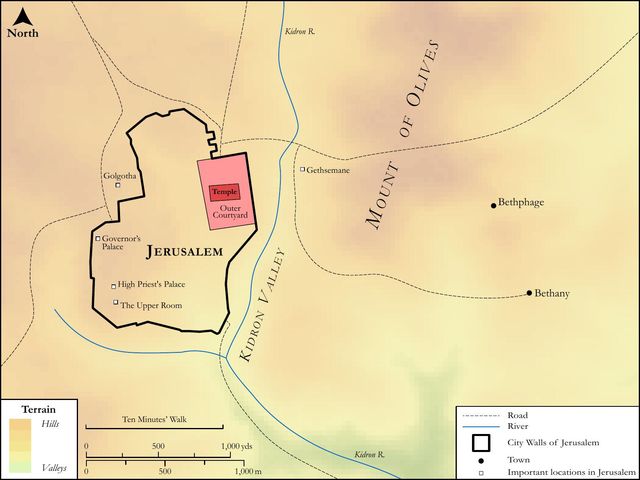
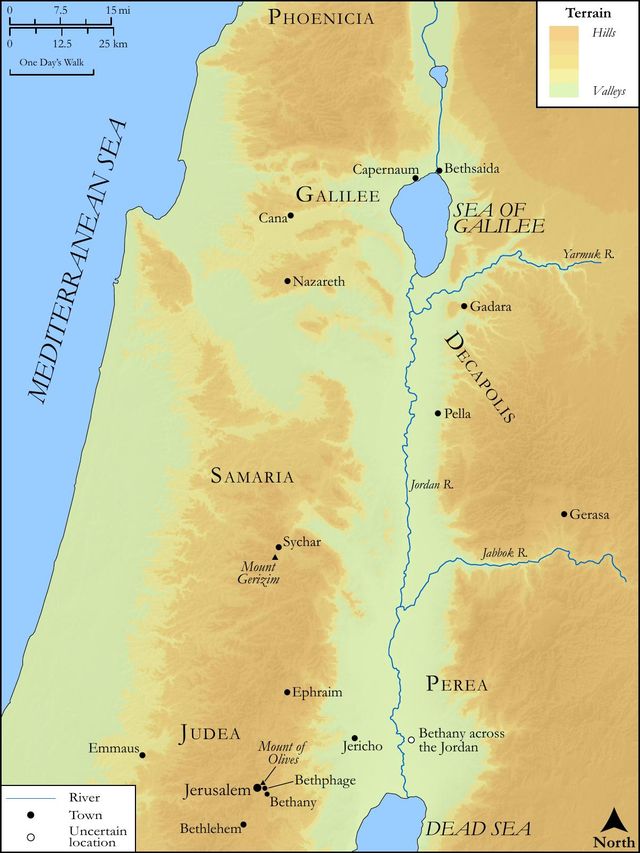
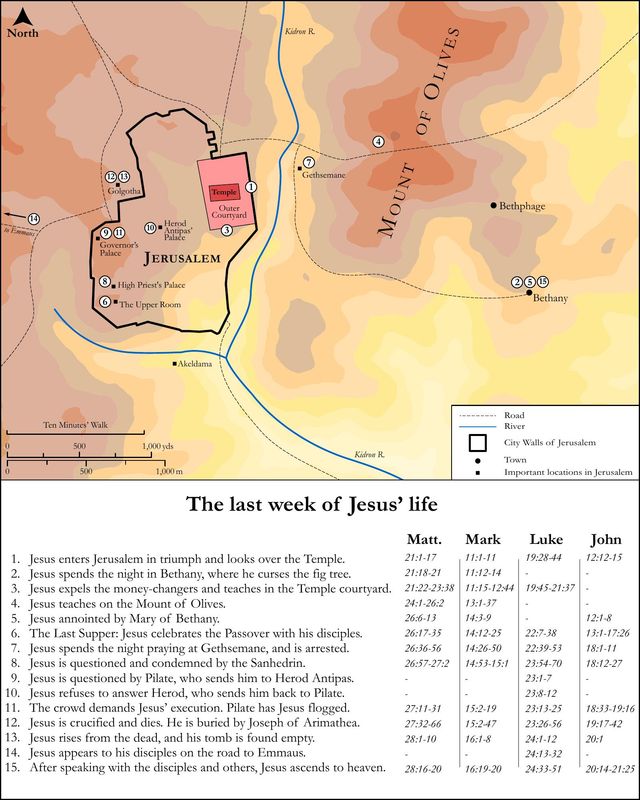
See on the biblical-era maps
Study this verse
Public-domain commentary
Matthew Henry
From his Commentary on the Whole Bible. Henry comments on passages, not single verses — this entry covers John 14:4–11. His four-level outline is real structure in the source text, so it is rendered as structure.
Christ, having set the happiness of heaven before them as the end, here shows them himself as the way to it, and tells them that they were better acquainted both with the end they were to aim at and with the way they were to walk in than they thought they were: You know, that is, 1. "You may know; it is none of the secret things which belong not to you, but one of the things revealed; you need not ascend into heaven, nor go down into the deep, for the word is nigh you (Rom 10:6-8), level to you." 2. "You do know; you know that which is the home and which is the way, though perhaps not as the home and as the way. You have been told it, and cannot but know, if you would recollect and consider it." Note, Jesus Christ is willing to make the best of his people's knowledge, though they are weak and defective in it. He knows the good that is in them better than they do themselves, and is certain that they have that knowledge, and faith, and love, of which they themselves are not sensible, or not certain.
This word of Christ gave occasion to two of his disciples to address themselves to him, and he answers them both.
I.Thomas enquired concerning the way (Joh 14:5), without any apology for contradicting his Master.
1.He said, "Lord, we know not whither thou goest, to what place or what state, and how can we know the way in which we must follow thee? We can neither guess at it, nor enquire it out, but must still be at a loss." Christ's testimony concerning their knowledge made them more sensible of their ignorance, and more inquisitive after further light. Thomas here shows more modesty than Peter, who thought he could follow Christ now. Peter was the more solicitous to know whither Christ went. Thomas here, though he complains that he did not know this, yet seems more solicitous to know the way. Now,
(1.)His confession of his ignorance was commendable enough. If good men be in the dark, and know but in part, yet they are willing to own their defects. But,
(2.)The cause of his ignorance was culpable. They knew not whither Christ went, because they dreamed of a temporal kingdom in external pomp and power, and doted upon this, notwithstanding what he had said again and again to the contrary. Hence it was that, when Christ spoke of going away and their following him, their fancy ran upon his going to some remarkable city or other, Bethlehem, or Nazareth, or Capernaum, or some of the cities of the Gentiles, as David to Hebron, there to be anointed king, and to restore the kingdom to Israel; and which way this place lay, where these castles in the air were to be built, east, west, north, or south, they could not tell, and therefore knew not the way. Thus still we think ourselves more in the dark than we need be concerning the future state of the church, because we expect its worldly prosperity, whereas it is spiritual advancement that the promise points at. Had Thomas understood, as he might have done, that Christ was going to the invisible world, the world of spirits, to which spiritual things only have a reference, he would not have said, Lord, we do not know the way.
II.Now to this complaint of their ignorance, which included a desire to be taught, Christ gives a full answer, Joh 14:6, Joh 14:7.
Thomas had enquired both whither he went and what was the way, and Christ answers both these enquiries and makes good what he had said, that they would have needed no answer if they had understood themselves aright; for they knew him, and he was the way; they knew the Father, and he was the end; and therefore, whither I go you know, and the way you know. Believe in God as the end, and in me as the way (Joh 14:1), and you do all you should do.
(1.)He speaks of himself as the way, Joh 14:6. Dost thou not know the way? I am the way, and I only, for no man comes to the Father but by me. Great things Christ here saith of himself, showing us,
[1.]The nature of his mediation: He is the way, the truth, and the life.
First, Let us consider these first distinctly. 1. Christ is the way, the highway spoken of, Isa 35:8. Christ was his own way, for by his own blood he entered into the holy place (Heb 9:12), and he is our way, for we enter by him. By his doctrine and example he teaches us our duty, by his merit and intercession he procures our happiness, and so he is the way. In him God and man meet, and are brought together. We could not get to the tree of life in the way of innocency; but Christ is another way to it. By Christ, as the way an intercourse is settled and kept up between heaven and earth; the angels of God ascend and descend; our prayers go to God, and his blessings come to us by him; this is the way that leads to rest, the good old way. The disciples followed him, and Christ tells them that they followed the road, and, while they continued following him, they would never be out of their way. 2. He is the truth. (1.) As truth is opposed to figure and shadow. Christ is the substance of all the Old Testament types, which are therefore said to be figures of the true, Heb 9:24. Christ is the true manna (Joh 6:32), the true tabernacle, Heb 8:2. (2.) As truth is opposed to falsehood and error; the doctrine of Christ is true doctrine. When we enquire for truth, we need learn no more than the truth as it is in Jesus. (3.) As truth is opposed to fallacy and deceit; he is true to all that trust in him, as true as truth itself, Co2 1:20. 3. He is the life; for we are alive unto God only in and through Jesus Christ, Rom 6:11. Christ formed in us is that to our souls which our souls are to our bodies. Christ is the resurrection and the life.
Secondly, Let us consider these jointly, and with reference to each other. Christ is the way, the truth, and the life; that is, 1. He is the beginning, the middle, and the end. In him we must set out, go on, and finish. As the truth, he is the guide of our way; as the life, he is the end of it. 2. He is the true and living way (Heb 10:20); there are truth and life in the way, as well as at the end of it. 3. He is the true way to life, the only true way; other ways may seem right, but the end of them is the way of death.
[2.]The necessity of his mediation: No man cometh to the Father but by me. Fallen man must come to God as a Judge, but cannot come to him as a Father, otherwise than by Christ as Mediator. We cannot perform the duty of coming to God, by repentance and the acts of worship, without the Spirit and grace of Christ, nor obtain the happiness of coming to God as our Father without his merit and righteousness; he is the high priest of our profession, our advocate.
(2.)He speaks of his Father as the end (Joh 14:7): "If you had known me aright, you would have known my Father also; and henceforth, by the glory you have seen in me and the doctrine you have heard from me, you know him and have seen him." Here is,
[1.]A tacit rebuke to them for their dulness and carelessness in not acquainting themselves with Jesus Christ, though they had been his constant followers and associates: If you had known me - . They knew him, and yet did not know him so well as they might and should have known him. They knew him to be the Christ, but did not follow on to know God in him. Christ had said to the Jews (Joh 8:19): If you had known me, you would have known my Father also; and here the same to his disciples; for it is hard to say which is more strange, the wilful ignorance of those that are enemies to the light, or the defects and mistakes of the children of light, that have had such opportunities of knowledge. If they had known Christ aright, they would have known that his kingdom is spiritual, and not of this world; that he came down from heaven, and therefore must return to heaven; and then they would have known his Father also, would have known whither he designed to go, when he said, I go to the Father, to a glory in the other world, not in this. If we knew Christianity better, we should better know natural religion.
[2.]A favourable intimation that he was well satisfied concerning their sincerity, notwithstanding the weakness of their understanding: "And henceforth, from my giving you this hint, which will serve as a key to all the instructions I have given you hitherto, let me tell you, you know him, and have seen him, inasmuch as you know me, and have seen me;" for in the face of Christ we see the glory of God, as we see a father in his son that resembles him. Christ tells his disciples that they were not so ignorant as they seemed to be; for, though little children, yet they had known the Father, Jo1 2:13. Note, Many of the disciples of Christ have more knowledge and more grace than they think they have, and Christ takes notice of, and is well pleased with, that good in them which they themselves are not aware of; for those that know God do not all at once know that they know him, Jo1 2:3.
II.Philip enquired concerning the Father (Joh 14:8), and Christ answered him, Joh 14:9-11, where observe,
1.Philip's request for some extraordinary discovery of the Father. He was not so forward to speak as some others of them were, and yet, from an earnest desire of further light, he cries out, Show us the Father. Philip listened to what Christ said to Thomas, and fastened upon the last words, You have seen him. "Nay," says Philip, "that is what we want, that is what we would have: Show us the Father and it sufficeth us." (1.) This supposes an earnest desire of acquaintance with God as a Father. The petition is, "Show us the Father; give us to know him in that relation to us;" and this he begs, not for himself only, but for the rest of the disciples. The plea is, It sufficeth us. He not only professes it himself, but will pass his word for his fellow-disciples. Grant us but one sight of the Father, and we have enough. Jansenius saith, "Though Philip did not mean it, yet the Holy Ghost, by his mouth, designed here to teach us that the satisfaction and happiness of a soul consist in the vision and fruition of God," Psa 16:11; Psa 17:15. In the knowledge of God the understanding rests, and is at the summit of its ambition; in the knowledge of God as our Father the soul is satisfied; a sight of the Father is a heaven upon earth, fills us with joy unspeakable. (2.) As Philip speaks it here, it intimates that he was not satisfied with such a discovery of the Father as Christ thought fit to give them, but he would prescribe to him, and press upon him, something further and no less than some visible appearance of the glory of God, like that to Moses (Exo 33:22), and to the elders of Israel, Exo 24:9-11. "Let us see the Father with our bodily eyes, as we see thee, and it sufficeth us; we will trouble thee with no more questions, Whither goest thou?" And so it manifests not only the weakness of his faith, but his ignorance of the gospel way of manifesting the Father, which is spiritual, and not sensible. Such a sight of God, he thinks, would suffice them, and yet those who did thus see him were not sufficed, but soon corrupted themselves, and made a graven image. Christ's institutions have provided better for the confirmation of our faith than our own inventions would.
2.Christ's reply, referring him to the discoveries already made of the Father, Joh 14:9-11.
(1.)He refers him to what he had seen, Joh 14:9. He upbraids him with his ignorance and inadvertency: "Have I been so long time with you, now above three years intimately conversant with you, and yet hast thou not known me, Philip? Now, he that hath seen me hath seen the Father; and how sayest thou then, Show us the Father? Wilt thou ask for that which thou hast already?" Now here,
[1.]He reproves him for two things: First, For not improving his acquaintance with Christ, as he might have done, to a clear and distinct knowledge of him: "Hast thou not known me, Philip, whom thou hast followed so long, and conversed with so much?" Philip, the first day he came to him, declared that he knew him to be the Messiah (Joh 1:45), and yet to this day did not know the Father in him. Many that have good knowledge in the scripture and divine things fall short of the attainments justly expected from them, for want of compounding the ideas they have, and going on to perfection. Many know Christ, who yet do not know what they might know of him, nor see what they should see in him. That which aggravated Philip's dulness was that he had so long an opportunity of improvement: I have been so long time with thee. Note, The longer we enjoy the means of knowledge and grace, the more inexcusable we are if we be found defective in grace and knowledge. Christ expects that our proficiency should be in some measure according to our standing, that we should not be always babes. Let us thus reason with ourselves: "Have I been so long a hearer of sermons, a student in the scripture, a scholar in the school of Christ, and yet so weak in the knowledge of Christ, and so unskilful in the word of righteousness?" Secondly, He reproves him for his infirmity in the prayer made, Show us the Father. Note, Herein appears much of the weakness of Christ's disciples that they know not what to pray for as they ought (Rom 8:26), but often ask amiss (Jam 4:3), for that which either is not promised or is already bestowed in the sense of the promise, as here.
[2.]He instructs him, and gives him a maxim which not only in general magnifies Christ and leads us to the knowledge of God in him, but justifies what Christ had said (Joh 14:7): You know the Father, and have seen him; and answered what Philip had asked, Show us the Father. Why, saith Christ, the difficulty is soon over, for he that hath seen me hath seen the Father. First, All that saw Christ in the flesh might have seen the Father in him, if Satan had not blinded their minds, and kept them from a sight of Christ, as the image of God, Co2 4:4. Secondly, All that saw Christ by faith did see the Father in him, though they were not suddenly aware that they did so. In the light of Christ's doctrine they saw God as the father of lights; in the miracles they saw God as the God of power, the finger of God. The holiness of God shone in the spotless purity of Christ's life, and his grace in all the acts of grace he did.
(2.)He refers him to what he had reason to believe (Joh 14:10, Joh 14:11): "Believest thou not that I am in the Father, and the Father in me, and therefore that in seeing me thou hast seen the Father? Hast thou not believed this? If not, take my word for it, and believe it now."
[1.]See here what it is which we are to believe: That I am in the Father, and the Father in me; that is, as he had said (Joh 10:30), I and my Father are one. He speaks of the Father and himself as two persons, and yet so one as never any two were or can be. In knowing Christ as God of God, light of light, very God of very God, begotten, not made, and as being of one substance with the Father, by whom all things were made, we know the Father; and in seeing him thus we see the Father. In Christ we behold more of the glory of God than Moses did at Mount Horeb.
[2.]See here what inducements we have to believe this; and they are two: - We must believe it, First, For his word's sake: The words that I speak to you, I speak not of myself. See Joh 7:16, My doctrine is not mine. What he said seemed to them careless as the word of man, speaking his own thought at his own pleasure; but really it was the wisdom of God that indited it and the will of God that enforced it. He spoke not of himself only, but the mind of God according to the eternal counsels. Secondly, For his works' sake: The Father that dwelleth in me, he doeth them; and therefore believe me for their sake. Observe, 1. The Father is said to dwell in him ho en emoi menōn - he abideth in me, by the inseparable union of the divine and human nature: never had God such a temple to dwell in on earth as the body of the Lord Jesus, Joh 2:21. Here was the true Shechinah, of which that in the tabernacle was but a type. The fulness of the Godhead dwelt in him bodily, Col 2:9. The Father so dwells in Christ that in him he may be found, as a man where he dwells. Seek ye the Lord, seek him in Christ, and he will be found, for in him he dwells. 2. He doeth the works. Many words of power, and works of mercy, Christ did, and the Father did them in him; and the work of redemption in general was God's own work. 3. We are bound to believe this, for the very works' sake. As we are to believe the being and perfections of God for the sake of the works of creation, which declare his glory; so we are to believe the revelation of God to man in Jesus Christ for the sake of the works of the Redeemer, those mighty works which, by showing forth themselves (Mat 14:2), Show forth him, and God in him. Note, Christ's miracles are proofs of his divine mission, not only for the conviction of infidels, but for the confirmation of the faith of his own disciples, Joh 2:11; Joh 5:36; Joh 10:37.
Historical interpretation
Five Centuries of Reception
5 surviving comments on this verse. Each one is dated, so this reads as a timeline rather than a list.
Select a marker to jump to its quote. Markers stagger vertically where authors wrote within a few decades of each other.
If ye had known me, ye would have known the Father also: but henceforth ye know Him, and have seen Him." And now we come to Philip, who, roused with the expectation of seeing the Father, and not understanding in what sense he was to take "seeing the Father," says: "Show us the Father, and it sufficeth us.
(Hom. lxxiii. 2) If the Jews, who wished to be separated from Christ, asked whither He was going, much more would the disciples, who wished never to be separated from Him, be anxious to know it. So with much love, and, at the same time, fear, they proceed to ask: Thomas saith unto Him, Lord, we know not whither Thou goest; and how can we know the way?
(Hom. lxxiii. 2) For if, He says, ye have Me for your guide to the Father, ye shall certainly come to Him. Nor can ye come by any other way. (c. 6:44) Whereas He had said above, No man can come to Me, except the Father draw him, now He says, No man cometh unto the Father but by Me, thus equalling Himself to the Father. The next words explain, Whither I go ye know, and the way ye know. If ye had known Me, He says, ye should have known My Father also; i. e. If ye had known My substance and dignity, ye would have known the Father's. They did know Him, but not as they ought to do. Nor was it till afterwards, when the Spirit came, that they were fully enlightened. On this account He adds, And from henceforth ye know Him, know Him, that is, spiritually. And have seen Him, i. e. by Me; meaning that he who had seen Him, had seen the Father. They saw Him, however, not in His pure substance, but clothed in flesh.
(Tr. lxix. 1) Our Lord had said that they knew both, Thomas says that they knew neither. Our Lord cannot lie; they knew not that they did know. Our Lord proves that they did: Jesus saith unto Him, I am the way, the truth, and the life.
(de Verb. Dom. s. liv) As if He said, I am the way, whereby thou wouldest go; I am the truth, whereto thou wouldest go; I am the life, in which thou wouldest abide. The truth and the life every one understands (capit); but not every one hath found the way. Even the philosophers of the world have seen that God is the life eternal, the truth which is the end of all knowledge. And the Word of God, which is truth and life with the Father, by taking upon Him human nature, is made the way. Walk by the Man, and thou wilt arrive at God. For it is better to limp on the right way, than to walk ever so stoutly by the wrong.
(Tr. lxix. 2) They knew then the way, because they knew He was the way. But what need to add, the truth, and the life? Because they were yet to be told whither He went. He went to the truth; He went to the life. He went then to Himself, by Himself. But didst Thou leave Thyself, O Lord, to come to us? (c. 3.). I know that Thou tookest upon Thee the form of a servant; by the flesh Thou camest, remaining where Thou wast; by that Thou returnedst, remaining where Thou hadst come to. If by this then Thou camest, and returnedst, by this Thou wast the way, not only to us, to come to Thee, but also to Thyself to come, and to return again. And when Thou wentest to life, which is Thyself, Thou raisedst that same flesh of Thine from death to life. Christ therefore went to life, when His flesh arose from death to life. And since the Word is life, Christ went to Himself; Christ being both, in one person, i. e. Word-flesh. Again, by the flesh God came to men, the truth to liars; for God is true, but every man a liar. When then He withdrew Himself from men, and lifted up His flesh to that place in which no liar is, the same Christ, by the way, by which He being the Word became flesh, by Himself, i. e. by His flesh, by the same returned to Truth, which is Himself, which truth, even amongst the liars He maintained unto death. Behold I myself, if I make you understand what I say, do in a certain sense go to you, though I do not leave myself. And when I cease speaking, I return to myself, but remain with you, if ye remember what ye have heard. If the image which God hath made can do this, how much more the Image which God hath begotten? Thus He goes by Himself, to Himself and to the Father, and we by Him, to Him and to the Father.
We have now the opportunity, dearly beloved, as far as we can, of understanding the earlier words of the Lord from the later, and His previous statements by those that follow, in what you have heard was His answer to the question of the Apostle Thomas. For when the Lord was speaking above of the mansions, of which He both said that they already were in His Father's house, and that He was going to prepare them; where we understood that those mansions already existed in predestination, and are also being prepared through the purifying by faith of the hearts of those who are hereafter to inhabit them, seeing that they themselves are the very house of God; and what else is it to dwell in God's house than to be in the number of His people, since His people are at the same time in God, and God in them? To make this preparation the Lord departed, that by believing in Him, though no longer visible, the mansion, whose outward form is always hid in the future, may now by faith be prepared: for this reason, therefore, He had said, "And if I go away and prepare a place for you, I will come again, and receive you unto myself; that where I am, there ye may be also. And whither I go ye know, and the way ye know."
In reply to this "Thomas saith unto Him, Lord, we know not whither Thou goest: and how can we know the way?" Both of these the Lord had said that they knew; both of them this other declares that he does not know, to wit, the place to which, and the way whereby, He is going. But he does not know that he is speaking falsely; they knew, therefore, and did not know that they knew. He will convince them that they already know what they imagine themselves still to be ignorant of. "Jesus saith unto him, I am the way, and the truth, and the life." What, brethren, does He mean? See, we have just heard the disciple asking, and the Master instructing, and we do not yet, even after His voice has sounded in our ears, apprehend the thought that lies hid in His words. But what is it we cannot apprehend? Could His apostles, with whom He was talking, have said to Him, We do not know Thee? Accordingly, if they knew Him, and He Himself is the way, they knew the way; if they knew Him who is Himself the truth, they knew the truth; if they knew Him who is also the life, they knew the life. Thus, you see, they were convinced that they knew what they knew not that they knew.
What is it, then, that we also have not apprehended in this discourse? What else, think you, brethren, but just that He said, "And whither I go ye know, and the way ye know"? And here we have discovered that they knew the way, because they knew Him who is the way: the way is that by which we go; but is the way the place also to which we go? And yet each of these He said that they knew, both whither He was going, and the way. There was need, therefore, for His saying, "I am the way," in order to show those who knew Him that they knew the way, which they thought themselves ignorant of; but what need was there for His saying, "I am the way, and the truth, and the life," when, after knowing the way by which He went, they had still to learn whither He was going, but just because it was to the truth and to the life He was going? By Himself, therefore, He was going to Himself. And whither go we, but to Him, and by what way go we, but by Him? He, therefore, went to Himself by Himself, and we by Him to Him; yea, likewise both He and we go thus to the Father. For He says also in another place of Himself, "I go to the Father;" and here on our account He says, "No man cometh unto the Father but by me." And in this way, He goeth by Himself both to Himself and to the Father, and we by Him both to Him and to the Father.
How can our Lord say, If ye had known Me, ye should have known My Father also; when He has just said, Whither I go ye know, and the way ye know? We must suppose that some of them knew, and others not: among the latter, Thomas.
Continue studying John 14:5 across the web’s major study libraries — every link below opens this exact verse, chapter, or book on the destination site.
Read & Compare
 BibleGatewayThis verse in more than 200 translations and 70 languages.
 Bible.comThe YouVersion reader — hundreds of translations, reading plans, and highlights.
 ESV.orgCrossway's official English Standard Version reader.
 NET BibleThe NET translation with 60,000+ translators' notes on every rendering decision.
 STEP BibleTyndale House's free study tool — original text, vocabulary, and scholarly resources.
 BibliaLogos Bible Software's free web reader.
 USCCBThe New American Bible (Revised Edition) with the U.S. bishops' study notes.
Commentaries
 BibleHub CommentariesDozens of classic commentaries on this verse, gathered on one page.
 StudyLightMore than 100 commentary sets — the largest collection on the web.
 BibleRefPlain-English commentary on what this verse means, verse by verse.
 Enduring WordDavid Guzik's free commentary on this chapter, widely used by Bible teachers.
 Bible Study ToolsVerse commentary alongside Greek and Hebrew study aids.
Original Language & Research
- BibleHub InterlinearThe verse word by word — original language, transliteration, and English.
- BibleHub LexiconEvery word's original-language definition and Strong's entry.
 Blue Letter BibleDeep-study tools — Strong's numbers, concordance, and word studies.
 CNTR CollationThe earliest Greek manuscripts of this verse, collated letter by letter.
Sermons, Hymns & Audio


TrulyRandomVerse is not affiliated with these sites and doesn’t control their content. They’re linked because they’re genuinely useful.
Summary
John 14:5 captures Thomas's earnest, yet literal, inquiry during Jesus's Farewell Discourse. In response to Jesus's declaration that His disciples knew His destination and the way to it, Thomas, speaking for the group's confusion, admits their ignorance regarding where Jesus was going and, consequently, how they could possibly know the path to follow Him. This direct question serves as a crucial setup for one of Jesus's most profound self-revelations about His identity as the exclusive "Way."
Context
ShowHideLiterary Context
This verse is situated within Jesus's "Farewell Discourse" (John 13-17), delivered in the Upper Room on the night before His crucifixion. The preceding verses (John 14:1-4) show Jesus comforting His disciples, who are troubled by His impending departure and Peter's predicted denial. Jesus assures them of a future dwelling place with Him in His Father's house, stating, "And whither I go ye know, and the way ye know" John 14:4. Thomas's question in John 14:5 directly challenges this assertion, highlighting the disciples' literal understanding of Jesus's spiritual pronouncements and setting the stage for Jesus's pivotal self-identification in John 14:6.
Historical & Cultural Context
First-century Jewish disciples would have understood "the way" in both a literal sense (a physical road or journey) and a metaphorical sense, referring to a course of life, a teaching, or a religious path (e.g., "the Way of the Lord" in Isaiah 40:3 or "the Way" as a designation for early Christianity in Acts 9:2). However, their expectation of a Messiah who would establish an earthly kingdom led them to interpret Jesus's words about "going away" and "knowing the way" through a temporal, political lens rather than a spiritual, eternal one. They anticipated a physical journey or a strategic plan for the kingdom, not a spiritual departure to the Father.
Key Themes
ShowHideA pervasive theme throughout John's Gospel is the disciples' struggle to grasp the spiritual realities Jesus teaches, often interpreting His words literally (e.g., John 4:32-34 regarding food, or John 11:11-13 regarding Lazarus's sleep). Thomas's question exemplifies this, as he fails to comprehend Jesus's spiritual destination (the Father's house) and the spiritual nature of the "way" to get there. Thomas, often characterized by his directness and need for tangible proof (John 20:24-29), serves as a foil here. His blunt admission of ignorance, though seemingly a moment of doubt, becomes the very prompt for Jesus to deliver one of His most profound and exclusive claims, revealing Himself as the unique path to God. Thomas's inquiry about "the way" is central. While he seeks a literal route, Jesus's subsequent response redefines "the way" from a geographical path or a set of instructions to a personal relationship with Himself. This sets up the critical theological truth that salvation and access to God are found exclusively in Christ.
Exposition and Analysis
ShowHideKey Word Analysis
ShowHideDerived from a Chaldean word meaning "the twin," Thomas is one of Jesus's twelve disciples. He is often portrayed as practical, direct, and sometimes skeptical, famously requiring tangible proof of Jesus's resurrection in John 20:24-29. Here, his character is consistent, as he voices a literal and pragmatic question in response to Jesus's spiritual statements.
This verb primarily means "to see" (literally or figuratively), but in its perfect tense, as used here, it implies "to know" or "to have knowledge." Thomas's statement, "we know not," directly contradicts Jesus's prior assertion, "ye know," highlighting the disconnect between Jesus's spiritual understanding of their knowledge and the disciples' literal lack of information about His destination.
This multifaceted term can denote a literal "road" or "path," a "journey," or, metaphorically, a "course of conduct," a "doctrine," or the "means to an end." Thomas's question clearly uses hodós in its literal sense, seeking geographical directions. However, Jesus's response in John 14:6 dramatically redefines hodós as a personal, spiritual reality, identifying Himself as the singular "Way" to the Father.
Verse Breakdown
ShowHide"Thomas saith unto him, Lord, we know not whither thou goest;"
Thomas, addressing Jesus with the respectful title "Lord" (Greek, kýrios'), openly expresses the disciples' collective bewilderment. His "we know not" directly contradicts Jesus's previous statement in John 14:4, "And whither I go ye know." This indicates the disciples' profound misunderstanding of Jesus's impending departure (Greek, hypágō'), which Jesus intends as a spiritual return to the Father, but which they perceive as a physical, unexplained journey.
"and how can we know the way?"
This second clause logically follows the first. If they do not know Jesus's destination ("whither thou goest"), then it is impossible for them to know "the way" (Greek, hodós') to that unknown place. Thomas's question, using the interrogative "how" (Greek, pōs'), seeks practical instruction or a map. It reveals their literal-mindedness and their inability to grasp the spiritual, metaphorical sense of "the way" that Jesus has in mind. The phrase "can we know" (Greek, dýnamai_ _eídō') underscores their perceived inability to comprehend the path without explicit directions.
Literary Devices
ShowHideJohn 14:5 employs several literary devices that enrich its meaning and set the stage for Jesus's subsequent revelation. Dialogue is central, as Thomas's direct question serves as a pivotal moment in the discourse, moving the narrative forward and prompting Jesus's profound response. The verse also utilizes Irony, as Jesus has just stated, "And whither I go ye know, and the way ye know" John 14:4. Thomas's immediate contradiction ("we know not") highlights the disciples' limited, literal understanding versus Jesus's spiritual truth, creating a dramatic tension that is resolved in John 14:6. Furthermore, there is a subtle Foreshadowing at play; Thomas's question about "the way" directly anticipates Jesus's self-identification as "the Way," preparing the reader for this foundational theological declaration.
Theological and Thematic Connections
ShowHideThomas's question in John 14:5 is not merely a practical inquiry but a profound theological pivot. It exposes the inherent human limitation in comprehending divine realities without divine revelation. The disciples, like humanity, are lost without a clear path to God. This verse underscores the necessity of Jesus's subsequent declaration, establishing Him as the sole mediator and the exclusive means by which humanity can approach God the Father. It highlights the Christian understanding that salvation is not achieved through human effort, knowledge, or adherence to a set of rules, but through a personal relationship with Jesus Christ, who embodies the truth and life necessary for spiritual passage.
Reflection and Application
ShowHideThomas's honest, albeit literal, question in John 14:5 offers profound lessons for contemporary believers. It reminds us that it is permissible, even beneficial, to voice our uncertainties and confusion in our spiritual journey. Rather than feigning understanding or suppressing genuine doubts, we are invited to bring our questions directly to Jesus, just as Thomas did. His question serves as a model for authentic discipleship, demonstrating that vulnerability can open the door to deeper revelation. In a world offering countless "ways" to fulfillment or spiritual enlightenment, Thomas's inquiry also underscores our innate human need for clear direction and purpose. This verse encourages us to continually seek Jesus as the definitive answer to life's most fundamental questions, trusting that He will illuminate the path, even when it seems obscure.
Questions for Reflection
ShowHideFAQ
ShowHideWhy did Thomas ask this question if Jesus had just said, "ye know"?
ShowHideThomas's question highlights the disciples' persistent struggle to grasp the spiritual nature of Jesus's teachings, often interpreting them literally. When Jesus said, "And whither I go ye know, and the way ye know" John 14:4, He was referring to His spiritual return to the Father and the path of faith in Him. The disciples, however, were still thinking in terms of a physical departure and a literal journey, expecting an earthly kingdom. Thomas, ever practical and direct, voiced the collective confusion, admitting their ignorance of Jesus's physical destination and, consequently, how they could know the route to it. His question, though born of misunderstanding, served as a crucial catalyst for Jesus to articulate one of His most profound theological truths in John 14:6.
Does Thomas's question imply a lack of faith?
ShowHideWhile Thomas's question reveals a literal-mindedness and a lack of full spiritual comprehension, it doesn't necessarily imply a fundamental lack of faith. Instead, it demonstrates his honesty and earnest desire for clarity. Thomas was willing to admit his confusion, which is a sign of intellectual integrity, rather than pretending to understand. This openness allowed Jesus to provide a direct and foundational answer. Throughout the Gospels, the disciples frequently misunderstand Jesus's words (e.g., Matthew 16:6-12), but their faith, though imperfect, was still growing. Thomas's question is less about doubt in Jesus's person and more about confusion regarding His immediate plans and the spiritual realities He was conveying.
How does Thomas's question relate to the broader theme of "knowing" in John's Gospel?
ShowHideThe theme of "knowing" (Greek, eídō') is central to John's Gospel, often distinguishing between superficial understanding and true, experiential knowledge of God and Jesus. In John 14:5, Thomas admits "we know not," directly contrasting with Jesus's assertion that "ye know" John 14:4. This highlights the gap between human perception and divine truth. For John, true "knowing" is not merely intellectual assent but a relational, transformative understanding that comes through faith in Jesus. Jesus's subsequent declaration in John 14:6 reveals that to truly "know" the way to the Father is to "know" Jesus Himself, as He embodies that path. This concept of knowing is deeply tied to eternal life (John 17:3).
Christ-Centered Fulfillment
ShowHideThomas's bewildered question, "how can we know the way?" in John 14:5 finds its ultimate and glorious fulfillment in Jesus Christ Himself. The Old Testament often spoke of "the way of the Lord" (e.g., Isaiah 40:3) as a path of righteousness and obedience, but it remained a path that humanity struggled to perfectly walk. In Christ, this abstract concept becomes incarnate. Jesus does not merely show the way; He is the way, the truth, and the life, as He explicitly declares in John 14:6. His life, death, and resurrection constitute the very means by which humanity can access God. He is the new and living way (Hebrews 10:19-20) through the veil of His flesh, offering direct access to the Father that was once impossible. Therefore, Thomas's question, born of human limitation, serves as a divine setup for the revelation that the ultimate answer to humanity's lostness and search for purpose is found exclusively in the person of Jesus, the Lamb of God who takes away the sin of the world (John 1:29). He is the one through whom all who believe find their path to eternal life and communion with God (John 3:16).