


New Testament · Gospels · Book 43 of 66
John
The fourth Gospel: the eternal Word made flesh, his signs and sayings, his last night with his disciples, his death and resurrection, written “that ye might believe.”
- 21 chapters
- 879 verses
- About 87 minutes to read
- The Life of Jesus, c. 6 BC – AD 30
John begins before the creation: “In the beginning was the Word, and the Word was with God, and the Word was God” (John 1:1). Thirteen verses later that Word “was made flesh, and dwelt among us” (1:14). The rest of the book shows who he is. Through chapter 12 Jesus works signs before the people and explains them in discourses, many of them spoken in the temple at the feasts. In chapters 13 to 17 he speaks to his disciples alone on the night he is betrayed. Then he is lifted up on the cross, and rises.
The writer says why he chose what he set down: “these are written, that ye might believe that Jesus is the Christ, the Son of God; and that believing ye might have life through his name” (20:31). Three words carry that aim through the book: believe, life and witness. Two threads run beside them: the sayings in which Jesus says “I am,” and “the hour,” which is “not yet come” at Cana (2:4) and has come when Greeks ask to see him (12:23).
But these are written, that ye might believe that Jesus is the Christ, the Son of God; and that believing ye might have life through his name.
John 20:31 KJV
Before you read
- Who wrote it
- Not named. Its writer is “the disciple whom Jesus loved,” who leaned on Jesus’ breast at supper (21:20): “This is the disciple which testifieth of these things, and wrote these things” (21:24). Traditionally the apostle John, son of Zebedee. Eusebius records:
John, who reclined on the bosom of Jesus, has left us one Gospel
. - When it was written
- The book gives no date. Jerome records that John
most recently of all the evangelists wrote a Gospel, at the request of the bishops of Asia
. - When it happens
- Three passovers are named (2:13; 6:4; 11:55). Jesus goes up to Jerusalem at the passover, at “a feast of the Jews” (5:1), at tabernacles (7:2) and at the dedication, “and it was winter” (10:22). He is crucified on “the preparation of the passover” (19:14).
- To whom
- Readers who needed Hebrew words interpreted, such as Rabbi, Messias and Siloam (1:38; 1:41; 9:7), and Jewish customs explained (2:6; 4:9). The book addresses them directly: “that ye might believe” (20:31).
- About the text
- The KJV prints the account of the woman taken in adultery (7:53–8:11). Faithful Christians differ on whether it stood in John’s own text.
Those who receive the account as John’s own It stood in John’s Gospel from the first. Jerome found it
in many of both the Greek as well as the Latin copies
, and Augustine wrote that some, fearing it would seem to excuse sin,remove from their scriptural texts the account of our Lord’s pardon of the adulteress
.Grounds John 8:11Jerome 420 · Against the Pelagians 2.17Augustine of Hippo 430 · On Adulterous Marriages 2.7.6
Those who hold it was added to John’s text The account is an early record of the Lord’s mercy, kept by the church apart from John’s own text. The oldest Greek copies lack it, others place it elsewhere, and 7:52 reads on into 8:12. Eusebius notes that Papias told
another story of a woman, who was accused of many sins before the Lord
.Grounds John 7:52John 8:12Eusebius of Caesarea 339 · Church History (Book III), Chapter 39, Section 16
How John is laid out
8 movements · 111 passages · 879 verses
The Word made flesh
1:1–18 · 18 verses
The Word was in the beginning with God and was God; by him all things were made, and in him was the light of men. John comes to bear witness of that Light. His own receive him not, but to as many as receive him he gives power to become the sons of God. The Word is made flesh, and the only begotten Son declares the Father.
Witnesses and the first signs
1:19–4:54 · 148 verses
John tells the priests and Levites from Jerusalem that he is not the Christ, and points to Jesus: “Behold the Lamb of God.” Andrew, Peter, Philip and Nathanael follow. At Cana Jesus turns water into wine; at the passover he drives the traders from the temple. He tells Nicodemus a man must be born again, offers a Samaritan woman living water, and heals a nobleman’s son from afar.
21 passages
- 1:19–28 John Testifies to the Authorities
- 1:29–34 Behold, the Lamb of God
- 1:35–51 Jesus Gathers His First Disciples
- 2:1–12 The Wedding at Cana: Jesus' First Sign
- 2:13–22 Jesus Cleanses the Temple
- 2:23–25 Jesus Knows What is in Man
- 3:1–10 Jesus Teaches Nicodemus
- 3:11–15 The Son of Man Must Be Lifted Up
- 3:16–21 For God So Loved the World
- 3:22–26 Jesus and John the Baptist Baptize
- 3:27–30 John the Baptist Testifies to Jesus’ Supremacy
- 3:31–36 The Superiority of the One from Heaven
- 4:1–3 Jesus Departs for Galilee
- 4:4–6 Jesus Must Go Through Samaria
- 4:7–15 The Woman at the Well
- 4:16–19 Jesus Reveals Her Past
- 4:20–26 Worship in Spirit and Truth
- 4:27–38 The Urgent Call to Harvest
- 4:39–42 Many Samaritans Believe
- 4:43–45 Jesus Returns to Galilee
- 4:46–54 Healing the Nobleman’s Son
Life from the Son
Chapters 5–6 · 118 verses
At the pool of Bethesda Jesus heals a man on the sabbath and answers the charge: the Son does what he sees the Father do, and all judgment is committed to him. In Galilee he feeds five thousand and walks on the sea. At Capernaum he calls himself the bread of life; many go back, and Peter answers, “thou hast the words of eternal life.”
11 passages
- 5:1–9 Jesus Heals a Man at Bethesda
- 5:10–16 Controversy Over the Sabbath
- 5:17–30 Jesus Claims Equality with God
- 5:31–47 The Five Witnesses to Jesus
- 6:1–15 Jesus Feeds the Five Thousand
- 6:16–21 Jesus Walks on the Sea
- 6:22–34 The People Seek the Wrong Bread
- 6:35–50 Jesus Declares, 'I Am the Bread of Life'
- 6:51–59 The Bread of Life: Eating His Flesh
- 6:60–66 The Hard Saying and Division
- 6:67–71 Peter's Confession and Judas’s Betrayal
Tabernacles and the dedication
Chapters 7–10 · 195 verses
At the feast of tabernacles Jesus cries, “If any man thirst, let him come unto me, and drink,” and calls himself the light of the world. When he says, “Before Abraham was, I am,” they take up stones. He opens the eyes of a man born blind, who is cast out, and speaks as the good shepherd. At the dedication they take up stones again.
25 passages
- 7:1–10 Jesus and His Brothers Before the Feast
- 7:11–13 Secret Arrival and Public Debate
- 7:14–24 Jesus Teaches in the Temple
- 7:25–31 Debate Over Jesus' Identity and Origin
- 7:32–36 Officers Sent to Arrest Jesus
- 7:37–39 The Promise of Living Water
- 7:40–52 Division and the Failure to Arrest Jesus
- 7:53–8:11 The Woman Caught in Adultery
- 8:12–20 Jesus Declares Himself the Light of the World
- 8:21–30 Warning: You Shall Die in Your Sins
- 8:31–43 Discipleship and True Freedom
- 8:44–47 You Are of Your Father the Devil
- 8:48–59 Jesus Claims Pre-existence: Before Abraham, I Am
- 9:1–7 The Healing of a Man Born Blind
- 9:8–12 Neighbors and the Identity of the Healed Man
- 9:13–17 The Pharisees Investigate the Sabbath Miracle
- 9:18–23 Interrogation of the Parents
- 9:24–34 The Man Defends Jesus and Is Cast Out
- 9:35–38 Jesus Reveals Himself to the Healed Man
- 9:39–41 Jesus Pronounces Judgment on Blindness
- 10:1–6 The Parable of the Sheepfold
- 10:7–18 I Am the Good Shepherd
- 10:19–21 Division Among the Jews
- 10:22–38 Confrontation at the Feast of Dedication
- 10:39–42 Retreat to Perea and Growing Belief
Lazarus, and the hour
Chapters 11–12 · 107 verses
Jesus raises Lazarus, four days dead, at Bethany, and Caiaphas counsels that one man should die for the people. Mary anoints Jesus’ feet, and a crowd with palm branches hails him as King of Israel. When Greeks ask to see him, he says the hour is come for the Son of man to be glorified. Many still do not believe, as Esaias foretold.
10 passages
- 11:1–16 Lazarus is Sick; Jesus Delays
- 11:17–37 Jesus Encounters Martha and Mary
- 11:38–44 The Raising of Lazarus
- 11:45–53 The Plot to Kill Jesus
- 11:54–57 Jesus Withdraws; Passover Approaches
- 12:1–11 The Anointing at Bethany
- 12:12–19 The Triumphal Entry
- 12:20–36 Greeks Seek Jesus; The Hour Has Come
- 12:37–43 Summary of Israel's Unbelief
- 12:44–50 Jesus' Final Public Testimony
The upper room
Chapters 13–17 · 155 verses
Before the passover Jesus washes his disciples’ feet and gives them a new commandment, to love one another as he has loved them. Judas goes out into the night. Jesus tells the rest that he goes to prepare a place, that he is the way, and that the Comforter will come. He is the vine, they the branches. He prays for them and for those who will believe.
Lifted up
Chapters 18–19 · 82 verses
Judas brings a band to the garden over the brook Cedron; when Jesus says “I am he,” they go backward and fall. Peter denies him three times. Before Pilate Jesus says his kingdom is not of this world. Pilate finds no fault in him, yet delivers him to be crucified. Jesus dies saying “It is finished,” a soldier pierces his side, and Joseph and Nicodemus bury him.
10 passages
- 18:1–12 Jesus Is Arrested in the Garden
- 18:13–14 Jesus Before Annas and Caiaphas
- 18:15–27 Peter Denies Jesus
- 18:28–40 Jesus Before Pilate
- 19:1–10 Jesus Scourged and Mocked
- 19:11–16 Jesus Affirms Divine Authority
- 19:17–27 The Crucifixion
- 19:28–30 Death of Jesus: 'It is Finished'
- 19:31–37 The Piercing and Scriptural Fulfillment
- 19:38–42 Burial of Jesus
The risen Lord
Chapters 20–21 · 56 verses
Mary Magdalene finds the tomb empty, and the risen Jesus calls her by name. He shows the disciples his hands and his side and breathes on them, saying, “Receive ye the Holy Ghost.” Eight days later Thomas confesses, “My Lord and my God.” By the sea of Tiberias Jesus fills the disciples’ net, asks Peter three times, “lovest thou me?” and bids him feed his sheep.
9 passages
- 20:1–10 The Empty Tomb Discovered
- 20:11–18 Jesus Appears to Mary Magdalene
- 20:19–23 Jesus Appears to the Disciples
- 20:24–29 Doubting Thomas
- 20:30–31 The Purpose of John's Gospel
- 21:1–14 Jesus Appears by the Sea of Galilee
- 21:15–19 "Feed My Sheep"
- 21:20–23 The Destiny of the Beloved Disciple
- 21:24–25 Epilogue and Author's Testimony
The words John turns on
Its stated purpose joins three: signs written so that readers believe and have life. Witness runs through the book; abide fills the vine of chapter 15.
What John teaches
sēmeîon · sign
Signs, that ye might believe
John calls Jesus’ mighty works signs, and the KJV often renders the word “miracles.” At Cana Jesus “manifested forth his glory; and his disciples believed on him” (2:11), and the healing of the nobleman’s son is “the second miracle” (4:54). Most of the signs open into a discourse: the loaves into the bread of life (6:26–35), the blind man’s eyes into the light of the world (9:5), Lazarus into the resurrection and the life (11:25). They also divide. “How can a man that is a sinner do such miracles?” some of the Pharisees ask, “And there was a division among them” (9:16). After Lazarus the council says, “this man doeth many miracles” (11:47), and takes counsel to put him to death. The book closes its account of the signs with their purpose (20:30–31).
eimí · I am
The “I am” sayings
In seven sayings Jesus names himself with “I am”: the bread of life (6:35), the light of the world (8:12), the door (10:9), the good shepherd (10:11), the resurrection and the life (11:25), the way, the truth and the life (14:6), and the true vine (15:1). At other times the words stand alone. “Before Abraham was, I am,” he tells those who claim Abraham (8:58). He does not say that he was, but that he is, in the name God gave Moses at the bush: “I AM THAT I AM” (Exodus 3:14). They take up stones; after “I and my Father are one” they do so again, and say why: “because that thou, being a man, makest thyself God” (10:30–33). When he answers the band in the garden, “I am he,” they go backward and fall (18:6).
martyréō · witness
Bearing witness
The book is a record of witnesses. John the Baptist “came for a witness, to bear witness of the Light” (1:7). Charged with making himself equal with God, Jesus names the witnesses to him: John (5:33), the works the Father gave him to finish (5:36), the Father himself (5:37), and the scriptures, “they are they which testify of me” (5:39). In the upper room he promises that the Comforter “shall testify of me,” and adds, “ye also shall bear witness” (15:26–27). At the cross the writer sets down what he saw of the blood and water: “he that saw it bare record, and his record is true” (19:35). The last chapter ends on the same word: “we know that his testimony is true” (21:24).
hṓra · hour
The hour of glory
At Cana Jesus tells his mother, “mine hour is not yet come” (2:4). Twice no man lays hands on him, for “his hour was not yet come” (7:30; 8:20). When Greeks ask to see him he says, “The hour is come, that the Son of man should be glorified” (12:23), and speaks of the corn of wheat that must die to bring forth fruit. The hour is his death, which he calls being lifted up: “And I, if I be lifted up from the earth, will draw all men unto me,” and John adds, “This he said, signifying what death he should die” (12:32–33). On the last night he prays, “Father, the hour is come; glorify thy Son” (17:1). In John the cross is where the Son is glorified.
Christ in John
John sets Jesus where the Old Testament sets the LORD. Isaiah saw “the Lord sitting upon a throne, high and lifted up” (Isaiah 6:1). John quotes the same chapter on Israel’s unbelief and says, “These things said Esaias, when he saw his glory, and spake of him” (John 12:41). Jesus tells those who search the scriptures that Moses “wrote of me” (5:46).
He is also the sacrifice the law foreshadowed. John the Baptist calls him “the Lamb of God, which taketh away the sin of the world” (1:29). He is condemned on “the preparation of the passover” (19:14), and when the soldiers do not break his legs, John writes, “that the scripture should be fulfilled, A bone of him shall not be broken” (19:36). The law said of the passover lamb, “neither shall ye break a bone thereof” (Exodus 12:46), and Paul writes, “Christ our passover is sacrificed for us” (1 Corinthians 5:7). As Moses lifted up the serpent so that whoever looked on it lived, the Son of man was lifted up, “That whosoever believeth in him should not perish, but have eternal life” (John 3:14–15).
People
By how many verses name them
- PeterSon of Jona (Matthew 16:17); a brother of Andrew34
- Pilate20
- JohnA son of Zechariah and Elizabeth19
- LazarusA brother of Martha and Mary11
- MosesSon of Amram and Jochebed; a brother of Aaron and Miriam; husband of Zipporah11
- Philip11
- AbrahamSon of Terah; a brother of Nahor, Haran and Sarah9
- MarthaA sister of Mary and Lazarus9
29 more are named.
Places
28 named
- GalileeWhere the first two signs are done, at Cana15
- JerusalemWhere he goes up at the feasts, and where he is condemned13
- CapernaumIn its synagogue he teaches that he is the bread of life5
- JudaeaHe leaves it for Galilee, and returns to it for Lazarus5
- NazarethNathanael doubts it; Pilate’s title on the cross names it5
- CanaWhere water becomes wine, and a nobleman hears his son lives4
- SamariaHe talks with a woman at Jacob’s well; her town believes4
- BethanyThe town of Lazarus, Martha and Mary, fifteen furlongs from Jerusalem3
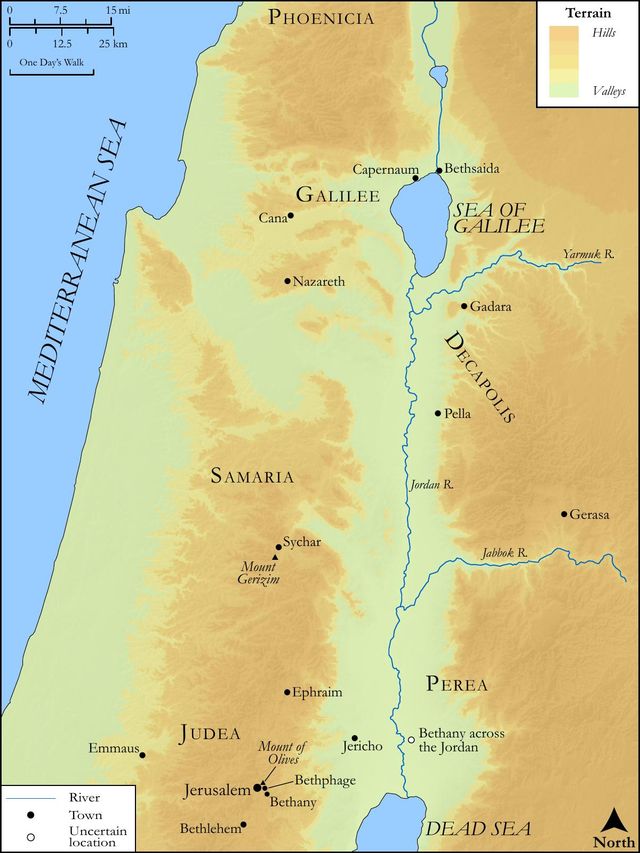
Where John reaches
The passages it leans on, and the ones that lean on it
John 1:1–3 Genesis 1:1 Colossians 1:16
“In the beginning”: the Word by whom all things were made, and Paul’s “by him were all things created.”
Angels of God ascending and descending: Jacob’s ladder at Bethel, now set upon the Son of man.
Born of water and of the Spirit: the clean water and the new spirit the LORD promised Israel.
The serpent of brass on a pole: whoever had been bitten looked on it and lived.
Water poured on the thirsty and the spirit on Jacob’s seed; John says Jesus spoke of the Spirit.
Books John links to most
The Church Fathers on John
5,981 quotations from 105 writers before AD 800 · the ten most quoted, in date order
- Tertullian220
- Origen253
- Cyprian258
- Hilary367
- Chrysostom407
- Theodore428
- Augustine430
- Cyril444
- Gregory604
- Bede735
Gregory of Nazianzus, on the Word who was in the beginning with God.
There never was a time when [the Father] was without his Word, or when he was not the Father.
Augustine, on the living bread that came down from heaven.
"I am the living bread, which came down from heaven." For that reason "living," because I came down from heaven. The manna also came down from heaven; but the manna was only a shadow, this is the truth.
Novatian, on “I and my Father are one.”
This word can be true of no human being, “I and the Father are one.” Christ alone declared this word out of the consciousness of his divinity.
Irenaeus cites the book’s purpose against those who divided Jesus from the Christ.
The Gospel knew no other Son of man but him who was of Mary, who also suffered. There was no Christ who flew away from Jesus before the passion. … this same person suffered and rose again, as John, the disciple of the Lord verifies
Keep studying
Articles