


John 7:52
Bible text: King James Version (1769 Blayney text) · Public domain
Bible text: King James Version with Strong's numbers · Public domain
Bible text: Berean Standard Bible · Public domain
Bible text: American Standard Version (1901) · Public domain
Bible text: World English Bible, Messianic edition · Public domain
Bible text: Geneva Bible (1599) · Public domain
Bible text: Young's Literal Translation · Public domain
- ἀπεκρίθησανapekrithēsanThey answeredG611V-ADI-3PVerb Aorist Middle Deponent Indicative 3rd Plural
- καὶkaiandG2532CONJConjunction
- εἶπανeipanthey saidG2036V-2AAI-3PVerb 2nd Aorist Active Indicative 3rd Plural
- αὐτῷ·autōto himG846P-DSMPersonal pronoun Dative Singular Masculine
- μὴmēSurely notG3361PRT-NNegative Particle Negative
- καὶkaialsoG2532CONJConjunction
- σὺsuyou yourselfG4771P-2NSPersonal pronoun Nominative 2nd Singular
- ἐκekfromG1537PREPPreposition
- τῆςtēs<the>G3588T-GSFDefinite article Genitive Singular Feminine
- ΓαλιλαίαςGalilaiasGalileeG1056N-GSF-LNoun Genitive Singular Feminine Location
- εἶ;eiare?G1510V-PAI-2SVerb Present Active Indicative 2nd Singular
- ἐραύνησονeraunēsondo searchG2045V-AAM-2SVerb Aorist Active Imperative 2nd Singular
- καὶkaiandG2532CONJConjunction
- ἴδεidedo seeG1492V-2AAM-2SVerb 2nd Aorist Active Imperative 2nd Singular
- ὅτιhotithatG3754CONJConjunction
- ἐκekout ofG1537PREPPreposition
- τῆςtēs<the>G3588T-GSFDefinite article Genitive Singular Feminine
- ΓαλιλαίαςGalilaiasGalileeG1056N-GSF-LNoun Genitive Singular Feminine Location
- προφήτηςprophētēsa prophetG4396N-NSMNoun Nominative Singular Masculine
- οὐκouknotG3756PRT-NNegative Particle Negative
- ἐγείρεταιegeiretaiis raisedG1453V-PPI-3SVerb Present Passive Indicative 3rd Singular
English is a literal word-by-word gloss of the Greek, not the KJV's wording. Why?
This is the original text the KJV's translators worked from — each Greek word with its own literal English meaning in this verse, prepared by scholars at Tyndale House, Cambridge. The KJV translates whole sentences, not word by word, so its wording differs: one Greek word can become several English words, and the KJV may choose “charity” where the gloss reads “love”. Both are faithful — they answer different questions. For the KJV's own rendering, switch to the KJV text.
Details
See on the biblical-era maps
Study this verse
Public-domain commentary
Matthew Henry
From his Commentary on the Whole Bible. Henry comments on passages, not single verses — this entry covers John 7:45–53. His four-level outline is real structure in the source text, so it is rendered as structure.
The chief priests and Pharisees are here in a close cabal, contriving how to suppress Christ; though this was the great day of the feast, they attended not the religious services of the day, but left them to the vulgar, to whom it was common for those great ecclesiastics to consign and turn over the business of devotion, while they thought themselves better employed in the affairs of church-policy. They sat in the council-chamber, expecting Christ to be brought a prisoner to them, as they had issued out warrants for apprehending him, Joh 7:32. Now here we are told,
I.What passed between them and their own officers, who returned without him, re infecta - having done nothing. Observe,
1.The reproof they gave the officers for not executing the warrant they gave them: Why have you not brought him? He appeared publicly; the people were many of them disgusted, and would have assisted them in taking him; this was the last day of the feast, and they would not have such another opportunity; "why then did you neglect your duty?" It vexed them that those who were their own creatures, who depended on them, and on whom they depended, into whose minds they had instilled prejudices against Christ, should thus disappoint them. Note, Mischievous men fret that they cannot do the mischief they would, Psa 112:10; Neh 6:16.
2.The reason which the officers gave for the non-execution of their warrant: Never man spoke like this man, Joh 7:46. Now,
(1.)This was a very great truth, that never any man spoke with that wisdom, and power, and grace, that convincing clearness, and that charming sweetness, wherewith Christ spoke; none of the prophets, no, not Moses himself.
(2.)The very officers that were sent to take him were taken with him, and acknowledged this. Though they were probably men who had no quick sense of reason or eloquence, and certainly had no inclination to think well of Jesus, yet so much self-evidence was there in what Christ said that they could not but prefer him before all those that sat in Moses's seat. Thus Christ was preserved by the power God has upon the consciences even of bad men.
(3.)They said this to their lords and masters, who could not endure to hear any thing that tended to the honour of Christ and yet could not avoid hearing this. Providence ordered it so that this should be said to them, that it might be a vexation in their sin and an aggravation of their sin. Their own officers, who could not be suspected to be biassed in favour of Christ, are witnesses against them. This testimony of theirs should have made them reflect upon themselves, with this thought, "Do we know what we are doing, when we are hating and persecuting one that speaks so admirably well?"
3.The Pharisees endeavour to secure their officers to their interest, and to beget in them prejudices against Christ, to whom they saw them begin to be well affected. They suggest two things: -
(1.)That if they embrace the gospel of Christ they will deceive themselves (Joh 7:47): Are you also deceived? Christianity has, from its first rise, been represented to the world as a great cheat upon it, and they that embraced it as men deceived, then when they began to be undeceived. Those that looked for a Messiah in external pomp thought those deceived who believed in a Messiah that appeared in poverty and disgrace; but the event declares that none were ever more shamefully deceived, nor put a greater cheat upon themselves, than those who promised themselves worldly wealth and secular dominion with the Messiah. Observe what a compliment the Pharisees paid to these officers: "Are you also deceived? What! men of your sense, and thought, and figure; men that know better than to be imposed upon by every pretender and upstart teacher?" They endeavour to prejudice them against Christ by persuading them to think well of themselves.
(2.)That they will disparage themselves. Most men, even in their religion, are willing to be governed by the example of those of the first rank; these officers therefore, whose preferments, such as they were, gave them a sense of honour, are desired to consider,
[1.]That, if they become disciples of Christ, they go contrary to those who were persons of quality and reputation: "Have any of the rulers, or of the Pharisees, believed on him? You know they have not, and you ought to be bound up by their judgment, and to believe and do in religion according to the will of your superiors; will you be wiser than they?" Some of the rulers did embrace Christ (Mat 9:18; Joh 4:53), and more believed in him, but wanted courage to confess him (Joh 12:42); but, when the interest of Christ runs low in the world, it is common for its adversaries to represent it as lower than really it is. But it was too true that few, very few, of them did. Note, First, The cause of Christ has seldom had rulers and Pharisees on its side. It needs not secular supports, nor proposes secular advantages, and therefore neither courts nor is courted by the great men of this world. Self-denial and the cross are hard lessons to rulers and Pharisees. Secondly, This has confirmed many in their prejudices against Christ and his gospel, that the rulers and Pharisees have been no friends to them. Shall secular men pretend to be more concerned about spiritual things than spiritual men themselves, or to see further into religion than those who make its study their profession? If rulers and Pharisees do not believe in Christ, they that do believe in him will be the most singular, unfashionable, ungenteel people in the world, and quite out of the way of preferment; thus are people foolishly swayed by external motives in matters of eternal moment, are willing to be damned for fashion-sake, and to go to hell in compliment to the rulers and Pharisees.
[2.]That they will link themselves with the despicable vulgar sort of people (Joh 7:43): But this people, who know not the law, are cursed, meaning especially those that were well-affected to the doctrine of Christ. Observe, First, How scornfully and disdainfully they speak of them: This people. It is not laos, this lay-people, distinguished from them that were the clergy, but ochlos outos, this rabble-people, this pitiful, scandalous, scoundrel people, whom they disdained to set with the dogs of their flock though God had set them with the lambs of his. If they meant the commonalty of the Jewish nation, they were the seed of Abraham, and in covenant with God, and not to be spoken of with such contempt. The church's common interests are betrayed when any one part of it studies to render the other mean and despicable. If they meant the followers of Christ, though they were generally persons of small figure and fortune, yet by owning Christ they discovered such a sagacity, integrity, and interest in the favours of Heaven, as made them truly great and considerable. Note, As the wisdom of God has often chosen base things, and things which are despised, so the folly of men has commonly debased and despised those whom God has chosen. Secondly, How unjustly they reproach them as ignorant of the word of God: They know not the law; as if none knew the law but those that knew it from them, and no scripture-knowledge were current but what came out of their mint; and as if none knew the law but such as were observant of their canons and traditions. Perhaps many of those whom they thus despised knew the law, and the prophets too, better than they did. Many a plain, honest, unlearned disciple of Christ, by meditation, experience, prayers, and especially obedience, attains to a more clear, sound, and useful knowledge of the word of God, than some great scholars with all their wit and learning. Thus David came to understand more than the ancients and all his teachers, Psa 119:99, Psa 119:100. If the common people did not know the law, yet the chief priests and Pharisees, of all men, should not have upbraided them with this; for whose fault was it but theirs, who should have taught them better, but, instead of that, took away the key of knowledge? Luk 11:52. Thirdly, How magisterially they pronounce sentence upon them: they are cursed, hateful to God, and all wise men; epikatartoi - an execrable people. It is well that their saying they were cursed did not make them so, for the curse causeless shall not come. It is a usurpation of God's prerogative, as well as great uncharitableness, to say of any particular persons, much more of any body of people, that they are reprobates. We are unable to try, and therefore unfit to condemn, and our rule is, Bless, and curse not. Some think they meant no more than that the people were apt to be deceived and made fools of; but they use this odious word, They are cursed, to express their own indignation, and to frighten their officers from having any thing to do with them; thus the language of hell, in our profane age, calls every thing that is displeasing cursed, and damned, and confounded. Now, for aught that appears, these officers had their convictions baffled and stifled by these suggestions, and they never enquire further after Christ; one word from a ruler or Pharisee will sway more with many than the true reason of things, and the great interests of their souls.
II.What passed between them and Nicodemus, a member of their own body, Joh 7:50, etc. Observe,
1.The just and rational objection which Nicodemus made against their proceedings. Even in their corrupt and wicked sanhedrim God left not himself quite without witness against their enmity; nor was the vote against Christ carried nemine contradicente - unanimously. Observe,
(1.)Who it was that appeared against them; it was Nicodemus, he that came to Jesus by night, being one of them, Joh 7:50. Observe, concerning him,
[1.]That, though he had been with Jesus, and taken him for his teacher, yet he retained his place in the council, and his vote among them. Some impute this to his weakness and cowardice, and think it was his fault that he did not quit his place, but Christ had never said to him, Follow me, else he would have done as others that left all to follow him; therefore it seems rather to have been his wisdom not immediately to throw up his place, because there he might have opportunity of serving Christ and his interest, and stemming the tide of the Jewish rage, which perhaps he did more than we are aware of. He might there be as Hushai among Absalom's counsellors, instrumental to turn their counsels into foolishness. Though we must in no case deny our Master, yet we may wait for an opportunity of confessing him to the best advantage. God has his remnant among all sorts, and many times finds, or puts, or makes, some good in the worst places and societies. There was Daniel in Nebuchadnezzar's court, and Nehemiah in Artaxerxes's.
[2.]That though at first he came to Jesus by night, for fear of being known, and still continued in his post; yet, when there was occasion, he boldly appeared in defence of Christ, and opposed the whole council that were set against him. Thus many believers who at first were timorous, and ready to flee at the shaking of a leaf, have at length, by divine grace, grown courageous, and able to laugh at the shaking of a spear. Let none justify the disguising of their faith by the example of Nicodemus, unless, like him, they be ready upon the first occasion openly to appear in the cause of Christ, though they stand alone in it; for so Nicodemus did here, and Joh 19:39.
(2.)What he alleged against their proceedings (Joh 7:51): Doth our law judge any man before it hear him (akousē par' autou - hear from himself) and know what he doeth? By no means, nor doth the law of any civilized nation allow it. Observe,
[1.]He prudently argues from the principles of their own law, and an incontestable rule of justice, that no man is to be condemned unheard. Had he urged the excellency of Christ's doctrine or the evidence of his miracles, or repeated to them his divine discourse with him (ch. 3), it had been but to cast pearls before swine, who would trample them under their feet, and would turn again and rend him; therefore he waives them.
[2.]Whereas they had reproached the people, especially the followers of Christ, as ignorant of the law, he here tacitly retorts the charge upon themselves, and shows how ignorant they were of some of the first principles of the law, so unfit were they to give law to others.
[3.]The law is here said to judge, and hear, and know, when magistrates that govern and are governed by it judge, and hear, and know; for they are the mouth of the law, and whatsoever they bind and loose according to the law is justly said to be bound and loosed by the law.
[4.]It is highly fit that none should come under the sentence of the law, till they have first by a fair trial undergone the scrutiny of it. Judges, when they receive the complaints of the accuser, must always reserve in their minds room for the defence of the accused, for they have two ears, to remind them to hear both sides; this is said to be the manner of the Romans, Act 25:18. The method of our law is Oyer and Terminer, first to hear and then to determine.
[5.]Persons are to be judged, not by what is said of them, but by what they do. Our law will not ask what men's opinions are of them, or out-cries against them, but, What have they done? What overt-acts can they be convicted of? Sentence must be given, secundum allegata et probata - according to what is alleged and proved. Facts, and not faces, must be known in judgment; and the scale of justice must be used before the sword of justice.
Now we may suppose that the motion Nicodemus made in the house upon this was, That Jesus should be desired to come and give them an account of himself and his doctrine, and that they should favour him with an impartial and unprejudiced hearing; but, though none of them could gainsay his maxim, none of them would second his motion.
2.What was said to this objection. Here is no direct reply given to it; but, when they could not resist the force of his argument, they fell foul upon him, and what was to seek in reason they made up in railing and reproach. Note, It is a sign of a bad cause when men cannot bear to hear reason, and take it as an affront to be reminded of its maxims. Whoever are against reason give cause to suspect that reason is against them. See how they taunt him: Art thou also of Galilee? Joh 7:52. Some think he was well enough served for continuing among those whom he knew to be enemies to Christ, and for his speaking no more on the behalf of Christ than what he might have said on behalf of the greatest criminal - that he should not be condemned unheard. Had he said, "As for this Jesus, I have heard him myself, and know he is a teacher come from God, and you in opposing him fight against God," as he ought to have said, he could not have been more abused than he was for this feeble effort of his tenderness for Christ. As to what they said to Nicodemus, we may observe,
(1.)How false the grounds of their arguing were, for,
[1.]They suppose that Christ was of Galilee, and this was false, and if they would have been at the pains of an impartial enquiry they would have found it so.
[2.]They suppose that because most of his disciples were Galileans they were all such, whereas he had abundance of disciples in Judea.
[3.]They suppose that out of Galilee no prophet had risen, and for this appeal to Nicodemus's search; yet this was false too: Jonah was of Gath-hepher, Nahum an Elkoshite, both of Galilee. Thus do they make lies their refuge.
(2.)How absurd their arguings were upon these grounds, such as were a shame to rulers and Pharisees.
[1.]Is any man of worth and virtue ever the worse for the poverty and obscurity of his country? The Galileans were the seed of Abraham; barbarians and Scythians are the seed of Adam; and have we not all one Father?
[2.]Supposing no prophet had risen out of Galilee, yet it is not impossible that any should arise thence. If Elijah was the first prophet of Gilead (as perhaps he was), and if the Gileadites were called fugitives, must it therefore be questioned whether he was a prophet or no?
3.The hasty adjournment of the court hereupon. They broke up the assembly in confusion, and with precipitation, and every man went to his own house. They met to take counsel together against the Lord and his Anointed, but they imagined a vain think; and not only he that sits in heaven laughed at them, but we may sit on earth and laugh at them too, to see all the policy of the close cabal broken to pieces with one plain honest word. They were not willing to hear Nicodemus, because they could not answer him. As soon as they perceived they had one such among them, they saw it was to no purpose to go on with their design, and therefore put off the debate to a more convenient season, when he was absent. Thus the counsel of the Lord is made to stand, in spite of the devices in the hearts of men.
Historical interpretation
Four Centuries of Reception
10 surviving comments on this verse. Each one is dated, so this reads as a timeline rather than a list.
Select a marker to jump to its quote. Markers stagger vertically where authors wrote within a few decades of each other.
Being therefore perplexed, because they had said, "None of the rulers hath believed on him," they addressed him, neither vehemently, nor yet with forbearance. For tell me, after he had said, "The Law judgeth no man," how doth it follow that they should say, "Art thou also of Galilee?" When they ought to have shown that they had not sent to summon Him without judgment, or that it was not fitting to allow Him speech, they take the reply rather in a rough and angry manner. "Search, and look: for out of Galilee hath arisen no prophet." Why, what had the man said? that Christ was a prophet? No; he said, that He ought not to be slain unjudged; but they replied insolently, and as to one who knew nothing of the Scriptures; as though one had said, "Go, learn," for this is the meaning of, "Search, and look."
What then? Shall one blame God for this? Away with the thought. This blame is theirs. And what other proof can a man bring of your not knowing the Law than your not obeying it? For when they had said, "Hath any of the rulers believed on him?" and, "These who know not the Law," Nicodemus in fair consequence upbraids them, saying, "Doth our law judge any man before it hear him?" He showeth that they neither know the Law, nor do the Law; for if that Law commandeth to kill no man without first hearing him, and they before hearing were eager for this deed, they were transgressors of the Law. And because they said, "None of the rulers hath believed on him", therefore the Evangelist informs us that Nicodemus was "one of them," to show that even rulers believed on Him; for although they showed not yet fitting boldness, still they were becoming attached to Christ.
(Hom. lii. 1) As they said that none of the rulers believed on Him, the Evangelist contradicts them: Nicodemus saith unto them, (he that came to Jesus by night, being one of them.)
(Hom. lii. 1, 2) Nicodemus shows that they knew the law, and did not act according to the law. They, instead of disproving this, take to rude and angry contradiction: They answered and said unto him, Art thou also of Galilee?
(Hom. lii. 2.) Then, by way of insult, they direct Him to the Scriptures, as if He were ignorant of them; Search and look, for out of Galilee ariseth no prophet: as if to say, Go, learn what the Scriptures say.
Observe how cautiously he rebukes them; he said not, "Ye desire to kill him, and condemn the man for a deceiver without proof"; but spake in a milder way, hindering their excessive violence, and their inconsiderate and murderous disposition. Wherefore he turns his discourse to the Law, saying, "Except it hear him carefully, and know what he doeth." So that not a bare "hearing," but "careful hearing" is required. For the meaning of, "know what he doeth," is, "what he intendeth," "on what account," "for what purpose," "whether for the subversion of the order of things and as an enemy."
It is evident that not all the doctors approved what they were doing, since one of the doctors was Nicodemus, who replied against their words.
Nicodemus, either out of weakness or fear of the doctors, did not reply to them when they wanted to diminish the words and works of Christ by mentioning Galilee.
They answered, from the prejudice of their heart, what they had answered to those officers, "Art thou also a Galilean?" That is, one seduced as it were by the Galilean. For the Lord was said to be a Galilean, because His parents were from the city of Nazareth. I have said "His parents" in regard to Mary, not as regards the seed of man; for on earth He sought but a mother, He had already a Father on high. For His nativity on both sides was marvellous: divine without mother, human without father. What, then, said those would-be doctors of the law to Nicodemus? "Search the Scriptures, and see that out of Galilee ariseth no prophet." Yet the Lord of the prophets arose thence.
(Tract. xxxiii. 2) i. e. led away by a Galilean. Our Lord was called a Galilean, because His parents were of the town of Nazareth; I mean by parents, Mary.
(Tract. xxxiii. 2.) No prophet indeed ariseth out of Galilee, but the Lord of prophets arose thence.
Being a Jew (it says) and home-born, why dost thou feign to have no knowledge of the Galileans, and art strangely co-ignorant of our matters with those who are absolutely ignorant? and being most conversant with the most sacred Scriptures, and versed in tho appointments of the Law, whence knewest thou not (he says) that it is not possible to look for a Prophet out of the Galilaeans? This then is the aim of the Pharisees' words. But we must notice this again: they spurn the multitudes as knowing nought of the things they ought to have had accurate knowledge of, and finding fault with their extreme want of learning, and loathing them and haughtily styling them uninstructed, themselves are caught sick of yet worse, and no wise differing from their inexperience. For those on receiving the miracles done through Christ, and gathering little by little faith in Him, at one time said, Christ when He cometh, will He do more miracles than these which this man. hath done? at another time drawn off from so right an opinion, they missed only from Nazareth being situate in Galilee wherein the Divine Scripture proclaims that the Lord was brought up, and they therefore said, Doth Christ come out of Galilee? said not the Scripture that of the seed of David and out of Bethlehem the village where David was, Christ cometh? But these loudly laughing at the ill-instructedness of the people and calling them cursed therefore, were in no superiority to their ignorance. For see they too say, Search and see that out of Galilee hath not arisen a prophet.
But one may with reason moved against them say, O ye who yield to none the palm in ill-instructedness, ye who have missed and are hard, where is the boast of your pride, a footprint of wisdom in you? where the understanding that belongs to those learned in the Law? for we ought not to doubt of our Saviour Christ, but to believe, nothing hesitating, God the Father saying of Him to holy Moses, A Prophet will I raise them up from among their brethren like unto thee. From among their brethren, how must it not surely mean of the Jews and of Israel? Verily ye shall not need accusers from without, yourselves of yourselves shall be convicted of being without understanding. For whereas our Saviour Christ teacheth and openly saith, I have come down from heaven not to do Mine own will but the will of Him That sent Me, ye were then thinking bitter things, and full besides of no slight wrath, ye said again, Is not this Jesus the son of Joseph, whose father and mother WE know? how saith He now, I have come down from heaven? Since then thou confessedst in plain words that thou knewest exactly His father and mother, thou knewest surely that He is of the root of Israel: how then saidst thou that He was a Galilaean Who was born of Jews? how an alien Who was of Israel? for not surely the having been brought up in Galilee, and having spent some time there, removes him that is of Israel from his race, since nought would hinder him that is sprung of Galilaeans from being a Jew by race if he should come into the land of the Jews. Vain therefore is it for the Pharisees wise in their own conceits to say of Christ our Saviour, that out of Galilee hath not arisen a Prophet. For they should rather have enquired how it was that He Who was of Jewish parents came to be a Galilaean, and so at length to consider His bringing up at Nazareth, and not on this account stray away from believing.
But we must observe again that no wise able to find fault |562 with His miracles, albeit whetted to the uttermost hostility, they gainsay from merely His country, since He was (according to their surmise) from Galilee. Their suspicion thence being therefore loosed, not doubtful at length would have been their faith, if they had been wise
They knew the place where He had resided, but never thought of enquiring where He was born; and therefore they not only denied that He was the Messiah, but even that He was a prophet.
Continue studying John 7:52 across the web’s major study libraries — every link below opens this exact verse, chapter, or book on the destination site.
Read & Compare
 BibleGatewayThis verse in more than 200 translations and 70 languages.
 Bible.comThe YouVersion reader — hundreds of translations, reading plans, and highlights.
 ESV.orgCrossway's official English Standard Version reader.
 NET BibleThe NET translation with 60,000+ translators' notes on every rendering decision.
 STEP BibleTyndale House's free study tool — original text, vocabulary, and scholarly resources.
 BibliaLogos Bible Software's free web reader.
 USCCBThe New American Bible (Revised Edition) with the U.S. bishops' study notes.
Commentaries
 BibleHub CommentariesDozens of classic commentaries on this verse, gathered on one page.
 StudyLightMore than 100 commentary sets — the largest collection on the web.
 BibleRefPlain-English commentary on what this verse means, verse by verse.
 Enduring WordDavid Guzik's free commentary on this chapter, widely used by Bible teachers.
 Bible Study ToolsVerse commentary alongside Greek and Hebrew study aids.
Original Language & Research
- BibleHub InterlinearThe verse word by word — original language, transliteration, and English.
- BibleHub LexiconEvery word's original-language definition and Strong's entry.
 Blue Letter BibleDeep-study tools — Strong's numbers, concordance, and word studies.
 CNTR CollationThe earliest Greek manuscripts of this verse, collated letter by letter.
Sermons, Hymns & Audio


TrulyRandomVerse is not affiliated with these sites and doesn’t control their content. They’re linked because they’re genuinely useful.
Summary
John 7:52 encapsulates the deep-seated prejudice and spiritual blindness of the Jewish religious authorities against Jesus, stemming from their contempt for His Galilean association. In response to Nicodemus's plea for due process, these leaders dismissively challenge his allegiance and assert a factually incorrect claim that no prophet ever arises from Galilee, thereby attempting to discredit Jesus based on a geographical bias rather than engaging with His teachings or miraculous works.
Context
ShowHideLiterary Context
This verse is situated at a critical juncture during the Feast of Tabernacles, as detailed in John 7. Jesus has been teaching openly in the temple, causing division among the people, with some believing Him to be the Christ and others seeking to arrest Him. The temple guards, sent to apprehend Jesus, return empty-handed, captivated by His words (John 7:45-46). This infuriates the Pharisees, who then question the guards and express their disdain for the common people who believe in Jesus (John 7:47-49). It is at this moment that Nicodemus, a Pharisee and member of the Sanhedrin who had previously visited Jesus by night (John 3:1-2), interjects, reminding them of the legal principle that a person should not be condemned without a hearing (John 7:50-51). The collective "they" in John 7:52 are the other Pharisees and chief priests, whose immediate, hostile retort to Nicodemus serves to shut down any further discussion and reinforce their prejudiced stance against Jesus.
Historical & Cultural Context
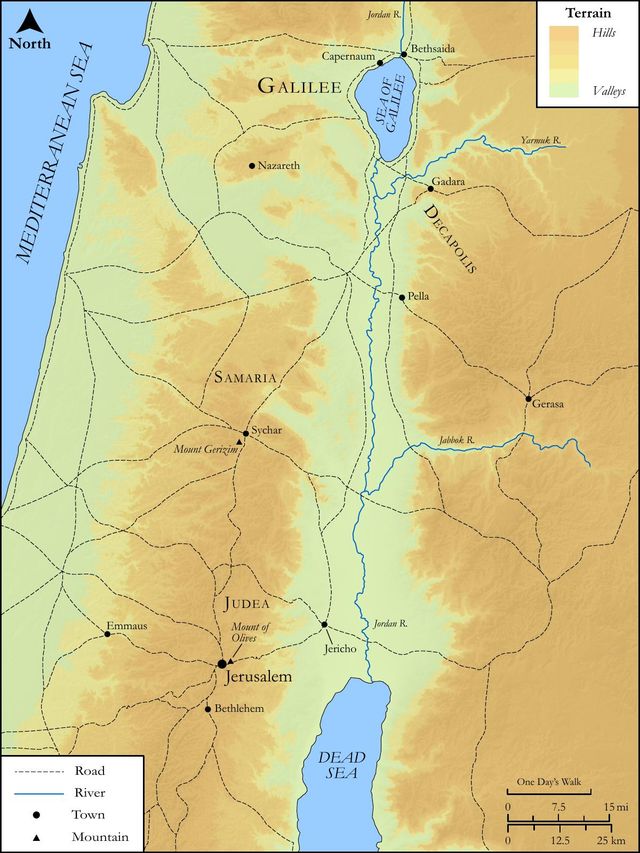
Galilee, a region in northern Palestine, was often viewed with disdain by the religious elite in Judea, particularly Jerusalem. It was considered a more Hellenized, less religiously pure, and less learned area, populated by a mix of Jews and Gentiles. The phrase "Galilee of the Gentiles" (Isaiah 9:1) reflected this perception. Judeans often looked down upon Galileans, viewing them as unsophisticated and prone to rebellion. This prejudice was deeply ingrained, leading to the assumption that no significant religious figure, especially a prophet, could originate from such a region. The Sanhedrin, the supreme Jewish judicial body, was based in Jerusalem, further solidifying the Judean perspective as the normative one. The leaders' question, "Art thou also of Galilee?", was a loaded rhetorical jab, intended to shame Nicodemus by associating him with the despised region and, by extension, with Jesus.
Key Themes
ShowHideThis verse powerfully illustrates several recurring themes in John's Gospel and the broader biblical narrative. Firstly, it highlights Spiritual Blindness and the Rejection of Truth by those who claim to possess the greatest insight. Despite their extensive knowledge of the Scriptures, the religious leaders' preconceived notions and prejudices prevent them from recognizing Jesus as the Messiah, who fulfills prophecies even about His humble origins (Isaiah 53:2-3). Secondly, it underscores the theme of Prejudice and Misconception, demonstrating how societal biases can override objective truth and lead to unjust condemnation. The leaders' assertion about Galilee was factually incorrect, as prophets like Jonah were from Gath Hepher in Galilee (2 Kings 14:25). This reveals their selective interpretation of Scripture and their unwillingness to genuinely "search" as they commanded. Finally, the verse subtly points to the Divine Paradox of God working through unexpected means and places, challenging human wisdom and societal norms, a theme echoed in the New Testament's emphasis on God choosing the humble and despised things of the world (1 Corinthians 1:27-29).
Exposition and Analysis
ShowHideKey Word Analysis
ShowHideOf Hebrew origin (גָּלִיל), referring to a region of Palestine, specifically "the heathen circle." This term carries the weight of the Judean elite's contempt for the northern region, often associated with a mixed population and perceived lack of religious purity or scholarly rigor. The use of this geographical identifier by the Pharisees is not merely descriptive but highly pejorative, aiming to discredit Jesus and anyone associated with Him.
To waken, rouse, lift up, raise up, or rise. In this context, it refers to the emergence or appearance of a prophet. The Pharisees' assertion that "no prophet ariseth from Galilee" is a definitive, absolute statement implying that Galilee is an unsuitable or unblessed place for divine revelation or prophetic gifting. This word choice emphasizes the idea of a divinely appointed or inspired emergence.
A foreteller, an inspired speaker. This term refers to one who speaks on behalf of God, delivering His message or foretelling future events. The Pharisees' denial that a prophet could arise from Galilee directly challenges Jesus's claim to divine authority and His perceived prophetic role, aligning with their broader rejection of His messianic claims.
Verse Breakdown
ShowHide"They answered and said unto him, Art thou also of Galilee?"
This opening clause reveals the immediate, hostile reaction of the religious leaders to Nicodemus's defense. The question, "Art thou also of Galilee?", is a rhetorical attack, implying that Nicodemus, by defending Jesus, has aligned himself with the despised region and its perceived unholy inhabitants. It's an attempt to shame and silence him, suggesting that his association with Galilee (and thus Jesus) compromises his standing and judgment.
"Search, and look:"
This is an imperative command, a directive from the religious leaders to Nicodemus (and implicitly, to anyone who might consider Jesus's claims). The Greek words ereunáō (search, investigate) and eídō (look, perceive, know) emphasize a thorough examination. Ironically, this command highlights their own failure to genuinely search the Scriptures without bias. They present themselves as authorities who have already searched and found no such evidence, thus implying that Nicodemus's search would yield the same "truth" they already hold.
"for out of Galilee ariseth no prophet."
This concluding statement is the core of their argument and the manifestation of their prejudice. It is a declarative assertion presented as an undeniable fact, intended to definitively dismiss Jesus's legitimacy. This claim is factually incorrect, as figures like Jonah were from Gath Hepher in Galilee (2 Kings 14:25), and even the prophet Nahum is traditionally associated with Elkosh in Galilee. Their statement reveals not a careful study of Scripture, but a deep-seated bias that overrides truth and prevents them from recognizing God's work in unexpected places.
Literary Devices
ShowHideThe verse is rich with Irony. The religious leaders, who pride themselves on their knowledge of the Law and Prophets, command Nicodemus to "Search, and look" while simultaneously making a demonstrably false claim about Galilee, revealing their own spiritual blindness and hypocrisy. Their supposed search has led them to a prejudiced conclusion, not to truth. The question, "Art thou also of Galilee?", functions as a Rhetorical Question designed not to elicit information, but to accuse and shame Nicodemus by associating him with a despised region and, by extension, with Jesus. This highlights the pervasive Prejudice and Bias that prevented them from engaging with Jesus's claims on their own merit, preferring instead to rely on geographical and social stereotypes.
Theological and Thematic Connections
ShowHideJohn 7:52 serves as a stark illustration of how human prejudice and preconceived notions can obstruct the recognition of divine truth. The religious leaders' dismissal of Jesus based on His perceived Galilean origin reflects a deeper spiritual blindness, where their rigid adherence to human traditions and social hierarchies overshadowed their ability to discern God's active presence. This episode underscores the biblical theme that God often chooses the humble, the unexpected, and the outwardly unimpressive to accomplish His greatest purposes, challenging human wisdom and pride. Their rejection of Jesus, rooted in a false premise about His origins, foreshadows the broader rejection of the Messiah by the very people He came to save, highlighting the tragic consequences of hardened hearts and closed minds.
Reflection and Application
ShowHideThis verse challenges us to critically examine our own biases and assumptions, especially when encountering new ideas or individuals who do not fit our preconceived molds. The religious leaders' error was not merely geographical; it was a profound spiritual failure to look beyond outward appearances and engage with truth. We are called to cultivate a heart of humility and a spirit of diligent inquiry, willing to "search and look" with an open mind, rather than allowing prejudice to dictate our conclusions. In a world often polarized by identity and origin, John 7:52 reminds us that God's truth can emerge from the most unexpected places, and His work often defies human categories and expectations. Our ability to recognize and embrace God's will depends on our willingness to overcome our own prejudices and seek Him diligently in His Word and in the world around us.
Questions for Reflection
ShowHideFAQ
ShowHideWas it historically accurate that no prophet arose from Galilee?
ShowHideNo, the statement "out of Galilee ariseth no prophet" was historically inaccurate. While many prominent prophets were associated with Judea or other regions, there were indeed prophets from Galilee. For example, the prophet Jonah, whose story is found in the Old Testament, was from Gath Hepher, a town located in Galilee (2 Kings 14:25). Additionally, some traditions link the prophet Nahum to Elkosh, which is also believed to be in Galilee. The Pharisees' assertion was not a statement of historical fact but a reflection of their deep-seated prejudice and a rhetorical device to discredit Jesus and Nicodemus. Their claim highlights their selective memory or willful ignorance when it came to Scripture, driven by their desire to reject Jesus.
Christ-Centered Fulfillment
ShowHideJohn 7:52 powerfully foreshadows the ultimate rejection of Jesus by the religious establishment, rooted in their inability to reconcile His humble origins with their expectations of the Messiah. Their prejudiced declaration, "out of Galilee ariseth no prophet," stands in stark contrast to the truth that the very Light of the World had indeed come from Galilee, fulfilling ancient prophecies that spoke of a great light dawning in that region (Isaiah 9:1-2). Jesus, though born in Bethlehem of Judea (Micah 5:2), grew up and began His ministry in Galilee, making it the primary stage for His early work and the calling of His first disciples (Matthew 4:12-17). This rejection based on perceived lowliness perfectly aligns with the New Testament's revelation that God's wisdom often appears as foolishness to the world, and His strength is made perfect in weakness (1 Corinthians 1:25). Jesus, the Messiah, did not conform to their earthly, prejudiced expectations, but rather fulfilled God's redemptive plan by embracing humility and suffering, ultimately becoming the Lamb of God who takes away the sin of the world, a truth obscured by their spiritual blindness.