


Nehemiah 6:16
Bible text: King James Version (1769 Blayney text) · Public domain
Bible text: King James Version with Strong's numbers · Public domain
Bible text: Berean Standard Bible · Public domain
Bible text: American Standard Version (1901) · Public domain
Bible text: World English Bible, Messianic edition · Public domain
Bible text: Geneva Bible (1599) · Public domain
Bible text: Young's Literal Translation · Public domain
- וַיְהִיvay·Hiand it wasH1961Conj-w ¦ V-Qal-ConsecImperf-3msVerb Qal Consecutive Imperfect 3rd Singular Masculineוַandיְהִיit was
- כַּאֲשֶׁרka·'a·Sherjust whenH834Prep-k ¦ RelParticle Relativeכַּjustאֲשֶׁרwhen
- שָׁמְעוּsha·me·'Uthey heardH8085V-Qal-Perf-3cpVerb Qal Perfect 3rd Plural common gender
- כָּלkolallH3605N-mscNoun Singular Masculine Construct
- אוֹיְבֵינוּ'oy·Vei·nuour enemiesH341V-Qal-Prtcpl-mp ¦ 1cpVerb Qal Participle Plural Masculine Constructאוֹיְבֵיenemiesנוּour
- וַיִּרְאוּvai·yir·'Uand they were afraidH3372Conj-w ¦ V-Qal-ConsecImperf-3mpVerb Qal Consecutive Imperfect 3rd Plural Masculineוַandיִּרְאוּthey were afraid
- כָּלkolallH3605N-mscNoun Singular Masculine Construct
- הַגּוֹיִםha·go·Yimthe nationsH1471Art ¦ N-mpNoun Plural Masculine Absoluteהַtheגּוֹיִםnations
- אֲשֶׁר'a·SherwhichH834RelParticle Relative
- סְבִיבֹתֵינוּse·vi·vo·Tei·nu[were] around usH5439N-cpc ¦ 1cpNoun Plural common gender Constructסְבִיבֹתֵי[were] aroundנוּus
- וַיִּפְּלוּvai·yi·pe·Luand they fellH5307Conj-w ¦ V-Qal-ConsecImperf-3mpVerb Qal Consecutive Imperfect 3rd Plural Masculineוַandיִּפְּלוּthey fell
- מְאֹדme·'OdexceedinglyH3966Adj-msAdjective Numerical Singular Masculine Absolute
- בְּעֵינֵיהֶםbe·'ei·nei·Hemin their own eyesH5869Prep-b ¦ N-fdc ¦ 3mpNoun Dual Feminine Constructבְּinעֵינֵיown eyesהֶםtheir
- וַיֵּדְעוּvai·Ye·de·'Uand they knewH3045Conj-w ¦ V-Qal-ConsecImperf-3mpVerb Qal Consecutive Imperfect 3rd Plural Masculineוַandיֵּדְעוּthey knew
- כִּיkithatH3588PrtParticle Conditional
- מֵאֵתme·'Etfrom withH854Prep-m ¦ PrepPrepositionמֵfromאֵתwith
- אֱלֹהֵינוּ'e·lo·Hei·nuour GodH430N-mpc ¦ 1cpNoun Plural Masculine ConstructאֱלֹהֵיGodנוּour
- נֶעֶשְׂתָהne·'es·Tahit had been doneH6213V-Niphal-Perf-3fsVerb Niphal Perfect 3rd Singular Feminine
- הַמְּלָאכָהha·me·la·Khahthe workH4399Art ¦ N-fsNoun Singular Feminine Absoluteהַtheמְּלָאכָהwork
- הַזֹּאתha·Zot<the> thisH2063Art ¦ PrtParticle Demonstrativeהַ<the>זֹּאתthis
English is a literal word-by-word gloss of the Hebrew, not the KJV's wording. Why?
This is the original text the KJV's translators worked from — each Hebrew word with its own literal English meaning in this verse, prepared by scholars at Tyndale House, Cambridge. The KJV translates whole sentences, not word by word, so its wording differs: one Hebrew word can become several English words, and the KJV may choose “the LORD” where the gloss reads “Yahweh”. Both are faithful — they answer different questions. For the KJV's own rendering, switch to the KJV text.
Details
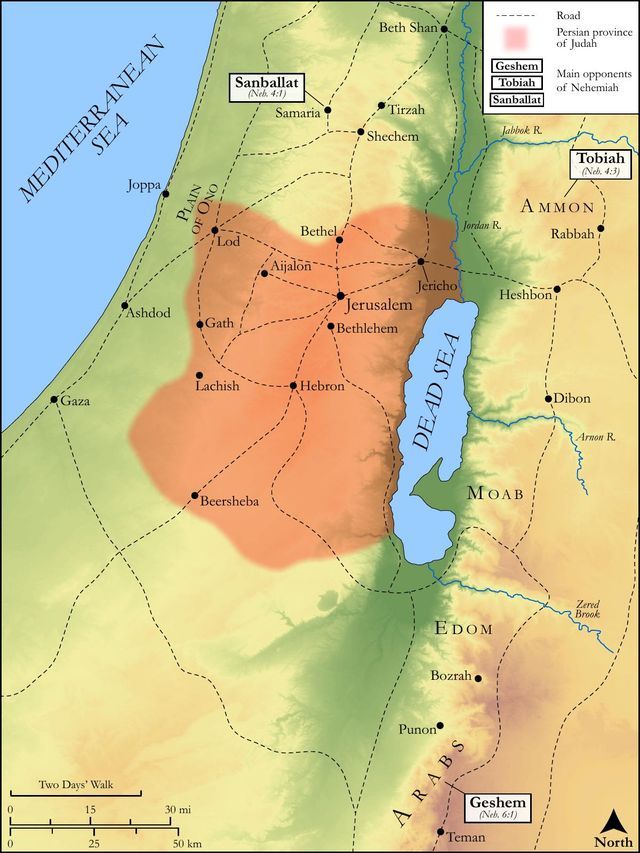
See on the biblical-era map
Study this verse
Public-domain commentary
Matthew Henry
From his Commentary on the Whole Bible. Henry comments on passages, not single verses — this entry covers Nehemiah 6:15–19. His two-level outline is real structure in the source text, so it is rendered as structure.
Nehemiah is here finishing the wall of Jerusalem, and yet still has trouble created him by his enemies.
I.Tobiah, and the other adversaries of the Jews, had the mortification to see the wall built up, notwithstanding all their attempts to hinder it. The wall was begun and finished in fifty-two days, and yet we have reason to believe they rested on the sabbaths, Neh 6:15. Many were employed, and there was room for them; what they did they did cheerfully, and minded their business because they loved it. The threats of their enemies, which were intended to weaken them, it is likely, quickened them to go on with their work the more vigorously, that they might get it done before the enemy came. Thus out of the eater came forth meat. See what a great deal of work may be done in a little time if we would set about it in earnest and keep close to it. When the enemies heard that the wall was finished before they thought it was well begun, and, when they doubted not but to put a stop to it, they were much cast down in their own eyes, Neh 6:16.
1.They were ashamed of their own confidence that they should cause the work to cease; they were crest-fallen upon the disappointment.
2.They envied the prosperity and success of the Jews, grieved to see the walls of Jerusalem built, while, it may be, the kings of Persia had not permitted them thus to fortify the cities of Samaria. When Cain envied his brother his countenance fell, Gen 4:5.
3.They despaired of ever doing them the mischief they designed them, of bringing them down and making a prey of them; and well they might, for they perceived, by the wonderful success, that the work was wrought of God. Even these heathens had so much sense as, [1.] To see a special providence of God conversant about the affairs of the church when they did remarkably prosper. They said among the heathen, The Lord has done great things for them; it is his doing, Psa 126:2. God fighteth for Israel and worketh with them. [2.] To believe that God's work would be perfect. When the perceived that the work was of God they expected no other than that it would go on and prosper. [3.] To conclude that, if it were of God, it was to no purpose to think of opposing it; it would certainly prevail and be victorious.
II.Nehemiah had the vexation, notwithstanding this, to see some of his own people treacherously corresponding with Tobiah and serving his interest; and a great grief and discouragement, no doubt, it was to him.
1.Even of the nobles of Judah there were those who had so little sense of honour and their country's good as to communicate with Tobiah by letter, Neh 6:17. They wrote with all the freedom and familiarity of friends to him, and welcomed his letters to them. Could nobles do a thing so mean? Nobles of Judah so wicked a thing? It seems great men are not always wise, not always honest.
2.Many in Judah were in a strict but secret confederacy with him to advance the interest of his country, though it would certainly be the ruin of their own. They were sworn unto him, not as their prince, but as their friend and ally, because both he and his son had married daughters of Israel, Neh 6:18. See the mischief of marrying with strangers; for one heathen that was converted by it ten Jews were perverted. When once they became akin to Tobiah they soon became sworn to him. A sinful love leads to a sinful league.
3.They had the impudence to court Nehemiah himself into a friendship with him: "They reported his good deeds before me, represented him as an intelligent gentleman and well worthy my acquaintance, an honest gentleman and one that I might confide in." We are indeed required to speak ill of no man, but never to speak well of bad men. Those that forsake the law praise the wicked, Pro 28:4.
4.They were so false as to betray Nehemiah's counsels to him; they uttered Nehemiah's words to him, perverting them, no doubt, and putting false constructions upon them, which furnished Tobiah with matter for letters to put him in fear and so drive him from his work and discourage him in it. Thus were all their thoughts against him for evil, yet God thought upon him for good.
Historical interpretation
Historical reception
1 surviving comment on this verse from the historical church.
It happened... that all the nations feared, etc. Those who previously sought to terrify the builders of the holy city, to delay them from working, now fear themselves with the construction of the same city completed, and they are disheartened, recognizing that this building was begun and completed by the authoring of God. Thus also in the holy Church, when a firm structure of charity, continence, peace, and other virtues has risen, the unclean spirits fear, and the temptation of their strength is repelled by our forces, and rather promotes our victory. This can also be received concerning heretics as well as false Catholics; who, by the constant faith of the good working through love, either are corrected and amended, or being exposed are guarded against and expelled from the boundaries of the Church.
Continue studying Nehemiah 6:16 across the web’s major study libraries — every link below opens this exact verse, chapter, or book on the destination site.
Read & Compare
 BibleGatewayThis verse in more than 200 translations and 70 languages.
 Bible.comThe YouVersion reader — hundreds of translations, reading plans, and highlights.
 ESV.orgCrossway's official English Standard Version reader.
 NET BibleThe NET translation with 60,000+ translators' notes on every rendering decision.
 STEP BibleTyndale House's free study tool — original text, vocabulary, and scholarly resources.
 BibliaLogos Bible Software's free web reader.
 USCCBThe New American Bible (Revised Edition) with the U.S. bishops' study notes.
Commentaries
 BibleHub CommentariesDozens of classic commentaries on this verse, gathered on one page.
 StudyLightMore than 100 commentary sets — the largest collection on the web.
 BibleRefPlain-English commentary on what this verse means, verse by verse.
 Enduring WordDavid Guzik's free commentary on this chapter, widely used by Bible teachers.
 Bible Study ToolsVerse commentary alongside Greek and Hebrew study aids.
Original Language & Research
- BibleHub InterlinearThe verse word by word — original language, transliteration, and English.
- BibleHub LexiconEvery word's original-language definition and Strong's entry.
 Blue Letter BibleDeep-study tools — Strong's numbers, concordance, and word studies.
 SefariaThe Hebrew text with Rashi and centuries of Jewish commentary.
Sermons, Hymns & Audio


TrulyRandomVerse is not affiliated with these sites and doesn’t control their content. They’re linked because they’re genuinely useful.
Summary
Nehemiah 6:16 captures the profound psychological defeat of Jerusalem's adversaries upon the miraculous completion of the city walls. Despite relentless opposition, threats, and cunning plots, the Jewish people, under Nehemiah's leadership, finished the monumental task in just 52 days. This verse reveals the enemies' internal humiliation as they were forced to acknowledge that the work's success was not merely human achievement but undeniably "wrought of our God," serving as a powerful testament to Yahweh's sovereign power and faithfulness.
Context
ShowHideLiterary Context
Nehemiah 6:16 stands as the triumphant culmination of intense and prolonged opposition against the rebuilding of Jerusalem's walls. The preceding verses in Nehemiah 6 detail Sanballat, Tobiah, and Geshem's escalating attempts to stop the work, ranging from mockery and threats (Nehemiah 4:1-3) to armed conspiracy (Nehemiah 4:7-8), and later, insidious plots to lure Nehemiah out of the city for assassination (Nehemiah 6:1-9). Even false prophets were hired to intimidate Nehemiah into fleeing (Nehemiah 6:10-14). Yet, through steadfast prayer, diligent work, and divine protection, the wall was completed in an astonishing 52 days, as recorded in Nehemiah 6:15. This verse, Nehemiah 6:16, then describes the inevitable and humbling reaction of the enemies to this undeniable evidence of God's favor.
Historical & Cultural Context
The events of Nehemiah unfold in the post-exilic period, specifically during the reign of Artaxerxes I (circa 445 BC). The Jewish people had returned from Babylonian captivity, a remnant striving to re-establish their identity and secure their homeland. Jerusalem, once a glorious capital, lay in ruins, its walls broken, making its inhabitants vulnerable to attack and a symbol of national shame. Fortified city walls were paramount for security and prestige in that day, signifying a city's strength and the protection of its people. The "enemies" mentioned—Sanballat the Horonite (governor of Samaria), Tobiah the Ammonite official, and Geshem the Arab—represented surrounding regional powers who viewed a rebuilt and strong Jerusalem as a threat to their own influence and control. Their opposition was not merely personal but geopolitical, aimed at preventing the resurgence of Jewish power and identity. The completion of the wall, therefore, was not just an architectural feat but a profound statement of divine restoration and a challenge to the existing power dynamics.
Key Themes
ShowHideNehemiah 6:16 powerfully encapsulates several overarching themes found throughout the book of Nehemiah and the broader biblical narrative. Foremost is the theme of Divine Sovereignty and Providence, demonstrating that God actively works to fulfill His purposes, even through human leaders and against formidable opposition. The completion of the wall, despite overwhelming odds, serves as a clear testament to God's hand, echoing the principle that "Unless the Lord builds the house, its builders labor in vain" (Psalm 127:1). Another key theme is Perseverance in Faith and Work, highlighting Nehemiah's unwavering commitment and the people's diligent labor, which were essential for God's work to be accomplished. The verse also underscores the Humiliation of God's Adversaries, as their schemes are thwarted, and they are forced to acknowledge the very power they sought to defy. Finally, the successful rebuilding of the wall serves as a Public Testimony to the Nations, revealing the power and faithfulness of the God of Israel to those who previously scorned or ignored Him, thus bringing glory to His name.
Exposition and Analysis
ShowHideKey Word Analysis
ShowHideThis verb literally means "to fall," but in this context, it carries the strong connotation of being humbled, dejected, or brought low. It signifies a profound internal collapse, a loss of confidence, and a deep sense of defeat. It's not just discouragement but a crushing blow to their pride and perceived power.
This word, often used idiomatically as "in their own eyes," emphasizes self-perception and internal judgment. It signifies that the enemies were humiliated and defeated from their own perspective. Their public posturing and bravado crumbled inwardly, revealing a stark awareness of their powerlessness. It speaks to a deep, personal shame and a shattered sense of superiority.
This verb means "to do," "to make," or "to accomplish." Here, in the passive sense ("was wrought"), it points to an action performed by an external agent. The crucial addition "of our God" attributes the entire accomplishment directly to divine agency, not human skill or strength alone. It implies a supernatural intervention that transcended normal human capabilities.
Verse Breakdown
ShowHide"And it came to pass, that when all our enemies heard [thereof], and all the heathen that [were] about us saw [these things]"
This opening clause emphasizes the undeniable nature of the wall's completion. The news was not confined to Jerusalem; it spread widely ("all our enemies heard"), and the physical evidence was visible to surrounding nations ("all the heathen that were about us saw"). This widespread awareness makes their subsequent reaction all the more significant, as it was a public and unavoidable reality.
"they were much cast down in their own eyes"
This is the immediate and profound psychological impact on the adversaries. Their previous mockery, threats, and plots had been predicated on the assumption that the Jews would fail. The wall's completion shattered this assumption, leading to a deep sense of internal humiliation, shame, and a realization of their own impotence. Their pride was utterly broken.
"for they perceived that this work was wrought of our God"
This final clause provides the crucial reason for their humiliation. It was not merely that the wall was finished, but that they understood or discerned the divine hand behind it. This perception was a grudging, yet undeniable, acknowledgment from the antagonists themselves that the project's success transcended mere human capability and was clearly a result of Yahweh's intervention. This forced confession of God's power by unbelievers is a powerful testimony to His sovereignty.
Literary Devices
ShowHideNehemiah 6:16 effectively employs several literary devices to convey its powerful message. Irony is prominent, as the very efforts of the enemies to thwart the work ultimately served to magnify God's power and the miraculous nature of the accomplishment. Their failure became the means by which God's glory was revealed. There is also a strong Contrast between the enemies' initial confidence and their ultimate humiliation, highlighting the futility of human opposition against divine will. The completed wall itself functions as a powerful Symbolism of God's faithfulness and protective presence over His people. Furthermore, the verse serves as a Testimony or witness, as the enemies' forced acknowledgment of God's agency validates the divine nature of the work, turning their defeat into a public declaration of Yahweh's supremacy.
Theological and Thematic Connections
ShowHideNehemiah 6:16 stands as a powerful testament to God's unwavering sovereignty and His faithfulness to His covenant people. It illustrates that when God initiates a work, He will bring it to completion, often in ways that defy human expectation and humble His adversaries. The enemies' grudging acknowledgment that the work was "wrought of our God" is a profound theological statement, demonstrating that God's power is so undeniable that even those who oppose Him are forced to recognize His hand. This divine intervention serves not only to protect His people but also to display His glory to the surrounding nations, fulfilling His purpose to be known among all peoples. It underscores the biblical principle that God's plans cannot be thwarted by human or demonic opposition, and His ultimate triumph is assured.
Reflection and Application
ShowHideNehemiah 6:16 offers immense encouragement and a vital lesson for believers navigating life's challenges and pursuing God's callings today. It reminds us that when we are engaged in God's work, even when faced with overwhelming opposition, cunning plots, and relentless discouragement, our ultimate confidence rests not in our own strength or ingenuity, but in the power and faithfulness of God. This verse challenges us to persevere in faith, knowing that God is able to accomplish what seems impossible, and that His timing and methods will ultimately bring Him glory. Our faithfulness, even in the face of adversity, can serve as a powerful testimony to those who do not yet know Him, compelling them, like Nehemiah's enemies, to acknowledge the divine hand at work. When God's hand is evident in our endeavors, it silences critics and validates His presence, demonstrating that His purposes cannot be thwarted.
Questions for Reflection
ShowHideFAQ
ShowHideWhat does "much cast down in their own eyes" truly mean in this context?
ShowHideThis phrase is a powerful Hebrew idiom indicating profound internal humiliation and a shattered sense of self-worth or confidence. It means the enemies were utterly defeated and ashamed from their own perspective. Their public bravado and attempts to intimidate and stop the work had utterly failed, and they were forced to confront their own powerlessness. It's more than simple disappointment; it's a deep, personal acknowledgment of their impotence in the face of divine power, leading to a loss of face and a crushing blow to their pride.
Why is it significant that the enemies "perceived that this work was wrought of our God"?
ShowHideThis perception is the theological crux of the verse. It's significant because it represents a grudging, undeniable confession from the very people who had actively opposed God's work. They could not attribute the rapid and successful completion of the wall to mere human effort or luck; they were compelled to acknowledge a supernatural, divine agency. This forced admission serves as a powerful public testimony to the surrounding pagan nations about the reality, power, and faithfulness of Yahweh, the God of Israel. It demonstrates that God's work is so evident that even His adversaries cannot deny His hand.
How does Nehemiah 6:16 relate to spiritual warfare today?
ShowHideNehemiah 6:16 offers immense encouragement for spiritual warfare. It illustrates that while spiritual enemies (like the devil and his forces) may scheme, threaten, and attempt to hinder God's work and His people, their ultimate efforts are futile. Just as God ensured the completion of the physical wall, He will ensure the advancement of His spiritual kingdom and the ultimate triumph of His purposes. The verse reminds us that the enemy's power is limited, and their ultimate defeat is certain. When believers persevere in faith and obedience, empowered by God, their work will not only succeed but will also serve as a powerful testimony that frustrates and humiliates the spiritual adversaries, confirming that "the gates of hell shall not prevail" against God's Church (Matthew 16:18).
Christ-Centered Fulfillment
ShowHideNehemiah 6:16, with its depiction of God's triumphant completion of the wall despite fierce opposition and the subsequent humiliation of His enemies, powerfully foreshadows the ultimate work of Christ. Just as the physical wall was "wrought of our God," the spiritual edifice of God's kingdom and the Church is built by Christ Himself, the Chief Cornerstone (Ephesians 2:20). The relentless opposition faced by Nehemiah and the Jews finds its ultimate parallel in the spiritual warfare waged against Christ throughout His earthly ministry, culminating in His crucifixion, which seemed like a victory for the enemy. However, the resurrection of Jesus Christ was the ultimate "work wrought of our God," demonstrating His complete triumph over sin, death, and the powers of darkness (Colossians 2:15). The enemies of Nehemiah were "cast down in their own eyes" as they perceived God's hand; similarly, every spiritual adversary will one day be utterly humbled and subjected under the feet of Christ (1 Corinthians 15:25). The completion of the wall served as a testimony to the surrounding nations; likewise, Christ's finished work on the cross and His ongoing building of His Church serves as the ultimate testimony to all humanity, inviting them to acknowledge God's power and grace, and fulfilling the Great Commission to make disciples of all nations (Matthew 28:18-20).