


Nehemiah 4:1
Bible text: King James Version (1769 Blayney text) · Public domain
Bible text: Berean Standard Bible · Public domain
Bible text: American Standard Version (1901) · Public domain
Bible text: World English Bible, Messianic edition · Public domain
Bible text: Geneva Bible (1599) · Public domain
Bible text: Young's Literal Translation · Public domain
- וַיְהִיva·ye·Hiand it wasH1961Conj-w ¦ V-Qal-ConsecImperf-3msVerb Qal Consecutive Imperfect 3rd Singular Masculineוַandיְהִיit was
- כַּאֲשֶׁרka·'a·Sherjust whenH834Prep-k ¦ RelParticle Relativeכַּjustאֲשֶׁרwhen
- שָׁמַעsha·Ma'he heardH8085V-Qal-Perf-3msVerb Qal Perfect 3rd Singular Masculine
- סַנְבַלַּטsan·va·LatSanballatH5571N-proper-mNoun Proper Masculine
- כִּיkithatH3588PrtParticle Conditional
- אֲנַחְנוּ'a·Nach·nuweH587Pro-1cpPronoun Personal 1st Plural common gender
- בוֹנִיםvo·Nim[were] rebuildingH1129V-Qal-Prtcpl-mpVerb Qal Participle Plural Masculine Absolute
- אֶת'et<obj.>H853DirObjMParticle Object Indicator
- הַחוֹמָהha·cho·Mahthe wallH2346Art ¦ N-fsNoun Singular Feminine Absoluteהַtheחוֹמָהwall
- וַיִּחַרvai·Yi·charand it burnedH2734Conj-w ¦ V-Qal-ConsecImperf-3msVerb Qal Consecutive Imperfect 3rd Singular Masculineוַandיִּחַרit burned
- לוֹloto himPrep-l ¦ 3msSuffix Personal 3rd Singular Masculineלtoוֹhim
- וַיִּכְעַסvai·yikh·'Asand he was angryH3707Conj-w ¦ V-Qal-ConsecImperf-3msVerb Qal Consecutive Imperfect 3rd Singular Masculineוַandיִּכְעַסhe was angry
- הַרְבֵּהhar·BehgreatlyH7235V-Hiphil-InfAbsVerb Hiphil Infinitive Absolute
- וַיַּלְעֵגvai·yal·'Egand he mockedH3932Conj-w ¦ V-Hiphil-ConsecImperf-3msVerb Hiphil Consecutive Imperfect 3rd Singular Masculineוַandיַּלְעֵגhe mocked
- עַל'al<on>H5921PrepPreposition
- הַיְּהוּדִיםhai·ye·hu·Dimthe JewsH3064Art ¦ N-mpNoun Gentilic Plural Masculine AbsoluteהַtheיְּהוּדִיםJews
English is a literal word-by-word gloss of the Hebrew, not the KJV's wording. Why?
This is the original text the KJV's translators worked from — each Hebrew word with its own literal English meaning in this verse, prepared by scholars at Tyndale House, Cambridge. The KJV translates whole sentences, not word by word, so its wording differs: one Hebrew word can become several English words, and the KJV may choose “the LORD” where the gloss reads “Yahweh”. Both are faithful — they answer different questions. For the KJV's own rendering, switch to the KJV text.
Details
See on the biblical-era map
Study this verse
Public-domain commentary
Matthew Henry
From his Commentary on the Whole Bible. Henry comments on passages, not single verses — this entry covers Nehemiah 4:1–6. His three-level outline is real structure in the source text, so it is rendered as structure.
Here is, I. The spiteful scornful reflection which Sanballat and Tobiah cast upon the Jews for their attempt to build the wall about Jerusalem. The country rang of it presently; intelligence was brought of it to Samaria, that nest of enemies to the Jews and their prosperity; and here we are told how they received the tidings. 1. In heart. They were very angry at the undertaking, and had great indignation, Neh 4:1. It vexed them that Nehemiah came to seek the welfare of the children of Israel (Neh 2:10); but, when they heard of this great undertaking for their good, they were out of all patience. They had hitherto pleased themselves with the thought that while Jerusalem was unwalled they could swallow it up and make themselves masters of it when they pleased; but, if it be walled, it will not only be fenced against them, but by degrees become formidable to them. The strength and safety of the church are the grief and vexation of its enemies. 2. In word. They despised it, and made it the subject of their ridicule. In this they sufficiently displayed their malice; but good was brought out of it; for, looking upon it as a foolish undertaking that would sink under its own weight, they did not go about to obstruct it till it was too late. Let us see with what pride and malice they set themselves publicly to banter it. (1.) Sanballat speaks with scorn of the workmen: "These feeble Jews" (Neh 4:2), "what will they do for materials? Will they revive the stones out of the rubbish? And what mean they by being so hasty? Do they think to make the walling of a city but one day's work, and to keep the feast of dedication with sacrifice the next day? Poor silly people! See how ridiculous they make themselves!" (2.) Tobiah speaks with no less scorn of the work itself. He has his jest too, and must show his wit, Neh 4:3. Profane scoffers sharpen one another. "Sorry work," says he, "they are likely to make of it; they themselves will be ashamed of it: If a fox go up, not with his subtlety, but with his weight, he will break down their stone wall." Many a good work has been thus looked upon with contempt by the proud and haughty scorners.
II.Nehemiah's humble and devout address to God when he heard of these reflections.
He had notice brought him of what they said. It is probable that they themselves sent him a message to this purport, to discourage him, hoping to jeer him out of his attempt; but he did not answer these fools according to their folly; he did not upbraid them with their weakness, but looked up to God by prayer.
1.He begs of God to take notice of the indignities that were done them (Neh 4:4), and in this we are to imitate him: Hear, O our God! for we are despised. Note,
(1.)God's people have often been a despised people, and loaded with contempt.
(2.)God does, and will, hear all the slights that are put upon his people, and it is their comfort that he does so and a good reason why they should be as though they were deaf, Psa 38:13, Psa 38:15. "Thou art our God to whom we appeal; our cause needs no more than a fair hearing."
2.He begs of God to avenge their cause and turn the reproach upon the enemies themselves (Neh 4:4, Neh 4:5); and this was spoken rather by a spirit of prophecy than by a spirit of prayer, and is not to be imitated by us who are taught of Christ to pray for those that despitefully use and persecute us. Christ himself prayed for those that reproached him: Father, forgive them. Nehemiah here prays, Cover not their iniquity. Note,
(1.)Those that cast contempt on God's people do but prepare everlasting shame for themselves.
(2.)It is a sin from which sinners are seldom recovered. Doubtless Nehemiah had reason to think the hearts of those sinners were desperately hardened, so that they would never repent of it, else he would not have prayed that it might never be blotted out. The reason he gives is not, They have abused us, but, They have provoked thee, and that before the builders, to whom, it is likely, they sent a spiteful message. Note, We should be angry at the malice of persecutors, not because it is abusive to us, but because it is offensive to God; and on that we may ground an expectation that God will appear against it, Psa 74:18, Psa 74:22.
III.The vigour of the builders, notwithstanding these reflections, Neh 4:6.
They made such good speed that in a little time they had run up the wall to half its height, for the people had a mind to work; their hearts were upon it, and they would have it forwarded. Note,
1.Good work goes on well when people have a mind to it.
2.The reproaches of enemies should rather quicken us to our duty than drive us from it.
Historical interpretation
Historical reception
1 surviving comment on this verse from the historical church.
Now it came to pass, when Sanballat heard, etc. Clearly, this is the anger of the heretics, these are their words, who vainly call themselves Samaritans, that is, guardians of God's law, when they are in fact greatly opposed to God and His laws, as they have long been separated from the house of David, that is, from the unity of Christ and the Church through heresies or schisms, or wicked deeds; who fear that their own impiety might be attacked and excluded, and therefore dread the building of the walls of faith. This is the derision of all who say they know God but deny Him by their deeds. For the Samaritans served the Lord in such a way that they did not renounce their ancient gods. Today, those who imitate them typologically are those who are Christians in such a way that they also consider their belly as their god, follow greed, which the Apostle clearly calls the service of idols; and being enslaved by the other allurements of the world, they serve the creature more than the Creator, who is blessed forever. And therefore, such people, like the heretics, do not want the walls of the Church to be renewed, lest, as the state of piety grows, they are forced to abandon their impiety. Such people are accustomed to call the Jews weak, that is, confessors of the faith, and easily vanquished by the nations, while in the daily contest for souls they prefer to embrace vices rather than to obtain the palm of victory through virtue. And because there are some among the heretics who even deny forgiveness to those who repent after falling, it is rightly added in the person of these:
Continue studying Nehemiah 4:1 across the web’s major study libraries — every link below opens this exact verse, chapter, or book on the destination site.
Read & Compare
 BibleGatewayThis verse in more than 200 translations and 70 languages.
 Bible.comThe YouVersion reader — hundreds of translations, reading plans, and highlights.
 ESV.orgCrossway's official English Standard Version reader.
 NET BibleThe NET translation with 60,000+ translators' notes on every rendering decision.
 STEP BibleTyndale House's free study tool — original text, vocabulary, and scholarly resources.
 BibliaLogos Bible Software's free web reader.
 USCCBThe New American Bible (Revised Edition) with the U.S. bishops' study notes.
Commentaries
 BibleHub CommentariesDozens of classic commentaries on this verse, gathered on one page.
 StudyLightMore than 100 commentary sets — the largest collection on the web.
 BibleRefPlain-English commentary on what this verse means, verse by verse.
 Enduring WordDavid Guzik's free commentary on this chapter, widely used by Bible teachers.
 Bible Study ToolsVerse commentary alongside Greek and Hebrew study aids.
Original Language & Research
- BibleHub InterlinearThe verse word by word — original language, transliteration, and English.
- BibleHub LexiconEvery word's original-language definition and Strong's entry.
 Blue Letter BibleDeep-study tools — Strong's numbers, concordance, and word studies.
 SefariaThe Hebrew text with Rashi and centuries of Jewish commentary.
Sermons, Hymns & Audio


TrulyRandomVerse is not affiliated with these sites and doesn’t control their content. They’re linked because they’re genuinely useful.
Summary
Nehemiah 4:1 marks a dramatic and pivotal shift in the narrative of Jerusalem's restoration, introducing the intensified and multifaceted opposition faced by Nehemiah and the Jewish people. Upon receiving news of the significant progress made on the city wall, Sanballat the Horonite, a formidable regional adversary, reacted with profound anger, deep indignation, and open mockery towards the diligent builders. This verse serves as a crucial narrative pivot, transitioning the focus from the internal organization and diligent labor described in the preceding chapter to the onset of external conflict and psychological warfare against God's work of rebuilding.
Context
ShowHideLiterary Context
Nehemiah 4:1 immediately follows the meticulous account in Nehemiah 3, which details the remarkable unity, organization, and diligent effort of various families and groups working on specific sections of the wall. The opening conjunction "But" in Nehemiah 4:1 sharply contrasts this productive, internal activity with the sudden emergence of external hostility. This verse functions as a narrative pivot, shifting the reader's focus from the successful dynamics of construction to the formidable challenges of opposition, thereby setting the stage for the escalating threats, conspiracies, and the subsequent need for vigilance, prayer, and armed readiness that characterize the remainder of the chapter. It underscores that progress in God's work often provokes intensified resistance.
Historical & Cultural Context
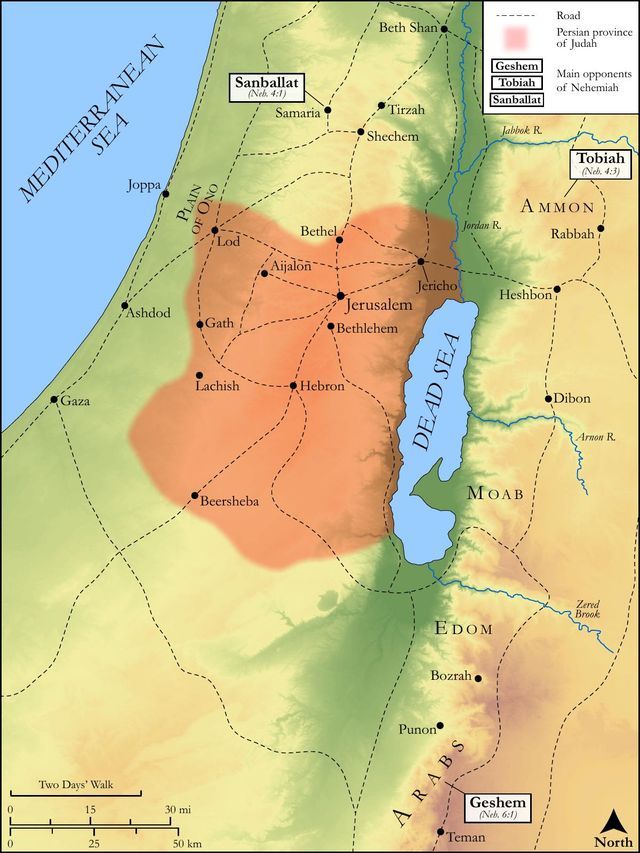
The events described in Nehemiah unfold in post-exilic Jerusalem, during the Persian period (specifically, the reign of Artaxerxes I, c. 445 BC). The Jewish people, having returned from Babylonian captivity, were under Persian rule, but their efforts to re-establish their national and religious identity through rebuilding the city walls were perceived as a significant political threat by neighboring officials. Sanballat, likely the governor of Samaria, along with his allies Tobiah the Ammonite and Geshem the Arabian, viewed a fortified Jerusalem as a direct challenge to their regional influence and a potential reassertion of Judean independence. Among the nations round about, public mockery and derision were potent psychological weapons, deliberately employed to demoralize, shame, and undermine the legitimacy and resolve of an enemy without resorting to immediate military confrontation, explaining Sanballat's initial chosen tactic.
Key Themes
ShowHideThis verse powerfully introduces and amplifies several key themes that permeate the book of Nehemiah. Firstly, it underscores the theme of Opposition to God's Work: any significant undertaking for God's kingdom will inevitably encounter resistance, often intensifying precisely as progress is made. Sanballat's wrath is not merely political but reflects a spiritual hostility to God's redemptive plan for His people and city, as foreshadowed by his initial displeasure upon Nehemiah's arrival in Nehemiah 2:10. Secondly, the verse highlights the theme of Spiritual Warfare, where the enemy employs psychological tactics like mockery and intimidation to sow doubt, create internal division, and discourage believers, rather than solely relying on physical force. Finally, it sets the stage for the crucial theme of Perseverance Amidst Adversity, demonstrating that despite such intense indignation and ridicule, Nehemiah and the Jews would continue their vital task, embodying unwavering commitment, prayer, and vigilance, as seen in their united effort in Nehemiah 4:6.
Exposition and Analysis
ShowHideKey Word Analysis
ShowHideThis primitive root describes a state of glowing or growing warm, which figuratively means to blaze up, often in the context of anger, zeal, or jealousy. It conveys a deep, burning anger, indicating intense displeasure or a heated fury. Sanballat's reaction was not merely annoyance but a profound, visceral rage, suggesting that the success of the Jews ignited a furious indignation within him, causing him to "be incensed" and "very wroth."
This primitive root signifies to trouble, and by implication, to grieve, rage, or be indignant. It denotes a state of being angry, grieved, or provoked to wrath, often implying a settled, vengeful anger rather than a fleeting emotion. When combined with "great" (H7235, râbâh - to increase, be great), it emphasizes the magnitude and severity of Sanballat's emotional response, indicating a profound and active hostility that moved beyond mere displeasure into a state of active outrage and vexation.
This primitive root means to deride, and by implication, to speak unintelligibly as if imitating a foreigner. It implies scornful derision, ridicule, and contempt, often with the specific intent to humiliate and discourage. Sanballat's action was a taunting, scoffing attitude, aiming to invalidate the efforts of the Jews and break their spirit through public shame and ridicule rather than direct physical confrontation. It suggests a deliberate attempt to "laugh to scorn" and "have in derision" their sacred work.
Verse Breakdown
ShowHide"But it came to pass, that when Sanballat heard that we builded the wall,"
The opening "But" serves as a strong adversative conjunction, signaling an immediate and dramatic shift from the unified, successful building efforts detailed in chapter 3 to the emergence of formidable external opposition. Sanballat's reaction is triggered by the news of the progress or completion of the wall, highlighting a crucial spiritual principle: success in God's work often provokes intensified resistance from adversaries who perceive it as a threat to their own power, agenda, or spiritual domain. The act of "building the wall" (H1129 bânâh - to build; H2346 chôwmâh - a wall of protection) signifies the restoration of security and identity for God's people.
"he was wroth,"
This clause describes Sanballat's immediate, intense, and personal emotional response. His anger (H2734 chârâh) is not merely a calculated political maneuver but a visceral, burning fury, suggesting that the rebuilding of Jerusalem's defenses was a deep affront to his authority, a challenge to his aspirations for regional dominance, and likely a manifestation of spiritual antagonism against God's purposes.
"and took great indignation,"
This phrase amplifies the preceding one, emphasizing the depth and magnitude of Sanballat's wrath. The "great indignation" (H7235 râbâh + H3707 kaʻaç) indicates a profound displeasure that has settled into a state of active hostility and outrage, signifying a determined and vengeful opposition rather than a fleeting emotion. It underscores the severity of his inner turmoil and his readiness to act upon it.
"and mocked the Jews."
This final clause describes the outward manifestation of Sanballat's internal rage. Mockery (H3932 lâʻag) here is a deliberate psychological weapon, a calculated act of scornful derision designed to demoralize the builders, sow doubt among them, and undermine their confidence. It's an attempt to halt the work not through immediate physical force, but through ridicule and contempt, questioning their ability, their right, and the divine backing of their endeavor, aiming to break their spirit through shame.
Literary Devices
ShowHideNehemiah 4:1 employs several impactful literary devices to convey its powerful message. The verse immediately follows the detailed account of cooperative building in Nehemiah 3, creating a stark antithesis between diligent, unified construction and fierce, external opposition. This contrast highlights the reality that divine progress often invites demonic resistance. Sanballat's choice to "mock the Jews" demonstrates a clear strategy of psychological warfare. Rather than immediate physical assault, he employs ridicule and contempt to demoralize the builders, sow seeds of doubt, and undermine their resolve. This tactic aims to break their spirit before breaking their defenses, revealing a shrewd understanding of human vulnerability. Furthermore, the intense reaction of Sanballat serves as foreshadowing for the escalating conflict that will characterize the remainder of the chapter, indicating that the rebuilding effort will be fraught with significant challenges and requiring constant vigilance and divine protection.
Theological and Thematic Connections
ShowHideThis passage profoundly illustrates the spiritual principle that significant progress in God's kingdom often provokes intense opposition. Sanballat's wrath is not merely political; it is a manifestation of the spiritual forces that resist God's redemptive work. This mirrors the ongoing battle between light and darkness, where the enemy seeks to discourage, distract, and destroy those who are building God's purposes. The mockery is a tactic to instill fear and doubt, challenging the legitimacy and divine backing of the work, and serving as a reminder that those who commit to God's will should anticipate resistance, knowing that such opposition often validates the importance and divine origin of their endeavor.
Reflection and Application
ShowHideNehemiah 4:1 serves as a timeless and potent reminder for believers engaged in God's work today. Whether we are building up our families in faith, serving diligently in the church, pursuing personal holiness, or advocating for righteousness and justice in the world, we should anticipate opposition. This opposition may not always manifest as physical threats; often, it comes in the insidious forms of ridicule, criticism, discouragement, or attempts to undermine our efforts and sow disunity. Sanballat's furious reaction teaches us that the enemy's wrath and mockery are often a clear sign that we are indeed making tangible progress in God's kingdom. Instead of being deterred or demoralized, we are called to recognize these tactics for what they are, stand firm in our divine calling, and press on with unwavering faith and resolve, just as Nehemiah and the Jews ultimately did. Our faithful response to mockery and indignation should be rooted in fervent prayer, a renewed commitment to the divine mandate, and a confident understanding that God's ultimate purposes will prevail despite all opposition.
Questions for Reflection
ShowHideFAQ
ShowHideWho was Sanballat, and why was he so angry?
ShowHideSanballat the Horonite was a prominent official, likely the governor of Samaria, a region situated north of Judah. He, along with his allies Tobiah the Ammonite and Geshem the Arabian, viewed the rebuilding of Jerusalem's walls as a direct and significant threat to their regional power and influence. A fortified Jerusalem would mean a resurgence of Jewish autonomy and a potential challenge to their established authority. His anger stemmed from a complex combination of political apprehension, personal animosity, and likely a spiritual opposition to the restoration of God's people and city, a displeasure that was evident from Nehemiah's initial arrival, as detailed in Nehemiah 2:10.
Why did Sanballat choose to "mock" the Jews instead of immediately attacking them?
ShowHideSanballat's choice of mockery was a deliberate psychological tactic, a form of psychological warfare. In ancient warfare, demoralizing the enemy and undermining their will to fight was often as crucial as, if not more effective than, immediate military might. By ridiculing the Jews and their efforts, Sanballat aimed to undermine their confidence, sow doubt about their ability and God's support, and create internal division and discouragement among the builders. This was an attempt to halt the work through intimidation, shame, and ridicule, hoping they would abandon the project themselves, thereby avoiding a potentially costly and uncertain direct military confrontation. This strategy of psychological assault is further elaborated in Nehemiah 4:2-3.
Christ-Centered Fulfillment
ShowHideThe intense opposition faced by Nehemiah and the Jews in building the physical wall of Jerusalem profoundly foreshadows the even more intense resistance encountered by Christ and His followers in building God's ultimate spiritual kingdom. Just as Sanballat's wrath was ignited by the visible progress of God's people, so too was the earthly ministry of Jesus met with escalating hostility from religious and political authorities. They mocked Him, ridiculed His claims, and sought tirelessly to undermine His work, culminating in the ultimate act of public scorn and derision on the cross, as vividly recounted in Matthew 27:39-44. Yet, through His sacrificial death and glorious resurrection, Christ triumphed decisively over all opposition, establishing an unshakable kingdom that no earthly power or spiritual foe can dismantle. For believers today, who are called to be living stones in God's spiritual temple (1 Peter 2:5) and to advance His gospel, the "building" of God's church and the proclamation of His truth will inevitably provoke the same spiritual opposition, often expressed through scorn, ridicule, and persecution, as Jesus Himself warned His disciples, "If the world hates you, know that it hated me before it hated you" (John 15:18-20). However, like Nehemiah, we are called to persevere with unwavering faith and courage, knowing that our ultimate victory is secured in Christ, who has already overcome the world and its opposition (John 16:33).