


Nehemiah 2:10
Bible text: King James Version (1769 Blayney text) · Public domain
Bible text: King James Version with Strong's numbers · Public domain
Bible text: Berean Standard Bible · Public domain
Bible text: American Standard Version (1901) · Public domain
Bible text: World English Bible, Messianic edition · Public domain
Bible text: Geneva Bible (1599) · Public domain
Bible text: Young's Literal Translation · Public domain
- וַיִּשְׁמַעvai·yish·Ma'and he heardH8085Conj-w ¦ V-Qal-ConsecImperf-3msVerb Qal Consecutive Imperfect 3rd Singular Masculineוַandיִּשְׁמַעhe heard
- סַנְבַלַּטsan·va·LatSanballatH5571N-proper-mNoun Proper Masculine
- הַחֹרֹנִיha·cho·ro·Nithe HoroniteH2772Art ¦ N-msNoun Gentilic Singular Masculine AbsoluteהַtheחֹרֹנִיHoronite
- וְטוֹבִיָּהve·toi·Yahand TobiahH2900Conj-w ¦ N-proper-mNoun Proper MasculineוְandטוֹבִיָּהTobiah
- הָעֶבֶדha·'E·vedthe servantH5650Art ¦ N-msNoun Singular Masculine Absoluteהָtheעֶבֶדservant
- הָעַמֹּנִיha·'a·mo·Nithe AmmoniteH5984Art ¦ N-msNoun Gentilic Singular Masculine AbsoluteהָtheעַמֹּנִיAmmonite
- וַיֵּרַעvai·Ye·ra'and it was displeasingH7489Conj-w ¦ V-Qal-ConsecImperf-3msVerb Qal Consecutive Imperfect 3rd Singular Masculineוַandיֵּרַעit was displeasing
- לָהֶםla·Hemto themPrep-l ¦ 3mpSuffix Personal 3rd Plural Masculineלָtoהֶםthem
- רָעָהra·'AhdispleasureH7451N-fsNoun Singular Feminine Absolute
- גְדֹלָהge·do·LahgreatH1419Adj-fsAdjective Singular Feminine Absolute
- אֲשֶׁר'a·SherthatH834RelParticle Relative
- בָּאba'he had comeH935V-Qal-Perf-3msVerb Qal Perfect 3rd Singular Masculine
- אָדָם'a·DamsomeoneH120N-msNoun Singular Masculine Absolute
- לְבַקֵּשׁle·va·Keshto seekH1245Prep-l ¦ V-Piel-InfVerb Piel Infinitive Constructלְtoבַקֵּשׁseek
- טוֹבָהto·VahgoodH2896N-fsNoun Singular Feminine Absolute
- לִבְנֵיliv·Neifor [the] people ofH1121Prep-l ¦ N-mpcNoun Plural Masculine Constructלִforבְנֵי[the] people of
- יִשְׂרָאֵלYis·ra·'ElIsraelH3478N-properNoun Proper Location
English is a literal word-by-word gloss of the Hebrew, not the KJV's wording. Why?
This is the original text the KJV's translators worked from — each Hebrew word with its own literal English meaning in this verse, prepared by scholars at Tyndale House, Cambridge. The KJV translates whole sentences, not word by word, so its wording differs: one Hebrew word can become several English words, and the KJV may choose “the LORD” where the gloss reads “Yahweh”. Both are faithful — they answer different questions. For the KJV's own rendering, switch to the KJV text.
Details
See on the biblical-era maps
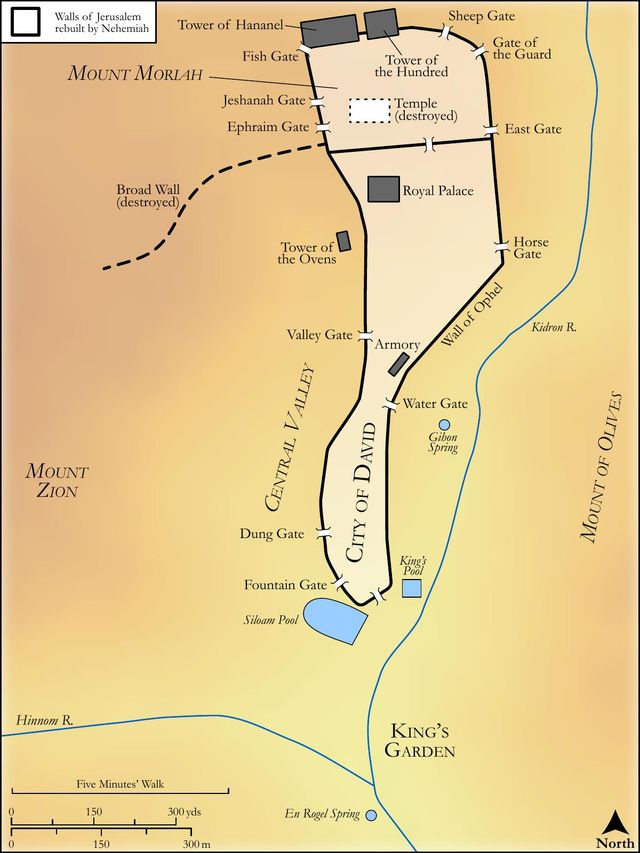
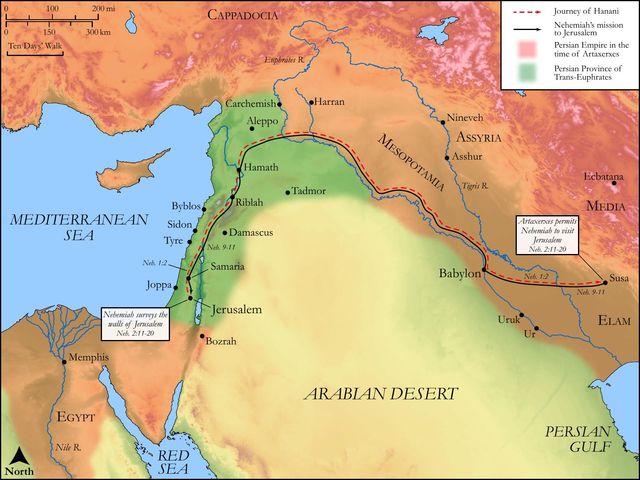
Study this verse
Public-domain commentary
Matthew Henry
From his Commentary on the Whole Bible. Henry comments on passages, not single verses — this entry covers Nehemiah 2:9–20. His four-level outline is real structure in the source text, so it is rendered as structure.
We are here told,
I.Now Nehemiah was dismissed by the court he was sent from.
The king appointed captains of the army and horsemen to go with him (Neh 2:9), both for his guard and to show that he was a man whom the king did delight to honour, that all the king's servants might respect him accordingly. Those whom the King of kings sends he thus protects, he thus dignifies with a host of angels to attend them.
II.How he was received by the country he was sent to.
1.By the Jews and their friends at Jerusalem. We are told,
(1.)That while he concealed his errand they took little notice of him. He was at Jerusalem three days (Neh 2:11), and it does not appear that any of the great men of the city waited on him to congratulate him on his arrival, but he remained unknown. The king sent horsemen to attend him, but the Jews sent none to meet him; he had no beast with him, but that which he himself rode on, Neh 2:12. Wise men, and those who are worthy of double honour, yet covet not to come with observation, to make a show, or make a noise, no, not when they come with the greatest blessings. Those that shortly are to have the dominion in the morning the world now knows not, but they lie hid, Jo1 3:1.
(2.)That though they took little notice of him he took great notice of them and their state. He arose in the night, and viewed the ruins of the walls, probably by moon-light (Neh 2:13), that he might see what was to be done and in what method they must go about it, whether the old foundation would serve, and what there was of the old materials that would be of use. Note,
[1.]Good work is likely to be well done when it is first well considered.
[2.]It is the wisdom of those who are engaged in public business, as much as may be, to see with their own eyes, and not to proceed altogether upon the reports and representations of others, and yet to do this without noise, and if possible unobserved.
[3.]Those that would build up the church's walls must first take notice of the ruins of those walls. Those that would know how to amend must enquire what is amiss, what needs reformation, and what may serve as it is.
(3.)That when he disclosed his design to the rulers and people they cheerfully concurred with him in it. He did not tell them, at first, what he came about (Neh 2:16), because he would not seem to do it for ostentation, and because, if he found it impracticable, he might retreat the more honourably. Upright humble men will not sound a trumpet before their alms or any other of their good offices. But when he had viewed and considered the thing, and probably felt the pulse of the rulers and people, he told them what God had put into his heart (Neh 2:12), even to build up the wall of Jerusalem, Neh 2:17. Observe,
[1.]How fairly he proposed the undertaking to them: "You see the distress we are in, how we lie exposed to the enemies that are round about us, how justly they reproach us as foolish and despicable, how easily they may make a prey of us whenever they have a mind; come, therefore, and let us build up the wall." He did not undertake to do the work without them (it could not be the work of one man), nor did he charge or command imperiously, though he had the king's commission; but in a friendly brotherly way he exhorted and excited them to join with him in this work. To encourage them hereto, he speaks of the design, First, As that which owed it origin to the special grace of God. He takes not the praise of it to himself, as a good thought of his own, but acknowledges that God put it into his heart, and therefore they all ought to countenance it (whatever is of God must be promoted), and might hope to prosper in it, for what God puts men upon he will own them in. Secondly, As that which owed its progress hitherto to the special providence of God. He produced the king's commission, told them how readily it was granted and how forward the king was to favour his design, in which he saw the hand of his God good upon him. It would encourage both him and them to proceed in an undertaking which God had so remarkably smiled upon. Thus he proposed it to them; and,
[2.]They presently came to a resolution, one and all, to concur with him: Let us rise up and build. They are ashamed that they have sat still so long without so much as attempting this needful work, and now resolve to rise up out of their slothfulness, to bestir themselves, and to stir up one another. "Let us rise up," that is, "let us do it with vigour, and diligence, and resolution, as those that are determined to go through with it." So they strengthened their hands, their own and one another's, for this good work. Note, First, Many a good work would find hands enough to be laid to it if there were but one good head to lead in it. They all saw the desolations of Jerusalem, yet none proposed the repair of them; but, when Nehemiah proposed it, they all consented to it. It is a pity that a good motion should be lost purely for want of one to move it and to break the ice in it. Secondly, By stirring up ourselves and one another to that which is good, we strengthen ourselves and one another for it; for the great reason why we are weak in our duty is because we are cold to it, indifferent and unresolved. Let us now see how Nehemiah was received,
2.By those that wished ill to the Jews. Those whom God and his Israel blessed they cursed.
(1.)When he did but show his face it vexed them, Neh 2:10. Sanballat and Tobiah, two of the Samaritans, but by birth the former a Moabite, the latter an Ammonite, when they saw one come armed with a commission from the king to do service to Israel, were exceedingly grieved that all their little paltry arts to weaken Israel were thus baffled and frustrated by a fair, and noble, and generous project to strengthen them. Nothing is a greater vexation to the enemies of good people, who have misrepresented them to princes as turbulent, and factious, and not fit to live, than to see them stand right in the opinion of their rulers, their innocency cleared and their reproach rolled away, and that they are thought not only fit to live, but fit to be trusted. When they saw a man come in that manner, who professedly sought the welfare of the children of Israel, it vexed them to the heart. The wicked shall see it, and be grieved.
(2.)When he began to act they set themselves to hinder him, but in vain, Neh 2:19, Neh 2:20.
[1.]See here with what little reason the enemies attempted to discourage him. They represented the undertaking as a silly thing: They laughed us to scorn and despised us as foolish builders, that could not finish what we began. They represented the undertaking also as a wicked thing, no better than treason: Will you rebel against the king? Because this was the old invidious charge, though now they had a commission from the king and were taken under his protection, yet still they must be called rebels.
[2.]See also with what good reason the Jews slighted these discouragements. They bore up themselves with this that they were the servants of the God of heaven, the only true and living God, that they were acting for him in what they did, and that therefore he would bear them out and prosper them, though the heathen raged, Psa 2:1. They considered also that the reason why these enemies did so malign them was because they had no right in Jerusalem, but envied them their right in it. Thus may the impotent menaces of the church's enemies be easily despised by the church's friends.
Historical interpretation
Historical reception
1 surviving comment on this verse from the historical church.
And Sanballat the Horonite, etc., heard. And the heretics are grieved, and all the enemies of the Church are saddened whenever they see any elected persons working for the sake of the Catholic faith or for the correction of customs, by which the walls of the Church are to be renewed. Indeed, the diversity of souls and matters is to be noted, for it was said above that those who remained from captivity in Judea were in great affliction and reproach; but also Nehemiah led a long fast with weeping and prayers because the walls of Jerusalem were broken down, and its gates were burned with fire. And now, on the contrary, the enemies of that same holy city are in great affliction and are grieved because its buildings are to be restored, and at the same time, the citizens understand that they are to be lifted from the insults of their enemies. From this, it is to be gathered that even in this life, the sentence of the Lord can be fulfilled; He who said: Amen, amen, I say to you, that you will weep and lament, but the world will rejoice; you will be sorrowful, but your sorrow will turn into joy (John 16). For as the world that rejoiced is weeping, the sorrow of the righteous will be turned into joy when the holy affairs of the Church are seen to grow, and those who had strayed by sinning are recognized to return to it by repenting.
Continue studying Nehemiah 2:10 across the web’s major study libraries — every link below opens this exact verse, chapter, or book on the destination site.
Read & Compare
 BibleGatewayThis verse in more than 200 translations and 70 languages.
 Bible.comThe YouVersion reader — hundreds of translations, reading plans, and highlights.
 ESV.orgCrossway's official English Standard Version reader.
 NET BibleThe NET translation with 60,000+ translators' notes on every rendering decision.
 STEP BibleTyndale House's free study tool — original text, vocabulary, and scholarly resources.
 BibliaLogos Bible Software's free web reader.
 USCCBThe New American Bible (Revised Edition) with the U.S. bishops' study notes.
Commentaries
 BibleHub CommentariesDozens of classic commentaries on this verse, gathered on one page.
 StudyLightMore than 100 commentary sets — the largest collection on the web.
 BibleRefPlain-English commentary on what this verse means, verse by verse.
 Enduring WordDavid Guzik's free commentary on this chapter, widely used by Bible teachers.
 Bible Study ToolsVerse commentary alongside Greek and Hebrew study aids.
Original Language & Research
- BibleHub InterlinearThe verse word by word — original language, transliteration, and English.
- BibleHub LexiconEvery word's original-language definition and Strong's entry.
 Blue Letter BibleDeep-study tools — Strong's numbers, concordance, and word studies.
 SefariaThe Hebrew text with Rashi and centuries of Jewish commentary.
Sermons, Hymns & Audio


TrulyRandomVerse is not affiliated with these sites and doesn’t control their content. They’re linked because they’re genuinely useful.
Summary
Nehemiah 2:10 marks a pivotal moment in Nehemiah's divinely appointed mission, immediately introducing the formidable opposition he would encounter upon his arrival in Jerusalem. The verse vividly portrays the intense displeasure of Sanballat the Horonite and Tobiah the servant, the Ammonite, who were profoundly vexed by the news that a man had come with the express purpose of seeking the comprehensive well-being and prosperity of the children of Israel. This hostile reaction serves as a clear harbinger of the significant challenges and spiritual warfare that would characterize the arduous task of rebuilding Jerusalem's walls and restoring its community.
Context
ShowHideLiterary Context
This verse serves as a critical turning point in the narrative of Nehemiah. It immediately follows Nehemiah's successful and divinely orchestrated petition to King Artaxerxes, who graciously granted him permission, letters of safe conduct, and essential resources for the rebuilding project in Jerusalem Nehemiah 2:1-8. Having journeyed to the province "Beyond the River" (Trans-Euphrates) and presented his royal credentials to the local governors Nehemiah 2:9, the news of his arrival and, more significantly, his explicit mission to "seek the welfare of the children of Israel" quickly reached the ears of key regional adversaries. This verse functions as the narrative pivot, shifting the focus from God's providential preparation and Nehemiah's successful royal commission to the direct confrontation with external human opposition that would define much of the subsequent rebuilding effort. It meticulously sets the stage for the escalating conflicts and plots detailed in later chapters, such as the scorn and conspiracies described in Nehemiah 4 and Nehemiah 6.
Historical & Cultural Context
The events of Nehemiah unfold during the mid-5th century BC, a period when the Persian Empire held dominion over a vast territory, including the province of Judah. Judah itself was a relatively small and vulnerable satrapy within the larger "province Beyond the River." Sanballat the Horonite is widely understood to have been the governor of Samaria, a region situated directly north of Judah, and a long-standing rival of the Jewish people. Tobiah the Ammonite was a prominent official, possibly governor, in the Ammonite territory, located east of the Jordan River. Both figures wielded substantial power and influence in their respective domains. Historically, there had been considerable tension and animosity between the returning Jewish exiles and their neighbors, particularly those who had settled in the land during the period of Jewish exile. The prospect of a strengthened, fortified Jerusalem under a zealous and royally-backed leader like Nehemiah was perceived as a direct and existential threat to their regional dominance, political stability, and economic interests. Their "grief" was not an expression of sorrow, but rather profound displeasure and bitter resentment, rooted in their desire to maintain the weakened status quo of Judah and actively prevent any resurgence of Jewish power or autonomy.
Key Themes
ShowHideNehemiah 2:10 powerfully introduces several pervasive themes that resonate throughout the book. Foremost is the theme of Opposition to God's Work. Any significant undertaking aligned with God's purposes, whether in biblical times or today, invariably provokes fierce resistance from those aligned against divine will. Nehemiah's mission, clearly God-ordained and blessed, immediately draws out adversaries, illustrating a recurring pattern of spiritual warfare against the advancement of God's kingdom and the flourishing of His people. Another crucial theme is Malicious Intent and Self-Interest. Sanballat and Tobiah's "grief" is deeply rooted in their own vested interests and a profound, deep-seated malice towards the Jewish people's prosperity. They harbored no desire for Jerusalem to regain strength, viewing it as a direct challenge to their regional hegemony and control. This malicious intent foreshadows their persistent efforts to undermine Nehemiah through scorn, conspiracy, and intimidation, as vividly depicted in their continued actions against the rebuilding efforts in Nehemiah 4:1-3 and Nehemiah 6:1-9. Finally, the verse subtly highlights Divine Providence and Human Response. While Nehemiah's journey and initial successes were clearly under God's sovereign hand, his arrival serves as a catalyst, exposing the hearts of those who would actively resist God's plan for Israel's restoration, thereby setting the stage for God to demonstrate His unwavering faithfulness in the face of human hostility.
Exposition and Analysis
ShowHideKey Word Analysis
ShowHideThis term signifies "bad" or "evil" (natural or moral). In this context, it denotes a profound sense of something being wrong, displeasing, or harmful to the individuals experiencing it. It does not imply sorrow, but rather an intense negative emotional state—vexation, anger, or resentment—arising from a perceived threat or an undesirable outcome. Here, it underscores the malicious nature of Sanballat and Tobiah's reaction to Nehemiah's benevolent mission.
This word means "great" in any sense, often indicating magnitude, intensity, or importance. When combined with raʻ ("evil" or "bad"), it intensifies the negative emotion, translating to "greatly evil," "very bad," or "profoundly displeasing." It emphasizes the extreme nature of their vexation, indicating that Nehemiah's arrival was not merely an annoyance but a significant and deeply troubling development for them.
This rich Hebrew term encompasses "good" in its widest sense, extending beyond mere physical safety or material prosperity. It refers to the holistic goodness, well-being, success, and flourishing of a community. It implies a state of comprehensive health, peace, and prosperity—social, economic, and spiritual. Sanballat and Tobiah were not merely annoyed by Nehemiah's presence; they were deeply disturbed by the very idea of the Jewish people flourishing in any aspect, as this would inevitably diminish their own regional control and influence.
Verse Breakdown
ShowHide"When Sanballat the Horonite, and Tobiah the servant, the Ammonite, heard [of it]"
This initial clause introduces the primary human antagonists who will relentlessly oppose Nehemiah's work. Sanballat, likely a governor from Samaria, and Tobiah, a prominent official in Ammon, are identified by their origins, highlighting their regional power bases. Their immediate awareness of Nehemiah's arrival and purpose underscores their vigilant oversight of regional affairs and their vested interest in maintaining the existing power dynamics.
"it grieved them exceedingly"
This phrase describes the intense emotional and psychological reaction of Sanballat and Tobiah. As detailed in the key word analysis, this is not sorrow but profound vexation, anger, and bitter resentment. The adverb "exceedingly" emphasizes the depth and severity of their negative response, indicating that Nehemiah's mission struck a raw nerve, threatening their established authority and influence.
"that there was come a man to seek the welfare of the children of Israel"
This final clause reveals the precise and specific cause of their intense hostility. It was not merely Nehemiah's presence, but his explicit, benevolent purpose—to seek the comprehensive well-being, prosperity, and flourishing of the Jewish people—that ignited their profound opposition. This highlights their fundamental antagonism to the restoration and strengthening of God's chosen people, viewing any resurgence of Judah as a direct challenge to their own regional power and influence.
Literary Devices
ShowHideNehemiah 2:10 effectively employs several potent literary devices to set the stage for the unfolding narrative. Foreshadowing is prominently featured, as the immediate and intense opposition from Sanballat and Tobiah clearly signals the numerous conflicts, plots, and challenges Nehemiah will face throughout the arduous rebuilding process. Their "grief" is a stark and unmistakable warning of the adversarial relationship to come. The verse also introduces a strong element of Antagonism, explicitly identifying the primary human adversaries who will stand against God's work through Nehemiah. This establishes a clear "us vs. them" dynamic, framing the narrative as a struggle between divine purpose and human resistance. There is also a subtle yet powerful Irony at play: Nehemiah arrives with the benevolent intention to seek "welfare" (ṭôwb – good), but his good intentions and actions are met with "grief" (raʻ – evil/bad) from his opponents. This stark contrast underscores the inherently malicious and self-serving nature of their opposition. Finally, the verse utilizes Juxtaposition by placing Nehemiah's compassionate and constructive mission ("to seek the welfare") directly against the malevolent and destructive reaction of his enemies ("grieved exceedingly"), thereby highlighting the inherent and unavoidable conflict between God's redemptive purposes and the resistance of a fallen world.
Theological and Thematic Connections
ShowHideNehemiah 2:10 serves as a profound theological statement, reminding us that whenever God's people embark on a work aligned with His divine will, opposition is not merely a possibility but an expectation. This resistance is often more than just human disagreement; it is frequently a manifestation of spiritual warfare, where forces hostile to God's kingdom actively seek to hinder His purposes and prevent the flourishing of His people. The "grief" of Sanballat and Tobiah is a powerful testament to the truth that light exposes darkness, and the advancement of goodness, truth, and divine order will invariably provoke a strong reaction from those who thrive in chaos, seek to maintain oppressive control, or whose self-interest is threatened by God's righteous plan. This verse underscores the reality that God's plan for His people's holistic flourishing will inevitably challenge the status quo of worldly powers and self-serving individuals, leading to direct conflict. It calls believers to cultivate spiritual discernment, recognizing the underlying nature of such opposition, and to remain steadfast and resolute in their God-given assignments, trusting implicitly that ultimate victory belongs solely to God.
Reflection and Application
ShowHideNehemiah 2:10 offers profound and timeless lessons for contemporary believers navigating their faith journey and engaging in God's work. When we commit ourselves to endeavors that are clearly aligned with God's will—whether it's pursuing personal spiritual growth, engaging in local or global ministry, seeking justice, or simply striving to live out our faith authentically in our daily lives—we should anticipate and be prepared for opposition. Not everyone will celebrate our "welfare" or rejoice in the progress of God's kingdom. Like Nehemiah, we must be prepared to face those who are "grieved exceedingly" by good and godly initiatives, often because such endeavors expose their own darkness or threaten their self-serving agendas. This verse encourages us to develop keen spiritual discernment, recognizing that opposition frequently stems from malice, self-interest, or a deeper spiritual antagonism rather than genuine concern or constructive critique. It calls us to persevere with unwavering resolve in our divine calling, understanding that God's sovereign plan will ultimately prevail despite human resistance. Furthermore, it reminds us to cultivate a consistent posture of prayer and absolute reliance on God for wisdom, strength, and protection, just as Nehemiah consistently did throughout his challenging mission, trusting that He who began a good work will faithfully bring it to completion.
Questions for Reflection
ShowHideFAQ
ShowHideWho were Sanballat and Tobiah, and why were they so important?
ShowHideSanballat the Horonite and Tobiah the Ammonite were highly influential and powerful regional officials during the Persian period, specifically in the mid-5th century BC. Sanballat was likely the governor of Samaria, a territory situated directly north of Judah, while Tobiah was a prominent official, possibly a governor or a high-ranking administrator, in the Ammonite region located east of the Jordan River. They were important because they wielded significant political, economic, and military influence in the areas surrounding Judah, making them formidable adversaries. Their opposition was not merely personal but represented a substantial political and economic threat to the aspirations of the Jewish people and the rebuilding of Jerusalem. They perceived a strong, fortified Judah as a direct challenge to their own regional dominance and control, which is precisely why they were so "grieved exceedingly" by Nehemiah's mission to seek the "welfare" of the Jewish people. Their actions throughout the book of Nehemiah vividly demonstrate their persistent and malicious efforts to undermine the restoration project.
Why were they "grieved exceedingly" by Nehemiah's mission?
ShowHideTheir "grief" was not an expression of sorrow or sadness, but rather intense anger, profound vexation, and bitter resentment. They were "grieved exceedingly" because Nehemiah's arrival and his explicitly stated purpose—to seek the holistic "welfare" (ṭôwb) of the children of Israel—directly threatened their long-standing vested interests and regional hegemony. For decades, Judah had remained weak, vulnerable, and largely undefended, allowing these neighboring powers to exert considerable influence and control over the region. The prospect of Jerusalem's walls being rebuilt and the Jewish community regaining strength, autonomy, and a distinct identity was a direct challenge to their existing power balance and prestige. They perceived Nehemiah's mission as a significant political and economic threat that would inevitably diminish their own authority and influence. Their extreme reaction reveals their malicious intent and their deep-seated desire to keep Judah in a perpetual state of weakness and subservience.
What does "welfare" mean in this context, and why was seeking it so provocative?
ShowHideThe Hebrew word translated as "welfare" is ṭôwb (H2896), which signifies much more than mere physical safety or material prosperity. It encompasses a comprehensive sense of goodness, flourishing, well-being, and success—social, economic, political, and spiritual. Nehemiah's mission was fundamentally about restoring Jerusalem's physical walls, which symbolized the city's security, its distinct identity as a covenant community, and its ability to function as a vibrant center for Jewish life and worship. Seeking this comprehensive "welfare" was profoundly provocative because it implied the resurgence of a strong, independent, and self-governing Judah. This would inevitably disrupt the existing power balance in the region, directly challenging the influence, control, and opportunistic gains that Sanballat and Tobiah had enjoyed over a weakened Judah for many years. Their "grief" was precisely because they did not want to see the Jewish people prosper, regain their former strength, or achieve autonomy.
Christ-Centered Fulfillment
ShowHideNehemiah 2:10, with its vivid depiction of intense opposition to God's redemptive work for His people's welfare, finds profound and ultimate Christ-centered fulfillment. Just as Nehemiah's mission to restore Jerusalem's physical walls and the spiritual well-being of Israel provoked the "grief" and malice of regional adversaries, so too did the ultimate mission of Christ, the true and eternal builder of God's spiritual temple, provoke the deepest hostility from the forces of darkness. Jesus came to seek the ultimate "welfare" of humanity, offering salvation, reconciliation with God, and eternal life, yet He was met with unparalleled opposition from the world and its spiritual rulers. He Himself warned His disciples, "If the world hates you, know that it has hated me before it hated you" John 15:18. His earthly ministry, culminating in His sacrificial death and glorious resurrection, was the supreme act of seeking humanity's ṭôwb—our holistic good and flourishing—but it was met with the ultimate "grief" and malevolent hostility of those aligned against God's kingdom. The ongoing work of the Church, which is Christ's body on earth, continues to face similar opposition as it seeks to advance the "welfare" of God's kingdom in a fallen world, recognizing that "our struggle is not against flesh and blood, but against the rulers, against the authorities, against the powers of this dark world and against the spiritual forces of evil in the heavenly realms" Ephesians 6:12. Yet, just as Nehemiah ultimately prevailed through God's strength and faithfulness, the ultimate and decisive victory belongs to Christ, who has triumphed over all opposing powers and authorities, ensuring the eternal welfare of His redeemed people and the complete establishment of His indestructible kingdom Colossians 2:15.