


Nehemiah 2:20
Bible text: King James Version (1769 Blayney text) · Public domain
Bible text: King James Version with Strong's numbers · Public domain
Bible text: Berean Standard Bible · Public domain
Bible text: American Standard Version (1901) · Public domain
Bible text: World English Bible, Messianic edition · Public domain
Bible text: Geneva Bible (1599) · Public domain
Bible text: Young's Literal Translation · Public domain
- וָאָשִׁיבva·'a·Shivand I brought backH7725Conj-w ¦ V-Hiphil-ConsecImperf-1csVerb Hiphil Consecutive Imperfect 1st Singular common genderוָandאָשִׁיבI brought back
- אוֹתָם'o·Tam<obj.> themH853DirObjM ¦ 3mpParticle Object Indicatorאוֹתָ<obj.>םthem
- דָּבָרda·VarwordH1697N-msNoun Singular Masculine Absolute
- וָאוֹמַרva·'o·Marand I saidH559Conj-w ¦ V-Qal-ConsecImperf-1csVerb Qal Consecutive Imperfect 1st Singular common genderוָandאוֹמַרI said
- לָהֶםla·Hemto themPrep-l ¦ 3mpSuffix Personal 3rd Plural Masculineלָtoהֶםthem
- אֱלֹהֵי'e·lo·Hei[the] God ofH430N-mpcNoun Plural Masculine Construct
- הַשָּׁמַיִםha·sha·Ma·yimthe heavensH8064Art ¦ N-mpNoun Plural Masculine Absoluteהַtheשָּׁמַיִםheavens
- הוּאhu'heH1931Pro-3msPronoun Personal 3rd Singular Masculine
- יַצְלִיחַyatz·Li·achhe will grant successH6743V-Hiphil-Imperf-3msVerb Hiphil Imperfect 3rd Singular Masculine
- לָנוּLa·nuto usPrep-l ¦ 1cpSuffix Personal 1st Plural common genderלָtoנוּus
- וַאֲנַחְנוּva·'a·Nach·nuand weH587Conj-w ¦ Pro-1cpPronoun Personal 1st Plural common genderוַandאֲנַחְנוּwe
- עֲבָדָיו'a·va·Davhis servantsH5650N-mpc ¦ 3msNoun Plural Masculine Constructעֲבָדָיservantsוhis
- נָקוּםna·Kumwe will ariseH6965V-Qal-Imperf-1cpVerb Qal Imperfect 1st Plural common gender
- וּבָנִינוּu·va·Ni·nuand we will rebuildH1129Conj-w ¦ V-Qal-ConsecPerf-1cpVerb Qal Consecutive Perfect 1st Plural common genderוּandבָנִינוּwe will rebuild
- וְלָכֶםve·la·Khemand [belongs] to youConj-w ¦ Prep-l ¦ 2mpSuffix Personal 2nd Plural Masculineוְandלָ[belongs] toכֶםyou
- אֵין'einnotH369N-mscNoun Singular Masculine Construct
- חֵלֶקChe·leka shareH2506N-msNoun Singular Masculine Absolute
- וּצְדָקָהu·tze·da·Kahand a rightH6666Conj-w ¦ N-fsNoun Singular Feminine Absoluteוּandצְדָקָהa right
- וְזִכָּרוֹןve·zi·ka·Ronand a memorialH2146Conj-w ¦ N-msNoun Singular Masculine Absoluteוְandזִכָּרוֹןa memorial
- בִּירוּשָׁלִָםbi·ru·sha·Limin JerusalemH3389Prep-b ¦ N-properNoun Proper LocationבִּinירוּשָׁלִָםJerusalem
English is a literal word-by-word gloss of the Hebrew, not the KJV's wording. Why?
This is the original text the KJV's translators worked from — each Hebrew word with its own literal English meaning in this verse, prepared by scholars at Tyndale House, Cambridge. The KJV translates whole sentences, not word by word, so its wording differs: one Hebrew word can become several English words, and the KJV may choose “the LORD” where the gloss reads “Yahweh”. Both are faithful — they answer different questions. For the KJV's own rendering, switch to the KJV text.
Details
See on the biblical-era maps
Study this verse
Public-domain commentary
Matthew Henry
From his Commentary on the Whole Bible. Henry comments on passages, not single verses — this entry covers Nehemiah 2:9–20. His four-level outline is real structure in the source text, so it is rendered as structure.
We are here told,
I.Now Nehemiah was dismissed by the court he was sent from.
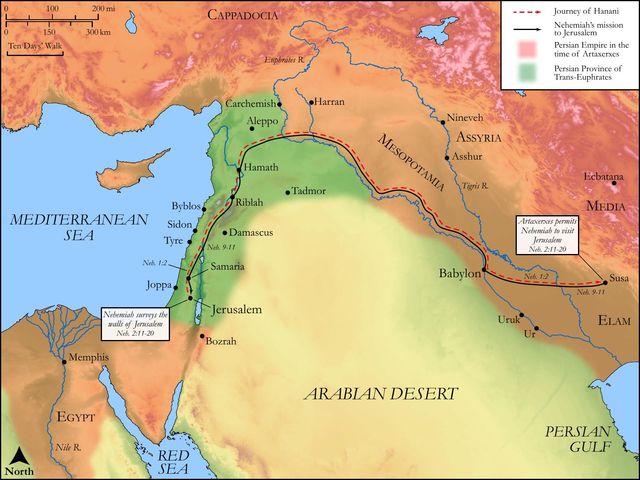
The king appointed captains of the army and horsemen to go with him (Neh 2:9), both for his guard and to show that he was a man whom the king did delight to honour, that all the king's servants might respect him accordingly. Those whom the King of kings sends he thus protects, he thus dignifies with a host of angels to attend them.
II.How he was received by the country he was sent to.
1.By the Jews and their friends at Jerusalem. We are told,
(1.)That while he concealed his errand they took little notice of him. He was at Jerusalem three days (Neh 2:11), and it does not appear that any of the great men of the city waited on him to congratulate him on his arrival, but he remained unknown. The king sent horsemen to attend him, but the Jews sent none to meet him; he had no beast with him, but that which he himself rode on, Neh 2:12. Wise men, and those who are worthy of double honour, yet covet not to come with observation, to make a show, or make a noise, no, not when they come with the greatest blessings. Those that shortly are to have the dominion in the morning the world now knows not, but they lie hid, Jo1 3:1.
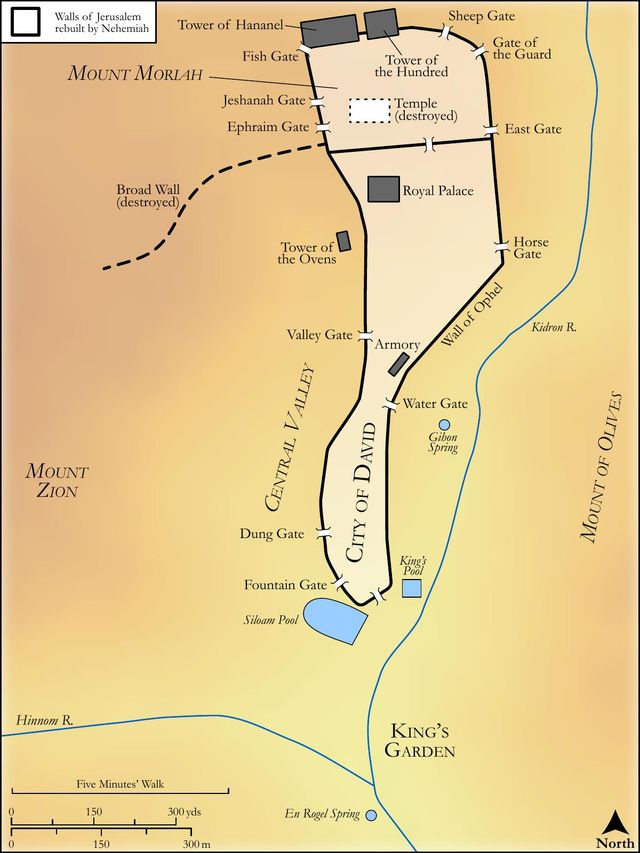
(2.)That though they took little notice of him he took great notice of them and their state. He arose in the night, and viewed the ruins of the walls, probably by moon-light (Neh 2:13), that he might see what was to be done and in what method they must go about it, whether the old foundation would serve, and what there was of the old materials that would be of use. Note,
[1.]Good work is likely to be well done when it is first well considered.
[2.]It is the wisdom of those who are engaged in public business, as much as may be, to see with their own eyes, and not to proceed altogether upon the reports and representations of others, and yet to do this without noise, and if possible unobserved.
[3.]Those that would build up the church's walls must first take notice of the ruins of those walls. Those that would know how to amend must enquire what is amiss, what needs reformation, and what may serve as it is.
(3.)That when he disclosed his design to the rulers and people they cheerfully concurred with him in it. He did not tell them, at first, what he came about (Neh 2:16), because he would not seem to do it for ostentation, and because, if he found it impracticable, he might retreat the more honourably. Upright humble men will not sound a trumpet before their alms or any other of their good offices. But when he had viewed and considered the thing, and probably felt the pulse of the rulers and people, he told them what God had put into his heart (Neh 2:12), even to build up the wall of Jerusalem, Neh 2:17. Observe,
[1.]How fairly he proposed the undertaking to them: "You see the distress we are in, how we lie exposed to the enemies that are round about us, how justly they reproach us as foolish and despicable, how easily they may make a prey of us whenever they have a mind; come, therefore, and let us build up the wall." He did not undertake to do the work without them (it could not be the work of one man), nor did he charge or command imperiously, though he had the king's commission; but in a friendly brotherly way he exhorted and excited them to join with him in this work. To encourage them hereto, he speaks of the design, First, As that which owed it origin to the special grace of God. He takes not the praise of it to himself, as a good thought of his own, but acknowledges that God put it into his heart, and therefore they all ought to countenance it (whatever is of God must be promoted), and might hope to prosper in it, for what God puts men upon he will own them in. Secondly, As that which owed its progress hitherto to the special providence of God. He produced the king's commission, told them how readily it was granted and how forward the king was to favour his design, in which he saw the hand of his God good upon him. It would encourage both him and them to proceed in an undertaking which God had so remarkably smiled upon. Thus he proposed it to them; and,
[2.]They presently came to a resolution, one and all, to concur with him: Let us rise up and build. They are ashamed that they have sat still so long without so much as attempting this needful work, and now resolve to rise up out of their slothfulness, to bestir themselves, and to stir up one another. "Let us rise up," that is, "let us do it with vigour, and diligence, and resolution, as those that are determined to go through with it." So they strengthened their hands, their own and one another's, for this good work. Note, First, Many a good work would find hands enough to be laid to it if there were but one good head to lead in it. They all saw the desolations of Jerusalem, yet none proposed the repair of them; but, when Nehemiah proposed it, they all consented to it. It is a pity that a good motion should be lost purely for want of one to move it and to break the ice in it. Secondly, By stirring up ourselves and one another to that which is good, we strengthen ourselves and one another for it; for the great reason why we are weak in our duty is because we are cold to it, indifferent and unresolved. Let us now see how Nehemiah was received,
2.By those that wished ill to the Jews. Those whom God and his Israel blessed they cursed.
(1.)When he did but show his face it vexed them, Neh 2:10. Sanballat and Tobiah, two of the Samaritans, but by birth the former a Moabite, the latter an Ammonite, when they saw one come armed with a commission from the king to do service to Israel, were exceedingly grieved that all their little paltry arts to weaken Israel were thus baffled and frustrated by a fair, and noble, and generous project to strengthen them. Nothing is a greater vexation to the enemies of good people, who have misrepresented them to princes as turbulent, and factious, and not fit to live, than to see them stand right in the opinion of their rulers, their innocency cleared and their reproach rolled away, and that they are thought not only fit to live, but fit to be trusted. When they saw a man come in that manner, who professedly sought the welfare of the children of Israel, it vexed them to the heart. The wicked shall see it, and be grieved.
(2.)When he began to act they set themselves to hinder him, but in vain, Neh 2:19, Neh 2:20.
[1.]See here with what little reason the enemies attempted to discourage him. They represented the undertaking as a silly thing: They laughed us to scorn and despised us as foolish builders, that could not finish what we began. They represented the undertaking also as a wicked thing, no better than treason: Will you rebel against the king? Because this was the old invidious charge, though now they had a commission from the king and were taken under his protection, yet still they must be called rebels.
[2.]See also with what good reason the Jews slighted these discouragements. They bore up themselves with this that they were the servants of the God of heaven, the only true and living God, that they were acting for him in what they did, and that therefore he would bear them out and prosper them, though the heathen raged, Psa 2:1. They considered also that the reason why these enemies did so malign them was because they had no right in Jerusalem, but envied them their right in it. Thus may the impotent menaces of the church's enemies be easily despised by the church's friends.
Continue studying Nehemiah 2:20 across the web’s major study libraries — every link below opens this exact verse, chapter, or book on the destination site.
Read & Compare
 BibleGatewayThis verse in more than 200 translations and 70 languages.
 Bible.comThe YouVersion reader — hundreds of translations, reading plans, and highlights.
 ESV.orgCrossway's official English Standard Version reader.
 NET BibleThe NET translation with 60,000+ translators' notes on every rendering decision.
 STEP BibleTyndale House's free study tool — original text, vocabulary, and scholarly resources.
 BibliaLogos Bible Software's free web reader.
 USCCBThe New American Bible (Revised Edition) with the U.S. bishops' study notes.
Commentaries
 BibleHub CommentariesDozens of classic commentaries on this verse, gathered on one page.
 StudyLightMore than 100 commentary sets — the largest collection on the web.
 BibleRefPlain-English commentary on what this verse means, verse by verse.
 Enduring WordDavid Guzik's free commentary on this chapter, widely used by Bible teachers.
 Bible Study ToolsVerse commentary alongside Greek and Hebrew study aids.
Original Language & Research
- BibleHub InterlinearThe verse word by word — original language, transliteration, and English.
- BibleHub LexiconEvery word's original-language definition and Strong's entry.
 Blue Letter BibleDeep-study tools — Strong's numbers, concordance, and word studies.
 SefariaThe Hebrew text with Rashi and centuries of Jewish commentary.
Sermons, Hymns & Audio


TrulyRandomVerse is not affiliated with these sites and doesn’t control their content. They’re linked because they’re genuinely useful.
Summary
Nehemiah 2:20 is a powerful declaration of faith and leadership, encapsulating Nehemiah's unwavering resolve in the face of early opposition to the rebuilding of Jerusalem's walls. This pivotal verse anchors the success of the monumental endeavor in God's divine favor, asserts the active commitment of God's servants to the task, and unequivocally denies any legitimate stake for those who stand against God's redemptive work in His holy city. It sets a firm spiritual and practical tone for the challenging work ahead, demonstrating both profound reliance on divine providence and the establishment of clear boundaries against adversaries.
Context
ShowHideLiterary Context
Nehemiah 2:20 marks a critical juncture in the narrative, immediately following Nehemiah's arrival in Jerusalem and his clandestine nocturnal inspection of the city's dilapidated walls. Having diligently secured royal decrees and provisions from King Artaxerxes, Nehemiah then presented his vision to the disheartened Jewish leaders, successfully inspiring them to "arise and build" as recorded in Nehemiah 2:18. This verse serves as Nehemiah's direct, forceful, and public rebuttal to the initial mockery and accusations leveled by Sanballat the Horonite, Tobiah the Ammonite official, and Geshem the Arab. These prominent regional figures questioned the loyalty of the Jewish people and the legitimacy of their intentions. Nehemiah's response in this verse is the first open confrontation with these adversaries, laying the groundwork for the persistent spiritual and physical battles that unfold throughout the subsequent chapters of the book, particularly the active and varied forms of opposition detailed in Nehemiah 4.
Historical & Cultural Context
The events of Nehemiah 2:20 are situated in post-exilic Jerusalem, approximately 445 BC, during the reign of Artaxerxes I of Persia. While the Jewish exiles had returned and the temple had been rebuilt, as noted in Ezra 6:15, the city walls remained in ruins. This left Jerusalem's inhabitants vulnerable to attack and signified a profound lack of national identity and security. The phrase "The God of heaven" was a common and significant title for God within the Persian Empire, used by both Jews and non-Jews. It underscored His supreme authority and transcendence over all earthly rulers and kingdoms, including the mighty Persian monarch himself. Nehemiah's use of this title was a theological assertion of divine backing for his mission. The adversaries—Sanballat, Tobiah, and Geshem—were influential regional officials whose power, prestige, and geopolitical interests were directly threatened by the prospect of a strong, rebuilt Jerusalem. They perceived a fortified city as a potential challenge to their regional dominance and a possible act of rebellion against Persian authority. Their opposition was thus rooted in a mix of political self-interest, economic concerns, and ethnic animosity.
Key Themes
ShowHideNehemiah 2:20 powerfully articulates several core themes central to both the book of Nehemiah and broader biblical theology. Firstly, it highlights Divine Sovereignty and Providence, emphasizing that the success of the rebuilding project rests entirely on "The God of heaven" who "will prosper us." This theme underscores God's active involvement, enablement, and ultimate control over His people's endeavors, a truth consistently demonstrated throughout the narrative of the wall's construction, culminating in its miraculous completion as recorded in Nehemiah 6:16. Secondly, the verse showcases Faithful Obedience and Bold Leadership, as Nehemiah and the people declare, "therefore we his servants will arise and build." This resolute commitment to action in the face of formidable opposition exemplifies the biblical call to courageous service in God's kingdom, echoing the steadfast resolve of leaders like Joshua, who famously declared, "as for me and my house, we will serve the Lord" Joshua 24:15. Finally, the verse establishes a clear theme of Exclusion of Adversaries and Covenantal Purity, asserting that those who oppose God's work have "no portion, nor right, nor memorial, in Jerusalem." This delineates the sacred boundary between God's covenant people and those outside, emphasizing the spiritual and communal integrity of the holy city and its inhabitants, a concept deeply rooted in God's promises concerning the land and His chosen people, as seen in Deuteronomy 12:9.
Exposition and Analysis
ShowHideKey Word Analysis
ShowHideThis verb (H6743) signifies to push forward, advance, succeed, or be effective. In Nehemiah 2:20, it carries the profound nuance of divine enablement and guaranteed success. Nehemiah's declaration is not a mere wish or a hopeful aspiration, but a confident assertion that God Himself will ensure the favorable outcome of their work. It implies that the success of the building project is not dependent on human strength, skill, or political maneuvering, but solely on God's active intervention and blessing. This word is frequently used in the Old Testament to describe God causing someone or something to succeed, as seen in the life of Joseph where "the Lord was with Joseph, and he was a prosperous man" Genesis 39:3.
This term (H2506) refers to a share, inheritance, or allotment, often specifically concerning land or property. In a broader sense, it can mean a share in a community, a destiny, or a spiritual inheritance. By stating the adversaries have "no portion," Nehemiah is unequivocally denying them any rightful claim to the land of Jerusalem, any inheritance within its sacred boundaries, or any share in the communal life and spiritual blessings reserved for God's covenant people. It is a declaration of legal, spiritual, and communal exclusion.
This word (H2146) denotes remembrance, a record, or a lasting name and legacy. To have "no memorial" in Jerusalem means that the adversaries will have no lasting recognition, no place in the city's sacred history, no name associated with its future, and no share in its spiritual heritage or ongoing life. It signifies a complete and utter erasure of their claim or influence, emphasizing their ultimate irrelevance and lack of legitimate connection to God's redemptive plan for His city.
Verse Breakdown
ShowHide"Then answered I them, and said unto them,"
This opening phrase immediately establishes the confrontational setting. Nehemiah, having heard the scorn, mockery, and accusations from Sanballat, Tobiah, and Geshem, does not retreat or hesitate. Instead, he steps forward to respond directly, with authority and unwavering conviction, marking the transition from their taunts to his decisive and public declaration.
"The God of heaven, he will prosper us;"
This is the theological bedrock of Nehemiah's confidence and the foundation of the entire rebuilding effort. He invokes "The God of heaven," a majestic title that emphasizes God's supreme sovereignty, transcendence, and universal dominion over all earthly powers and circumstances, a particularly significant assertion in the context of the vast Persian Empire. The active verb "will prosper" (Hebrew: tsâlach, in the future tense) expresses absolute certainty in divine enablement and guaranteed success for the rebuilding project, asserting that the outcome is assured by God Himself, independent of human effort or political favor alone.
"therefore we his servants will arise and build:"
This clause represents the human response of faithful obedience to the divine promise. The logical connector "therefore" explicitly links their action directly to God's assured prosperity and blessing. By identifying themselves as "his servants," Nehemiah and the people underscore their allegiance, obedience, and dedication to God's will and purposes. The phrase "will arise and build" is a powerful declaration of resolute commitment, immediate action, and courageous determination, demonstrating their readiness to undertake the daunting task despite formidable opposition.
"but ye have no portion, nor right, nor memorial, in Jerusalem."
This concluding, emphatic statement draws an unyielding boundary between God's covenant people and their adversaries. "No portion" (Hebrew: chêleq) denies them any inheritance, share, or legitimate claim to the land or its resources. "Nor right" (Hebrew: tsᵉdâqâh, meaning justice or righteousness) denies them any legal standing, moral authority, or legitimate claim to participate in Jerusalem's governance, affairs, or future. "Nor memorial" (Hebrew: zikrôwn) denies them any lasting name, legacy, or remembrance within Jerusalem's sacred history or future. This comprehensive triad of denials—portion, right, and memorial—comprehensively excludes the opponents from any legitimate stake—past, present, or future—in God's holy city and its redemptive purposes.
Literary Devices
ShowHideNehemiah 2:20 is rich with powerful literary devices that amplify its message. The most prominent is Antithesis, which creates a sharp contrast between Nehemiah's faith-filled declaration and the people's resolute action ("we his servants will arise and build") and the complete, emphatic exclusion of the adversaries ("but ye have no portion, nor right, nor memorial, in Jerusalem"). This stark opposition highlights the divine favor and legitimate claim on one side versus the utter lack of any legitimate claim on the other. The use of the title "The God of heaven" functions as a potent Appeal to Authority, invoking the highest possible divine power to validate Nehemiah's words and the project's divine backing, directly countering the limited earthly authority and influence of the opponents. Furthermore, the triadic phrase "portion, nor right, nor memorial" is a classic example of Merism, a rhetorical device where three distinct but related terms are used to express a comprehensive totality or complete denial. In this case, it emphasizes the absolute and total exclusion of the adversaries from Jerusalem's past, present, and future, leaving no ambiguity about their lack of belonging or influence.
Theological and Thematic Connections
ShowHideNehemiah 2:20 stands as a profound theological statement concerning God's active sovereignty over human endeavors and the critical necessity of distinguishing between those who genuinely serve God's purposes and those who actively oppose them. It powerfully affirms that God is the initiator and enabler of His work, and His people are called to respond with unwavering obedience, courageous action, and confident reliance on His provision. The declaration of divine prosperity ("he will prosper us") echoes the consistent biblical theme that God is faithful to bring to completion what He begins, often through the diligent and courageous work of His devoted servants. Simultaneously, the stark exclusion of the adversaries ("no portion, nor right, nor memorial") underscores the sobering reality that not all who observe or interact with God's work are part of His covenant community. This clear distinction is crucial for maintaining the purity, integrity, and sacred purpose of God's people and their mission. It serves as a potent reminder that there are spiritual boundaries that define true allegiance and participation in God's kingdom, and that our ultimate belonging is based on His gracious invitation, not on any human claim or merit.
Reflection and Application
ShowHideNehemiah 2:20 offers profound and timeless lessons for believers navigating challenges in their service to God. It calls us to cultivate an unwavering confidence in "The God of heaven," recognizing that His omnipotence and faithfulness are the true sources of our success, not our own abilities, resources, or favorable external circumstances. When confronted with opposition, ridicule, discouragement, or seemingly insurmountable obstacles, our response should be firmly rooted in this divine assurance, inspiring us to "arise and build" with resolute commitment and unshakeable courage. This verse also serves as a vital reminder to exercise spiritual discernment, distinguishing between genuine partners in God's work and those whose intentions are hostile, self-serving, or aimed at undermining His purposes. Not everyone who appears to be interested in spiritual matters truly belongs to God's kingdom, and we must be prepared to draw clear, loving, but firm boundaries when necessary, protecting the integrity and purity of the mission. Our ultimate allegiance is to God alone, and our participation in His kingdom is based solely on His grace and call, not on any human claim or merit.
Questions for Reflection
ShowHideFAQ
ShowHideWhat does "The God of heaven" signify in this context?
ShowHide"The God of heaven" (Hebrew: Elohei shamayim) is a significant theological title, particularly prevalent in post-exilic books like Nehemiah, Ezra, and Daniel. It emphasizes God's supreme sovereignty, transcendence, and universal dominion. In Nehemiah 2:20, it serves as a powerful declaration that God is not merely a local deity or one among many gods, but the ultimate ruler over all creation, including the vast Persian Empire and its king. This title underscores that Nehemiah's authority, the legitimacy of the rebuilding project, and its assured success come directly from the highest possible power, far above any earthly opposition from Sanballat, Tobiah, or Geshem. It reinforces the biblical truth that God's plan cannot be thwarted by human adversaries, as seen in the prophetic declaration that "The God of heaven will set up a kingdom that shall never be destroyed" Daniel 2:44.
Why did Nehemiah so forcefully exclude the opponents from having "portion, nor right, nor memorial, in Jerusalem"?
ShowHideNehemiah's forceful exclusion was not merely an act of defiance but a profound theological and legal assertion, rooted in the covenantal identity of Israel. The terms "portion," "right," and "memorial" carry immense weight in biblical thought. "Portion" (Hebrew: chêleq) refers to an inheritance or share, particularly in the land of Israel, which was divinely allotted to the tribes. By denying them a "portion," Nehemiah asserts they have no legitimate claim to the sacred land or its resources, as they are not part of God's covenant people. "Right" (Hebrew: tsᵉdâqâh, related to justice and righteousness) denies them any legal standing, moral authority, or just claim to participate in Jerusalem's governance, affairs, or future. "Memorial" (Hebrew: zikrôwn) signifies a lasting name, remembrance, or legacy. Denying a "memorial" means they would have no historical legacy, no future recognition, and no place in the spiritual heritage within the holy city. This comprehensive exclusion was essential to protect the spiritual and physical integrity of the rebuilt Jerusalem and its covenant community from those who actively sought to undermine God's work. It established a clear boundary between God's chosen people and those who were hostile to His purposes, ensuring the purity of the rebuilding effort and the distinct identity of the community, as God had established a unique covenant with Israel, setting them apart from surrounding hostile nations Deuteronomy 7:6.
Christ-Centered Fulfillment
ShowHideNehemiah 2:20, with its declaration of divine prosperity and the decisive exclusion of adversaries, finds its ultimate and profound fulfillment in the person and redemptive work of Jesus Christ. Just as "The God of heaven" empowered and prospered Nehemiah's work of rebuilding the physical walls of Jerusalem, so too did God the Father empower and prosper the ultimate redemptive mission of His Son, Jesus. Jesus Himself declared, "I will build my church, and the gates of hell shall not prevail against it" Matthew 16:18, signifying a spiritual rebuilding that transcends any physical structure. Those who are "His servants" in the New Covenant are called to "arise and build" by participating in the Great Commission, empowered by the indwelling Holy Spirit to be His witnesses "to the end of the earth" Acts 1:8. Crucially, just as Nehemiah declared that the adversaries had "no portion, nor right, nor memorial, in Jerusalem," so too does the New Testament unequivocally distinguish between those who are truly part of God's spiritual kingdom and those who are not. Those who reject Christ have no spiritual "portion" in the glorious inheritance of the saints Ephesians 1:11, no "right" to the tree of life in the new creation Revelation 22:14, and no "memorial" in the Lamb's Book of Life, facing eternal exclusion Revelation 20:15. Jesus Himself is the ultimate "memorial," the living cornerstone upon whom the spiritual temple, His Church, is built, and all who believe in Him become living stones in that holy dwelling 1 Peter 2:4-5. Thus, Nehemiah's bold declaration foreshadows the definitive spiritual reality established by Christ, where salvation and true belonging are found exclusively in Him, and all who oppose His kingdom are ultimately excluded from its eternal blessings and glorious future.