


Nehemiah 2:18
Bible text: King James Version (1769 Blayney text) · Public domain
Bible text: King James Version with Strong's numbers · Public domain
Bible text: Berean Standard Bible · Public domain
Bible text: American Standard Version (1901) · Public domain
Bible text: World English Bible, Messianic edition · Public domain
Bible text: Geneva Bible (1599) · Public domain
Bible text: Young's Literal Translation · Public domain
- וָאַגִּידva·'a·Gidand I toldH5046Conj-w ¦ V-Hiphil-ConsecImperf-1csVerb Hiphil Consecutive Imperfect 1st Singular common genderוָandאַגִּידI told
- לָהֶםla·Hemto themPrep-l ¦ 3mpSuffix Personal 3rd Plural Masculineלָtoהֶםthem
- אֶת'et<obj.>[about]H853DirObjMParticle Object Indicator
- יַדyad[the] hand ofH3027N-cscNoun Singular common gender Construct
- אֱלֹהַי'e·lo·Haimy GodH430N-mpc ¦ 1csNoun Plural Masculine ConstructאֱלֹהַGodיmy
- אֲשֶׁר'a·SherthatH834RelParticle Relative
- הִיאhi'itH1931Pro-3fsPronoun Personal 3rd Singular Feminine
- טוֹבָהto·Vah[was] goodH2896Adj-fsAdjective Singular Feminine Absolute
- עָלַי'a·Laion meH5921Prep ¦ 1csPrepositionעָלַonיme
- וְאַףve·'afand alsoH637Conj-w ¦ PrtParticle Interjectionוְandאַףalso
- דִּבְרֵיdiv·Rei[the] words ofH1697N-mpcNoun Plural Masculine Construct
- הַמֶּלֶךְha·Me·lekhthe kingH4428Art ¦ N-msNoun Singular Masculine Absoluteהַtheמֶּלֶךְking
- אֲשֶׁר'a·SherwhichH834RelParticle Relative
- אָמַר'a·marhe had spokenH559V-Qal-Perf-3msVerb Qal Perfect 3rd Singular Masculine
- לִיLito mePrep-l ¦ 1csSuffix Personal 1st Singular common genderלִtoיme
- וַיֹּאמְרוּvai·yo·me·Ruand they saidH559Conj-w ¦ V-Qal-ConsecImperf-3mpVerb Qal Consecutive Imperfect 3rd Plural Masculineוַandיֹּאמְרוּthey said
- נָקוּםna·Kumlet us ariseH6965V-Qal-Imperf-1cpVerb Qal Imperfect 1st Plural common gender
- וּבָנִינוּu·va·Ni·nuand we will rebuildH1129Conj-w ¦ V-Qal-ConsecPerf-1cpVerb Qal Consecutive Perfect 1st Plural common genderוּandבָנִינוּwe will rebuild
- וַיְחַזְּקוּvay·cha·ze·Kuand they strengthenedH2388Conj-w ¦ V-Piel-ConsecImperf-3mpVerb Piel Consecutive Imperfect 3rd Plural Masculineוַandיְחַזְּקוּthey strengthened
- יְדֵיהֶםye·dei·Hemtheir handsH3027N-cdc ¦ 3mpNoun Dual common gender Constructיְדֵיhandsהֶםtheir
- לַטּוֹבָהla·to·Vahfor <the> goodH2896Prep-l ¦ N-fsNoun Singular Feminine Absoluteלַfor <the>טּוֹבָהgood
English is a literal word-by-word gloss of the Hebrew, not the KJV's wording. Why?
This is the original text the KJV's translators worked from — each Hebrew word with its own literal English meaning in this verse, prepared by scholars at Tyndale House, Cambridge. The KJV translates whole sentences, not word by word, so its wording differs: one Hebrew word can become several English words, and the KJV may choose “the LORD” where the gloss reads “Yahweh”. Both are faithful — they answer different questions. For the KJV's own rendering, switch to the KJV text.
Details
See on the biblical-era maps
Study this verse
Public-domain commentary
Matthew Henry
From his Commentary on the Whole Bible. Henry comments on passages, not single verses — this entry covers Nehemiah 2:9–20. His four-level outline is real structure in the source text, so it is rendered as structure.
We are here told,
I.Now Nehemiah was dismissed by the court he was sent from.
The king appointed captains of the army and horsemen to go with him (Neh 2:9), both for his guard and to show that he was a man whom the king did delight to honour, that all the king's servants might respect him accordingly. Those whom the King of kings sends he thus protects, he thus dignifies with a host of angels to attend them.
II.How he was received by the country he was sent to.
1.By the Jews and their friends at Jerusalem. We are told,
(1.)That while he concealed his errand they took little notice of him. He was at Jerusalem three days (Neh 2:11), and it does not appear that any of the great men of the city waited on him to congratulate him on his arrival, but he remained unknown. The king sent horsemen to attend him, but the Jews sent none to meet him; he had no beast with him, but that which he himself rode on, Neh 2:12. Wise men, and those who are worthy of double honour, yet covet not to come with observation, to make a show, or make a noise, no, not when they come with the greatest blessings. Those that shortly are to have the dominion in the morning the world now knows not, but they lie hid, Jo1 3:1.
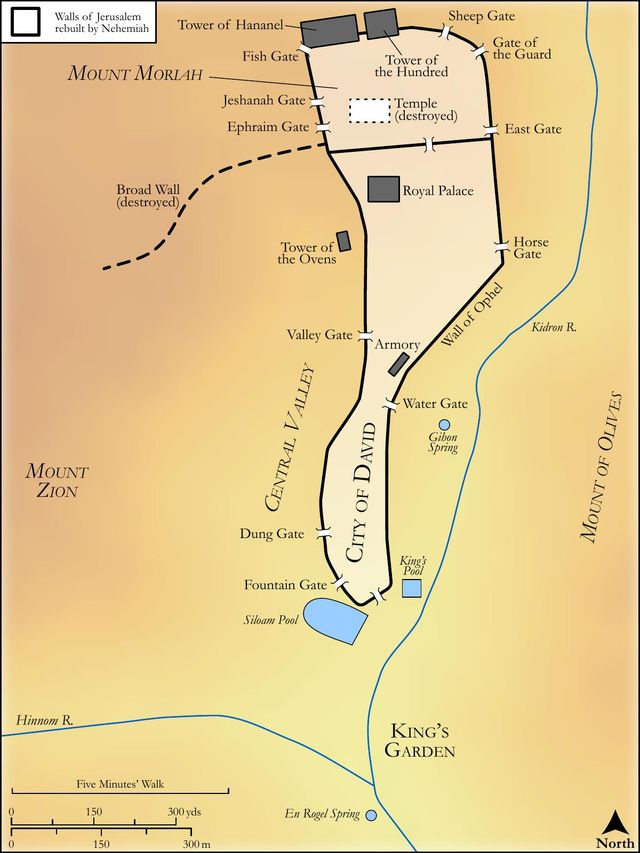
(2.)That though they took little notice of him he took great notice of them and their state. He arose in the night, and viewed the ruins of the walls, probably by moon-light (Neh 2:13), that he might see what was to be done and in what method they must go about it, whether the old foundation would serve, and what there was of the old materials that would be of use. Note,
[1.]Good work is likely to be well done when it is first well considered.
[2.]It is the wisdom of those who are engaged in public business, as much as may be, to see with their own eyes, and not to proceed altogether upon the reports and representations of others, and yet to do this without noise, and if possible unobserved.
[3.]Those that would build up the church's walls must first take notice of the ruins of those walls. Those that would know how to amend must enquire what is amiss, what needs reformation, and what may serve as it is.
(3.)That when he disclosed his design to the rulers and people they cheerfully concurred with him in it. He did not tell them, at first, what he came about (Neh 2:16), because he would not seem to do it for ostentation, and because, if he found it impracticable, he might retreat the more honourably. Upright humble men will not sound a trumpet before their alms or any other of their good offices. But when he had viewed and considered the thing, and probably felt the pulse of the rulers and people, he told them what God had put into his heart (Neh 2:12), even to build up the wall of Jerusalem, Neh 2:17. Observe,
[1.]How fairly he proposed the undertaking to them: "You see the distress we are in, how we lie exposed to the enemies that are round about us, how justly they reproach us as foolish and despicable, how easily they may make a prey of us whenever they have a mind; come, therefore, and let us build up the wall." He did not undertake to do the work without them (it could not be the work of one man), nor did he charge or command imperiously, though he had the king's commission; but in a friendly brotherly way he exhorted and excited them to join with him in this work. To encourage them hereto, he speaks of the design, First, As that which owed it origin to the special grace of God. He takes not the praise of it to himself, as a good thought of his own, but acknowledges that God put it into his heart, and therefore they all ought to countenance it (whatever is of God must be promoted), and might hope to prosper in it, for what God puts men upon he will own them in. Secondly, As that which owed its progress hitherto to the special providence of God. He produced the king's commission, told them how readily it was granted and how forward the king was to favour his design, in which he saw the hand of his God good upon him. It would encourage both him and them to proceed in an undertaking which God had so remarkably smiled upon. Thus he proposed it to them; and,
[2.]They presently came to a resolution, one and all, to concur with him: Let us rise up and build. They are ashamed that they have sat still so long without so much as attempting this needful work, and now resolve to rise up out of their slothfulness, to bestir themselves, and to stir up one another. "Let us rise up," that is, "let us do it with vigour, and diligence, and resolution, as those that are determined to go through with it." So they strengthened their hands, their own and one another's, for this good work. Note, First, Many a good work would find hands enough to be laid to it if there were but one good head to lead in it. They all saw the desolations of Jerusalem, yet none proposed the repair of them; but, when Nehemiah proposed it, they all consented to it. It is a pity that a good motion should be lost purely for want of one to move it and to break the ice in it. Secondly, By stirring up ourselves and one another to that which is good, we strengthen ourselves and one another for it; for the great reason why we are weak in our duty is because we are cold to it, indifferent and unresolved. Let us now see how Nehemiah was received,
2.By those that wished ill to the Jews. Those whom God and his Israel blessed they cursed.
(1.)When he did but show his face it vexed them, Neh 2:10. Sanballat and Tobiah, two of the Samaritans, but by birth the former a Moabite, the latter an Ammonite, when they saw one come armed with a commission from the king to do service to Israel, were exceedingly grieved that all their little paltry arts to weaken Israel were thus baffled and frustrated by a fair, and noble, and generous project to strengthen them. Nothing is a greater vexation to the enemies of good people, who have misrepresented them to princes as turbulent, and factious, and not fit to live, than to see them stand right in the opinion of their rulers, their innocency cleared and their reproach rolled away, and that they are thought not only fit to live, but fit to be trusted. When they saw a man come in that manner, who professedly sought the welfare of the children of Israel, it vexed them to the heart. The wicked shall see it, and be grieved.
(2.)When he began to act they set themselves to hinder him, but in vain, Neh 2:19, Neh 2:20.
[1.]See here with what little reason the enemies attempted to discourage him. They represented the undertaking as a silly thing: They laughed us to scorn and despised us as foolish builders, that could not finish what we began. They represented the undertaking also as a wicked thing, no better than treason: Will you rebel against the king? Because this was the old invidious charge, though now they had a commission from the king and were taken under his protection, yet still they must be called rebels.
[2.]See also with what good reason the Jews slighted these discouragements. They bore up themselves with this that they were the servants of the God of heaven, the only true and living God, that they were acting for him in what they did, and that therefore he would bear them out and prosper them, though the heathen raged, Psa 2:1. They considered also that the reason why these enemies did so malign them was because they had no right in Jerusalem, but envied them their right in it. Thus may the impotent menaces of the church's enemies be easily despised by the church's friends.
Continue studying Nehemiah 2:18 across the web’s major study libraries — every link below opens this exact verse, chapter, or book on the destination site.
Read & Compare
 BibleGatewayThis verse in more than 200 translations and 70 languages.
 Bible.comThe YouVersion reader — hundreds of translations, reading plans, and highlights.
 ESV.orgCrossway's official English Standard Version reader.
 NET BibleThe NET translation with 60,000+ translators' notes on every rendering decision.
 STEP BibleTyndale House's free study tool — original text, vocabulary, and scholarly resources.
 BibliaLogos Bible Software's free web reader.
 USCCBThe New American Bible (Revised Edition) with the U.S. bishops' study notes.
Commentaries
 BibleHub CommentariesDozens of classic commentaries on this verse, gathered on one page.
 StudyLightMore than 100 commentary sets — the largest collection on the web.
 BibleRefPlain-English commentary on what this verse means, verse by verse.
 Enduring WordDavid Guzik's free commentary on this chapter, widely used by Bible teachers.
 Bible Study ToolsVerse commentary alongside Greek and Hebrew study aids.
Original Language & Research
- BibleHub InterlinearThe verse word by word — original language, transliteration, and English.
- BibleHub LexiconEvery word's original-language definition and Strong's entry.
 Blue Letter BibleDeep-study tools — Strong's numbers, concordance, and word studies.
 SefariaThe Hebrew text with Rashi and centuries of Jewish commentary.
Sermons, Hymns & Audio


TrulyRandomVerse is not affiliated with these sites and doesn’t control their content. They’re linked because they’re genuinely useful.
Summary
Nehemiah 2:18 marks the pivotal moment when Nehemiah, having secretly surveyed Jerusalem's ruined walls, reveals his divine commission and the king's support to the Jewish leaders. This verse powerfully captures the essence of inspired leadership, God's tangible favor, and the immediate, unified, and resolute response of the people, galvanizing them to undertake the monumental task of rebuilding the city's defenses. It sets the stage for the arduous but ultimately successful restoration project.
Context
ShowHideLiterary Context
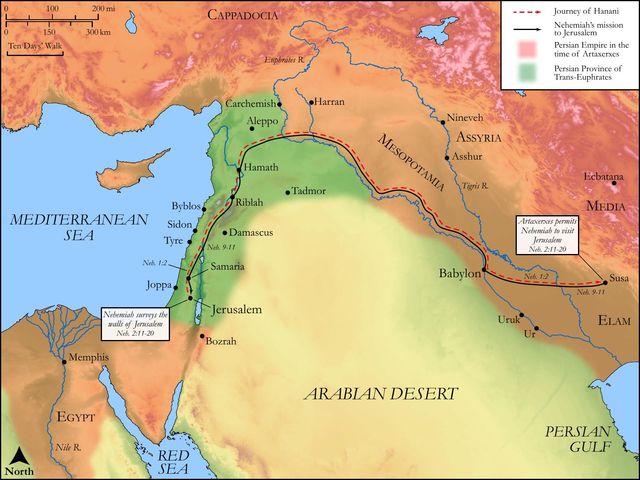
Nehemiah 2:18 immediately follows Nehemiah's clandestine inspection of Jerusalem's dilapidated walls, detailed in Nehemiah 2:11-16. Having arrived in Jerusalem with letters and resources from King Artaxerxes, Nehemiah spent three nights assessing the full scope of the destruction without alerting potential adversaries or even the local Jewish leadership. This strategic reconnaissance allowed him to grasp the enormity of the task and formulate his presentation. Only after this thorough, personal evaluation did he convene with the priests, nobles, and officials, preparing to present his vision and call them to action. Verse 18 is the climax of this initial phase, where his carefully prepared revelation meets the people's readiness for restoration.
Historical & Cultural Context
The events of Nehemiah 2:18 unfold in the mid-5th century BC, during the Persian Empire's dominion over Judah, approximately 90 years after the initial return of exiles under Zerubbabel and Joshua (as recounted in Ezra 2) and roughly a decade after Ezra's arrival (see Ezra 7). Despite earlier attempts, Jerusalem's walls remained in ruins, a symbol of shame, vulnerability, and a lack of national identity for the returning exiles. A city without walls was defenseless against brigands and hostile neighbors like Sanballat, Tobiah, and Geshem, who are introduced later in the narrative. The rebuilding of the walls was not merely a construction project but a profound act of spiritual and national restoration, signifying God's faithfulness to His covenant people and their re-establishment in the land.
Key Themes
ShowHideThis verse powerfully encapsulates several overarching themes central to the book of Nehemiah. Firstly, Divine Providence and Favor are paramount, as Nehemiah explicitly attributes his success and the king's positive response to "the hand of my God which was good upon me." This echoes a similar sentiment expressed by Ezra in Ezra 7:6 and highlights the belief that God actively directs the affairs of His people and their leaders. Secondly, Inspiring Leadership is evident in Nehemiah's strategic planning, courageous initiative, and transparent communication. He doesn't just issue commands but shares his personal testimony of God's leading and the king's endorsement, mobilizing the community through conviction rather than mere authority. Thirdly, the theme of Unity and Collective Action shines through the people's immediate and unanimous response, "Let us rise up and build." This collective resolve to undertake a daunting task demonstrates a shared burden and willingness to cooperate, a principle crucial for any great work of God, as seen in the New Testament church's unity in Ephesians 4:16. Finally, the phrase "strengthened their hands for this good work" underscores the theme of Diligent Effort and Commitment, signifying a firm resolve and readiness to put forth strenuous effort in a divinely appointed endeavor.
Exposition and Analysis
ShowHideKey Word Analysis
ShowHideThis is a powerful Hebrew idiom signifying God's active blessing, protection, and enabling power. Derived from H3027 (yâd), meaning "hand" (indicating power, means, direction), and H430 (ʼĕlôhîym), referring to "God," it implies that God's favor was tangibly at work in Nehemiah's life and circumstances, making his mission possible and successful, even in the court of a pagan king. It's an acknowledgment that human efforts are empowered and guided by divine intervention.
(ṭôwb), this word encompasses a wide range of positive meanings, including beautiful, beneficial, pleasant, prosperous, and favorable. When applied to "the hand of my God," it emphasizes the benevolent, advantageous, and favorable nature of God's intervention. When describing the "work," it signifies that the task itself is inherently beneficial, righteous, and divinely sanctioned.
This idiomatic expression, combining H2388 (châzaq) meaning "to be strong, courageous, to fasten upon" and H3027 (yâd) meaning "hand," literally means "to strengthen hands," but it conveys the idea of taking courage, becoming determined, resolving to act vigorously, or preparing for hard work with resolve and confidence. It signifies a mental and physical readiness to commit fully to a task, often in the face of daunting challenges or opposition. It's an internal resolve made manifest in outward action.
(bânâh), this primitive root means to construct, build (literally and figuratively), or even to establish. In this context, it refers directly to the physical act of constructing the city walls, but it also carries the broader implication of restoring, establishing, and bringing order to a broken situation, signifying a foundational act of renewal.
Verse Breakdown
ShowHide"Then I told them of the hand of my God which was good upon me;"
Nehemiah begins his address by attributing his success not to his own diplomatic skill or the king's benevolence, but to the sovereign favor of God. This establishes a theological foundation for the project, framing it as God's work rather than merely a human endeavor. It builds trust and confidence among the people by demonstrating that the mission is divinely sanctioned and supported.
"as also the king's words that he had spoken unto me."
Following the divine endorsement, Nehemiah provides concrete, tangible evidence of God's favor: the king's explicit permission, provision of resources (timber, a military escort), and appointment as governor. This validates the divine claim with earthly authority, making the vision practical and achievable in the eyes of the leaders and people. It demonstrates that God's favor can manifest through secular authorities.
"And they said, Let us rise up and build."
This is the immediate, enthusiastic, and unified response of the Jewish leaders and people. It signifies not just agreement, but a collective declaration of intent and commitment. The phrase "Let us rise up" (Hebrew, naquma, from H6965 qûwm) is a call to action, indicating a readiness to move from contemplation to active participation. This spontaneous unity is crucial for the success of any large-scale community project.
"So they strengthened their hands for [this] good [work]."
This concluding phrase describes the internal resolve and determination that followed their verbal commitment. It indicates that the people not only agreed to build but also prepared themselves mentally and physically for the arduous labor ahead. The "good work" (Hebrew, ha'melakah ha'tovah, with H2896 ṭôwb) underscores the divinely appointed and beneficial nature of the task, reinforcing its spiritual significance beyond mere construction.
Literary Devices
ShowHideNehemiah 2:18 employs several effective literary devices. The phrase "the hand of my God which was good upon me" is a powerful idiom and an example of anthropomorphism, attributing a human characteristic (a hand) to God to convey His active involvement and benevolent power. It functions as a synecdoche, where "hand" represents God's entire enabling presence and favor. The verse also showcases a clear call and response structure: Nehemiah's persuasive revelation (the "call") is met with the people's immediate and unified affirmation, "Let us rise up and build" (the "response"). This dynamic highlights effective leadership and the power of collective will. Finally, the concluding statement, "So they strengthened their hands for this good work," serves as a metaphorical summary of their renewed resolve and commitment, capturing the spirit of readiness for the monumental task ahead.
Theological and Thematic Connections
ShowHideNehemiah 2:18 powerfully illustrates the principle that divine favor often precedes and empowers human endeavor. Nehemiah's humble acknowledgment of God's "good hand" upon him sets a precedent for all who seek to accomplish God's will: success is not merely a result of human skill or charisma, but of God's enabling presence. This verse also highlights the essential role of visionary leadership in mobilizing God's people and the transformative power of unity in response to a clear, God-given mandate. The people's immediate and resolute commitment to "rise up and build" exemplifies a faith that moves from belief to action, understanding that God's work requires both His blessing and our diligent effort.
Reflection and Application
ShowHideNehemiah 2:18 offers a profound blueprint for how God's work is accomplished through His people. It teaches us that effective leadership involves not just vision, but the humble acknowledgment of God's favor and the transparent sharing of His leading. When we articulate a God-given vision with conviction and demonstrate how God has opened doors, it inspires others to join the cause. The people's immediate and unified response, "Let us rise up and build," is a powerful reminder that when God's will is clear, our appropriate response is often collective, decisive action, even in the face of overwhelming tasks. This verse challenges us to consider what "good work" God is calling us to in our lives, our families, our churches, or our communities. Are we waiting for all obstacles to disappear, or are we, like the Jews of Jerusalem, willing to "strengthen our hands" and commit to the arduous but ultimately rewarding labor, trusting that God's hand is good upon us?
Questions for Reflection
ShowHideFAQ
ShowHideWhy did Nehemiah wait to tell the people about his mission until after he had secretly surveyed the walls?
ShowHideNehemiah's strategic delay in revealing his mission, as described in Nehemiah 2:11-16, was a testament to his wise and cautious leadership. Firstly, it allowed him to personally assess the full extent of the damage and the monumental task ahead without prematurely raising expectations or alerting potential adversaries, such as Sanballat and Tobiah, who would soon emerge. By understanding the reality on the ground, he could present a more informed and compelling case. Secondly, it ensured that his proposal was grounded in fact rather than mere enthusiasm. He wanted to present a clear, actionable plan, backed by both divine favor and royal decree, to a people who had previously experienced failed attempts at rebuilding. This careful preparation maximized the impact of his revelation and secured the immediate, unified "Let us rise up and build" response.
What is the significance of the phrase "strengthened their hands" for believers today?
ShowHideThe phrase "strengthened their hands" (Hebrew, chazaq yadayim') signifies a resolute commitment and vigorous preparation for hard work. For believers today, it carries profound significance. It calls us to move beyond passive agreement or mere good intentions and to actively prepare ourselves for the "good work" that God has called us to do, whether it's spiritual growth, serving in the church, engaging in missions, or living out our faith in our daily vocations. Just as the Jews prepared for physical labor, we are called to spiritual and practical diligence. This might involve dedicating ourselves to prayer, studying God's Word, developing skills, or making sacrifices. It implies a readiness to face challenges with courage and perseverance, knowing that God's "good hand" is upon us, just as it was upon Nehemiah and the people of Jerusalem. It reminds us that while God provides the vision and enablement, He also expects our full, determined participation, as seen in Colossians 3:23.
Christ-Centered Fulfillment
ShowHideNehemiah 2:18, with its emphasis on a leader empowered by God's "good hand" to rebuild a ruined city and unify a dispirited people, powerfully foreshadows the ultimate work of Christ. Nehemiah, as a faithful servant, rallied the people to restore physical walls, but Jesus Christ came to rebuild the spiritual walls of humanity, broken by sin. He is the ultimate leader, not merely appointed by an earthly king, but eternally sanctioned by God the Father, as declared in John 3:16. His mission was to restore what was utterly ruined: humanity's relationship with God, establishing a new covenant through His sacrifice on the cross (Hebrews 8:6). Just as the people "strengthened their hands" for the physical work, believers are called to "strengthen their hands" in faith and obedience, participating in the spiritual building project of the Church, which is the body of Christ (Ephesians 2:19-22). The enthusiastic response of "Let us rise up and build" finds its ultimate fulfillment in the church's mission to proclaim the Gospel and build God's kingdom, empowered by the Holy Spirit, who is the "good hand of God" upon us today (Acts 1:8). Christ's work is the true "good work" that restores not just a city, but eternal life and communion with God.