


Nehemiah 2:4
Bible text: King James Version (1769 Blayney text) · Public domain
Bible text: Berean Standard Bible · Public domain
Bible text: American Standard Version (1901) · Public domain
Bible text: World English Bible, Messianic edition · Public domain
Bible text: Geneva Bible (1599) · Public domain
Bible text: Young's Literal Translation · Public domain
- וַיֹּאמֶרvai·Yo·merand he saidH559Conj-w ¦ V-Qal-ConsecImperf-3msVerb Qal Consecutive Imperfect 3rd Singular Masculineוַandיֹּאמֶרhe said
- לִיlito mePrep-l ¦ 1csSuffix Personal 1st Singular common genderלִtoיme
- הַמֶּלֶךְha·Me·lekhthe kingH4428Art ¦ N-msNoun Singular Masculine Absoluteהַtheמֶּלֶךְking
- עַל'alonH5921PrepPreposition
- מַהmahwhat?H4100InterrogPronoun Interrogative
- זֶּהzehthisH2088PrtParticle Demonstrative
- אַתָּה'a·Tah[are] youH859Pro-2msPronoun Personal 2nd Singular Masculine
- מְבַקֵּשׁme·va·KeshrequestingH1245V-Piel-Prtcpl-msVerb Piel Participle Singular Masculine Absolute
- וָאֶתְפַּלֵּלva·'et·pa·Leland I prayedH6419Conj-w ¦ V-Hithpael-ConsecImperf-1csVerb Hithpael Consecutive Imperfect 1st Singular common genderוָandאֶתְפַּלֵּלI prayed
- אֶל'eltoH413PrepPreposition
- אֱלֹהֵי'e·lo·Hei[the] God ofH430N-mpcNoun Plural Masculine Construct
- הַשָּׁמָיִםha·sha·Ma·yimthe heavensH8064Art ¦ N-mpNoun Plural Masculine Absoluteהַtheשָּׁמָיִםheavens
English is a literal word-by-word gloss of the Hebrew, not the KJV's wording. Why?
This is the original text the KJV's translators worked from — each Hebrew word with its own literal English meaning in this verse, prepared by scholars at Tyndale House, Cambridge. The KJV translates whole sentences, not word by word, so its wording differs: one Hebrew word can become several English words, and the KJV may choose “the LORD” where the gloss reads “Yahweh”. Both are faithful — they answer different questions. For the KJV's own rendering, switch to the KJV text.
Details
See on the biblical-era maps
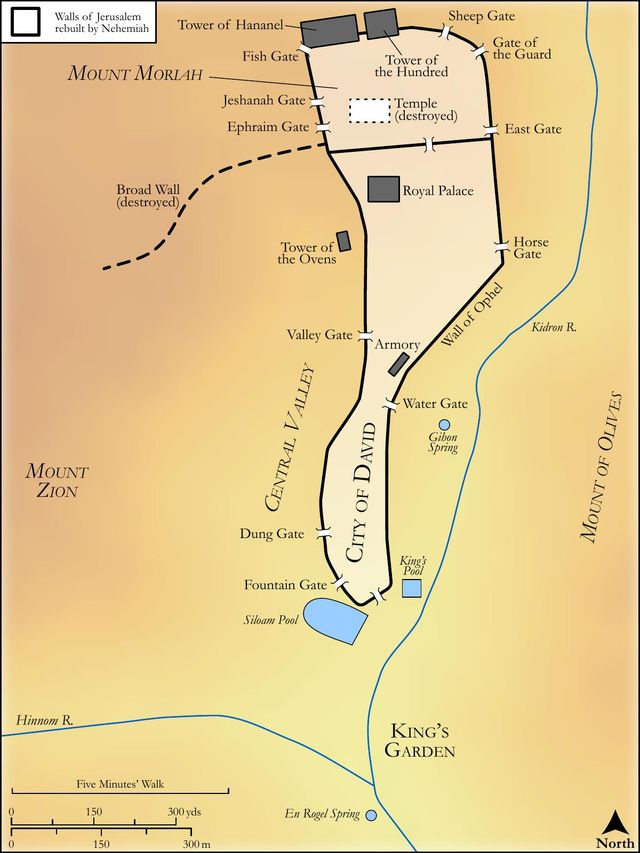
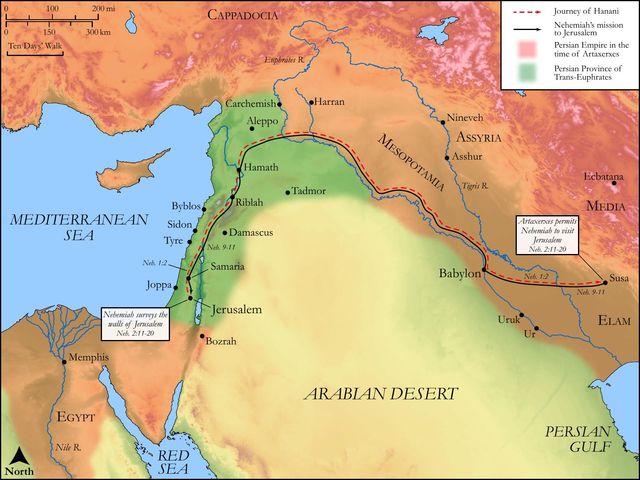
Study this verse
Public-domain commentary
Matthew Henry
From his Commentary on the Whole Bible. Henry comments on passages, not single verses — this entry covers Nehemiah 2:1–8. His three-level outline is real structure in the source text, so it is rendered as structure.
When Nehemiah had prayed for the relief of his countrymen, and perhaps in David's words (Psa 51:18, Build thou the walls of Jerusalem), he did not sit still and say, "Let God now do his own work, for I have no more to do," but set himself to forecast what he could do towards it. our prayers must be seconded with our serious endeavours, else we mock God. Nearly four months passed, from Chisleu to Nisan (from November to March), before Nehemiah made his application to the king for leave to go to Jerusalem, either because the winter was not a proper time for such a journey, and he would not make the motion till he could pursue it, or because it was so long before his month of waiting came, and there was no coming into the king's presence uncalled, Est 4:11. Now that he attended the king's table he hoped to have his ear. We are not thus limited to certain moments in our addresses to the King of kings, but have liberty of access to him at all times; to the throne of grace we never come unseasonably. Now here is,
I.The occasion which he gave the king to enquire into his cares and griefs, by appearing sad in his presence.
Those that speak to such great men must not fall abruptly upon their business, but fetch a compass. Nehemiah would try whether he was in a good humour before he ventured to tell him his errand, and this method he took to try him. He took up the wine and gave it to the king when he called for it, expecting that then he would look him in the face. He had not used to be sad in the king's presence, but conformed to the rules of the court (as courtiers must do), which would admit no sorrows, Est 4:2. Though he was a stranger, a captive, he was easy and pleasant. Good men should do what they can by their cheerfulness to convince the world of the pleasantness of religious ways and to roll away the reproach cast upon them as melancholy; but there is a time for all things, Ecc 3:4. Nehemiah now saw cause both to be sad and to appear so. The miseries of Jerusalem gave him cause to be sad, and his showing his grief would give occasion to the king to enquire into the cause. He did not dissemble sadness, for he was really in grief for the afflictions of Joseph, and was not like the hypocrites who disfigure their faces; yet he could have concealed his grief if it had been necessary (the heart knows its own bitterness, and in the midst of laughter is often sad), but it would now serve his purpose to discover his sadness. Though he had wine before him, and probably, according to the office of the cup-bearer, did himself drink of it before he gave it to the king, yet it would not make his heart glad, while God's Israel was in distress.
II.The kind notice which the king took of his sadness and the enquiry he made into the cause of it (Neh 2:2): Why is thy countenance sad, seeing thou art not sick? Note,
1.We ought, from a principle of Christian sympathy, to concern ourselves in the sorrows and sadnesses of others, even of our inferiors, and not say, What is it to us? Let not masters despise their servants' griefs, but desire to make them easy. The great God is not pleased with the dejections and disquietments of his people, but would have them both serve him with gladness and eat their bread with joy.
2.It is not strange if those that are sick have sad countenances, because of what is felt and what is feared; sickness will make those grave that were most airy and gay: yet a good man, even in sickness, may be of good cheer if he knows that his sins are forgiven.
3.Freedom from sickness is so great a mercy that while we have that we ought not to be inordinately dejected under any outward burden; yet sorrow for our own sins, the sins of others, and the calamities of God's church, may well sadden the countenance, without sickness.
III.The account which Nehemiah gave the king of the cause of his sadness, which he gave with meekness and fear.
1.With fear. He owned that now (though it appears by the following story that he was a man of courage) he was sorely afraid, perhaps of the king's wrath (for those eastern monarchs assumed an absolute power of life and death, Dan 2:12, Dan 2:13; Dan 5:19) or of misplacing a word, and losing his request by the mismanagement of it. Though he was a wise man, he was jealous of himself, lest he should say any thing imprudently; it becomes us to be so. A good assurance is indeed a good accomplishment, yet a humble self-diffidence is not man's dispraise.
2.With meekness. Without reflection upon any man, and with all the respect, deference, and good-will, imaginable to the king his master, he says, "Let the king live for ever; he is wise and good, and the fittest man in the world to rule." He modestly asked, "Why should not my countenance be sad as it is when (though I myself am well and at east) the city" (the king knew what city he meant), "the place of my fathers' sepulchres, lieth waste?" Many are melancholy and sad but can give no reason for being so, cannot tell why nor wherefore; such should chide themselves for, and chide themselves out of, their unjust and unreasonable griefs and fears. But Nehemiah could give so good a reason for his sadness as to appeal to the king himself concerning it. Observe,
(1.)He calls Jerusalem the place of his fathers' sepulchres, the place where his ancestors were buried. It is good for us to think often of our fathers' sepulchres; we are apt to dwell in our thoughts upon their honours and titles, their houses and estates, but let us think also of their sepulchres, and consider that those who have gone before us in the world have also gone before us out of the world, and their monuments are momentos to us. There is also a great respect owing to the memory of our fathers, which we should not be willing to see injured. All nations, even those that have had no expectation of the resurrection of the dead, have looked upon the sepulchres of their ancestors as in some degree sacred and not to be violated.
(2.)He justifies himself in his grief: "I do well to be sad. Why should I not be so?" There is a time even for pious and prosperous men to be sad and to show their grief. The best men must not think to antedate heaven by banishing all sorrowful thoughts; it is a vale of tears we pass through, and we must submit to the temper of the climate.
(3.)He assigns the ruins of Jerusalem as the true cause of his grief. Note, All the grievances of the church, but especially its desolations, are, and ought to be, matter of grief and sadness to all good people, to all that have a concern for God's honour and that are living members of Christ's mystical body, and are of a public spirit; they favour even Zion's dust, Psa 102:14.
IV.The encouragement which the king gave him to tell his mind, and the application he thereupon made in his heart to God, Neh 2:4.
The king had an affection for him, and was not pleased to see him melancholy. It is also probable that he had a kindness for the Jews' religion; he had discovered it before in the commission he gave to Ezra, who was a churchman, and now again in the power he put Nehemiah into, who was a statesman. Wanting therefore only to know how he might be serviceable to Jerusalem, he asks this its anxious friend, "For what dost thou make request? Something thou wouldst have; what is it?" He was afraid to speak (Neh 2:2), but this gave him boldness; much more may the invitation Christ has given us to pray, and the promise that we shall speed, enable us to come boldly to the throne of grace. Nehemiah immediately prayed to the God of heaven that he would give him wisdom to ask properly and incline the king's heart to grant him his request. Those that would find favour with kings must secure the favour of the King of kings. He prayed to the God of heaven as infinitely above even this mighty monarch. It was not a solemn prayer (he had not opportunity for that), but a secret sudden ejaculation; he lifted up his heart to that God who understands the language of his heart: Lord, give me a mouth and wisdom; Lord, give me favour in the sight of this man. Note, It is good to be much in pious ejaculations, especially upon particular occasions. Wherever we are we have a way open heaven-ward. This will not hinder any business, but further it rather; therefore let no business hinder this, but give rise to it rather. Nehemiah had prayed very solemnly with reference to this very occasion (Neh 1:11), yet, when it comes to the push, he prays again. Ejaculations and solemn prayers must not jostle out one another, but each have its place.
V.His humble petition to the king.
When he had this encouragement he presented his petition very modestly and with submission to the king's wisdom (Neh 2:5), but very explicitly. He asked for a commission to go as governor to Judah, to build the wall of Jerusalem, and to stay there for a certain time, so many months, we may suppose; and then either he had his commission renewed or went back and was sent again, so that he presided there twelve years at least, Neh 5:14. He also asked for a convoy (Neh 2:7), and an order upon the governors, not only to permit and suffer him to pass through their respective provinces, but to supply him with what he had occasion for, with another order upon the keeper of the forest of Lebanon to give him timber for the work that he designed.
VI.The king's great favour to him in asking him when he would return, Neh 2:6.
He intimated that he was unwilling to lose him, or to be long without him, yet to gratify him, and do a real office of kindness to his people, he would spare him awhile, and let him have what clauses he pleased inserted in his commission, Neh 2:8. Here was an immediate answer to his prayer; for the seed of Jacob never sought the God of Jacob in vain. In the account he gives of the success of his petition he takes notice,
1.Of the presence of the queen; she sat by (Neh 2:6), which (they say) was not usual in the Persian court, Est 1:11. Whether the queen was his back friend, that would have hindered him, and he observes it to the praise of God's powerful providence that though she was by yet he succeeded, or whether she was his true friend, and it is observed to the praise of God's kind providence that she was present to help forward his request, is not certain.
2.Of the power and grace of God. He gained his point, not according to his merit, his interest in the king, or his good management, but according to the good hand of his God upon him. Gracious souls take notice of God's hand, his good hand, in all events which turn in favour of them. This is the Lord's doing, and therefore doubly acceptable.
Continue studying Nehemiah 2:4 across the web’s major study libraries — every link below opens this exact verse, chapter, or book on the destination site.
Read & Compare
 BibleGatewayThis verse in more than 200 translations and 70 languages.
 Bible.comThe YouVersion reader — hundreds of translations, reading plans, and highlights.
 ESV.orgCrossway's official English Standard Version reader.
 NET BibleThe NET translation with 60,000+ translators' notes on every rendering decision.
 STEP BibleTyndale House's free study tool — original text, vocabulary, and scholarly resources.
 BibliaLogos Bible Software's free web reader.
 USCCBThe New American Bible (Revised Edition) with the U.S. bishops' study notes.
Commentaries
 BibleHub CommentariesDozens of classic commentaries on this verse, gathered on one page.
 StudyLightMore than 100 commentary sets — the largest collection on the web.
 BibleRefPlain-English commentary on what this verse means, verse by verse.
 Enduring WordDavid Guzik's free commentary on this chapter, widely used by Bible teachers.
 Bible Study ToolsVerse commentary alongside Greek and Hebrew study aids.
Original Language & Research
- BibleHub InterlinearThe verse word by word — original language, transliteration, and English.
- BibleHub LexiconEvery word's original-language definition and Strong's entry.
 Blue Letter BibleDeep-study tools — Strong's numbers, concordance, and word studies.
 SefariaThe Hebrew text with Rashi and centuries of Jewish commentary.
Sermons, Hymns & Audio


TrulyRandomVerse is not affiliated with these sites and doesn’t control their content. They’re linked because they’re genuinely useful.
Summary
Nehemiah 2:4 captures a profoundly pivotal moment where King Artaxerxes, having observed Nehemiah's sadness, directly probes the reason for his distress and implicitly invites a request. Before articulating a single word to the powerful earthly monarch, Nehemiah instinctively and silently turns to the "God of heaven" in prayer. This brief, unrecorded petition reveals Nehemiah's immediate, deep-seated dependence on divine wisdom and sovereign guidance, powerfully underscoring that true help and direction in high-stakes situations come from God alone.
Context
ShowHideLiterary Context
This verse is strategically positioned as the spiritual fulcrum within the unfolding narrative of Nehemiah's burden and subsequent mission to rebuild Jerusalem. The preceding chapter, Nehemiah 1, details Nehemiah's profound grief upon hearing of Jerusalem's desolate state, leading him into a period of intense mourning, fasting, and extended prayer (Nehemiah 1:2-11). Four months later, while serving as the king's cupbearer, Nehemiah's sorrow becomes evident to King Artaxerxes, who inquires about it (Nehemiah 2:1-2). Despite his initial "great fear" (Nehemiah 2:2), Nehemiah explains his sorrow regarding the ruined city of his fathers' tombs (Nehemiah 2:3). It is at this precise juncture, after Nehemiah has conveyed his grief, that the king asks the crucial question, "For what dost thou make request?", setting the stage for Nehemiah's silent, immediate prayer in Nehemiah 2:4. This moment is the culmination of Nehemiah's prior spiritual preparation and the direct catalyst for his audacious request to rebuild Jerusalem's walls, demonstrating how God orchestrates events and prepares His servants for critical opportunities.
Historical & Cultural Context
Nehemiah served during the zenith of the Persian Empire, specifically under Artaxerxes I (465-424 BC). The Jewish people were exiles, or descendants of exiles, who had been allowed to return to Judah under earlier decrees, most notably Cyrus's decree recorded in Ezra 1. However, Jerusalem's walls remained in ruins, a stark symbol of national disgrace, vulnerability, and lack of true sovereignty, making the city an easy target for hostile neighbors. The role of a cupbearer was one of immense trust and proximity to the king, often involving significant political influence and access, but also carrying inherent risks. Kings of that day wielded absolute power, and approaching them with requests, especially those concerning sensitive political matters like rebuilding fortifications, was fraught with danger, even for trusted servants. Nehemiah's admitted fear (Nehemiah 2:2) was therefore entirely rational and culturally appropriate. The prevalent cultural understanding of divine intervention, even among pagan rulers, is subtly acknowledged; even powerful kings could be seen as instruments of a higher power, as articulated in Proverbs 21:1. Nehemiah's immediate prayer to "the God of heaven" reflects a deeply ingrained monotheistic conviction in a polytheistic world, acknowledging God's supreme authority over all earthly rulers and circumstances.
Key Themes
ShowHideNehemiah 2:4 powerfully encapsulates several key themes central to the book of Nehemiah and broader biblical theology. Firstly, it highlights the theme of Divine Sovereignty and Providence, demonstrating how God orchestrates circumstances and influences the hearts of powerful rulers to accomplish His purposes, even through seemingly mundane interactions. Secondly, it underscores the Centrality and Power of Prayer, particularly instantaneous, "arrow prayers" that reflect a constant, living communion with God. Nehemiah's example illustrates that genuine leadership is rooted in profound Dependence on God, not merely human wisdom or political skill. Despite his privileged position and access to the most powerful man on earth, Nehemiah's first recourse is to his heavenly King, showcasing a deep Trust in God's Guidance and Favor. This verse also subtly introduces the theme of Courage Born of Faith, as Nehemiah, having just admitted his fear, finds the resolve to proceed after his brief, silent prayer. Ultimately, it contributes to the overarching theme of Restoration and God's Faithfulness to His covenant people, as this pivotal prayer sets in motion the monumental work of rebuilding Jerusalem, a work that begins with a humble, yet profound, act of faith.
Exposition and Analysis
ShowHideKey Word Analysis
ShowHideA primitive root; to judge (officially or mentally); by extension, to intercede, pray; intreat, judge(-ment), (make) pray(-er, -ing), make supplication. In this context, pâlal signifies an act of immediate, internal supplication. Unlike the lengthy, formal prayer in Nehemiah 1, this is a swift, silent turning to God, often termed an "arrow prayer." It demonstrates Nehemiah's habitual communion with God, where divine counsel and strength are sought in real-time, under immense pressure, before any human response is articulated. This immediate recourse to prayer underscores a profound, moment-by-moment reliance on God's wisdom and intervention.
Plural of אֱלוֹהַּ; gods in the ordinary sense; but specifically used (in the plural thus, especially with the article) of the supreme God; occasionally applied by way of deference to magistrates; and sometimes as a superlative; angels, [idiom] exceeding, God (gods) (-dess, -ly), [idiom] (very) great, judges, [idiom] mighty. Here, ʼĕlôhîym refers specifically to the one supreme God, the God of Israel. When coupled with "of heaven," it emphasizes His singular, transcendent nature and supreme authority over all earthly powers. Nehemiah's prayer is directed not to a local deity or a mere idol, but to the ultimate, sovereign ruler of the universe, demonstrating his unwavering monotheistic conviction and trust in God's omnipotence.
Dual of an unused singular שָׁמֶה; from an unused root meaning to be lofty; the sky (as aloft; the dual perhaps alluding to the visible arch in which the clouds move, as well as to the higher ether where the celestial bodies revolve); air, [idiom] astrologer, heaven(-s). The inclusion of shâmayim with ʼĕlôhîym ("God of heaven") further emphasizes God's transcendence, universal dominion, and ultimate authority. This title, prominent in post-exilic books, contrasts God with earthly rulers and local deities, asserting His sovereignty over all creation and all nations. For Nehemiah, addressing God in this manner in the presence of the Persian king underscores his conviction that the true power and ultimate decision-maker is not Artaxerxes, but the transcendent God who rules over all earthly powers and can influence the hearts of kings (Proverbs 21:1).
Verse Breakdown
ShowHide"Then the king said unto me, For what dost thou make request?"
This clause represents a divinely orchestrated, critical turning point. The king's direct question, following Nehemiah's explanation of his sorrow, is an explicit invitation to articulate a specific desire or solution. It places Nehemiah in an immediate, high-stakes situation where his response could determine the fate of his mission, the future of Jerusalem, and potentially his own life. The pressure is immense, requiring not just a quick answer, but one that is wise, persuasive, and aligned with God's will. This moment highlights God's active involvement in opening doors and creating opportune circumstances for His servants to step into their divine assignments.
"So I prayed to the God of heaven."
This is the spiritual core of the verse and the profound, immediate response to the king's query. The conjunction "So" indicates an instantaneous, unhesitating action. Nehemiah's prayer is silent and internal, a swift, unrecorded cry for divine guidance, favor, and courage before he speaks to the king. It reveals his spiritual priority: before addressing the most powerful man on earth, he first addresses the most powerful being in the universe. This brief, yet potent, prayer demonstrates Nehemiah's deep-seated faith, his constant communion with God, and his absolute dependence on God's sovereignty to direct his words and the king's heart. It is the spiritual foundation upon which all subsequent actions and successes in rebuilding Jerusalem are built.
Literary Devices
ShowHideNehemiah 2:4 masterfully employs several literary devices to convey its powerful spiritual message. The most prominent is Narrative Disclosure, where the author grants the reader privileged access to Nehemiah's internal spiritual state and immediate action ("So I prayed to the God of heaven"), which remains outwardly invisible to King Artaxerxes. This technique provides profound insight into Nehemiah's character, illustrating his deep faith and constant reliance on God even in moments of intense pressure. There is also a strong element of Juxtaposition or Contrast at play: the earthly king, with all his temporal power and authority, asks a crucial question, but Nehemiah's immediate, unrecorded response is to turn to the "God of heaven," the ultimate sovereign. This stark contrast highlights where Nehemiah's true allegiance and ultimate source of help lie, emphasizing the supremacy of divine authority over human power. The verse also functions as a moment of Dramatic Irony, as the king is entirely unaware that Nehemiah is consulting a higher authority and receiving divine counsel before formulating his response, adding a layer of divine orchestration to the human interaction and foreshadowing God's unseen hand in the unfolding events.
Theological and Thematic Connections
ShowHideNehemiah 2:4 serves as a timeless testament to the power and necessity of prayer, particularly in moments of immediate decision and pressure. It underscores the biblical truth that true wisdom, courage, and effective action flow from a deep, moment-by-moment dependence on God. Nehemiah's "arrow prayer" demonstrates that communion with God is not confined to formal, lengthy sessions, but is an ongoing, integrated aspect of a believer's life, available and essential in every circumstance. This immediate turning to the "God of heaven" before responding to an earthly king highlights God's supreme sovereignty over all human affairs and His ability to influence even the most powerful individuals for His purposes. It teaches us that our first recourse in any challenge or opportunity should always be to seek divine counsel and favor, trusting that God actively works through our prayers to achieve His will and accomplish His redemptive plans.
Reflection and Application
ShowHideNehemiah 2:4 offers profound and practical lessons for believers navigating the complexities of modern life. It challenges us to cultivate a spiritual habit of instantaneous prayer, recognizing that every decision, every conversation, and every unexpected opportunity is a potential moment for divine intervention. In a world that often pressures us to respond quickly based on our own limited wisdom, fear, or worldly strategies, Nehemiah's example calls us to pause, even for a silent second, and direct our hearts to the "God of heaven." This practice fosters a deep trust in God's sovereignty, reminding us that He is actively involved in our circumstances and can influence people and events far beyond our control. It also emphasizes the importance of prior spiritual preparation; Nehemiah's quick prayer was effective because it flowed from months of sustained prayer and fasting, demonstrating that consistent spiritual discipline equips us to respond faithfully and courageously when God opens doors. When confronted with fear, daunting tasks, or unexpected opportunities, our first and most vital response should be to turn to God, allowing His peace and wisdom to guide our words and actions, knowing that He is the true source of all success.
Questions for Reflection
ShowHideFAQ
ShowHideWhat is an "arrow prayer" and why is Nehemiah 2:4 a prime example?
ShowHideAn "arrow prayer" is a short, spontaneous, often silent prayer, shot up to God in a moment of immediate need, decision, or crisis. It's like an arrow launched swiftly and directly to its target, bypassing formal rituals to connect instantly with the divine. Nehemiah 2:4 is a prime example because, when confronted by the powerful King Artaxerxes with a direct question about his request, Nehemiah doesn't engage in a lengthy, formal prayer. Instead, he instantly and silently "prayed to the God of heaven" before uttering a word to the king. This demonstrates a deep, habitual communion with God, where divine counsel and strength are sought in real-time, under immense pressure. It perfectly embodies the biblical encouragement to “pray without ceasing”.
Why is the title "God of heaven" significant in this context?
ShowHideThe title "God of heaven" (Hebrew: Elohei haShamayim) is highly significant, especially in post-exilic books like Nehemiah, Ezra, and Daniel. It emphasizes God's supreme authority, transcendence, and universal dominion. In a world where many nations worshipped local or national deities, this title declares that the God of Israel is not confined to a specific land or people, but is the sovereign ruler over all creation, all nations, and all earthly powers—including the mighty Persian King Artaxerxes. For Nehemiah, invoking this title in his silent prayer underscores his absolute trust that his help comes from a God who controls all circumstances and can influence the hearts of even secular rulers (Proverbs 21:1). It reinforces that the ultimate source of Nehemiah's success is not his own wit or the king's favor, but the omnipotent and omnipresent "God of heaven."
Christ-Centered Fulfillment
ShowHideNehemiah's immediate and profound reliance on the "God of heaven" in a moment of critical decision beautifully foreshadows the perfect dependence of Jesus Christ on His Heavenly Father. Throughout His earthly ministry, Jesus consistently modeled a life of prayer and absolute submission to the Father's will. Just as Nehemiah turned to God before speaking to an earthly king, Jesus frequently withdrew to pray (Luke 5:16, Mark 1:35), seeking the Father's guidance and strength before major decisions or challenging encounters, culminating in His Gethsemane prayer of surrender (Luke 22:42). His entire life was an embodiment of the principle, "The Son can do nothing of his own accord, but only what he sees the Father doing" (John 5:19). Furthermore, Christ is not only the perfect example of prayerful dependence but also the ultimate answer to Nehemiah's silent plea for divine intervention. The "God of heaven" whom Nehemiah prayed to is the same God who sent His Son, Jesus, to accomplish the ultimate restoration—not of physical walls, but of humanity's broken relationship with God. Through Christ's atoning sacrifice and glorious resurrection, we now have direct access to the "God of heaven" (Ephesians 2:18), and He Himself lives to intercede for us at the Father's right hand (Romans 8:34, Hebrews 7:25), ensuring that our own "arrow prayers" are heard and answered by the sovereign Lord of all.