


Nehemiah 2:5
Bible text: King James Version (1769 Blayney text) · Public domain
Bible text: King James Version with Strong's numbers · Public domain
Bible text: Berean Standard Bible · Public domain
Bible text: American Standard Version (1901) · Public domain
Bible text: World English Bible, Messianic edition · Public domain
Bible text: Geneva Bible (1599) · Public domain
Bible text: Young's Literal Translation · Public domain
- וָאֹמַרva·'o·Marand I saidH559Conj-w ¦ V-Qal-ConsecImperf-1csVerb Qal Consecutive Imperfect 1st Singular common genderוָandאֹמַרI said
- לַמֶּלֶךְla·Me·lekhto the kingH4428Prep-l ¦ N-msNoun Singular Masculine Absoluteלַto theמֶּלֶךְking
- אִם'imifH518PrtParticle Conditional
- עַל'al[is] onH5921PrepPreposition
- הַמֶּלֶךְha·Me·lekhthe kingH4428Art ¦ N-msNoun Singular Masculine Absoluteהַtheמֶּלֶךְking
- טוֹבTovgoodH2896Adj-msAdjective Singular Masculine Absolute
- וְאִםve·'imand ifH518Conj-w ¦ PrtParticle Conditionalוְandאִםif
- יִיטַבyi·Tavhe is goodH3190V-Qal-Imperf-3msVerb Qal Imperfect 3rd Singular Masculine
- עַבְדְּךָ'av·de·Khayour servantH5650N-msc ¦ 2msNoun Singular Masculine Constructעַבְדְּservantךָyour
- לְפָנֶיךָle·fa·Nei·kha<to> before youH6440Prep-l ¦ N-mpc ¦ 2msNoun Plural Masculine Constructלְ<to>פָנֶיbeforeךָyou
- אֲשֶׁר'a·SherthatH834RelParticle Relative
- תִּשְׁלָחֵנִיtish·la·Che·niyou will send meH7971V-Qal-Imperf-2ms ¦ 1csVerb Qal Imperfect 2nd Singular Masculineתִּשְׁלָחֵyou will sendנִיme
- אֶל'eltoH413PrepPreposition
- יְהוּדָהye·hu·DahJudahH3063N-properNoun Proper Location
- אֶל'eltoH413PrepPreposition
- עִיר'ir[the] city ofH5892N-fscNoun Singular Feminine Construct
- קִבְרוֹתkiv·Rot[the] tombs ofH6913N-fpcNoun Plural Feminine Construct
- אֲבֹתַי'a·vo·Taimy ancestorsH1N-fpc ¦ 1csNoun Plural Feminine Constructאֲבֹתַancestorsיmy
- וְאֶבְנֶנָּהve·'ev·Ne·nahand I will rebuild itH1129Conj-w ¦ V-Qal-ConjImperf-1cs ¦ 3fsVerb Qal Conjunction+Imperfect 1st Singular common genderוְandאֶבְנֶI will rebuildנָּהit
English is a literal word-by-word gloss of the Hebrew, not the KJV's wording. Why?
This is the original text the KJV's translators worked from — each Hebrew word with its own literal English meaning in this verse, prepared by scholars at Tyndale House, Cambridge. The KJV translates whole sentences, not word by word, so its wording differs: one Hebrew word can become several English words, and the KJV may choose “the LORD” where the gloss reads “Yahweh”. Both are faithful — they answer different questions. For the KJV's own rendering, switch to the KJV text.
Details
See on the biblical-era maps
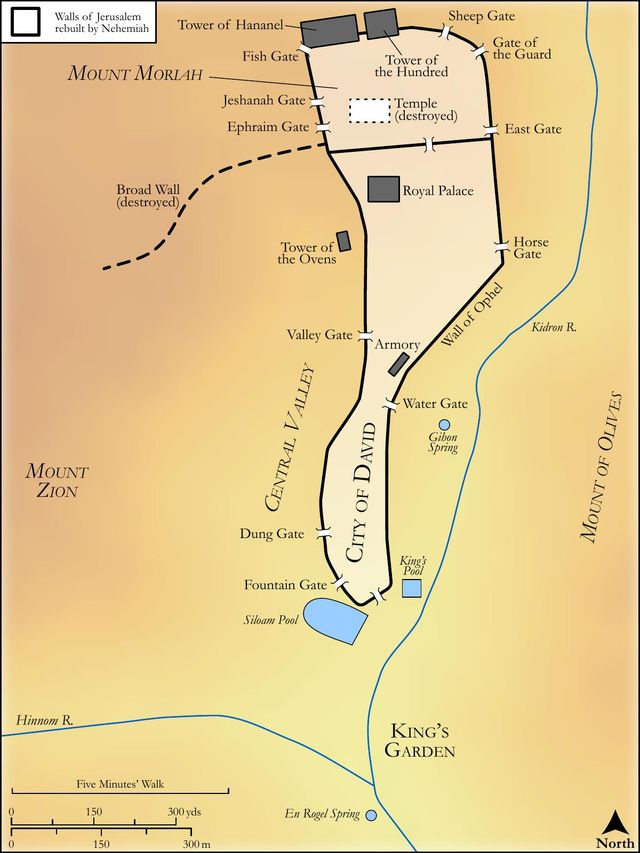
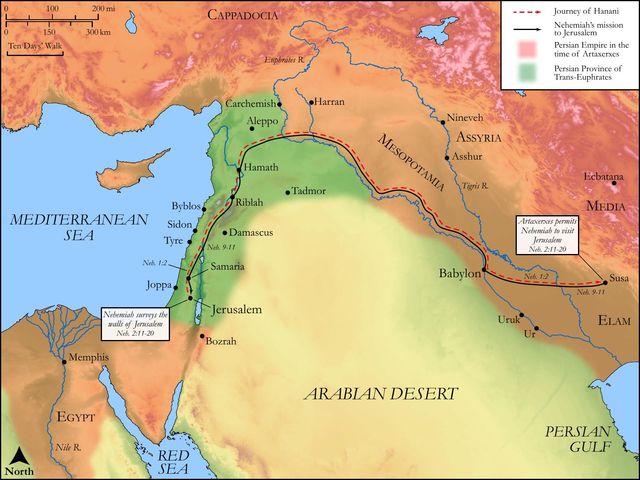
Study this verse
Public-domain commentary
Matthew Henry
From his Commentary on the Whole Bible. Henry comments on passages, not single verses — this entry covers Nehemiah 2:1–8. His three-level outline is real structure in the source text, so it is rendered as structure.
When Nehemiah had prayed for the relief of his countrymen, and perhaps in David's words (Psa 51:18, Build thou the walls of Jerusalem), he did not sit still and say, "Let God now do his own work, for I have no more to do," but set himself to forecast what he could do towards it. our prayers must be seconded with our serious endeavours, else we mock God. Nearly four months passed, from Chisleu to Nisan (from November to March), before Nehemiah made his application to the king for leave to go to Jerusalem, either because the winter was not a proper time for such a journey, and he would not make the motion till he could pursue it, or because it was so long before his month of waiting came, and there was no coming into the king's presence uncalled, Est 4:11. Now that he attended the king's table he hoped to have his ear. We are not thus limited to certain moments in our addresses to the King of kings, but have liberty of access to him at all times; to the throne of grace we never come unseasonably. Now here is,
I.The occasion which he gave the king to enquire into his cares and griefs, by appearing sad in his presence.
Those that speak to such great men must not fall abruptly upon their business, but fetch a compass. Nehemiah would try whether he was in a good humour before he ventured to tell him his errand, and this method he took to try him. He took up the wine and gave it to the king when he called for it, expecting that then he would look him in the face. He had not used to be sad in the king's presence, but conformed to the rules of the court (as courtiers must do), which would admit no sorrows, Est 4:2. Though he was a stranger, a captive, he was easy and pleasant. Good men should do what they can by their cheerfulness to convince the world of the pleasantness of religious ways and to roll away the reproach cast upon them as melancholy; but there is a time for all things, Ecc 3:4. Nehemiah now saw cause both to be sad and to appear so. The miseries of Jerusalem gave him cause to be sad, and his showing his grief would give occasion to the king to enquire into the cause. He did not dissemble sadness, for he was really in grief for the afflictions of Joseph, and was not like the hypocrites who disfigure their faces; yet he could have concealed his grief if it had been necessary (the heart knows its own bitterness, and in the midst of laughter is often sad), but it would now serve his purpose to discover his sadness. Though he had wine before him, and probably, according to the office of the cup-bearer, did himself drink of it before he gave it to the king, yet it would not make his heart glad, while God's Israel was in distress.
II.The kind notice which the king took of his sadness and the enquiry he made into the cause of it (Neh 2:2): Why is thy countenance sad, seeing thou art not sick? Note,
1.We ought, from a principle of Christian sympathy, to concern ourselves in the sorrows and sadnesses of others, even of our inferiors, and not say, What is it to us? Let not masters despise their servants' griefs, but desire to make them easy. The great God is not pleased with the dejections and disquietments of his people, but would have them both serve him with gladness and eat their bread with joy.
2.It is not strange if those that are sick have sad countenances, because of what is felt and what is feared; sickness will make those grave that were most airy and gay: yet a good man, even in sickness, may be of good cheer if he knows that his sins are forgiven.
3.Freedom from sickness is so great a mercy that while we have that we ought not to be inordinately dejected under any outward burden; yet sorrow for our own sins, the sins of others, and the calamities of God's church, may well sadden the countenance, without sickness.
III.The account which Nehemiah gave the king of the cause of his sadness, which he gave with meekness and fear.
1.With fear. He owned that now (though it appears by the following story that he was a man of courage) he was sorely afraid, perhaps of the king's wrath (for those eastern monarchs assumed an absolute power of life and death, Dan 2:12, Dan 2:13; Dan 5:19) or of misplacing a word, and losing his request by the mismanagement of it. Though he was a wise man, he was jealous of himself, lest he should say any thing imprudently; it becomes us to be so. A good assurance is indeed a good accomplishment, yet a humble self-diffidence is not man's dispraise.
2.With meekness. Without reflection upon any man, and with all the respect, deference, and good-will, imaginable to the king his master, he says, "Let the king live for ever; he is wise and good, and the fittest man in the world to rule." He modestly asked, "Why should not my countenance be sad as it is when (though I myself am well and at east) the city" (the king knew what city he meant), "the place of my fathers' sepulchres, lieth waste?" Many are melancholy and sad but can give no reason for being so, cannot tell why nor wherefore; such should chide themselves for, and chide themselves out of, their unjust and unreasonable griefs and fears. But Nehemiah could give so good a reason for his sadness as to appeal to the king himself concerning it. Observe,
(1.)He calls Jerusalem the place of his fathers' sepulchres, the place where his ancestors were buried. It is good for us to think often of our fathers' sepulchres; we are apt to dwell in our thoughts upon their honours and titles, their houses and estates, but let us think also of their sepulchres, and consider that those who have gone before us in the world have also gone before us out of the world, and their monuments are momentos to us. There is also a great respect owing to the memory of our fathers, which we should not be willing to see injured. All nations, even those that have had no expectation of the resurrection of the dead, have looked upon the sepulchres of their ancestors as in some degree sacred and not to be violated.
(2.)He justifies himself in his grief: "I do well to be sad. Why should I not be so?" There is a time even for pious and prosperous men to be sad and to show their grief. The best men must not think to antedate heaven by banishing all sorrowful thoughts; it is a vale of tears we pass through, and we must submit to the temper of the climate.
(3.)He assigns the ruins of Jerusalem as the true cause of his grief. Note, All the grievances of the church, but especially its desolations, are, and ought to be, matter of grief and sadness to all good people, to all that have a concern for God's honour and that are living members of Christ's mystical body, and are of a public spirit; they favour even Zion's dust, Psa 102:14.
IV.The encouragement which the king gave him to tell his mind, and the application he thereupon made in his heart to God, Neh 2:4.
The king had an affection for him, and was not pleased to see him melancholy. It is also probable that he had a kindness for the Jews' religion; he had discovered it before in the commission he gave to Ezra, who was a churchman, and now again in the power he put Nehemiah into, who was a statesman. Wanting therefore only to know how he might be serviceable to Jerusalem, he asks this its anxious friend, "For what dost thou make request? Something thou wouldst have; what is it?" He was afraid to speak (Neh 2:2), but this gave him boldness; much more may the invitation Christ has given us to pray, and the promise that we shall speed, enable us to come boldly to the throne of grace. Nehemiah immediately prayed to the God of heaven that he would give him wisdom to ask properly and incline the king's heart to grant him his request. Those that would find favour with kings must secure the favour of the King of kings. He prayed to the God of heaven as infinitely above even this mighty monarch. It was not a solemn prayer (he had not opportunity for that), but a secret sudden ejaculation; he lifted up his heart to that God who understands the language of his heart: Lord, give me a mouth and wisdom; Lord, give me favour in the sight of this man. Note, It is good to be much in pious ejaculations, especially upon particular occasions. Wherever we are we have a way open heaven-ward. This will not hinder any business, but further it rather; therefore let no business hinder this, but give rise to it rather. Nehemiah had prayed very solemnly with reference to this very occasion (Neh 1:11), yet, when it comes to the push, he prays again. Ejaculations and solemn prayers must not jostle out one another, but each have its place.
V.His humble petition to the king.
When he had this encouragement he presented his petition very modestly and with submission to the king's wisdom (Neh 2:5), but very explicitly. He asked for a commission to go as governor to Judah, to build the wall of Jerusalem, and to stay there for a certain time, so many months, we may suppose; and then either he had his commission renewed or went back and was sent again, so that he presided there twelve years at least, Neh 5:14. He also asked for a convoy (Neh 2:7), and an order upon the governors, not only to permit and suffer him to pass through their respective provinces, but to supply him with what he had occasion for, with another order upon the keeper of the forest of Lebanon to give him timber for the work that he designed.
VI.The king's great favour to him in asking him when he would return, Neh 2:6.
He intimated that he was unwilling to lose him, or to be long without him, yet to gratify him, and do a real office of kindness to his people, he would spare him awhile, and let him have what clauses he pleased inserted in his commission, Neh 2:8. Here was an immediate answer to his prayer; for the seed of Jacob never sought the God of Jacob in vain. In the account he gives of the success of his petition he takes notice,
1.Of the presence of the queen; she sat by (Neh 2:6), which (they say) was not usual in the Persian court, Est 1:11. Whether the queen was his back friend, that would have hindered him, and he observes it to the praise of God's powerful providence that though she was by yet he succeeded, or whether she was his true friend, and it is observed to the praise of God's kind providence that she was present to help forward his request, is not certain.
2.Of the power and grace of God. He gained his point, not according to his merit, his interest in the king, or his good management, but according to the good hand of his God upon him. Gracious souls take notice of God's hand, his good hand, in all events which turn in favour of them. This is the Lord's doing, and therefore doubly acceptable.
Continue studying Nehemiah 2:5 across the web’s major study libraries — every link below opens this exact verse, chapter, or book on the destination site.
Read & Compare
 BibleGatewayThis verse in more than 200 translations and 70 languages.
 Bible.comThe YouVersion reader — hundreds of translations, reading plans, and highlights.
 ESV.orgCrossway's official English Standard Version reader.
 NET BibleThe NET translation with 60,000+ translators' notes on every rendering decision.
 STEP BibleTyndale House's free study tool — original text, vocabulary, and scholarly resources.
 BibliaLogos Bible Software's free web reader.
 USCCBThe New American Bible (Revised Edition) with the U.S. bishops' study notes.
Commentaries
 BibleHub CommentariesDozens of classic commentaries on this verse, gathered on one page.
 StudyLightMore than 100 commentary sets — the largest collection on the web.
 BibleRefPlain-English commentary on what this verse means, verse by verse.
 Enduring WordDavid Guzik's free commentary on this chapter, widely used by Bible teachers.
 Bible Study ToolsVerse commentary alongside Greek and Hebrew study aids.
Original Language & Research
- BibleHub InterlinearThe verse word by word — original language, transliteration, and English.
- BibleHub LexiconEvery word's original-language definition and Strong's entry.
 Blue Letter BibleDeep-study tools — Strong's numbers, concordance, and word studies.
 SefariaThe Hebrew text with Rashi and centuries of Jewish commentary.
Sermons, Hymns & Audio


TrulyRandomVerse is not affiliated with these sites and doesn’t control their content. They’re linked because they’re genuinely useful.
Summary
Nehemiah 2:5 marks the critical juncture where Nehemiah, after months of prayer and patient waiting, finally articulates his profound burden and audacious request to King Artaxerxes I. This pivotal moment reveals Nehemiah's blend of deep spiritual preparation, diplomatic skill, and unwavering vision, as he humbly yet courageously petitions the most powerful man in the world for permission to travel to Judah and rebuild the desolate walls of Jerusalem, the city of his ancestors. It is the decisive step that transitions his personal anguish into a divinely orchestrated mission of restoration.
Context
ShowHideLiterary Context
Nehemiah 2:5 serves as the climactic verbalization of a burden that has been building within Nehemiah since the devastating news arrived in Nehemiah 1:3. Chapter 1 meticulously details Nehemiah's response: an extended period of weeping, mourning, fasting, and fervent prayer, confessing the sins of Israel and appealing to God's covenant faithfulness (Nehemiah 1:4-11). Four months later, in Nehemiah 2:1-3, the king notices Nehemiah's sadness, prompting an inquiry. Before responding, Nehemiah offers a silent, instantaneous prayer (Nehemiah 2:4), demonstrating his constant reliance on God even in high-stakes situations. Thus, Nehemiah 2:5 is not a spontaneous outburst but a carefully considered, Spirit-prompted articulation of a God-given vision, meticulously prepared through prayer and patience, embodying the critical link between spiritual discipline and courageous action.
Historical & Cultural Context
The events of Nehemiah 2:5 are set in Susa, one of the grand capitals of the vast Persian Empire, during the reign of Artaxerxes I (465-424 BC). Nehemiah's position as cupbearer was one of immense trust and intimacy, granting him direct access to the king but also demanding absolute loyalty and discretion. For a cupbearer to display sadness or initiate a personal request of such magnitude was highly unusual and fraught with peril, as it could be misconstrued as discontent, disloyalty, or even a veiled accusation against the king's prosperity. Jerusalem, at this time, remained a vulnerable, unfortified city, its walls still in ruins from the Babylonian destruction of 586 BC. Previous attempts to rebuild had been met with fierce opposition and even royal decrees to cease work, as detailed in Ezra 4:7-24. Nehemiah's poignant reference to "the city of my fathers' sepulchres" would have resonated deeply within the Persian court, where reverence for ancestral burial grounds was a universally understood and respected concept, adding a powerful layer of personal, sacred, and legitimate appeal to his audacious request.
Key Themes
ShowHideThis pivotal verse powerfully encapsulates several overarching themes central to the book of Nehemiah and the broader biblical narrative. Firstly, it profoundly illustrates Divine Sovereignty and Favor, as Nehemiah's appeal to the king's "favour" is implicitly understood as God's sovereign hand inclining the king's heart, a theological truth articulated in Proverbs 21:1. Secondly, it highlights the theme of Burden for God's People and City, revealing Nehemiah's deep spiritual and emotional connection to Jerusalem and his ancestral heritage, which serves as the driving force behind his desire for its restoration. Thirdly, Nehemiah exemplifies Boldness and Strategic Planning, moving from prolonged prayer to decisive, articulate action with a clear objective ("that I may build it"), showcasing the hallmarks of effective, God-led leadership. Finally, the verse sets the stage for the overarching theme of Restoration and Rebuilding, which extends beyond mere physical walls to encompass the restoration of community, identity, and hope for the Jewish remnant, echoing prophetic calls for rebuilding found in post-exilic books such as Haggai 1 and Zechariah 1.
Exposition and Analysis
ShowHideKey Word Analysis
ShowHideThis primitive root means "to be (causative) make well, literally (sound, beautiful) or figuratively (happy, successful, right)." While it can signify general goodness, in this context, when used with "in thy sight" (pânîym, H6440), it specifically denotes "to find acceptance," "to please," or "to be agreeable." Nehemiah's use of this word is a diplomatic overture, acknowledging the king's absolute prerogative to grant or deny. However, from Nehemiah's perspective, rooted in his preceding prayer, this human favor is implicitly understood as a manifestation of God's sovereign favor, inclining the king's heart toward his petition, as God had promised in Nehemiah 1:11.
This noun, derived from the root "to bury," refers to a "sepulchre," "grave," or "burying place." Nehemiah's specific mention of "the city of my fathers' sepulchres" is profoundly significant. It elevates his request beyond a simple administrative matter, grounding it in deep ancestral and spiritual connection to Jerusalem. For Nehemiah, Jerusalem was not merely a ruined city but the sacred ground where his forefathers, including those of the covenant, were laid to rest. This phrase appeals to a universal respect for ancestral burial sites, imbuing his mission with personal urgency, religious legitimacy, and a sense of sacred duty, linking him directly to the heritage and promises of Israel.
This primitive root means "to build (literally and figuratively)," "to rebuild," or "to establish." In the immediate context of Nehemiah 2:5, it refers specifically to the physical reconstruction of Jerusalem's protective walls and gates. However, the act of "building" carried far broader implications for the post-exilic community. It signified the restoration of security, dignity, and a functioning city, which was crucial for the physical, social, and spiritual well-being of the Jewish remnant. Beyond the physical, it implied the re-establishment of communal identity, hope, and a renewed sense of purpose for God's people in their land.
Verse Breakdown
ShowHide"And I said unto the king"
This concise opening marks the decisive moment of Nehemiah's direct and courageous address to King Artaxerxes. It follows Nehemiah's silent, instantaneous prayer in Nehemiah 2:4, indicating that his words were not impulsive but carefully considered, Spirit-led, and delivered with a calculated blend of courage and humility appropriate for addressing an absolute monarch.
"If it please the king, and if thy servant have found favour in thy sight"
This is a masterstroke of diplomatic and respectful address, characteristic of Persian courtly protocol. Nehemiah acknowledges the king's absolute authority and seeks his gracious permission, framing his request as entirely dependent on the king's benevolence. The phrase "if thy servant have found favour" subtly attributes any positive reception to the king's goodwill, while for Nehemiah, it would have been understood as God's sovereign favor working through the king's heart.
"that thou wouldest send me unto Judah, unto the city of my fathers' sepulchres"
Nehemiah clearly and precisely states his desired destination: Judah, specifically Jerusalem. His deliberate use of "the city of my fathers' sepulchres" is a powerful and deeply personal appeal, highlighting his profound connection to the city not merely as a political entity but as the sacred burial place of his ancestors. This choice lends a profound, almost familial, urgency and legitimacy to his request, appealing to a universal respect for ancestral ties.
"that I may build it"
This final, succinct clause articulates Nehemiah's precise purpose and vision. He does not merely wish to visit or observe; he has a clear, actionable plan: to rebuild the city, specifically its vital defenses. This demonstrates his foresight, determination, and readiness to take direct responsibility for the daunting task, presenting himself as a leader with a defined objective and a commitment to its execution.
Literary Devices
ShowHideNehemiah 2:5 is rich with effective literary devices that underscore its significance. The opening phrase, "If it please the king, and if thy servant have found favour in thy sight," is a classic example of Diplomatic Language or a Politeness Formula. This courtly address is meticulously designed to show utmost deference and respect to an absolute monarch, thereby mitigating the inherent risk of Nehemiah's audacious petition and subtly paving the way for a favorable reception. Furthermore, the phrase "the city of my fathers' sepulchres" functions as a powerful form of Metonymy, where Jerusalem is referred to not by its common name but by a deeply personal, culturally resonant, and emotionally charged characteristic. This choice emphasizes the sacred, ancestral, and emotional significance of the city to Nehemiah, elevating his mission beyond a mere political or architectural project to a spiritual and familial imperative. Finally, the overall structure of the verse, moving from a deferential preamble to a direct and concise statement of purpose ("that I may build it"), exemplifies Nehemiah's Strategic Communication and Conciseness, demonstrating the qualities of a leader who can present a bold vision effectively and persuasively.
Theological and Thematic Connections
ShowHideNehemiah 2:5 stands as a profound testament to God's sovereign hand in human affairs and His unwavering faithfulness to His covenant people. Nehemiah's meticulous preparation, which included intense prayer and fasting, underscores the crucial biblical principle that divine favor often accompanies human diligence and dependence on God. His humble yet bold request to the king demonstrates a deep trust that God, who holds the hearts of rulers in His hand, would sovereignly open the way for His purposes to be fulfilled. This moment highlights that God uses ordinary individuals, burdened by His concerns and empowered by His Spirit, to accomplish extraordinary tasks for the advancement of His kingdom. The rebuilding of Jerusalem's walls was not merely a physical construction project but a crucial step in the spiritual and national restoration of Israel after the exile, signifying renewed hope, security, and a re-established identity for God's people in their land.
Reflection and Application
ShowHideNehemiah 2:5 offers profound and enduring lessons for believers today, powerfully demonstrating the synergy between fervent prayer, courageous action, and divine orchestration. Nehemiah's consistent and prolonged prayer life before approaching the king teaches us the indispensable value of spiritual preparation and seeking God's specific will before embarking on any significant undertaking. When God places a burden on our hearts—whether for a community in need, an injustice, a family member's spiritual well-being, or a specific ministry calling—this verse calls us to respond with a blend of strategic planning and audacious faith. We are powerfully reminded that our God is sovereign over all circumstances, including the hearts of those in authority, and He can open doors that seem humanly impossible. Like Nehemiah, we are invited to articulate our God-given visions with clarity, humility, and purpose, trusting that He will provide the necessary favor, resources, and perfect timing for His work to be accomplished through us. This verse encourages us to move beyond mere concern or passive observation to active, Spirit-led engagement in the areas where God has called us to "build" or restore, knowing that our efforts are part of His larger redemptive plan.
Questions for Reflection
ShowHideFAQ
ShowHideWhy was it risky for Nehemiah to make this request to King Artaxerxes?
ShowHideNehemiah's request was inherently risky for several significant reasons. Firstly, as the king's personal cupbearer, his role demanded unwavering loyalty, constant availability, and an appearance of perpetual contentment. Requesting a prolonged leave of absence from such a vital, intimate position could easily be perceived as disinterest in his duties, a lack of loyalty, or even a subtle criticism of the king's court. Secondly, Jerusalem was a distant and historically rebellious province; previous attempts to rebuild its walls had been met with fierce opposition from neighboring adversaries and even resulted in royal decrees to cease work (Ezra 4:7-24). A request to rebuild its defenses could easily be interpreted by the king or his advisors as an attempt to fortify a rebellious outpost, posing a direct threat to the king's authority and stability within the empire. In an absolute monarchy, any perceived slight, challenge, or disloyalty could result in severe punishment, including death. Nehemiah's courage, therefore, was not merely personal but deeply rooted in his faith that God had prepared the king's heart and would grant him favor.
What is the significance of Nehemiah referring to Jerusalem as "the city of my fathers' sepulchres"?
ShowHideThis phrase carries profound and multi-layered significance, highlighting Jerusalem's sacred and ancestral importance to Nehemiah. By referring to it as "the city of my fathers' sepulchres," Nehemiah emphasizes that Jerusalem was not merely a geographical location or a political entity, but the hallowed burial place of his ancestors, directly linking him to the covenant heritage, history, and identity of Israel. This personal connection underscored his deep emotional and spiritual investment in its restoration, elevating the project beyond mere civic duty to a sacred calling rooted in his familial and national identity. Furthermore, it appealed to the king's understanding of ancestral reverence, a concept widely respected among the nations, lending a powerful layer of legitimacy, pathos, and universal appeal to Nehemiah's otherwise audacious request. It communicated that his burden was deeply personal, tied to his very identity and the honor of his lineage.
Christ-Centered Fulfillment
ShowHideNehemiah's profound burden for the broken walls of Jerusalem and his divinely appointed mission to rebuild them powerfully foreshadow the ultimate redemptive work of Jesus Christ. Just as Nehemiah interceded for his people and physically restored their city's defenses, Jesus Christ came to intercede for a spiritually broken humanity and to rebuild the spiritual walls of salvation and communion with God. Nehemiah's journey from the king's glorious court to a desolate city mirrors Christ's condescension from heavenly glory to a fallen world to accomplish redemption for His people (Philippians 2:5-8). The security, identity, and hope that the rebuilt walls offered to ancient Israel find their ultimate fulfillment in the spiritual security and new identity believers have in Christ, who is our sure foundation and protective wall against all spiritual adversaries (Ephesians 2:19-22). Moreover, Nehemiah's vision for a restored Jerusalem points forward to the New Jerusalem, the eternal city of God, where no physical walls are needed for defense because God Himself is its glory and protection, and where there is no more sorrow, crying, or pain (Revelation 21:1-4). Ultimately, Nehemiah's work of rebuilding the physical city is a type of Christ's infinitely greater work of building His Church, a spiritual temple composed of living stones, and establishing His eternal kingdom, ensuring a secure and glorious future for all who are found in Him (1 Peter 2:4-5; Hebrews 12:22-24).