


Ezra 7:6
- הוּאhu'thatH1931Pro-3msPronoun Personal 3rd Singular Masculine
- עֶזְרָא'ez·Ra'EzraH5830N-proper-mNoun Proper Masculine
- עָלָה'a·Lahhe came upH5927V-Qal-Perf-3msVerb Qal Perfect 3rd Singular Masculine
- מִבָּבֶלmi·ba·Velfrom BabylonH894Prep-m ¦ N-properNoun Proper LocationמִfromבָּבֶלBabylon
- וְהוּאve·hu'and heH1931Conj-w ¦ Pro-3msPronoun Personal 3rd Singular Masculineוְandהוּאhe
- סֹפֵרso·Fer[was] a scribeH5608N-msNoun Singular Masculine Absolute
- מָהִירma·HirskilledH4106Adj-msAdjective Singular Masculine Absolute
- בְּתוֹרַתbe·to·Ratin [the] law ofH8451Prep-b ¦ N-fscNoun Singular Feminine Constructבְּinתוֹרַת[the] law of
- מֹשֶׁהmo·ShehMosesH4872N-proper-mNoun Proper Masculine
- אֲשֶׁר'a·SherwhichH834RelParticle Relative
- נָתַןna·Tanhe had givenH5414V-Qal-Perf-3msVerb Qal Perfect 3rd Singular Masculine
- יְהוָהYah·wehYahwehH3068N-properNoun Proper Title
- אֱלֹהֵי'e·lo·Hei[the] God ofH430N-mpcNoun Plural Masculine Construct
- יִשְׂרָאֵלYis·ra·'ElIsraelH3478N-properNoun Proper Location
- וַיִּתֶּןvai·yi·tenand he gaveH5414Conj-w ¦ V-Qal-ConsecImperf-3msVerb Qal Consecutive Imperfect 3rd Singular Masculineוַandיִּתֶּןhe gave
- לוֹloto <the> himPrep-l ¦ 3msSuffix Personal 3rd Singular Masculineלto <the>וֹhim
- הַמֶּלֶךְha·Me·lekhthe kingH4428Art ¦ N-msNoun Singular Masculine Absoluteהַtheמֶּלֶךְking
- כְּיַדke·yadaccording to [the] hand ofH3027Prep-k ¦ N-cscNoun Singular common gender Constructכְּaccording toיַד[the] hand of
- יְהוָהYah·wehYahwehH3068N-properNoun Proper Title
- אֱלֹהָיו'e·lo·Havhis GodH430N-mpc ¦ 3msNoun Plural Masculine ConstructאֱלֹהָיGodוhis
- עָלָיו'a·Lavon himH5921Prep ¦ 3msPreposition Definiteעָלָיonוhim
- כֹּלkolallH3605N-mscNoun Singular Masculine Construct
- בַּקָּשָׁתוֹba·ka·sha·Tohis requestH1246N-fsc ¦ 3msNoun Singular Feminine Constructבַּקָּשָׁתrequestוֹhis
English is a literal word-by-word gloss of the Hebrew, not the KJV's wording. Why?
This is the original text the KJV's translators worked from — each Hebrew word with its own literal English meaning in this verse, prepared by scholars at Tyndale House, Cambridge. The KJV translates whole sentences, not word by word, so its wording differs: one Hebrew word can become several English words, and the KJV may choose “the LORD” where the gloss reads “Yahweh”. Both are faithful — they answer different questions. For the KJV's own rendering, switch to the KJV text.
Details
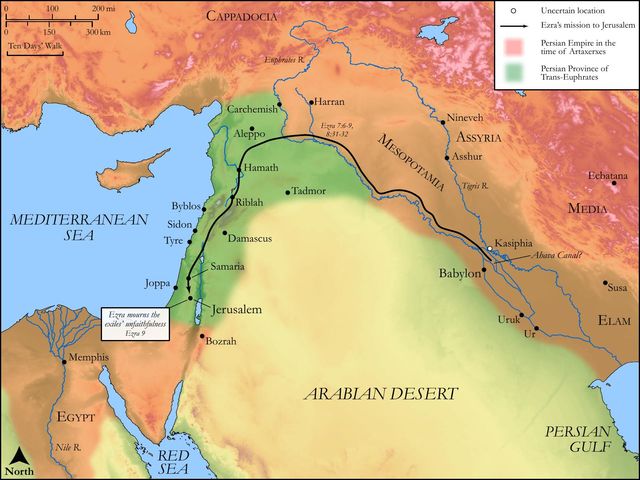
See on the biblical-era map
Study this verse
Public-domain commentary
Matthew Henry
From his Commentary on the Whole Bible. Henry comments on passages, not single verses — this entry covers Ezra 7:1–10. His three-level outline is real structure in the source text, so it is rendered as structure.
Here is, I. Ezra's pedigree. He was one of the sons of Aaron, a priest. Him God chose to be an instrument of good to Israel, that he might put honour upon the priesthood, the glory of which had been much eclipsed by the captivity. He is said to be the son of Seraiah, that Seraiah, as is supposed, whom the king of Babylon put to death when he sacked Jerusalem, Kg2 25:18, Kg2 25:21. If we take the shortest computation, it was seventy-five years since Seraiah died; many reckon it much longer, and, because they suppose Ezra called out in the prime of his time to public service, do therefore think that Seraiah was not his immediate parent, but his grandfather or great-grandfather, but that he was the first eminent person that occurred in his genealogy upwards, which is carried up here as high as Aaron, yet leaving out many for brevity-sake, which may be supplied from Ch1 6:4, etc. He was a younger brother, or his father was Jozadak, the father of Jeshua, so that he was not high priest, but nearly allied to the high priest.
II.His character. Though of the younger house, his personal qualifications made him very eminent.
1.He was a man of great learning, a scribe, a ready scribe, in the law of Moses, Ezr 7:6. He was very much conversant with the scriptures, especially the writings of Moses, had the words ready and was well acquainted with the sense and meaning of them. It is to be feared that learning ran low among the Jews in Babylon; but Ezra was instrumental to revive it. The Jews say that he collected and collated all the copies of the law he could find out, and published an accurate edition of it, with all the prophetical books, historical and poetical, that were given by divine inspiration, and so made up the canon of the Old Testament, with the addition of the prophecies and histories of his own time. If he was raised up of God, and qualified and inclined to do this, all generations have reason to call him blessed, and to bless God for him. God sent to the Jews prophets and scribes, Mat 23:34. Ezra went under the latter denomination. Now that prophecy was about to cease it was time to promote scripture-knowledge, pursuant to the counsel of God by the last of the prophets, Mal 4:4. Remember the law of Moses. Gospel ministers are called scribes instructed to the kingdom of heaven (Mat 13:52), New Testament scribes. It was a pity that such a worthy name as this should be worn, as it was in the degenerate ages of the Jewish church, by men who were professed enemies to Christ and his gospel (Woe unto you, scribes and Pharisees), who were learned in the letter of the law, but strangers to the spirit of it.
2.He was a man of great piety and holy zeal (Ezr 7:10): He had prepared his heart to seek the law of the Lord, etc.
(1.)That which he chose for his study was the law of the Lord. The Chaldeans, among whom he was born and bred, were famed for literature, especially the study of the stars, to which, being a studious man, we may suppose that Ezra was tempted to apply himself. But he got over the temptation; the law of his God was more to him than all the writings of their magicians and astrologers, which he knew enough of with good reason to despise them.
(2.)He sought the law of the Lord, that is, he made it his business to enquire into it, searched the scriptures, and sought the knowledge of God, of his mind and will, in the scriptures, which is to be found there, but not without seeking.
(3.)He made conscience of doing according to it; he set it before him as his rule, formed his sentiments and temper by it, and managed himself in his whole conversation according to it. This use we must make of our knowledge of the scriptures; for happy are we if we do what we know of the will of God.
(4.)He set himself to teach Israel the statutes and judgments of that law. What he knew he was willing to communicate for the good of others; for the ministration of the Spirit is given to every man to profit withal. But observe the method: he first learned and then taught, sought the law of the Lord and so laid up a good treasure, and then instructed others and laid out what he had laid up. He also first did and then taught, practised the commandments himself and then directed others in the practice of them; thus his example confirmed his doctrine.
(5.)He prepared his heart to do all this, or he fixed his heart. He took pains in his studies, and thoroughly furnished himself for what he designed, and then put on resolution to proceed and persevere in them, and thus he became a ready scribe. Moses in Egypt, Ezra in Babylon, and both in captivity, were wonderfully fitted for eminent services to the church.
III.His expedition to Jerusalem for the good of his country:
He went up from Babylon (Ezr 7:6), and, in four months' time, came to Jerusalem, Ezr 7:8. It was strange that such a man as he staid so long in Babylon after his brethren had gone up; but God sent him not thither till he had work for him to do there; and none went but those whose spirits God raised to go up. Some think that this Artaxerxes was the same with that Darius whose decree we had (ch. 6), and that Ezra came the very year after the temple was finished: that was the sixth year, this the seventh (v. 8), so Dr. Lightfoot. My worthy and learned friend, lately deceased, Mr. Talents, in his chronological tables, places it about fifty-seven years after the finishing of the temple; others further on. I have only to observe,
1.How kind the king was to him. He granted him all his request, whatever he desired to put him into a capacity to serve his country.
2.How kind his people were to him. When he went many more went with him, because they desired not to stay in Babylon when he had gone thence, and because they would venture to dwell in Jerusalem when he had gone thither.
3.How kind his God was to him. He obtained this favour from his king and country by the good hand of the Lord that was upon him, v. 6, 9. Note, Every creature is that to us which God makes it to be, and from him our judgment proceeds. As we must see the events that shall occur in the hand of God, so we must see the hand of God in the events that do occur, and acknowledge him with thankfulness when we have reason to call it his good hand.
Historical interpretation
Historical reception
1 surviving comment on this verse from the historical church.
After these words, in the reign of Artaxerxes king of Persia, etc. Josephus (Antiq. XIII, 5) considers this Artaxerxes, under whom Ezra ascended from Babylon to Jerusalem, to be Xerxes, the son of Darius, who reigned after him. Furthermore, the books of Chronicles believe that the successor of the same Xerxes, who is also called Artaxerxes by them, is here designated. Now Darius, under whom the temple was built, reigned thirty-six years; after him Xerxes reigned twenty years; after whom Artabanus for seven months, which chronographers count as a year; after whom Artaxerxes for forty years. Ezra, a swift scribe in the law of Moses, because he restored the law which had been consumed; not only the law but also, as common tradition of the elders says, he rewrote the entire series of sacred Scripture which had been equally consumed by fire, as he saw fitting for the readers. They say in this work, he added some words which he deemed appropriate; among which is this: "And there arose not a prophet in Israel like Moses, whom the Lord knew face to face," etc. Words indeed which only one who lived long after Moses could say. And in the book of Samuel: "Formerly in Israel a man going to inquire of God would say, Come and let us go to the seer. For he who is now called a prophet was formerly called a seer" (1 Sam. IX). Moreover, he left untouched some entire volumes, which were once held among the people of Israel; of which now only the memory of the name remains in sacred Scripture; as it is said in the book of Numbers: "Wherefore it is said in the book of the wars of the Lord" (Num. XXI). And in Joshua: "Is this not written in the book of Jashar?" (Jos. X). But also in the volume of Kings and Chronicles, the historical books of the prophets Ahijah the Shilonite, and Shemaiah, Iddo, and Nathan, as well as Isaiah, and Jehu the son of Hanani are mentioned (1 Kings XVI; 2 Chron. IX); concerning whom it is said that he wrote the book of the kings of Israel; and many others, of which it is said no traces can be found today. The Hebrews also report, and there is no doubt among them about this matter, that the same Ezra invented lighter letters against the names of those they had hitherto used, by which he swiftly restored such a great amount of books that had been consumed. Therefore he is known not only as a scribe but also as a swift scribe. However, the earlier letters remained with the Samaritans, with which they used to write the five books of Moses, which they alone had received from the sacred Scripture.
Continue studying Ezra 7:6 across the web’s major study libraries — every link below opens this exact verse, chapter, or book on the destination site.
Read & Compare
 BibleGatewayThis verse in more than 200 translations and 70 languages.
 Bible.comThe YouVersion reader — hundreds of translations, reading plans, and highlights.
 ESV.orgCrossway's official English Standard Version reader.
 NET BibleThe NET translation with 60,000+ translators' notes on every rendering decision.
 STEP BibleTyndale House's free study tool — original text, vocabulary, and scholarly resources.
 BibliaLogos Bible Software's free web reader.
 USCCBThe New American Bible (Revised Edition) with the U.S. bishops' study notes.
Commentaries
 BibleHub CommentariesDozens of classic commentaries on this verse, gathered on one page.
 StudyLightMore than 100 commentary sets — the largest collection on the web.
 BibleRefPlain-English commentary on what this verse means, verse by verse.
 Enduring WordDavid Guzik's free commentary on this chapter, widely used by Bible teachers.
 Bible Study ToolsVerse commentary alongside Greek and Hebrew study aids.
Original Language & Research
- BibleHub InterlinearThe verse word by word — original language, transliteration, and English.
- BibleHub LexiconEvery word's original-language definition and Strong's entry.
 Blue Letter BibleDeep-study tools — Strong's numbers, concordance, and word studies.
 SefariaThe Hebrew text with Rashi and centuries of Jewish commentary.
Sermons, Hymns & Audio


TrulyRandomVerse is not affiliated with these sites and doesn’t control their content. They’re linked because they’re genuinely useful.
Summary
Ezra 7:6 introduces Ezra, a pivotal figure in post-exilic Judah, as he embarks on a divinely appointed journey from Babylon to Jerusalem. The verse highlights his exceptional proficiency and dedication as a "ready scribe" in the Law of Moses, a Law explicitly stated as given by the LORD God of Israel. It powerfully underscores the sovereign hand of the LORD upon Ezra, enabling him to gain extraordinary favor from King Artaxerxes, who granted all his requests, thereby facilitating the spiritual and communal restoration of the Jewish people.
Context
ShowHideLiterary Context
Ezra 7:6 marks a crucial turning point in the book of Ezra. Chapters 1-6 detail the initial return of exiles under Zerubbabel and Jeshua, culminating in the successful rebuilding and dedication of the temple in Ezra 6. A significant chronological gap of approximately 58 years separates the events of chapter 6 from chapter 7, during which the returned community in Jerusalem struggled with spiritual apathy, intermarriage with foreign peoples, and a general neglect of the Mosaic Law. Chapter 7 introduces Ezra as a new, divinely commissioned leader, shifting the narrative's focus from physical reconstruction to spiritual reformation. His journey and profound purpose, further elaborated in Ezra 7:7-10, set the stage for the reestablishment of the Law as the central guiding principle for the returned exiles, directly leading into the significant reforms described in the latter half of the book of Ezra and subsequently in Nehemiah.
Historical & Cultural Context
This verse is situated within the reign of Artaxerxes I Longimanus (465-424 BC), a powerful Persian king whose vast empire encompassed the province of Judah. Following the Babylonian exile, the Persian policy, famously initiated by Cyrus the Great, generally permitted conquered peoples to return to their homelands, rebuild their temples, and practice their religions, often providing imperial resources for such endeavors. This strategic approach aimed to foster stability and loyalty within the diverse empire. Ezra's journey from Babylon, a major center of the Jewish diaspora, to Jerusalem occurred in the seventh year of Artaxerxes' reign (458 BC). The cultural backdrop was one where imperial decrees held absolute authority, yet God's providence frequently worked through these very decrees, as evidenced by the king's remarkable generosity towards Ezra. The Jewish community in Judah, though physically returned, faced the profound challenge of re-establishing their distinct covenant identity and relationship with God in a land still influenced by foreign customs and religious practices.
Key Themes
ShowHideEzra 7:6 encapsulates several crucial themes central to the book of Ezra and the broader biblical narrative. Firstly, it highlights the supremacy and divine origin of the Law of Moses. By explicitly stating "which the LORD God of Israel had given," the text emphasizes that the Law is not a human construct but God's direct revelation, foundational for Israel's identity and covenant relationship, a theme consistently echoed throughout the Pentateuch and later prophetic books, such as Deuteronomy 4:5-8. Secondly, it underscores God's sovereign providence and active involvement in human affairs, particularly in the lives of His chosen servants. The powerful phrase "the hand of the LORD his God upon him" signifies divine enablement and favor, ensuring Ezra's success despite formidable obstacles. This theme of divine empowerment and God's guiding hand is also prominently featured in the parallel narrative of Nehemiah 2:8, where Nehemiah similarly attributes his success to God's "good hand." Thirdly, the verse exemplifies the importance of faithful leadership and the consecration of gifts for divine purpose. Ezra's characterization as a "ready scribe" demonstrates the profound value of diligent study and expertise in God's Word, a commitment further elaborated in Ezra 7:10, where his purpose is to seek, do, and teach the Law.
Exposition and Analysis
ShowHideKey Word Analysis
ShowHideThe Hebrew phrase for "ready scribe" combines two significant terms. Çâphar (scribe) refers to someone skilled in writing, recording, and interpreting, often holding a position of authority as a secretary or scholar. Mâhîyr (ready) signifies "quick," "skillful," "diligent," or "expert." Therefore, Ezra was far more than a mere copyist; he was exceptionally adept at understanding, interpreting, and applying the Law. This implies not only intellectual proficiency but also a deep commitment to study and a profound grasp of its theological and practical implications, establishing him as an authoritative teacher and expounder of God's Word, uniquely qualified for the spiritual restoration of his people.
This is a powerful and frequently used idiom throughout the Old Testament, signifying God's active power, presence, and favor. The word yâd (hand) often denotes power, means, or direction. When "the hand of the LORD" (Yᵉhôvâh) is upon someone, it indicates divine empowerment, guidance, protection, or enablement for a specific task or mission. In Ezra's case, it serves as the theological explanation for the extraordinary favor he received from King Artaxerxes, suggesting that God was supernaturally orchestrating events to ensure the success of Ezra's mission. This phrase removes any doubt that Ezra's achievements were solely due to his own abilities or political maneuvering, attributing them directly to God's sovereign intervention and providential care.
Verse Breakdown
ShowHide"This Ezra went up from Babylon;"
This initial clause introduces the central figure, Ezra, and establishes his point of origin: Babylon. Babylon, though once the place of Israel's exile, had become a significant center of Jewish life and learning. His "going up" to Jerusalem signifies more than a geographical ascent; it represents a pilgrimage, a return to the spiritual heartland, emphasizing the sacred nature of his journey from the imperial center to the holy city. This movement symbolizes a return to the covenant land and a renewed focus on the spiritual heritage of Israel.
"and he [was] a ready scribe in the law of Moses,"
This crucial descriptive phrase defines Ezra's primary identity and expertise. He is presented not as a military leader or a political figure, but as a scholar and expert in God's revealed will. The term "ready scribe" highlights his exceptional diligence, skill, and profound understanding of the Mosaic Law, positioning him as an authoritative interpreter and teacher—a role essential for the spiritual restoration of the community and the re-establishment of covenant faithfulness.
"which the LORD God of Israel had given:"
This parenthetical yet vital statement underscores the divine origin and inherent authority of the Law. By explicitly attributing the Law to "the LORD God of Israel," the text reinforces its sacred, non-negotiable nature as God's direct revelation to His covenant people. This divine authorship provides the ultimate basis for Ezra's authority in teaching and for the Law's foundational role in the life of the nation, distinguishing it from human legislation.
"and the king granted him all his request,"
This clause highlights the remarkable and seemingly improbable favor Ezra received from the powerful Persian monarch, King Artaxerxes. It indicates that Ezra's petition for resources, authority, and permission to travel and implement reforms was fully approved, likely including significant financial and logistical support. This extraordinary concession from a powerful pagan ruler demonstrates a divine orchestration of events that transcended normal political expectations or human negotiation.
"according to the hand of the LORD his God upon him."
This concluding phrase provides the theological explanation for the king's unprecedented generosity and Ezra's remarkable success. It attributes Ezra's achievements and the king's favorable disposition directly to the active, enabling, and protective power of God. It is a clear declaration of divine providence, emphasizing that God was actively working through Ezra, and even through the secular authorities, to accomplish His redemptive purposes for Israel's spiritual restoration.
Literary Devices
ShowHideEzra 7:6 masterfully employs several literary devices to convey its profound theological message. Characterization is central, as Ezra is immediately defined by his unique skill and devotion as a "ready scribe in the law of Moses," establishing him as a figure of spiritual authority rather than military or political might. The most prominent device is Idiom, specifically "the hand of the LORD his God upon him." This powerful and recurring biblical idiom serves as a clear theological statement, attributing all success and favorable circumstances not to human effort or chance, but directly to God's sovereign intervention and enabling power. This functions as a profound declaration of Divine Providence, explicitly highlighting God's active orchestration of events, even through a pagan king, to fulfill His purposes for His people. The structure of the verse itself, moving from Ezra's identity to the king's action and then to the divine reason for that action, demonstrates a clear Cause and Effect relationship, with God's hand as the ultimate, underlying cause of all that transpires.
Theological and Thematic Connections
ShowHideEzra 7:6 serves as a powerful testament to God's unwavering commitment to His covenant people and His sovereign ability to raise up and empower individuals for specific redemptive purposes. It underscores the centrality of God's revealed Word as the foundation for national and individual life, demonstrating that spiritual restoration hinges on a return to and diligent application of the divine Law. Ezra's example highlights that true spiritual leadership is rooted in deep personal study and obedience to God's commands, coupled with a humble reliance on His empowering grace. The verse also illustrates how God can work through unexpected channels, even secular rulers, to achieve His divine will, reinforcing the theme of His absolute sovereignty over all earthly powers and His faithfulness to His promises.
Reflection and Application
ShowHideEzra 7:6 offers profound lessons for contemporary believers, emphasizing the transformative power of God's Word and His active involvement in our lives. Like Ezra, we are called to cultivate a deep and diligent engagement with the Scriptures, not merely as an academic exercise but as a foundational discipline for spiritual growth and obedience. Ezra's commitment to being a "ready scribe" challenges us to move beyond superficial knowledge to a profound understanding and eager application of God's truth in our daily walk. This requires intentional study, meditation, and a willingness to allow God's Word to shape our thoughts and actions. Furthermore, the verse reminds us that our effectiveness in God's service is not solely dependent on our own skills or efforts, but on the "hand of the LORD" being upon us. This encourages a posture of humble reliance on divine favor and empowerment, trusting that God will open doors, provide resources, and overcome obstacles when we are faithfully pursuing His will. It also inspires us to recognize that God can work through any circumstance or authority, even those seemingly indifferent or opposed to His purposes, to accomplish His redemptive plan, calling us to prayer and faithful witness in all spheres of influence.
Questions for Reflection
ShowHideFAQ
ShowHideWhat was the significance of Ezra being a "ready scribe" in the Law of Moses?
ShowHideThe significance of Ezra being a "ready scribe" (Hebrew: sopher mahir) is multifaceted and profoundly important for his mission. Firstly, it highlights his exceptional expertise and diligence in the Mosaic Law. He was not merely a copyist, but a profound scholar, interpreter, and authoritative teacher of God's Word. This deep understanding allowed him to accurately expound the Law to the returning exiles, which was crucial for their spiritual reformation and restoration of covenant faithfulness. Secondly, it underscores the importance of the Law itself as the divine revelation given by "the LORD God of Israel." Ezra's role was to re-establish the Law's authority and centrality in the community's life, guiding them back into obedience. His "readiness" implied not only intellectual mastery but also a heart prepared to "seek the law of the LORD, and to do it, and to teach in Israel statutes and judgments," as further detailed in Ezra 7:10. This made him uniquely qualified to lead the spiritual revival of the post-exilic community, transforming them from a scattered people into a nation living under God's covenant.
Christ-Centered Fulfillment
ShowHideEzra, as a "ready scribe in the law of Moses," serves as a profound type and foreshadowing of the ultimate and perfect interpreter and fulfiller of God's Law, Jesus Christ. While Ezra diligently taught and sought to restore adherence to the written Law, Jesus perfectly embodied it, living a life of complete and sinless obedience that none other could achieve (Hebrews 4:15). Christ is not merely a scribe of the Law but its very author and living embodiment (John 1:1-3). He came not to abolish the Law but to fulfill it (Matthew 5:17), perfectly upholding its righteous demands and ultimately bearing its curse on the cross for humanity's sin (Galatians 3:13). Furthermore, just as the "hand of the LORD" was upon Ezra, empowering him for his mission and granting him favor, the full power and authority of God rested upon Jesus, enabling His miraculous works, authoritative teaching that astonished the crowds (Matthew 7:29), and ultimately His resurrection from the dead (Acts 2:24). Through Christ, the Law's demands are met, and its spiritual intent is written on the hearts of believers by the Holy Spirit (Jeremiah 31:33), establishing a new and better covenant that far surpasses the reformation Ezra sought to achieve, offering not just external adherence but internal transformation and true righteousness.