


Ezra 7:7
Bible text: King James Version (1769 Blayney text) · Public domain
Bible text: King James Version with Strong's numbers · Public domain
Bible text: Berean Standard Bible · Public domain
Bible text: American Standard Version (1901) · Public domain
Bible text: World English Bible, Messianic edition · Public domain
Bible text: Geneva Bible (1599) · Public domain
Bible text: Young's Literal Translation · Public domain
- וַיַּעֲלוּvai·ya·'a·Luand they came upH5927Conj-w ¦ V-Qal-ConsecImperf-3mpVerb Qal Consecutive Imperfect 3rd Plural Masculineוַandיַּעֲלוּthey came up
- מִבְּנֵיmi·be·neisome of [the] people ofH1121Prep-m ¦ N-mpcNoun Plural Masculine Constructמִsome ofבְּנֵי[the] people of
- יִשְׂרָאֵלYis·ra·'elIsraelH3478N-properNoun Proper Location
- וּמִןu·minand some ofH4480Conj-w ¦ PrepPrepositionוּandמִןsome of
- הַכֹּהֲנִיםha·ko·ha·Nimthe priestsH3548Art ¦ N-mpNoun Plural Masculine Absoluteהַtheכֹּהֲנִיםpriests
- וְהַלְוִיִּםve·hal·vi·Yimand the LevitesH3881Conj-w ¦ Art ¦ N-mpNoun Gentilic Plural Masculine AbsoluteוְandהַtheלְוִיִּםLevites
- וְהַמְשֹׁרְרִיםve·ham·sho·re·Rimand the singersH7891Conj-w ¦ Art ¦ V-Piel-Prtcpl-mpVerb Piel Participle Plural Masculine Absoluteוְandהַtheמְשֹׁרְרִיםsingers
- וְהַשֹּׁעֲרִיםve·ha·sho·'a·Rimand the gatekeepersH7778Conj-w ¦ Art ¦ N-mpNoun Plural Masculine Absoluteוְandהַtheשֹּׁעֲרִיםgatekeepers
- וְהַנְּתִינִיםve·ha·ne·ti·Nimand the temple servantsH5411Conj-w ¦ Art ¦ N-mpNoun Plural Masculine Absoluteוְandהַtheנְּתִינִיםtemple servants
- אֶל'eltoH413PrepPreposition
- יְרוּשָׁלִָםye·ru·sha·LimJerusalemH3389N-properNoun Proper Location
- בִּשְׁנַתbish·natin yearH8141Prep-b ¦ N-fscNoun Singular Feminine Constructבִּinשְׁנַתyear
- שֶׁבַעShe·va'sevenH7651Adj-csAdjective Numerical Singular common gender Absolute
- לְאַרְתַּחְשַׁסְתְּאle·'ar·tach·Shast'of ArtaxerxesH783Prep-l ¦ N-proper-mNoun Proper MasculineלְofאַרְתַּחְשַׁסְתְּאArtaxerxes
- הַמֶּלֶךְha·Me·lekhthe kingH4428Art ¦ N-msNoun Singular Masculine Absoluteהַtheמֶּלֶךְking
English is a literal word-by-word gloss of the Hebrew, not the KJV's wording. Why?
This is the original text the KJV's translators worked from — each Hebrew word with its own literal English meaning in this verse, prepared by scholars at Tyndale House, Cambridge. The KJV translates whole sentences, not word by word, so its wording differs: one Hebrew word can become several English words, and the KJV may choose “the LORD” where the gloss reads “Yahweh”. Both are faithful — they answer different questions. For the KJV's own rendering, switch to the KJV text.
Details
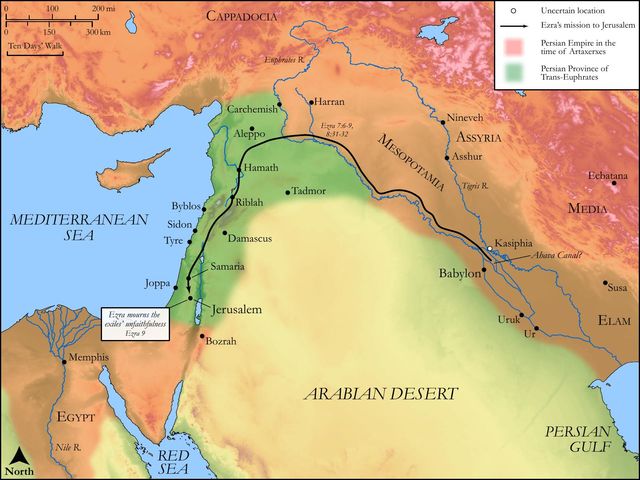
See on the biblical-era map
Study this verse
Public-domain commentary
Matthew Henry
From his Commentary on the Whole Bible. Henry comments on passages, not single verses — this entry covers Ezra 7:1–10. His three-level outline is real structure in the source text, so it is rendered as structure.
Here is, I. Ezra's pedigree. He was one of the sons of Aaron, a priest. Him God chose to be an instrument of good to Israel, that he might put honour upon the priesthood, the glory of which had been much eclipsed by the captivity. He is said to be the son of Seraiah, that Seraiah, as is supposed, whom the king of Babylon put to death when he sacked Jerusalem, Kg2 25:18, Kg2 25:21. If we take the shortest computation, it was seventy-five years since Seraiah died; many reckon it much longer, and, because they suppose Ezra called out in the prime of his time to public service, do therefore think that Seraiah was not his immediate parent, but his grandfather or great-grandfather, but that he was the first eminent person that occurred in his genealogy upwards, which is carried up here as high as Aaron, yet leaving out many for brevity-sake, which may be supplied from Ch1 6:4, etc. He was a younger brother, or his father was Jozadak, the father of Jeshua, so that he was not high priest, but nearly allied to the high priest.
II.His character. Though of the younger house, his personal qualifications made him very eminent.
1.He was a man of great learning, a scribe, a ready scribe, in the law of Moses, Ezr 7:6. He was very much conversant with the scriptures, especially the writings of Moses, had the words ready and was well acquainted with the sense and meaning of them. It is to be feared that learning ran low among the Jews in Babylon; but Ezra was instrumental to revive it. The Jews say that he collected and collated all the copies of the law he could find out, and published an accurate edition of it, with all the prophetical books, historical and poetical, that were given by divine inspiration, and so made up the canon of the Old Testament, with the addition of the prophecies and histories of his own time. If he was raised up of God, and qualified and inclined to do this, all generations have reason to call him blessed, and to bless God for him. God sent to the Jews prophets and scribes, Mat 23:34. Ezra went under the latter denomination. Now that prophecy was about to cease it was time to promote scripture-knowledge, pursuant to the counsel of God by the last of the prophets, Mal 4:4. Remember the law of Moses. Gospel ministers are called scribes instructed to the kingdom of heaven (Mat 13:52), New Testament scribes. It was a pity that such a worthy name as this should be worn, as it was in the degenerate ages of the Jewish church, by men who were professed enemies to Christ and his gospel (Woe unto you, scribes and Pharisees), who were learned in the letter of the law, but strangers to the spirit of it.
2.He was a man of great piety and holy zeal (Ezr 7:10): He had prepared his heart to seek the law of the Lord, etc.
(1.)That which he chose for his study was the law of the Lord. The Chaldeans, among whom he was born and bred, were famed for literature, especially the study of the stars, to which, being a studious man, we may suppose that Ezra was tempted to apply himself. But he got over the temptation; the law of his God was more to him than all the writings of their magicians and astrologers, which he knew enough of with good reason to despise them.
(2.)He sought the law of the Lord, that is, he made it his business to enquire into it, searched the scriptures, and sought the knowledge of God, of his mind and will, in the scriptures, which is to be found there, but not without seeking.
(3.)He made conscience of doing according to it; he set it before him as his rule, formed his sentiments and temper by it, and managed himself in his whole conversation according to it. This use we must make of our knowledge of the scriptures; for happy are we if we do what we know of the will of God.
(4.)He set himself to teach Israel the statutes and judgments of that law. What he knew he was willing to communicate for the good of others; for the ministration of the Spirit is given to every man to profit withal. But observe the method: he first learned and then taught, sought the law of the Lord and so laid up a good treasure, and then instructed others and laid out what he had laid up. He also first did and then taught, practised the commandments himself and then directed others in the practice of them; thus his example confirmed his doctrine.
(5.)He prepared his heart to do all this, or he fixed his heart. He took pains in his studies, and thoroughly furnished himself for what he designed, and then put on resolution to proceed and persevere in them, and thus he became a ready scribe. Moses in Egypt, Ezra in Babylon, and both in captivity, were wonderfully fitted for eminent services to the church.
III.His expedition to Jerusalem for the good of his country:
He went up from Babylon (Ezr 7:6), and, in four months' time, came to Jerusalem, Ezr 7:8. It was strange that such a man as he staid so long in Babylon after his brethren had gone up; but God sent him not thither till he had work for him to do there; and none went but those whose spirits God raised to go up. Some think that this Artaxerxes was the same with that Darius whose decree we had (ch. 6), and that Ezra came the very year after the temple was finished: that was the sixth year, this the seventh (v. 8), so Dr. Lightfoot. My worthy and learned friend, lately deceased, Mr. Talents, in his chronological tables, places it about fifty-seven years after the finishing of the temple; others further on. I have only to observe,
1.How kind the king was to him. He granted him all his request, whatever he desired to put him into a capacity to serve his country.
2.How kind his people were to him. When he went many more went with him, because they desired not to stay in Babylon when he had gone thence, and because they would venture to dwell in Jerusalem when he had gone thither.
3.How kind his God was to him. He obtained this favour from his king and country by the good hand of the Lord that was upon him, v. 6, 9. Note, Every creature is that to us which God makes it to be, and from him our judgment proceeds. As we must see the events that shall occur in the hand of God, so we must see the hand of God in the events that do occur, and acknowledge him with thankfulness when we have reason to call it his good hand.
Historical interpretation
Historical reception
1 surviving comment on this verse from the historical church.
And they ascended from the children of Israel, etc. Because on the first day of the first month he began to ascend from Babylon, and on the first day of the fifth month he came to Jerusalem, he says they came to Jerusalem by anticipation. Moreover, in the following he describes more fully in order how they came, and where they assembled their army. It should be noted that at the beginning of this volume it is written that they ascended from Babylon according to the promise of Cyrus, with leaders Zerubbabel and Joshua, of the sons of Judah and Benjamin with the priests and Levites, all whose spirits God had stirred. It is also added of them that they were of the captivity which Nebuchadnezzar king of Babylon had carried to Babylon. However, here under the leadership of Ezra there is no mention of Judah and Benjamin, nor of those carried away by Nebuchadnezzar, but only of the children of Israel, and of the priests and Levites who went up with him. Whence it seems likely that those who were called back to Jerusalem at that time were from Judah and Benjamin, who had been carried to Babylon by Nebuchadnezzar. But those who are now read to have been led back by Ezra were from the ten tribes, who were specially called Israel after the division; whom the kings of Assyria had long before the times of Nebuchadnezzar taken captive and made to dwell beyond the mountains of the Medes. Thus, for the most part, two tribes returned home and laboriously restored the temple. But the ten tribes, who had less care for the temple and religion, neglected to return to their homeland though commanded by the king, because with the empire of the Chaldeans destroyed, they lived freely under the kings of Persia, who favored their people. Yet, when they learned that the temple had been rebuilt and that the envy of the Samaritans was curbed, some of them finally consented to return home; although many remained there, whose descendants are said to still be detained in those parts today, serving the Persian nation. Just as often mentioned, Zerubbabel and Joshua designate the Lord and Savior, who by his grace releases the captivity of the human race and builds his own house in us by sanctifying and possessing us; so also Ezra, both priest and swift scribe, plainly announces the same Lord, who did not come to destroy the law but to fulfill it (Matthew V). He could rightly be called a scribe of the law of God, or a swift scribe in the law of Moses, because he gave the law to Moses through an angel, he taught the holy prophets all truth by the grace of his Spirit, and as soon as he touched the minds of all the elect with his love, he kindled them to understand and do the will of God the Father. Hence, promising the grace of the New Testament, the prophet said: "And this is the covenant that I will make with the house of Israel after those days," says the Lord; "I will put my laws into their minds, and write them on their hearts" (Jeremiah XXXI, Hebrews XV). The psalmist beautifully remembers this scribe, saying: "My tongue is the pen of a swift-writing scribe" (Psalm XLIV). For the tongue of the prophet was the pen of a swift scribe; because what the Lord inwardly taught him by illuminating him without any delay, he himself declared outwardly to men in time by his tongue’s service. Ezra, whose name means helper, openly demonstrates this. He is indeed the one through whom alone the faithful people are usually introduced to be liberated from tribulations, and as if from Babylonian captivity to the freedom of Jerusalem, from the confusion of vices to the peace and serenity of virtues, advancing by the steps of merits. In the second psalm of Ascents (Anabathmon), he shouts to all who aim for the highest, showing by whom they should aim and reach: "My help comes from the Lord, who made heaven and earth" (Psalm CXX). Ezra also held this figure in his actions, when he led a considerable part of the people back from captivity to Jerusalem, and brought money and sacred vessels to the glory of his temple, purging the people from foreign wives with pontifical authority. All these things also indicate what has been or will be done by the Lord in the holy Church, which is clear to an educated reader; but we too will strive to make it apparent even to simpler people. For just as Ezra ascended from Babylon, and with him the children of Israel, and the sons of priests and Levites; this signifies the pious dispensation of our Redeemer, who appearing in the flesh entered the confusion of this world, himself free from the confusion of vices, to lead us back with him, freed from all confusion, to the tranquility of heavenly peace; whose pledge of eternal peace we have received in the present Church, as the Lord says: "Peace I leave with you, my peace I give to you” (John XIV); that is, I leave temporary peace to those traveling on earth, I give eternal peace to those reaching the heavenly homeland. It is also blessed that he began to ascend from Babylon in the first month, and came to Jerusalem in the fifth month with the sons of the captivity whom he led. For the journey from Babylon to Jerusalem is completed in four months; because through the four books of the holy Gospel, we learn the faith and sacraments of truth, by which we ought to ascend from the captivity of the ancient enemy, led by the Lord, to the freedom of the glory of the sons of God. In the same four books are contained the commandments of works, by whose as it were daily steps we can reach the promised heights. Nor was it without the figure of mystery that on the first day of the month he began to ascend from Babylon, and again on the first day of the month he came to Jerusalem; for the beginning of the month, in which the moon is believed to borrow new light from the sun, designates the new beginning of heavenly grace. And fittingly Ezra ascended from Babylon on the first day of the first month with those he saved from captivity; because the beginning of a holy way of life, in which we renounce Satan and his kingdom, is brought about in us by the illumination of divine grace. Also, he came to Jerusalem on the first day of the fifth month, for this too is not done by the freedom of our will, but by the inspiration of heavenly light, that, having heard the oracles of the Gospel, we are incorporated into the members of the holy Church. A noble and healthy custom in the Church, grown from the teaching of the fathers, is that those who are catechized should have the sacrament of the four Gospels explained to them, and their beginnings be recited. Again on the first day of the fifth month, he came with those who had been freed from their enemies, to Jerusalem; because when we enter the heavenly kingdom, having completed the precepts of the four holy Gospels, we celebrate as it were the new beginning of the month, because we already see the joys of the new light in the Sun of righteousness, and after the four months of luminous action, as a pilgrim in the way of life, we celebrate the fifth month of perpetual reward in the light of the heavenly homeland.
Continue studying Ezra 7:7 across the web’s major study libraries — every link below opens this exact verse, chapter, or book on the destination site.
Read & Compare
 BibleGatewayThis verse in more than 200 translations and 70 languages.
 Bible.comThe YouVersion reader — hundreds of translations, reading plans, and highlights.
 ESV.orgCrossway's official English Standard Version reader.
 NET BibleThe NET translation with 60,000+ translators' notes on every rendering decision.
 STEP BibleTyndale House's free study tool — original text, vocabulary, and scholarly resources.
 BibliaLogos Bible Software's free web reader.
 USCCBThe New American Bible (Revised Edition) with the U.S. bishops' study notes.
Commentaries
 BibleHub CommentariesDozens of classic commentaries on this verse, gathered on one page.
 StudyLightMore than 100 commentary sets — the largest collection on the web.
 BibleRefPlain-English commentary on what this verse means, verse by verse.
 Enduring WordDavid Guzik's free commentary on this chapter, widely used by Bible teachers.
 Bible Study ToolsVerse commentary alongside Greek and Hebrew study aids.
Original Language & Research
- BibleHub InterlinearThe verse word by word — original language, transliteration, and English.
- BibleHub LexiconEvery word's original-language definition and Strong's entry.
 Blue Letter BibleDeep-study tools — Strong's numbers, concordance, and word studies.
 SefariaThe Hebrew text with Rashi and centuries of Jewish commentary.
Sermons, Hymns & Audio


TrulyRandomVerse is not affiliated with these sites and doesn’t control their content. They’re linked because they’re genuinely useful.
Summary
Ezra 7:7 chronicles a pivotal moment in the post-exilic history of Israel, marking the second major return of Jewish exiles from Babylon to Jerusalem. This significant repatriation, occurring in the seventh year of King Artaxerxes, was led by the esteemed scribe and priest, Ezra, and comprised a diverse assembly including the general populace, priests, Levites, and various temple functionaries such as singers, porters, and Nethinims. This comprehensive movement underscores God's meticulous providence in re-establishing His covenant people in their land, not merely for physical resettlement but for the spiritual and communal revitalization of Jerusalem and the proper, God-ordained functioning of the Temple.
Context
ShowHideLiterary Context
Ezra 7:7 serves as the immediate commencement of the second major wave of returnees from Babylonian exile, following the detailed introduction of Ezra's character and the divine favor he enjoyed in Ezra 7:1-6. This verse builds upon the initial return under Zerubbabel and Jeshua, which focused on the rebuilding of the Temple as narrated in Ezra chapters 1-6. While the first wave addressed the physical structure of the Temple, Ezra's subsequent mission, as illuminated in Ezra 7:10, was primarily to establish and enforce the Law of God among the repatriated community. This spiritual and legal foundation would later complement the physical rebuilding of Jerusalem's walls under Nehemiah, whose narrative directly follows Ezra's, highlighting a continuous divine work of restoration.
Historical & Cultural Context
The return detailed in Ezra 7:7 occurred in the "seventh year of Artaxerxes the king," specifically Artaxerxes I Longimanus, which corresponds to approximately 458 BC. This places Ezra's mission roughly 60 years after the completion of the Second Temple (c. 516 BC) and about 13 years prior to Nehemiah's arrival in Jerusalem. The Persian Empire, which held dominion over Judah, maintained a strategic policy of allowing various ethnic groups to return to their homelands and rebuild their religious centers. This policy, while serving Persian imperial interests by fostering stability, was divinely orchestrated, fulfilling prophecies of Israel's return from exile, such as those found in Jeremiah 29:10-14. Culturally, the meticulous listing of diverse groups—priests, Levites, singers, porters, and Nethinims—underscores the highly structured nature of the Israelite community and the critical importance of re-establishing the full complement of roles necessary for proper Temple worship, communal governance, and the spiritual instruction of the people in Jerusalem.
Key Themes
ShowHideEzra 7:7 powerfully illustrates several profound theological and narrative themes. Firstly, it highlights Divine Sovereignty and Timing, emphasizing that this return was not a random migration but a meticulously planned and divinely appointed event, occurring at a precise moment in history under the authority of a pagan king, demonstrating God's control over all earthly powers. Secondly, the verse speaks to the theme of Comprehensive Restoration, detailing the return of a diverse cross-section of the community, from the general "children of Israel" to specific temple functionaries. This indicates a holistic re-establishment of not just the physical presence in the land but also the spiritual, communal, and liturgical infrastructure necessary for a thriving covenant people. Finally, the emphasis on the return of priests, Levites, and other temple servants underscores the overarching theme of Spiritual Renewal and the Centrality of Worship. Ezra's subsequent actions in establishing the Law, as highlighted in Ezra 7:10, confirm that the ultimate purpose of this return was the spiritual revitalization of Jerusalem and the proper, God-ordained functioning of the Temple as the heart of Israel's relationship with God.
Exposition and Analysis
ShowHideKey Word Analysis
ShowHideThis primitive root signifies "to ascend" or "to go up," encompassing a wide variety of senses, both literal and figurative. In Ezra 7:7, it literally describes the physical journey of the exiles ascending from Babylon (which was geographically lower) to Jerusalem, which was situated on a high plateau. Figuratively, it also implies a spiritual ascent—a movement towards restoration, re-establishment, and a renewed relationship with God at His chosen dwelling place.
Derived from a root meaning "to build," this term refers to a son, but in its widest sense, it encompasses descendants, offspring, or members of a group. Here, "children of Israel" signifies the collective body of the Israelite people, emphasizing their identity as descendants of Jacob (Israel) and members of the covenant nation, highlighting the continuity of God's chosen people despite their exile.
This term, meaning "one given" or "dedicated," refers to a specific class of temple servants. These individuals, often non-Israelite descendants (potentially from groups like the Gibeonites, as seen in Joshua 9:27), were assigned to assist the Levites with the more laborious and menial tasks associated with the Temple service, such as drawing water and cutting wood. Their inclusion in this list signifies the comprehensive nature of the restoration, ensuring that all necessary support roles for the Temple's full operation were re-established.
Verse Breakdown
ShowHide"And there went up [some] of the children of Israel"
This initial phrase describes the primary action of the verse—the return journey. "Children of Israel" refers to the general populace, representing the broader community of Jewish exiles who chose to return to their ancestral land. Their collective movement signifies a re-gathering of the dispersed people of God, indicating a desire to rebuild their national and spiritual identity in Jerusalem.
"and of the priests, and the Levites"
These groups represent the essential religious leadership and functionaries. The priests were responsible for offering sacrifices, mediating between God and the people, and maintaining the sanctity of the Temple. The Levites assisted them in various capacities, including teaching the Law, maintaining the Temple structure, and leading worship. Their return was fundamental for the re-establishment of proper Temple worship and the spiritual instruction of the community.
"and the singers, and the porters, and the Nethinims"
This detailed enumeration specifies distinct sub-groups of temple servants, emphasizing the comprehensive nature of the restoration. The singers (a specific group of Levites) were crucial for leading musical worship, the porters (also Levites) maintained order and security at the Temple gates, and the Nethinims provided essential support services. Their presence ensures that all necessary roles, from the most sacred to the most menial, were accounted for in the re-establishment of a fully functioning Temple system.
"unto Jerusalem"
The destination of their arduous journey, Jerusalem, was not merely a geographical location but the spiritual and national heart of Israel. It was the site of the Temple, the place where God had chosen to dwell among His people. The return to Jerusalem symbolized a return to their covenant heritage, their identity as God's chosen people, and the very center of their worship and communal life.
"in the seventh year of Artaxerxes the king"
This precise dating firmly anchors the event in historical reality. The mention of "Artaxerxes the king" (Artaxerxes I Longimanus) underscores that this significant return was sanctioned by the reigning Persian monarch, highlighting God's sovereign ability to work through pagan rulers to accomplish His divine purposes for His people. It also points to the meticulous nature of biblical history, grounding spiritual truth in verifiable historical context and demonstrating God's precise timing.
Literary Devices
ShowHideEzra 7:7 employs several literary devices to convey its profound message and historical significance. The most prominent is Enumeration/List, as the verse meticulously lists the diverse groups of returnees: "children of Israel, and of the priests, and the Levites, and the singers, and the porters, and the Nethinims." This detailed listing is not merely for informational purposes; it powerfully emphasizes the comprehensive and holistic nature of the restoration. It showcases that God's plan for His people involved re-establishing every facet of their community, from the general populace to the most specialized temple servants, ensuring a fully functional and spiritually vibrant society. Furthermore, the Precision in Dating ("in the seventh year of Artaxerxes the king") serves as a form of Historical Verisimilitude, lending credibility and weight to the narrative. It grounds the spiritual event in concrete historical reality, demonstrating God's active and precise involvement in the unfolding of human history, orchestrating events according to His perfect timing and purpose, even through the decrees of foreign rulers.
Theological and Thematic Connections
ShowHideEzra 7:7 stands as a powerful testament to God's unwavering covenant faithfulness and His commitment to the restoration of His people after the desolation of exile. The diverse composition of the returning exiles—from the general populace to the specialized temple servants—underscores God's desire for a complete and holistic restoration, not just of physical presence in the land, but of spiritual order, communal identity, and the proper functioning of worship. This return was a divine act of grace, fulfilling ancient promises and demonstrating that even amidst the rule of foreign empires, God remains sovereign over history, orchestrating events for the good of His people. It highlights the importance of spiritual leadership, the re-establishment of the Law, and the centrality of the Temple as foundational to the health and identity of God's people, setting the stage for a profound renewal of their covenant relationship.
Reflection and Application
ShowHideEzra 7:7 offers profound insights for believers today, particularly regarding God's meticulous providence and the importance of every role within His kingdom. Just as God orchestrated the return of a diverse group—priests, Levites, singers, porters, and Nethinims—each with a vital function in the re-establishment of Temple worship and community life, so too does He precisely time events in our lives and call each member of His church to a unique and indispensable role. This verse reminds us that no calling is too small or insignificant in the grand tapestry of God's redemptive plan; every contribution, whether prominent or behind-the-scenes, is essential for the flourishing of His body. It challenges us to consider our own "return to Jerusalem," a spiritual re-focusing on God's design and purpose for our lives and for the church, prioritizing spiritual order, communal worship, and adherence to His Word. In a world often marked by chaos and uncertainty, Ezra 7:7 assures us of God's sovereign hand, faithfully guiding His people towards their ultimate restoration and purpose, continually working to bring about His perfect will.
Questions for Reflection
ShowHideFAQ
ShowHideWho were the Nethinims, and why are they significant in this verse?
ShowHideThe Nethinims (Hebrew, Nâthîyn') were a class of temple servants whose name literally means "given ones" or "dedicated ones." They were typically non-Israelite individuals, often descendants of foreign captives or those dedicated to temple service, such as the Gibeonites mentioned in Joshua 9:27. Their significance in Ezra 7:7 lies in their inclusion among the returning exiles, which highlights the comprehensive nature of the restoration. It demonstrates that even the most menial and supportive roles within the Temple service were considered vital for the full re-establishment of worship and communal life, underscoring that every function, regardless of its perceived status, is essential in God's house and contributes to the overall spiritual health of the community.
What was the primary purpose of this second return led by Ezra?
ShowHideWhile the initial return under Zerubbabel focused primarily on rebuilding the physical Temple structure, as detailed in Ezra 3:8, Ezra's mission with this second wave of returnees was distinctly spiritual and legal. As a skilled scribe and priest, Ezra's ultimate purpose was to establish, teach, and enforce the Law of God among the Jewish community in Jerusalem, as explicitly stated in Ezra 7:10. This spiritual renewal and adherence to God's covenant were crucial for the long-term health and identity of the post-exilic community, setting the moral, theological, and legal foundation for their continued existence as God's chosen people.
Christ-Centered Fulfillment
ShowHideEzra 7:7, with its depiction of a divinely orchestrated return and the re-establishment of a diverse community centered around the Temple and the Law, finds its ultimate and profound fulfillment in Jesus Christ. The "return to Jerusalem" foreshadows the ultimate spiritual return to God made possible through Christ, who reconciles humanity to the Father, bringing us back from spiritual exile into His presence. Just as Ezra brought the Law to a scattered people, Jesus is the very embodiment and perfect fulfillment of the Law, not to abolish it but to complete its righteous demands and reveal its true spirit (Matthew 5:17). The physical Temple, central to the returnees' purpose and worship, finds its true reality and ultimate significance in Christ, who declared Himself the Temple that would be destroyed and rebuilt in three days, referring to His own body and resurrection (John 2:19-21). Furthermore, the diverse groups returning—priests, Levites, singers, porters, and Nethinims—point to the unified, yet diverse, body of Christ, where all believers, regardless of their background, former status, or perceived importance, are made "fellow citizens with the saints and members of the household of God" (Ephesians 2:19-22). Through Christ, we are all living stones, built together into a spiritual house, a holy priesthood, with Him as the cornerstone, offering spiritual sacrifices acceptable to God (1 Peter 2:5). His new covenant ministry is the ultimate and perfect spiritual restoration, far surpassing any Old Testament return, establishing a new community of worshipers in spirit and truth.