


Ezra 6:14
Bible text: King James Version (1769 Blayney text) · Public domain
Bible text: King James Version with Strong's numbers · Public domain
Bible text: Berean Standard Bible · Public domain
Bible text: American Standard Version (1901) · Public domain
Bible text: World English Bible, Messianic edition · Public domain
Bible text: Geneva Bible (1599) · Public domain
Bible text: Young's Literal Translation · Public domain
- וְשָׂבֵיve·sa·Veiand [the] elders ofH7868Conj-w ¦ N-mpcNoun Plural Masculine Constructוְandשָׂבֵי[the] elders of
- יְהוּדָיֵאye·hu·da·Ye'Jews theH3062N-mp ¦ ArtNoun Gentilic Plural Masculine DefiniteיְהוּדָיֵJewsאthe
- בָּנַיִןba·Na·yin[were] buildingH1124V-Peal-Prtcpl-mpVerb Peal Participle Plural Masculine Absolute
- וּמַצְלְחִיןu·matz·le·Chinand prosperingH6744Conj-w ¦ V-Hiphil-Prtcpl-mpVerb Hiphil Participle Plural Masculine Absoluteוּandמַצְלְחִיןprospering
- בִּנְבוּאַתbin·vu·'Atby [the] prophesying ofH5017Prep-b ¦ N-fscNoun Singular Feminine Constructבִּbyנְבוּאַת[the] prophesying of
- חַגַּיcha·GaiHaggaiH2292N-proper-mNoun Proper Masculine
- נְבִיָּאne·vi·'ah'prophet theH5029N-cs ¦ ArtNoun Singular common gender Definiteנְבִיָּprophetאthe
- וּזְכַרְיָהu·ze·khar·Yahand ZechariahH2148Conj-w ¦ N-proper-mNoun Proper MasculineוּandזְכַרְיָהZechariah
- בַּרbar[the] son ofH1247N-cscNoun Singular common gender Construct
- עִדּוֹאi·Do'IddoH5714N-proper-mNoun Proper Masculine
- וּבְנוֹu·ve·Noand they builtH1124Conj-w ¦ V-Peal-Perf-3mpVerb Peal Perfect 3rd Plural Masculineוּandבְנוֹthey built
- וְשַׁכְלִלוּve·shakh·Li·luand they finishedH3635Conj-w ¦ V-Shaphel-Perf-3mpVerb Shaphel Perfect 3rd Plural Masculineוְandשַׁכְלִלוּthey finished
- מִןminaccording toH4481PrepPreposition
- טַעַםta·'am[the] decree ofH2942N-cscNoun Singular common gender Construct
- אֱלָהּ'e·Lah[the] God ofH426N-cscNoun Singular common gender Construct
- יִשְׂרָאֵלYis·ra·'ElIsraelH3479N-properNoun Proper Location
- וּמִטְּעֵםu·mi·te·'Emand according to [the] decree ofH2942Conj-w ¦ Prep-m ¦ N-cscNoun Singular common gender Constructוּandמִaccording toטְּעֵם[the] decree of
- כּוֹרֶשׁKo·reshCyrusH3567N-proper-mNoun Proper Masculine
- וְדָרְיָוֶשׁve·da·re·Ya·veshand DariusH1868Conj-w ¦ N-proper-mNoun Proper MasculineוְandדָרְיָוֶשׁDarius
- וְאַרְתַּחְשַׁשְׂתְּאve·'ar·tach·Shas·te'and ArtaxerxesH783Conj-w ¦ N-proper-mNoun Proper MasculineוְandאַרְתַּחְשַׁשְׂתְּאArtaxerxes
- מֶלֶךְMe·lekh[the] king ofH4430N-cscNoun Singular common gender Construct
- פָּרָסpa·RasPersiaH6540N-properNoun Proper Location
English is a literal word-by-word gloss of the Hebrew, not the KJV's wording. Why?
This is the original text the KJV's translators worked from — each Hebrew word with its own literal English meaning in this verse, prepared by scholars at Tyndale House, Cambridge. The KJV translates whole sentences, not word by word, so its wording differs: one Hebrew word can become several English words, and the KJV may choose “the LORD” where the gloss reads “Yahweh”. Both are faithful — they answer different questions. For the KJV's own rendering, switch to the KJV text.
Details
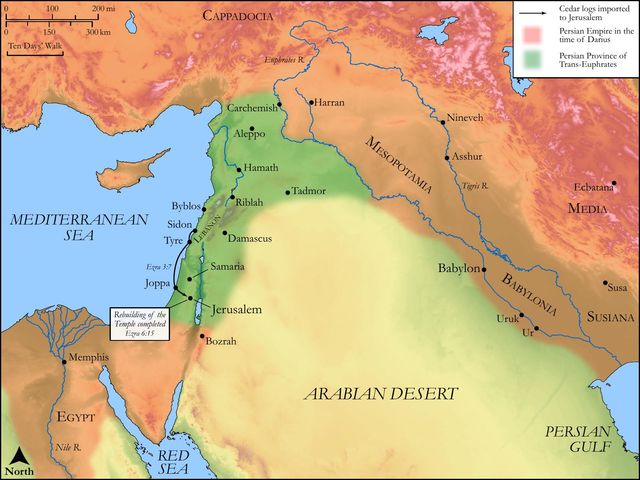
See on the biblical-era map
Study this verse
Public-domain commentary
Matthew Henry
From his Commentary on the Whole Bible. Henry comments on passages, not single verses — this entry covers Ezra 6:13–22. His two-level outline is real structure in the source text, so it is rendered as structure.
Here we have, I. The Jews' enemies made their friends. When they received this order from the king they came with as much haste to encourage and assist the work as their predecessors had done to put a stop to it, Ezr 4:23. What the king ordered they did, and, because they would not be thought to do it with reluctance, they did it speedily, Ezr 6:13. The king's moderation made them, contrary to their own inclination, moderate too.
II.The building of the temple carried on, and finished in a little time, Ezr 6:14, Ezr 6:15.
Now the elders of the Jews built with cheerfulness. For aught I know, the elders themselves laboured at it with their own hands; and, if they did, it was no disparagement to their eldership, but an encouragement to the other workmen.
1.They found themselves bound to it by the commandment of the God of Israel, who had given them power that they might use it in his service.
2.They found themselves shamed into it by the commandment of the heathen kings, Cyrus formerly, Darius now, and Artaxerxes some time after. Can the elders of the Jews be remiss in this good work when these foreign princes appear so warm in it? Shall native Israelites grudge their pains and care about this building when strangers grudge not to be at the expense of it?
3.They found themselves encouraged in it by the prophesying of Haggai and Zechariah, who, it is likely, represented to them (as bishop Patrick suggests) the wonderful goodness of God in inclining the heart of the king of Persia to favour them thus. And now the work went on so prosperously that, in four hears' time, it was brought to perfection. As for God, his work is perfect. The gospel church, that spiritual temple, is long in the building, but it will be finished at last, when the mystical body is completed. Every believer is a living temple, building up himself in his most holy faith. Much opposition is given to this work by Satan and our own corruptions. We trifle, and proceed in it with many stops and pauses; but he that has begun the good work will see it performed, and will bring forth judgment unto victory. Spirits of just men will be made perfect.
III.The dedication of the temple.
When it was built, being designed only for sacred uses, they showed by an example how it should be used, which (says bishop Patrick) is the proper sense of the word dedicate. They entered upon it with solemnity and probably with a public declaration of the separating of it from common uses and the surrender of it to the honour of God, to be employed in his worship.
1.The persons employed in this service were not only the priests and Levites who officiated, but the children of Israel, some of each of the twelve tribes, though Judah and Benjamin were the chief, and the rest of the children of the captivity or transportation, which intimates that there were many besides the children of Israel, of other nations, who transported themselves with them, and became proselytes to their religion, unless we read it, even the remnant of the children of the captivity, and then, we may suppose, notice is hereby taken of their mean and afflicted condition, because the consideration of that helped to make them devout and serious in this and other religious exercises. A sad change! The children of Israel have become children of the captivity, and there appears but a remnant of them, according to that prediction (Isa 7:3), Shear-jashub - The remnant shall return.
2.The sacrifices that were offered upon this occasion were bullocks, rams, and lambs (Ezr 6:17), for burnt-offerings and peace-offerings; not to be compared, in number, with what had been offered at the dedication of Solomon's temple, but, being according to their present ability, they were accepted, for, after a great trial of affliction, the abundance of their joy, and their deep poverty, abounded to the riches of their liberality, Co2 8:2. These hundreds were more to them than Solomon's thousands were to him. But, besides these, they offered twelve he-goats for sin-offerings, one for every tribe, to make atonement for their sins, which they looked upon as necessary in order to the acceptance of their services. Thus, by getting iniquity taken away, they would free themselves from that which had been the sting of their late troubles, and which, if not removed, would be a worm at the root of their present comforts.
3.This service was performed with joy. They were all glad to see the temple built and the concerns of it in so good a posture. Let us learn to welcome holy ordinances with joy and attend on them with pleasure. Let us serve the Lord with gladness. Whatever we dedicate to God, let it be done with joy that he will please to accept of it.
4.When they dedicated the house they settled the household. Small comfort could they have in the temple without the temple service, and therefore they set the priests in their divisions and the Levites in their courses, Ezr 6:18. Having set up the worship of God in this dedication, they took care to keep it up, and made the book of Moses their rule, to which they had an eye in this establishment. Though the temple service could not now be performed with so much pomp and plenty as formerly, because of their poverty, yet perhaps it was performed with as much purity and close adherence to the divine institution as ever, which was the true glory of it. No beauty like the beauty of holiness.
IV.The celebration of the passover in the newly-erected temple.
Now that they were newly delivered out of their bondage in Babylon it was seasonable to commemorate their deliverance out of their bondage in Egypt. Fresh mercies should put us in mind of former mercies. We may suppose that they had kept the passover, after a sort, every year since their return, for they had an altar and a tabernacle. But they were liable to frequent disturbances from their enemies, were straitened for room, and had not conveniences about them, so that they could not do it with due solemnity till the temple was built; and now they made a joyful festival of it, it falling out in the next month after the temple was finished and dedicated, Ezr 6:19. Notice is here taken,
1.Of the purity of the priests and Levites that killed the passover, Ezr 6:20. In Hezekiah's time the priests were many of them under blame for not purifying themselves. But now it is observed, to their praise, that they were purified together, as one man (so the word is); they were unanimous both in their resolutions and in their endeavours to make and keep themselves ceremonially clean for this solemnity; they joined together in their preparations, that they might help one another, so that all of them were pure, to a man. The purity of ministers adds much to the beauty of their ministrations; so does their unity.
2.Of the proselytes that communicated with them in this ordinance: All such as had separated themselves unto them, had left their country and the superstitions of it and cast in their lot with the Israel of God, and had turned from the filthiness of the heathen of the land, both their idolatries and immoralities, to seek the Lord God of Israel as their God, did eat the passover. See how the proselytes, the converts, are described. They separated themselves from the filthiness of sin and fellowship with sinners, joined themselves with the Israel of God in conformity and communion, and set themselves to seek the God of Israel; and those that do so in sincerity, though strangers and foreigners, are welcome to eat of the gospel feast, as fellow-citizens with the saints and of the household of God.
3.Of the great pleasure and satisfaction wherewith they kept the feast of unleavened bread, Ezr 6:22. The Lord had made them joyful, had given them both cause to rejoice and hearts to rejoice. It was now about twenty years since the foundation of this temple was laid, and we may suppose the old men that then wept at the remembrance of the first temple were most of them dead by this time, so that now there were no tears mingled with their joys. Those that are, upon good grounds, joyful, have therefore reason to be thankful, because it is God that makes them to rejoice. He is the fountain whence all the streams of our joy flow. God has promised to all those who take hold of his covenant that he will make them joyful in his house of prayer. The particular occasion they had for joy at this time was that God had turned the heart of the emperor to them, to strengthen their hands. If those that have been, or who we feared would have been, against us, prove to be for us, we may rejoice in it as a token for good, that our ways please the Lord (Pro 16:7), and he must have the glory of it.
Historical interpretation
Historical reception
2 surviving comments on this verse. Each one is dated, so this reads as a timeline rather than a list.
And they built and constructed, etc. He says Artaxerxes, who reigned after Darius, during whose time Ezra ascended from Babylon to Jerusalem. However, it is questioned how it is said that, by order not only of Cyrus and Darius but also Artaxerxes, the house of God was constructed, when it is immediately stated that it was completed and dedicated during the reign of Darius. Unless it should be believed that Artaxerxes, having sent much gold and silver to Jerusalem, also ordered that anything lacking in the building or decoration of the temple, or in its vessels, be completed from the money he had sent and given. For it is written that the same king, along with his princes and counselors, sent much gold and silver and precious vessels to the temple while Ezra was hastening there. Among other things, it is mentioned in the copy of the king’s letter: But whatever else is needed for the house of your God, which you have to provide, you shall do so from the king’s treasury and finances (1 Esdras VII). The month of Adar, on the third day of which the house of the Lord was completed, is called March by us, which the Scripture usually calls the twelfth month according to the lunar cycle. It is not without mystery that the house of the Lord, which began in the seventh month with the building of the altar, was completed in the twelfth month. For it began at the start of the seventh month; because we begin all good works with the grace of the Holy Spirit preceding us, and, with it accompanying us, we strive for perfection. It was completed in the twelfth month due to the significance of perfection contained in this number, especially due to the sum of the apostles, in whose faith and doctrine the church is perfected. Similarly, the number twelve signifies the perfection of correct faith and action because whether you multiply three by four or four by three, you will complete twelve. The number three is rightly related to faith because of the confession of the Holy Trinity; the number four to good works because of the same number of excellent virtues, prudence, fortitude, temperance, and justice; of which the Book of Wisdom, in praising Wisdom itself, mentions, saying: For she teaches soberness and prudence, righteousness, and courage; nothing in life is more useful than these (Wisdom VIII). Therefore, it is right that the house of the Lord, begun in the seventh month, was completed and dedicated in the twelfth month; because the mind of the elect is illuminated by the grace of the Holy Spirit so that it may reach the perfection of good works with faith in the holy and undivided Trinity, and thus joyfully awaits the dedication of blessed reward. And since this same reward pertains to our future celebration at the time of the universal resurrection and in the vision of the same Trinity in which we now believe, it is rightly mentioned that the house of the Lord was completed not only in the twelfth month but also on the third day of it; because the Lord rose from the dead on the third day, our resurrection can rightly be designated by the three days’ number, of which the prophet says: He has torn us, but he will heal us; he has struck us, but he will bind us up; after two days he will revive us; on the third day, he will raise us up (Hosea VI). The building of the temple began in the first year of King Cyrus and was completed in the sixth year of Darius; which are, according to the Chroniclers, forty years. For Cyrus reigned for thirty years, after him, his son Cambyses reigned for eight years, who in this volume, as Josephus asserts, is called Artaxerxes; after him, the Magi, who killed him, ruled for one year, after which Darius until the temple’s completion and dedication, six years; which are, as we said, forty-five years. However, it is questioned how, with the Lord saying to the Jews under the figure of the temple about his passion and resurrection: Destroy this temple, and in three days I will raise it up; they responded: It took forty-six years to build this temple, and will you raise it up in three days? (John II); when no more than sixty-five years are found from the first year of Cyrus to the sixth year of King Darius. But if we read in Josephus’ History, where he adds three years after the temple’s completion and dedication, in which the construction of the surrounding fortifications and other remaining parts were completed; we will see that the sum of forty-six years can be correctly calculated for the construction of the temple with all its prominent structures completed. However, adhering to this chapter of the Gospel, we should bear in mind that the temple built by Solomon and rebuilt by Zerubbabel and Jesus has multiple representations. It signifies each chosen soul, which, because of Christ dwelling in it, is rightly called Christ’s house and temple; and the entire church, that is, the congregation of all the elect, both angels and humans; and the Lord’s own body, which was born of the virgin, lived without sin in the world, was released from death by the impious but was resurrected by him on the third day to life. This figure is particularly fitting to that which says the temple was built in forty-six years. For physiologists report that the human body in the womb grows from conception to the complete formation of its members in this number of days. And it was fitting that the house, which was to have the figure of the Lord’s body, should be founded in Jerusalem in the same number of years in which the Lord’s own body was to be formed in the sacred womb of the virgin, who is rightfully named Jerusalem, that is, the city of the great King and the vision of peace, of whom it is said: He is our peace, who made both one (Ephesians II). Just as what is written about the same temple: The door for the middle story was in the right side of the house; and they went up with winding stairs into the middle story, and out of the middle into the third (1 Kings VI); specifically prefigured the Lord’s body, of which it is written: But one of the soldiers with a spear pierced his side, and immediately there came out blood and water (John XIX). For the door of the middle story was in the right side of the house, meaning starting from the eastern corner of the southern side to the earth, and through its inner part by a hidden way rising gradually to the higher stories; because our Lord and Savior wished to open for us the door of salvation in his body’s right side, through whose sacraments, being washed and sanctified, we might enter the higher hall of the heavenly kingdom. We ascend through the door of the middle story into the upper room when, consecrated through the water of baptism and the cup of the Lord’s chalice, we pass from this earthly conversation to the heavenly life of souls. From the upper room, we also penetrate into the third story when we accumulate the bliss of souls with the perception of immortal bodies.
And they prospered according to the prophecy, etc. For the same prophets had foretold that if they persisted in building the temple, they would soon, with the Lord's granting, complete the work itself and also abundantly abound in all good things as a reward for their devotion. Among these is the saying of Zechariah: The hands of Zerubbabel have laid the foundation of this house, and his hands shall also finish it; and you will know that the Lord of hosts has sent me to you (Zech. IV). This means that when you see the temple completed by that same Zerubbabel who laid its foundation, then you will understand that I was sent by the Lord and that what I spoke, I said by His command. Also Haggai says: From the twenty-fourth day of the ninth month, from the day that the foundation of the temple of the Lord was laid, consider: Is the seed yet in the barn? And do the vine, the fig tree, the pomegranate, and the olive tree still not yield? From this day, I will bless you (Haggai II). And the outcome of events showed that what was truly predicted had come true. Moreover, all the prophets, indeed all the sacred authors of Scripture, promise prosperity to the builders of the holy Church, that is, to the teachers, if they, not wearied by adversities, do not rest from their holy labor. For divine help shall be present, whereby the house of the Lord, begun in the heart of the listeners by believing and living well, will be completed. To those same architects will come the blessing of the fruits of the vine, the fig tree, the pomegranate, and the olive tree, that is, a more abundant supply of spiritual gifts, which will undoubtedly be granted to us more abundantly by the Lord as we more diligently strive to build the habitation of His glory, whether in ourselves or in the hearts of our neighbors. Nor should anyone consider contrary what Haggai says, that the foundation of the temple was laid under King Darius, to this sacred history we are expounding, which states that in the second year of King Cyrus the temple was founded by the masons, with the people greatly rejoicing and praising God (I Esdr. III). For then the foundation of the temple itself was described, that is, the interior house of holiness, whose measurements are especially referred to in the histories of Kings and Chronicles. But now, along with the building of the house itself, the buildings of the porticos and treasuries, which surrounded the house in a circle on every side, are narrated as founded, of which mention is made in the book of Chronicles as follows: He also made the courtyard of the priests, and the great vestibule, and the doors of the vestibule, which he covered with bronze (I Chron. IV). In this vestibule surrounding the temple, both the people used to stand to pray and the guards and doorkeepers of the temple used to keep watch through their shifts day and night, as the book of Chronicles abundantly teaches there. Sometimes this house generally is counted with the temple itself; as in the Gospel, where the Lord, teaching in the temple, was brought a woman caught in adultery by the Pharisees and Scribes (John VIII), whom they could have brought only into some portico of the temple; at other times, separately under the name of treasuries, or chambers, or porticoes, or courtyards. Hence the Psalmist says: Who stand in the house of the Lord, in the courtyards of the house of our God.
Continue studying Ezra 6:14 across the web’s major study libraries — every link below opens this exact verse, chapter, or book on the destination site.
Read & Compare
 BibleGatewayThis verse in more than 200 translations and 70 languages.
 Bible.comThe YouVersion reader — hundreds of translations, reading plans, and highlights.
 ESV.orgCrossway's official English Standard Version reader.
 NET BibleThe NET translation with 60,000+ translators' notes on every rendering decision.
 STEP BibleTyndale House's free study tool — original text, vocabulary, and scholarly resources.
 BibliaLogos Bible Software's free web reader.
 USCCBThe New American Bible (Revised Edition) with the U.S. bishops' study notes.
Commentaries
 BibleHub CommentariesDozens of classic commentaries on this verse, gathered on one page.
 StudyLightMore than 100 commentary sets — the largest collection on the web.
 BibleRefPlain-English commentary on what this verse means, verse by verse.
 Enduring WordDavid Guzik's free commentary on this chapter, widely used by Bible teachers.
 Bible Study ToolsVerse commentary alongside Greek and Hebrew study aids.
Original Language & Research
- BibleHub InterlinearThe verse word by word — original language, transliteration, and English.
- BibleHub LexiconEvery word's original-language definition and Strong's entry.
 Blue Letter BibleDeep-study tools — Strong's numbers, concordance, and word studies.
 SefariaThe Hebrew text with Rashi and centuries of Jewish commentary.
Sermons, Hymns & Audio


TrulyRandomVerse is not affiliated with these sites and doesn’t control their content. They’re linked because they’re genuinely useful.
Summary
Ezra 6:14 powerfully chronicles the triumphant completion of the Second Temple in Jerusalem, a monumental achievement for the post-exilic Jewish community. This verse profoundly asserts that the successful rebuilding was not merely the product of human endeavor but a divinely orchestrated work, propelled by the prophetic encouragement of Haggai and Zechariah, and remarkably facilitated by the sovereign decrees of powerful Persian kings—Cyrus, Darius, and Artaxerxes. It stands as an enduring testament to God's unwavering faithfulness to His covenant promises and His sovereign ability to utilize both spiritual and secular authorities to accomplish His redemptive purposes, culminating in the prosperity and finalization of His sacred house.
Context
ShowHideLiterary Context
Ezra 6:14 stands at the climax of the narrative of the Second Temple's rebuilding, which commenced in Ezra 3 following the initial return from Babylonian exile. Chapters 1-6 meticulously detail the initial enthusiasm, the subsequent opposition that tragically halted the work for many years (as recounted in Ezra 4), and the crucial divine intervention through the ministries of prophets Haggai and Zechariah (highlighted in Ezra 5) that spurred the people to resume construction. This verse, coming shortly before the joyous dedication of the Temple in Ezra 6:16-18, signifies the successful culmination of this arduous, multi-decade endeavor. It seamlessly bridges the historical account of the Temple's construction with its subsequent dedication and the celebration of Passover, emphatically highlighting God's faithfulness in bringing His plans to fruition despite significant and prolonged obstacles.
Historical & Cultural Context
The period described in Ezra 6:14 is the post-exilic era, specifically the late 6th century BCE, following the Jewish people's return from seventy years of Babylonian captivity. The Persian Empire, having overthrown Babylon, was the dominant world power, and its administrative structure played a pivotal role in the Jewish restoration. Cyrus the Great had issued a benevolent decree permitting the Jews to return and rebuild their Temple, as explicitly stated in Ezra 1:1-4, but subsequent opposition from local adversaries led to a cessation of work under later kings. The reign of Darius I (522-486 BCE) proved crucial; his discovery and re-affirmation of Cyrus's original decree, meticulously detailed in Ezra 6:1-12, provided the necessary political and financial backing for the work to resume and be completed. Artaxerxes, mentioned here, refers to a later king (likely Artaxerxes I, 465-424 BCE) whose decrees would further support the restoration of Jerusalem and its people, underscoring the long-term, providential care of God through successive Persian monarchs, demonstrating His ability to use even pagan rulers for His divine purposes.
Key Themes
ShowHideThis verse powerfully encapsulates several overarching themes found throughout the book of Ezra and the broader post-exilic narrative. Firstly, it emphasizes Divine Sovereignty and Providence, demonstrating God's absolute ability to orchestrate events and utilize even pagan rulers to accomplish His will, a truth echoed in Proverbs 21:1. Secondly, the verse highlights the Power of the Prophetic Word; the ministries of Haggai and Zechariah were instrumental in rekindling the people's zeal and overcoming their apathy and fear, proving that God's word is living, active, and effective (Hebrews 4:12). Thirdly, it illustrates the principle of Obedience and Divine Blessing, where the "prospering" of the work is directly linked to the people's renewed obedience in building according to God's command, reinforcing the biblical pattern of blessing following faithful action. Finally, it underscores the Centrality of the Temple as the dwelling place of God's presence and the focal point for Israel's worship and identity, a foundational theme throughout the Old Testament narrative, from the Tabernacle in Exodus 25 to Solomon's Temple in 1 Kings 6.
Exposition and Analysis
ShowHideKey Word Analysis
ShowHideThis verb (H1124) signifies the act of construction or making. Its repeated use in Ezra 6:14 emphasizes the sustained, physical labor involved in the Temple's reconstruction. It highlights the tangible effort of the Jewish elders and the community in bringing the divine command to fruition, underscoring both human responsibility and the eventual successful completion of the arduous task.
This verb (H6744) denotes success, advancement, or effectiveness in an undertaking. In this context, it implies more than mere completion; it suggests that the work was accomplished with divine favor and blessing, overcoming all obstacles and achieving its intended purpose with ease and fruitfulness. The prosperity was not solely in terms of material resources, but in the spiritual and communal flourishing that accompanied the renewed obedience to God's command.
This term (H2941) refers to an official decree, order, or edict, often with judicial authority. Its repeated use in the verse emphasizes the authoritative nature of the directives that led to the Temple's completion. It highlights that the rebuilding was not an arbitrary human project but was carried out under the binding authority of both the God of Israel and the highest human rulers of the time, underscoring a divinely sanctioned and legally recognized endeavor.
Verse Breakdown
ShowHide"And the elders of the Jews builded, and they prospered through the prophesying of Haggai the prophet and Zechariah the son of Iddo."
This opening clause establishes the primary human agents, "the elders of the Jews," representing the collective effort and leadership of the community. Crucially, their "prospering" in the building efforts is directly attributed to the "prophesying" of Haggai and Zechariah. These prophets delivered God's timely and divinely inspired word, challenging the people's apathy, reminding them of God's promises, and urging them to prioritize the Temple's construction. Their ministry ignited the people's zeal and secured divine favor on their work, demonstrating the transformative power of God's spoken word.
"And they builded, and finished [it],"
This phrase emphasizes the successful and complete culmination of the arduous task. The repetition of "builded" underscores the sustained, diligent effort required over many years, while "finished [it]" marks the triumphant conclusion of the Temple's construction, bringing to an end years of delay, opposition, and discouragement. This completion was a monumental achievement, signaling a new era for the returned exiles and the restoration of proper worship.
"according to the commandment of the God of Israel,"
This critical declaration asserts that the ultimate authority and driving force behind the Temple's completion was God Himself. The rebuilding was not merely a human initiative but a direct fulfillment of God's sovereign will and a response to His divine mandate. This highlights God's unwavering faithfulness to His covenant promises and His active, providential involvement in the affairs of His people, orchestrating events to ensure His purposes are realized.
"and according to the commandment of Cyrus, and Darius, and Artaxerxes king of Persia."
This final clause profoundly demonstrates God's sovereign ability to work through secular authorities, even pagan kings, to accomplish His divine purposes. Cyrus initiated the return and the initial rebuilding decree, Darius confirmed and enforced that decree, and Artaxerxes later provided further support for the broader restoration of Jerusalem. The explicit mention of these three successive Persian kings underscores the long-term, consistent, and providential hand of God working through the highest world leaders to ensure His divine plan for His people and His house was realized, showcasing His dominion over all earthly powers.
Literary Devices
ShowHideEzra 6:14 employs several powerful literary devices to convey its profound message. Repetition is prominent, with the verb "builded" appearing twice, emphasizing the sustained effort, perseverance, and ultimate success of the construction. More significantly, the phrase "according to the commandment of" is repeated, creating a powerful Parallelism that juxtaposes the divine command with the human royal decrees. This parallelism highlights the ultimate source of authority (God) and the instrumental means through which His will was executed (the Persian kings), thereby underscoring the theme of Divine Sovereignty—God's ultimate plan is so powerful that it compels even foreign rulers to act in ways that further His kingdom purposes. The verse also functions as a Climax, bringing to a triumphant close the long and challenging narrative of the Temple's reconstruction, providing a sense of resolution and divine vindication after years of struggle and delay. Furthermore, the inclusion of specific names (Haggai, Zechariah, Cyrus, Darius, Artaxerxes) lends a strong sense of Historical Veracity and concrete detail to the narrative, grounding the theological claims in verifiable historical events.
Theological and Thematic Connections
ShowHideEzra 6:14 profoundly illustrates God's unwavering commitment to His covenant people and His sovereign control over all of history. The completion of the Temple, against all odds and through the decrees of pagan kings, testifies to God's ability to use any means necessary, even unexpected ones, to fulfill His promises. It affirms that God's purposes will ultimately prevail, regardless of human opposition, apathy, or changing political landscapes. The verse also underscores the vital role of prophetic ministry in stirring God's people to action and the immense blessing that accompanies obedience to His revealed will. It teaches that true prosperity in God's work comes not merely from human effort or strategic planning, but fundamentally from divine enablement, active participation, and faithful alignment with His commands. This completion represents a significant step in the restoration of Israel's identity and worship after exile.
Reflection and Application
ShowHideEzra 6:14 offers a profound encouragement for believers today, reminding us that God's purposes are unstoppable, and He is faithful to complete what He starts, even when the path is long and fraught with obstacles. In our own lives, whether facing personal challenges, spiritual apathy, or seemingly insurmountable hurdles in ministry or community, this verse calls us to trust in God's sovereign hand. It reminds us that our "building" projects—be they spiritual disciplines, family discipleship, community service, or vocational endeavors—are not reliant solely on our strength or ingenuity, but on God's enabling power and His divine command. We are called to heed the prophetic voice of God's Word, which, like Haggai and Zechariah's message, can rekindle our zeal, correct our priorities, and guide us to "prosper" in our endeavors for His glory. This verse also challenges us to recognize God's work in unexpected places and through unlikely means, even through secular authorities or challenging circumstances, and to faithfully persevere, knowing that diligence in obedience ultimately leads to divine blessing and the completion of His good work in and through us.
Questions for Reflection
ShowHideFAQ
ShowHideWhat was the significance of the prophets Haggai and Zechariah in the rebuilding effort?
ShowHideThe prophets Haggai and Zechariah were absolutely critical to the successful completion of the Second Temple. After the initial enthusiasm for rebuilding waned due to opposition and the people's focus shifted to their own homes, God raised up these two prophets. Their divinely inspired messages, recorded in the books of Haggai and Zechariah, directly addressed the people's apathy, fear, and misplaced priorities. Haggai challenged them with the piercing question, "Is it a time for you yourselves to dwell in your paneled houses, while this house lies in ruins?" (Haggai 1:4). Zechariah encouraged them with the powerful promise, "Not by might nor by power, but by my Spirit,' says the Lord of hosts" (Zechariah 4:6). Their words rekindled the people's zeal, instilled courage, and reminded them of God's presence and promises, directly leading to the resumption and successful completion of the Temple, as Ezra 6:14 clearly states. They were God's instruments to motivate and guide His people back to their divine task.
How did the decrees of the Persian kings contribute to the Temple's completion?
ShowHideThe decrees of the Persian kings were instrumental and divinely orchestrated in the completion of the Temple, demonstrating God's sovereignty over earthly rulers. Cyrus the Great, in Ezra 1:1-4, issued the initial decree allowing the Jews to return to Jerusalem and rebuild the Temple, even providing resources. Later, when opposition halted the work, King Darius I, after a search of the archives, rediscovered and re-affirmed Cyrus's original decree, providing not only legal protection but also financial support from the royal treasury for the Temple's construction (Ezra 6:1-12). While Artaxerxes' specific contribution to the Temple's completion isn't detailed in Ezra 6, his mention here likely refers to his later decrees (e.g., in Ezra 7) that further supported the Jewish community and the restoration of Jerusalem, solidifying the long-term Persian policy of supporting the Temple and its worship. Thus, these kings' commands provided the necessary political and material framework for the work to proceed and be finished.
Christ-Centered Fulfillment
ShowHideEzra 6:14, with its focus on the completion of the physical Temple through divine command and human cooperation, finds profound Christ-centered fulfillment in the New Testament. The earthly Temple, though glorious, was ultimately a shadow of a greater reality: Jesus Christ Himself. He boldly declared, "Destroy this temple, and in three days I will raise it up," speaking not of the stone structure, but of the temple of His own body (John 2:19-21). Christ is the ultimate dwelling place of God, the true Temple where God's presence fully resides in bodily form (Colossians 2:9). The prophetic word that spurred the building in Ezra points to Christ as the very Word of God incarnate (John 1:1), through whom all things are made and through whom God speaks His final and complete revelation (Hebrews 1:1-2). Furthermore, the "finished" work of the Temple in Ezra foreshadows Christ's triumphant declaration on the cross, "It is finished!" (John 19:30), signifying the complete and perfect sacrifice that inaugurated the new covenant and fully accomplished God's redemptive plan. The building of the Temple in Ezra also prefigures the ongoing construction of God's spiritual temple, the Church, with Christ as the cornerstone and believers as living stones, continually being built into a holy dwelling for God's Spirit (1 Peter 2:4-5; Ephesians 2:19-22). Thus, Ezra 6:14 is not just a historical account of a completed building, but a powerful testament to God's sovereign plan to establish His dwelling place among humanity, ultimately and perfectly fulfilled in Jesus Christ and His ongoing work through His Spirit in His church.