


Ezra 6:15
Bible text: King James Version (1769 Blayney text) · Public domain
Bible text: Berean Standard Bible · Public domain
Bible text: American Standard Version (1901) · Public domain
Bible text: World English Bible, Messianic edition · Public domain
Bible text: Geneva Bible (1599) · Public domain
Bible text: Young's Literal Translation · Public domain
- וְשֵׁיצִיאve·shei·Tzi'and it was brought forthH3319Conj-w ¦ V-Shaphel-Perf-3msVerb Shaphel Perfect 3rd Singular Masculineוְandשֵׁיצִיאit was brought forth
- בַּיְתָהbay·Tah'house theH1005N-cs ¦ ArtNoun Singular common gender Definiteבַּיְתָhouseהthe
- דְנָהde·NahthisH1836PrtParticle Demonstrative
- עַד'aduntilH5705PrepPreposition
- יוֹםYomdayH3118N-csNoun Singular common gender Absolute
- תְּלָתָהte·la·TahthreeH8532Adj-csAdjective Numerical Singular common gender Absolute
- לִירַחli·Rachof [the] month ofH3393Prep-l ¦ N-cscNoun Singular common gender Constructלִofירַח[the] month of
- אֲדָר'a·DarAdarH144N-properNoun Proper Title
- דִּיdiwhichH1768ConjConjunction
- הִיאhi'itH1932Pro-3fsPronoun Personal 3rd Singular Feminine
- שְׁנַתshe·nat[was] yearH8140N-fscNoun Singular Feminine Construct
- שֵׁתShetsixH8353Adj-csAdjective Numerical Singular common gender Absolute
- לְמַלְכוּתle·mal·Khutof [the] reign ofH4437Prep-l ¦ N-fscNoun Singular Feminine Constructלְofמַלְכוּת[the] reign of
- דָּרְיָוֶשׁda·re·Ya·veshDariusH1868N-proper-mNoun Proper Masculine
- מַלְכָּאmal·Ka'king theH4430N-cs ¦ ArtNoun Singular common gender Definiteמַלְכָּkingאthe
English is a literal word-by-word gloss of the Hebrew, not the KJV's wording. Why?
This is the original text the KJV's translators worked from — each Hebrew word with its own literal English meaning in this verse, prepared by scholars at Tyndale House, Cambridge. The KJV translates whole sentences, not word by word, so its wording differs: one Hebrew word can become several English words, and the KJV may choose “the LORD” where the gloss reads “Yahweh”. Both are faithful — they answer different questions. For the KJV's own rendering, switch to the KJV text.
Details
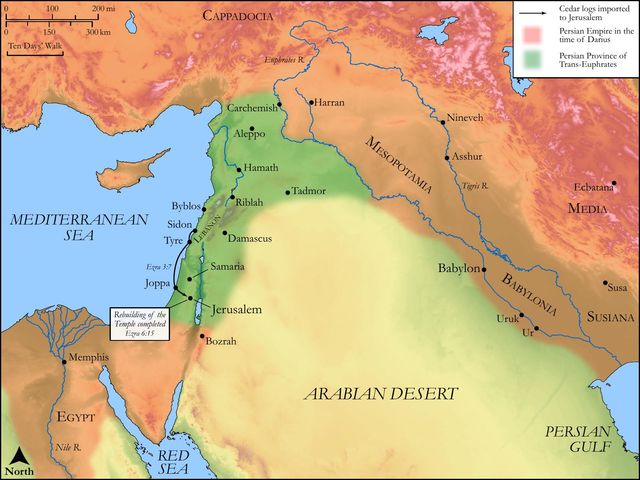
See on the biblical-era map
Study this verse
Public-domain commentary
Matthew Henry
From his Commentary on the Whole Bible. Henry comments on passages, not single verses — this entry covers Ezra 6:13–22. His two-level outline is real structure in the source text, so it is rendered as structure.
Here we have, I. The Jews' enemies made their friends. When they received this order from the king they came with as much haste to encourage and assist the work as their predecessors had done to put a stop to it, Ezr 4:23. What the king ordered they did, and, because they would not be thought to do it with reluctance, they did it speedily, Ezr 6:13. The king's moderation made them, contrary to their own inclination, moderate too.
II.The building of the temple carried on, and finished in a little time, Ezr 6:14, Ezr 6:15.
Now the elders of the Jews built with cheerfulness. For aught I know, the elders themselves laboured at it with their own hands; and, if they did, it was no disparagement to their eldership, but an encouragement to the other workmen.
1.They found themselves bound to it by the commandment of the God of Israel, who had given them power that they might use it in his service.
2.They found themselves shamed into it by the commandment of the heathen kings, Cyrus formerly, Darius now, and Artaxerxes some time after. Can the elders of the Jews be remiss in this good work when these foreign princes appear so warm in it? Shall native Israelites grudge their pains and care about this building when strangers grudge not to be at the expense of it?
3.They found themselves encouraged in it by the prophesying of Haggai and Zechariah, who, it is likely, represented to them (as bishop Patrick suggests) the wonderful goodness of God in inclining the heart of the king of Persia to favour them thus. And now the work went on so prosperously that, in four hears' time, it was brought to perfection. As for God, his work is perfect. The gospel church, that spiritual temple, is long in the building, but it will be finished at last, when the mystical body is completed. Every believer is a living temple, building up himself in his most holy faith. Much opposition is given to this work by Satan and our own corruptions. We trifle, and proceed in it with many stops and pauses; but he that has begun the good work will see it performed, and will bring forth judgment unto victory. Spirits of just men will be made perfect.
III.The dedication of the temple.
When it was built, being designed only for sacred uses, they showed by an example how it should be used, which (says bishop Patrick) is the proper sense of the word dedicate. They entered upon it with solemnity and probably with a public declaration of the separating of it from common uses and the surrender of it to the honour of God, to be employed in his worship.
1.The persons employed in this service were not only the priests and Levites who officiated, but the children of Israel, some of each of the twelve tribes, though Judah and Benjamin were the chief, and the rest of the children of the captivity or transportation, which intimates that there were many besides the children of Israel, of other nations, who transported themselves with them, and became proselytes to their religion, unless we read it, even the remnant of the children of the captivity, and then, we may suppose, notice is hereby taken of their mean and afflicted condition, because the consideration of that helped to make them devout and serious in this and other religious exercises. A sad change! The children of Israel have become children of the captivity, and there appears but a remnant of them, according to that prediction (Isa 7:3), Shear-jashub - The remnant shall return.
2.The sacrifices that were offered upon this occasion were bullocks, rams, and lambs (Ezr 6:17), for burnt-offerings and peace-offerings; not to be compared, in number, with what had been offered at the dedication of Solomon's temple, but, being according to their present ability, they were accepted, for, after a great trial of affliction, the abundance of their joy, and their deep poverty, abounded to the riches of their liberality, Co2 8:2. These hundreds were more to them than Solomon's thousands were to him. But, besides these, they offered twelve he-goats for sin-offerings, one for every tribe, to make atonement for their sins, which they looked upon as necessary in order to the acceptance of their services. Thus, by getting iniquity taken away, they would free themselves from that which had been the sting of their late troubles, and which, if not removed, would be a worm at the root of their present comforts.
3.This service was performed with joy. They were all glad to see the temple built and the concerns of it in so good a posture. Let us learn to welcome holy ordinances with joy and attend on them with pleasure. Let us serve the Lord with gladness. Whatever we dedicate to God, let it be done with joy that he will please to accept of it.
4.When they dedicated the house they settled the household. Small comfort could they have in the temple without the temple service, and therefore they set the priests in their divisions and the Levites in their courses, Ezr 6:18. Having set up the worship of God in this dedication, they took care to keep it up, and made the book of Moses their rule, to which they had an eye in this establishment. Though the temple service could not now be performed with so much pomp and plenty as formerly, because of their poverty, yet perhaps it was performed with as much purity and close adherence to the divine institution as ever, which was the true glory of it. No beauty like the beauty of holiness.
IV.The celebration of the passover in the newly-erected temple.
Now that they were newly delivered out of their bondage in Babylon it was seasonable to commemorate their deliverance out of their bondage in Egypt. Fresh mercies should put us in mind of former mercies. We may suppose that they had kept the passover, after a sort, every year since their return, for they had an altar and a tabernacle. But they were liable to frequent disturbances from their enemies, were straitened for room, and had not conveniences about them, so that they could not do it with due solemnity till the temple was built; and now they made a joyful festival of it, it falling out in the next month after the temple was finished and dedicated, Ezr 6:19. Notice is here taken,
1.Of the purity of the priests and Levites that killed the passover, Ezr 6:20. In Hezekiah's time the priests were many of them under blame for not purifying themselves. But now it is observed, to their praise, that they were purified together, as one man (so the word is); they were unanimous both in their resolutions and in their endeavours to make and keep themselves ceremonially clean for this solemnity; they joined together in their preparations, that they might help one another, so that all of them were pure, to a man. The purity of ministers adds much to the beauty of their ministrations; so does their unity.
2.Of the proselytes that communicated with them in this ordinance: All such as had separated themselves unto them, had left their country and the superstitions of it and cast in their lot with the Israel of God, and had turned from the filthiness of the heathen of the land, both their idolatries and immoralities, to seek the Lord God of Israel as their God, did eat the passover. See how the proselytes, the converts, are described. They separated themselves from the filthiness of sin and fellowship with sinners, joined themselves with the Israel of God in conformity and communion, and set themselves to seek the God of Israel; and those that do so in sincerity, though strangers and foreigners, are welcome to eat of the gospel feast, as fellow-citizens with the saints and of the household of God.
3.Of the great pleasure and satisfaction wherewith they kept the feast of unleavened bread, Ezr 6:22. The Lord had made them joyful, had given them both cause to rejoice and hearts to rejoice. It was now about twenty years since the foundation of this temple was laid, and we may suppose the old men that then wept at the remembrance of the first temple were most of them dead by this time, so that now there were no tears mingled with their joys. Those that are, upon good grounds, joyful, have therefore reason to be thankful, because it is God that makes them to rejoice. He is the fountain whence all the streams of our joy flow. God has promised to all those who take hold of his covenant that he will make them joyful in his house of prayer. The particular occasion they had for joy at this time was that God had turned the heart of the emperor to them, to strengthen their hands. If those that have been, or who we feared would have been, against us, prove to be for us, we may rejoice in it as a token for good, that our ways please the Lord (Pro 16:7), and he must have the glory of it.
Continue studying Ezra 6:15 across the web’s major study libraries — every link below opens this exact verse, chapter, or book on the destination site.
Read & Compare
 BibleGatewayThis verse in more than 200 translations and 70 languages.
 Bible.comThe YouVersion reader — hundreds of translations, reading plans, and highlights.
 ESV.orgCrossway's official English Standard Version reader.
 NET BibleThe NET translation with 60,000+ translators' notes on every rendering decision.
 STEP BibleTyndale House's free study tool — original text, vocabulary, and scholarly resources.
 BibliaLogos Bible Software's free web reader.
 USCCBThe New American Bible (Revised Edition) with the U.S. bishops' study notes.
Commentaries
 BibleHub CommentariesDozens of classic commentaries on this verse, gathered on one page.
 StudyLightMore than 100 commentary sets — the largest collection on the web.
 BibleRefPlain-English commentary on what this verse means, verse by verse.
 Enduring WordDavid Guzik's free commentary on this chapter, widely used by Bible teachers.
 Bible Study ToolsVerse commentary alongside Greek and Hebrew study aids.
Original Language & Research
- BibleHub InterlinearThe verse word by word — original language, transliteration, and English.
- BibleHub LexiconEvery word's original-language definition and Strong's entry.
 Blue Letter BibleDeep-study tools — Strong's numbers, concordance, and word studies.
 SefariaThe Hebrew text with Rashi and centuries of Jewish commentary.
Sermons, Hymns & Audio


TrulyRandomVerse is not affiliated with these sites and doesn’t control their content. They’re linked because they’re genuinely useful.
Summary
Ezra 6:15 marks a momentous milestone in the post-exilic history of Israel, recording the triumphant completion of the Second Temple in Jerusalem. After decades of interruption, persistent opposition, and renewed effort spurred by prophetic encouragement, the sacred house of God was finally brought to fruition on the third day of the month Adar, in the sixth year of the reign of Darius I. This verse encapsulates the culmination of divine faithfulness, human perseverance, and the precise fulfillment of prophecy, signifying the re-establishment of central worship and the renewed national identity for the returned Jewish exiles.
Context
ShowHideLiterary Context
Ezra 6:15 serves as the climactic declaration within the narrative detailing the rebuilding of the Temple following the Babylonian exile. The book of Ezra commences with the remarkable decree of Cyrus, allowing the Jewish exiles to return to Jerusalem and rebuild their sanctuary (Ezra 1). While the foundation was laid with great celebration and some lamentation (Ezra 3), the work soon faced formidable and sustained opposition from surrounding peoples, particularly the Samaritans, leading to a prolonged cessation of construction, as meticulously documented in Ezra 4. The narrative then shifts to the powerful ministries of the prophets Haggai and Zechariah, whose divine promptings reignited the people's resolve to resume the work (Ezra 5:1-2). This renewed activity prompted a fresh inquiry from Tattenai, the governor of Trans-Euphrates, which ultimately led to the discovery of Cyrus's original decree in the archives at Ecbatana (Ezra 6:1-5). Consequently, Darius I issued his own decree, not only reaffirming Cyrus's permission but also commanding active assistance and protection for the builders (Ezra 6:6-12). Ezra 6:15, therefore, stands as the triumphant conclusion to this long and arduous process, immediately preceding the joyful dedication ceremonies and the celebration of Passover described in Ezra 6:16-22.
Historical & Cultural Context
The completion of the Second Temple, as recorded in Ezra 6:15, transpired during the zenith of the Persian Empire, under the reign of Darius I Hystaspes (522-486 BC). This era succeeded the devastating Babylonian exile, which had witnessed the destruction of Solomon's magnificent Temple in 586 BC. The return of the Jewish exiles was an unparalleled act of divine providence, as no other conquered people were granted such a privilege by their imperial overlords. The Temple was far more than a mere edifice; it represented the spiritual and national heart of Israel, symbolizing God's enduring presence among His covenant people and the continuity of their sacred identity. Its completion was a profound declaration of restoration, a beacon of hope for a people who had endured immense suffering, displacement, and cultural assimilation pressures. The precise dating within the verse—the sixth year of Darius's reign, approximately 516 BC—is historically pivotal, as it places the Temple's completion roughly 70 years after the destruction of the First Temple, thereby remarkably fulfilling Jeremiah's prophecy concerning the seventy years of desolation for Jerusalem (Jeremiah 29:10). This meticulous record-keeping underscores the profound significance of this event for the Jewish community and its historical veracity within the sophisticated Persian administrative system.
Key Themes
ShowHideThe completion of the Temple in Ezra 6:15 powerfully encapsulates several foundational theological themes. First, Divine Faithfulness and Providence are supremely evident. Despite decades of delay, fierce opposition, and human discouragement, God's unwavering commitment to His covenant promises is unmistakably displayed. He sovereignly orchestrated complex geopolitical events, even utilizing pagan kings like Cyrus and Darius, to ensure His purposes for His people and His dwelling place were brought to fruition (Proverbs 21:1). Second, the theme of Perseverance and Dedication is profoundly highlighted. The Jewish community, under the courageous leadership of Zerubbabel and Joshua, demonstrated remarkable resilience and unwavering commitment. Their renewed efforts, spurred by the prophetic ministries, powerfully illustrate that faithful obedience and persistent labor are indispensable in God's work, even when confronting seemingly insurmountable obstacles (Galatians 6:9). Third, this momentous event unequivocally signifies the Fulfillment of Prophecy. The precise 70-year period of exile and desolation, foretold by Jeremiah, culminates with the Temple's completion, marking a new era of restoration and the re-establishment of the covenant community in their ancestral land (Daniel 9:2). The finished Temple was a tangible, undeniable sign that God was indeed bringing His people back and rebuilding their spiritual and national center.
Exposition and Analysis
ShowHideKey Word Analysis
ShowHideThis verb, derived from a root meaning "to go out" or "to bring out," here signifies the successful completion or accomplishment of a task. In the context of Ezra 6:15, it denotes the finalization of the Temple's construction, a monumental undertaking that had faced significant delays and opposition. The use of this word emphasizes that the building project was not merely underway or near completion, but definitively brought to its intended end, marking a pivotal moment of achievement and divine enablement.
This refers to the twelfth month of the Jewish religious calendar, corresponding to late February or early March in the Gregorian calendar. The specific mention of "the third day of the month Adar" provides an exact chronological marker for the Temple's completion. This precision underscores the historical meticulousness of the biblical record and highlights the profound importance of this specific date for the Jewish community, signifying a precise moment of divine faithfulness and human perseverance.
This name identifies Darius I Hystaspes, a powerful and influential king of the Persian Empire who reigned from 522 to 486 BC. The reference to his "sixth year" (approximately 516 BC) firmly anchors the event in verifiable secular history. This specific dating not only confirms the accuracy of the Ezra narrative but also highlights God's sovereign control over world leaders and empires, demonstrating His ability to use even pagan rulers to accomplish His divine purposes for His chosen people.
Verse Breakdown
ShowHide"And this house was finished"
This concise yet powerful declaration announces the successful conclusion of the Second Temple's construction. After decades of interruption, fervent prayer, and renewed labor, the long-awaited goal of rebuilding God's dwelling place in Jerusalem was finally achieved. The phrase "this house" specifically refers to the sacred Temple, symbolizing the restoration of Israel's central place of worship and the re-establishment of their unique religious and national identity.
"on the third day of the month Adar"
This clause provides the exact date of the Temple's completion. The precision of "the third day" combined with the specific month "Adar" (the twelfth month of the Jewish calendar) underscores the historical accuracy and verifiable nature of the biblical account. This meticulous dating highlights the profound significance of this milestone for the returned exiles, marking a precise moment of divine intervention and human triumph.
"which was in the sixth year of the reign of Darius the king"
This final clause further anchors the event within the broader historical context of the Persian Empire. By dating the completion to the sixth year of Darius I Hystaspes (circa 516 BC), the verse provides a crucial chronological reference point that aligns with external historical records. This not only confirms the biblical narrative's veracity but also powerfully illustrates God's sovereign control over world affairs, using even powerful earthly monarchs to fulfill His redemptive plans for His people.
Literary Devices
ShowHideEzra 6:15, though brief, effectively employs several literary devices to convey its profound significance. The most prominent is Historical Precision, evident in the meticulous dating ("the third day of the month Adar, which was in the sixth year of the reign of Darius the king"). This exactitude serves as a powerful Chronological Marker, firmly rooting the event in verifiable history and lending irrefutable credibility to the entire narrative of the Temple's arduous rebuilding. It contrasts sharply with the long, challenging process described in preceding chapters, presenting the completion as a definitive, undeniable fact. There is also a subtle yet profound element of Understatement; the simple declaration "And this house was finished" belies the immense struggle, the decades of perseverance, the prophetic encouragement, and the miraculous divine intervention that ultimately led to this moment. The brevity and declarative nature of the statement emphasize the finality and certainty of the accomplishment, inviting the reader to reflect on the sheer magnitude of what was achieved after such prolonged difficulty and opposition.
Theological and Thematic Connections
ShowHideThe completion of the Second Temple, as triumphantly recorded in Ezra 6:15, stands as a powerful and enduring testament to God's unwavering faithfulness to His covenant promises and His absolute sovereign control over the unfolding of human history. It profoundly demonstrates that despite human failure, formidable opposition, and lengthy delays, God's ultimate redemptive purposes will always prevail. This momentous event serves as a tangible reminder that God is the initiator, sustainer, and perfecter of His work, often accomplishing His will through the steadfast perseverance of His people and even through the decrees of powerful earthly rulers. It underscores the profound theme of restoration, not merely of a physical structure, but of a people's spiritual identity, their covenant relationship with God, and their capacity for renewed worship and faithful obedience.
Reflection and Application
ShowHideThe completion of the Second Temple in Ezra 6:15 offers profound and enduring lessons for contemporary believers. It serves as a powerful reminder that God's ultimate plans will always come to fruition, even when faced with overwhelming obstacles, prolonged delays, or seemingly insurmountable opposition. In our own lives, whether pursuing personal spiritual growth, engaging in ministry endeavors, or contributing to community projects, we frequently encounter discouragement, setbacks, and fierce resistance. This verse profoundly encourages us to persevere in faith, trusting implicitly that God is actively at work behind the scenes, sovereignly orchestrating circumstances and powerfully empowering His people. It calls us to reflect deeply on the "finished" aspects of our faith—most supremely, the completed and perfect work of Christ on the cross—and to draw immense strength from His unwavering faithfulness to complete what He has graciously started in us. Just as the returned exiles celebrated the Temple's completion with profound joy and gratitude, we too should pause to acknowledge, celebrate, and give all glory to God for His faithfulness in bringing His purposes to pass in our individual lives and in the broader church, even when the process is long, arduous, and fraught with difficulty.
Questions for Reflection
ShowHideFAQ
ShowHideWhy is the date of the Temple's completion so precisely stated in Ezra 6:15?
ShowHideThe precise dating—"the third day of the month Adar, which was in the sixth year of the reign of Darius the king"—is profoundly significant for several interconnected reasons. First, it underscores the historical veracity and meticulous accuracy of the biblical account, allowing it to be correlated with external historical records of the Persian Empire. This level of precision lends immense credibility to the entire narrative of the return and rebuilding. Second, it highlights the immense importance of this event for the Jewish people. The completion of the Temple was not merely another building project; it represented the re-establishment of their spiritual center, their national identity, and their covenant relationship with God after decades of exile and struggle. Recording the exact date made it a memorable, celebrated, and foundational milestone for generations. Third, it implicitly connects to the remarkable fulfillment of prophecy, particularly Jeremiah's foretelling of a 70-year period of desolation for Jerusalem (Jeremiah 29:10). The First Temple's destruction occurred in 586 BC, and its completion in 516 BC (Darius's sixth year) aligns remarkably with this 70-year timeframe, powerfully demonstrating God's unwavering faithfulness to His spoken word.
What was the significance of the Second Temple's completion for the Jewish people?
ShowHideThe completion of the Second Temple was profoundly and multi-dimensionally significant for the Jewish people. It marked the physical and spiritual re-establishment of their presence in the land of Judah after the traumatic Babylonian exile. The Temple was the central place of worship, where sacrifices were offered according to the Mosaic Law, and the very presence of God was believed to dwell. Its completion therefore meant the restoration of proper worship, allowing the community to renew and deepen their covenant relationship with God. It also served as an incredibly powerful symbol of their national identity, resilience, and divine favor. After years of displacement, relentless opposition, and profound discouragement, the finished Temple was a tangible, undeniable sign of God's faithfulness to His promises of restoration, providing a renewed sense of hope, purpose, and belonging for the returned exiles. It paved the way for the subsequent joyful dedication ceremonies and the celebration of Passover, as vividly described in Ezra 6:16-22.
Christ-Centered Fulfillment
ShowHideThe triumphant completion of the Second Temple, celebrated in Ezra 6:15, profoundly points forward to the ultimate and perfect "Temple" in the person of Jesus Christ. While the physical structure was indeed a place where God's presence symbolically dwelt and where sacrifices were offered for sin, it was always a temporary and incomplete shadow of a greater, eternal reality. Jesus Himself declared, "Destroy this temple, and in three days I will raise it up," speaking not of the stone edifice, but of the temple of His own body (John 2:19-21). Through His sacrificial death on the cross and His glorious resurrection, Christ became the true and living Temple, the ultimate dwelling place of God among humanity, in whom "the whole fullness of deity dwells bodily" (Colossians 2:9). He is the perfect and final sacrifice, fulfilling and superseding all the Temple's sacrificial system, thereby making direct, unhindered access to God the Father possible for all who believe (Hebrews 10:10-14). Furthermore, believers in Christ are now collectively the "temple of the Holy Spirit" (1 Corinthians 6:19) and are being built together into a spiritual house, a holy priesthood, a dwelling place for God by the Spirit (Ephesians 2:20-22). Thus, the completion of the physical temple in Ezra powerfully foreshadows the glorious, permanent, and intimate reality of God's presence with His people, fully realized in Christ and His church, culminating in the new heavens and new earth where God Himself will dwell directly with humanity, and there will be no need for a temple, "for the Lord God Almighty and the Lamb are its temple" (Revelation 21:3 and Revelation 21:22).