


Daniel 9:2
Bible text: King James Version (1769 Blayney text) · Public domain
Bible text: King James Version with Strong's numbers · Public domain
Bible text: Berean Standard Bible · Public domain
Bible text: American Standard Version (1901) · Public domain
Bible text: World English Bible, Messianic edition · Public domain
Bible text: Geneva Bible (1599) · Public domain
Bible text: Young's Literal Translation · Public domain
- בִּשְׁנַתbish·Natin yearH8141Prep-b ¦ N-fscNoun Singular Feminine Constructבִּinשְׁנַתyear
- אַחַת'a·ChatoneH259Adj-fsAdjective Numerical Singular Feminine Absolute
- לְמָלְכוֹle·ma·le·Khoof reigning hisH4427Prep-l ¦ V-Qal-Inf ¦ 3msVerb Qal Infinitive Constructלְofמָלְכreigningוֹhis
- אֲנִי'a·NiIH589Pro-1csPronoun Personal 1st Singular common gender
- דָּנִיֵּאלda·ni·YelDanielH1840N-proper-mNoun Proper Masculine
- בִּינֹתִיbi·No·tiI observedH995V-Qal-Perf-1csVerb Qal Perfect 1st Singular common gender
- בַּסְּפָרִיםba·se·fa·Rimin the scrollsH5612Prep-b ¦ N-mpNoun Plural Masculine Absoluteבַּin theסְּפָרִיםscrolls
- מִסְפַּרmis·Par[the] number ofH4557N-mscNoun Singular Masculine Construct
- הַשָּׁנִיםha·sha·Nimthe yearsH8141Art ¦ N-mpNoun Plural Masculine Absoluteהַtheשָּׁנִיםyears
- אֲשֶׁר'a·SherwhichH834RelParticle Relative
- הָיָהha·Yahit cameH1961V-Qal-Perf-3msVerb Qal Perfect 3rd Singular Masculine
- דְבַרde·var[the] word ofH1697N-mscNoun Singular Masculine Construct
- יְהוָהYah·wehYahwehH3068N-properNoun Proper Title
- אֶל'eltoH413PrepPreposition
- יִרְמִיָהyir·mi·YahJeremiahH3414N-proper-mNoun Proper Masculine
- הַנָּבִיאha·na·Vi'the prophetH5030Art ¦ N-msNoun Singular Masculine Absoluteהַtheנָּבִיאprophet
- לְמַלֹּאותle·ma·Lotto completeH4390Prep-l ¦ V-Piel-InfVerb Piel Infinitive Constructלְtoמַלֹּאותcomplete
- לְחָרְבוֹתle·cha·re·Votto [the] ruins ofH2723Prep-l ¦ N-fpcNoun Plural Feminine Constructלְtoחָרְבוֹת[the] ruins of
- יְרוּשָׁלִַםye·ru·sha·LimJerusalemH3389N-properNoun Proper Location
- שִׁבְעִיםshiv·'ImseventyH7657Adj-mpAdjective Numerical Plural Masculine Absolute
- שָׁנָהsha·Nahyear[s]H8141N-fsNoun Singular Feminine Absolute
English is a literal word-by-word gloss of the Hebrew, not the KJV's wording. Why?
This is the original text the KJV's translators worked from — each Hebrew word with its own literal English meaning in this verse, prepared by scholars at Tyndale House, Cambridge. The KJV translates whole sentences, not word by word, so its wording differs: one Hebrew word can become several English words, and the KJV may choose “the LORD” where the gloss reads “Yahweh”. Both are faithful — they answer different questions. For the KJV's own rendering, switch to the KJV text.
Details
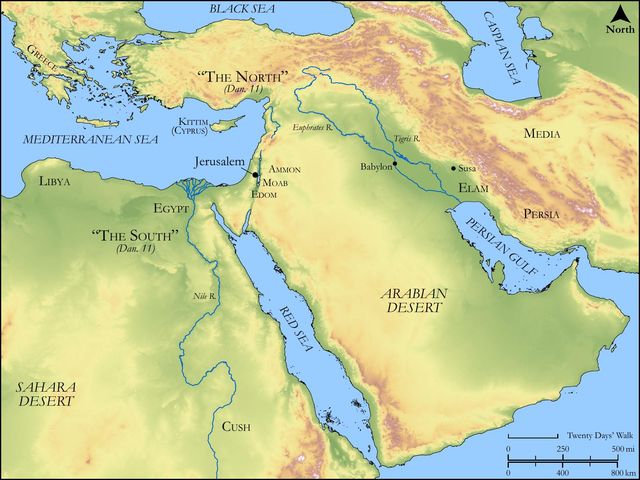
See on the biblical-era map
Study this verse
Public-domain commentary
Matthew Henry
From his Commentary on the Whole Bible. Henry comments on passages, not single verses — this entry covers Daniel 9:1–3.
We left Daniel, in the close of the foregoing chapter, employed in the king's business; but here we have him employed in better business than any king had for him, speaking to God and hearing from him, not for himself only, but for the church, whose mouth he was to God, and for whose use the oracles of God were committed to him, relating to the days of the Messiah. Observe, 1. When it was that Daniel had this communion with God (Dan 9:1), in the first year of Darius the Mede, who was newly made king of the Chaldeans, Babylon being conquered by him and his nephew, or grandson, Cyrus. In this year the seventy years of the Jews' captivity ended, but the decree for their release was not yet issued out; so that this address of Daniel's to God seems to have been ready in that year, and, probably, before he was cast into the lions' den. And one powerful inducement, perhaps, it was to him then to keep so close to the duty of prayer, though it cost him his life, that he had so lately experienced the benefit and comfort of it. 2. What occasioned his address to God by prayer (Dan 9:2): He understood by books that seventy years was the time fixed for the continuance of the desolations of Jerusalem. Dan 9:2. The book by which he understood this was the book of the prophecies of Jeremiah, in which he found it expressly foretold (Jer 29:10), After seventy years be accomplished in Babylon (and therefore they must be reckoned from the first captivity, in the third year of Jehoiakim, which Daniel had reason to remember by a good token, for it was in that captivity that he was carried away himself, Dan 1:1), I will visit you, and perform my good word towards you. It was likewise said (Jer 25:11), This whole land shall be seventy years a desolation (chorbath), the same word that Daniel here uses for the desolations of Jerusalem, which shows that he had that prophecy before him when he wrote this. Though Daniel was himself a great prophet, and one that was well acquainted with the visions of God, yet he was a diligent student in the scripture, and thought it no disparagement to him to consult Jeremiah's prophecies. He was a great politician, and prime-minister of state to one of the greatest monarchs upon earth, and yet could find both heart and time to converse with the word of God. The greatest and best men in the world must not think themselves above their Bibles. 3. How serious and solemn his address to God was when he understood that the seventy years were just upon expiring (for it appears, by Ezekiel's dating of his prophecies, that they exactly computed the years of their captivity), then he set his face to seek God by prayer. Note, God's promises are intended, not to supersede, but to excite and encourage, our prayers; and, when we see the day of the performance of them approaching, we should the more earnestly plead them with God and put them in suit. So Daniel did here; he prayed three times a day, and, no doubt, in every prayer made mention of the desolations of Jerusalem; yet he did not think that enough, but even in the midst of his business set time apart for an extraordinary application to Heaven on Jerusalem's behalf. God had said to Ezekiel that though Daniel, among others, stood before him, his intercession should not prevail to prevent the judgment (Eze 14:14), yet he hopes, now that the warfare is accomplished (Isa 40:2), his prayer may be heard for the removing of the judgment. When the day of deliverance dawns it is time for God's praying people to bestir themselves; something extraordinary is then expected and required from them, besides their daily sacrifice. Now Daniel sought by prayer and supplications, for fear lest the sins of the people should provoke him to defer their deliverance longer than was intended, or rather that the people might be prepared by the grace of God for the deliverance now that the providence of God was about to work it out for them. Now observe, (1.) The intenseness of his mind in this prayer; I set my face unto the Lord God to seek him, which denotes the fixedness of his thoughts, the firmness of his faith, and the fervour of his devout affections, in the duty. We must, in prayer, set God before us, an set ourselves as in his presence; to him we must direct our prayer and must look up. Probably, in token of his setting his face towards God, he did, as usual, set his face towards Jerusalem, to affect his own heart the more with the desolations of it. (2.) The mortification of his body in this prayer. In token of his deep humiliation before God for his own sins, and the sins of his people, and the sense he had of his unworthiness, when he prayed he fasted, put on sackcloth, and lay in ashes, the more to affect himself with the desolations of Jerusalem, which he was praying for the repair of, and to make himself sensible that he was now about an extraordinary work.
Historical interpretation
Four Centuries of Reception
3 surviving comments on this verse. Each one is dated, so this reads as a timeline rather than a list.
Select a marker to jump to its quote. Markers stagger vertically where authors wrote within a few decades of each other.
Verse 2. "I, Daniel, understood by the books the number of the years concerning which the word of the Lord had come to the prophet Jeremiah, that seventy years would be accomplished for the desolation of Jerusalem." Jeremiah had predicted seventy years for the desolation of the Temple (Jeremiah 29:1-10), at the end of which the people would again return to Judaea and build the Temple and the city of Jerusalem. But this fact did not render Daniel careless, but rather encouraged him to pray that God might through his supplications fulfil that which He had graciously promised. Thus he avoided the danger that carelessness might result in pride, and pride cause offense to the Lord. Accordingly we read in Genesis that prior to the Deluge one hundred and twenty years were appointed for men to come to repentance (Genesis 6:3); and inasmuch as they refused to repent even within so long an interval of time as a hundred years, God did not wait for the remaining twenty years to be fulfilled, but brought on the punishment earlier which He had threatened for a later time. So also Jeremiah is told, on account of the hardness of the heart of the Jewish people: "Pray not for this people, for I will not hearken unto thee" (Jeremiah 7:16). Samuel also was told: "How long wilt thou mourn over Saul? I also have rejected him" (1 Samuel 16:1). And so it was with sackcloth and ashes that Daniel besought the Lord to fulfil what He had promised, not that Daniel lacked faith concerning the future, but rather he would avoid the danger that a feeling of security might produce carelessness, and carelessness produce an offense to God.
Darius, the son of Astyages, who destroyed the Babylonian Empire with the help of his kinsmen Cyrus, was sixty-two years old when he attacked Babylon. He is called by another name by the Greeks. He took the prophet Daniel and led him into the middle of his court and feted him with every honor. Daniel himself made mention of this Darius: “In the first year of Darius.…” In his chronology, Eusebius counts thirty years from the destruction of Jerusalem to the beginning of the reign of Cyrus, king of the Persians. Julius Africanus, however, counts seventy years. Moreover, Jerome has this to say in his exposition of the prophet Daniel: “The Hebrews pass on a story of this sort up until the seventieth year, when Jeremiah had said that the captivity of the Jews would come to an end. Zechariah also speaks about this at the beginning of his book.”
When the time fixed for the captivity is completed, Daniel begins to pray for the return; indeed, he had not dared to pray [to that purpose] before that moment, in order not to press God needlessly and in order not to hear the word that had been addressed to Jeremiah: “Do not pray for this people, and do not intercede with me, for I will not hear you.” But after seeing that the sentence had been executed, he prays with fasting and sackcloth and ashes. At the same time he thought that the Jews might stay a longer time in captivity because of their sins, according to the fact that God had added thirty years to the Jews in Egypt and had reduced [the time for repentance conceded] to the generation of Noah of twenty years and of fifty in the case of the house of Ephrem. Moreover, it is not at the beginning of their fault that the sinners ask questions of the judge but after the punishment.
Continue studying Daniel 9:2 across the web’s major study libraries — every link below opens this exact verse, chapter, or book on the destination site.
Read & Compare
 BibleGatewayThis verse in more than 200 translations and 70 languages.
 Bible.comThe YouVersion reader — hundreds of translations, reading plans, and highlights.
 ESV.orgCrossway's official English Standard Version reader.
 NET BibleThe NET translation with 60,000+ translators' notes on every rendering decision.
 STEP BibleTyndale House's free study tool — original text, vocabulary, and scholarly resources.
 BibliaLogos Bible Software's free web reader.
 USCCBThe New American Bible (Revised Edition) with the U.S. bishops' study notes.
Commentaries
 BibleHub CommentariesDozens of classic commentaries on this verse, gathered on one page.
 StudyLightMore than 100 commentary sets — the largest collection on the web.
 BibleRefPlain-English commentary on what this verse means, verse by verse.
 Enduring WordDavid Guzik's free commentary on this chapter, widely used by Bible teachers.
 Bible Study ToolsVerse commentary alongside Greek and Hebrew study aids.
Original Language & Research
- BibleHub InterlinearThe verse word by word — original language, transliteration, and English.
- BibleHub LexiconEvery word's original-language definition and Strong's entry.
 Blue Letter BibleDeep-study tools — Strong's numbers, concordance, and word studies.
 SefariaThe Hebrew text with Rashi and centuries of Jewish commentary.
Sermons, Hymns & Audio


TrulyRandomVerse is not affiliated with these sites and doesn’t control their content. They’re linked because they’re genuinely useful.
Summary
Daniel 9:2 presents the prophet Daniel, in the first year of Darius the Mede's reign, diligently studying sacred texts. Through this study, he gains a profound understanding of the specific timeline for Jerusalem's desolation, recognizing that the seventy-year period prophesied by Jeremiah was nearing its completion. This realization serves as the catalyst for Daniel's subsequent prayer of confession and intercession, setting the stage for the pivotal revelation of the seventy weeks.
Context
ShowHideLiterary Context
Daniel 9:2 immediately follows the account of Babylon's fall to the Medo-Persians and the establishment of Darius the Mede's rule, marking a significant shift in world empires as foretold in earlier visions (e.g., Daniel 2). This verse transitions the narrative from prophetic visions received by Daniel to his profound engagement with existing written prophecy. It sets the stage for Daniel's extended prayer in Daniel 9:3-19 and the subsequent angelic visitation and revelation of the "seventy weeks" prophecy in Daniel 9:20-27. The verse highlights Daniel's active pursuit of understanding God's revealed will, rather than passively awaiting new revelation.
Historical & Cultural Context
The setting is approximately 539-538 BC, in Babylon, shortly after the city's conquest by Cyrus the Great, operating under the figurehead Darius the Mede (possibly a satrap or another name for Cyrus). The Jewish people had been in Babylonian exile for nearly 70 years, a period of immense suffering and longing for return to their homeland. Daniel himself was an elderly man, having served in the Babylonian court for decades. The "books" Daniel studied would have been the prophetic scrolls available to him, likely including the writings of Jeremiah, which would have been preserved and revered by the exilic community. The concept of "seventy years" was a well-known prophetic period within the Jewish consciousness, representing a divinely appointed time of judgment and purification.
Key Themes
ShowHideThis verse underscores several crucial themes. Firstly, it emphasizes Divine Revelation and Human Understanding, showcasing that God's sovereign plan is not only revealed but also intended to be understood by His people through diligent study of His Word. Daniel's "understanding by books" highlights that spiritual insight often comes through careful engagement with established scripture, as seen in Psalm 119:105. Secondly, it points to Prophetic Fulfillment and God's Sovereignty, as the nearing completion of Jeremiah's prophecy demonstrates God's faithfulness to His promises and His absolute control over the course of history, even amidst the desolation of His people and city (Isaiah 46:10). Finally, the verse highlights the Importance of Scripture as the primary means by which God communicates His will and timing, inspiring faithful response and intercession, much like the Bereans who "examined the Scriptures daily" in Acts 17:11.
Exposition and Analysis
ShowHideKey Word Analysis
ShowHideFrom the Hebrew words meaning "judge" and "God," signifying "God is my judge" or "Judge of God." This name is highly significant as it reflects the character and role of the prophet himself. Daniel, throughout his life, stood as a faithful witness and interpreter of God's judgment and righteous decrees, even in a pagan court. Here, he acts as one who discerns God's judgment and timing through diligent study.
This term refers to "writings," "scrolls," or "documents." It explicitly indicates that Daniel's understanding was not a new, direct revelation or vision at this moment, but rather a profound insight gained from a careful and scholarly examination of existing written prophecies. This emphasizes the authority and sufficiency of God's written Word as a source of divine truth and understanding for His people.
Derived from a root meaning "drought" or "dryness," this word signifies "desolation," "destruction," or a "waste place." It vividly describes the ruined state of Jerusalem and the temple following the Babylonian conquest. The use of this term underscores the severity of God's judgment upon His people for their disobedience, yet it also sets the stage for the promised restoration, as the period of desolation was divinely appointed and finite.
Verse Breakdown
ShowHide"In the first year of his reign"
This temporal marker precisely dates Daniel's realization to the initial period of Darius the Mede's rule, placing it around 539-538 BC, shortly after the fall of Babylon. This specific timing is crucial as it indicates the nearing completion of the seventy-year exile, prompting Daniel's urgent inquiry.
"I Daniel understood by books the number of the years"
This clause reveals Daniel's active engagement with scripture. The phrase "understood by books" (Hebrew: bi'sfarim) indicates that his comprehension came from a diligent study of written prophecies, not a new vision. He was discerning a specific numerical period—"the number of the years"—which refers to the duration of Jerusalem's desolation. This highlights the importance of intellectual and spiritual engagement with God's revealed Word.
"whereof the word of the LORD came to Jeremiah the prophet"
This identifies the precise source of Daniel's understanding: the prophetic writings of Jeremiah. It confirms the intertextual nature of Daniel's study, linking his current understanding directly to previous divine revelation given through another prophet. This emphasizes the unity and continuity of God's prophetic message throughout history.
"that he would accomplish seventy years in the desolations of Jerusalem"
This final clause specifies the content of Jeremiah's prophecy that Daniel understood: a divinely decreed period of "seventy years" for Jerusalem's "desolations." This refers to the period of the Babylonian captivity and the ruined state of the city and temple, a consequence of Judah's sin and a fulfillment of God's judgment. Daniel's understanding that this period was to "accomplish" (or "be completed") signaled that the time for restoration was at hand.
Literary Devices
ShowHideDaniel 9:2 is rich in literary devices that enhance its theological significance. Intertextuality is prominent, as Daniel explicitly references and engages with the prophecy of Jeremiah, demonstrating the interconnectedness of biblical revelation and the importance of studying the whole counsel of God. This verse also employs Foreshadowing, as Daniel's understanding of the seventy years of desolation directly precedes and sets the stage for the much larger and more complex "seventy weeks" prophecy in the latter part of the chapter, which extends God's redemptive timeline far beyond the immediate return from exile. Furthermore, there is an element of Divine Sovereignty conveyed through the precise numerical prophecy and its nearing fulfillment, emphasizing God's meticulous control over historical events and His faithfulness to His word, even in judgment.
Theological and Thematic Connections
ShowHideDaniel 9:2 serves as a profound theological anchor, demonstrating God's meticulous sovereignty over history and His faithfulness to His prophetic word. Daniel's diligent study and subsequent understanding of Jeremiah's prophecy highlight that God's plans are not arbitrary but are revealed and can be comprehended by those who diligently seek Him in His Word. This verse underscores the principle that divine revelation often builds upon prior revelation, with later prophets and believers gaining insight into the unfolding of God's eternal purposes. The completion of the seventy years of desolation signifies the end of a specific period of judgment and the impending dawn of restoration, revealing God's ultimate desire to bless and restore His people, even after severe discipline. This understanding then compels Daniel into a deep prayer of confession and intercession, illustrating the proper human response to discerning God's will and timing.
Reflection and Application
ShowHideDaniel 9:2 offers a powerful model for believers today. In an age of information overload and spiritual distraction, Daniel's example calls us to a disciplined and prayerful engagement with God's written Word. His "understanding by books" reminds us that profound spiritual insight often comes not from dramatic visions, but from diligent, persistent study of the Scriptures. This deep dive into God's truth should lead, as it did for Daniel, to a clearer understanding of God's character, His purposes, and His timing. Such understanding should then prompt us to prayer, confession, and intercession for our communities and the world, aligning our hearts with God's will. Just as Daniel recognized the nearing fulfillment of a specific prophecy, we too are called to discern the signs of the times through the lens of Scripture, living with hope and urgency in light of God's ultimate redemptive plan. Our study should not be merely academic but transformative, leading to a deeper walk with God and a more fervent pursuit of His kingdom.
Questions for Reflection
ShowHideFAQ
ShowHideWhat "books" did Daniel study to understand the prophecy?
ShowHideWhile the text doesn't specify every book, it explicitly states that Daniel understood "whereof the word of the LORD came to Jeremiah the prophet." This strongly indicates that Daniel was studying the prophetic scrolls of Jeremiah, particularly passages like Jeremiah 25:11-12 and Jeremiah 29:10, which clearly foretold the seventy-year period of Babylonian captivity and Jerusalem's desolation. This suggests that the prophetic writings of Jeremiah were preserved and accessible to the exilic community in Babylon.
Christ-Centered Fulfillment
ShowHideDaniel's understanding of the seventy years of desolation and the impending restoration of Jerusalem, while significant for Israel's immediate future, ultimately points to a far greater and more profound fulfillment in Jesus Christ. The end of the physical exile and the return to the land foreshadow the spiritual liberation from the bondage of sin and death that Christ accomplishes for all who believe, as declared in John 8:36. The "desolations of Jerusalem" find their ultimate resolution not merely in a rebuilt city, but in the New Jerusalem, the heavenly city of God, where Christ reigns eternally and where there will be no more sorrow or death, as vividly described in Revelation 21:1-4). Jesus himself is the ultimate "Word of the LORD" (John 1:1,14), the one through whom God speaks His final and most complete revelation, fulfilling all the Law and the Prophets (Matthew 5:17). Daniel's diligent study of the written word to understand God's plan prefigures the Christian's reliance on the inspired Scriptures to comprehend the person and work of Christ, who is the culmination and fulfillment of all God's promises and prophetic timelines (Luke 24:44).