


Jeremiah 25:12
Bible text: King James Version (1769 Blayney text) · Public domain
Bible text: King James Version with Strong's numbers · Public domain
Bible text: Berean Standard Bible · Public domain
Bible text: American Standard Version (1901) · Public domain
Bible text: World English Bible, Messianic edition · Public domain
Bible text: Geneva Bible (1599) · Public domain
Bible text: Young's Literal Translation · Public domain
- וְהָיָהve·ha·Yahand it will beH1961Conj-w ¦ V-Qal-ConsecPerf-3msVerb Qal Consecutive Perfect 3rd Singular Masculineוְandהָיָהit will be
- כִמְלֹאותkhim·Lotwhen are completedH4390Prep-k ¦ V-Qal-InfVerb Qal Infinitive Constructכִwhenמְלֹאותare completed
- שִׁבְעִיםshiv·'ImseventyH7657Adj-mpAdjective Numerical Plural Masculine Absolute
- שָׁנָהsha·Nahyear[s]H8141N-fsNoun Singular Feminine Absolute
- אֶפְקֹד'ef·KodI will visit [judgment]H6485V-Qal-Imperf-1csVerb Qal Imperfect 1st Singular common gender
- עַל'alonH5921PrepPreposition
- מֶלֶךְMe·lekh[the] king ofH4428N-mscNoun Singular Masculine Construct
- בָּבֶלba·VelBabylonH894N-properNoun Proper Location
- וְעַלve·'aland onH5921Conj-w ¦ PrepPrepositionוְandעַלon
- הַגּוֹיha·Goythe nationH1471Art ¦ N-msNoun Singular Masculine Absoluteהַtheגּוֹיnation
- הַהוּאha·Hu'<the> thatH1931Art ¦ Pro-3msPronoun Personal 3rd Singular Masculineהַ<the>הוּאthat
- נְאֻםne·'um[the] utterance ofH5002N-mscNoun Singular Masculine Construct
- יְהוָהYah·wehYahwehH3068N-properNoun Proper Title
- אֶת'et<obj.>H853DirObjMParticle Object Indicator
- עֲוֹנָם'a·vo·Namtheir iniquityH5771N-msc ¦ 3mpNoun Singular Masculine Constructעֲוֹנָiniquityםtheir
- וְעַלve·'aland onH5921Conj-w ¦ PrepPrepositionוְandעַלon
- אֶרֶץ'E·retz[the] land ofH776N-fscNoun Singular Feminine Construct
- כַּשְׂדִּיםkas·Dim[the] ChaldeansH3778N-properNoun Proper Location
- וְשַׂמְתִּיve·sam·Tiand I will makeH7760Conj-w ¦ V-Qal-ConsecPerf-1csVerb Qal Consecutive Perfect 1st Singular common genderוְandשַׂמְתִּיI will make
- אֹתוֹ'o·To<obj.> itH853DirObjM ¦ 3msParticle Object Indicatorאֹת<obj.>וֹit
- לְשִׁמְמוֹתle·shi·Motinto desolations ofH8077Prep-l ¦ N-fpcNoun Plural Feminine Constructלְintoשִׁמְמוֹתdesolations of
- עוֹלָםo·LamperpetuityH5769N-msNoun Singular Masculine Absolute
English is a literal word-by-word gloss of the Hebrew, not the KJV's wording. Why?
This is the original text the KJV's translators worked from — each Hebrew word with its own literal English meaning in this verse, prepared by scholars at Tyndale House, Cambridge. The KJV translates whole sentences, not word by word, so its wording differs: one Hebrew word can become several English words, and the KJV may choose “the LORD” where the gloss reads “Yahweh”. Both are faithful — they answer different questions. For the KJV's own rendering, switch to the KJV text.
Details
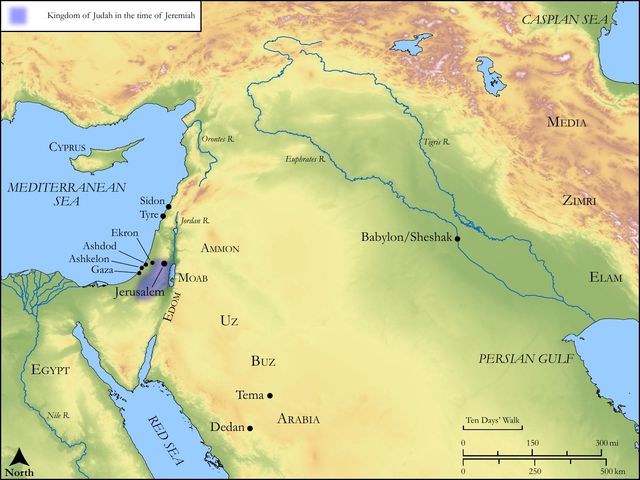
See on the biblical-era map
Study this verse
Public-domain commentary
Matthew Henry
From his Commentary on the Whole Bible. Henry comments on passages, not single verses — this entry covers Jeremiah 25:8–14. His two-level outline is real structure in the source text, so it is rendered as structure.
Here is the sentence grounded upon the foregoing charge: "Because you have not heard my words, I must take another course with you," Jer 25:8. Note, When men will not regard the judgments of God's mouth they may expect to feel the judgments of his hands, to hear the rod, since they would not hear the word; for the sinner must either be parted from his sin or perish in it. Wrath comes without remedy against those only that sin without repentance. It is not so much men's turning aside that ruins them as their not returning.
I.The ruin of the land of Judah by the king of Babylon's armies is here decreed, Jer 25:9.
God sent to them his servants the prophets, and they were not heeded, and therefore God will send for his servant the king of Babylon, whom they cannot mock, and despise, and persecute, as they did his servants the prophets. Note, The messengers of God's wrath will be sent against those that would not receive the messengers of his mercy. One way or other God will be heeded, and will make men know that he is the Lord. Nebuchadrezzar, though a stranger to the true God, the God of Israel, nay, an enemy to him and afterwards a rival with him, was yet, in the descent he made upon his country. God's servant, accomplished his purpose, was employed by him, and was an instrument in his hand for the correction of his people. He was really serving God's designs when he thought he was serving his own ends. Justly therefore does God here call himself The Lord of hosts (Jer 25:8), for here is an instance of his sovereign dominion, not only over the inhabitants, but over the armies of this earth, of which he makes what use he pleases. He has them all at his command. The most potent and absolute monarchs are his servants. Nebuchadrezzar, who is an instrument of his wrath, is as truly his servant as Cyrus, who is an instrument of his mercy. The land of Judah being to be made desolate, God here musters his army that is to make it so, gathers it together, takes all the families of the north, if there be occasion for them, leads them on as their commander-in-chief, brings them against this land, gives them success, not only against Judah and Jerusalem, but against all the nations round about, that there might be no dependence upon them as allies or assistants against that threatening force. The utter destruction of this and all the neighbouring lands is here described, Jer 25:9-11. It shall be total: The whole land shall be a desolation, not only desolate, but a desolation itself; both city and country shall be laid waste, and all the wealth of both be made a prey of. It shall be lasting, even perpetual desolations; they shall continue so long in ruins, and after long waiting there shall appear so little prospect of relief, that every one shall call it perpetual. This desolation shall be the ruin of their credit among their neighbours; it shall bury their honour in the dust, shall make them an astonishment and a hissing; every one will be amazed at them, and hiss them off the stage of action with just disgrace for deserting a God who would have been their protection for impostors who would certainly be their destruction. It will likewise be the ruin of all their comfort among themselves; it shall be a final period of all their joy: I will take from them the voice of mirth, hang their harps on the willow-trees, and put them out of tune for songs. I will take from them the voice of mirth; they shall neither have cause for it nor hearts for it. They would not hear the voice of God's word and therefore the voice of mirth shall no more be heard among them. They shall be deprived of food: The sound of the mill-stones shall not be heard; for, when the enemy has seized their stores, the sound of the grinding must needs be low, Ecc 12:4. An end shall be put to all business; there shall not be seen the light of a candle, for there shall be no work to be done worth candle-light. And, lastly, they shall be deprived of their liberty: Those nations shall serve the king of Babylon seventy years. The fixing of time during which the captivity should last would be of great use, not only for the confirmation of the prophecy, when the event (which in this particular could by no human sagacity be foreseen) should exactly answer the prediction, but for the comfort of the people of God in their calamity and the encouragement of faith and prayer. Daniel, who was himself a prophet, had an eye to it, Dan 9:2. Nay, God himself had an eye to it (Ch2 36:22); for therefore he stirred up the spirit of Cyrus, that the word spoken by the mouth of Jeremiah might be accomplished. Known unto God are all his works from the beginning of the world, which appears by this, that, when he has thought fit, some of them have been made known to his servants the prophets and by them to his church.
II.The ruin of Babylon, at last, is here likewise foretold, as it had been, long before, by Isaiah, Jer 25:12-14.
The destroyers must themselves be destroyed, and the rod thrown into the fire, when the correcting work is done with it. This shall be done when seventy years are accomplished; for the destruction of Babylon must make way for the deliverance of the captives. It is a great doubt when these seventy years commence; some date them from the captivity in the fourth year of Jehoiakim and first of Nebuchadrezzar, others from the captivity of Jehoiachin eight years after. I rather incline to the former, because then these nations began to serve the king of Babylon, and because usually God has taken the earliest time from which to reckon the accomplishment of a promise of mercy, as will appear in computing the 400 years' servitude in Egypt. And, if so, eighteen or nineteen years of the seventy had run out before Jerusalem and the temple were quite destroyed in the eleventh year of Zedekiah. However that be, when the time, the set time, to favour Zion, has come, the king of Babylon must be visited, and all the instances of his tyranny reckoned for; then that nation shall be punished for their iniquity, as the other nations have been punished for theirs. That land must then be a perpetual desolation, such as they had made other lands; for the Judge of all the earth will both do right and avenge wrong, as King of nations and King of saints. Let proud conquerors and oppressors be moderate in the use of their power and success, for it will come at last to their own turn to suffer; their day will come to fall. In this destruction of Babylon, which was to be brought about by the Medes and Persians, reference shall be had,
1.To what God had said: I will bring upon that land all my words; for all the wealth and honour of Babylon shall be sacrificed to the truth of the divine predictions, and all its power broken, rather than one iota or tittle of God's word shall fall to the ground. The same Jeremiah that prophesied the destruction of other nations by the Chaldeans foretold also the destruction of the Chaldeans themselves; and this must be brought upon them, Jer 25:13. It is with reference to this very event that God says, I will confirm the word of my servant, and perform the counsel of my messengers, Isa 44:26.
2.Two what they had done (Jer 25:14): I will recompense them according to their deeds, by which they transgressed the law of God, even then when they were made to serve his purposes. They had made many nations to serve them, and trampled upon them with the greatest insolence imaginable; but not that the measure of their iniquity is full many nations and great kings, that are in alliance with and come in to the assistance of Cyrus king of Persia, shall serve themselves of them also, shall make themselves masters of their country, enrich themselves with their spoils, and make them the footstool by which to mount the throne of universal monarchy. They shall make use of them for servants and soldiers. He that leads into captivity shall go into captivity.
Historical interpretation
Historical reception
2 surviving comments on this verse. Each one is dated, so this reads as a timeline rather than a list.
Select a marker to jump to its quote. Markers stagger vertically where authors wrote within a few decades of each other.
Israel … killed those who were sent, and not even before the Lord of the vineyard were they ashamed, but even he was slain by them. Truly, when he came and found no fruit in them, he cursed them through the fig tree, saying, “From now on, let there be no fruit from you.” The fig tree was dead and fruitless so that even the disciples wondered when it withered away. Then was fulfilled that which was spoken by the prophet: “I will take away from them the voice of joy and the voice of gladness, the voice of the bridegroom and the voice of the bride, the scent of myrrh and the light of a lamp, and the whole land shall be destroyed.” For the whole service of the law has been abolished from them, and from now on and forever they remain without a feast.
(Verse 11 and following) And these nations will serve the king of Babylon for seventy years. And when seventy years have been completed, I will punish the king of Babylon and that nation, says the Lord, for their iniquities, and the land of the Chaldeans, and I will make it an eternal wasteland. And I will bring upon that land all my words that I have spoken against it, all that is written in this book, which Jeremiah prophesied against all the nations. Just as Jerusalem, after seventy years, received back its former inhabitants and, having completed its punishments because it obeyed the command of God, now enjoys its former happiness; so the king of Babylon, who was lifted up in pride and trusted in his own strength, because he reigned among the nations and not according to the will of the Lord, will be destroyed when the Medes and Persians come. Ultimately, only the remains of the city of Babylon exist to this day. And the Lord placed her in everlasting solitude, and fulfilled all the words that are contained in the volume of this very prophet. For in the following, the sermon of Jeremiah describes the evils that Babylon is to suffer.
Continue studying Jeremiah 25:12 across the web’s major study libraries — every link below opens this exact verse, chapter, or book on the destination site.
Read & Compare
 BibleGatewayThis verse in more than 200 translations and 70 languages.
 Bible.comThe YouVersion reader — hundreds of translations, reading plans, and highlights.
 ESV.orgCrossway's official English Standard Version reader.
 NET BibleThe NET translation with 60,000+ translators' notes on every rendering decision.
 STEP BibleTyndale House's free study tool — original text, vocabulary, and scholarly resources.
 BibliaLogos Bible Software's free web reader.
 USCCBThe New American Bible (Revised Edition) with the U.S. bishops' study notes.
Commentaries
 BibleHub CommentariesDozens of classic commentaries on this verse, gathered on one page.
 StudyLightMore than 100 commentary sets — the largest collection on the web.
 BibleRefPlain-English commentary on what this verse means, verse by verse.
 Enduring WordDavid Guzik's free commentary on this chapter, widely used by Bible teachers.
 Bible Study ToolsVerse commentary alongside Greek and Hebrew study aids.
Original Language & Research
- BibleHub InterlinearThe verse word by word — original language, transliteration, and English.
- BibleHub LexiconEvery word's original-language definition and Strong's entry.
 Blue Letter BibleDeep-study tools — Strong's numbers, concordance, and word studies.
 SefariaThe Hebrew text with Rashi and centuries of Jewish commentary.
Sermons, Hymns & Audio


TrulyRandomVerse is not affiliated with these sites and doesn’t control their content. They’re linked because they’re genuinely useful.
Summary
Jeremiah 25:12 stands as a powerful divine decree, announcing God's precise and decisive judgment against the mighty Babylonian Empire and the land of the Chaldeans. This prophecy declares that once Judah's seventy-year period of captivity and servitude is complete, the Lord will hold Babylon accountable for its own profound iniquity, culminating in its utter and perpetual desolation. The verse underscores God's absolute sovereignty over all nations, demonstrating that even those He uses as instruments of His will are not exempt from His righteous justice and that His divine timeline for both judgment and restoration is unfailingly precise.
Context
ShowHideLiterary Context
Jeremiah 25:12 is a pivotal declaration embedded within a broader prophetic oracle concerning God's universal judgment. Immediately preceding this verse, Jeremiah 25:11 explicitly foretells Judah's seventy-year servitude to the king of Babylon, a period of divine discipline for their persistent disobedience and idolatry. Verse 12 then dramatically shifts the prophetic focus, revealing that the very nation God employed as His instrument of judgment—Babylon—will itself face a commensurate and devastating reckoning. This sequential prophecy highlights a crucial theological principle: God's sovereignty extends over all nations, and no empire, however formidable, operates outside His ultimate control. The wider context of Jeremiah 25 details the "cup of wrath" that Judah, and subsequently numerous surrounding nations, including Babylon, are destined to drink, culminating in a sweeping judgment upon the earth.
Historical & Cultural Context
The prophecy articulated in Jeremiah 25 was delivered in the fourth year of Jehoiakim, king of Judah (circa 605 BC). This period marked a critical turning point in the politics of the nations, specifically the Battle of Carchemish, where Nebuchadnezzar's Babylonian forces decisively defeated Egypt, solidifying Babylon's ascendancy as the dominant regional power. Judah, strategically positioned between these empires, became tributary to Babylon. The "seventy years" mentioned refers to the divinely appointed duration of Judah's exile, commencing with Nebuchadnezzar's first deportation of Jews in 605 BC and concluding with Cyrus the Great's decree allowing their return in 538 BC. While the precise duration is closer to 67-68 years, "seventy" often served as a round, symbolic number in prophetic language, signifying a complete and definite period. The Chaldeans were the ruling dynasty of the Neo-Babylonian Empire, renowned for their military might, advanced civilization, and pervasive idolatry. Their capital, Babylon, was an architectural marvel and a symbol of human pride and imperial grandeur, making the prophesied "perpetual desolations" a particularly shocking and profound declaration to its contemporary audience.
Key Themes
ShowHideThis verse profoundly contributes to several overarching themes prevalent in the book of Jeremiah and the broader prophetic literature. Firstly, it powerfully asserts Divine Sovereignty, demonstrating that God is the ultimate orchestrator of history, raising up and bringing down empires according to His perfect timing and purpose, as vividly depicted in Daniel 2:21. Secondly, it underscores Divine Justice and Retribution, affirming that God's judgment is never arbitrary but is a righteous and inevitable response to "iniquity." Even nations used by God for His purposes are not exempt from accountability for their own sin, particularly their pride, cruelty, and idolatry. Thirdly, the precise prophecy of the "seventy years" and the subsequent judgment on Babylon provides a profound message of Hope and Assurance for the exiled people of Judah, guaranteeing that their suffering has a definite end and that their oppressors will face consequences. This reinforces God's unwavering faithfulness to His covenant promises, a theme later elaborated in Jeremiah 29:10.
Exposition and Analysis
ShowHideKey Word Analysis
ShowHideThis verb, derived from H4390, signifies "to fill" or "to be full of," conveying the sense of completion, fulfillment, or expiration. In this context, it precisely denotes the divinely ordained end of the seventy-year period of Judah's servitude. The word implies that this duration is not arbitrary but a set, full measure of time that must run its course before the next phase of God's redemptive plan unfolds. It powerfully conveys a sense of divine precision and certainty in the unfolding of prophetic events.
This versatile root carries a broad semantic range including "to visit," "to oversee," or "to care for." While it can imply a benevolent visitation, here it unequivocally denotes a hostile visitation, an act of judgment, or retribution. God will "visit" Babylon not to bless, but to hold them accountable for their "iniquity," to exact a penalty, and to bring about their downfall. This word emphasizes God's active, personal, and just involvement in administering consequences.
This noun, H5771, refers to perversity, moral evil, guilt, and the punishment resulting from such wrongdoing. It describes not merely a mistake, but a deliberate twisting or deviation from God's righteous standard. Babylon's "iniquity" encompasses its pervasive idolatry, its oppressive and cruel treatment of conquered peoples (including Judah), and its arrogant defiance of the one true God. The judgment is therefore not arbitrary, but a just and necessary consequence of their deep-seated moral corruption and rebellion against divine standards.
Verse Breakdown
ShowHide"And it shall come to pass, when seventy years are accomplished,"
This opening clause establishes the precise divine timeline for the momentous events to follow. The "seventy years" refers to the divinely appointed duration of Judah's Babylonian exile, a period specifically ordained for their discipline and purification. The phrase "are accomplished" emphasizes the certainty and completion of this period, signaling a decisive turning point in God's redemptive history and the fulfillment of His prophetic word.
"that I will punish the king of Babylon, and that nation,"
Here, the prophetic focus shifts from Judah's captivity to Babylon's impending judgment. The emphatic "I will punish" highlights God's direct and personal agency in this act of retribution, underscoring His sovereign will. The judgment is directed specifically at "the king of Babylon," representing the head and embodiment of the empire, and "that nation," encompassing the entire Babylonian people, signifying a comprehensive and devastating divine decree against them.
"saith the LORD, for their iniquity,"
This parenthetical phrase, "saith the LORD," serves as a divine authentication of the prophecy, underscoring its absolute authority and certainty. It confirms that this is not merely Jeremiah's human prediction but a direct, infallible oracle from Yahweh, the covenant God. The explicit reason for Babylon's punishment is then stated: "for their iniquity," emphasizing that God's judgment is always righteous, just, and provoked by specific moral failings, not arbitrary whim.
"and the land of the Chaldeans, and will make it perpetual desolations."
This final clause specifies the full extent and severe nature of the impending judgment. The punishment extends beyond the king and the nation to the very "land of the Chaldeans," indicating a geographical and environmental devastation. The phrase "perpetual desolations" signifies a complete, lasting, and irreversible ruin, a state of utter waste and uninhabited wilderness, serving as a stark and enduring monument to God's justice against a proud and wicked empire.
Literary Devices
ShowHideJeremiah 25:12 employs several potent literary devices to convey its message with profound impact. Divine Pronouncement is central, marked by the authoritative phrase "saith the LORD," which imbues the prophecy with undeniable divine authority and certainty, indicating that this is an infallible word from the sovereign God. The precise specification of "seventy years" functions as a form of Prophetic Precision, lending significant credibility to the divine foreknowledge and meticulous control over historical events. The declaration of "perpetual desolations" is a powerful use of Hyperbole to emphasize the totality, permanence, and lasting nature of Babylon's destruction, though it also reflects a grim historical reality as the once-mighty city eventually became a desolate ruin. Furthermore, there is a profound element of Irony at play: Babylon, chosen by God as His instrument of judgment against Judah, now faces judgment itself. This demonstrates that God's sovereignty extends even to those who unwittingly serve His purposes, holding them fully accountable for their own moral failings and injustices.
Theological and Thematic Connections
ShowHideJeremiah 25:12 is a profound testament to God's unwavering justice, His absolute sovereignty over all nations, and His faithfulness to His covenant promises. It reveals that while God may use wicked nations as instruments for His disciplinary purposes, as seen with Isaiah 10:5-7 or Babylon, He never condones their sin. Instead, He holds them fully accountable for their own pride, cruelty, and idolatry, ensuring that ultimate justice will prevail. This principle offers deep reassurance to believers that no injustice goes unnoticed by God and that even the most formidable earthly powers are subject to His divine timeline and judgment. The specific mention of "seventy years" also underscores God's meticulous control over history, providing a beacon of hope for the oppressed, knowing that their suffering has a divinely appointed end and that His promises will be fulfilled.
Reflection and Application
ShowHideJeremiah 25:12 offers both profound reassurance and a sobering warning for all generations. For those who feel overwhelmed by the apparent power of oppressive practices or who witness widespread injustice, this verse serves as a powerful reminder that God is ultimately in control. No nation, no ruler, and no human system, however mighty or seemingly invincible, operates outside the purview of His divine justice. God has a precise timeline for all things, and His promises of judgment against wickedness and restoration for His people will inevitably be fulfilled. This truth should inspire patient endurance, unwavering faith in God's perfect timing, and a deep sense of peace in His sovereign plan. Conversely, the judgment on Babylon serves as a stark warning against national pride, unchecked power, and the accumulation of "iniquity." It calls individuals and nations alike to humility, repentance, and adherence to God's moral standards, for accountability before Him is certain and inescapable. Ultimately, this prophecy invites us to align our lives, our hopes, and our actions with the eternal purposes of the sovereign Lord, trusting in His righteous character and His ultimate triumph over all evil.
Questions for Reflection
ShowHideFAQ
ShowHideWhat is the significance of the "seventy years" mentioned in this verse?
ShowHideThe "seventy years" refers to the divinely appointed duration of Judah's Babylonian exile and servitude, as first declared in Jeremiah 25:11. This period was a disciplinary measure for Judah's persistent sin, idolatry, and failure to observe the Sabbath rest for the land. Jeremiah 25:12 then prophesies that once this period of judgment on Judah is "accomplished," God will turn His attention to Babylon, the very nation He used as His instrument, and punish them for their own "iniquity." This specific timeframe underscores God's precise control over historical events and His commitment to both discipline and ultimate restoration. The prophecy was fulfilled as the Babylonian Empire fell to the Medes and Persians in 539 BC, roughly 70 years after Nebuchadnezzar's first deportation of Jews in 605 BC, leading to the Jews' return to their homeland as promised in Jeremiah 29:10.
Christ-Centered Fulfillment
ShowHideJeremiah 25:12, with its declaration of divine judgment upon Babylon after a set period, finds its ultimate Christ-centered fulfillment in the broader narrative of God's sovereign control over history and His final, decisive victory over all evil. Just as God precisely timed the seventy years of Judah's exile and Babylon's subsequent fall, so too did He orchestrate the perfect timing of Christ's advent, His atoning death, and His glorious resurrection, fulfilling prophecies concerning the Lamb of God who takes away the sin of the world. The "iniquity" of Babylon, which brought about its desolation, foreshadows the universal human condition of sin, which only Christ's perfect sacrifice could address, offering forgiveness and reconciliation rather than perpetual desolation for those who believe (Romans 5:8). Furthermore, the "perpetual desolations" pronounced upon earthly Babylon point to the ultimate and eternal judgment that awaits all unrighteousness and rebellion against God, culminating in the final, symbolic destruction of "Babylon the Great" in the book of Revelation (Revelation 18:21). Yet, in Christ, God's people are not destined for desolation but for an eternal kingdom, a new heaven and a new earth where righteousness dwells (2 Peter 3:13), established by the King of Kings, whose dominion is everlasting and whose justice is perfectly executed in grace and truth (Revelation 19:16).