


Jeremiah 25:13
Bible text: King James Version (1769 Blayney text) · Public domain
Bible text: King James Version with Strong's numbers · Public domain
Bible text: Berean Standard Bible · Public domain
Bible text: American Standard Version (1901) · Public domain
Bible text: World English Bible, Messianic edition · Public domain
Bible text: Geneva Bible (1599) · Public domain
Bible text: Young's Literal Translation · Public domain
- וְהֵבֵאתִיve·he·ve·tiand I will bringH935Conj-w ¦ V-Hiphil-ConsecPerf-1csVerb Hiphil Consecutive Perfect 1st Singular common genderוְandהֵבֵאתִיI will bring
- עַל'alonH5921PrepPreposition
- הָאָרֶץha·'A·retzthe landH776Art ¦ N-fsNoun Singular Feminine Absoluteהָtheאָרֶץland
- הַהִיאha·Hi'<the> thatH1931Art ¦ Pro-3fsPronoun Personal 3rd Singular Feminineהַ<the>הִיאthat
- אֶת'et<obj.>H853DirObjMParticle Object Indicator
- כָּלkolallH3605N-mscNoun Singular Masculine Construct
- דְּבָרַיde·va·Raimy wordsH1697N-mpc ¦ 1csNoun Plural Masculine Constructדְּבָרַwordsיmy
- אֲשֶׁר'a·SherwhichH834RelParticle Relative
- דִּבַּרְתִּיdi·Bar·tiI spokeH1696V-Piel-Perf-1csVerb Piel Perfect 1st Singular common gender
- עָלֶיהָ'a·Lei·haon itH5921Prep ¦ 3fsPreposition Definiteעָלֶיonהָit
- אֵת'et<obj.>H853DirObjMParticle Object Indicator
- כָּלkoleveryH3605N-mscNoun Singular Masculine Construct
- הַכָּתוּבha·ka·Tuv<the> [thing] writtenH3789Art ¦ V-Qal-PassPrtcpl-msVerb Qal Participle Passive Singular Masculine Absoluteהַ<the>כָּתוּב[thing] written
- בַּסֵּפֶרba·Se·ferin the bookH5612Prep-b ¦ N-msNoun Singular Masculine Absoluteבַּin theסֵּפֶרbook
- הַזֶּהha·Zeh<the> thisH2088Art ¦ PrtParticle Demonstrativeהַ<the>זֶּהthis
- אֲשֶׁר'a·SherwhichH834RelParticle Relative
- נִבָּאni·Ba'he prophesiedH5012V-Niphal-Perf-3msVerb Niphal Perfect 3rd Singular Masculine
- יִרְמְיָהוּyir·me·Ya·huJeremiahH3414N-proper-mNoun Proper Masculine
- עַל'alonH5921PrepPreposition
- כָּלkolallH3605N-mscNoun Singular Masculine Construct
- הַגּוֹיִםha·go·Yimthe nationsH1471Art ¦ N-mpNoun Plural Masculine Absoluteהַtheגּוֹיִםnations
English is a literal word-by-word gloss of the Hebrew, not the KJV's wording. Why?
This is the original text the KJV's translators worked from — each Hebrew word with its own literal English meaning in this verse, prepared by scholars at Tyndale House, Cambridge. The KJV translates whole sentences, not word by word, so its wording differs: one Hebrew word can become several English words, and the KJV may choose “the LORD” where the gloss reads “Yahweh”. Both are faithful — they answer different questions. For the KJV's own rendering, switch to the KJV text.
Details
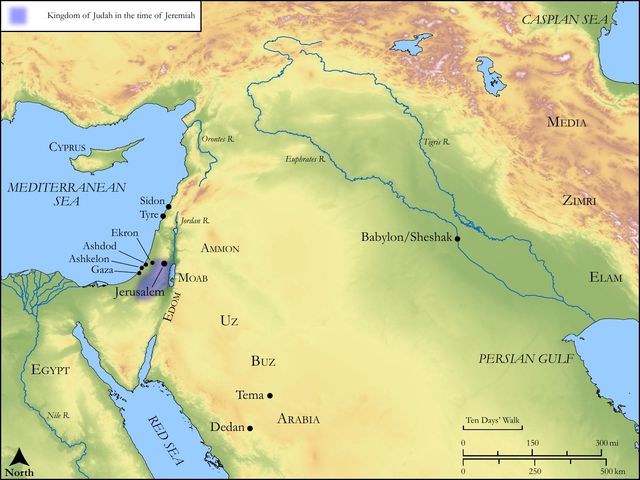
See on the biblical-era map
Study this verse
Public-domain commentary
Matthew Henry
From his Commentary on the Whole Bible. Henry comments on passages, not single verses — this entry covers Jeremiah 25:8–14. His two-level outline is real structure in the source text, so it is rendered as structure.
Here is the sentence grounded upon the foregoing charge: "Because you have not heard my words, I must take another course with you," Jer 25:8. Note, When men will not regard the judgments of God's mouth they may expect to feel the judgments of his hands, to hear the rod, since they would not hear the word; for the sinner must either be parted from his sin or perish in it. Wrath comes without remedy against those only that sin without repentance. It is not so much men's turning aside that ruins them as their not returning.
I.The ruin of the land of Judah by the king of Babylon's armies is here decreed, Jer 25:9.
God sent to them his servants the prophets, and they were not heeded, and therefore God will send for his servant the king of Babylon, whom they cannot mock, and despise, and persecute, as they did his servants the prophets. Note, The messengers of God's wrath will be sent against those that would not receive the messengers of his mercy. One way or other God will be heeded, and will make men know that he is the Lord. Nebuchadrezzar, though a stranger to the true God, the God of Israel, nay, an enemy to him and afterwards a rival with him, was yet, in the descent he made upon his country. God's servant, accomplished his purpose, was employed by him, and was an instrument in his hand for the correction of his people. He was really serving God's designs when he thought he was serving his own ends. Justly therefore does God here call himself The Lord of hosts (Jer 25:8), for here is an instance of his sovereign dominion, not only over the inhabitants, but over the armies of this earth, of which he makes what use he pleases. He has them all at his command. The most potent and absolute monarchs are his servants. Nebuchadrezzar, who is an instrument of his wrath, is as truly his servant as Cyrus, who is an instrument of his mercy. The land of Judah being to be made desolate, God here musters his army that is to make it so, gathers it together, takes all the families of the north, if there be occasion for them, leads them on as their commander-in-chief, brings them against this land, gives them success, not only against Judah and Jerusalem, but against all the nations round about, that there might be no dependence upon them as allies or assistants against that threatening force. The utter destruction of this and all the neighbouring lands is here described, Jer 25:9-11. It shall be total: The whole land shall be a desolation, not only desolate, but a desolation itself; both city and country shall be laid waste, and all the wealth of both be made a prey of. It shall be lasting, even perpetual desolations; they shall continue so long in ruins, and after long waiting there shall appear so little prospect of relief, that every one shall call it perpetual. This desolation shall be the ruin of their credit among their neighbours; it shall bury their honour in the dust, shall make them an astonishment and a hissing; every one will be amazed at them, and hiss them off the stage of action with just disgrace for deserting a God who would have been their protection for impostors who would certainly be their destruction. It will likewise be the ruin of all their comfort among themselves; it shall be a final period of all their joy: I will take from them the voice of mirth, hang their harps on the willow-trees, and put them out of tune for songs. I will take from them the voice of mirth; they shall neither have cause for it nor hearts for it. They would not hear the voice of God's word and therefore the voice of mirth shall no more be heard among them. They shall be deprived of food: The sound of the mill-stones shall not be heard; for, when the enemy has seized their stores, the sound of the grinding must needs be low, Ecc 12:4. An end shall be put to all business; there shall not be seen the light of a candle, for there shall be no work to be done worth candle-light. And, lastly, they shall be deprived of their liberty: Those nations shall serve the king of Babylon seventy years. The fixing of time during which the captivity should last would be of great use, not only for the confirmation of the prophecy, when the event (which in this particular could by no human sagacity be foreseen) should exactly answer the prediction, but for the comfort of the people of God in their calamity and the encouragement of faith and prayer. Daniel, who was himself a prophet, had an eye to it, Dan 9:2. Nay, God himself had an eye to it (Ch2 36:22); for therefore he stirred up the spirit of Cyrus, that the word spoken by the mouth of Jeremiah might be accomplished. Known unto God are all his works from the beginning of the world, which appears by this, that, when he has thought fit, some of them have been made known to his servants the prophets and by them to his church.
II.The ruin of Babylon, at last, is here likewise foretold, as it had been, long before, by Isaiah, Jer 25:12-14.
The destroyers must themselves be destroyed, and the rod thrown into the fire, when the correcting work is done with it. This shall be done when seventy years are accomplished; for the destruction of Babylon must make way for the deliverance of the captives. It is a great doubt when these seventy years commence; some date them from the captivity in the fourth year of Jehoiakim and first of Nebuchadrezzar, others from the captivity of Jehoiachin eight years after. I rather incline to the former, because then these nations began to serve the king of Babylon, and because usually God has taken the earliest time from which to reckon the accomplishment of a promise of mercy, as will appear in computing the 400 years' servitude in Egypt. And, if so, eighteen or nineteen years of the seventy had run out before Jerusalem and the temple were quite destroyed in the eleventh year of Zedekiah. However that be, when the time, the set time, to favour Zion, has come, the king of Babylon must be visited, and all the instances of his tyranny reckoned for; then that nation shall be punished for their iniquity, as the other nations have been punished for theirs. That land must then be a perpetual desolation, such as they had made other lands; for the Judge of all the earth will both do right and avenge wrong, as King of nations and King of saints. Let proud conquerors and oppressors be moderate in the use of their power and success, for it will come at last to their own turn to suffer; their day will come to fall. In this destruction of Babylon, which was to be brought about by the Medes and Persians, reference shall be had,
1.To what God had said: I will bring upon that land all my words; for all the wealth and honour of Babylon shall be sacrificed to the truth of the divine predictions, and all its power broken, rather than one iota or tittle of God's word shall fall to the ground. The same Jeremiah that prophesied the destruction of other nations by the Chaldeans foretold also the destruction of the Chaldeans themselves; and this must be brought upon them, Jer 25:13. It is with reference to this very event that God says, I will confirm the word of my servant, and perform the counsel of my messengers, Isa 44:26.
2.Two what they had done (Jer 25:14): I will recompense them according to their deeds, by which they transgressed the law of God, even then when they were made to serve his purposes. They had made many nations to serve them, and trampled upon them with the greatest insolence imaginable; but not that the measure of their iniquity is full many nations and great kings, that are in alliance with and come in to the assistance of Cyrus king of Persia, shall serve themselves of them also, shall make themselves masters of their country, enrich themselves with their spoils, and make them the footstool by which to mount the throne of universal monarchy. They shall make use of them for servants and soldiers. He that leads into captivity shall go into captivity.
Historical interpretation
Historical reception
2 surviving comments on this verse. Each one is dated, so this reads as a timeline rather than a list.
Select a marker to jump to its quote. Markers stagger vertically where authors wrote within a few decades of each other.
Israel … killed those who were sent, and not even before the Lord of the vineyard were they ashamed, but even he was slain by them. Truly, when he came and found no fruit in them, he cursed them through the fig tree, saying, “From now on, let there be no fruit from you.” The fig tree was dead and fruitless so that even the disciples wondered when it withered away. Then was fulfilled that which was spoken by the prophet: “I will take away from them the voice of joy and the voice of gladness, the voice of the bridegroom and the voice of the bride, the scent of myrrh and the light of a lamp, and the whole land shall be destroyed.” For the whole service of the law has been abolished from them, and from now on and forever they remain without a feast.
(Verse 11 and following) And these nations will serve the king of Babylon for seventy years. And when seventy years have been completed, I will punish the king of Babylon and that nation, says the Lord, for their iniquities, and the land of the Chaldeans, and I will make it an eternal wasteland. And I will bring upon that land all my words that I have spoken against it, all that is written in this book, which Jeremiah prophesied against all the nations. Just as Jerusalem, after seventy years, received back its former inhabitants and, having completed its punishments because it obeyed the command of God, now enjoys its former happiness; so the king of Babylon, who was lifted up in pride and trusted in his own strength, because he reigned among the nations and not according to the will of the Lord, will be destroyed when the Medes and Persians come. Ultimately, only the remains of the city of Babylon exist to this day. And the Lord placed her in everlasting solitude, and fulfilled all the words that are contained in the volume of this very prophet. For in the following, the sermon of Jeremiah describes the evils that Babylon is to suffer.
Continue studying Jeremiah 25:13 across the web’s major study libraries — every link below opens this exact verse, chapter, or book on the destination site.
Read & Compare
 BibleGatewayThis verse in more than 200 translations and 70 languages.
 Bible.comThe YouVersion reader — hundreds of translations, reading plans, and highlights.
 ESV.orgCrossway's official English Standard Version reader.
 NET BibleThe NET translation with 60,000+ translators' notes on every rendering decision.
 STEP BibleTyndale House's free study tool — original text, vocabulary, and scholarly resources.
 BibliaLogos Bible Software's free web reader.
 USCCBThe New American Bible (Revised Edition) with the U.S. bishops' study notes.
Commentaries
 BibleHub CommentariesDozens of classic commentaries on this verse, gathered on one page.
 StudyLightMore than 100 commentary sets — the largest collection on the web.
 BibleRefPlain-English commentary on what this verse means, verse by verse.
 Enduring WordDavid Guzik's free commentary on this chapter, widely used by Bible teachers.
 Bible Study ToolsVerse commentary alongside Greek and Hebrew study aids.
Original Language & Research
- BibleHub InterlinearThe verse word by word — original language, transliteration, and English.
- BibleHub LexiconEvery word's original-language definition and Strong's entry.
 Blue Letter BibleDeep-study tools — Strong's numbers, concordance, and word studies.
 SefariaThe Hebrew text with Rashi and centuries of Jewish commentary.
Sermons, Hymns & Audio


TrulyRandomVerse is not affiliated with these sites and doesn’t control their content. They’re linked because they’re genuinely useful.
Summary
Jeremiah 25:13 serves as a potent divine declaration, asserting Yahweh's unwavering commitment to execute every word of judgment He has pronounced, not only against the specific land of Babylon but, through Jeremiah's comprehensive prophetic ministry, against all the nations. This verse underscores the absolute certainty, divine origin, and universal scope of God's revealed will, emphasizing that His spoken and written prophecies are immutable and will inevitably come to pass, bringing about His just and sovereign purposes in history.
Context
ShowHideLiterary Context
Jeremiah 25:13 stands near the close of a pivotal introductory section (Jeremiah 25:1-14) that encapsulates the core message of Jeremiah's prophetic ministry spanning twenty-three years. The preceding verses (Jeremiah 25:1-11) meticulously detail Judah's persistent disobedience and the impending seventy-year Babylonian captivity, explicitly identifying it as divine judgment. Verse 12 then shifts focus, pronouncing a reciprocal judgment upon Babylon itself, stating that after the seventy years, God will punish the king of Babylon and "that nation" for their iniquity. Verse 13, therefore, functions as a comprehensive summary and an emphatic divine guarantee, affirming that all the words of judgment—specifically those recorded in Jeremiah's prophetic "book"—will indeed be fulfilled, not only against Judah and Babylon but against the full array of nations mentioned in the prophet's broader message. It acts as a theological preface and an unyielding promise of the prophecies that follow, particularly the "cup of wrath" section (Jeremiah 25:15-38) and the extensive oracles against foreign nations found later in the book (Jeremiah 46-51).
Historical & Cultural Context
The historical backdrop for Jeremiah 25 is precisely dated to the fourth year of Jehoiakim, king of Judah, which significantly coincides with the first year of Nebuchadnezzar, king of Babylon (Jeremiah 25:1). This period, roughly 605 BC, marked a critical watershed among the nations, as Babylon decisively defeated Egypt at the Battle of Carchemish, solidifying its position as the preeminent imperial power. Judah found itself precariously situated between these two colossal empires, often attempting to navigate its survival through shifting and ultimately futile alliances. Culturally and spiritually, the people of Judah, despite relentless prophetic warnings, had largely abandoned their covenant with Yahweh, immersing themselves in rampant idolatry, pervasive oppression, and syncretistic worship practices, mirroring the spiritual decline of the surrounding nations. Jeremiah's prophecies, including those directed against foreign nations, were not mere geopolitical predictions but profound theological declarations of Yahweh's absolute sovereignty over all earthly kingdoms and His universal demand for righteousness and justice, even from those who did not explicitly acknowledge Him.
Key Themes
ShowHideJeremiah 25:13 powerfully contributes to several overarching and foundational themes woven throughout the book of Jeremiah and indeed, across biblical theology. Firstly, it emphatically highlights Divine Sovereignty, demonstrating God's absolute and unchallengeable control over the rise and fall of nations. He uses empires like Babylon as instruments of His judgment against His rebellious people, as clearly seen in Jeremiah 25:9, but then holds those very instruments accountable for their own wickedness and pride, as prophesied in the expansive judgments against Babylon in Jeremiah 50-51. Secondly, the verse profoundly underscores the Infallibility and Efficacy of God's Word. The repeated phrases "all my words" and "all that is written" emphasize that God's declarations, whether spoken through His prophet or meticulously recorded, are not mere suggestions or possibilities but divine decrees that possess inherent power and will inevitably come to pass. This theme is foundational to understanding the nature of prophecy in the Old Testament, where the precise fulfillment of a prophet's words serves to validate their divine origin and authority (compare Deuteronomy 18:21-22). Finally, the explicit mention of "all the nations" points to Universal Justice, affirming that God's moral governance and righteous judgment extend far beyond Israel to encompass the entire world, holding all peoples accountable for their actions, their idolatry, and their defiance of His holy standards.
Exposition and Analysis
ShowHideKey Word Analysis
ShowHideDerived from the root dâbar (H1696), which means "to speak" or "to arrange," dâbâr refers to a "word," "matter," "thing," or "affair." In this context, "all my words" signifies God's divine utterances, decrees, and pronouncements. The comprehensive nature of "all my words" emphasizes that every single declaration, warning, and judgment originating from God will be fulfilled without exception. It highlights the active, performative power inherent in God's speech, where His word is not merely descriptive but effectively brings about what it declares.
This is a primitive root meaning "to grave," and by implication, "to write," "describe," "inscribe," "prescribe," or "subscribe." The phrase "all that is written in this book" underscores the permanence, authority, and verifiable nature of Jeremiah's prophecies. It signifies that God's spoken word was not ephemeral but was meticulously recorded, serving as an enduring testament to His will and a concrete record against which future events could be measured. This dual emphasis on spoken and written word reinforces its immutability and reliability across generations.
This term refers to a "foreign nation" or "Gentile," often used collectively for the non-Israelite peoples. The phrase "against all the nations" dramatically broadens the scope of God's judgment beyond Judah and even Babylon to include all the surrounding kingdoms mentioned in Jeremiah's prophecies (e.g., Egypt, Philistia, Moab, Ammon, Edom, Damascus, Elam, Media). It emphasizes the universal reach of God's sovereignty and justice, demonstrating unequivocally that no nation or people group is outside His purview or exempt from accountability to His divine standards.
Verse Breakdown
ShowHide"And I will bring upon that land"
This opening clause firmly establishes God as the sovereign agent, the one who actively initiates and executes judgment. "That land" primarily refers to Babylon, as explicitly indicated by the preceding verse (Jeremiah 25:12), which declares God's intention to punish the king of Babylon and "that nation" for their iniquity. This highlights God's strategic use of Babylon as an instrument of judgment against Judah, but also His subsequent, righteous judgment upon Babylon itself for its pride, cruelty, and excessive zeal.
"all my words which I have pronounced against it"
This specifies the precise content and origin of the judgment: it is entirely derived from God's own declarations. The phrase "all my words" emphasizes the totality, comprehensiveness, and divine authority of these pronouncements. The active voice "I have pronounced" underscores God's direct involvement and personal authority in speaking these judgments, making them undeniable, unavoidable, and certain of fulfillment.
"even all that is written in this book"
This parenthetical yet profoundly crucial phrase clarifies that the "words" pronounced by God are not only spoken but also formally recorded and preserved. "This book" refers to the collected prophecies of Jeremiah, emphasizing their divine inspiration and authoritative nature as a written revelation. The act of writing down the prophecies ensures their preservation, accuracy, and serves as a permanent testimony to God's warnings and intentions, making their future fulfillment verifiable and God's faithfulness undeniable.
"which Jeremiah hath prophesied against all the nations."
This final clause identifies Jeremiah as the divinely chosen human instrument through whom God's words were delivered and meticulously recorded. Crucially, it expands the scope of the prophecy from the specific "that land" (Babylon) to encompass "all the nations," indicating that Jeremiah's prophetic ministry extended beyond Judah and Babylon to a wider array of foreign kingdoms. This reinforces the universal nature of God's sovereign rule, His impartial justice, and His comprehensive plan for judgment and, ultimately, redemption across the entire world.
Literary Devices
ShowHideJeremiah 25:13 employs several potent literary devices to convey its message of divine certainty and universal judgment with profound impact. The most prominent is Repetition and Emphasis, powerfully demonstrated through the recurring use of the quantifier "all" ("all my words," "all that is written," "all the nations"). This rhetorical device serves to underscore the comprehensive, exhaustive, and inescapable nature of God's judgment and the vast scope of Jeremiah's prophetic ministry. Nothing is omitted; every word will be fulfilled, and every nation is subject to God's righteous decree. There is also a clear and powerful example of Divine Fiat or Authoritative Declaration, as God is presented as the primary and irresistible actor ("I will bring," "I have pronounced"). This highlights His absolute sovereignty and the irresistible power of His divine will. The phrase "this book" functions as a form of Metonymy, where the physical object (the collected prophetic scrolls) stands for the entire body of Jeremiah's divine messages, emphasizing their collected, authoritative, and enduring nature as a written revelation. Finally, the verse itself is a powerful example of Prophetic Foretelling, serving as a meta-statement about the inherent nature and unwavering reliability of all the prophecies contained within Jeremiah's extensive work.
Theological and Thematic Connections
ShowHideJeremiah 25:13 is a profound theological statement on the absolute reliability and irresistible power of God's word, serving as a foundational anchor for the entire prophetic corpus. It asserts God's absolute sovereignty over all of history, demonstrating that He not only foretells future events but actively orchestrates their precise and inevitable fulfillment. The verse underscores that divine judgment is never arbitrary but is always a righteous and just response to sin, meticulously declared and recorded. It reveals a God who is utterly faithful to His warnings as much as He is to His promises, ensuring that perfect justice will ultimately prevail over all nations. This comprehensive scope of judgment highlights God's universal dominion and His unwavering moral governance over all humanity, extending far beyond His covenant people, Israel.
Reflection and Application
ShowHideJeremiah 25:13 offers enduring and vital lessons for contemporary believers, serving as a powerful reminder of the unchanging character of God and the immutable, effective nature of His word. In a world often characterized by profound uncertainty, shifting truths, and moral relativism, this verse provides a firm and unshakeable foundation: God's declarations are not subject to human whims, political contingencies, or the passage of time; they are eternal, effective, and perfectly reliable. This profound truth should cultivate within us a deep and abiding trust in His promises for salvation, His warnings against sin, and His ultimate control over all things, both individually and corporately. It also calls us to a sober consideration of our own accountability, recognizing that just as entire nations are held to account before a just God, so too are individuals. Furthermore, this verse encourages a global and missional perspective on God's active involvement in the affairs of all peoples and His ultimate plan to bring justice and redemption to the entire world. This understanding can profoundly fuel our fervent prayers for nations, strengthen our commitment to seeking justice, and bolster our confidence in the ultimate and glorious triumph of God's righteous kingdom.
Questions for Reflection
ShowHideFAQ
ShowHideWhat is "that land" referring to in Jeremiah 25:13?
ShowHide"That land" primarily refers to Babylon, specifically "the land of the Chaldeans." This is made clear by the preceding verse, Jeremiah 25:12, where God explicitly states His intention to punish the king of Babylon and "that nation" for their iniquity. While God's words of judgment are ultimately against "all the nations," the immediate and specific focus of "that land" in this context is on Babylon, which, after serving as God's instrument of judgment against Judah, would itself face divine retribution.
What does "all that is written in this book" signify?
ShowHide"All that is written in this book" signifies the comprehensive collection of prophecies and divine messages delivered by Jeremiah throughout his extensive ministry, which were meticulously recorded and compiled. This phrase emphasizes the complete nature and divine authority of Jeremiah's written work. It underscores that God's word is not only spoken but also preserved in a tangible, verifiable form, ensuring its accuracy and serving as an enduring testimony to God's faithfulness in fulfilling His every declaration. It highlights the profound importance of the prophetic scrolls as a permanent, authoritative record of God's revealed will, intended to be read, understood, and witnessed by future generations as His word came to pass.
Why does God bring judgment against "all the nations"?
ShowHideGod brings judgment against "all the nations" because His absolute sovereignty extends over all humanity, and all peoples are inherently accountable to Him for their actions, their idolatry, and their defiance of His moral order. The Old Testament consistently portrays Yahweh as the universal King, the God of all creation, not merely the tribal deity of Israel. Nations, like individuals, engage in wickedness, injustice, oppression, and pride, and God, in His perfect righteousness and holiness, must hold them accountable. This universal judgment demonstrates His impartial justice, His ultimate control over the course of human history, and His unwavering commitment to establish His righteous kingdom across the entire earth. The vivid imagery of the "cup of wrath" in Jeremiah 25:15-29 powerfully illustrates this universal scope of divine judgment.
Christ-Centered Fulfillment
ShowHideJeremiah 25:13, with its profound emphasis on God's spoken and written words being brought to pass with absolute certainty against all nations, finds its ultimate fulfillment and deepest redemptive meaning in the person and work of Jesus Christ. He is the very Word of God incarnate (John 1:1, John 1:14), the living embodiment of all that God has pronounced and written in the sacred Scriptures. Just as Jeremiah's prophecies were meticulously recorded and perfectly fulfilled in their historical context, so too is Christ the fulfillment of all prophecy—the Law, the Prophets, and the Psalms (Luke 24:44). He is the one through whom God's eternal purposes, encompassing both righteous judgment and glorious salvation, are perfectly executed.
Furthermore, the universal scope of judgment against "all the nations" in Jeremiah 25:13 powerfully points forward to Christ's universal authority and ultimate judgment. All authority in heaven and on earth has been irrevocably given to Him by the Father (Matthew 28:18), and He is appointed by God to judge the living and the dead (John 5:22, Acts 17:31). The "book" mentioned in Jeremiah, containing God's words of judgment, prefigures the books of judgment that will be opened before the Great White Throne, where all nations will ultimately stand before Christ, the righteous Judge (Revelation 20:11-15). Ultimately, Christ is the faithful and true witness, the one who brings to perfect completion every word that proceeds from the mouth of God (Revelation 19:11). Thus, Jeremiah 25:13 serves as a powerful testament to the sovereign God whose words are perfectly fulfilled, not only in historical events but supremely and eternally in the person and redemptive work of Jesus Christ, the Lamb who is worthy to open the scroll and execute God's righteous decrees (Revelation 5:1-5).