


Revelation 10:11
Bible text: King James Version (1769 Blayney text) · Public domain
Bible text: Berean Standard Bible · Public domain
Bible text: American Standard Version (1901) · Public domain
Bible text: World English Bible, Messianic edition · Public domain
Bible text: Geneva Bible (1599) · Public domain
Bible text: Young's Literal Translation · Public domain
- καὶkaiAndG2532CONJConjunction
- λέγουσίνlegousinthey sayG3004V-PAI-3PVerb Present Active Indicative 3rd Plural
- μοι·moito meG3165P-1DSPersonal pronoun Dative 1st Singular
- δεῖdeiIt is necessaryG1163V-PAI-3SVerb Present Active Indicative 3rd Singular
- σεsefor youG4771P-2ASPersonal pronoun Accusative 2nd Singular
- πάλινpalinagainG3825ADVAdverb
- προφητεῦσαιprophēteusaito prophesyG4395V-AANVerb Aorist Active Infinitive
- ἐπὶepiconcerningG1909PREPPreposition
- λαοῖςlaoispeoplesG2992N-DPMNoun Dative Plural Masculine
- καὶkaiandG2532CONJConjunction
- ἔθνεσινethnesinnationsG1484N-DPNNoun Dative Plural Neuter
- καὶkaiandG2532CONJConjunction
- γλώσσαιςglōssais[concerning] tonguesG1100N-DPFNoun Dative Plural Feminine
- καὶkaiandG2532CONJConjunction
- βασιλεῦσινbasileusin[concerning] kingsG935N-DPMNoun Dative Plural Masculine
- πολλοῖςpolloismanyG4183A-DPMAdjective Dative Plural Masculine
English is a literal word-by-word gloss of the Greek, not the KJV's wording. Why?
This is the original text the KJV's translators worked from — each Greek word with its own literal English meaning in this verse, prepared by scholars at Tyndale House, Cambridge. The KJV translates whole sentences, not word by word, so its wording differs: one Greek word can become several English words, and the KJV may choose “charity” where the gloss reads “love”. Both are faithful — they answer different questions. For the KJV's own rendering, switch to the KJV text.
Details
See on the biblical-era maps
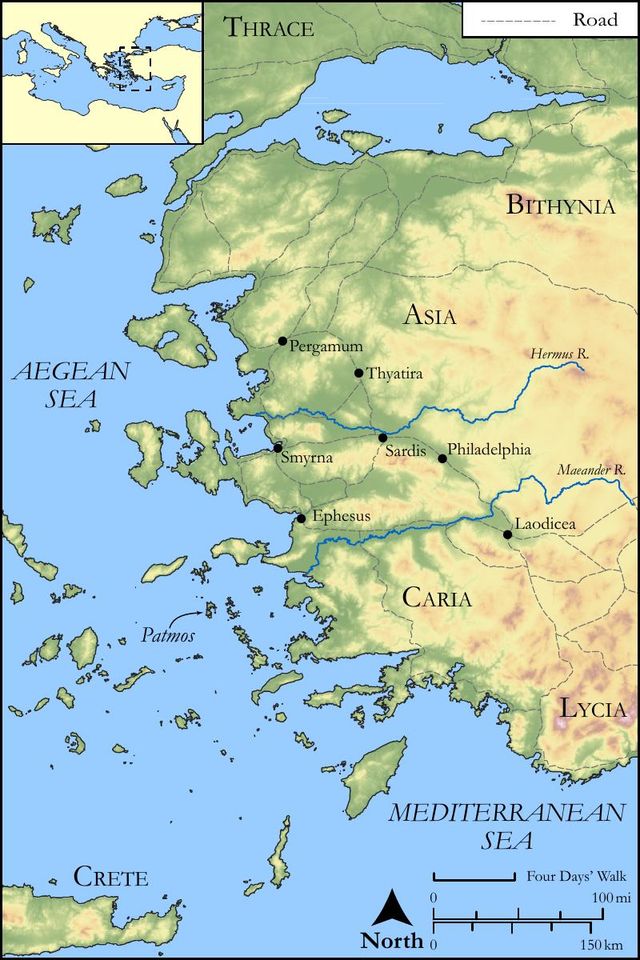

Study this verse
Public-domain commentary
Matthew Henry
From his Commentary on the Whole Bible. Henry comments on passages, not single verses — this entry covers Revelation 10:8–11. His two-level outline is real structure in the source text, so it is rendered as structure.
Here we have, I. A strict charge given to the apostle, which was, 1. That he should go and take the little book out of the hands of that mighty angel mentioned before. This charge was given, not by the angel himself who stood upon the earth, but by the same voice from heaven that in the fourth verse had lain an injunction upon him not to write what he had discerned by the seven thunders. 2. To eat the book; this part of the charge was given by the angel himself, hinting to the apostle that before he should publish what he had discovered he must more thoroughly digest the predictions, and be in himself suitably affected with them.
II.An account of the taste and relish which this little book would have, when the apostle had taken it in; at first, while in his mouth, sweet.
All persons feel a pleasure in looking into future events, and in having them foretold; and all good men love to receive a word from God, of what import soever it be. But, when this book of prophecy was more thoroughly digested by the apostle, the contents would be bitter; these were things so awful and terrible, such grievous persecutions of the people of God, and such desolation made in the earth, that the foresight and foreknowledge of them would not be pleasant, but painful to the mind of the apostle: thus was Ezekiel's prophecy to him, Eze 3:3.
III.The apostle's discharge of the duty he was called to (Rev 10:10):
He took the little book out of the angel's hand, and ate it up, and he found the relish to be as was told him.
1.It becomes the servants of God to digest in their own souls the messages they bring to others in his name, and to be suitably affected therewith themselves.
2.It becomes them to deliver every message with which they are charged, whether pleasing or unpleasing to men. That which is least pleasing may be most profitable; however, God's messengers must not keep back any part of the counsel of God.
IV.The apostle is made to know that this book of prophecy, which he had now taken in, was not given him merely to gratify his own curiosity, or to affect him with pleasure or pain, but to be communicated by him to the world. Here his prophetical commission seems to be renewed, and he is ordered to prepare for another embassy, to convey those declarations of the mind and will of God which are of great importance to all the world, and to the highest and greatest men in the world, and such should be read and recorded in many languages. This indeed is the case; we have them in our language, and are all obliged to attend to them, humbly to enquire into the meaning of them, and firmly to believe that every thing shall have its accomplishment in the proper time; and, when the prophecies shall be fulfilled, the sense and truth of them will appear, and the omniscience, power, and faithfulness of the great God will be adored.
Historical interpretation
Seven Centuries of Reception
6 surviving comments on this verse. Each one is dated, so this reads as a timeline rather than a list.
Select a marker to jump to its quote. Markers stagger vertically where authors wrote within a few decades of each other.
"And He says unto me, Thou must again prophesy to the peoples, and to the tongues, and to the nations, and to many kings." He says this, because when John said these things he was in the island of Patmos, condemned to the labour of the mines by Caesar Domitian. There, therefore, he saw the Apocalypse; and when grown old, he thought that he should at length receive his quittance by suffering, Domitian being killed, all his judgments were discharged. And John being dismissed from the mines, thus subsequently delivered the same Apocalypse which he had received from God. This, therefore, is what He says: Thou must again prophesy to all nations, because thou seest the crowds of Antichrist rise up; and against them other crowds shall stand, and they shall fall by the sword on the one side and on the other.
In the one angel he clearly shows the body of the church. Although he speaks of one, he shows many. “He says to me, ‘You must preach again.’ ” When did the church ever cease from its preaching, so that she should preach again what she had preached before? However, in the whole world [the church] is commanded to preach again among the peoples, tribes, tongues and in many regions what she had preached before. For there is one church diffused throughout the whole world, which she has filled with its preaching.
This passage indicates either that after the vision of the divine Revelation, that which was seen will not immediately receive its fulfillment, but that the saint must prophesy to those who read his Gospel and his Revelation until the consummation. Or the passage indicates that [John] would not yet taste death, but that at the end he would come to hinder the acceptance of the deceit of the antichrist.
And he said to me: You must prophesy again about many peoples and nations. He explains what the book eaten and the sweetness mixed with bitterness signify, namely, that, being freed from exile, he would preach the Gospel to the nations, sweet indeed with love, but bitter with the persecutions to be endured.
And he said to me: Thou must prophesy again to many peoples, and nations, and kings, and tongues. This is said to John specifically, and to preachers generally. They are ordered to prophesy, that is to preach, again, so as to proclaim again by their actions what they preach with their mouths.
And he says to me, "You must prophesy again concerning peoples, nations, languages, and many kings," as if he said: because you have already seen in a vision both the end of the present age and the wrath against the ungodly, do not consider the day of the end to be present in deed; there is a long time in between, during which you must also prophesy to many nations and kings. Therefore, until now, the divine John prophesies through the Gospel, through his Catholic Epistles, and through the present Revelation; for everything has been spoken and foretold to him in the Spirit.
Continue studying Revelation 10:11 across the web’s major study libraries — every link below opens this exact verse, chapter, or book on the destination site.
Read & Compare
 BibleGatewayThis verse in more than 200 translations and 70 languages.
 Bible.comThe YouVersion reader — hundreds of translations, reading plans, and highlights.
 ESV.orgCrossway's official English Standard Version reader.
 NET BibleThe NET translation with 60,000+ translators' notes on every rendering decision.
 STEP BibleTyndale House's free study tool — original text, vocabulary, and scholarly resources.
 BibliaLogos Bible Software's free web reader.
 USCCBThe New American Bible (Revised Edition) with the U.S. bishops' study notes.
Commentaries
 BibleHub CommentariesDozens of classic commentaries on this verse, gathered on one page.
 StudyLightMore than 100 commentary sets — the largest collection on the web.
 BibleRefPlain-English commentary on what this verse means, verse by verse.
 Enduring WordDavid Guzik's free commentary on this chapter, widely used by Bible teachers.
 Bible Study ToolsVerse commentary alongside Greek and Hebrew study aids.
Original Language & Research
- BibleHub InterlinearThe verse word by word — original language, transliteration, and English.
- BibleHub LexiconEvery word's original-language definition and Strong's entry.
 Blue Letter BibleDeep-study tools — Strong's numbers, concordance, and word studies.
 CNTR CollationThe earliest Greek manuscripts of this verse, collated letter by letter.
Sermons, Hymns & Audio


TrulyRandomVerse is not affiliated with these sites and doesn’t control their content. They’re linked because they’re genuinely useful.
Summary
Revelation 10:11 delivers a profound re-commissioning to the Apostle John, following his symbolic consumption of the little scroll. This verse marks a pivotal transition, shifting John's experience from personal revelation to an explicit divine mandate to resume and expand his prophetic ministry. He is tasked with proclaiming God's message of judgment and ultimate triumph to a vast, universal audience, encompassing all peoples, nations, languages, and rulers across the earth.
Context
ShowHideLiterary Context
This verse immediately follows the dramatic interlude of the mighty angel and the little scroll in Revelation 10. John has just been commanded to take the scroll from the angel's hand and eat it (Revelation 10:8-9). The act of eating the scroll, described in Revelation 10:10, results in a dual experience: it is "sweet as honey" in his mouth, symbolizing the delightful nature of receiving divine revelation, but "bitter" in his stomach, representing the often difficult and painful reality of proclaiming God's truth, especially concerning judgment and suffering. Having internalized this divine word, John is then given this renewed commission, indicating that the assimilation of truth is not an end in itself but a preparation for further, broader proclamation. This re-commissioning sets the stage for the subsequent visions detailing the final judgments and the ultimate triumph of God's kingdom.
Historical & Cultural Context
The book of Revelation was written during a period of intense persecution of Christians under the Roman Empire, likely during the reign of Emperor Domitian (c. AD 95). John, exiled to the island of Patmos (Revelation 1:9), received these visions to encourage and warn the early church. The concept of a prophet receiving and then proclaiming a divine message was deeply rooted in Old Testament tradition (e.g., Ezekiel eating a scroll in Ezekiel 2:8-10 and Ezekiel 3:1-3). The Roman Empire, with its vast array of "peoples, and nations, and tongues, and kings," represented the dominant world power of the time, often hostile to the Christian faith. The message that John must prophesy "before" such a diverse and powerful audience underscores the universal scope and ultimate authority of God's word, which transcends all earthly boundaries and political structures.
Key Themes
ShowHideRevelation 10:11 contributes significantly to several overarching themes within the book. Firstly, it emphasizes the divine imperative of prophecy and proclamation. John's commission to "prophesy again" highlights that God's revelation is dynamic and requires ongoing declaration, not merely passive reception. Secondly, it reinforces the universal scope of God's redemptive and judgmental plan. The repeated phrase "peoples, and nations, and tongues, and kings" is a characteristic apocalyptic formula in Revelation, appearing in contexts of universal worship (Revelation 5:9, Revelation 7:9) and universal opposition (Revelation 11:9, Revelation 13:7). Here, it signifies that the prophetic message of the Apocalypse is intended for all humanity, from the common person to those in positions of ultimate authority, underscoring God's sovereignty over all earthly powers.
Exposition and Analysis
ShowHideKey Word Analysis
ShowHideThis word conveys a divine necessity or imperative. It indicates that John's renewed prophetic ministry is not optional but divinely mandated, a binding obligation from God. This necessity is rooted in God's sovereign plan and purpose for the unfolding of history and the revelation of His will.
In this context, "prophesy" encompasses more than merely foretelling future events. It refers to speaking forth the divine will, declaring God's truth, warnings, and purposes under inspiration. John's role is to articulate what he has seen and heard, interpreting God's actions and revealing the ultimate triumph of Christ.
This adverb signifies a repetition or renewal of action. It implies that John's prophetic work is not concluded but is entering a new, intensified phase. It suggests a re-commissioning for a continued or expanded ministry, building upon his previous prophetic experiences and now empowered by the internalization of the little scroll's message.
While literally meaning "tongue," in this context, it signifies "language." Its inclusion in the list of "peoples, nations, and kings" emphasizes the linguistic diversity of the audience to whom John's prophecy must be proclaimed. It highlights the global reach of God's message, transcending all linguistic barriers.
Verse Breakdown
ShowHide"And he said unto me,"
This phrase establishes the divine origin of the command. The "he" refers to the mighty angel who had just presented John with the little scroll and engaged him in the symbolic act of its consumption. This direct address underscores the personal and authoritative nature of the commission given to John.
"Thou must prophesy again"
This is the core of the re-commissioning. "Thou" (John) is the recipient of the imperative. "Must" (Greek: deî) indicates a divine necessity and obligation, not a suggestion. "Prophesy" means to speak forth God's word, revealing His will and future plans. "Again" signifies a continuation or renewal of his prophetic ministry, now with a fresh mandate and a deeper understanding gained from eating the scroll.
"before many peoples, and nations, and tongues, and kings."
This comprehensive list defines the universal scope of John's renewed prophetic mission. "Peoples" (Greek: laós) refers to general populations; "nations" (Greek: éthnos) refers to ethnic or national groups, often implying Gentiles; "tongues" (Greek: glōssa) refers to different languages, emphasizing linguistic diversity; and "kings" (Greek: basileús) refers to those in positions of political authority. Together, these terms signify that the message of Revelation is intended for all humanity, across all societal strata, political boundaries, and cultural distinctions.
Literary Devices
ShowHideRevelation 10:11 employs several significant literary devices. The most prominent is Merism, seen in the phrase "peoples, and nations, and tongues, and kings." This device uses a list of contrasting or complementary parts to represent a whole, effectively conveying the universal scope of John's commission. By listing diverse categories of humanity—from general populations to specific ethnic groups, linguistic communities, and political rulers—the text emphasizes that God's message is intended for everyone, without exception. This universal reach is further underscored by the Repetition of the conjunction "and" (Greek: kai) before each category, creating a cumulative effect that reinforces the expansive nature of the audience. The entire verse functions as a Divine Commission, a common literary motif in biblical prophecy where a prophet is explicitly called and empowered by God for a specific task, often involving the proclamation of a message. This commission serves to validate John's authority and the importance of the message he is about to deliver.
Theological and Thematic Connections
ShowHideRevelation 10:11 stands as a powerful testament to the ongoing nature of God's revelation and the universal scope of His redemptive and judgmental purposes. It underscores that understanding divine truth is not an end in itself, but a preparation for proclamation. The bitter-sweet experience of the scroll, immediately preceding this commission, highlights the dual nature of God's word: delightful in its reception but often challenging and painful in its declaration, especially when it concerns judgment or suffering. Nevertheless, the divine imperative ("Thou must prophesy") affirms the non-negotiable call to share this truth, regardless of the difficulty, because it is for all humanity. This echoes the biblical principle that God desires all to hear His word and respond.
Reflection and Application
ShowHideRevelation 10:11 serves as a profound call to every believer today, reminding us that receiving God's truth is always for the purpose of sharing it. Just as John was re-commissioned to "prophesy again," so too are Christians called to be active participants in God's ongoing mission to proclaim His message to the world. The "sweet" experience of encountering God's grace and promises should fuel our desire to share, while the "bitter" reality of a fallen world, resistance to the Gospel, and the difficult truths of sin and judgment should not deter us. This verse challenges us to consider the breadth of our own evangelistic and discipleship efforts. Are we limiting the scope of God's message, or are we actively seeking to share it with "peoples, and nations, and tongues, and kings"—that is, with everyone we encounter, regardless of their background, status, or language? Our commission is as universal as God's love and His ultimate authority.
Questions for Reflection
ShowHideFAQ
ShowHideWhat does it mean for John to "prophesy again"?
ShowHideFor John to "prophesy again" means he is receiving a renewed or intensified commission for his prophetic ministry. It implies that his previous prophetic activity, likely encompassing the earlier visions recorded in Revelation 1-9, is not the end of his task. After internalizing the message of the little scroll, which signifies a deeper understanding of God's purposes, he is now mandated to continue speaking forth God's word, but with an expanded scope and perhaps a new phase of revelation. This "again" underscores the ongoing nature of divine revelation and the continuous call for God's servants to proclaim it.
Why is the audience specified as "peoples, and nations, and tongues, and kings"?
ShowHideThis four-part phrase is a common apocalyptic formula in the book of Revelation, signifying universality. It emphasizes that the prophetic message is not limited to a specific group or region but is intended for all humanity. "Peoples" refers to general populations, "nations" to distinct ethnic or national groups (often including Gentiles), "tongues" to linguistic diversity, and "kings" to those in positions of political power. By listing these categories, the text powerfully communicates that God's message transcends all social, cultural, linguistic, and political boundaries, asserting His ultimate sovereignty over all creation and all earthly authorities. This echoes the universal scope of the Gospel itself, as seen in passages like Matthew 24:14.
Christ-Centered Fulfillment
ShowHideRevelation 10:11 finds its ultimate Christ-centered fulfillment in the person and work of Jesus Christ, who is the supreme Prophet, the Word of God incarnate, and the King of kings. John's commission to "prophesy again" to all "peoples, and nations, and tongues, and kings" directly mirrors the universal scope of Christ's own mission and the Great Commission He gave to His disciples. Jesus Himself declared that "all authority in heaven and on earth has been given to me" (Matthew 28:18), and on that basis, commanded His followers to "go and make disciples of all nations" (Matthew 28:19). The message John is to proclaim, though containing elements of judgment and tribulation, ultimately points to the triumph of the Lamb of God, who "purchased for God persons from every tribe and language and people and nation" (Revelation 5:9). Thus, John's prophetic task is not merely to foretell future events, but to bear witness to the reign of Christ over all things, whose ultimate victory will be acknowledged by every tongue and before every king (Philippians 2:10-11). The "bitter" truth of judgment is necessary because of humanity's sin, but it leads to the "sweet" reality of Christ's redemptive work, offering salvation to all who believe, regardless of their earthly standing (John 3:16).