


Daniel 9:1
Bible text: King James Version (1769 Blayney text) · Public domain
Bible text: Berean Standard Bible · Public domain
Bible text: American Standard Version (1901) · Public domain
Bible text: World English Bible, Messianic edition · Public domain
Bible text: Geneva Bible (1599) · Public domain
Bible text: Young's Literal Translation · Public domain
- בִּשְׁנַתbish·Natin yearH8141Prep-b ¦ N-fscNoun Singular Feminine Constructבִּinשְׁנַתyear
- אַחַת'a·ChatoneH259Adj-fsAdjective Numerical Singular Feminine Absolute
- לְדָרְיָוֶשׁle·da·re·Ya·veshof DariusH1867Prep-l ¦ N-proper-mNoun Proper MasculineלְofדָרְיָוֶשׁDarius
- בֶּןben[the] son ofH1121N-mscNoun Singular Masculine Construct
- אֲחַשְׁוֵרוֹשׁ'a·chash·ve·Ro·oshAhasuerusH325N-proper-mNoun Proper Masculine
- מִזֶּרַעmi·Ze·ra'one of [the] descendant[s] ofH2233Prep-m ¦ N-mscNoun Singular Masculine Constructמִone ofזֶּרַע[the] descendant[s] of
- מָדָיma·DaiMediaH4074N-properNoun Proper Location
- אֲשֶׁר'a·SherwhoH834RelParticle Relative
- הָמְלַךְha·me·Lakhhe had been made kingH4427V-Hophal-Perf-3msVerb Hophal Perfect 3rd Singular Masculine
- עַל'aloverH5921PrepPreposition
- מַלְכוּתmal·Khut[the] kingdom ofH4438N-fscNoun Singular Feminine Construct
- כַּשְׂדִּיםkas·Dim[the] ChaldeansH3778N-properNoun Proper Location
English is a literal word-by-word gloss of the Hebrew, not the KJV's wording. Why?
This is the original text the KJV's translators worked from — each Hebrew word with its own literal English meaning in this verse, prepared by scholars at Tyndale House, Cambridge. The KJV translates whole sentences, not word by word, so its wording differs: one Hebrew word can become several English words, and the KJV may choose “the LORD” where the gloss reads “Yahweh”. Both are faithful — they answer different questions. For the KJV's own rendering, switch to the KJV text.
Details
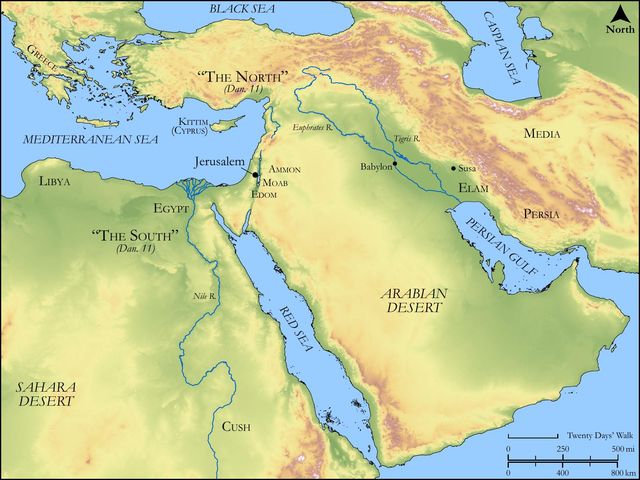
See on the biblical-era map
Study this verse
Public-domain commentary
Matthew Henry
From his Commentary on the Whole Bible. Henry comments on passages, not single verses — this entry covers Daniel 9:1–3.
We left Daniel, in the close of the foregoing chapter, employed in the king's business; but here we have him employed in better business than any king had for him, speaking to God and hearing from him, not for himself only, but for the church, whose mouth he was to God, and for whose use the oracles of God were committed to him, relating to the days of the Messiah. Observe, 1. When it was that Daniel had this communion with God (Dan 9:1), in the first year of Darius the Mede, who was newly made king of the Chaldeans, Babylon being conquered by him and his nephew, or grandson, Cyrus. In this year the seventy years of the Jews' captivity ended, but the decree for their release was not yet issued out; so that this address of Daniel's to God seems to have been ready in that year, and, probably, before he was cast into the lions' den. And one powerful inducement, perhaps, it was to him then to keep so close to the duty of prayer, though it cost him his life, that he had so lately experienced the benefit and comfort of it. 2. What occasioned his address to God by prayer (Dan 9:2): He understood by books that seventy years was the time fixed for the continuance of the desolations of Jerusalem. Dan 9:2. The book by which he understood this was the book of the prophecies of Jeremiah, in which he found it expressly foretold (Jer 29:10), After seventy years be accomplished in Babylon (and therefore they must be reckoned from the first captivity, in the third year of Jehoiakim, which Daniel had reason to remember by a good token, for it was in that captivity that he was carried away himself, Dan 1:1), I will visit you, and perform my good word towards you. It was likewise said (Jer 25:11), This whole land shall be seventy years a desolation (chorbath), the same word that Daniel here uses for the desolations of Jerusalem, which shows that he had that prophecy before him when he wrote this. Though Daniel was himself a great prophet, and one that was well acquainted with the visions of God, yet he was a diligent student in the scripture, and thought it no disparagement to him to consult Jeremiah's prophecies. He was a great politician, and prime-minister of state to one of the greatest monarchs upon earth, and yet could find both heart and time to converse with the word of God. The greatest and best men in the world must not think themselves above their Bibles. 3. How serious and solemn his address to God was when he understood that the seventy years were just upon expiring (for it appears, by Ezekiel's dating of his prophecies, that they exactly computed the years of their captivity), then he set his face to seek God by prayer. Note, God's promises are intended, not to supersede, but to excite and encourage, our prayers; and, when we see the day of the performance of them approaching, we should the more earnestly plead them with God and put them in suit. So Daniel did here; he prayed three times a day, and, no doubt, in every prayer made mention of the desolations of Jerusalem; yet he did not think that enough, but even in the midst of his business set time apart for an extraordinary application to Heaven on Jerusalem's behalf. God had said to Ezekiel that though Daniel, among others, stood before him, his intercession should not prevail to prevent the judgment (Eze 14:14), yet he hopes, now that the warfare is accomplished (Isa 40:2), his prayer may be heard for the removing of the judgment. When the day of deliverance dawns it is time for God's praying people to bestir themselves; something extraordinary is then expected and required from them, besides their daily sacrifice. Now Daniel sought by prayer and supplications, for fear lest the sins of the people should provoke him to defer their deliverance longer than was intended, or rather that the people might be prepared by the grace of God for the deliverance now that the providence of God was about to work it out for them. Now observe, (1.) The intenseness of his mind in this prayer; I set my face unto the Lord God to seek him, which denotes the fixedness of his thoughts, the firmness of his faith, and the fervour of his devout affections, in the duty. We must, in prayer, set God before us, an set ourselves as in his presence; to him we must direct our prayer and must look up. Probably, in token of his setting his face towards God, he did, as usual, set his face towards Jerusalem, to affect his own heart the more with the desolations of it. (2.) The mortification of his body in this prayer. In token of his deep humiliation before God for his own sins, and the sins of his people, and the sense he had of his unworthiness, when he prayed he fasted, put on sackcloth, and lay in ashes, the more to affect himself with the desolations of Jerusalem, which he was praying for the repair of, and to make himself sensible that he was now about an extraordinary work.
Historical interpretation
Historical reception
2 surviving comments on this verse. Each one is dated, so this reads as a timeline rather than a list.
Select a marker to jump to its quote. Markers stagger vertically where authors wrote within a few decades of each other.
Verse 1. "In the first year of the Darius who was the son of Ahasuerus of the race of the Medes and who reigned over the kingdom of the Chaldeans, in the first year of his reign..." This is the Darius who in cooperation with Cyrus conquered the Chaldeans and Babylonians. We are not to think of that other Darius in the second year of whose reign the Temple was built (as Porphyry supposes in making out a late date for Daniel); nor are we to think of the Darius who was vanquished by Alexander, the king of the Macedonians. He therefore adds the name of his father and also refers to his victory, inasmuch as he was the first of the race of the Medes to overthrow the kingdom of the Chaldeans. He does this to avoid any mistake in the reading which might arise from the similarity of the name.
We must distinguish between the reign of Darius son of Ahasuerus and that of Darius the Persian. In this way, the things that are now being read will harmonize with the things that were spoken earlier. He did not simply introduce Darius as Darius the Mede but rather as one “from the race of the Medes.” Now, as it is clear, he was not a Mede on both sides of his family, that is, on his father’s and mother’s side. At the same time he ruled over the kingdom of the Chaldeans, when Belshazzar was killed in the middle of the night by a divine intervention after his godless act. According to my research, this Darius seems to have reigned for a very brief time.
Continue studying Daniel 9:1 across the web’s major study libraries — every link below opens this exact verse, chapter, or book on the destination site.
Read & Compare
 BibleGatewayThis verse in more than 200 translations and 70 languages.
 Bible.comThe YouVersion reader — hundreds of translations, reading plans, and highlights.
 ESV.orgCrossway's official English Standard Version reader.
 NET BibleThe NET translation with 60,000+ translators' notes on every rendering decision.
 STEP BibleTyndale House's free study tool — original text, vocabulary, and scholarly resources.
 BibliaLogos Bible Software's free web reader.
 USCCBThe New American Bible (Revised Edition) with the U.S. bishops' study notes.
Commentaries
 BibleHub CommentariesDozens of classic commentaries on this verse, gathered on one page.
 StudyLightMore than 100 commentary sets — the largest collection on the web.
 BibleRefPlain-English commentary on what this verse means, verse by verse.
 Enduring WordDavid Guzik's free commentary on this chapter, widely used by Bible teachers.
 Bible Study ToolsVerse commentary alongside Greek and Hebrew study aids.
Original Language & Research
- BibleHub InterlinearThe verse word by word — original language, transliteration, and English.
- BibleHub LexiconEvery word's original-language definition and Strong's entry.
 Blue Letter BibleDeep-study tools — Strong's numbers, concordance, and word studies.
 SefariaThe Hebrew text with Rashi and centuries of Jewish commentary.
Sermons, Hymns & Audio


TrulyRandomVerse is not affiliated with these sites and doesn’t control their content. They’re linked because they’re genuinely useful.
Summary
Daniel 9:1 serves as a precise chronological and geopolitical anchor, establishing the historical context for Daniel's profound prayer and the subsequent revelation of the seventy weeks prophecy. By specifying the "first year of Darius the son of Ahasuerus, of the seed of the Medes, which was made king over the realm of the Chaldeans," the verse firmly places the narrative immediately following the fall of Babylon to the Medo-Persian Empire, underscoring God's sovereign control over the rise and fall of nations and setting the stage for one of the Bible's most significant messianic prophecies.
Context
ShowHideLiterary Context
Daniel 9:1 marks a significant transition in the book of Daniel. The preceding chapters (Daniel 7 and 8) present Daniel's visions concerning future world empires and the coming of the Messiah, often in symbolic and apocalyptic language. Chapter 9, however, returns to a historical setting, providing a concrete date and political landscape that immediately precedes Daniel's deep intercessory prayer and the angelic revelation concerning the "seventy weeks." This precise historical anchoring grounds the subsequent prophetic discourse, emphasizing its reality within human history. It also follows the dramatic account of the fall of Babylon in Daniel 5 and the establishment of the new Medo-Persian rule, which included the appointment of Darius the Mede, as narrated in Daniel 6.
Historical & Cultural Context
The verse places the events in the "first year of Darius the son of Ahasuerus, of the seed of the Medes," which historically corresponds to 539/538 BC, immediately after the conquest of Babylon by Cyrus the Great. "Darius the Mede" is widely understood by scholars as a viceroy or governor appointed by Cyrus over the newly conquered territory of Babylonia, often identified with Gobryas (Ugbaru in Babylonian texts) or a title for Cyrus himself, rather than a distinct Persian king like Darius I Hystaspes. The phrase "realm of the Chaldeans" specifically refers to the Neo-Babylonian Empire, which had been the dominant world power. The mention of "the seed of the Medes" highlights the prominent role of the Medes in the initial phase of the Medo-Persian Empire's administration of the former Babylonian territories, signifying a pivotal shift in global power dynamics. This transition was crucial for the Jewish exiles, as it marked the end of the seventy years of Babylonian captivity prophesied by Jeremiah.
Key Themes
ShowHideThis verse powerfully introduces several key themes that permeate the book of Daniel and the broader biblical narrative. Firstly, it highlights Divine Sovereignty over History, demonstrating that the transfer of power from Babylon to Medo-Persia was not random but part of God's predetermined plan, fulfilling earlier prophecies regarding the succession of empires, as seen in Nebuchadnezzar's dream in Daniel 2. Secondly, it emphasizes the Fulfillment of Prophecy, as Daniel's understanding of Jeremiah's seventy-year prophecy (mentioned in Daniel 9:2) is directly prompted by this historical transition. Thirdly, it underscores the Reliability of God's Word, showing how God orchestrates world events to bring His promises to pass. Finally, the verse sets the stage for Intercessory Prayer and Revelation, as Daniel's response to understanding God's timing is to seek Him earnestly, leading to the profound seventy weeks prophecy that lays out the timeline for Israel's future and the coming of the Messiah.
Exposition and Analysis
ShowHideKey Word Analysis
ShowHideOf Persian origin, this term refers to Darejavesh, a title or name associated with several Persian kings. In Daniel 9:1, it specifically designates the Median ruler who was made king over the Chaldean realm following the fall of Babylon. The use of this name anchors the prophecy to a specific, verifiable historical figure, emphasizing the precise timing of Daniel's vision within the Medo-Persian period.
From the root meaning "to sow," this word primarily means "seed," but figuratively extends to "posterity" or "offspring." In the phrase "of the seed of the Medes," it denotes Darius's lineage and national identity, emphasizing his ethnic origin and connecting him to the Median component of the Medo-Persian Empire, rather than solely the Persian. This detail reinforces the historical accuracy and specific political context of the time.
A primitive root meaning "to reign" or, inceptively, "to ascend the throne." Causatively, it means "to induct into royalty" or "to make king." The passive voice, "was made king," is significant here, implying that Darius's kingship over the Chaldean realm was not self-initiated but was bestowed upon him, likely by Cyrus the Great, the actual conqueror of Babylon. This highlights his delegated authority and transitional role within the newly established empire.
Verse Breakdown
ShowHide"In the first year of Darius the son of Ahasuerus"
This opening phrase provides the precise chronological setting for the events of Daniel 9. It establishes the time as the inaugural year of Darius's reign over the conquered Babylonian territory, placing it immediately after the fall of Babylon. The identity of "Ahasuerus" as Darius's father further specifies his lineage, though this Ahasuerus is distinct from the Persian king of Esther's time. This precise dating is crucial for understanding Daniel's subsequent realization about the seventy years of desolation.
"of the seed of the Medes"
This clause clarifies Darius's ethnic and national origin. It emphasizes his Median lineage, indicating that he belonged to the Median component of the Medo-Persian alliance that conquered Babylon. This detail is important because it aligns with the prophetic succession of empires seen earlier in Daniel, where the Medes and Persians together succeed the Babylonian kingdom. It distinguishes him as a Median ruler, possibly a viceroy, rather than a direct Persian emperor.
"which was made king over the realm of the Chaldeans;"
This final clause describes Darius's political authority and the extent of his dominion. He was "made king," implying an appointment rather than an independent conquest, over the "realm of the Chaldeans," which refers to the former Neo-Babylonian Empire. This signifies the complete overthrow of Babylonian power and the establishment of Medo-Persian rule, fulfilling the prophecies of empire succession and setting the stage for the return of the Jewish exiles.
Literary Devices
ShowHideDaniel 9:1 employs several literary devices to establish its significance. Historical Anchoring is paramount, as the verse meticulously provides specific names, lineage, and a precise chronological marker ("first year of Darius") to ground the subsequent prophetic revelation in verifiable historical reality. This precision lends credibility and weight to the divine messages that follow. Furthermore, the verse functions as a form of Foreshadowing, subtly preparing the reader for the profound prophetic insights of Daniel 9. By setting the scene with the transition of power, it implicitly points to the fulfillment of earlier prophecies (like Jeremiah's seventy years) and the unfolding of God's larger redemptive plan. Finally, there is Thematic Linkage to earlier chapters, particularly Daniel 2 and Daniel 5, by reiterating the shift in world powers from Babylon to Medo-Persia. This reinforces the overarching theme of God's sovereign control over human kingdoms, demonstrating that the rise and fall of empires occur according to His divine decree.
Theological and Thematic Connections
ShowHideDaniel 9:1, while seemingly a simple historical introduction, profoundly underscores the biblical truth of God's absolute sovereignty over human history. The precise dating and identification of the ruling power demonstrate that even the grand geopolitical shifts of ancient empires are not random occurrences but are orchestrated by divine providence. This verse sets the stage for Daniel's understanding that the seventy years of exile, prophesied by Jeremiah, were nearing their end, signifying God's faithfulness to His covenant promises and His meticulous timing in fulfilling His word. It reminds us that God is actively involved in the affairs of nations, raising up and bringing down kingdoms according to His eternal purpose, ultimately working all things for the glory of His name and the advancement of His redemptive plan.
Reflection and Application
ShowHideDaniel 9:1, though brief, offers a powerful reminder of God's meticulous involvement in the sweep of history. For believers, this verse provides immense comfort and a firm foundation for trust: no political upheaval, global crisis, or personal challenge falls outside the purview of God's sovereign plan. Just as He orchestrated the precise timing of the Medo-Persian conquest and the end of the Babylonian exile, He continues to govern all things today, working His purposes through human events, even those that seem chaotic or unjust. This understanding should cultivate a deep sense of peace, knowing that our God is on the throne, faithfully bringing His promises to fruition. It also challenges us to be like Daniel, who, upon discerning the signs of the times (the end of the seventy years), was moved to earnest prayer and intercession. We are called to be attentive to God's word, seeking to understand His purposes for our generation, and to respond with faithful prayer and action, trusting that He is at work, always.
Questions for Reflection
ShowHideFAQ
ShowHideWho was Darius the Mede, and why is his identity debated?
ShowHideDarius the Mede, mentioned in Daniel 9:1, is presented as the king who took over the realm of the Chaldeans (Babylon) after its fall. His identity has been a subject of historical debate because no extrabiblical historical records explicitly name a "Darius the Mede" as a king reigning between the fall of Babylon (539 BC) and the beginning of Cyrus the Great's full reign over Babylon. Some scholars propose he was a viceroy or governor appointed by Cyrus, possibly Gobryas (Ugbaru), who was a general who conquered Babylon for Cyrus. Others suggest "Darius" might be a title for Cyrus himself, or that he was a lesser Median noble given authority over the city. The biblical text, however, consistently portrays him as a distinct figure who "was made king" over the Chaldean realm, emphasizing his Median lineage and his role in the transition of power, which is consistent with the Medo-Persian conquest. Regardless of the precise historical identification, his mention firmly anchors Daniel's prophecy in a specific, verifiable historical period.
Why is the precise dating in Daniel 9:1 important for the rest of the chapter?
ShowHideThe precise dating in Daniel 9:1 is critically important because it provides the historical trigger for Daniel's profound prayer and the subsequent revelation of the seventy weeks prophecy. In Daniel 9:2, Daniel states that "in the first year of his reign I Daniel understood by books the number of the years, whereof the word of the LORD came to Jeremiah the prophet, that he would accomplish seventy years in the desolations of Jerusalem." This means that the specific historical moment of Darius's reign—the very beginning of the Medo-Persian rule over Babylon—was the exact point at which Daniel realized that the seventy years of Babylonian captivity, prophesied by Jeremiah (e.g., Jeremiah 25:11), were nearing their completion. This understanding then propelled Daniel into the earnest prayer found in Daniel 9:3-19, which in turn prompted the angel Gabriel to deliver the detailed prophecy of the seventy weeks, outlining the timeline for Israel's future and the coming of the Messiah. The historical anchor of Daniel 9:1 thus serves as the essential catalyst for the chapter's deep theological and prophetic insights.
Christ-Centered Fulfillment
ShowHideWhile Daniel 9:1 itself is a historical marker, its significance is deeply Christ-centered in its broader context. The verse establishes the precise historical setting for the seventy weeks prophecy, a timeline that ultimately points to the first advent of Christ and His atoning work. God's sovereign orchestration of history, evident in the transfer of power from Babylon to the Medo-Persians and the precise timing of the end of the seventy-year exile, foreshadows His meticulous plan for the arrival of His Son. Just as God brought about the fulfillment of Jeremiah's prophecy at a specific historical juncture, so too did He send His Son "when the fullness of time had come" (Galatians 4:4). The reliability of God's word, demonstrated by the historical accuracy of Daniel 9:1 and the subsequent fulfillment of the seventy years, provides an unshakable foundation for trusting in the greater prophecies concerning the Messiah. Christ is the ultimate King, whose reign transcends all earthly empires, and His coming was the ultimate fulfillment of God's redemptive plan, establishing a kingdom that "shall never be destroyed" (Daniel 2:44). Thus, this seemingly simple historical detail in Daniel 9:1 serves as a foundational stone in the grand narrative of God's faithfulness, culminating in the person and work of Jesus Christ, the sovereign Lord over all history and all realms (Philippians 2:9-11).