


Daniel 6:1
Bible text: King James Version (1769 Blayney text) · Public domain
Bible text: Berean Standard Bible · Public domain
Bible text: American Standard Version (1901) · Public domain
Bible text: World English Bible, Messianic edition · Public domain
Bible text: Geneva Bible (1599) · Public domain
Bible text: Young's Literal Translation · Public domain
- שְׁפַרshe·Farit seemed goodH8232V-Peal-Perf-3msVerb Peal Perfect 3rd Singular Masculine
- קֳדָםko·DambeforeH6925N-csNoun Singular common gender Absolute
- דָּרְיָוֶשׁda·re·Ya·veshDariusH1868N-proper-mNoun Proper Masculine
- וַהֲקִיםva·ha·Kimand he appointedH6966Conj-w ¦ V-Hiphil-Perf-3msVerb Hiphil Perfect 3rd Singular Masculineוַandהֲקִיםhe appointed
- עַל'aloverH5922PrepPreposition
- מַלְכוּתָאmal·khu·Ta'kingdom theH4437N-fs ¦ ArtNoun Singular Feminine Definiteמַלְכוּתָkingdomאthe
- לַאֲחַשְׁדַּרְפְּנַיָּאla·'a·chash·dar·pe·nai·Ya'<obj.> satraps theH324Prep-l ¦ N-mp ¦ ArtNoun Plural Masculine Definiteלַ<obj.>אֲחַשְׁדַּרְפְּנַיָּsatrapsאthe
- מְאָהme·'Ahone hundredH3969Adj-csAdjective Numerical Singular common gender Absolute
- וְעֶשְׂרִיןve·'es·Rinand twentyH6243Conj-w ¦ Adj-csAdjective Numerical Singular common gender Absoluteוְandעֶשְׂרִיןtwenty
- דִּיdiwhoH1768ConjConjunction
- לֶהֱוֹןle·he·Vonthey will beH1934V-Peal-Imperf-3mpVerb Peal Imperfect 3rd Plural Masculine
- בְּכָלbe·kholover allH3606Prep-b ¦ N-cscNoun Singular common gender Constructבְּoverכָלall
- מַלְכוּתָאmal·khu·Ta'kingdom theH4437N-fs ¦ ArtNoun Singular Feminine Definiteמַלְכוּתָkingdomאthe
English is a literal word-by-word gloss of the Hebrew, not the KJV's wording. Why?
This is the original text the KJV's translators worked from — each Hebrew word with its own literal English meaning in this verse, prepared by scholars at Tyndale House, Cambridge. The KJV translates whole sentences, not word by word, so its wording differs: one Hebrew word can become several English words, and the KJV may choose “the LORD” where the gloss reads “Yahweh”. Both are faithful — they answer different questions. For the KJV's own rendering, switch to the KJV text.
Details
See on the biblical-era map
Study this verse
Public-domain commentary
Matthew Henry
From his Commentary on the Whole Bible. Henry comments on passages, not single verses — this entry covers Daniel 6:1–5. His two-level outline is real structure in the source text, so it is rendered as structure.
We are told concerning Daniel,
I.What a great man he was.
When Darius, upon his accession to the crown of Babylon by conquest, new-modelled the government, he made Daniel prime-minister of state, set him at the helm, and made him first commissioner both of the treasury and of the great seal. Darius's dominion was very large; all he got by his conquests and acquests was that he had so many more countries to take care of; no more can be expected from himself than what one man can do, and therefore others must be employed under him. He set over the kingdom 120 princes (Dan 6:1), and appointed them their districts, in which they were to administer justice, preserve the public peace, and levy the king's revenue. Note, Inferior magistrates are ministers of God to us for good as well as the sovereign; and therefore we must submit ourselves both to the king as supreme and to the governors that are constituted and commissioned by him, Pe1 2:13, Pe1 2:14. Over these princes there was a triumvirate, or three presidents, who were to take and state the public accounts, to receive appeals from the princes, or complaints against them in case of mal-administration, that the king should have no damage (Dan 6:2), that he should not sustain loss in his revenue and that the power he delegated to the princes might not be abused to the oppression of the subject, for by that the king (whether he thinks so or no) receives real damage, both as it alienates the affections of his people from him and as it provokes the displeasure of his God against him. Of these three Daniel was chief, because he was found to go beyond them all in all manner of princely qualifications. He was preferred above the presidents and princes (Dan 6:3), and so wonderfully well pleased the king was with his management that he thought to set him over the whole realm, and let him place and displace at his pleasure. Now,
1.We must take notice of it to the praise of Darius that he would prefer a man thus purely for his personal merit, and his fitness for business; and those sovereigns that would be well served must go by that rule. Daniel had been a great man in the kingdom that was conquered, and for that reason, one would think, should have been looked upon as an enemy, and as such imprisoned or banished. He was a native of a foreign kingdom, and a ruined one, and upon that account might have been despised as a stranger and captive. But, Darius, it seems, was very quick-sighted in judging of men's capacities, and was soon aware that this Daniel had something extraordinary in him, and therefore, though no doubt he had creatures of his own, not a few, that expected preferment in this newly-conquered kingdom, and were gaping for it, and those that had been long his confidants would depend upon it that they should be now his presidents, yet so well did he consult the public welfare that, finding Daniel to excel them all in prudence and virtue, and probably having heard of his being divinely inspired, he made him his right hand.
2.We must take notice of it, to the glory of God, that, though Daniel was now very old (it was above seventy years since he was brought a captive to Babylon), yet he was as able as ever for business both in body and mind, and that he who had continued faithful to his religion through all the temptations of the foregoing reigns in a new government was as much respected as ever. He kept in by being an oak, not by being a willow, by a constancy in virtue, not by a pliableness to vice. Such honesty is the best policy, for it secures a reputation; and those who thus honour God he will honour.
II.What a good man he was:
An excellent spirit was in him, Dan 6:3. And he was faithful to every trust, dealt fairly between the sovereign and the subject, and took care that neither should be wronged, so that there was no error, or fault, to be found in him, Dan 6:4. He was not only not chargeable with any treachery or dishonesty, but not even with any mistake or indiscretion. He never made any blunder, nor had any occasion to plead inadvertency or forgetfulness for his excuse. This is recorded for an example to all that are in places of public trust to approve themselves both careful and conscientious, that they may be free, not only from fault, but from error, not only from crime, but from mistake.
III.What ill-will was borne him, both for his greatness and for his goodness.
The presidents and princes envied him because he was advanced above them, and probably hated him because he had a watchful eye upon them and took care they should not wrong the government to enrich themselves. See here,
1.The cause of envy, and that is every thing that is good. Solomon complains of it as a vexation that for every right work a man is envied of his neighbour (Ecc 4:4), that the better a man is the worse he is thought of by his rivals. Daniel is envied because he has a more excellent spirit than his neighbours.
2.The effect of envy, and that is every thing that is bad. Those that envied Daniel sought no less than his ruin. His disgrace would not serve them; it was his death that they desired. Wrath is cruel, and anger is outrageous, but who can stand before envy? Pro 27:4. Daniel's enemies set spies upon him, to observe him in the management of his place; they sought to find occasion against him, something on which to ground an accusation concerning the kingdom, some instance of neglect or partiality, some hasty word spoken, some person borne hard upon, or some necessary business overlooked. And if they could but have found the mote, the mole-hill, of a mistake, it would have been soon improved to the beam, to the mountain, of an unpardonable misdemeanour. But they could find no occasion against him; they owned that they could not. Daniel always acted honestly, and now the more warily, and stood the more upon his guard, because of his observers, Psa 27:11. Note, We have all need to walk circumspectly, because we have many eyes upon us, and some that watch for our halting. Those especially have need to carry their cup even that have it full. They concluded, at length, that they should not find any occasion against him except concerning the law of his God Dan 6:5. It seems then that Daniel kept up the profession of his religion, and held it fast without wavering or shrinking, and yet that was no bar to his preferment; there was no law that required him to be of the king's religion, or incapacitated him to bear office in the state unless he were. It was all one to the king what God he prayed to, so long as he did the business of his place faithfully and well. He was at the king's service usque ad aras - as far as the altars; but there he left him. In this matter therefore his enemies hoped to ensnare him. Quaerendum est crimen laesae religionis ubi majestatis deficit - When treason could not be charged upon him he was accused of impiety. Grotius. Note, It is an excellent thing, and much for the glory of God, when those who profess religion conduct themselves so inoffensively in their whole conversation that their most watchful spiteful enemies may find no occasion of blaming them, save only in the matters of their God, in which they walk according to their consciences. It is observable that, when Daniel's enemies could find no occasion against him concerning the kingdom, they had so much sense of justice left that they did not suborn witnesses against him to accuse him of crimes he was innocent of, and to swear treason upon him, wherein they shame many that were called Jews and are called Christians.
Historical interpretation
Five Centuries of Reception
3 surviving comments on this verse. Each one is dated, so this reads as a timeline rather than a list.
Select a marker to jump to its quote. Markers stagger vertically where authors wrote within a few decades of each other.
Daniel received the Holy Spirit and therefore prophesied. So, too, the king promoted him because he had the grace of the Spirit. For the king spoke in this regard, “I have heard of you that the Spirit of the holy God is in you.” And farther on it is written, “Then Daniel became distinguished above all the other presidents and satraps, because an excellent spirit was in him.” And the spirit of Moses also was shared by those who were to be judges.
Verse 1. "It pleased Darius to appoint over his kingdom one hundred and twenty satraps, that they might be throughout his whole kingdom; and over them there were three princes, of which Daniel was one." Josephus, of whom we made mention above, in writing an account of this passage, put it this way: Now Darius, who destroyed the empire of the Babylonians in cooperation with his relative, Cyrus, - for they carried on the war as allies - was sixty-two years of age at the time he captured Babylon. He was the son of Astyages, and was known to the Greeks by another name. Moreover he took away the prophet Daniel with him and took him to Media, and made him one of the three princes who were in charge of his whole kingdom. Hence we see that when Babylon was overthrown, Darius returned to his own kingdom in Media, and brought Daniel along with him in the same honorable capacity to which he had been promoted by Belshazzar. There is no doubt but what Darius had heard of the sign and portent which had come to Belshazzar, and also of the interpretation which Daniel had set forth, and how he had foretold the rule of the Medes and the Persians. And so no one should be troubled by the fact that Daniel is said in one place to have lived in Darius's reign, and in another place in the reign of Cyrus. The Septuagint rendered Darius by the name Artaxerxes. But as for the fact that a non-chronological order is followed, so that some history is narrated in the reign of Darius before material is given for Belshazzar's reign, whereas we are subsequently to read that he was put to death by Darius, it seems to me that the anachronism results from the fact that the author has brought all the historical portions together in immediate sequence. Therefore it is at the close of the earlier vision that he had stated: "And Darius the Mede succeeded to the realm at the age of sixty-two." And so it was under this Darius who put Belshazzar to death that the events took place of which we are about to speak.
We need to take notice that previously the Babylonians, that is, their princes, had used trickery in their jealousy of Daniel to destroy Daniel and his companions and had persuaded Nebuchadnezzar to build the golden statue and to order that it alone be worshiped by those under his authority. So, too, now the Medes use trickery in the elaboration of the edict and decree in order to destroy Daniel.
Continue studying Daniel 6:1 across the web’s major study libraries — every link below opens this exact verse, chapter, or book on the destination site.
Read & Compare
 BibleGatewayThis verse in more than 200 translations and 70 languages.
 Bible.comThe YouVersion reader — hundreds of translations, reading plans, and highlights.
 ESV.orgCrossway's official English Standard Version reader.
 NET BibleThe NET translation with 60,000+ translators' notes on every rendering decision.
 STEP BibleTyndale House's free study tool — original text, vocabulary, and scholarly resources.
 BibliaLogos Bible Software's free web reader.
 USCCBThe New American Bible (Revised Edition) with the U.S. bishops' study notes.
Commentaries
 BibleHub CommentariesDozens of classic commentaries on this verse, gathered on one page.
 StudyLightMore than 100 commentary sets — the largest collection on the web.
 BibleRefPlain-English commentary on what this verse means, verse by verse.
 Enduring WordDavid Guzik's free commentary on this chapter, widely used by Bible teachers.
 Bible Study ToolsVerse commentary alongside Greek and Hebrew study aids.
Original Language & Research
- BibleHub InterlinearThe verse word by word — original language, transliteration, and English.
- BibleHub LexiconEvery word's original-language definition and Strong's entry.
 Blue Letter BibleDeep-study tools — Strong's numbers, concordance, and word studies.
 SefariaThe Hebrew text with Rashi and centuries of Jewish commentary.
Sermons, Hymns & Audio


TrulyRandomVerse is not affiliated with these sites and doesn’t control their content. They’re linked because they’re genuinely useful.
Summary
Daniel 6:1 introduces the administrative restructuring of the vast Medo-Persian Empire under King Darius, who, having recently acquired the former Babylonian territories, strategically appointed one hundred and twenty high-ranking officials to govern the entire kingdom. This foundational verse meticulously establishes the new imperial context and administrative framework, setting the stage for the dramatic events of Daniel's life, including his elevation within this system and the subsequent conspiracy that leads to his trial in the lions' den, thereby highlighting the seamless transition of power and the meticulous establishment of new governance.
Context
ShowHideLiterary Context
Daniel 6:1 immediately follows the climactic narrative of Babylon's fall and the death of King Belshazzar, as vividly described in Daniel 5:30-31. This verse marks a crucial turning point in the book, signifying the definitive transition of imperial power from the Babylonian Empire to the Medo-Persian Empire. It serves as the narrative's opening scene for the celebrated account of Daniel in the lions' den, laying the administrative groundwork for Daniel's continued prominence and the challenges he faces under this new regime. The detailed description of the new governmental structure is not merely historical background; it is indispensable for comprehending the subsequent plot, particularly the jealousy and conspiracy against Daniel that directly arises from his elevated position within this very system, as further elaborated in Daniel 6:2-4.
Historical & Cultural Context
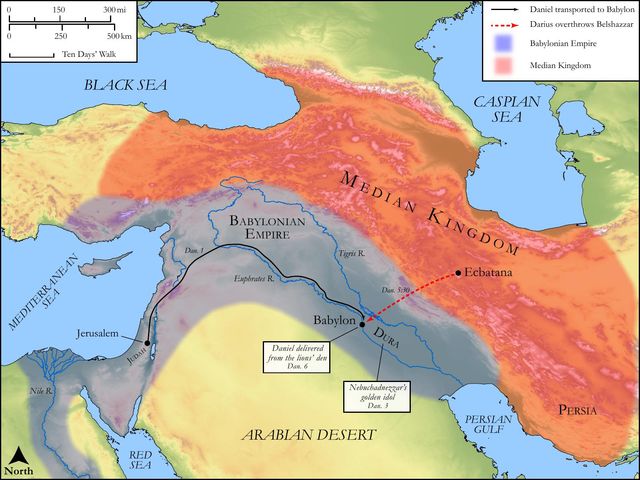
Following the swift conquest of Babylon by the Medes and Persians, traditionally dated to 539 BC, the new empire, under the leadership of Darius the Mede, immediately embarked on the critical task of consolidating its vast and diverse territories. The appointment of "an hundred and twenty princes" reflects the established administrative practices of large ancient empires, particularly the Persian Empire, which was renowned for its sophisticated and highly organized provincial system. These "princes" (Aramaic: achashdarpan) were essentially satraps or provincial governors, each entrusted with significant authority over a specific region or province. Their comprehensive duties included maintaining law and order, administering justice, overseeing local economies, and collecting taxes, all while reporting to a centralized authority. This hierarchical and decentralized administrative structure was vital for effectively governing an empire that spanned vast geographical expanses and encompassed numerous distinct peoples, ensuring both control and the efficient extraction of resources from the conquered lands.
Key Themes
ShowHideThis verse contributes significantly to several overarching themes woven throughout the book of Daniel. Firstly, it powerfully underscores the theme of God's sovereignty over earthly kingdoms. The swift and decisive transition of power from Babylon to Media-Persia, precisely as foretold in Nebuchadnezzar's dream of four kingdoms in Daniel 2 and Daniel's vision of four beasts in Daniel 7, demonstrates that human empires rise and fall not merely by human will or military might, but according to God's divine and immutable plan. As Daniel 2:21 profoundly declares, God "removes kings and sets up kings." Secondly, the verse highlights the importance of wise and effective administration in governing a vast dominion, a characteristic that Daniel himself exemplifies throughout his career. Lastly, the meticulous establishment of this new administrative system is absolutely critical for setting the stage for Daniel's remarkable elevation and the subsequent testing of his unwavering faithfulness. The very structure designed for imperial control becomes the backdrop for a divine demonstration of God's power to deliver His loyal servant amidst intense political intrigue and human jealousy, as the narrative dramatically unfolds in Daniel 6.
Exposition and Analysis
ShowHideKey Word Analysis
ShowHideThis term, according to the provided data, refers to a title rather than a personal name, associated with several Persian kings. In the context of Daniel 6:1, it identifies the new ruler of the Medo-Persian Empire who succeeded Belshazzar. The mention of "Darius" signifies the pivotal shift in imperial power and the establishment of a new political order under his supreme authority, initiating a new era of governance.
This Aramaic word specifically denotes a satrap or governor of a major province within the Persian Empire. These officials wielded significant administrative and executive power within their assigned territories, being responsible for local governance, the enforcement of law, and the collection of revenue. Their appointment by Darius underscores the systematic, comprehensive, and hierarchical nature of the new imperial administration, indicating a well-structured system of control.
This term refers to dominion, encompassing both the abstract concept of kingship or reign and, more concretely, the realm or territory over which a king rules. In Daniel 6:1, it specifically refers to the vast territory recently conquered by Darius, which now encompasses the former Babylonian Empire. The repeated use of "kingdom" throughout the verse emphasizes the immense scope of Darius's authority and the extensive administrative task he undertakes to consolidate and manage this newly acquired dominion.
Verse Breakdown
ShowHide"It pleased Darius to set over the kingdom"
This opening phrase immediately conveys Darius's sovereign decision and personal initiative in establishing the new administrative structure. The act of "setting over" implies a deliberate, authoritative, and strategic appointment, signifying the immediate consolidation of power and the implementation of a systematic approach to governance following the conquest of Babylon. It highlights the new king's focus on imposing order and exerting control over his newly acquired territories.
"an hundred and twenty princes"
This specifies the exact number of high-ranking officials appointed by Darius. The large numerical detail underscores the immense size and inherent diversity of the newly acquired empire, necessitating a broad and extensive network of regional administrators to effectively manage its various provinces and diverse peoples. This precise number provides a concrete scale to the imperial organization and hints at the complexity of the task.
"which should be over the whole kingdom"
This concluding clause emphatically highlights the comprehensive and all-encompassing nature of Darius's administrative plan. These 120 princes were not merely localized officials but were collectively entrusted with responsibility for the entire vast dominion, ensuring uniform governance, consistent policy enforcement, and centralized control across all conquered territories. This sets the crucial stage for Daniel's unique and ultimately perilous position within this extensive and powerful hierarchy.
Literary Devices
ShowHideDaniel 6:1 masterfully employs several literary devices to establish its narrative context, imbue the scene with realism, and subtly foreshadow future events. The prominent use of Administrative Detail is evident in the specific number "an hundred and twenty princes" and the expansive phrase "over the whole kingdom." This meticulous detail lends a strong sense of historical realism and scale to the newly established Medo-Persian Empire, grounding the dramatic events that follow in a believable and well-structured administrative framework. Furthermore, the verse functions as a powerful piece of Foreshadowing. By describing the creation of a vast and hierarchical network of high-ranking officials, the narrative subtly prepares the reader for the inevitable political rivalries, jealousies, and conspiracies that will arise, particularly against Daniel, who is soon to be elevated to a position of authority above these very princes. This sets the crucial stage for the central conflict and the testing of Daniel's faithfulness within the chapter. Lastly, the verse serves as a critical Transitional Narrative, marking the definitive and administrative shift in imperial power from the Babylonian Empire to the Medo-Persian Empire, thereby preparing the reader for the new political and cultural context in which Daniel's unwavering faith will be profoundly tested.
Theological and Thematic Connections
ShowHideDaniel 6:1, while appearing to be a straightforward administrative detail, carries profound theological weight, serving as a powerful testament to God's ultimate and unwavering sovereignty over all earthly kingdoms and human endeavors. Even as empires rise and fall, and new rulers meticulously implement their strategic plans for governance, the divine hand orchestrates history according to His immutable purposes. Darius's decision to organize his vast kingdom, though a human act of political and administrative genius, occurs precisely within the larger framework of God's prophetic timeline, demonstrating unequivocally that no human authority, no matter how powerful or comprehensive, operates outside of His overarching and sovereign control. This verse serves as a potent reminder that God is actively and intimately involved in the affairs of nations, setting up and pulling down leaders as He wills, ultimately working all things for the good of His people and the advancement of His eternal kingdom.
Reflection and Application
ShowHideDaniel 6:1 invites us to deeply reflect on God's unwavering and absolute sovereignty in a world often characterized by political upheaval, shifting powers, and seemingly chaotic events. Just as Darius meticulously organized his vast empire, God orchestrates the intricate details of human history, even the rise and fall of nations and the appointments of leaders, with divine precision. For us today, this profound truth provides immense comfort and a compelling call to trust. We are powerfully reminded that no government, no political system, and no human leader operates outside the purview of God's ultimate authority and providential care. This understanding should cultivate within us a deep and abiding sense of peace, knowing that our ultimate hope and security are not found in earthly rulers or transient systems, but in the King of Kings who reigns supreme over all creation. It also challenges us to be faithful citizens and unwavering witnesses within whatever earthly structures or organizations we find ourselves, knowing that God can use even the most complex administrative systems to advance His divine purposes and demonstrate His power through His devoted servants, just as He so remarkably did with Daniel.
Questions for Reflection
ShowHideFAQ
ShowHideWho was Darius the Mede, and why is he establishing this kingdom?
ShowHideDarius the Mede is presented in Daniel 5:31 as the one who "received the kingdom" after the dramatic fall of Babylon. While historical records outside of the book of Daniel do not explicitly name a "Darius the Mede" as the immediate successor to Belshazzar, most scholars propose various identifications for him, such as Gobryas (Ugbaru), the general who conquered Babylon for Cyrus the Great, or as a viceroy appointed by Cyrus himself. The book of Daniel consistently portrays him as the initial ruler of the Medo-Persian Empire, directly responsible for its immediate administrative organization and consolidation. His pivotal role here is to establish the new imperial order following the decisive Babylonian defeat, thereby meticulously setting the stage for the significant events of Daniel 6 and Daniel's continued prominence.
Why did Darius appoint exactly 120 princes, and what was their role?
ShowHideThe appointment of "an hundred and twenty princes" reflects the practical and strategic necessity of governing a vast, newly conquered, and diverse empire. The number 120 (or potentially 127 in later Persian administration, as seen in Esther 1:1) likely represents a methodical division of the empire into major provinces or satrapies, each meticulously overseen by a high-ranking official. These "princes," or satraps, were entrusted with significant responsibilities for local administration, maintaining law and order, collecting taxes, and ensuring the unwavering loyalty of their respective regions to the central imperial authority. This highly organized system allowed the central government to effectively exert control over a diverse and widespread dominion, ensuring efficient governance, consistent policy implementation, and optimal resource management across the "whole kingdom."
Christ-Centered Fulfillment
ShowHideDaniel 6:1, with its vivid depiction of a new king establishing his dominion through a meticulously organized and expansive administration, finds its ultimate and profound fulfillment in the person and eternal reign of Jesus Christ. While Darius's kingdom was earthly, temporary, and limited by human power, Jesus's kingdom is eternal, universal, and transcends all earthly powers and administrative structures. The appointment of 120 princes to govern a vast realm, though impressive, ultimately foreshadows the supreme and ultimate authority granted to Christ, who, after His glorious resurrection, declared, "All authority in heaven and on earth has been given to me" (Matthew 28:18). Just as Darius sought to bring order and control to his newly acquired kingdom, Christ's perfect reign brings divine order, ultimate justice, and everlasting peace to a fallen and chaotic world. He is the true and sovereign King of Kings and Lord of Lords, before whom "every knee should bow, in heaven and on earth and under the earth" (Philippians 2:10). The administrative setup in Daniel 6:1, designed to control and manage an earthly empire, ultimately serves as a providential backdrop for God's miraculous care for His servant Daniel, pointing to the greater, overarching truth that all earthly powers and systems are ultimately subservient to God's grand redemptive plan, culminating in the establishment of Christ's everlasting kingdom, which "shall never be destroyed" (Daniel 2:44) and will endure forever.