


Esther 1:1
Bible text: King James Version (1769 Blayney text) · Public domain
Bible text: King James Version with Strong's numbers · Public domain
Bible text: Berean Standard Bible · Public domain
Bible text: American Standard Version (1901) · Public domain
Bible text: World English Bible, Messianic edition · Public domain
Bible text: Geneva Bible (1599) · Public domain
Bible text: Young's Literal Translation · Public domain
- וַיְהִיvay·Hiand it wasH1961Conj-w ¦ V-Qal-ConsecImperf-3msVerb Qal Consecutive Imperfect 3rd Singular Masculineוַandיְהִיit was
- בִּימֵיbi·Meiin [the] days ofH3117Prep-b ¦ N-mpcNoun Plural Masculine Constructבִּinימֵי[the] days of
- אֲחַשְׁוֵרוֹשׁ'a·chash·ve·Ro·oshAhasuerusH325N-proper-mNoun Proper Masculine
- הוּאhu'thatH1931Pro-3msPronoun Personal 3rd Singular Masculine
- אֲחַשְׁוֵרוֹשׁ'a·chash·ve·Ro·oshAhasuerusH325N-proper-mNoun Proper Masculine
- הַמֹּלֵךְha·mo·leKhwho reignedH4427Art ¦ V-Qal-Prtcpl-msVerb Qal Participle Singular Masculine Absoluteהַwhoמֹּלֵךְreigned
- מֵהֹדּוּme·Ho·dufrom IndiaH1912Prep-m ¦ N-properNoun Proper LocationמֵfromהֹדּוּIndia
- וְעַדve·'adand toH5704Conj-w ¦ PrepPrepositionוְandעַדto
- כּוּשׁKushCushH3568N-properNoun Proper Location
- שֶׁבַעShe·va'sevenH7651Adj-csAdjective Numerical Singular common gender Absolute
- וְעֶשְׂרִיםve·'es·Rimand twentyH6242Conj-w ¦ Adj-mpAdjective Numerical Plural Masculine Absoluteוְandעֶשְׂרִיםtwenty
- וּמֵאָהu·me·'Ahand one hundredH3967Conj-w ¦ Adj-fsAdjective Numerical Singular Feminine Absoluteוּandמֵאָהone hundred
- מְדִינָהme·di·Nahprovince[s]H4082N-fsNoun Singular Feminine Absolute
English is a literal word-by-word gloss of the Hebrew, not the KJV's wording. Why?
This is the original text the KJV's translators worked from — each Hebrew word with its own literal English meaning in this verse, prepared by scholars at Tyndale House, Cambridge. The KJV translates whole sentences, not word by word, so its wording differs: one Hebrew word can become several English words, and the KJV may choose “the LORD” where the gloss reads “Yahweh”. Both are faithful — they answer different questions. For the KJV's own rendering, switch to the KJV text.
Details
See on the biblical-era maps
Study this verse
Public-domain commentary
Matthew Henry
From his Commentary on the Whole Bible. Henry comments on passages, not single verses — this entry covers Esther 1:1–9.
Which of the kings of Persia this Ahasuerus was the learned are not agreed. Mordecai is said to have been one of those that were carried captive from Jerusalem (Est 2:5, Est 2:6), whence it should seem that this Ahasuerus was one of the first kings of that empire. Dr. Lightfoot thinks that he was that Artaxerxes who hindered the building of the temple, who is called also Ahasuerus (Ezr 4:6, Ezr 4:7), after his great-grandfather of the Medes, Dan 9:1. We have here an account,
I.Of the vast extent of his dominion.
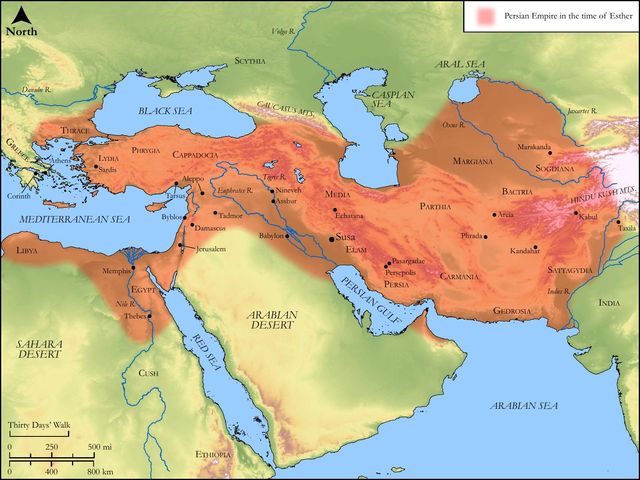
In the time of Darius and Cyrus there were but 120 princes (Dan 6:1); now there were 127, from India to Ethiopia, Est 1:1. It had become an over-grown kingdom, which in time would sink with its own weight, and, as usual, would lose its provinces as fast as it got them. If such vast power be put into a bad hand, it is able to do so much the more mischief; but, if into a good hand, it is able to do so much the more good. Christ's kingdom is, or shall be, far larger than this, when the kingdoms of the world shall all become his; and it shall be everlasting.
II.Of the great pomp and magnificence of his court.
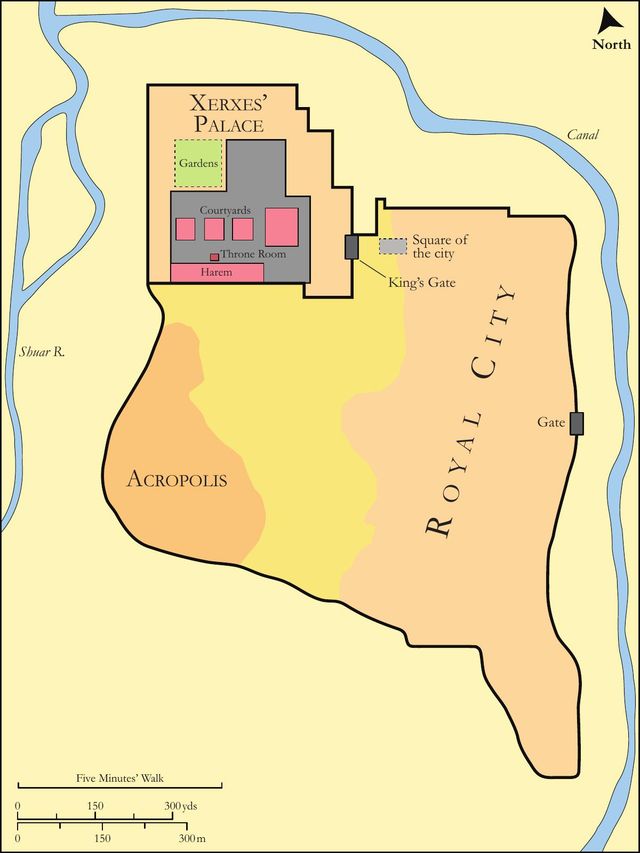
When he found himself fixed in his throne, the pride of his heart rising with the grandeur of his kingdom, he made a most extravagant feast, wherein he put himself to vast expense and trouble only to show the riches of his glorious kingdom and the honour of his excellent majesty, Est 1:4. This was vain glory, an affection of pomp to no purpose at all; for none questioned the riches of his kingdom, nor offered to vie with him for honour. If he had shown the riches of his kingdom and the honour of his majesty, as some of his successors did, in contributing largely towards the building of the temple and the maintaining of the temple service (Ezr 6:8, Ezr 7:22), it would have turned to a much better account. Two feasts Ahasuerus made: - 1. One for his nobles and princes, which lasted a hundred and eighty days, Est 1:3, Est 1:4. Not that he feasted the same persons every day for all that time, but perhaps the nobles and princes of one province one day, of another province another day, while thus he and his constant attendants fared sumptuously every day. The Chaldee paraphrast (who is very bold in his additions to the story of this book) says that there had been a rebellion among his subjects and that this feast was kept for joy of the quashing of it. 2. Another was made for all the people, both great and small, which lasted seven days, some one day and some another; and, because no house would hold them, they were entertained in the court of the garden, Est 1:5. The hangings with which the several apartments were divided or the tents which were there pitched for the company, were very fine and rich; so were the beds or benches on which they sat, and the pavement under their feet, Est 1:6. Better is a dinner of herbs with quietness, and the enjoyment of one's self and a friend, than this banquet of wine with all the noise and tumult that must needs attend it.
III.Of the good order which in some respects was kept there notwithstanding.
We do not find this like Belshazzar's feast, in which dunghill-gods were praised and the vessels of the sanctuary profaned, Dan 5:3, Dan 5:4. Yet the Chaldee paraphrase says that the vessels of the sanctuary were used in this feast, to the great grief of the pious Jews. It was not like Herod's feast, which reserved a prophet's head for the last dish. Two things which are laudable we may gather from the account here given of this feast: - 1. That there was no forcing of healths, nor urging of them: The drinking was according to the law, probably some law lately made; none did compel, no, not by continual proposing of it (as Josephus explains it); they did not send the glass about, but every man drank as he pleased (Est 1:8), so that if there were any that drank to excess it was their own fault, a fault which few would commit when the king's order put an honour upon sobriety. This caution of a heathen prince, even when he would show his generosity, may shame many who are called Christians, who think they do not sufficiently show their good housekeeping, nor bid their friends welcome, unless they make them drunk, and, under pretence of sending the health round, send the sin round, and death with it. There is a woe to those that do so; let them read it and tremble, Hab 2:15, Hab 2:16. It is robbing men of their reason, their richest jewel, and making them fools, the greatest wrong that can be. 2. That there was no mixed dancing; for the gentlemen and ladies were entertained asunder, not as in the feast of Belshazzar, whose wives and concubines drank with him (Dan 5:2), or that of Herod, whose daughter danced before him. Vashti feasted the women in her own apartment; not openly in the court of the garden, but in the royal house, Est 1:9. Thus, while the king showed the honour of his majesty, she and her ladies showed the honour of their modesty, which is truly the majesty of the fair sex.
Historical interpretation
Fourteen Centuries of Reception
4 surviving comments on this verse. Each one is dated, so this reads as a timeline rather than a list.
Select a marker to jump to its quote. Markers stagger vertically where authors wrote within a few decades of each other.
The Book of Esther stands corrupted by various translators. Which (book) I, lifting up from the archives of the Hebrews, have translated more accurately word for word. The common edition drags the book by knotted ropes of words hither and yon, adding to it things which may have been said or heard at any time. This is as is usual with instruction by schools, when a subject has been taken up, to figure out from the words which someone could have used, which one either suffered injury, or which one caused injury (to the text).
And you, O Paula and Eustochium, since you have both studied to enter the libraries of the Hebrews and also have approved of the battles of the interpreters, holding the Hebrew Book of Esther, look through each word of our translation, so you may be able to understand me also to augmented nothing by adding, but rather with faithful witness to have translated, just as it is found in the Hebrew, the Hebrew history into the Latin language. We are not affected by the praises of men, nor are we afraid of (their) slanders. For to be pleasing to God we do not inwardly fear those caring for the minas of men, "for God has scattered the bones of those desiring to be pleasing to men" (Ps 52.6), and according to the Apostle, those like this are "not able to be servants of Christ" (Gal 1.10).
Not only the Holy Scriptures, but the Jewish Antiquities of Josephus as well contain the story of Esther, although they differ in some of the historical details. Therefore, there is some question as to the actual identity of that Ahasuerus who ruled from India to Ethiopia over one hundred twenty-seven provinces. In fact, when Josephus mentions him, he relates that he was Cyrus son of King Xerxes who reigned over Persia after his father Darius. He also adds that this Cyrus was called Artaxerxes by the Greeks, having the nickname “Long-handed,” and was in power for forty years. But I do not think that Esther lived at that time. Ezra writes that he had returned at that time from Babylonia, but he would never have omitted mentioning Esther if she had actually accomplished the things which are attributed to her. Therefore Eusebius, in his Chronicles, thinks that this Ahasuerus was called Artaxerxes and reigned after Darius for forty years, having the nickname Nothus as his father had.
The story of Esther is found not only in the holy books but also in the Antiquities of Josephus, though their accounts of these events differ in certain respects. But the latter also raises the question of just who was this Ahasuerus who ruled from India to Ethiopia, over one hundred and twenty-seven provinces; for when Josephus mentions him, he reports that Cyrus was the son of King Xerxes who ruled in Persia after his uncle Darius. He says, therefore, that Cyrus was the one the Greeks called Artaxerxes—surnamed “Longhand”—who held the kingdom for forty years; but I don’t believe that Esther lived in that era because Ezra would never have kept silent about her, given that he writes that it was at that time that Ezra and Menna returned from Babylon, and then narrates their subsequent actions. Eusebius, accordingly, suggests in his Chronicle that this Ahasuerus was called Artaxerxes, and that he reigned for forty years after his uncle Darius, who was surnamed “Bastard.”
This Book takes its name from queen Esther, whose history is here recorded. The general opinion of almost all commentators on the Holy Scriptures makes Mardochai the writer of it: which also may be collected below from chap. 9 ver. 20.
Continue studying Esther 1:1 across the web’s major study libraries — every link below opens this exact verse, chapter, or book on the destination site.
Read & Compare
 BibleGatewayThis verse in more than 200 translations and 70 languages.
 Bible.comThe YouVersion reader — hundreds of translations, reading plans, and highlights.
 ESV.orgCrossway's official English Standard Version reader.
 NET BibleThe NET translation with 60,000+ translators' notes on every rendering decision.
 STEP BibleTyndale House's free study tool — original text, vocabulary, and scholarly resources.
 BibliaLogos Bible Software's free web reader.
 USCCBThe New American Bible (Revised Edition) with the U.S. bishops' study notes.
Commentaries
 BibleHub CommentariesDozens of classic commentaries on this verse, gathered on one page.
 StudyLightMore than 100 commentary sets — the largest collection on the web.
 BibleRefPlain-English commentary on what this verse means, verse by verse.
 Enduring WordDavid Guzik's free commentary on this chapter, widely used by Bible teachers.
 Bible Study ToolsVerse commentary alongside Greek and Hebrew study aids.
Original Language & Research
- BibleHub InterlinearThe verse word by word — original language, transliteration, and English.
- BibleHub LexiconEvery word's original-language definition and Strong's entry.
 Blue Letter BibleDeep-study tools — Strong's numbers, concordance, and word studies.
 SefariaThe Hebrew text with Rashi and centuries of Jewish commentary.
Sermons, Hymns & Audio


TrulyRandomVerse is not affiliated with these sites and doesn’t control their content. They’re linked because they’re genuinely useful.
Summary
Esther 1:1 serves as the foundational opening of the Book of Esther, immediately immersing the reader in the opulent and expansive world of the Achaemenid Persian Empire. It introduces King Ahasuerus, historically identified as Xerxes I, and meticulously details the immense geographical scope of his dominion, stretching from India to Ethiopia and encompassing 127 provinces. This initial verse masterfully establishes the formidable secular backdrop against which the divine, though unmentioned, providence will orchestrate the dramatic salvation of the Jewish people.
Context
ShowHideLiterary Context
Esther 1:1 functions as the grand overture to the entire book, immediately setting the stage for the dramatic events that will unfold. It precedes the account of King Ahasuerus's lavish feast, which serves as the immediate catalyst for Queen Vashti's dethronement in Esther 1:10-12 and, subsequently, Esther's rise to power. This opening verse is crucial for establishing the scale of the empire, which underscores the magnitude of the challenge faced by the Jewish people and the remarkable nature of their deliverance. Without this initial description of imperial grandeur, the subsequent events—from the selection of a new queen to Haman's genocidal plot and Mordecai and Esther's courageous intervention—would lack their full dramatic weight and historical grounding, making the eventual deliverance seem less miraculous.
Historical & Cultural Context
The individual identified as Ahasuerus in the Hebrew text is widely accepted by historians as Xerxes I, who reigned over the Persian Empire from 486-465 BC. This period represents the zenith of Achaemenid Persian power, an empire renowned for its vast administrative structure, advanced infrastructure, and diverse cultural tapestry. The description "from India even unto Ethiopia" accurately reflects the empire's immense geographical reach, extending from the Indus Valley in the east to the region of ancient Kush (modern-day Sudan) in the southwest. The "hundred and seven and twenty provinces" (מְדִינָה, mᵉdînāh) signifies a highly organized, centralized imperial administration, capable of governing a multitude of distinct peoples and territories. This historical anchoring is vital, as it grounds the narrative in a verifiable historical epoch, emphasizing that God's redemptive plan unfolds not in a mythical realm but within the concrete realities of human history and political power.
Key Themes
ShowHideThis introductory verse immediately introduces several foundational themes that permeate the Book of Esther. Firstly, it highlights Imperial Grandeur and Power, showcasing the colossal scale of the Persian Empire as the backdrop for the story, emphasizing the seemingly insurmountable odds faced by a vulnerable minority. Secondly, it provides Historical Anchoring, firmly rooting the narrative in a specific time and place, lending credibility and weight to the unfolding events. Most subtly, yet profoundly, it sets the stage for the theme of Divine Providence, even though God's name is conspicuously absent from the entire book. The immense power of Ahasuerus's kingdom serves to magnify the unseen hand of God, who sovereignly works through human agents and political circumstances to protect His covenant people, demonstrating that His purposes transcend even the mightiest earthly empires. This theme resonates with the broader biblical truth that God's plans cannot be thwarted, as seen in passages like Proverbs 21:1, where the king's heart is in the hand of the Lord, or Daniel 2:21, which speaks of God's sovereignty over kingdoms.
Exposition and Analysis
ShowHideKey Word Analysis
ShowHideThis is the Hebrew transliteration of the Old Persian name Khshayarsha, more commonly known in Greek as Xerxes I. As the "title (rather than name) of a Persian king," it identifies a powerful, historical figure, not a fictional construct, lending verisimilitude to the narrative and placing the events of Esther squarely within the Achaemenid Persian Empire (486-465 BC).
Derived "of foreign origin," this term refers to "Hodu (i.e. Hindustan)," denoting the easternmost boundary of the Persian Empire. Its inclusion emphasizes the vast geographical expanse of Ahasuerus's dominion, stretching across continents and diverse cultures, from its eastern extremity.
"Probably of foreign origin," this refers to "Cush (or Ethiopia)," the ancient kingdom located south of Egypt, representing the southernmost boundary of the Persian Empire. Paired with "India," it forms a merism, a literary device indicating the full, comprehensive extent of the kingdom from one extreme to the other.
Verse Breakdown
ShowHide"¶ Now it came to pass in the days of Ahasuerus,"
This phrase immediately establishes the temporal setting of the narrative, anchoring it in the reign of a specific historical monarch. The "¶" (pilcrow) often denotes a new paragraph or section in older translations, emphasizing the beginning of a new narrative unit. This opening sets a formal, almost annalistic tone, typical of historical accounts, signaling the commencement of a significant historical record.
"(this [is] Ahasuerus which reigned, from India even unto Ethiopia,"
This parenthetical clause serves to clarify and elaborate on the identity of Ahasuerus, particularly for an audience who might not immediately recognize the name or fully grasp the extent of his power. The geographical markers "India" and "Ethiopia" are not merely descriptive but are strategically chosen to convey the immense, almost unimaginable, breadth of his empire, painting a picture of unparalleled global dominance in the ancient world, from its easternmost to its southernmost reaches.
"[over] an hundred and seven and twenty provinces:)"
This final detail further quantifies the empire's vastness and administrative complexity. The mention of 127 provinces underscores the highly organized and centralized nature of Persian rule, demonstrating the king's absolute authority over a diverse array of peoples and territories. This detail highlights the formidable power structure against which the Jewish exiles, a small minority, would find themselves navigating, making their eventual deliverance all the more remarkable.
Literary Devices
ShowHideEsther 1:1 employs several literary techniques to establish its grand scope. The most prominent is Merism, seen in the phrase "from India even unto Ethiopia." By naming the two geographical extremes of the empire, the author effectively conveys the entirety of Ahasuerus's vast dominion, emphasizing its immense size without needing to list every territory. This creates a sense of overwhelming power and reach. The verse also functions as a powerful Framing Device, immediately establishing the historical and political context for the entire book. It sets a tone of imperial grandeur and absolute human authority, which subtly contrasts with the unseen, yet ultimately sovereign, hand of God that will guide the narrative. Furthermore, the detailed enumeration of "an hundred and seven and twenty provinces" uses Hyperbole (or at least a strong emphasis on scale) to impress upon the reader the sheer magnitude and administrative complexity of the Persian Empire, thereby magnifying the stakes involved in the story of Esther and Mordecai.
Theological and Thematic Connections
ShowHideEsther 1:1, despite its seemingly secular introduction, lays the groundwork for profound theological insights. It immediately presents the overwhelming power of a human empire, setting the stage for the implicit theme of God's sovereignty over all earthly rulers and kingdoms. The vastness of Ahasuerus's dominion serves to highlight, by contrast, the even greater, unseen dominion of God, who works providentially even when His name is not explicitly mentioned. This verse subtly introduces the tension between human power and divine purpose, a core theological thread throughout the Bible, demonstrating that God's plan for His people will unfold regardless of the might of worldly empires.
Reflection and Application
ShowHideEsther 1:1, while a historical introduction, offers rich ground for reflection. It reminds us that God's story is always interwoven with human history, even in the most powerful and seemingly secular of empires. We are called to recognize that no matter how vast or formidable earthly powers may appear, they operate within the ultimate boundaries of God's sovereign plan. This verse encourages us to look beyond the visible structures of power and discern the invisible hand of God at work, even when His presence is not overtly declared. It cultivates a trust that God is always active, orchestrating events for the good of His people and the fulfillment of His purposes, even in places where His name is not spoken aloud. This perspective fosters resilience and faith, knowing that our ultimate hope rests not in the strength of human rulers or systems, but in the unwavering sovereignty of the Almighty, who is continually at work, shaping history for His glory and our good.
Questions for Reflection
ShowHideFAQ
ShowHideWhy does the Book of Esther begin by emphasizing the vastness of Ahasuerus's empire?
ShowHideThe emphasis on the immense size and power of Ahasuerus's empire in Esther 1:1 is crucial for several reasons. Firstly, it establishes the formidable backdrop against which the Jewish people, a relatively small and vulnerable group of exiles, exist. This contrast magnifies the stakes of the narrative and highlights the seemingly insurmountable odds they face. Secondly, it underscores the magnitude of God's providential intervention; if God can protect His people within such a vast and powerful gentile empire, it demonstrates His supreme sovereignty over all human authority. Finally, it grounds the story in a specific historical and geographical reality, lending credibility to the events that follow and inviting the reader to understand the narrative as a true account of God's work in history.
Is King Ahasuerus truly Xerxes I, and how do we know?
ShowHideWhile the Hebrew text uses "Ahasuerus," scholarly consensus overwhelmingly identifies him with Xerxes I, the Persian king who reigned from 486-465 BC. This identification is supported by several lines of evidence. The Greek translation of Esther (the Septuagint) often uses "Artaxerxes," but this is generally considered a later interpretive gloss. Historical records outside the Bible, particularly those from Greek historians like Herodotus, describe a Persian king named Xerxes whose reign, character, and empire's extent align remarkably well with the details provided in Esther. For instance, Herodotus describes Xerxes's vast empire stretching to India and Ethiopia, and his lavish banquets and administrative style match the descriptions in Esther 1. The name "Ahasuerus" itself is a Hebrew transliteration of the Old Persian name Khshayarsha, which is the root of the Greek "Xerxes." This strong correlation between biblical details and extra-biblical historical accounts provides confidence in the identification.
Christ-Centered Fulfillment
ShowHideEsther 1:1, by establishing the vastness and power of an earthly kingdom, subtly sets the stage for the ultimate, eternal kingdom of Christ. While Ahasuerus's dominion stretched "from India even unto Ethiopia" and encompassed 127 provinces, his reign was temporal and limited. In stark contrast, Jesus Christ's kingdom is universal and everlasting, extending over all creation and all generations, as declared in Psalm 145:13, "Your kingdom is an everlasting kingdom". The providential hand of God, implicitly at work in Esther to preserve His people within a mighty human empire, foreshadows the ultimate divine sovereignty exercised through Christ. He is the true King of kings and Lord of lords, whose authority transcends all earthly boundaries and political powers, a truth powerfully affirmed in Revelation 19:16. The earthly empire of Ahasuerus, with all its grandeur, serves as a mere shadow of the glorious, eternal reign of Christ, under whom every knee will bow and every tongue confess, as described in Philippians 2:10-11. Thus, Esther 1:1, in its depiction of a mighty but finite human kingdom, points forward to the boundless and eternal dominion of our Savior, Jesus Christ, who reigns supreme over all things for the good of His church, having been seated at God's right hand in the heavenly realms.