


Ezra 7:22
- עַד'adup toH5705PrepPreposition
- כְּסַףke·SafsilverH3702N-csNoun Singular common gender Absolute
- כַּכְּרִיןka·ke·RintalentsH3604N-mpNoun Plural Masculine Absolute
- מְאָהme·'Ahone hundredH3969Adj-csAdjective Numerical Singular common gender Absolute
- וְעַדve·'adand up toH5705Conj-w ¦ PrepPrepositionוְandעַדup to
- חִנְטִיןchin·Tinwheat<s>H2591N-mpNoun Plural Masculine Absolute
- כֹּרִיןko·RincorsH3734N-mpNoun Plural Masculine Absolute
- מְאָהme·'Ahone hundredH3969Adj-csAdjective Numerical Singular common gender Absolute
- וְעַדve·'adand up toH5705Conj-w ¦ PrepPrepositionוְandעַדup to
- חֲמַרcha·MarwineH2562N-csNoun Singular common gender Absolute
- בַּתִּיןba·TinbathsH1325N-mpNoun Plural Masculine Absolute
- מְאָהme·'Ahone hundredH3969Adj-csAdjective Numerical Singular common gender Absolute
- וְעַדve·'adand up toH5705Conj-w ¦ PrepPrepositionוְandעַדup to
- בַּתִּיןba·TinbathsH1325N-mpNoun Plural Masculine Absolute
- מְשַׁחme·ShachoilH4887N-csNoun Singular common gender Absolute
- מְאָהme·'Ahone hundredH3969Adj-csAdjective Numerical Singular common gender Absolute
- וּמְלַחu·me·Lachand saltH4416Conj-w ¦ N-csNoun Singular common gender Absoluteוּandמְלַחsalt
- דִּיdiwhichH1768ConjConjunction
- לָאla'notH3809NegParticle Negative
- כְתָבkhe·Tav[is] writingH3792N-csNoun Singular common gender Absolute
English is a literal word-by-word gloss of the Hebrew, not the KJV's wording. Why?
This is the original text the KJV's translators worked from — each Hebrew word with its own literal English meaning in this verse, prepared by scholars at Tyndale House, Cambridge. The KJV translates whole sentences, not word by word, so its wording differs: one Hebrew word can become several English words, and the KJV may choose “the LORD” where the gloss reads “Yahweh”. Both are faithful — they answer different questions. For the KJV's own rendering, switch to the KJV text.
Details
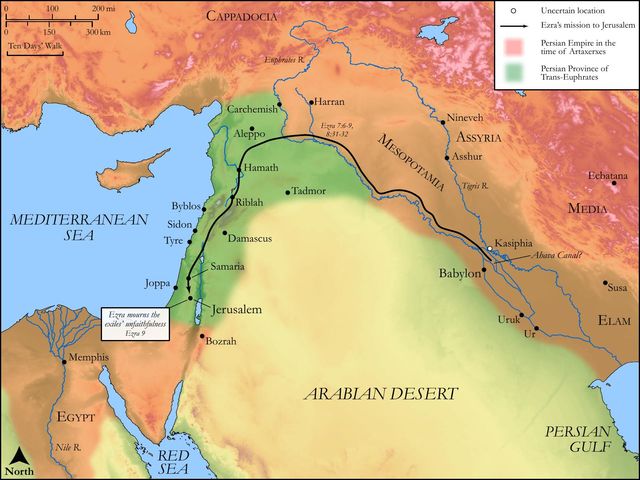
See on the biblical-era map
Study this verse
Public-domain commentary
Matthew Henry
From his Commentary on the Whole Bible. Henry comments on passages, not single verses — this entry covers Ezra 7:11–26. His three-level outline is real structure in the source text, so it is rendered as structure.
We have here the commission which the Persian emperor granted to Ezra, giving him authority to act for the good of the Jews; and it is very ample and full, and beyond what could have been expected. The commission runs, we suppose, in the usual form: Artaxerxes, King of kings. This however is too high a title for any mortal man to assume; he was indeed king of some kings, but to speak as if he were king of all kings was to usurp his prerogative who hath all power both in heaven and in earth. He sends greeting to his trusty and well-beloved Ezra, whom he calls a scribe of the law of the God of heaven (Ezr 7:12), a title which (it seems by this) Ezra valued himself by, and desired no other, no, not when he was advanced to the proconsular dignity. He reckoned it more his honour to be a scribe of God's law than to be a peer or prince of the empire. Let us observe the articles of this commission.
I.He gives Ezra leave to go up to Jerusalem, and as many of his countrymen as pleased to go up with him, Ezr 7:13.
He and they were captives, and therefore they would not quit his dominions without his royal license.
II.He gives him authority to enquire into the affairs of Judah and Jerusalem, Ezr 7:14.
The rule of his enquiry was to be the law of his God, which was in his hand. He must enquire whether the Jews, in their religion, had and did according to that law - whether the temple was built, the priesthood was settled, and the sacrifices were offered conformably to the divine appointment. If, upon enquiry, he found any thing amiss, he must see to get it amended, and, like Titus in Crete, must set in order the things that were wanting, Tit 1:5. Thus is God's law magnified and made honourable, and thus are the Jews restored to their ancient privilege of governing themselves by that law, and are no longer under the statutes that were not good, the statutes of their oppressors, Eze 20:25.
III.He entrusts him with the money that was freely given by the king himself and his counsellors, and collected among his subjects, for the service of the house of God, Ezr 7:15, Ezr 7:16.
1.Let this be taken notice of,
(1.)To the honour of God, as the one only living and true God;' for even those that worshipped other gods were so convinced of the sovereignty of the God of Israel that they were willing to incur expenses in order to recommend themselves to his favour. See Psa 45:12; Psa 68:26.
(2.)To the praise of this heathen king, that he honoured the God of Israel though his worshippers were a despicable handful of poor men, who were not able to bear the charges of their own religion and were now his vassals, and that, though he was not wrought upon to quit his own superstitions, yet he protected and encouraged the Jews in their religion, and did not only say, Be you warmed, and be you filled, but gave them such things as they needed.
(3.)To the reproach of the memory of the wicked kings of Judah. Those that had been trained up in the knowledge and worship of the God of Israel, and had his law and his prophets, often plundered and impoverished the temple; but here a heathen prince enriched it. Thus afterwards the gospel was rejected by the Jews, but welcomed by the Gentiles. See Rom 11:11, Through their fall salvation has come to the Gentiles. Act 13:46.
2.We are here told that Ezra was entrusted,
(1.)To receive this money and to carry it to Jerusalem; for he was a man of known integrity, whom they could confide in, that he would not convert to his own use the least part of that which was given to the public. We find Paul going to Jerusalem upon such an errand, to bring alms to his nation and offerings, Act 24:17.
(2.)To lay out this money in the best manner, in sacrifices to be offered upon the altar of God (Ezr 7:17), and in whatever else he or his brethren thought fit (Ezr 7:18), with this limitation only that it should be after the will of their God, which they were better acquainted with than the king was. Let the will of our God be always our rule in our expenses, and particularly in what we lay out for his service. God's work must always be done according to his will. Besides money, he had vessels also given him for the service of the temple, Ezr 7:19. Cyrus restored what of right belonged to the temple, but these were given over and above: thus it receiveth its own with usury. These he must deliver before the God of Jerusalem, as intended for his honour, there where he had put his name.
IV.He draws him a bill, or warrant rather, upon the treasurers on that side the river, requiring them to furnish him with what he had occasion for out of the king's revenues, and to place it to the king's account, Ezr 7:20, Ezr 7:22. This was considerately done; for Ezra, having yet to enquire into the sate of things, knew not what he should have occasion for and was modest in his demand. It was also kindly done, and evinced a great affection to the temple and a great confidence in Ezra. It is the interest of princes and great men to use their wealth and power for the support and encouragement of religion. What else are great revenues good for but that they enable men to do much good of this kind if they have but hearts to do it?
V.He charges him to let nothing be wanting that was requisite to be done in or about the temple for the honour of the God of Israel. Observe, in this charge (Ezr 7:23),
1.How honourably he speaks of God. He had called him before the God of Jerusalem; but here, lest it should be thought that he looked upon him as a local deity, he calls him twice, with great veneration, the God of heaven.
2.How strictly he eyes the word and law of God, which, it is likely, he had read and admired: "Whatsoever is commanded by your God" (whose institutions, though he wrote himself King of kings, he would not presume in the least iota or tittle to alter or add to) "let it be done, let it be diligently done, with care and speed." And,
3.How solicitously he deprecates the wrath of God: Why should there be wrath against the realm? The neglect and contempt of religion bring the judgments of God upon kings and kingdoms; and the likeliest expedient to turn away his wrath, when it is ready to break out against a people, is to support and encourage religion. Would we secure our peace and prosperity? Let us take care that the cause of God be not starved.
VI.He exempts all the ministers of the temple from paying taxes to the government.
From the greatest of the priests to the least of the Nethinim, it shall not be lawful for the king's officers to impose that toll, tribute, or custom upon them, which the rest of the king's subjects paid, Ezr 7:24. This put a great honour upon them as free denizens of the empire, and would gain them respect as favourites of the crown; and it gave them liberty to attend their ministry with more cheerfulness and freedom. We suppose it was only what they needed for themselves and their families, and the maintenance of their ministry, that was hereby allowed to come to them custom-free. If any of them should take occasion from this privilege to meddle in trade and merchandise, they justly lost the benefit of it.
VII.He empowers Ezra to nominate and appoint judges and magistrates for all the Jews on that side the river, Ezr 7:25, Ezr 7:26.
It was a great favour to the Jews to have such nobles of themselves, and especially to have them of Ezra's nomination.
1.All that knew the laws of Ezra's God (that is, all that professed the Jewish religion) were to be under the jurisdiction of these judges, which intimates that they were exempted from the jurisdiction of the heathen magistrates.
2.These judges were allowed and encouraged to make proselytes: Let them teach the laws of God to those that do not know them. Though he would not turn Jew himself, he cared not how many of his subjects did.
3.They were authorized to enforce the judgments they gave, and the orders they made, conformable to the law of God (which was hereby made the law of the king), with severe penalties - imprisonment, banishment, fine, or death, according as their law directed. They were not allowed to make new laws, but must see the laws of God duly executed; and they were entrusted with the sword in order that they might be a terror to evil doers. What could Jehoshaphat, or Hezekiah, or David himself, as king, have done more for the honour of God and the furtherance of religion?
Historical interpretation
Historical reception
1 surviving comment on this verse from the historical church.
But salt without measure. Everything that pertains to the rite, etc. It is agreed by all that salt signifies wisdom, whence in common speech dull-witted people are called tasteless; but it matters what kind of salt it is. For the Lord also commanded that in every sacrifice salt be offered (Levit. II), and in the Gospel He says: Have salt in yourselves and be at peace with one another (Mark IX). Nor is it in vain that David is read to have struck the Edomites in the Valley of Salt, because surely we are commanded to offer the salt of heavenly wisdom, by which catechumens are initiated, in all our works' sacrifices. David indeed strikes the Salt Pans of the valleys with their inhabitants, as Christ destroys weak and worldly wisdom along with its followers. Hence it is well ordered now that salt be given diligently without measure in the house of the God of heaven; because it is surely necessary that whatever wisdom anyone has, they should exhibit it all in service to their Creator. And it is to be recalled that the Samaritans, writing to another Artaxerxes, were said to have mentioned the salt they had eaten in the palace, and therefore could not tolerate that the temple and the city of God be built against his interests. But now here Artaxerxes commands all the guardians of the public treasury, among other donations, to give their salt to the house of the God of heaven as much as is needed. For it is recognized there that heretics sometimes are emboldened to attack the Church with the deceitful taste of human wisdom. But here it is implied that those converted to the faith at the same time as wisdom often assist that very faith through the discipline of the same secular wisdom, as they more powerfully conquer its adversaries through it.
Continue studying Ezra 7:22 across the web’s major study libraries — every link below opens this exact verse, chapter, or book on the destination site.
Read & Compare
 BibleGatewayThis verse in more than 200 translations and 70 languages.
 Bible.comThe YouVersion reader — hundreds of translations, reading plans, and highlights.
 ESV.orgCrossway's official English Standard Version reader.
 NET BibleThe NET translation with 60,000+ translators' notes on every rendering decision.
 STEP BibleTyndale House's free study tool — original text, vocabulary, and scholarly resources.
 BibliaLogos Bible Software's free web reader.
 USCCBThe New American Bible (Revised Edition) with the U.S. bishops' study notes.
Commentaries
 BibleHub CommentariesDozens of classic commentaries on this verse, gathered on one page.
 StudyLightMore than 100 commentary sets — the largest collection on the web.
 BibleRefPlain-English commentary on what this verse means, verse by verse.
 Enduring WordDavid Guzik's free commentary on this chapter, widely used by Bible teachers.
 Bible Study ToolsVerse commentary alongside Greek and Hebrew study aids.
Original Language & Research
- BibleHub InterlinearThe verse word by word — original language, transliteration, and English.
- BibleHub LexiconEvery word's original-language definition and Strong's entry.
 Blue Letter BibleDeep-study tools — Strong's numbers, concordance, and word studies.
 SefariaThe Hebrew text with Rashi and centuries of Jewish commentary.
Sermons, Hymns & Audio


TrulyRandomVerse is not affiliated with these sites and doesn’t control their content. They’re linked because they’re genuinely useful.
Summary
Ezra 7:22 meticulously details the extensive provisions decreed by King Artaxerxes I of Persia for the temple service in Jerusalem, enumerating vast quantities of silver, wheat, wine, and oil, alongside an unlimited supply of salt. This royal generosity was designed to support the restored worship practices and sustain the Levitical personnel, powerfully illustrating God's sovereign orchestration of the post-exilic return and the re-establishment of His people's spiritual life.
Context
ShowHideLiterary Context
Ezra 7:22 is situated within the crucial royal decree of King Artaxerxes I, recorded in Ezra 7:11-26. This decree is a pivotal moment in the book of Ezra, marking the authorization for Ezra, a priest and skilled scribe, to lead a second wave of Jewish exiles back to Jerusalem. While the initial return under Zerubbabel focused on rebuilding the physical temple structure, Ezra's mission was profoundly spiritual: to restore proper worship, enforce the Mosaic Law, and re-establish the spiritual order of the community. The specific and generous provisions detailed in this verse are not mere bureaucratic footnotes; they are foundational for the daily sacrifices, offerings, and the overall functionality of the temple as the vibrant center of Israelite worship, signifying the king's full endorsement and substantial material support for Ezra's divinely inspired task. This detailed list underscores the practical necessities for maintaining the temple's operations and the personnel serving within it, ensuring the continuity of the covenant relationship between God and His people.
Historical & Cultural Context
The historical backdrop for Ezra 7:22 is the mid-5th century BCE, during the reign of Artaxerxes I (465-424 BCE), a powerful monarch of the vast Achaemenid Persian Empire. Following the Babylonian exile, Persian imperial policy, famously initiated by Cyrus the Great (as seen in Ezra 1:1-4), generally permitted and often encouraged subject peoples to return to their homelands and worship their respective deities. This policy was pragmatic, fostering stability within the diverse empire by appeasing local populations and potentially believing that the gods of these peoples would bless the Persian realm. Artaxerxes' decree to Ezra was thus part of a broader imperial strategy that viewed the restoration of local cults as beneficial for imperial control and order. The lavishness of the provisions, including immense quantities of precious metals and foodstuffs, reflects the immense wealth of the Persian Empire and the king's absolute authority to allocate such vast resources. Furthermore, the meticulous detail of the decree highlights the sophisticated bureaucratic precision of the Persian administration and the significant value placed on temple cults, even by a pagan ruler, for maintaining social cohesion.
Key Themes
ShowHideThis verse powerfully encapsulates several key themes central to the book of Ezra and the broader post-exilic narrative. Firstly, it prominently displays Divine Providence through Royal Decree, demonstrating God's sovereign ability to work through unexpected channels—even pagan kings like Artaxerxes—to accomplish His redemptive purposes for His people's restoration. Artaxerxes' decree, though undoubtedly rooted in political considerations, was ultimately a testament to God's overarching plan for the spiritual and physical rebuilding of Jerusalem, as highlighted in Proverbs 21:1. Secondly, the Generous Provision for Worship is strikingly evident in the specified amounts: one hundred talents of silver, one hundred measures of wheat, one hundred baths of wine, and one hundred baths of oil. This abundance underscores the king's (and by extension, God's) commitment to the sanctity and proper functioning of the temple worship, ensuring that the necessary elements for sacrifices and offerings were readily available. Thirdly, the verse directly contributes to the theme of the Restoration of Temple Service, as these supplies were indispensable for the various offerings and ceremonies prescribed by the Mosaic Law, allowing the temple in Jerusalem to once again function as the vibrant center of Israelite worship, fulfilling the vision of a restored covenant community. Finally, the phrase "salt without prescribing" highlights an Unrestricted Supply for a crucial commodity, not only for food preservation but also for its symbolic significance as a required component in grain offerings (as seen in Leviticus 2:13) and as a symbol of an enduring covenant (as referenced in Numbers 18:19). This open-ended provision emphasizes the unreserved support for the temple's needs, mirroring God's boundless faithfulness.
Exposition and Analysis
ShowHideKey Word Analysis
ShowHideCorresponding to the Hebrew kikkār, this term refers to a talent, which was a very large unit of weight, typically around 75 pounds (or approximately 34 kilograms). One hundred talents of silver, therefore, represented an immense sum, equivalent to roughly 7,500 pounds (over 3,400 kg) of silver. This quantity signifies an extraordinary level of royal generosity and the significant financial resources dedicated to the temple's restoration and ongoing service. It underscores the king's serious commitment to Ezra's mission and the substantial value placed on the temple.
This term, corresponding to the Hebrew kôr, denotes a dry measure. Properly, it refers to a deep round vessel, and specifically, a cor or measure for dry goods. A kôr was roughly equivalent to 10 baths or about 6.2 bushels (approximately 220 liters). One hundred kôr of wheat would have been a substantial amount, providing ample grain for daily offerings, sustenance for the temple personnel, and potentially for the general population in need, highlighting the comprehensive nature of the royal provision.
Corresponding to the Hebrew bath, this was a liquid measure, approximately 6 gallons (or about 22 liters). One hundred baths of wine and one hundred baths of oil represent significant quantities for both libation offerings (wine) and for anointing, lamps, and food preparation (oil). These provisions were crucial for the regular functioning of the temple rituals and the daily lives of those serving there, ensuring the continuity of sacred practices.
This term refers to salt, a vital commodity in the ancient world for preservation and seasoning. In the context of the temple, salt was explicitly required for grain offerings (Leviticus 2:13) and symbolized permanence and covenant. The phrase "salt without prescribing" (Aramaic, _lâʼ _kᵉthâb'__, literally "not written") means "without a written limit" or "unlimited." This unquantified provision emphasizes the king's complete and unreserved commitment to providing whatever was necessary for the temple's needs, echoing the boundless provision of God.
Verse Breakdown
ShowHide"Unto an hundred talents of silver"
This opening clause immediately establishes the immense scale of the king's generosity. The "hundred talents" signifies an enormous sum of precious metal, indicating a substantial financial endowment for the temple's needs, including repairs, purchase of sacrificial animals, and general expenses. This was not a token gesture but a significant investment, demonstrating the king's earnest support for the temple's restoration.
"and to an hundred measures of wheat"
Following the silver, the decree specifies an equally generous provision of staple food. "Measures" (kor) of wheat would have provided sustenance for the priests and Levites, and also been used for the various grain offerings and bread required for temple rituals. This ensured the practical needs of the temple community were met, allowing them to focus on their sacred duties without material concern.
"and to an hundred baths of wine, and to an hundred baths of oil"
These liquid provisions were essential for the daily functioning of the temple. Wine was used for libations, accompanying sacrifices, and for the priests' consumption. Oil was vital for anointing, for the lamps in the temple (such as the menorah), and for preparing offerings. The identical quantity for both underscores their equal importance in the temple's liturgical and practical life, ensuring all aspects of worship were well-supplied.
"and salt without prescribing [how much]"
This final clause highlights a unique aspect of the decree: an unlimited supply of salt. Salt was crucial for food preservation and, more significantly, was a required component in every grain offering (Leviticus 2:13), symbolizing purity, permanence, and the enduring nature of the covenant. The absence of a prescribed limit emphasizes the king's full commitment to ensuring all necessary elements for worship were available without constraint, reflecting a profound and unreserved support.
Literary Devices
ShowHideEzra 7:22 employs several literary devices to convey its message of lavish provision and divine orchestration. The repeated use of "an hundred" for silver, wheat, wine, and oil creates a sense of Hyperbole or extreme abundance, emphasizing the extraordinary generosity of the king's decree. This numerical Repetition also lends a rhythmic, almost poetic quality to the list, highlighting the comprehensive and systematic nature of the provisions. The inclusion of "salt without prescribing" serves as a powerful Symbolism, as salt in ancient Israel represented permanence, purity, and the enduring nature of covenants (e.g., a "covenant of salt" in Numbers 18:19). Its unlimited provision thus symbolizes an unreserved and lasting commitment to the temple's needs, echoing God's own boundless faithfulness. The entire decree, as presented in Ezra, functions as a narrative device to illustrate Divine Providence, showcasing how God sovereignly works through human instruments, even pagan rulers, to accomplish His redemptive purposes for His people.
Theological and Thematic Connections
ShowHideEzra 7:22 stands as a powerful testament to God's faithful and abundant provision for His people and His work, often utilizing unexpected channels. The lavish decree of a pagan king, Artaxerxes, for the restoration of temple worship in Jerusalem, demonstrates God's sovereignty over all earthly powers. It reminds us that God is not limited by human political structures or religious affiliations; He can move the hearts of rulers and orchestrate circumstances to ensure His purposes are fulfilled and His people are sustained. This verse underscores that when God calls His people to a task, He also provides the necessary resources, whether directly or through the generosity of others. It highlights the principle that God's kingdom work is never hindered by a lack of resources, but rather by a lack of faith or obedience, encouraging us to trust fully in His unfailing supply for every need.
Reflection and Application
ShowHideThe detailed provisions in Ezra 7:22 offer profound lessons for contemporary believers. Firstly, they serve as a powerful reminder of God's boundless generosity and His unwavering commitment to sustaining His work in the world. Just as He moved the heart of Artaxerxes to provide for the physical temple in Jerusalem, so too does He continue to provide for His spiritual temple—the Church—and its global mission today. This should cultivate a deep and abiding trust in God's provision, encouraging us to step out in faith, knowing that He will equip us for every good work He calls us to undertake. Secondly, this verse challenges us to consider our own role in God's economy. The king's lavish giving for the temple inspires us to be generous stewards of the resources God has entrusted to us, whether financial, material, or spiritual. Our contributions, no matter how small or large, are vital for the continued spread of the Gospel, the building up of the body of Christ, and the compassionate care of those in need. It calls us to participate cheerfully and sacrificially in God's ongoing work, recognizing that our giving is an act of worship, a tangible expression of our faith, and a partnership with the divine plan for redemption and restoration.
Questions for Reflection
ShowHideFAQ
ShowHideWhy did a pagan king like Artaxerxes provide such lavish support for the Jewish temple?
ShowHideKing Artaxerxes' decree, while seemingly altruistic, was likely rooted in a complex combination of political pragmatism and divine influence. From a political standpoint, the Persian Empire generally adopted a policy of religious tolerance and support for local cults within its vast territories. By allowing and even funding the restoration of temples and religious practices, Persian kings fostered stability, gained the loyalty of their diverse subject peoples, and potentially believed that the gods of these peoples would bless the empire. Furthermore, the decree explicitly states that Ezra was to ensure the law of God was observed, which would contribute to order and governance in the province. However, the biblical narrative consistently attributes such acts to God's sovereign hand, moving the hearts of kings (as seen in Proverbs 21:1). Thus, while Artaxerxes had his own reasons, the ultimate explanation for this extraordinary generosity is divine providence, fulfilling God's plan for the restoration of His people after the Babylonian exile and the re-establishment of proper worship in Jerusalem.
What is the significance of "salt without prescribing"?
ShowHideThe phrase "salt without prescribing" (literally "salt without writing") signifies an unlimited, unquantified provision of salt. This holds both practical and profound symbolic significance. Practically, salt was a vital commodity in the ancient world for food preservation and as a seasoning. Symbolically, salt held deep meaning in Israelite culture and worship. It was a required component in every grain offering presented to the Lord, symbolizing purity, preservation, and the enduring nature of the covenant (as commanded in Leviticus 2:13). Furthermore, a "covenant of salt" (as mentioned in Numbers 18:19 and 2 Chronicles 13:5) denoted an unbreakable, perpetual agreement. Therefore, providing salt without limit underscored the king's deep commitment to the temple's needs and, more profoundly, reflected God's own boundless and enduring faithfulness to His covenant with Israel, ensuring that nothing essential for pure and lasting worship would ever be lacking.
Christ-Centered Fulfillment
ShowHideThe lavish provisions for the temple in Ezra 7:22 find their ultimate and most profound fulfillment in Jesus Christ. The silver, wheat, wine, and oil, meticulously detailed for the temple's sustenance and sacrificial system, all point forward to the perfect and all-sufficient provision found in the person and work of Christ. The Old Testament temple, with its sacrifices and offerings, served as a shadow of the reality to come, and Jesus is that reality (Hebrews 10:1). He is the ultimate Lamb of God, whose single, perfect sacrifice on the cross forever atoned for sin, rendering the continuous animal sacrifices unnecessary (Hebrews 9:11-14). The wine and oil, used for libations and anointing, foreshadow the new covenant established in Christ's blood (Luke 22:20) and the anointing of the Holy Spirit, which believers receive through Him (1 John 2:27). Moreover, the "salt without prescribing," symbolizing an enduring covenant, is fully realized in the eternal covenant of grace secured by Christ, a covenant that will never be broken or diminished (Jeremiah 31:31-34). Just as Artaxerxes provided without limit for the physical temple, God the Father provided His Son without reservation, the ultimate and inexhaustible provision for our spiritual needs, making us living temples of the Holy Spirit (1 Corinthians 6:19), complete in Him (Colossians 2:10).