


Ezra 7:15
Bible text: King James Version (1769 Blayney text) · Public domain
Bible text: King James Version with Strong's numbers · Public domain
Bible text: Berean Standard Bible · Public domain
Bible text: American Standard Version (1901) · Public domain
Bible text: World English Bible, Messianic edition · Public domain
Bible text: Geneva Bible (1599) · Public domain
Bible text: Young's Literal Translation · Public domain
- וּלְהֵיבָלָהu·le·hei·va·Lahand to carryH2987Conj-w ¦ Prep-l ¦ V-Hiphil-InfVerb Hiphil Infinitive Constructוּandלְtoהֵיבָלָהcarry
- כְּסַףke·SafsilverH3702N-csNoun Singular common gender Absolute
- וּדְהַבu·de·Havand goldH1722Conj-w ¦ N-csNoun Singular common gender Absoluteוּandדְהַבgold
- דִּיdiwhichH1768ConjConjunction
- מַלְכָּאmal·Ka'king theH4430N-cs ¦ ArtNoun Singular common gender Definiteמַלְכָּkingאthe
- וְיָעֲטוֹהִיve·ya·'a·To·hiand his counselorsH3272Conj-w ¦ V-Qal-Prtcpl-mp ¦ 3msVerb Qal Participle Plural Masculine Constructוְandיָעֲטוֹcounselorsהִיhis
- הִתְנַדַּבוּhit·na·Da·vuthey have offered freelyH5069V-Hitpaal-Perf-3mpVerb Hitpaal Perfect 3rd Plural Masculine
- לֶאֱלָהּle·'e·Lahto [the] God ofH426Prep-l ¦ N-cscNoun Singular common gender Constructלֶtoאֱלָהּ[the] God of
- יִשְׂרָאֵלYis·ra·'ElIsraelH3479N-properNoun Proper Location
- דִּיdiwhoH1768ConjConjunction
- בִירוּשְׁלֶםvi·ru·she·Lem[is] in JerusalemH3390Prep-b ¦ N-properNoun Proper Locationבִ[is] inירוּשְׁלֶםJerusalem
- מִשְׁכְּנֵהּmish·ke·Nehhis abodeH4907N-csc ¦ 3msNoun Singular common gender Constructמִשְׁכְּנֵabodeהּhis
English is a literal word-by-word gloss of the Hebrew, not the KJV's wording. Why?
This is the original text the KJV's translators worked from — each Hebrew word with its own literal English meaning in this verse, prepared by scholars at Tyndale House, Cambridge. The KJV translates whole sentences, not word by word, so its wording differs: one Hebrew word can become several English words, and the KJV may choose “the LORD” where the gloss reads “Yahweh”. Both are faithful — they answer different questions. For the KJV's own rendering, switch to the KJV text.
Details
See on the biblical-era map
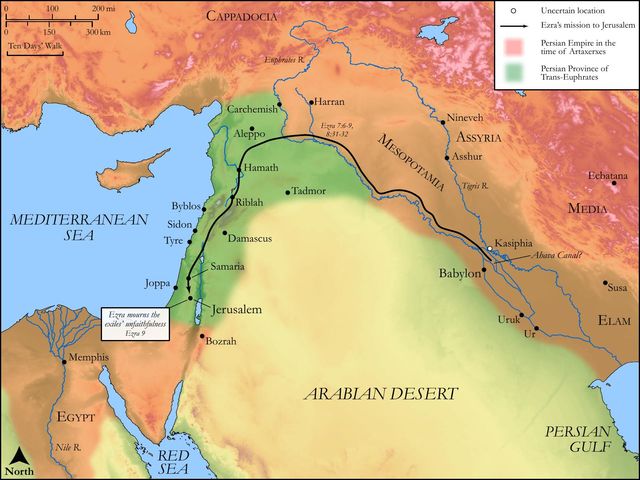
Study this verse
Public-domain commentary
Matthew Henry
From his Commentary on the Whole Bible. Henry comments on passages, not single verses — this entry covers Ezra 7:11–26. His three-level outline is real structure in the source text, so it is rendered as structure.
We have here the commission which the Persian emperor granted to Ezra, giving him authority to act for the good of the Jews; and it is very ample and full, and beyond what could have been expected. The commission runs, we suppose, in the usual form: Artaxerxes, King of kings. This however is too high a title for any mortal man to assume; he was indeed king of some kings, but to speak as if he were king of all kings was to usurp his prerogative who hath all power both in heaven and in earth. He sends greeting to his trusty and well-beloved Ezra, whom he calls a scribe of the law of the God of heaven (Ezr 7:12), a title which (it seems by this) Ezra valued himself by, and desired no other, no, not when he was advanced to the proconsular dignity. He reckoned it more his honour to be a scribe of God's law than to be a peer or prince of the empire. Let us observe the articles of this commission.
I.He gives Ezra leave to go up to Jerusalem, and as many of his countrymen as pleased to go up with him, Ezr 7:13.
He and they were captives, and therefore they would not quit his dominions without his royal license.
II.He gives him authority to enquire into the affairs of Judah and Jerusalem, Ezr 7:14.
The rule of his enquiry was to be the law of his God, which was in his hand. He must enquire whether the Jews, in their religion, had and did according to that law - whether the temple was built, the priesthood was settled, and the sacrifices were offered conformably to the divine appointment. If, upon enquiry, he found any thing amiss, he must see to get it amended, and, like Titus in Crete, must set in order the things that were wanting, Tit 1:5. Thus is God's law magnified and made honourable, and thus are the Jews restored to their ancient privilege of governing themselves by that law, and are no longer under the statutes that were not good, the statutes of their oppressors, Eze 20:25.
III.He entrusts him with the money that was freely given by the king himself and his counsellors, and collected among his subjects, for the service of the house of God, Ezr 7:15, Ezr 7:16.
1.Let this be taken notice of,
(1.)To the honour of God, as the one only living and true God;' for even those that worshipped other gods were so convinced of the sovereignty of the God of Israel that they were willing to incur expenses in order to recommend themselves to his favour. See Psa 45:12; Psa 68:26.
(2.)To the praise of this heathen king, that he honoured the God of Israel though his worshippers were a despicable handful of poor men, who were not able to bear the charges of their own religion and were now his vassals, and that, though he was not wrought upon to quit his own superstitions, yet he protected and encouraged the Jews in their religion, and did not only say, Be you warmed, and be you filled, but gave them such things as they needed.
(3.)To the reproach of the memory of the wicked kings of Judah. Those that had been trained up in the knowledge and worship of the God of Israel, and had his law and his prophets, often plundered and impoverished the temple; but here a heathen prince enriched it. Thus afterwards the gospel was rejected by the Jews, but welcomed by the Gentiles. See Rom 11:11, Through their fall salvation has come to the Gentiles. Act 13:46.
2.We are here told that Ezra was entrusted,
(1.)To receive this money and to carry it to Jerusalem; for he was a man of known integrity, whom they could confide in, that he would not convert to his own use the least part of that which was given to the public. We find Paul going to Jerusalem upon such an errand, to bring alms to his nation and offerings, Act 24:17.
(2.)To lay out this money in the best manner, in sacrifices to be offered upon the altar of God (Ezr 7:17), and in whatever else he or his brethren thought fit (Ezr 7:18), with this limitation only that it should be after the will of their God, which they were better acquainted with than the king was. Let the will of our God be always our rule in our expenses, and particularly in what we lay out for his service. God's work must always be done according to his will. Besides money, he had vessels also given him for the service of the temple, Ezr 7:19. Cyrus restored what of right belonged to the temple, but these were given over and above: thus it receiveth its own with usury. These he must deliver before the God of Jerusalem, as intended for his honour, there where he had put his name.
IV.He draws him a bill, or warrant rather, upon the treasurers on that side the river, requiring them to furnish him with what he had occasion for out of the king's revenues, and to place it to the king's account, Ezr 7:20, Ezr 7:22. This was considerately done; for Ezra, having yet to enquire into the sate of things, knew not what he should have occasion for and was modest in his demand. It was also kindly done, and evinced a great affection to the temple and a great confidence in Ezra. It is the interest of princes and great men to use their wealth and power for the support and encouragement of religion. What else are great revenues good for but that they enable men to do much good of this kind if they have but hearts to do it?
V.He charges him to let nothing be wanting that was requisite to be done in or about the temple for the honour of the God of Israel. Observe, in this charge (Ezr 7:23),
1.How honourably he speaks of God. He had called him before the God of Jerusalem; but here, lest it should be thought that he looked upon him as a local deity, he calls him twice, with great veneration, the God of heaven.
2.How strictly he eyes the word and law of God, which, it is likely, he had read and admired: "Whatsoever is commanded by your God" (whose institutions, though he wrote himself King of kings, he would not presume in the least iota or tittle to alter or add to) "let it be done, let it be diligently done, with care and speed." And,
3.How solicitously he deprecates the wrath of God: Why should there be wrath against the realm? The neglect and contempt of religion bring the judgments of God upon kings and kingdoms; and the likeliest expedient to turn away his wrath, when it is ready to break out against a people, is to support and encourage religion. Would we secure our peace and prosperity? Let us take care that the cause of God be not starved.
VI.He exempts all the ministers of the temple from paying taxes to the government.
From the greatest of the priests to the least of the Nethinim, it shall not be lawful for the king's officers to impose that toll, tribute, or custom upon them, which the rest of the king's subjects paid, Ezr 7:24. This put a great honour upon them as free denizens of the empire, and would gain them respect as favourites of the crown; and it gave them liberty to attend their ministry with more cheerfulness and freedom. We suppose it was only what they needed for themselves and their families, and the maintenance of their ministry, that was hereby allowed to come to them custom-free. If any of them should take occasion from this privilege to meddle in trade and merchandise, they justly lost the benefit of it.
VII.He empowers Ezra to nominate and appoint judges and magistrates for all the Jews on that side the river, Ezr 7:25, Ezr 7:26.
It was a great favour to the Jews to have such nobles of themselves, and especially to have them of Ezra's nomination.
1.All that knew the laws of Ezra's God (that is, all that professed the Jewish religion) were to be under the jurisdiction of these judges, which intimates that they were exempted from the jurisdiction of the heathen magistrates.
2.These judges were allowed and encouraged to make proselytes: Let them teach the laws of God to those that do not know them. Though he would not turn Jew himself, he cared not how many of his subjects did.
3.They were authorized to enforce the judgments they gave, and the orders they made, conformable to the law of God (which was hereby made the law of the king), with severe penalties - imprisonment, banishment, fine, or death, according as their law directed. They were not allowed to make new laws, but must see the laws of God duly executed; and they were entrusted with the sword in order that they might be a terror to evil doers. What could Jehoshaphat, or Hezekiah, or David himself, as king, have done more for the honour of God and the furtherance of religion?
Historical interpretation
Historical reception
1 surviving comment on this verse from the historical church.
And to bring silver and gold, etc. Note the faith and wisdom of the king and his counselors, who understood that the gifts they wished to offer to the Lord should be offered through him who had the law of God in his hand, that is, fulfilled it in deeds. It is wondrous to say, how faithfully and learnedly the king declares that he has a tabernacle in Jerusalem, whom he previously called the God of heaven; for we are accustomed to use a tabernacle on a journey, and the God of heaven has a tabernacle in Jerusalem; because he who has an eternal seat in the heavens deigns to dwell for a time with the saints who are on pilgrimage in this Church. Hence that passage of Revelation, "Behold, the tabernacle of God is with men" (Rev. 21). Indeed, because the blessed Ezra represented not only the preachers of the holy Church, among whom he was one, but also the Lord Savior, to whose members he belonged, it is as if we offer our gifts through him, whose help we need in all things, so that the good works we do may be acceptable to God the Father. For no one, he says, comes to the Father except through me (John 6). And concerning him, John says, "He is the atonement for our sins" (1 John 2).
Continue studying Ezra 7:15 across the web’s major study libraries — every link below opens this exact verse, chapter, or book on the destination site.
Read & Compare
 BibleGatewayThis verse in more than 200 translations and 70 languages.
 Bible.comThe YouVersion reader — hundreds of translations, reading plans, and highlights.
 ESV.orgCrossway's official English Standard Version reader.
 NET BibleThe NET translation with 60,000+ translators' notes on every rendering decision.
 STEP BibleTyndale House's free study tool — original text, vocabulary, and scholarly resources.
 BibliaLogos Bible Software's free web reader.
 USCCBThe New American Bible (Revised Edition) with the U.S. bishops' study notes.
Commentaries
 BibleHub CommentariesDozens of classic commentaries on this verse, gathered on one page.
 StudyLightMore than 100 commentary sets — the largest collection on the web.
 BibleRefPlain-English commentary on what this verse means, verse by verse.
 Enduring WordDavid Guzik's free commentary on this chapter, widely used by Bible teachers.
 Bible Study ToolsVerse commentary alongside Greek and Hebrew study aids.
Original Language & Research
- BibleHub InterlinearThe verse word by word — original language, transliteration, and English.
- BibleHub LexiconEvery word's original-language definition and Strong's entry.
 Blue Letter BibleDeep-study tools — Strong's numbers, concordance, and word studies.
 SefariaThe Hebrew text with Rashi and centuries of Jewish commentary.
Sermons, Hymns & Audio


TrulyRandomVerse is not affiliated with these sites and doesn’t control their content. They’re linked because they’re genuinely useful.
Summary
Ezra 7:15 captures a pivotal moment in the post-exilic restoration of Jerusalem, detailing the generous contribution of silver and gold by King Artaxerxes and his counselors. These precious metals were freely offered for the service of the God of Israel, whose sacred dwelling place was established in Jerusalem. This verse underscores divine providence, demonstrating how God can sovereignly move the hearts of even pagan rulers to support His purposes, specifically the beautification and resourcing of the temple and the re-establishment of Mosaic Law in the Holy City through Ezra.
Context
ShowHideLiterary Context
Ezra 7:15 is situated within the broader narrative of Ezra's return to Jerusalem, specifically detailing the decree issued by King Artaxerxes I Longimanus (465-424 BC). This chapter marks a significant turning point in the book of Ezra, shifting focus from the initial return under Zerubbabel and the completion of the Second Temple in Ezra 6 to the spiritual and legal restoration led by Ezra. The preceding verses (Ezra 7:11-14) outline the king's official letter, granting Ezra extensive authority as a scribe "skilled in the Law of Moses" to transport temple vessels, collect offerings, and implement God's law. Verse 15 specifically details the king's personal contribution, alongside his counselors, of valuable resources, emphasizing the royal endorsement and provision for the temple and its services. This sets the stage for Ezra's journey and his subsequent reforms, demonstrating a divinely orchestrated provision for the spiritual renewal of the Jewish community.
Historical & Cultural Context
The events of Ezra 7 unfold during the Persian Empire's dominion over Judah, a period following the Babylonian exile. The Achaemenid Persian kings, while polytheistic, often adopted a policy of religious tolerance and even patronage towards the diverse peoples within their vast empire, provided it ensured stability and loyalty. Artaxerxes' decree, therefore, while remarkable, fits within this broader imperial strategy. The "God of Israel, whose habitation is in Jerusalem" refers to the recently rebuilt Second Temple, completed in 516 BC (as recorded in Ezra 6:15). The king's offering of silver and gold was not merely a political gesture but a substantial material contribution, reflecting the immense wealth of the Persian court and the high value placed on such metals. This act also reflects the diplomatic practice of the Persian kings, who would often send gifts or resources to support cultic activities in various parts of their empire, sometimes to appease deities or secure divine favor, even from foreign gods.
Key Themes
ShowHideThis verse powerfully contributes to several overarching themes in the book of Ezra and the broader biblical narrative. Firstly, Divine Providence is prominently displayed, as God sovereignly works through unexpected channels—even a pagan king—to accomplish His will for His people. This echoes the truth found in Proverbs 21:1, which states that "The king's heart is in the hand of the Lord like channels of water; He turns it wherever He wishes." Secondly, the theme of Generosity and Support for Worship is highlighted by the "freely offered" nature of the gifts. This emphasizes the importance of voluntary and abundant contributions for the advancement of God's work, particularly in the context of temple service and the re-establishment of spiritual order. Lastly, the phrase "whose habitation is in Jerusalem" reinforces the Significance of Jerusalem and the Temple as the chosen place for God's presence among His people. Despite the exile and the destruction of the first temple, Jerusalem remains the focal point of Israel's worship and identity, signifying God's faithfulness to His covenant promises regarding His dwelling place.
Exposition and Analysis
ShowHideKey Word Analysis
ShowHideThis Aramaic verb (H2987) means "to bring" or "to carry." In the context of Ezra 7:15, it highlights the practical and logistical aspect of transporting the valuable silver and gold from the Persian court to Jerusalem. This was no small feat, requiring significant trust, security, and divine favor for Ezra and his companions to safely convey such immense wealth across a vast distance for the sacred purpose of the Temple.
This Aramaic verb (H5069) signifies a willing, spontaneous, and generous contribution, often going beyond what is strictly required or expected. It implies an act of voluntary beneficence, a freewill offering born of a willing heart. In this context, it underscores that King Artaxerxes' and his counselors' gifts were not coerced or extracted under duress, but rather presented as an act of genuine, albeit perhaps politically motivated, generosity. This emphasizes the remarkable nature of God's influence, moving even a foreign monarch to such a benevolent act towards the God of Israel.
The Aramaic noun (H4907), corresponding to the Hebrew mishkan (tabernacle), refers to a "residence" or "dwelling place." In this context, it unequivocally refers to the Temple in Jerusalem, which was considered the earthly dwelling place of God's special, manifest presence among His people. While God's omnipresence is a foundational theological truth, the Temple served as the designated locus for His prescribed worship. The phrase "whose habitation is in Jerusalem" powerfully reaffirms Jerusalem's unique theological status as the sacred center of Israelite worship and the chosen city where God had placed His name.
Verse Breakdown
ShowHide"And to carry the silver and gold"
This initial clause specifies the purpose of Ezra's mission regarding the precious metals. It implies the physical transportation of these valuable assets from the Persian capital (likely Susa or Babylon) to Jerusalem. This was not a small undertaking, requiring significant logistical planning, security, and trust, given the immense value of the cargo. The "silver and gold" were not merely currency but sacred offerings designated for the temple.
"which the king and his counsellors have freely offered"
This part identifies the source of the precious metals and the nature of their contribution. The "king and his counsellors" highlights the highest echelons of Persian power, indicating a significant, official, and unanimous decision. The phrase "freely offered" (as discussed in Key Word Analysis) emphasizes the voluntary and generous nature of their gifts, suggesting a divine influence at work in the hearts of these pagan rulers, moving them to support the God of Israel.
"unto the God of Israel, whose habitation [is] in Jerusalem"
This final clause clarifies the ultimate recipient and purpose of the offerings, as well as the theological significance of the destination. The gifts were directed "unto the God of Israel," explicitly acknowledging Him as the rightful recipient of such worship and honor. The appended phrase "whose habitation [is] in Jerusalem" serves as a theological anchor, reinforcing Jerusalem's unique status as the city where God had chosen to establish His earthly dwelling place—the Temple. This connection underscores the sacred purpose of the offerings: to beautify, maintain, and resource the very place where God's presence resided among His people.
Literary Devices
ShowHideEzra 7:15 employs several literary devices that enhance its meaning and impact. Divine Irony is powerfully present in the fact that a pagan king and his non-Israelite counselors are "freely offering" precious metals to the God of Israel. This highlights God's absolute sovereignty over all rulers and nations, demonstrating His ability to use even those outside His covenant people to accomplish His redemptive purposes. There is also clear Emphasis on the value and quantity of the offerings through the specific mention of "silver and gold," signifying the king's abundant generosity and the importance of the temple's needs. The phrase "whose habitation is in Jerusalem" functions as a powerful Theological Affirmation, reiterating Jerusalem's unique status as God's chosen dwelling place, even after the destruction of the first temple and the exile. This serves to reinforce the continuity of God's covenant promises and His enduring presence with His people in their restored homeland.
Theological and Thematic Connections
ShowHideEzra 7:15 serves as a profound theological statement on God's sovereign control over human affairs and His unwavering commitment to His people and His dwelling place. It illustrates that God's plans are not contingent on human piety alone, but He can orchestrate events and move the hearts of powerful individuals, even those outside the covenant community, to fulfill His purposes. This divine orchestration ensures that resources are provided for the advancement of His kingdom and the restoration of His worship. The voluntary nature of the king's offering also speaks to the principle of generous giving as an act of devotion and support for spiritual endeavors, reminding us that all resources ultimately belong to God and are to be used for His glory. The specific mention of Jerusalem as God's "habitation" reaffirms the enduring significance of the Temple as the center of Israel's worship and the tangible symbol of God's presence among them, setting the stage for the spiritual reforms Ezra was to enact.
Reflection and Application
ShowHideEzra 7:15 offers timeless lessons for believers today. It powerfully reminds us that God is sovereign over all earthly authorities and circumstances. Just as He moved the heart of a pagan king to contribute to His work, He can use any person, any situation, or any resource to advance His kingdom purposes. This should inspire both trust in His providence and openness to unexpected avenues of blessing and support for ministry. Furthermore, the "freely offered" nature of the gifts challenges us to consider our own generosity towards God's work. Are we giving willingly, spontaneously, and beyond what is merely required, recognizing that our material resources can be instrumental in building up His church and spreading His truth? Finally, the emphasis on Jerusalem as God's "habitation" underscores the importance of places where God's truth is taught and His worship is conducted. We are called to value, support, and participate in the life of the local church and other ministries that faithfully proclaim God's Word and facilitate His presence among His people.
Questions for Reflection
ShowHideFAQ
ShowHideWhy would a pagan king like Artaxerxes contribute to the God of Israel?
ShowHideKing Artaxerxes' contribution was likely a confluence of factors, all ultimately orchestrated by divine providence. Historically, Persian kings often adopted a policy of religious tolerance and even patronage towards the diverse cults within their empire as a means of maintaining stability and securing the favor of various deities, hoping for blessings upon their own reign and empire. Ezra's wisdom and diplomatic skill, perhaps divinely inspired, may have also played a role in gaining the king's favor. Ultimately, the biblical perspective attributes this generosity to the sovereign hand of God, who "turns the king's heart wherever He wishes" (Proverbs 21:1). It demonstrates God's ability to use unexpected instruments, even non-believers, to accomplish His purposes for His people and the advancement of His kingdom.
What was the specific purpose of the silver and gold mentioned in this verse?
ShowHideThe silver and gold were primarily intended for the beautification and service of the Second Temple in Jerusalem. Ezra 7:16-19 elaborates on their use, stating they were for "the house of your God which is in Jerusalem" and for "whatever seems good to you and your brothers to do with the rest of the silver and gold." This included purchasing animals for sacrifices, grain offerings, drink offerings, and potentially for the general upkeep and adornment of the temple structure itself. The king's decree also permitted Ezra to draw further funds from the royal treasury if needed (Ezra 7:20), underscoring the comprehensive nature of the provision for the temple's needs and the re-establishment of its full sacrificial system.
Christ-Centered Fulfillment
ShowHideEzra 7:15, with its focus on God's "habitation in Jerusalem" and the generous offerings for His temple, finds its ultimate fulfillment in Jesus Christ. The Old Testament temple, though a place of God's special presence, was a physical structure, limited by space and time, and its sacrifices were temporary. Jesus, however, is the very embodiment of God's dwelling among humanity, the true and eternal "habitation" of God. As John 1:14 declares, "The Word became flesh and dwelt among us," literally "tabernacled" among us, signifying that in Christ, God's presence is no longer confined to a building but is personally present in human form. The silver and gold offered by Artaxerxes, while valuable, were material gifts for a temporary sanctuary. Christ, in contrast, offered Himself as the ultimate and perfect sacrifice, the "Lamb of God who takes away the sin of the world" (John 1:29). His self-offering was not merely generous but complete and eternally effective, fulfilling all the types and shadows of the Old Testament sacrificial system. Furthermore, through Christ, believers themselves become "temples of the Holy Spirit" (1 Corinthians 6:19), signifying that God's dwelling place is now within His people, a spiritual reality far surpassing any physical structure. Thus, the provision for the earthly temple in Ezra 7:15 foreshadows the infinitely greater provision of God's presence and salvation found in Jesus Christ, who is our ultimate temple, sacrifice, and dwelling place.