


Ezra 6:4
Bible text: King James Version (1769 Blayney text) · Public domain
Bible text: Berean Standard Bible · Public domain
Bible text: American Standard Version (1901) · Public domain
Bible text: World English Bible, Messianic edition · Public domain
Bible text: Geneva Bible (1599) · Public domain
Bible text: Young's Literal Translation · Public domain
- נִדְבָּכִיןnid·ba·KhinrowsH5073N-mpNoun Plural Masculine Absolute
- דִּיdiofH1768ConjConjunction
- אֶבֶן'E·venstone ofH69N-cscNoun Singular common gender Construct
- גְּלָלge·LalrollingH1560N-csNoun Singular common gender Absolute
- תְּלָתָאte·la·Ta'threeH8532Adj-csAdjective Numerical Singular common gender Absolute
- וְנִדְבָּךְve·nid·Bakhand a rowH5073Conj-w ¦ N-csNoun Singular common gender Absoluteוְandנִדְבָּךְa row
- דִּיdiofH1768ConjConjunction
- אָע'a'timberH636N-csNoun Singular common gender Absolute
- חֲדַתcha·DatnewH2323Adj-csAdjective Singular common gender Absolute
- וְנִפְקְתָאve·Nif·ke·Ta'and expense theH5313Conj-w ¦ N-fs ¦ ArtNoun Singular Feminine Definiteוְandנִפְקְתָexpenseאthe
- מִןminfromH4481PrepPreposition
- בֵּיתbeit[the] house ofH1005N-cscNoun Singular common gender Construct
- מַלְכָּאmal·Ka'king theH4430N-cs ¦ ArtNoun Singular common gender Definiteמַלְכָּkingאthe
- תִּתְיְהִבtit·ye·Hivlet it be givenH3052V-Hitpael-Imperf-2msVerb Hitpael Imperfect 2nd Singular Masculine
English is a literal word-by-word gloss of the Hebrew, not the KJV's wording. Why?
This is the original text the KJV's translators worked from — each Hebrew word with its own literal English meaning in this verse, prepared by scholars at Tyndale House, Cambridge. The KJV translates whole sentences, not word by word, so its wording differs: one Hebrew word can become several English words, and the KJV may choose “the LORD” where the gloss reads “Yahweh”. Both are faithful — they answer different questions. For the KJV's own rendering, switch to the KJV text.
Details
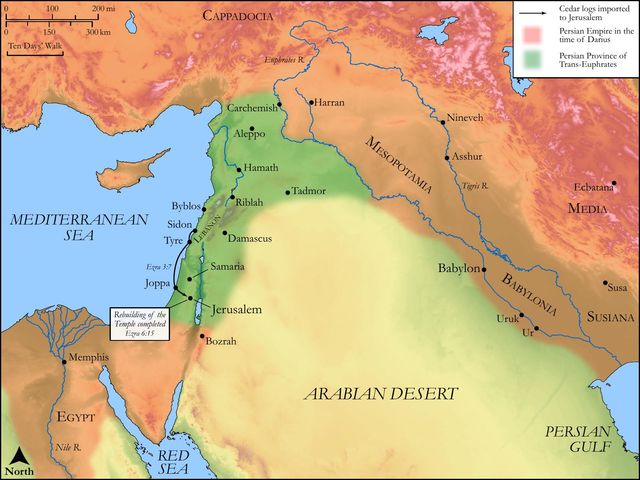
See on the biblical-era map
Study this verse
Public-domain commentary
Matthew Henry
From his Commentary on the Whole Bible. Henry comments on passages, not single verses — this entry covers Ezra 6:1–12. His four-level outline is real structure in the source text, so it is rendered as structure.
We have here, I. The decree of Cyrus for the building of the temple repeated. To this the Samaritans referred because the Jews pleaded it, and perhaps hoped it would not be found, and then their plea would be over-ruled and a stop put to their work. Search was ordered to be made for it among the records; for, it seems, the tribes had not taken care to provide themselves with an authentic copy of it, which might have stood them in good stead, but they must appeal to the original. It was looked for in Babylon (Ezr 6:1), where Cyrus was when he signed it. But, when it was not found there, Darius did not make that a pretence to conclude that therefore there was no such decree, and thereupon to give judgment against the Jews; but it is probable, having himself heard that such a decree was certainly made, he ordered the rolls in other places to be searched, and at length it was found at Achmetha, in the province of the Medes, Ezr 6:2. Perhaps some that durst not destroy it, yet hid it there, out of ill will to the Jews, that they might lose the benefit of it. But Providence so ordered that it came to light; and it is here inserted, Ezr 6:3-5. 1. Here is a warrant for the building of the temple: Let the house of God at Jerusalem, yea, let that house be built (so it may be read), within such and such dimensions, and with such and such materials. 2. A warrant for the taking of the expenses of the building out of the king's revenue, Ezr 6:4. We do not find that they had received what was here ordered them, the face of things at court being soon changed. 3. A warrant for the restoring of the vessels and utensils of the temple, which Nebuchadnezzar had taken away (Ezr 6:5), with an order that the priests, the Lord's ministers, should return them all to their places in the house of God.
II.The confirmation of it by a decree of Darius, grounded upon it and in pursuance of it.
1.The decree of Darius is very explicit and satisfactory.
(1.)He forbids his officers to do any thing in opposition to the building of the temple. The manner of expression intimates that he knew they had a mind to hinder it: Be you far hence (Ezr 6:6); let the work of this house of God alone, Ezr 6:7. Thus was the wrath of the enemy made to praise God and the remainder thereof did he restrain.
(2.)He orders them out of his own revenue to assist the builders with money,
[1.]For carrying on the building, Ezr 6:8. Herein he pursues the example of Cyrus, Ezr 6:4.
[2.]For maintaining the sacrifices there when it was built, Ezr 6:9. He ordered that they should be supplied with every thing they wanted both for burnt-offerings and meat-offerings. He was content it should be a rent-charge upon his revenue, and ordered it to be paid every day, and this without fail, that they might offer sacrifices and prayers with them (for the patriarchs, when they offered sacrifice, called on the name of the Lord, so did Samuel, Elijah, and others) for the life (that is, the happiness and prosperity) of the king and his sons, Ezr 6:10. See here how he gives honour, First, To Israel's God, whom he calls once and again the God of heaven. Secondly, To his ministers, in ordering his commissioners to give out supplies for the temple service at the appointment of the priests. Those that thought to control them must now be, in this matter, at their command. It was a new thing for God's priests to have such an interest in the public money. Thirdly, To prayer: That they may pray for the life of the king. He knew they were a praying people, and had heard that God was nigh to them in all that which they called upon him for. He was sensible he needed their prayers and might receive benefit by them, and was kind to them in order that he might have an interest in their prayers. It is the duty of God's people to pray for those that are in authority over them, not only for the good and gentle, but also for the forward; but they are particularly bound in gratitude to pray for their protectors and benefactors; and it is the wisdom of princes to desire their prayers, and to engage them. Let not the greatest princes despise the prayers of the meanest saints; it is desirable to have them for us, and dreadful to have them against us.
(3.)He enforces his decree with a penalty (Ezr 6:11): "Let none either oppose the work and service of the temple or withhold the supports granted to it by the crown upon pain of death. If any alter this decree, let him be (hanged before his own door as we say), hanged upon a beam of his own house, and, as an execrable man, let his house be made a dunghill."
(4.)He entails a divine curse upon all those kings and people that should ever have any hand in the destruction of this house, Ezr 6:12. What he would not do himself for the protection of the temple he desired that God, to whom vengeance belongs, would do. This bespeaks him zealous in the cause; and though this temple was, at length, most justly destroyed by the righteous hand of God, yet perhaps the Romans, who were the instruments of that destruction, felt the effects of this curse, for that empire sensibly declined ever after.
2.From all this we learn,
(1.)That the heart of kings is in the hand of God, and he turns it which way soever he pleases; what they are he makes them to be, for he is King of kings.
(2.)That when God's time has come for the accomplishing of his gracious purposes concerning his church he will raise up instruments to promote them from whom such good service was not expected. The earth sometimes helps the woman (Rev 12:16), and those are made use of for the defence of religion who have little religion themselves.
(3.)That what is intended for the prejudice of the church has often, by the overruling providence of God, been made serviceable to it, Phi 1:12. The enemies of the Jews, in appealing to Darius, hoped to get an order to suppress them, but, instead of that, they got an order to supply them. Thus out of the eater comes forth meat. The apocryphal Esdras (or Ezra), Book 1 ch. 3 and 4, gives another account of this decree in favour of the Jews, that Darius had vowed that if ever he came to the kingdom he would build the temple at Jerusalem, and that Zerubbabel, who was one of his attendants (whereas it is plain here that he was now at Jerusalem), for making an ingenious discourse before him on that subject (Great is the truth and will prevail), was told to ask what recompence he would, and asked only for this order, in pursuance of the king's vow.
Continue studying Ezra 6:4 across the web’s major study libraries — every link below opens this exact verse, chapter, or book on the destination site.
Read & Compare
 BibleGatewayThis verse in more than 200 translations and 70 languages.
 Bible.comThe YouVersion reader — hundreds of translations, reading plans, and highlights.
 ESV.orgCrossway's official English Standard Version reader.
 NET BibleThe NET translation with 60,000+ translators' notes on every rendering decision.
 STEP BibleTyndale House's free study tool — original text, vocabulary, and scholarly resources.
 BibliaLogos Bible Software's free web reader.
 USCCBThe New American Bible (Revised Edition) with the U.S. bishops' study notes.
Commentaries
 BibleHub CommentariesDozens of classic commentaries on this verse, gathered on one page.
 StudyLightMore than 100 commentary sets — the largest collection on the web.
 BibleRefPlain-English commentary on what this verse means, verse by verse.
 Enduring WordDavid Guzik's free commentary on this chapter, widely used by Bible teachers.
 Bible Study ToolsVerse commentary alongside Greek and Hebrew study aids.
Original Language & Research
- BibleHub InterlinearThe verse word by word — original language, transliteration, and English.
- BibleHub LexiconEvery word's original-language definition and Strong's entry.
 Blue Letter BibleDeep-study tools — Strong's numbers, concordance, and word studies.
 SefariaThe Hebrew text with Rashi and centuries of Jewish commentary.
Sermons, Hymns & Audio


TrulyRandomVerse is not affiliated with these sites and doesn’t control their content. They’re linked because they’re genuinely useful.
Summary
Ezra 6:4 meticulously details the architectural specifications and crucial financial provisions for the Second Temple's reconstruction in Jerusalem, as decreed by King Darius I of Persia. This verse, part of a comprehensive royal mandate, specifies the use of "three rows of great stones, and a row of new timber" for the building's structural integrity and aesthetic quality, while unequivocally stating that "the expenses be given out of the king's house," thereby ensuring both the high standard of the edifice and the secure, imperial funding for its completion.
Context
ShowHideLiterary Context
Ezra 6:4 is strategically positioned within King Darius's official decree, which marks a pivotal turning point in the post-exilic narrative of the Temple's rebuilding. This decree directly follows the providential discovery of King Cyrus's original mandate in the royal archives at Ecbatana, legally validating the Jews' right to reconstruct their sanctuary. The preceding verse, Ezra 6:3, establishes the impressive dimensions of the Temple, setting the stage for the detailed material specifications found in verse 4. The broader literary context reveals a period of significant opposition and frustrating delays, as chronicled in Ezra 4:4-5, which saw the work halted for many years. Darius's decree, therefore, is not merely a re-affirmation but a robust, legally binding document that provides unprecedented imperial backing, including direct financial support, designed to decisively overcome all previous obstacles and ensure the Temple's swift and complete restoration.
Historical & Cultural Context
The historical backdrop is the vast and powerful Achaemenid Persian Empire, which had successfully absorbed the Neo-Babylonian Empire. King Darius I (reigned 522-486 BC) was renowned as a highly organized and effective ruler, celebrated for his administrative reforms and his pragmatic policy of religious tolerance. This policy allowed subject peoples to worship their own deities, often with imperial support, as long as it contributed to the stability and loyalty within the empire. For the returning Jewish exiles, a small and vulnerable community in a politically charged region, the decree from "the king's house" represented an extraordinary act of imperial patronage. This was far more than mere permission; it was an active endorsement and a substantial financial subsidy, reflecting the Persian strategy of maintaining peace and loyalty through the support of local religious institutions. The specific mention of "great stones" and "new timber" also speaks to the high standards of Persian imperial construction, which typically utilized the best available materials and craftsmanship for significant public works, underscoring the importance of this project in the eyes of the empire.
Key Themes
ShowHideThis verse powerfully contributes to several overarching themes within the book of Ezra and the broader biblical narrative. It profoundly underscores the theme of Divine Providence, demonstrating God's sovereign hand at work even through a pagan king like Darius to fulfill His ancient promises concerning the restoration of His people and their worship in Jerusalem. The meticulous details of materials and funding highlight God's commitment to a Meticulous Restoration, emphasizing that the Temple was to be rebuilt not as a mere functional structure, but as a grand, durable, and beautiful dwelling place worthy of His name, reflecting the reverence due to Him. Furthermore, the decree for expenses from the "king's house" vividly portrays the theme of Assured Provision, illustrating God's ability to open unexpected channels of resources and remove financial obstacles for His work, even when His people are facing economic hardship, as seen in the broader context of the post-exilic community's struggles (compare Haggai 1:6). This royal support ensures the project's viability and underscores the completeness of God's commitment to His redemptive plan for His people.
Exposition and Analysis
ShowHideKey Word Analysis
ShowHideThis Aramaic term, derived from a root meaning "to roll," implies something weighty or of considerable size. When applied to stones, as here, it refers to large, substantial, and often hewn blocks. Its use signifies that the Temple was to be constructed with monumental and durable materials, indicating a structure of significant scale and permanence, not a flimsy or temporary edifice.
This Aramaic word directly corresponds to the Hebrew term for "stone." In this context, combined with "great," it denotes high-quality, prepared building blocks. The emphasis on "great stones" highlights the robust foundation and walls intended for the Temple, ensuring its structural integrity and symbolizing the enduring nature of God's presence and covenant.
This Aramaic adjective, corresponding to the Hebrew "chadash," means "new" in the sense of fresh, unblemished, or recently acquired. When applied to timber, it implies wood that is not old, decayed, or reused, but rather prime quality, likely specially cut and prepared for the sacred structure. This detail underscores the commitment to excellence and purity in the materials used for God's house.
This Aramaic noun, corresponding to the Hebrew "ets," refers to a tree or wood. In construction, it denotes beams, planks, or other wooden components. The specification of "new timber" suggests that the wooden elements, likely for the roof, interior framing, or decorative elements, were to be of the finest quality, contributing to both the structural soundness and the aesthetic beauty of the Temple.
This Aramaic term, derived from a root meaning "to go out," refers to an outgo or expenditure. Its inclusion here is crucial, as it explicitly addresses the financial burden of the rebuilding project. The king's mandate to cover these "expenses" from the royal treasury removed the primary obstacle that had previously hindered the Temple's completion, ensuring that lack of funds would no longer be an issue.
This phrase refers to the royal palace or, more broadly, the imperial treasury and administrative apparatus. It signifies that the funding for the Temple's reconstruction was to come directly from the vast resources of the Persian Empire. This royal patronage was an immense blessing, transforming the project from a local, financially constrained endeavor into one fully supported by the most powerful empire of the day, guaranteeing its completion.
Verse Breakdown
ShowHide"[With] three rows of great stones, and a row of new timber"
This clause provides precise architectural specifications for the Temple's foundation and superstructure. The "three rows of great stones" likely refers to a substantial foundation or the lower courses of the Temple walls, indicating stability, grandeur, and a robust construction typical of imperial projects. The "row of new timber" probably refers to a wooden course laid between stone courses (a common ancient building technique for earthquake resistance) or, more likely, the main timber beams for the roof structure, which would have been critical for the building's integrity and aesthetic finish. This detail underscores the meticulous planning and high-quality materials mandated for God's dwelling place.
"and let the expenses be given out of the king's house"
This second clause addresses the crucial financial aspect of the rebuilding project. It mandates that all necessary costs, from materials procurement to labor wages, are to be covered directly by the Persian royal treasury. This provision was a game-changer for the impoverished Jewish community, removing the primary obstacle of funding and transforming the project from a local, struggling endeavor into one with full imperial backing, thereby guaranteeing its completion without monetary constraints.
Literary Devices
ShowHideEzra 6:4 masterfully employs Specification and Emphasis to convey the thoroughness of Darius's decree and the immense significance of the Temple project. The precise enumeration of "three rows of great stones" and "a row of new timber" provides concrete details that ground the decree in tangible reality, emphasizing the high quality and robust nature of the intended construction. The phrase "out of the king's house" uses Metonymy, where "king's house" stands for the royal treasury or the vast imperial funds, thereby highlighting the immense and authoritative source of provision. The verse also utilizes Juxtaposition, placing the detailed material requirements alongside the assured financial provision, demonstrating a comprehensive and holistic approach to ensuring the project's success. This detailed articulation serves to reassure the Jewish community of the decree's legitimacy, the project's assured completion, and God's powerful hand at work through unexpected means.
Theological and Thematic Connections
ShowHideEzra 6:4 is a powerful testament to God's unwavering faithfulness and His sovereign control over human affairs, even those of powerful pagan rulers. It demonstrates that God orchestrates events and moves the hearts of kings to accomplish His divine purposes, ensuring the restoration of His people and the re-establishment of their worship. The meticulous details concerning materials and funding underscore the importance of the Temple as the dwelling place of God's presence and the center of Israel's spiritual life, signifying that God desires excellence and provides abundantly for what He ordains. This divine provision, channeled through an unexpected source, serves as a profound encouragement that God will always supply the means for His work to be completed, regardless of the obstacles or the perceived inadequacy of His servants, reminding us that His resources are limitless and His plans unstoppable.
Reflection and Application
ShowHideEzra 6:4 offers profound lessons for believers today, reminding us that God remains committed to His plans and purposes, even when they seem impossible or face overwhelming opposition. Just as He moved the heart of King Darius, an unlikely and powerful source, to provide not only permission but also generous resources for the Temple's rebuilding, He can open unexpected doors and supply for His work in our lives and ministries. This verse encourages us to cultivate a steadfast trust in God's provision, understanding that His resources are limitless and His methods often surprising. It also challenges us to commit to excellence in our service to Him, recognizing that He deserves our very best efforts, talents, and resources, just as the Temple was to be built with "great stones" and "new timber." Our perseverance in obedience, even amidst hardship, can lead to the glorious completion of God's purposes, just as the Jews' faithfulness culminated in the Temple's dedication. This passage calls us to both faithful labor and confident reliance on God's abundant grace.
Questions for Reflection
ShowHideFAQ
ShowHideWhy was Darius's decree so significant for the rebuilding of the Temple?
ShowHideDarius's decree was profoundly significant because it not only re-affirmed King Cyrus's earlier mandate for the Temple's reconstruction but also added comprehensive and legally binding provisions that addressed the major obstacles the Jewish community faced. Specifically, it provided explicit architectural details, guaranteed protection from opposition, and, crucially, mandated that all expenses be paid directly "out of the king's house" Ezra 6:4. This removed the immense financial burden from the impoverished exiles and elevated the project to an imperial undertaking, ensuring its completion. It transformed the rebuilding from a local, vulnerable effort into a state-sponsored enterprise, backed by the immense power and resources of the Persian Empire, thus guaranteeing its success.
What was the symbolic importance of using "three rows of great stones, and a row of new timber"?
ShowHideThe specification of "three rows of great stones, and a row of new timber" was both practically and symbolically important. Practically, it ensured the structural integrity, durability, and grandeur of the Temple, indicating it was to be a permanent and impressive edifice, not a temporary structure. Symbolically, it underscored the reverence due to God's dwelling place. The use of "great stones" (large, costly, hewn blocks) and "new timber" (fresh, unblemished wood) signified a commitment to excellence and a desire to offer God nothing but the very best. This attention to quality reflected the sacredness of the Temple and the importance of worship, mirroring the meticulous instructions given for the first Temple and the Tabernacle Exodus 25:1-9. It conveyed that God's dwelling deserved the highest standards of craftsmanship and materials available.
Christ-Centered Fulfillment
ShowHideEzra 6:4, with its emphasis on the rebuilding of a physical temple through divine provision and royal decree, beautifully foreshadows the ultimate Temple and the ultimate provision found in Jesus Christ. The earthly Temple, built with "great stones" and "new timber," served as a temporary dwelling place for God's presence among His people, a shadow of the reality to come. However, Jesus declared Himself to be the true Temple, famously stating, "Destroy this temple, and in three days I will raise it up," referring to His own body John 2:19. Through His death and resurrection, Christ became the ultimate meeting place between God and humanity, the perfect and enduring dwelling of God's Spirit in human form Colossians 2:9. Just as Darius's "king's house" provided for the physical Temple, God's boundless grace and "riches in glory by Christ Jesus" Philippians 4:19 provide for the spiritual building of His church. We, as believers, are now "living stones" being built into a "spiritual house" with Christ as the cornerstone 1 Peter 2:5, signifying that God's dwelling is no longer confined to a physical structure but resides in the community of His redeemed people, purchased and sustained by the ultimate sacrifice and provision of the Lamb of God Revelation 21:22. The temporal provision for an earthly structure points to the eternal, all-sufficient provision of Christ for His eternal spiritual dwelling.