


Ezra 6:5
Bible text: King James Version (1769 Blayney text) · Public domain
Bible text: King James Version with Strong's numbers · Public domain
Bible text: Berean Standard Bible · Public domain
Bible text: American Standard Version (1901) · Public domain
Bible text: World English Bible, Messianic edition · Public domain
Bible text: Geneva Bible (1599) · Public domain
Bible text: Young's Literal Translation · Public domain
- וְאַףVe·'afand alsoH638Conj-w ¦ AdvAdverbוְandאַףalso
- מָאנֵיma·Nei[the] vessels ofH3984N-mpcNoun Plural Masculine Construct
- בֵיתveit[the] house ofH1005N-cscNoun Singular common gender Construct
- אֱלָהָא'e·la·Ha'<the> GodH426N-cs ¦ ArtNoun Singular common gender Definiteאֱלָהָ<the>אGod
- דִּיdiofH1768ConjConjunction
- דַהֲבָהda·ha·Vah'<the> goldH1722N-cs ¦ ArtNoun Singular common gender Definiteדַהֲבָ<the>הgold
- וְכַסְפָּאve·khas·Pa'and <the> silverH3702Conj-w ¦ N-cs ¦ ArtNoun Singular common gender Definiteוְandכַסְפָּ<the>אsilver
- דִּיdiwhichH1768ConjConjunction
- נְבוּכַדְנֶצַּרne·vu·khad·ne·TzarNebuchadnezzarH5020N-proper-mNoun Proper Masculine
- הַנְפֵּקhan·Pekhe brought outH5312V-Haphel-Perf-3msVerb Haphel Perfect 3rd Singular Masculine
- מִןminfromH4481PrepPreposition
- הֵיכְלָאheikh·La'temple theH1965N-cs ¦ ArtNoun Singular common gender Definiteהֵיכְלָtempleאthe
- דִיdiwhichH1768ConjConjunction
- בִירוּשְׁלֶםvi·ru·she·Lem[was] in JerusalemH3390Prep-b ¦ N-properNoun Proper Locationבִ[was] inירוּשְׁלֶםJerusalem
- וְהֵיבֵלve·hei·Veland he carriedH2987Conj-w ¦ V-Hiphil-Perf-3msVerb Hiphil Perfect 3rd Singular Masculineוְandהֵיבֵלhe carried
- לְבָבֶלle·va·Velto BabylonH895Prep-l ¦ N-properNoun Proper LocationלְtoבָבֶלBabylon
- יַהֲתִיבוּןya·ha·ti·Vunlet them send backH8421V-Haphel-Imperf-3mpVerb Haphel Imperfect 3rd Plural Masculine
- וִיהָךְVi·hokhand let it goH1946Conj-w ¦ V-Qal-ConjImperf-3msVerb Qal Conjunction+Imperfect 3rd Singular Masculineוִandיהָךְlet it go
- לְהֵיכְלָאle·hei·khe·La'to temple theH1965Prep-l ¦ N-cs ¦ ArtNoun Singular common gender Definiteלְtoהֵיכְלָtempleאthe
- דִיdiwhichH1768ConjConjunction
- בִירוּשְׁלֶםvi·ru·she·Lem[is] in JerusalemH3390Prep-b ¦ N-properNoun Proper Locationבִ[is] inירוּשְׁלֶםJerusalem
- לְאַתְרֵהּle·'at·Rehto its placeH870Prep-l ¦ N-csc ¦ 3fsNoun Singular common gender Constructלְtoאַתְרֵplaceהּits
- וְתַחֵתve·ta·Chetso you may deposit [them]H5182Conj-w ¦ V-Hiphil-ConjImperf-2msVerb Hiphil Conjunction+Imperfect 2nd Singular Masculineוְsoתַחֵתyou may deposit [them]
- בְּבֵיתbe·Veitin [the] house ofH1005Prep-b ¦ N-cscNoun Singular common gender Constructבְּinבֵית[the] house of
- אֱלָהָא'e·la·Ha'<the> GodH426N-cs ¦ ArtNoun Singular common gender Definiteאֱלָהָ<the>אGod
English is a literal word-by-word gloss of the Hebrew, not the KJV's wording. Why?
This is the original text the KJV's translators worked from — each Hebrew word with its own literal English meaning in this verse, prepared by scholars at Tyndale House, Cambridge. The KJV translates whole sentences, not word by word, so its wording differs: one Hebrew word can become several English words, and the KJV may choose “the LORD” where the gloss reads “Yahweh”. Both are faithful — they answer different questions. For the KJV's own rendering, switch to the KJV text.
Details
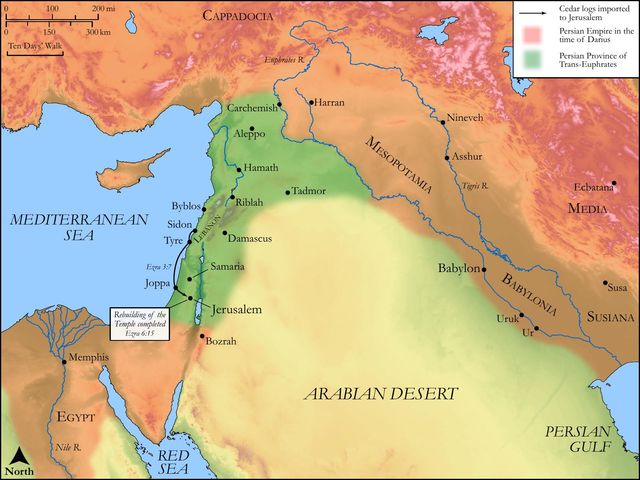
See on the biblical-era map
Study this verse
Public-domain commentary
Matthew Henry
From his Commentary on the Whole Bible. Henry comments on passages, not single verses — this entry covers Ezra 6:1–12. His four-level outline is real structure in the source text, so it is rendered as structure.
We have here, I. The decree of Cyrus for the building of the temple repeated. To this the Samaritans referred because the Jews pleaded it, and perhaps hoped it would not be found, and then their plea would be over-ruled and a stop put to their work. Search was ordered to be made for it among the records; for, it seems, the tribes had not taken care to provide themselves with an authentic copy of it, which might have stood them in good stead, but they must appeal to the original. It was looked for in Babylon (Ezr 6:1), where Cyrus was when he signed it. But, when it was not found there, Darius did not make that a pretence to conclude that therefore there was no such decree, and thereupon to give judgment against the Jews; but it is probable, having himself heard that such a decree was certainly made, he ordered the rolls in other places to be searched, and at length it was found at Achmetha, in the province of the Medes, Ezr 6:2. Perhaps some that durst not destroy it, yet hid it there, out of ill will to the Jews, that they might lose the benefit of it. But Providence so ordered that it came to light; and it is here inserted, Ezr 6:3-5. 1. Here is a warrant for the building of the temple: Let the house of God at Jerusalem, yea, let that house be built (so it may be read), within such and such dimensions, and with such and such materials. 2. A warrant for the taking of the expenses of the building out of the king's revenue, Ezr 6:4. We do not find that they had received what was here ordered them, the face of things at court being soon changed. 3. A warrant for the restoring of the vessels and utensils of the temple, which Nebuchadnezzar had taken away (Ezr 6:5), with an order that the priests, the Lord's ministers, should return them all to their places in the house of God.
II.The confirmation of it by a decree of Darius, grounded upon it and in pursuance of it.
1.The decree of Darius is very explicit and satisfactory.
(1.)He forbids his officers to do any thing in opposition to the building of the temple. The manner of expression intimates that he knew they had a mind to hinder it: Be you far hence (Ezr 6:6); let the work of this house of God alone, Ezr 6:7. Thus was the wrath of the enemy made to praise God and the remainder thereof did he restrain.
(2.)He orders them out of his own revenue to assist the builders with money,
[1.]For carrying on the building, Ezr 6:8. Herein he pursues the example of Cyrus, Ezr 6:4.
[2.]For maintaining the sacrifices there when it was built, Ezr 6:9. He ordered that they should be supplied with every thing they wanted both for burnt-offerings and meat-offerings. He was content it should be a rent-charge upon his revenue, and ordered it to be paid every day, and this without fail, that they might offer sacrifices and prayers with them (for the patriarchs, when they offered sacrifice, called on the name of the Lord, so did Samuel, Elijah, and others) for the life (that is, the happiness and prosperity) of the king and his sons, Ezr 6:10. See here how he gives honour, First, To Israel's God, whom he calls once and again the God of heaven. Secondly, To his ministers, in ordering his commissioners to give out supplies for the temple service at the appointment of the priests. Those that thought to control them must now be, in this matter, at their command. It was a new thing for God's priests to have such an interest in the public money. Thirdly, To prayer: That they may pray for the life of the king. He knew they were a praying people, and had heard that God was nigh to them in all that which they called upon him for. He was sensible he needed their prayers and might receive benefit by them, and was kind to them in order that he might have an interest in their prayers. It is the duty of God's people to pray for those that are in authority over them, not only for the good and gentle, but also for the forward; but they are particularly bound in gratitude to pray for their protectors and benefactors; and it is the wisdom of princes to desire their prayers, and to engage them. Let not the greatest princes despise the prayers of the meanest saints; it is desirable to have them for us, and dreadful to have them against us.
(3.)He enforces his decree with a penalty (Ezr 6:11): "Let none either oppose the work and service of the temple or withhold the supports granted to it by the crown upon pain of death. If any alter this decree, let him be (hanged before his own door as we say), hanged upon a beam of his own house, and, as an execrable man, let his house be made a dunghill."
(4.)He entails a divine curse upon all those kings and people that should ever have any hand in the destruction of this house, Ezr 6:12. What he would not do himself for the protection of the temple he desired that God, to whom vengeance belongs, would do. This bespeaks him zealous in the cause; and though this temple was, at length, most justly destroyed by the righteous hand of God, yet perhaps the Romans, who were the instruments of that destruction, felt the effects of this curse, for that empire sensibly declined ever after.
2.From all this we learn,
(1.)That the heart of kings is in the hand of God, and he turns it which way soever he pleases; what they are he makes them to be, for he is King of kings.
(2.)That when God's time has come for the accomplishing of his gracious purposes concerning his church he will raise up instruments to promote them from whom such good service was not expected. The earth sometimes helps the woman (Rev 12:16), and those are made use of for the defence of religion who have little religion themselves.
(3.)That what is intended for the prejudice of the church has often, by the overruling providence of God, been made serviceable to it, Phi 1:12. The enemies of the Jews, in appealing to Darius, hoped to get an order to suppress them, but, instead of that, they got an order to supply them. Thus out of the eater comes forth meat. The apocryphal Esdras (or Ezra), Book 1 ch. 3 and 4, gives another account of this decree in favour of the Jews, that Darius had vowed that if ever he came to the kingdom he would build the temple at Jerusalem, and that Zerubbabel, who was one of his attendants (whereas it is plain here that he was now at Jerusalem), for making an ingenious discourse before him on that subject (Great is the truth and will prevail), was told to ask what recompence he would, and asked only for this order, in pursuance of the king's vow.
Historical interpretation
Historical reception
1 surviving comment on this verse from the historical church.
But the golden and silver vessels of the temple, etc. It states that the vessels were then placed in the temple of God, signifying the temple of the Babylonians, in which Nebuchadnezzar had placed them, as is more clearly read above, from which Cyrus had ordered them to be taken and returned to Jerusalem. So far, the letters of King Cyrus, which were found in Ecbatana; to which were suddenly added, in a new and unusual manner, from the persona and authority of King Darius:
Continue studying Ezra 6:5 across the web’s major study libraries — every link below opens this exact verse, chapter, or book on the destination site.
Read & Compare
 BibleGatewayThis verse in more than 200 translations and 70 languages.
 Bible.comThe YouVersion reader — hundreds of translations, reading plans, and highlights.
 ESV.orgCrossway's official English Standard Version reader.
 NET BibleThe NET translation with 60,000+ translators' notes on every rendering decision.
 STEP BibleTyndale House's free study tool — original text, vocabulary, and scholarly resources.
 BibliaLogos Bible Software's free web reader.
 USCCBThe New American Bible (Revised Edition) with the U.S. bishops' study notes.
Commentaries
 BibleHub CommentariesDozens of classic commentaries on this verse, gathered on one page.
 StudyLightMore than 100 commentary sets — the largest collection on the web.
 BibleRefPlain-English commentary on what this verse means, verse by verse.
 Enduring WordDavid Guzik's free commentary on this chapter, widely used by Bible teachers.
 Bible Study ToolsVerse commentary alongside Greek and Hebrew study aids.
Original Language & Research
- BibleHub InterlinearThe verse word by word — original language, transliteration, and English.
- BibleHub LexiconEvery word's original-language definition and Strong's entry.
 Blue Letter BibleDeep-study tools — Strong's numbers, concordance, and word studies.
 SefariaThe Hebrew text with Rashi and centuries of Jewish commentary.
Sermons, Hymns & Audio


TrulyRandomVerse is not affiliated with these sites and doesn’t control their content. They’re linked because they’re genuinely useful.
Summary
Ezra 6:5 articulates a crucial component of King Darius's decree, mandating the precise return of the golden and silver vessels, originally plundered from the Jerusalem Temple by Nebuchadnezzar and taken to Babylon. This specific instruction not only validates the Jewish people's right to rebuild their sacred house but profoundly underscores God's meticulous faithfulness in reversing the desolation of exile, ensuring that every consecrated item is restored "to his place" for the re-establishment of proper, holy worship in Jerusalem.
Context
ShowHideLiterary Context
Ezra 6:5 is embedded within King Darius's definitive decree concerning the rebuilding of the Temple in Jerusalem. This decree is a direct response to the challenge posed by Tatnai, the governor of Trans-Euphrates, who questioned the authority of the Jews to continue their construction efforts (Ezra 5:3-5). Following a search of the royal archives that confirmed Cyrus the Great's original edict (Ezra 6:1-2), Darius not only reaffirms Cyrus's permission but expands upon it. His decree includes provisions for financial support for the Temple's reconstruction and severe penalties for any who would obstruct the work (Ezra 6:3-12). Verse 5 specifically reiterates and reinforces a provision from Cyrus's initial decree (Ezra 1:7-11), focusing on the meticulous restoration of the sacred Temple vessels. This detailed command highlights the Persian king's unwavering commitment to the decree and, more profoundly, God's providential hand in orchestrating the precise fulfillment of His purposes for His people and their worship.
Historical & Cultural Context
The historical setting for Ezra 6:5 is the post-exilic period, specifically during the reign of Darius I (522-486 BC), following the seventy-year Babylonian captivity (c. 586-538 BC). The destruction of Jerusalem and its Temple in 586 BC by King Nebuchadnezzar of Babylon was a cataclysmic event, marked by the plundering of sacred treasures and the forced exile of the Jewish populace (2 Kings 25:13-17). These vessels were far more than mere spoils of war; they were potent symbols of Israel's covenant relationship with God and the sanctity of His dwelling place. Their removal signified the desecration and desolation of the Temple. The Persian Empire, under Cyrus the Great, conquered Babylon in 539 BC, and Cyrus subsequently issued a decree in 538 BC allowing the Jews to return and rebuild their Temple, even initiating the return of some plundered vessels (Ezra 1:1-11). Darius I was prompted to re-examine the matter due to local opposition to the rebuilding efforts. His decree in Ezra 6, including the specific instruction about the vessels, represents a powerful reaffirmation of Persian policy, which often involved respecting the gods and cults of their conquered peoples to ensure stability and loyalty within their vast empire. This aligns with the broader Persian administrative strategy of religious tolerance and support for local traditions.
Key Themes
ShowHideThis verse powerfully contributes to several overarching themes within the book of Ezra and the broader biblical narrative. Firstly, it profoundly illustrates Divine Sovereignty and Restoration, demonstrating that God orchestrates historical events and uses even pagan kings, like Cyrus and Darius, as instruments to fulfill His redemptive purposes (Proverbs 21:1). The meticulous return of the vessels symbolizes the reversal of judgment and the restoration of His people and their worship. Secondly, it highlights the Sanctity of Sacred Objects and Worship. The precise instruction to return "every one to his place" underscores the profound reverence for the Temple articles, which were consecrated for divine service and integral to the worship of Yahweh. Their restoration was not merely practical but deeply symbolic of the re-establishment of proper, holy worship according to divine standards. Thirdly, the verse points to the Fulfillment of Prophecy, as the return from exile, the rebuilding of the Temple, and the restoration of its articles were all anticipated by prophets like Jeremiah, who spoke of a seventy-year period of desolation followed by a return (e.g., Jeremiah 29:10). The precision and detail of Darius's decree affirm God's faithfulness to His covenant promises, even after a period of severe judgment and apparent abandonment.
Exposition and Analysis
ShowHideKey Word Analysis
ShowHideAs per H3984, this Aramaic term refers to a "utensil" or "vessel." In this context, it specifically denotes the sacred implements used in the Temple. These were not ordinary household items but consecrated instruments—bowls, basins, shovels, censers, and other cultic objects—crafted from precious metals (gold and silver) and designated exclusively for divine service. Their significance lay not merely in their material value but in their sacred function, making their desecration a profound affront to God and their restoration essential for the legitimate resumption of Temple worship.
Derived from H8421, this Aramaic verb means "to come back" or "to return," and transitively, "to restore" or "to bring back." In Ezra 6:5, it signifies more than a simple physical relocation. It carries the weight of legal and spiritual restitution, a divine and royal mandate to rectify a past injustice. This word emphasizes the active, deliberate command for the vessels to be returned to their rightful, consecrated status and location, underscoring the comprehensive reversal of their plunder and the re-establishment of their sacred purpose.
This Aramaic noun means "a place." The phrase "every one to his place" (KJV rendering of ‘al-'atreh) highlights the meticulousness and specificity of the command. It is not sufficient for the vessels to merely be returned to Jerusalem; each item must be returned to its precise, designated location within the Temple. This precision underscores the sacred order of Temple liturgy and the divine concern for proper, ordered worship, reflecting God's own character of order, holiness, and attention to detail in all matters pertaining to His worship.
Verse Breakdown
ShowHide"And also let the golden and silver vessels of the house of God"
This initial clause immediately identifies the subject as items of immense value and profound sacredness. The specification of "golden and silver" emphasizes their preciousness, signifying not only material wealth but also their symbolic value as consecrated offerings and instruments dedicated solely to divine service. These are not ordinary objects but sacred implements set apart for Yahweh's worship.
"which Nebuchadnezzar took forth out of the temple which [is] at Jerusalem, and brought unto Babylon"
This segment provides the crucial historical context of their removal. It explicitly names Nebuchadnezzar, the Babylonian king, as the perpetrator of the plunder. The act of taking them "forth out of the temple" and bringing them "unto Babylon" signifies the desecration of God's dwelling place, the humiliation of His chosen people, and the cessation of legitimate worship in Jerusalem, marking the beginning of the seventy-year exile.
"be restored, and brought again unto the temple which [is] at Jerusalem, [every one] to his place, and place [them] in the house of God"
This concluding and most significant clause issues the clear, emphatic command for complete restitution. The repetition of "be restored" and "brought again" underscores the certainty, completeness, and divine imperative of this reversal. The destination is explicitly "the temple which [is] at Jerusalem," emphasizing the re-establishment of God's dwelling place in its rightful and holy location. The phrase "[every one] to his place" highlights the meticulousness required, ensuring the precise and orderly return of each item to its specific function within the sacred space. This is a command for a full, proper, and consecrated re-installation, symbolizing the renewal of worship and God's tangible presence among His people.
Literary Devices
ShowHideEzra 6:5 masterfully employs several literary devices to convey its profound message. Repetition is a prominent feature, with phrases like "the temple which [is] at Jerusalem" appearing twice, and the double emphasis on the action: "be restored, and brought again." This repetition serves to underscore the critical importance of both the sacred location and the comprehensive nature of the restoration, reinforcing the divine imperative for the Temple's re-establishment and the precise return of its articles. Contrast is also powerfully evident, implicitly setting Nebuchadnezzar's act of plundering and destruction against Darius's decree of restoration and rebuilding. This stark opposition highlights God's ultimate power to reverse human acts of desecration and bring about His intended purposes. Most significantly, the verse utilizes profound Symbolism. The "golden and silver vessels" are not merely physical objects; they symbolize the sanctity of God's worship, the continuity of the covenant relationship, and the very presence of God among His people. Their return "to his place" symbolizes the restoration of proper, ordered worship, the renewal of God's favor, and the re-establishment of the covenant community in their land. The meticulousness of the command for their return further symbolizes God's own precise and loving care for His people and for the integrity of His worship.
Theological and Thematic Connections
ShowHideEzra 6:5 serves as a powerful theological statement about God's unwavering faithfulness and His sovereign control over human history. Even amidst the political machinations of empires and the consequences of Israel's disobedience, God meticulously orchestrates events to bring about His promised restoration. The return of these sacred vessels, once spoils of war and symbols of national humiliation, now becomes a tangible sign of divine reversal and renewed covenant relationship. It underscores the enduring importance of proper worship and the sanctity of what is dedicated to God, demonstrating that true restoration involves not just physical rebuilding but also the re-establishment of spiritual order and reverence. This verse testifies to a God who remembers His promises, reverses judgment, and actively works through unexpected means to bring His people back into full fellowship and worship, ensuring that His purposes prevail over all human opposition and historical setbacks.
Reflection and Application
ShowHideEzra 6:5 offers profound lessons for contemporary believers, reminding us that God's sovereignty extends over all earthly powers and circumstances, even when things appear chaotic, lost, or beyond human repair. Just as He orchestrated the precise return of the Temple vessels through the decree of a pagan king, He continues to work in unexpected ways to fulfill His purposes in our lives and in the world. This verse calls us to trust in God's restorative power, recognizing that what seems broken, plundered, or beyond repair in our lives, our churches, or our communities can be divinely re-established and set right. Furthermore, the meticulous care for the Temple vessels challenges us to consider what "vessels" in our own lives—our time, talents, resources, relationships, and even our physical bodies—are consecrated to God. Are we using them "to his place," for His intended purpose and glory? This passage encourages us to live with a deep reverence for God and for all that pertains to His kingdom, actively participating in His ongoing work of restoration and worship, always seeking to align our lives with His divine order and holy purposes.
Questions for Reflection
ShowHideFAQ
ShowHideWhy were these vessels so important to be specifically mentioned in the decree?
ShowHideThe vessels were not merely decorative items; they were sacred implements consecrated for specific functions within the Temple's sacrificial system and worship rituals. They symbolized the tangible presence of God, the purity required for worship, and the continuity of the covenant between God and Israel. When Nebuchadnezzar plundered them (as described in 2 Kings 25:13-17), it was an act of profound desecration and a symbol of Israel's humiliation and God's judgment. Their return was therefore essential for the legitimate re-establishment of Temple worship and a powerful symbol of God's faithfulness in reversing the desolation of exile. The meticulous instruction to return "every one to his place" underscores their unique sacredness and the divine concern for proper order and holiness in worship, signifying that God's presence and the means of approaching Him were being fully restored.
Does this verse have relevance for Christians today, given there's no physical temple or vessels in the same way?
ShowHideAbsolutely. While Christians do not worship in a physical temple with literal vessels, the profound theological principles embedded in Ezra 6:5 remain highly relevant. Firstly, it powerfully illustrates God's sovereignty over all earthly authorities and circumstances, reminding us that He works through unexpected channels to fulfill His purposes, even through pagan kings. This encourages us to trust in His overarching plan. Secondly, it highlights the sanctity of worship and the importance of dedicating what is precious to God. For believers, our bodies are now considered a "temple of the Holy Spirit" (1 Corinthians 6:19-20), and our lives, talents, and resources are to be offered as "spiritual sacrifices" (1 Peter 2:5). The meticulous care for the vessels teaches us to approach our service and dedication to God with reverence, intentionality, and a desire to use our "vessels" for His glory, "every one to his place" in the body of Christ. Finally, it offers a profound message of hope and restoration, demonstrating God's desire and power to reverse what is broken and bring about renewal in our lives and in the world.
Christ-Centered Fulfillment
ShowHideEzra 6:5, with its emphasis on the meticulous restoration of sacred vessels to the Temple, finds its ultimate and most profound fulfillment in Jesus Christ. The physical Temple and its articles were shadows, pointing to the greater reality of God's presence among His people and the means by which humanity could approach Him. Jesus himself declared, "Destroy this temple, and in three days I will raise it up," referring to the temple of his body (John 2:19-21). He is the true Temple, the ultimate dwelling place of God, in whom all the fullness of the Godhead dwells bodily (Colossians 2:9). The plundered vessels symbolize humanity alienated from God by sin, desecrated and carried away into spiritual captivity. Christ, through His atoning sacrifice on the cross, acts as the great restorer, not merely returning physical objects but cleansing and restoring humanity itself to its rightful "place" in fellowship with God. His blood cleanses us from sin, making us "vessels for honorable use, set apart as holy, useful to the master of the house, ready for every good work" (2 Timothy 2:21). He is the ultimate High Priest who entered the true, heavenly sanctuary, not with the blood of bulls and goats, but with His own precious blood, securing an eternal redemption for all who believe (Hebrews 9:11-14). The meticulous return of "every one to his place" foreshadows the new creation in Christ, where believers, as living stones, are being built into a spiritual house, a holy priesthood, offering spiritual sacrifices acceptable to God through Jesus Christ (1 Peter 2:5). In the New Jerusalem, the ultimate fulfillment of God's dwelling with His people, there will be no need for a physical temple, "for its temple is the Lord God the Almighty and the Lamb" (Revelation 21:22), signifying the complete and eternal restoration of God's presence among His people through Christ, forever.