


2 Kings 25:14
Bible text: King James Version (1769 Blayney text) · Public domain
Bible text: Berean Standard Bible · Public domain
Bible text: American Standard Version (1901) · Public domain
Bible text: World English Bible, Messianic edition · Public domain
Bible text: Geneva Bible (1599) · Public domain
Bible text: Young's Literal Translation · Public domain
- וְאֶתve·'Etand <obj.>H853Conj-w ¦ DirObjMParticle Object Indicatorוְandאֶת<obj.>
- הַסִּירֹתha·si·Rotthe potsH5518Art ¦ N-fpNoun Plural Feminine Absoluteהַtheסִּירֹתpots
- וְאֶתve·'Etand <obj.>H853Conj-w ¦ DirObjMParticle Object Indicatorוְandאֶת<obj.>
- הַיָּעִיםhai·ya·'Imthe shovelsH3257Art ¦ N-mpNoun Plural Masculine Absoluteהַtheיָּעִיםshovels
- וְאֶתve·'Etand <obj.>H853Conj-w ¦ DirObjMParticle Object Indicatorוְandאֶת<obj.>
- הַמְזַמְּרוֹתham·za·me·Rotthe snuffersH4212Art ¦ N-fpNoun Plural Feminine Absoluteהַtheמְזַמְּרוֹתsnuffers
- וְאֶתve·'Etand <obj.>H853Conj-w ¦ DirObjMParticle Object Indicatorוְandאֶת<obj.>
- הַכַּפּוֹתha·ka·Potthe pansH3709Art ¦ N-fpNoun Plural Feminine Absoluteהַtheכַּפּוֹתpans
- וְאֵתve·'Etand <obj.>H853Conj-w ¦ DirObjMParticle Object Indicatorוְandאֵת<obj.>
- כָּלkolallH3605N-mscNoun Singular Masculine Construct
- כְּלֵיke·Lei[the] articles ofH3627N-mpcNoun Plural Masculine Construct
- הַנְּחֹשֶׁתha·ne·Cho·shet<the> bronzeH5178Art ¦ N-fsNoun Singular Feminine Absoluteהַ<the>נְּחֹשֶׁתbronze
- אֲשֶׁר'a·SherwhichH834RelParticle Relative
- יְשָׁרְתוּye·sha·re·tupeople servedH8334V-Piel-Imperf-3mpVerb Piel Imperfect 3rd Plural Masculine
- בָםvamwith themPrep-b ¦ 3mpSuffix Personal 3rd Plural Masculineבָwithםthem
- לָקָחוּla·Ka·chuthey tookH3947V-Qal-Perf-3cpVerb Qal Perfect 3rd Plural common gender
English is a literal word-by-word gloss of the Hebrew, not the KJV's wording. Why?
This is the original text the KJV's translators worked from — each Hebrew word with its own literal English meaning in this verse, prepared by scholars at Tyndale House, Cambridge. The KJV translates whole sentences, not word by word, so its wording differs: one Hebrew word can become several English words, and the KJV may choose “the LORD” where the gloss reads “Yahweh”. Both are faithful — they answer different questions. For the KJV's own rendering, switch to the KJV text.
Details
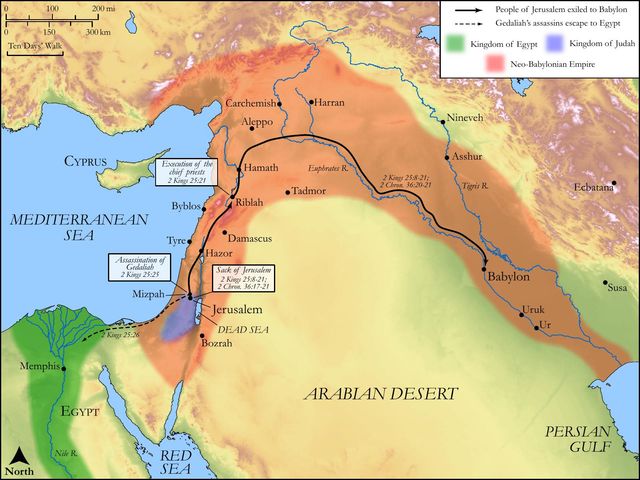
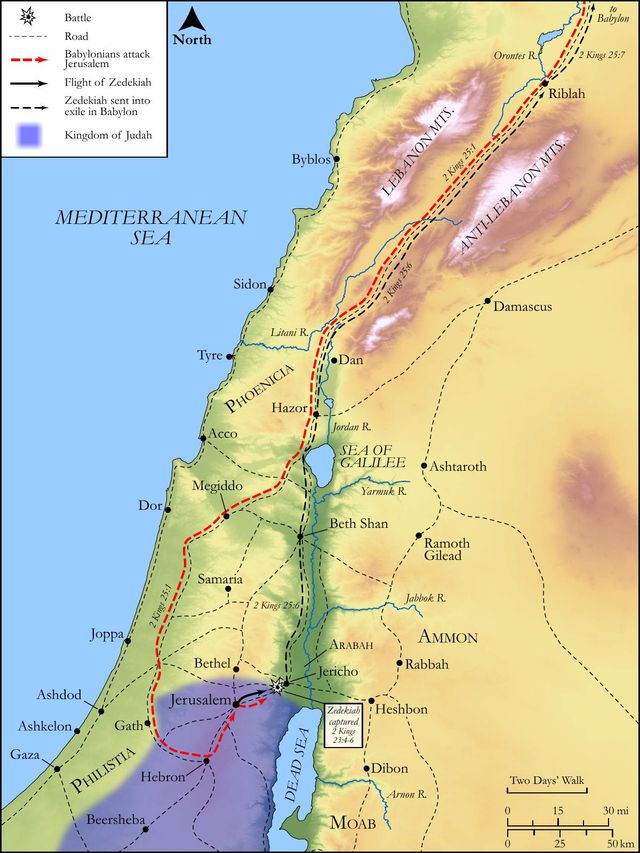
See on the biblical-era maps
Study this verse
Public-domain commentary
Matthew Henry
From his Commentary on the Whole Bible. Henry comments on passages, not single verses — this entry covers 2 Kings 25:8–21.
Though we have reason to think that the army of the Chaldeans were much enraged against the city for holding out with so much stubbornness, yet they did not therefore put all to fire and sword as soon as they had taken the city (which is too commonly done in such cases), but about a month after (compare Kg2 25:8 with Kg2 25:3) Nebuzar-adan was sent with orders to complete the destruction of Jerusalem. This space God gave them to repent, after all the foregoing days of his patience, but in vain; their hearts (for aught that appears) were still hardened, and therefore execution is awarded to the utmost. 1. The city and temple are burnt, Kg2 25:9. It does not appear that the king of Babylon designed to send any colonies to people Jerusalem and therefore he ordered it to be laid in ashes, as a nest of rebels. At the burning of the king's house and the houses of the great men one cannot so much wonder (the inhabitants had, by their sins, made them combustible), but that the house of the Lord should perish in these flames, that that holy and beautiful house should be burnt with fire (Isa 64:11), is very strange. That house which David prepared for, and which Solomon built at such a vast expense - that house which had the eye and heart of God perpetually upon it (Kg1 9:3) - might not that have been snatched as a brand out of this burning? No, it must not be fire-proof against God's judgments. This stately structure must be turned into ashes, and it is probable the ark in it, for the enemies, having heard how dearly the Philistines paid for the abusing of it, durst not seize that, nor did any of its friends take care to preserve it, for then we should have heard of it again in the second temple. One of the apocryphal writers does indeed tell us that the prophet Jeremiah got it out of the temple, and conveyed it to a cave in Mount Nebo on the other side Jordan, and hid it there (2 Macc. 2:4, 5), but that could not be, for Jeremiah was a close prisoner at that time. By the burning of the temple God would show how little cares for the external pomp of his worship when the life and power of religion are neglected. The people trusted to the temple, as if that would protect them in their sins (Jer 7:4), but God, by this, let them know that when they had profaned it they would find it but a refuge of lies. This temple had stood about 420, some say 430 years. The people having forfeited the promises made concerning it, those promises must be understood of the gospel-temple, which is God's rest for ever. It is observable that the second temple was burnt by the Romans the same month, and the same day of the month, that the first temple was burnt by the Chaldeans, which, Josephus says, was the tenth of August. 2. The walls of Jerusalem are demolished (Kg2 25:10), as if the victorious army would be revenged on them for having kept them out so long, or at least prevent the like opposition another time. Sin unwalls a people and takes away their defence. These walls were never repaired till Nehemiah's time. 3. The residue of the people are carried away captive to Babylon, Kg2 25:11. Most of the inhabitants had perished by sword or famine, or had made their escape when the king did (for it is said, Kg2 25:5, His army was scattered from him), so that there were very few left, who with the deserters, making in all but 832 persons (as appears, Jer 52:29), were carried away into captivity; only the poor of the land were left behind (Kg2 25:12), to till the ground and dress the vineyards for the Chaldeans. Sometimes poverty is a protection; for those that have nothing have nothing to lose. When the rich Jews, who had been oppressive to the poor, were made strangers, nay, prisoners, in an enemy's country, the poor whom they had despised and oppressed had liberty and peace in their own country. Thus Providence sometimes remarkably humbles the proud and favours those of low degree. 4. The brazen vessels, and other appurtenances of the temple, are carried away, those of silver and gold being most of them gone before. Those two famous columns of brass, Jachin and Boaz, which signified the strength and stability of the house of God, were broken to pieces and the brass of them was carried to Babylon, Kg2 25:13. When the things signified were sinned away what should the signs stand there for? Ahaz had profanely cut off the borders of the bases, and put the brazen sea upon a pavement of stones (Kg2 16:17); justly therefore are the brass themselves, and the brazen sea, delivered into the enemy's hand. It is just with God to take away his ordinances from those that profane and abuse them, that curtail and depress them. Some things remained of gold and silver (Kg2 25:15) which were now carried off; but most of this plunder was brass, such a vast quantity of it that it is said to be without weight, Kg2 25:16. The carrying away of the vessels wherewith they ministered (Kg2 25:14) put an end to the ministration. It was a righteous thing with God to deprive those of the benefit of his worship who had slighted it so long and preferred false worships before it. Those that would have many altars shall now have none. 5. Several of the great men are slain in cold blood - Seraiah the chief priest (who was the father of Ezra as appears, Ezr 7:1), the second priest (who, when there was occasion, officiated for him), and three door-keepers of the temple (Kg2 25:18), the general of the army, five privy-counsellors (afterwards they made them up seven, Jer 52:25), the secretary of war, or pay-master of the army, and sixty country gentlemen who had concealed themselves in the city. These, being persons of some rank, were brought to the king of Babylon (Kg2 25:19, Kg2 25:20), who ordered them to be all put to death (Kg2 25:21), when, in reason, they might have hoped that surely the bitterness of death was past. These the king of Babylon's revenge looked upon as most active in opposing him; but divine justice, we may suppose, looked upon them as ringleaders in that idolatry and impiety which were punished by these desolations. This completed the calamity: So Judah was carried away out of their land, about 860 years after they were put in possession of it by Joshua. Now the scripture was fulfilled, The Lord shall bring thee, and the king which thou shalt set over thee, into a nation which thou hast not known, Deu 28:36. Sin kept their fathers forty years out of Canaan, and now turned them out. The Lord is known by those judgments which he executes, and makes good that word which he has spoken, Amo 3:2. You only have I known of all the families of the earth, therefore I will punish you for all your iniquities.
Continue studying 2 Kings 25:14 across the web’s major study libraries — every link below opens this exact verse, chapter, or book on the destination site.
Read & Compare
 BibleGatewayThis verse in more than 200 translations and 70 languages.
 Bible.comThe YouVersion reader — hundreds of translations, reading plans, and highlights.
 ESV.orgCrossway's official English Standard Version reader.
 NET BibleThe NET translation with 60,000+ translators' notes on every rendering decision.
 STEP BibleTyndale House's free study tool — original text, vocabulary, and scholarly resources.
 BibliaLogos Bible Software's free web reader.
 USCCBThe New American Bible (Revised Edition) with the U.S. bishops' study notes.
Commentaries
 BibleHub CommentariesDozens of classic commentaries on this verse, gathered on one page.
 StudyLightMore than 100 commentary sets — the largest collection on the web.
 BibleRefPlain-English commentary on what this verse means, verse by verse.
 Enduring WordDavid Guzik's free commentary on this chapter, widely used by Bible teachers.
 Bible Study ToolsVerse commentary alongside Greek and Hebrew study aids.
Original Language & Research
- BibleHub InterlinearThe verse word by word — original language, transliteration, and English.
- BibleHub LexiconEvery word's original-language definition and Strong's entry.
 Blue Letter BibleDeep-study tools — Strong's numbers, concordance, and word studies.
 SefariaThe Hebrew text with Rashi and centuries of Jewish commentary.
Sermons, Hymns & Audio


TrulyRandomVerse is not affiliated with these sites and doesn’t control their content. They’re linked because they’re genuinely useful.
Summary
Second Kings 25:14 meticulously catalogs the systematic plundering of the Jerusalem Temple by the Babylonian forces under Nebuchadnezzar. This verse specifically enumerates various bronze implements—pots, shovels, snuffers, and spoons—all of which were integral to the daily rituals and sacred ministry within the Temple. The detailed listing underscores the thoroughness of the despoilers and the profound desecration of God's sanctuary, marking a tangible aspect of Judah's divine judgment and the cessation of its formal worship.
Context
ShowHideLiterary Context
This verse is deeply embedded within the tragic climax of the Deuteronomistic History, specifically detailing the fall of Jerusalem and the destruction of the Temple in 586 BC. Following a prolonged siege, the city walls were breached, and the Temple, the spiritual epicenter of the nation, was systematically dismantled. 2 Kings 25:9 recounts the burning of the Temple itself, while the preceding verse, 2 Kings 25:13, details the removal of the larger, more prominent bronze items like the pillars, the Sea, and the stands. Verse 14, by contrast, focuses on the smaller, yet equally essential, bronze vessels used for daily liturgical functions, emphasizing the comprehensive nature of the plunder. This meticulous inventory serves to highlight the utter devastation and the complete cessation of Temple worship, demonstrating the fulfillment of prophetic warnings throughout the book of 2 Kings.
Historical & Cultural Context
The destruction of Jerusalem and its Temple by the Neo-Babylonian Empire under Nebuchadnezzar II was a cataclysmic event for ancient Israel, marking the end of the Kingdom of Judah and the beginning of the Babylonian exile. The Temple, built by Solomon centuries earlier, was not merely a building but the perceived dwelling place of Yahweh, the focal point of Israelite worship, national identity, and covenant relationship. Its destruction, therefore, was an unparalleled national trauma, signifying a profound disruption of their religious and political life. The plundering of sacred vessels was a common practice in war among the nations, as when Belshazzar and his lords drank from the vessels taken out of the temple at Jerusalem and praised their gods, symbolizing the subjugation of the defeated nation's god by the conquering deity. For the Israelites, however, this was understood not as a defeat of Yahweh, but as His righteous judgment executed through a foreign power, fulfilling numerous prophetic warnings found in books like Jeremiah.
Key Themes
ShowHideThe meticulous accounting of the Temple's plundered items in 2 Kings 25 contributes to several overarching themes within the book of Kings and the broader biblical narrative. Firstly, it powerfully illustrates the theme of desecration and plunder. The removal of items like "pots, shovels, snuffers, and spoons," though seemingly mundane, signifies the complete violation and defilement of a sacred space. These were not ordinary household items but vessels consecrated for holy service, highlighting the ultimate disrespect shown to God's sanctuary and the cessation of its functions. Secondly, this event is a stark manifestation of divine judgment. The destruction of the Temple and the plundering of its sacred vessels were not merely acts of war but understood by the prophets, particularly Jeremiah, as God's righteous judgment upon Judah for its persistent idolatry, covenant unfaithfulness, and oppression. Finally, it underscores the loss of national identity and worship center. The Temple was central to Israel's national and religious identity, and its destruction meant the cessation of the sacrificial system and the temporary loss of their primary place of worship, forcing a profound re-evaluation of their relationship with God and the nature of true worship, a theme explored further in books like Ezekiel and Lamentations.
Exposition and Analysis
ShowHideKey Word Analysis
ShowHideFrom a primitive root meaning "to boil up," this term refers to a pot, caldron, or pan, and in this context, likely large vessels used for boiling sacrificial meat or carrying ashes from the altar. Their removal signifies the disruption of the practical, daily operations of the sacrificial system and the cessation of the sacred meals associated with Temple worship.
From a root meaning "to prune" or "to sing," this word refers to a tweezer or snuffer, specifically used for trimming the wicks of the menorah lamps in the Temple. These implements ensured a clean and continuous flame, symbolizing God's perpetual presence and the ongoing worship. Their seizure indicates the cessation of this perpetual light and the disruption of the ritualistic maintenance of God's dwelling place.
This primitive root means "to attend as a menial or worshipper," "to serve," or "to contribute to." It denotes sacred service or priestly duties, distinguishing these items from ordinary household utensils. The phrase "wherewith they ministered" explicitly highlights the liturgical function of these bronze vessels, emphasizing that their removal was not just a loss of material goods but a direct assault on the very mechanisms of divine worship and the priestly function itself.
Verse Breakdown
ShowHide"And the pots, and the shovels, and the snuffers, and the spoons,"
This detailed enumeration highlights specific categories of smaller, yet essential, bronze implements used in the Temple. "Pots" were likely for ashes or boiling, "shovels" for removing ashes from the altar, "snuffers" for trimming lamp wicks, and "spoons" possibly for incense or blood offerings. The list conveys a sense of thoroughness in the plundering, leaving no sacred tool untouched.
"and all the vessels of brass"
This phrase serves as a comprehensive category, encompassing the previously listed items and any other bronze implements used in the Temple that might not have been specifically named. It emphasizes that the Babylonians took all such vessels, leaving nothing behind, underscoring the completeness of the desecration.
"wherewith they ministered,"
This critical clause clarifies the function and sacred nature of these items. They were not common utensils but were consecrated and used specifically for the performance of priestly duties and rituals within the Temple. This highlights the profound desecration involved in their removal, as they were integral to the very act of worship and the covenant relationship between God and Israel.
"took they away."
This concise statement describes the decisive act of seizure and removal by the Babylonian forces. It signifies the end of their sacred use, their profanation, and their transfer to Babylon as spoils of war, symbolizing the complete subjugation of Judah and the cessation of its formal Temple worship, fulfilling divine judgment.
Literary Devices
ShowHideThe primary literary device at play in 2 Kings 25:14 is Enumeration, where a detailed list of items is provided. This meticulous cataloging of "pots, shovels, snuffers, and spoons," followed by the encompassing "all the vessels of brass," serves to emphasize the systematic and exhaustive nature of the Babylonian plunder. The effect is to convey the utter devastation and thoroughness of the desecration, leaving no sacred implement untouched. This detailed listing also contributes to the Pathos of the narrative, as it highlights the loss of even the most mundane, yet essential, tools of worship, evoking a sense of tragedy and profound loss for the reader. Furthermore, there is an element of Metonymy, where these specific vessels stand in for the entire system of Temple worship and the sacred space itself. Their removal symbolizes the complete cessation of the sacrificial cult and the public worship of Yahweh in Jerusalem.
Theological and Thematic Connections
ShowHideThe plundering of the Temple vessels, particularly the seemingly humble bronze implements, serves as a powerful theological statement about the nature of divine judgment and the profound consequences of covenant unfaithfulness. It underscores that even sacred objects and spaces are not immune to God's wrath when His people persist in disobedience and idolatry. This event fulfilled long-standing prophetic warnings, demonstrating God's sovereignty over nations and His commitment to upholding His covenant, even if it means disciplining His own people through devastating means. The removal of these tools of ministry symbolized the temporary cessation of the formal sacrificial system, forcing the exiled community to re-evaluate their understanding of God's presence and the nature of true worship, shifting focus from physical structures to a more internalized faith and a longing for restoration.
Reflection and Application
ShowHideThe detailed account of the Temple's destruction and the plundering of its vessels in 2 Kings 25:14 serves as a sobering reminder of the profound consequences of spiritual apostasy and the unwavering nature of God's justice. It challenges us to consider whether our outward forms of worship are matched by inward purity and genuine obedience. While we no longer have a physical temple or a sacrificial system, the principle remains: true worship is not about the grandeur of our buildings or the elaborate nature of our rituals, but about the condition of our hearts. The loss of these sacred implements, which were integral to "ministering" before God, compels us to reflect on what truly constitutes ministry in our lives today. Are we using our "vessels"—our gifts, time, resources, and bodies—for sacred service to God, or have they become profaned by worldly pursuits? This passage calls us to a deep introspection, ensuring that our lives are lived in faithful devotion, recognizing that God values a repentant and obedient heart far above any physical edifice or ritualistic observance. It reminds us that God is sovereign even over the destruction of what is sacred, working His purposes through all events, and ultimately calling His people to a deeper, more authentic relationship with Him.
Questions for Reflection
ShowHideFAQ
ShowHideWhat was the significance of these specific bronze vessels in Temple worship?
ShowHideThe bronze vessels listed in 2 Kings 25:14—pots, shovels, snuffers, and spoons—were not merely decorative items but highly functional implements essential for the daily operation of the Temple's sacrificial and ritualistic services. The "pots" (Hebrew: sîrōṯ) were likely used for carrying ashes from the altar or for boiling sacrificial meat. The "shovels" (Hebrew: yāʿîm) were specifically for removing ashes from the altar of burnt offering, a continuous process. The "snuffers" (Hebrew: məzammərōṯ) were used to trim the wicks of the menorah lamps in the Holy Place, ensuring the perpetual light. The "spoons" (Hebrew: kappōṯ) could have been used for incense offerings or for collecting and applying sacrificial blood. The phrase "wherewith they ministered" explicitly states their purpose: they were tools of sacred service (šārəṯû), integral to the priests' performance of their duties before God. Their removal thus signified the complete cessation of the Temple's functions and the disruption of Israel's covenant worship, marking a profound moment of divine judgment.
Christ-Centered Fulfillment
ShowHideThe plundering of the Temple's bronze vessels in 2 Kings 25:14, symbolizing the end of an era of physical worship and the judgment on an unfaithful people, finds its profound Christ-centered fulfillment in the person and work of Jesus Christ. Just as the physical Temple was destroyed, Jesus prophesied the destruction of the Jerusalem Temple of His day, declaring that He would rebuild it in three days, referring to the "temple of his body" (John 2:19-21). He is the ultimate and final "vessel" of ministry, whose perfect sacrifice on the cross rendered all the Old Testament rituals and their associated implements obsolete. The "pots" and "shovels" for ashes are no longer needed because Christ's once-for-all sacrifice cleanses us completely from sin (Hebrews 9:26). The "snuffers" for the lamp are superseded by Christ, who is the "light of the world" (John 8:12), illuminating the path to God. The "spoons" for incense are replaced by the sweet aroma of Christ's perfect obedience and the prayers of the saints offered through Him (Revelation 8:3-4). In Christ, the focus shifts from external objects and rituals to an internal, spiritual reality. Believers, united with Christ, become the "temple of the Holy Spirit" (1 Corinthians 6:19), called to worship God "in spirit and in truth" (John 4:23-24). The plundering of the Old Covenant Temple foreshadows the greater reality that God's presence is no longer confined to a building or its vessels, but dwells in His people through Christ, establishing a new and living way of access and worship.