


2 Chronicles 4:22
Bible text: King James Version (1769 Blayney text) · Public domain
Bible text: King James Version with Strong's numbers · Public domain
Bible text: Berean Standard Bible · Public domain
Bible text: American Standard Version (1901) · Public domain
Bible text: World English Bible, Messianic edition · Public domain
Bible text: Geneva Bible (1599) · Public domain
Bible text: Young's Literal Translation · Public domain
- וְהַמְזַמְּרוֹתve·ham·za·me·Rotand the snuffersH4212Conj-w ¦ Art ¦ N-fpNoun Plural Feminine Absoluteוְandהַtheמְזַמְּרוֹתsnuffers
- וְהַמִּזְרָקוֹתve·ha·miz·ra·Kotand the bowlsH4219Conj-w ¦ Art ¦ N-fpNoun Plural Feminine Absoluteוְandהַtheמִּזְרָקוֹתbowls
- וְהַכַּפּוֹתve·hak·ka·Potand the pansH3709Conj-w ¦ Art ¦ N-fpNoun Plural Feminine Absoluteוְandהַtheכַּפּוֹתpans
- וְהַמַּחְתּוֹתve·ha·mach·Totand the fire-pansH4289Conj-w ¦ Art ¦ N-fpNoun Plural Feminine Absoluteוְandהַtheמַּחְתּוֹתfire-pans
- זָהָבza·HavgoldH2091N-msNoun Singular Masculine Absolute
- סָגוּרsa·Gurpure goldH5462N-msNoun Singular Masculine Absolute
- וּפֶתַחu·Fe·tachand [the] entrance ofH6607Conj-w ¦ N-mscNoun Singular Masculine Constructוּandפֶתַח[the] entrance of
- הַבַּיִתHa·ba·yitthe houseH1004Art ¦ N-msNoun Singular Masculine Absoluteהַtheבַּיִתhouse
- דַּלְתוֹתָיוdal·to·Tavits doorsH1817N-fpc ¦ 3msNoun Plural Feminine Constructדַּלְתוֹתָיdoorsוits
- הַפְּנִימִיּוֹתha·pe·ni·mi·Yot<the> innerH6442Art ¦ Adj-fpAdjective Plural Feminine Absoluteהַ<the>פְּנִימִיּוֹתinner
- לְקֹדֶשׁle·Ko·deshto [the] holy place ofH6944Prep-l ¦ N-mscNoun Title Singular Masculine Constructלְtoקֹדֶשׁ[the] holy place of
- הַקֳּדָשִׁיםha·ko·da·Shimthe holy placesH6944Art ¦ N-mpNoun Title Plural Masculine Absoluteהַtheקֳּדָשִׁיםholy places
- וְדַלְתֵיve·dal·Teiand [the] doors ofH1817Conj-w ¦ N-fdcNoun Dual Feminine Constructוְandדַלְתֵי[the] doors of
- הַבַּיִתha·Ba·yitthe houseH1004Art ¦ N-msNoun Singular Masculine Absoluteהַtheבַּיִתhouse
- לַהֵיכָלla·hei·Khalof the templeH1964Prep-l ¦ N-msNoun Singular Masculine Absoluteלַof theהֵיכָלtemple
- זָהָבza·HavgoldH2091N-msNoun Singular Masculine Absolute
English is a literal word-by-word gloss of the Hebrew, not the KJV's wording. Why?
This is the original text the KJV's translators worked from — each Hebrew word with its own literal English meaning in this verse, prepared by scholars at Tyndale House, Cambridge. The KJV translates whole sentences, not word by word, so its wording differs: one Hebrew word can become several English words, and the KJV may choose “the LORD” where the gloss reads “Yahweh”. Both are faithful — they answer different questions. For the KJV's own rendering, switch to the KJV text.
Details
See on the biblical-era maps
Study this verse
Public-domain commentary
Matthew Henry
From his Commentary on the Whole Bible. Henry comments on passages, not single verses — this entry covers 2 Chronicles 4:11–22.
We have here such a summary both of the brass-work and the gold-work of the temple as we had before (Kg1 7:13, etc.), in which we have nothing more to observe than, 1. That Huram the workman was very punctual: He finished all that he was to make (Ch2 4:11), and left no part of his work undone. Huram, his father, he is called, Ch2 4:16. Probably it was a sort of nickname by which he was commonly known, Father Huram; for the king of Tyre called him Huram Abi, my father, in compliance with whom Solomon called him his, he being a great artist and father of the artificers in brass and iron. He acquitted himself well both for ingenuity and industry. 2. Solomon was very generous. He made all the vessels in great abundance (Ch2 4:18), many of a sort, that many hands might be employed, and so the work might go on with expedition, or that some might be laid up for use when others were worn out. Freely he has received, and he will freely give. When he had made vessels enough for the present he could not convert the remainder of the brass to his own use; it is devoted to God, and it shall be used for him.
Continue studying 2 Chronicles 4:22 across the web’s major study libraries — every link below opens this exact verse, chapter, or book on the destination site.
Read & Compare
 BibleGatewayThis verse in more than 200 translations and 70 languages.
 Bible.comThe YouVersion reader — hundreds of translations, reading plans, and highlights.
 ESV.orgCrossway's official English Standard Version reader.
 NET BibleThe NET translation with 60,000+ translators' notes on every rendering decision.
 STEP BibleTyndale House's free study tool — original text, vocabulary, and scholarly resources.
 BibliaLogos Bible Software's free web reader.
 USCCBThe New American Bible (Revised Edition) with the U.S. bishops' study notes.
Commentaries
 BibleHub CommentariesDozens of classic commentaries on this verse, gathered on one page.
 StudyLightMore than 100 commentary sets — the largest collection on the web.
 BibleRefPlain-English commentary on what this verse means, verse by verse.
 Enduring WordDavid Guzik's free commentary on this chapter, widely used by Bible teachers.
 Bible Study ToolsVerse commentary alongside Greek and Hebrew study aids.
Original Language & Research
- BibleHub InterlinearThe verse word by word — original language, transliteration, and English.
- BibleHub LexiconEvery word's original-language definition and Strong's entry.
 Blue Letter BibleDeep-study tools — Strong's numbers, concordance, and word studies.
 SefariaThe Hebrew text with Rashi and centuries of Jewish commentary.
Sermons, Hymns & Audio


TrulyRandomVerse is not affiliated with these sites and doesn’t control their content. They’re linked because they’re genuinely useful.
Summary
This verse culminates the detailed inventory of the sacred furnishings and architectural elements within Solomon's magnificent Temple, underscoring the unparalleled value and sanctity of God's dwelling place. It specifically enumerates various implements essential for Temple service—snuffers, basins, spoons, and censers—all meticulously crafted from pure gold, alongside the very doors of the Temple, including the inner doors leading to the Most Holy Place, which were also made of gold. The chronicler's emphasis on gold serves to highlight the divine glory and the meticulous standard of excellence attributed to God's sanctuary.
Context
ShowHideLiterary Context
This verse is strategically positioned at the conclusion of 2 Chronicles chapter 4, which provides an exhaustive description of the Temple's furnishings and vessels, immediately following the architectural outline in 2 Chronicles 3. The chronicler, addressing a post-exilic audience, meticulously details these items to emphasize the grandeur and divine authorization of the first Temple, thereby inspiring hope and a renewed commitment to worship among those who had returned to a desolate Jerusalem. The precise enumeration of every golden implement and door underscores the continuity of divine instruction from the Tabernacle (as detailed in Exodus 25-31) to the Temple, reinforcing the idea that God's presence and the proper means of worship were central to Israel's identity and restoration. The meticulousness in describing even the smallest items highlights the comprehensive nature of God's demands for holiness in His sanctuary.
Historical & Cultural Context
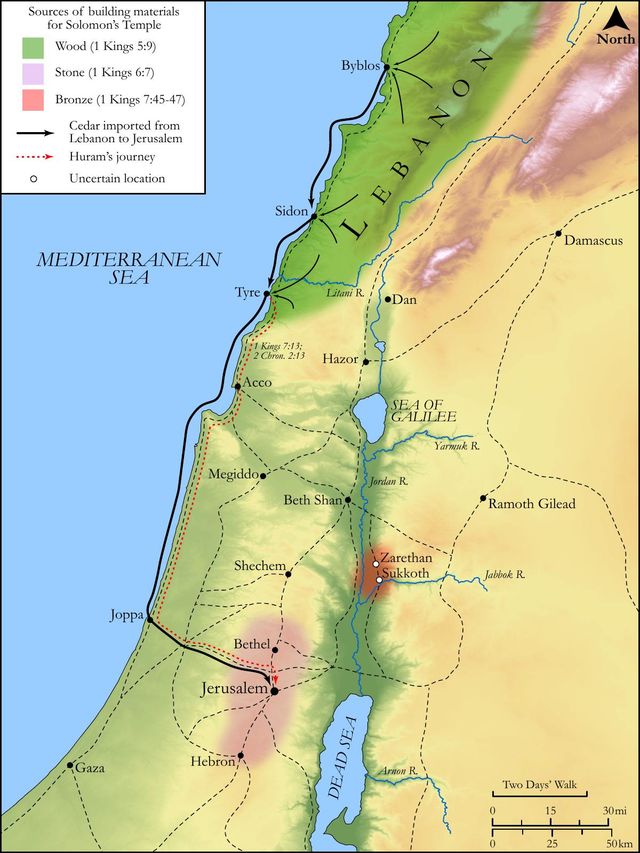
Solomon's Temple, constructed in Jerusalem during the 10th century BCE, was the preeminent religious and national edifice of ancient Israel, symbolizing God's covenant presence among His people. The extensive use of gold, as vividly portrayed in 2 Chronicles 4:22, was a testament to the immense wealth and political influence of Solomon's reign, facilitated by strategic trade routes and alliances, notably with Tyre. Among the nations round about, temples lavishly adorned with precious metals were common, signifying the power, wealth, and honor of the god to whom they were dedicated. For Israel, however, gold carried profound theological weight, representing purity, incorruptibility, divine majesty, and the inherent value of objects set apart for the Holy One of Israel. The detailed craftsmanship, often involving skilled artisans from Phoenicia (as noted in 2 Chronicles 2:7), further illustrates the pinnacle of artistic and engineering achievement dedicated to God's house.
Key Themes
ShowHideThe detailed account of the Temple's golden furnishings in 2 Chronicles 4 contributes significantly to several overarching themes within the book of Chronicles. Firstly, it powerfully conveys the theme of Divine Glory and Purity. The pervasive use of "pure gold" signifies the unparalleled holiness, perfection, and majesty of God, for whom the Temple was consecrated. Gold, an incorruptible and precious metal, was the most fitting material to represent divine splendor and the sacredness of His presence, reflecting the principle that only the purest and best should be offered to God. Secondly, the meticulous attention given to every item, from the grand bronze sea to the "snuffers" and "spoons," highlights the theme of Meticulousness in Worship. This underscores that every aspect of worship, regardless of its perceived significance, is important in God's eyes and demands reverence, precision, and dedication. Finally, the specific mention of the "inner doors thereof for the most holy place" being made of gold emphasizes the theme of Sacred Access and Separation. The Holy of Holies, the innermost sanctuary where the Ark of the Covenant resided and God's presence uniquely manifested, was a place of profound sacredness and restricted access, symbolizing the holy distance between a transcendent God and sinful humanity, a theme profoundly developed in later biblical texts concerning the new covenant, such as Hebrews 9.
Exposition and Analysis
ShowHideKey Word Analysis
ShowHideFrom an unused root meaning to shimmer, H2091 refers to gold, figuratively, something gold-colored (i.e., yellow), as oil, or a clear sky. In the context of the Temple, "gold" signifies immense value, purity, and divine glory. Its pervasive use throughout the Temple's construction and furnishings underscores the supreme worth and majesty of God, for whom only the most precious materials were deemed fitting.
A primitive root, H5462 means to shut up; figuratively, to surrender. In an idiomatic sense, it can mean "pure." When combined with "gold," as in "pure gold," it emphasizes gold that has been refined to its highest quality, free from impurities. This term highlights not only the material's immense value but also its symbolic purity and perfection, which were essential for objects dedicated to divine service and reflective of God's absolute holiness.
H6944 refers to a sacred place or thing; rarely abstract, sanctity. It is used to describe consecrated things, hallowed things, and holiness. In the phrase "most holy place" (literally "holiness of holies"), it designates the innermost sanctuary of the Tabernacle and Temple, the most sacred space where God's presence was uniquely manifested. The golden doors to this place underscore its supreme sanctity and the profound separation between God's unapproachable holiness and human sinfulness.
Verse Breakdown
ShowHide"And the snuffers, and the basons, and the spoons, and the censers, [of] pure gold"
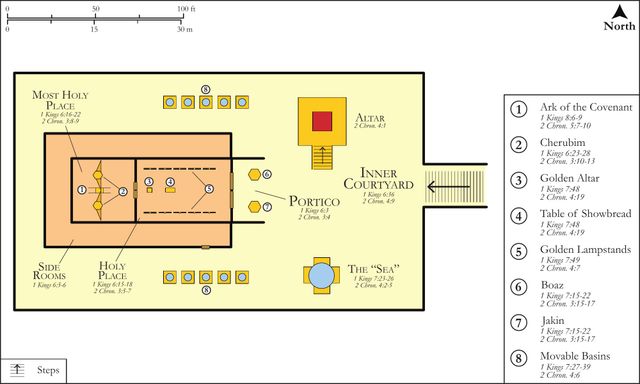
This initial clause meticulously lists four types of smaller, functional implements crucial for daily Temple service. "Snuffers" were used for trimming the wicks of the menorah, ensuring a clean and steady light. "Basons" (bowls) served various ritual purposes, such as collecting sacrificial blood or holding libations. "Spoons" (or pans) were typically employed for carrying incense or coals for the altars. "Censers" (or firepans) were specifically designed for burning incense. The explicit declaration that even these utilitarian items were crafted from "pure gold" profoundly emphasizes the principle that every facet of worship and service to God, regardless of its perceived grandeur, was to be treated with the utmost reverence, purity, and dedication, reflecting the divine majesty they served.
"and the entry of the house, the inner doors thereof for the most holy [place]"
This segment shifts focus from the smaller implements to significant architectural features—the doors of the Temple. "The entry of the house" refers to the main external doors of the Temple building, through which worshippers would enter the outer courts and then the Holy Place. More significantly, "the inner doors thereof for the most holy place" refers to the highly symbolic and sacred doors that separated the Holy Place from the Most Holy Place (the Holy of Holies). These doors, often accompanied by a veil in the Tabernacle tradition, delineated the boundary of God's immediate, manifest presence, underscoring its exclusivity and profound sacredness.
"and the doors of the house of the temple, [were of] gold"
This concluding phrase serves as a powerful reiteration and emphatic statement, confirming that all these mentioned doors—both the main entrance doors and the inner doors leading to the Most Holy Place—were made entirely of gold. The repetition of "gold" reinforces the extraordinary value, inherent beauty, and supreme sanctity of the entire Temple structure and everything contained within it. It signifies that even the very points of access to God's dwelling were adorned with the most precious and pure material, reflecting the glory and unapproachable holiness of the One who resided there.
Literary Devices
ShowHideThe chronicler masterfully employs several literary devices in 2 Chronicles 4:22 to convey its profound theological message. Emphasis is powerfully achieved through the repeated mention of "pure gold" and "gold." This repetition is not mere redundancy but a deliberate rhetorical strategy to underscore the extraordinary value, sanctity, and divine glory associated with every element of the Temple, from the most utilitarian implement to the most significant architectural barrier. The detailed enumeration of specific items (snuffers, basins, spoons, censers) also functions as a form of Merism, where a comprehensive list of parts is used to represent the whole, implying that all temple implements and all significant doors were made of this precious material, leaving no detail overlooked in the pursuit of divine excellence. Furthermore, Symbolism is paramount. Gold itself is a potent symbol throughout Scripture, representing purity, incorruptibility, divine majesty, and immense value. Its pervasive use in the Temple, particularly for the doors to the Most Holy Place, symbolizes the unapproachable holiness of God and the sacred, exclusive nature of His presence, a barrier that only divine intervention could ultimately bridge.
Theological and Thematic Connections
ShowHide2 Chronicles 4:22 profoundly encapsulates the theological principle that God is worthy of the absolute best, and His worship demands meticulous attention to purity and excellence. The sheer quantity and quality of gold used in the Temple's construction and furnishings speak volumes about the immeasurable worth and glory of God. This detail teaches that our approach to God, our worship, and our service should be marked by intentionality, reverence, and a commitment to offering Him what is most precious, not merely what is convenient or leftover. The golden doors to the Most Holy Place also serve as a profound theological symbol of the separation between a holy God and sinful humanity, a barrier that only God Himself could ultimately bridge through His own initiative and provision.
Reflection and Application
ShowHideWhile the physical Temple and its golden implements are no longer central to Christian worship, the timeless principles embedded in 2 Chronicles 4:22 remain profoundly relevant for believers today. This verse challenges us to deeply consider the quality of our worship and service to God. The immense cost and exquisite beauty of the Temple signify the immeasurable worth and glory of God; therefore, our worship, our time, our talents, and our material resources should reflect His supreme value in our lives, not just in grand gestures but in every small detail. It reminds us that every act of service, whether seemingly grand or insignificant, should be undertaken with reverence, purity of heart, and an unwavering commitment to excellence, knowing that we are serving a holy God who sees all. Just as the ancient Israelites gave their finest gold, we are called to give our best—our purest motives, our undivided attention, and our sincere devotion—in all aspects of our lives, recognizing that our bodies are now the temple of the Holy Spirit and our lives are to be living sacrifices, holy and pleasing to God.
Questions for Reflection
ShowHideFAQ
ShowHideWhat was the practical purpose of the "snuffers," "basins," "spoons," and "censers" in the Temple?
ShowHideThese items were integral to the daily operations and ritual purity of the Temple. "Snuffers" were small implements, often resembling scissors or tongs, used to trim the wicks of the golden lampstand (menorah), ensuring the lamps burned brightly and cleanly without smoke. "Basins" (or bowls) were versatile vessels used for various purposes, including collecting the blood from sacrifices, holding water for ritual washing, or for libations (liquid offerings). "Spoons" (or pans) were likely used to carry incense or coals from the altar of burnt offering to the altar of incense. "Censers" (or firepans) were specifically designed for burning incense, which produced a fragrant smoke symbolizing the prayers of the saints ascending to God (Revelation 8:3-4). The fact that even these functional items were made of pure gold underscores the sacredness and divine importance of every aspect of Temple service, reflecting the holiness of the God being worshipped.
Christ-Centered Fulfillment
ShowHide2 Chronicles 4:22, with its profound emphasis on pure gold and the exclusive access to the Most Holy Place, finds its ultimate Christ-centered fulfillment in the person and redemptive work of Jesus. The physical Temple, magnificent and divinely ordained as it was, served as a tangible shadow and prophetic type pointing to the true and ultimate dwelling place of God. The golden doors to the Most Holy Place, symbolizing the sacred barrier between a holy God and sinful humanity, were a constant, visible reminder that direct, unhindered access to God's immediate presence was restricted by human sin. However, in Christ, this formidable barrier was supernaturally and eternally removed. When Jesus, the Lamb of God who takes away the sin of the world, offered Himself as the perfect, once-for-all sacrifice on the cross, the veil of the Temple, which separated the Holy Place from the Most Holy Place, was dramatically torn from top to bottom (Matthew 27:51). This profound event signified that through Christ's shed blood and His perfect obedience, a new and living way was opened for all believers to boldly enter the Most Holy Place—that is, into the very presence of God the Father. Furthermore, Christ Himself is the ultimate Temple, the place where God fully dwells among humanity in bodily form (John 2:19-21). As believers, we are now incorporated into Him, becoming living stones in a spiritual house, a temple of the Holy Spirit, called to offer spiritual sacrifices of praise and service that are pure and acceptable to God through Him (1 Peter 2:5). Thus, the gold of the old covenant Temple, representing purity and divine glory, points forward to the incorruptible purity, divine majesty, and perfect access found perfectly and eternally in Christ, who grants us full and unhindered communion with God.