


2 Chronicles 2:7
- וְעַתָּהve·'a·Tahand thereforeH6258Conj-w ¦ AdvAdverbוְandעַתָּהtherefore
- שְׁלַחshe·lachsendH7971V-Qal-Imp-2msVerb Qal Imperative 2nd Singular Masculine
- לִיlito mePrep-l ¦ 1csSuffix Personal 1st Singular common genderלִtoיme
- אִישׁ'isha manH376N-msNoun Singular Masculine Absolute
- חָכָםcha·KhamskillfulH2450Adj-msAdjective Singular Masculine Absolute
- לַעֲשׂוֹתla·'a·sOtto workH6213Prep-l ¦ V-Qal-InfVerb Qal Infinitive Constructלַtoעֲשׂוֹתwork
- בַּזָּהָבba·za·Havin <the> goldH2091Prep-b ¦ N-msNoun Singular Masculine Absoluteבַּin <the>זָּהָבgold
- וּבַכֶּסֶףu·va·Ke·sefand in <the> silverH3701Conj-w ¦ Prep-b ¦ N-msNoun Singular Masculine Absoluteוּandבַin <the>כֶּסֶףsilver
- וּבַנְּחֹשֶׁתu·va·ne·Cho·shetand in <the> bronzeH5178Conj-w ¦ Prep-b ¦ N-fsNoun Singular Feminine Absoluteוּandבַin <the>נְּחֹשֶׁתbronze
- וּבַבַּרְזֶלu·va·bar·Zeland in <the> ironH1270Conj-w ¦ Prep-b ¦ N-msNoun Singular Masculine Absoluteוּandבַin <the>בַּרְזֶלiron
- וּבָאַרְגְּוָןu·va·'ar·ge·Vanand in <the> purpleH710Conj-w ¦ Prep-b ¦ N-msNoun Singular Masculine Absoluteוּandבָin <the>אַרְגְּוָןpurple
- וְכַרְמִילve·khar·Miland crimsonH3758Conj-w ¦ N-msNoun Singular Masculine Absoluteוְandכַרְמִילcrimson
- וּתְכֵלֶתu·te·Khe·letand violetH8504Conj-w ¦ N-fsNoun Singular Feminine Absoluteוּandתְכֵלֶתviolet
- וְיֹדֵעַve·yo·De·a'and [one who] knowsH3045Conj-w ¦ V-Qal-Prtcpl-msVerb Qal Participle Singular Masculine Absoluteוְandיֹדֵעַ[one who] knows
- לְפַתֵּחַle·fa·Te·achto engraveH6605Prep-l ¦ V-Piel-InfVerb Piel Infinitive Constructלְtoפַתֵּחַengrave
- פִּתּוּחִיםpi·tu·ChimengravingsH6603N-mpNoun Plural Masculine Absolute
- עִם'imwithH5973PrepPreposition
- הַחֲכָמִיםha·cha·kha·Mimthe skillful [people]H2450Art ¦ Adj-mpAdjective Plural Masculine Absoluteהַtheחֲכָמִיםskillful [people]
- אֲשֶׁר'a·SherwhoH834RelParticle Relative
- עִמִּי'i·Mi[are] with meH5973Prep ¦ 1csPrepositionעִמִּ[are] withיme
- בִּיהוּדָהbi·hu·Dahin JudahH3063Prep-b ¦ N-properNoun Proper LocationבִּinיהוּדָהJudah
- וּבִירוּשָׁלִַםu·vi·ru·sha·Limand in JerusalemH3389Conj-w ¦ Prep-b ¦ N-properNoun Proper LocationוּandבִinירוּשָׁלִַםJerusalem
- אֲשֶׁר'a·SherwhomH834RelParticle Relative
- הֵכִיןhe·Khinhe appointedH3559V-Hiphil-Perf-3msVerb Hiphil Perfect 3rd Singular Masculine
- דָּוִידda·VidDavidH1732N-proper-mNoun Proper Masculine
- אָבִי'a·Vimy fatherH1N-msc ¦ 1csNoun Singular Masculine Constructאָבִfatherיmy
English is a literal word-by-word gloss of the Hebrew, not the KJV's wording. Why?
This is the original text the KJV's translators worked from — each Hebrew word with its own literal English meaning in this verse, prepared by scholars at Tyndale House, Cambridge. The KJV translates whole sentences, not word by word, so its wording differs: one Hebrew word can become several English words, and the KJV may choose “the LORD” where the gloss reads “Yahweh”. Both are faithful — they answer different questions. For the KJV's own rendering, switch to the KJV text.
Details
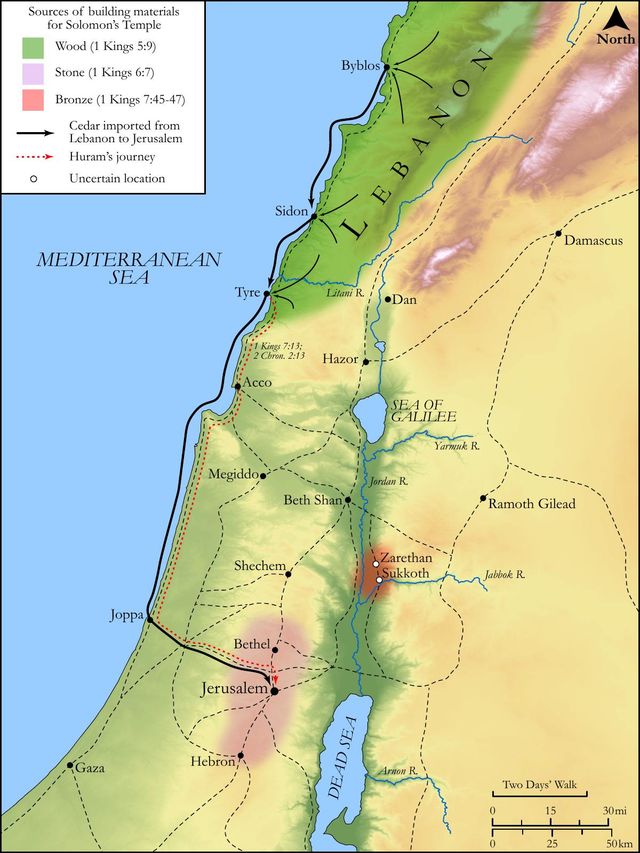
See on the biblical-era map
Study this verse
Public-domain commentary
Matthew Henry
From his Commentary on the Whole Bible. Henry comments on passages, not single verses — this entry covers 2 Chronicles 2:1–10. His three-level outline is real structure in the source text, so it is rendered as structure.
Solomon's wisdom was given him, not merely for speculation, to entertain himself (though it is indeed a princely entertainment), nor merely for conversation, to entertain his friends, but for action; and therefore to action he immediately applies himself. Observe,
I.His resolution within himself concerning his business (Ch2 2:1):
He determined to build, in the first place, a house for the name of the Lord. It is fit that he who is the first should be served - first a temple and then a palace, a house not so much for himself, or his own convenience and magnitude, as for the kingdom, for the honour of it among its neighbours and for the decent reception of the people whenever they had occasion to apply to their prince; so that in both he aimed at the public good. Those are the wisest men that lay out themselves most for the honour of the name of the Lord and the welfare of communities. We are not born for ourselves, but for God and our country.
II.His embassy to Huram, king of Tyre, to engage his assistance in the prosecution of his designs.
The purport of his errand to him is much the same here as we had it Kg1 5:2, etc., only here it is more largely set forth.
1.The reasons why he makes this application to Huram are here more fully represented, for information to Huram as well as for inducement.
(1.)He pleads his father's interest in Huram, and the kindness he had received from him (Ch2 2:3): As thou didst deal with David, so deal with me. As we must show kindness to, so we may expect kindness from, our fathers' friends, and with them should cultivate a correspondence.
(2.)He represents his design in building the temple: he intended it for a place of religious worship (Ch2 2:4), that all the offerings which God had appointed for the honour of his name might be offered up there. The house was built that it might be dedicated to God and used in his service. This we should aim at in all our business, that our havings and doings may be all to the glory of God. He mentions various particular services that were there to be performed, for the instruction of Huram. The mysteries of the true religion, unlike those of the Gentile superstition, coveted not concealment.
(3.)He endeavors to inspire Huram with very great and high thoughts of the God of Israel, by expressing the mighty veneration he had for his holy name: Great is our God above all gods, above all idols, above all princes. Idols are nothing, princes are little, and both under the control of the God of Israel; and therefore, [1.] "The house must be great; not in proportion to the greatness of that God to whom it is to be dedicated (for between finite and infinite there can be no proportion), but in some proportion to the great value and esteem we have for this God." [2.] "Yet, be it ever so great, it cannot be a habitation for the great God. Let not Huram think that the God of Israel, like the gods of the nations, dwells in temples made with hands, Act 17:24. No, the heaven of heavens cannot contain him. It is intended only for the convenience of his priests and worshippers, that they may have a fit place wherein to burn sacrifice before him." [3.] He looked upon himself, though a mighty prince, as unworthy the honour of being employed in this great work: Who am I that I should build him a house? It becomes us to go about every work for God with a due sense of our utter insufficiency for it and our incapacity to do any thing adequate to the divine perfections. It is part of the wisdom wherein we ought to walk towards those that are without carefully to guard against all misapprehension which any thing we say or do may occasion concerning God; so Solomon does here in his treaty with Huram.
2.The requests he makes to him are more particularly set down here. (1.) He desired Huram would furnish him with a good hand to work (Ch2 2:7): Send me a man. He had cunning men with him in Jerusalem and Judah, whom David provided, Ch1 22:15. Let them not think but that Jews had some among them that were artists. But "send me a man to direct them. There are ingenious men in Jerusalem, but not such engravers as are in Tyre; and therefore, since temple-work must be the best in its kind, let me have the best workmen that can be got." (2.) With good materials to work on (Ch2 2:8), cedar and other timber in abundance (Ch2 2:8, Ch2 2:9); for the house must be wonderfully great, that is, very stately and magnificent, no cost must be spared, nor any contrivance wanting in it.
3.Here is Solomon's engagement to maintain the workmen (Ch2 2:10), to give them so much wheat and barley, so much wine and oil. He did not feed his workmen with bread and water, but with plenty, and every thing of the best. Those that employ labourers ought to take care they be not only well paid, but well provided for with sufficient of that which is wholesome and fit for them. Let the rich masters do for their poor workmen as they would be done by if the tables were turned.
Continue studying 2 Chronicles 2:7 across the web’s major study libraries — every link below opens this exact verse, chapter, or book on the destination site.
Read & Compare
 BibleGatewayThis verse in more than 200 translations and 70 languages.
 Bible.comThe YouVersion reader — hundreds of translations, reading plans, and highlights.
 ESV.orgCrossway's official English Standard Version reader.
 NET BibleThe NET translation with 60,000+ translators' notes on every rendering decision.
 STEP BibleTyndale House's free study tool — original text, vocabulary, and scholarly resources.
 BibliaLogos Bible Software's free web reader.
 USCCBThe New American Bible (Revised Edition) with the U.S. bishops' study notes.
Commentaries
 BibleHub CommentariesDozens of classic commentaries on this verse, gathered on one page.
 StudyLightMore than 100 commentary sets — the largest collection on the web.
 BibleRefPlain-English commentary on what this verse means, verse by verse.
 Enduring WordDavid Guzik's free commentary on this chapter, widely used by Bible teachers.
 Bible Study ToolsVerse commentary alongside Greek and Hebrew study aids.
Original Language & Research
- BibleHub InterlinearThe verse word by word — original language, transliteration, and English.
- BibleHub LexiconEvery word's original-language definition and Strong's entry.
 Blue Letter BibleDeep-study tools — Strong's numbers, concordance, and word studies.
 SefariaThe Hebrew text with Rashi and centuries of Jewish commentary.
Sermons, Hymns & Audio


TrulyRandomVerse is not affiliated with these sites and doesn’t control their content. They’re linked because they’re genuinely useful.
Summary
King Solomon, embarking on the monumental and divinely ordained task of constructing the Temple for the Lord in Jerusalem, dispatches a specific and detailed request to Hiram, the King of Tyre. This verse meticulously outlines Solomon's urgent need for a master craftsman, highly skilled in working with precious metals—gold, silver, brass, and iron—as well as in the intricate dyeing of purple, crimson, and blue fabrics, and proficient in engraving. It underscores Solomon's strategic foresight and his recognition that such a grand undertaking, intended to honor God, demanded not only immense resources but also the most exceptional and specialized human talent available, complementing the existing skilled artisans provided by his father, David.
Context
ShowHideLiterary Context
This verse is an integral part of Solomon's initial diplomatic overture to King Hiram, detailed in 2 Chronicles 2:1-10. Having already declared his solemn intention to build a magnificent Temple for the Lord, a project of unparalleled national and spiritual significance as outlined in 2 Chronicles 2:1, Solomon now articulates the specific human resources required. This undertaking fulfills the long-standing promise made to his father David concerning the construction of God's house, a promise recorded in 2 Samuel 7:13. The detailed request for a master craftsman in 2 Chronicles 2:7 finds a close parallel in 1 Kings 5:6, highlighting the critical importance of this alliance and the specialized expertise sought for the Temple's elaborate design and construction. The narrative flow emphasizes Solomon's methodical approach to fulfilling God's command, moving from the decision to build to the securing of necessary materials and, crucially, the specialized human talent.
Historical & Cultural Context
In the ancient Near East, Phoenicia, particularly the city-state of Tyre, was renowned for its unparalleled craftsmanship in metallurgy, woodworking, and the production of highly prized dyes. While Israel possessed skilled laborers, the intricate and ornate designs specified for the Temple, especially its decorative elements and the handling of precious materials, necessitated an expertise that surpassed what was readily available within Israelite borders. The materials mentioned—gold, silver, brass, and iron—were the most valuable and durable metals of the era, essential for both structural and decorative components. The dyes—purple, crimson, and blue—were exceptionally rare and expensive, derived from specific snails (murex for purple and blue) and insects (kermes for crimson). These colors were universally associated with royalty, wealth, and sacred vestments, as seen in the Tabernacle's construction in Exodus 26:1 and the priestly garments in Exodus 28:5-6. Solomon's request therefore reflects a pragmatic understanding of the best available resources and a willingness to engage in international collaboration for a sacred purpose, demonstrating his commitment to excellence in God's service.
Key Themes
ShowHideThis verse powerfully contributes to several overarching themes within 2 Chronicles and the broader biblical narrative. It underscores the theme of Divine Purpose, Human Skill, and Excellence, demonstrating that God's grand plans often involve the specialized talents and collaborative efforts of many individuals, and that the work dedicated to Him should be of the highest possible quality, reflecting His own perfection. The detailed enumeration of skills and materials emphasizes a commitment to Excellence in Service and Worship, where nothing less than the finest would suffice for God's dwelling place. Furthermore, the request to Hiram highlights the theme of International Collaboration and Interdependence, showing how unique talents from diverse nations can converge for a common, sacred goal, transcending national boundaries for a divine project. Finally, Solomon's acknowledgment of the "cunning men" already with him, "whom David my father did provide," speaks to the Continuity of God's Plan across generations and the profound benefit of prior preparation and investment in skilled labor, ensuring a seamless transition and a strong foundation for the monumental task of building the Temple.
Exposition and Analysis
ShowHideKey Word Analysis
ShowHideThis word means "wise, intelligent, skilful or artful." In this context, it denotes an extraordinary level of wisdom, ingenuity, and expertise in craftsmanship. It describes a master artisan, someone profoundly proficient and insightful in their trade, capable of executing complex and artistic tasks with precision and understanding, far beyond mere competence.
These refer to highly prized and costly dyes. Purple (H710) was typically associated with royalty, wealth, and divine majesty. Crimson (H3758), a deep red, symbolized vitality, sacrifice, and richness. Blue (H8504) often represented the heavens, divinity, and purity. Their inclusion signifies the Temple's sacredness, its royal patronage, and its intended splendor, reflecting the colors used in the Tabernacle (e.g., Exodus 25:4).
This primitive root means "to open wide (literally or figuratively); specifically, to loosen, begin, plough, carve." In this context, it refers to the intricate artistic work of incising designs into materials, particularly metals or stone. This skill was crucial for the decorative elements of the Temple, such as cherubim, palm trees, and open flowers, which adorned its walls, doors, and furnishings, adding to its beauty and symbolic richness.
Verse Breakdown
ShowHide"Send me now therefore a man cunning to work in gold, and in silver, and in brass, and in iron"
Solomon's immediate and primary request is for a master metallurgist. The enumeration of these four key metals highlights the extensive work required in various metal applications, from structural components to decorative overlays and sacred vessels within the Temple. This indicates a need for someone not merely skilled in one metal, but a versatile expert capable of handling the properties and intricacies of each with exceptional proficiency.
"and in purple, and crimson, and blue"
This clause specifies the need for expertise in textiles and dyeing. The inclusion of these particular colors underscores the requirement for artisans capable of producing or working with the most luxurious and symbolically significant fabrics, essential for the Temple's curtains, veils, and priestly garments, reflecting the divine instructions for the Tabernacle and emphasizing the sacredness and royal nature of God's dwelling.
"and that can skill to grave"
This refers to the specialized talent of engraving or carving. It points to the need for an artist who can execute intricate, detailed designs, crucial for the aesthetic and symbolic elements of the Temple's interior and furnishings, transforming raw materials into works of sacred art that would visually communicate theological truths.
"with the cunning men that [are] with me in Judah and in Jerusalem, whom David my father did provide"
This final clause reveals Solomon's awareness of and appreciation for the existing pool of skilled Israelite craftsmen. It acknowledges David's foresight in assembling and training artisans for the future Temple project, indicating a desire for collaboration between local and foreign experts rather than a complete reliance on external help. It also highlights the continuity of the divine plan across generations and the blessing of preparation.
Literary Devices
ShowHideThe verse employs several literary devices to convey Solomon's meticulous planning and the grandeur of the Temple project. The most prominent is Enumeration, seen in the detailed listing of materials (gold, silver, brass, iron, purple, crimson, blue) and skills (working metals, dyeing, engraving). This precise listing emphasizes the comprehensive nature of the required expertise and the high standards set for the Temple's construction, underscoring the vast scope of the undertaking. There is also an element of Emphasis through the repeated notion of "cunning" or "skill," which underscores the exceptional proficiency demanded for this sacred task and highlights that ordinary skill would not suffice for God's house. Finally, the mention of "whom David my father did provide" serves as a form of Continuity or Legacy, connecting Solomon's immediate efforts to his father's long-term preparation and God's unfolding plan, demonstrating the generational nature of God's work.
Theological and Thematic Connections
ShowHideThis passage beautifully illustrates the principle that while God's purposes are sovereign, He often chooses to accomplish them through human effort and skill. Solomon's request for a master craftsman highlights that divine projects, even those as sacred as building God's dwelling place, require human excellence, dedication, and collaboration. It teaches that God values not only spiritual devotion but also the diligent application of diverse talents and professional expertise. The detailed nature of the required skills underscores the biblical emphasis on giving God our very best, reflecting His own perfection and glory in our service. This commitment to excellence in craftsmanship for the Temple foreshadows the New Testament concept of believers as living stones, each uniquely gifted and contributing to the spiritual house of God, where every part is essential for the whole.
Reflection and Application
ShowHideSolomon's meticulous search for the most skilled artisans for God's Temple serves as a profound reminder that our gifts, talents, and professional skills are not merely for personal gain or earthly pursuits, but are to be consecrated and utilized for God's glory. Just as Solomon sought out unparalleled craftsmanship for a physical structure, we are called to employ our unique abilities—whether artistic, technical, intellectual, relational, or administrative—with excellence and diligence in every sphere of our lives, recognizing that all good work, when offered to God, can be an act of worship. This verse also teaches us the vital importance of collaboration within the body of Christ, acknowledging that no single individual possesses all the necessary gifts. It encourages humility in seeking help and wisdom from others, even those from different backgrounds or traditions, to achieve God's greater purposes. Our commitment to excellence, our willingness to collaborate, and our understanding that our "cunning" is a divine provision, transform our daily tasks into sacred service, building up God's kingdom in tangible and spiritual ways, demonstrating His glory in and through us.
Questions for Reflection
ShowHideFAQ
ShowHideWhy did Solomon need foreign craftsmen if Israel already had "cunning men"?
ShowHideWhile Israel did possess skilled artisans, as acknowledged by Solomon, the Phoenicians, particularly from Tyre, were renowned throughout the ancient world for their superior and highly specialized expertise in certain crafts. This included advanced metallurgy, intricate engraving, and the production of rare and valuable dyes. The scale and complexity of the Temple project, intended to be a magnificent dwelling place for God, demanded the absolute finest craftsmanship available. Solomon's request was not a dismissal of Israelite skill but a strategic recognition that the unparalleled expertise of Tyrian craftsmen was essential to achieve the divine standard of excellence required for the Temple's construction, complementing the existing local talent. This collaboration underscored a practical wisdom in seeking the best resources for a divinely appointed task.
What is the significance of the specific materials mentioned in this verse?
ShowHideThe materials listed—gold, silver, brass, iron, purple, crimson, and blue—were not chosen arbitrarily; they held immense value and symbolic significance in the ancient world. Gold and silver represented wealth, purity, and divine majesty, used for the most sacred and ornate elements of the Temple. Brass (bronze) and iron were crucial for structural integrity and practical implements. The dyes—purple, crimson, and blue—were exceptionally rare and expensive, associated with royalty, nobility, and sacredness. Their use in the Tabernacle (e.g., Exodus 26:1) established their sacred significance, marking the Temple as a place set apart for God's glory and a symbol of His royal presence. These materials collectively speak to the immense value and sacredness of God's dwelling place.
How does this verse relate to God's sovereignty in building His Temple?
ShowHideThis verse beautifully illustrates the paradox of divine sovereignty and human responsibility. While the Temple's construction was God's ultimate plan and initiative, He chose to accomplish it through human means and collaboration. Solomon, as God's chosen king, actively sought out the best human resources, demonstrating that God often works through the diligent efforts, wisdom, and specialized skills of individuals and even nations. It shows that God's sovereign will does not negate human agency but often incorporates it, using human ingenuity and cooperation—even from foreign sources like Hiram and his craftsmen—to bring about His divine purposes. The Temple, though built by human hands, was ultimately a testament to God's faithfulness and design, a partnership between divine command and human obedience and skill.
Christ-Centered Fulfillment
ShowHideThe meticulous search for a master craftsman for Solomon's Temple, a physical dwelling place for God's presence, finds its ultimate and profound fulfillment in Jesus Christ. While Solomon sought an earthly artisan to construct a building, God Himself, in the person of Jesus, is the ultimate "cunning man" (or master builder) who perfectly executes the divine design for a spiritual Temple. Jesus declared, "Destroy this temple, and in three days I will raise it up," speaking of the temple of His body, which became the true dwelling place of God among humanity (John 2:21). Moreover, Christ is the chief cornerstone (Ephesians 2:20) upon whom the entire spiritual Temple, the Church, is built. Just as Solomon needed diverse skills, Christ, as the head of the Church, provides a rich array of spiritual gifts and talents to His body, the believers, enabling them to be "built up as a spiritual house to be a holy priesthood" (1 Peter 2:5). The precious materials and intricate designs of Solomon's Temple foreshadow the immeasurable value and divine beauty of the Church, redeemed by the precious blood of Christ (1 Peter 1:18-19), and adorned with the righteousness and glory of God. In Christ, the need for an external craftsman is transcended, as He Himself is both the architect and the foundation, perfectly fulfilling God's eternal plan for communion with humanity.