


2 Chronicles 2:8
- וּשְׁלַחu·she·lachand sendH7971Conj-w ¦ V-Qal-Imp-2msVerb Qal Imperative 2nd Singular Masculineוּandשְׁלַחsend
- לִיlito mePrep-l ¦ 1csSuffix Personal 1st Singular common genderלִtoיme
- עֲצֵי'a·Tzeiwood<s> ofH6086N-mpcNoun Plural Masculine Construct
- אֲרָזִים'a·ra·Zimcedar<s>H730N-mpNoun Plural Masculine Absolute
- בְּרוֹשִׁיםbe·ro·Shimfir<s>H1265N-mpNoun Plural Masculine Absolute
- וְאַלְגּוּמִּיםve·'al·gu·Mimand algum<s>H418Conj-w ¦ N-mpNoun Plural Masculine Absoluteוְandאַלְגּוּמִּיםalgum<s>
- מֵהַלְּבָנוֹןme·ha·le·va·nOnfrom <the> LebanonH3844Prep-m ¦ Art ¦ N-properNoun Proper Locationמֵfromהַ<the>לְּבָנוֹןLebanon
- כִּיkiforH3588PrtParticle Conditional
- אֲנִי'a·NiIH589Pro-1csPronoun Personal 1st Singular common gender
- יָדַעְתִּיya·Da'·tiI knowH3045V-Qal-Perf-1csVerb Qal Perfect 1st Singular common gender
- אֲשֶׁר'a·SherthatH834RelParticle Relative
- עֲבָדֶיךָ'a·va·Dei·khayour servantsH5650N-mpc ¦ 2msNoun Plural Masculine Constructעֲבָדֶיservantsךָyour
- יוֹדְעִיםyod·'Im[are] knowingH3045V-Qal-Prtcpl-mpVerb Qal Participle Plural Masculine Absolute
- לִכְרוֹתlikh·Rotto cutH3772Prep-l ¦ V-Qal-InfVerb Qal Infinitive Constructלִtoכְרוֹתcut
- עֲצֵי'a·Tzei[the] wood<s> ofH6086N-mpcNoun Plural Masculine Construct
- לְבָנוֹןle·va·NonLebanonH3844N-properNoun Proper Location
- וְהִנֵּהve·hi·Nehand there!H2009Conj-w ¦ PrtParticle Interjectionוְandהִנֵּהthere!
- עֲבָדַי'a·va·Daimy servantsH5650N-mpc ¦ 1csNoun Plural Masculine Constructעֲבָדַservantsיmy
- עִם'im[will be] withH5973PrepPreposition
- עֲבָדֶיךָ'a·va·Dei·khayour servantsH5650N-mpc ¦ 2msNoun Plural Masculine Constructעֲבָדֶיservantsךָyour
English is a literal word-by-word gloss of the Hebrew, not the KJV's wording. Why?
This is the original text the KJV's translators worked from — each Hebrew word with its own literal English meaning in this verse, prepared by scholars at Tyndale House, Cambridge. The KJV translates whole sentences, not word by word, so its wording differs: one Hebrew word can become several English words, and the KJV may choose “the LORD” where the gloss reads “Yahweh”. Both are faithful — they answer different questions. For the KJV's own rendering, switch to the KJV text.
Details
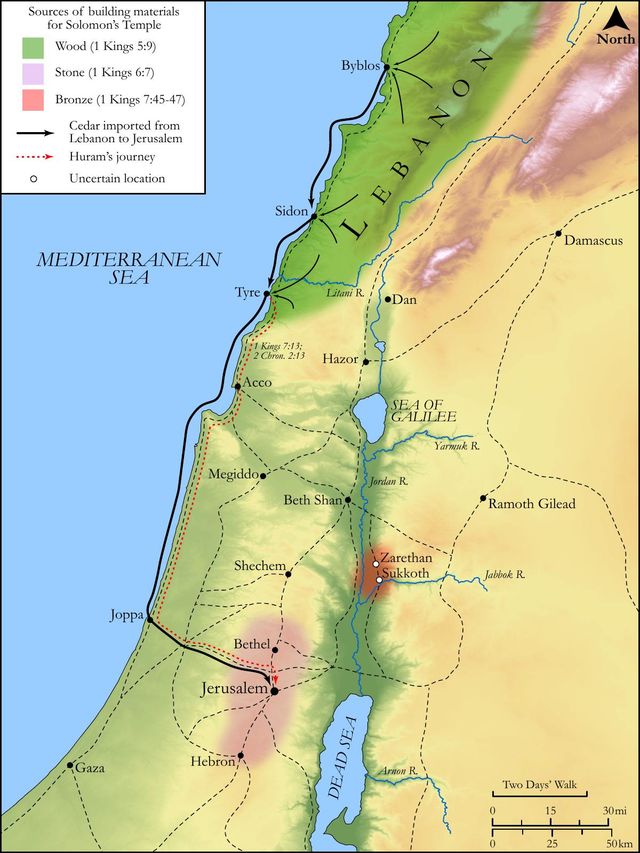
See on the biblical-era map
Study this verse
Public-domain commentary
Matthew Henry
From his Commentary on the Whole Bible. Henry comments on passages, not single verses — this entry covers 2 Chronicles 2:1–10. His three-level outline is real structure in the source text, so it is rendered as structure.
Solomon's wisdom was given him, not merely for speculation, to entertain himself (though it is indeed a princely entertainment), nor merely for conversation, to entertain his friends, but for action; and therefore to action he immediately applies himself. Observe,
I.His resolution within himself concerning his business (Ch2 2:1):
He determined to build, in the first place, a house for the name of the Lord. It is fit that he who is the first should be served - first a temple and then a palace, a house not so much for himself, or his own convenience and magnitude, as for the kingdom, for the honour of it among its neighbours and for the decent reception of the people whenever they had occasion to apply to their prince; so that in both he aimed at the public good. Those are the wisest men that lay out themselves most for the honour of the name of the Lord and the welfare of communities. We are not born for ourselves, but for God and our country.
II.His embassy to Huram, king of Tyre, to engage his assistance in the prosecution of his designs.
The purport of his errand to him is much the same here as we had it Kg1 5:2, etc., only here it is more largely set forth.
1.The reasons why he makes this application to Huram are here more fully represented, for information to Huram as well as for inducement.
(1.)He pleads his father's interest in Huram, and the kindness he had received from him (Ch2 2:3): As thou didst deal with David, so deal with me. As we must show kindness to, so we may expect kindness from, our fathers' friends, and with them should cultivate a correspondence.
(2.)He represents his design in building the temple: he intended it for a place of religious worship (Ch2 2:4), that all the offerings which God had appointed for the honour of his name might be offered up there. The house was built that it might be dedicated to God and used in his service. This we should aim at in all our business, that our havings and doings may be all to the glory of God. He mentions various particular services that were there to be performed, for the instruction of Huram. The mysteries of the true religion, unlike those of the Gentile superstition, coveted not concealment.
(3.)He endeavors to inspire Huram with very great and high thoughts of the God of Israel, by expressing the mighty veneration he had for his holy name: Great is our God above all gods, above all idols, above all princes. Idols are nothing, princes are little, and both under the control of the God of Israel; and therefore, [1.] "The house must be great; not in proportion to the greatness of that God to whom it is to be dedicated (for between finite and infinite there can be no proportion), but in some proportion to the great value and esteem we have for this God." [2.] "Yet, be it ever so great, it cannot be a habitation for the great God. Let not Huram think that the God of Israel, like the gods of the nations, dwells in temples made with hands, Act 17:24. No, the heaven of heavens cannot contain him. It is intended only for the convenience of his priests and worshippers, that they may have a fit place wherein to burn sacrifice before him." [3.] He looked upon himself, though a mighty prince, as unworthy the honour of being employed in this great work: Who am I that I should build him a house? It becomes us to go about every work for God with a due sense of our utter insufficiency for it and our incapacity to do any thing adequate to the divine perfections. It is part of the wisdom wherein we ought to walk towards those that are without carefully to guard against all misapprehension which any thing we say or do may occasion concerning God; so Solomon does here in his treaty with Huram.
2.The requests he makes to him are more particularly set down here. (1.) He desired Huram would furnish him with a good hand to work (Ch2 2:7): Send me a man. He had cunning men with him in Jerusalem and Judah, whom David provided, Ch1 22:15. Let them not think but that Jews had some among them that were artists. But "send me a man to direct them. There are ingenious men in Jerusalem, but not such engravers as are in Tyre; and therefore, since temple-work must be the best in its kind, let me have the best workmen that can be got." (2.) With good materials to work on (Ch2 2:8), cedar and other timber in abundance (Ch2 2:8, Ch2 2:9); for the house must be wonderfully great, that is, very stately and magnificent, no cost must be spared, nor any contrivance wanting in it.
3.Here is Solomon's engagement to maintain the workmen (Ch2 2:10), to give them so much wheat and barley, so much wine and oil. He did not feed his workmen with bread and water, but with plenty, and every thing of the best. Those that employ labourers ought to take care they be not only well paid, but well provided for with sufficient of that which is wholesome and fit for them. Let the rich masters do for their poor workmen as they would be done by if the tables were turned.
Continue studying 2 Chronicles 2:8 across the web’s major study libraries — every link below opens this exact verse, chapter, or book on the destination site.
Read & Compare
 BibleGatewayThis verse in more than 200 translations and 70 languages.
 Bible.comThe YouVersion reader — hundreds of translations, reading plans, and highlights.
 ESV.orgCrossway's official English Standard Version reader.
 NET BibleThe NET translation with 60,000+ translators' notes on every rendering decision.
 STEP BibleTyndale House's free study tool — original text, vocabulary, and scholarly resources.
 BibliaLogos Bible Software's free web reader.
 USCCBThe New American Bible (Revised Edition) with the U.S. bishops' study notes.
Commentaries
 BibleHub CommentariesDozens of classic commentaries on this verse, gathered on one page.
 StudyLightMore than 100 commentary sets — the largest collection on the web.
 BibleRefPlain-English commentary on what this verse means, verse by verse.
 Enduring WordDavid Guzik's free commentary on this chapter, widely used by Bible teachers.
 Bible Study ToolsVerse commentary alongside Greek and Hebrew study aids.
Original Language & Research
- BibleHub InterlinearThe verse word by word — original language, transliteration, and English.
- BibleHub LexiconEvery word's original-language definition and Strong's entry.
 Blue Letter BibleDeep-study tools — Strong's numbers, concordance, and word studies.
 SefariaThe Hebrew text with Rashi and centuries of Jewish commentary.
Sermons, Hymns & Audio


TrulyRandomVerse is not affiliated with these sites and doesn’t control their content. They’re linked because they’re genuinely useful.
Summary
Second Chronicles 2:8 captures King Solomon's strategic and diplomatic request to King Hiram of Tyre for specific, high-quality timber—cedar, fir, and algum trees—sourced from the renowned forests of Lebanon. This pivotal verse highlights Solomon's profound wisdom in acknowledging and leveraging the superior skill of Hiram's Phoenician servants in felling and processing timber. This collaboration was a crucial step in gathering the immense resources required for the construction of the magnificent Temple in Jerusalem, a project of unparalleled national, spiritual, and architectural significance for Israel.
Context
ShowHideLiterary Context
This verse is situated early in 2 Chronicles, specifically within the detailed preparations for the construction of the Temple. Following King David's fervent, divinely inspired desire to build a permanent dwelling for the Lord—a task he was providentially prevented from completing—his son Solomon inherits this sacred mandate. The preceding verses establish Solomon's initial communication with Hiram, outlining the grand purpose of the Temple and the necessity of specialized labor and materials. 2 Chronicles 2:8 forms a precise component of Solomon's comprehensive request, demonstrating his meticulous planning and his reliance on external expertise for a project that would define his reign and serve as the central place of worship for the nation. The Chronicler frequently emphasizes the spiritual significance and divine blessing associated with the Temple's construction, portraying it as a fulfillment of God's covenant promises to David and a testament to Israel's devotion.
Historical & Cultural Context
The relationship between the emerging Israelite kingdom and the powerful Phoenician city-state of Tyre was characterized by strategic alliance, particularly during the reigns of David and Solomon. Tyre, a dominant maritime power, was celebrated throughout the ancient Near East for its exceptionally skilled craftsmen, advanced shipbuilding techniques, and unparalleled expertise in forestry, especially in harvesting the prized cedar and fir trees from the vast, ancient forests of Lebanon. These timbers were invaluable for large-scale construction dueo their durability, aromatic qualities, and natural resistance to decay. King Hiram had previously supplied cedar and skilled artisans for David's palace, establishing a strong precedent for their cooperation. Solomon's acknowledgment that Hiram's "servants can skill to cut timber in Lebanon" (2 Chronicles 2:8) was not mere diplomatic flattery but a genuine recognition of their widely known, specialized proficiency. The mention of "algum trees" (also known as almug in 1 Kings 10:11) is particularly significant, as this rare and highly valuable wood was likely imported from distant lands, possibly Ophir, via Tyre's extensive trade networks, underscoring the extraordinary quality and exotic nature of the materials sought for God's dwelling.
Key Themes
ShowHideThis verse contributes to several overarching themes within 2 Chronicles and the broader biblical narrative. Firstly, it powerfully illustrates the theme of Divine Provision and Human Cooperation, demonstrating how God sovereignly orchestrates circumstances and relationships, even involving international alliances like that between Solomon and Hiram, to facilitate His divine purposes. Secondly, it highlights the Value of Specialized Skill and Wisdom in Leadership. Solomon, despite his renowned wisdom, humbly recognized and sought out the unique expertise of others, exemplifying that effective leadership involves discerning and strategically utilizing diverse gifts for a common, divinely appointed goal. This principle is echoed in 1 Kings 5:6, where Solomon specifically requests Sidonian skill. Thirdly, the meticulous gathering of specific, high-quality materials for the Temple underscores the theme of Diligent Preparation and Excellence in Worship. The Temple was intended to be a place of unparalleled beauty and grandeur, reflecting the majesty of the God it honored, thus necessitating the finest resources and craftsmanship. Finally, it subtly points to the theme of God's Universal Sovereignty, as even non-Israelite nations and their distinct resources are brought into service for the building of His sacred sanctuary.
Exposition and Analysis
ShowHideKey Word Analysis
ShowHideThis term refers to a type of cypress or fir tree, known for its strong, aromatic wood. In the ancient world, fir was highly valued alongside cedar for construction, particularly for flooring, paneling, and beams, due to its durability and straight grain. Its inclusion in Solomon's request underscores the comprehensive nature of the timber needed for the Temple, utilizing the best available resources from Lebanon's renowned forests.
This Hebrew verb means "to know," "to perceive," "to understand," or "to be acquainted with." In this context, as used in "can skill to cut timber," it denotes a deep, practical knowledge, expertise, or mastery of a craft. Solomon's statement implies not merely a general awareness but a profound acknowledgment of the Phoenicians' superior, specialized proficiency and extensive experience in forestry, logging, and timber processing, particularly concerning the challenging terrain and massive trees of Lebanon. It signifies a recognized excellence in their trade.
This primitive root primarily means "to cut," "to cut off," "to fell," or "to cut down." While its direct meaning here is the felling and processing of trees, the broader semantic range of kârath can subtly evoke the precision, decisive action, and even the covenantal implications (as it also means "to make a covenant," often by cutting an animal) involved in preparing materials for a sacred purpose. In the context of the Temple, it signifies the deliberate and exact preparation of materials for a holy dwelling, underscoring the careful craftsmanship required.
Verse Breakdown
ShowHide"Send me also cedar trees, fir trees, and algum trees, out of Lebanon:"
This initial clause details King Solomon's specific and comprehensive request for three distinct types of timber. Cedar was highly prized for its durability, aromatic qualities, and majestic size, making it ideal for structural beams and elaborate paneling. Fir (or cypress) was also strong and used extensively for flooring, paneling, and other construction elements. Algum, as a rare and valuable wood, was reserved for decorative and musical purposes. The explicit mention "out of Lebanon" emphasizes the source of the finest timber in the ancient world, renowned for its vast, ancient forests and the quality of its wood.
"for I know that thy servants can skill to cut timber in Lebanon;"
This clause serves as Solomon's diplomatic justification and a profound acknowledgment of Hiram's unparalleled expertise. He expresses his full awareness and confidence in the exceptional proficiency of Hiram's Phoenician workers. This statement is a strategic compliment, affirming their renowned mastery in felling, transporting, and preparing the massive trees of Lebanon—a task that was highly specialized, laborious, and often dangerous. It underscores Solomon's humility and wisdom in seeking the best available resources and labor for the construction of God's house.
"and, behold, my servants [shall be] with thy servants,"
This final clause demonstrates Solomon's commitment to a cooperative effort and his willingness to contribute. He is not merely demanding resources but offering reciprocal labor. His servants would work alongside Hiram's, learning from their superior expertise, assisting with the arduous tasks, and fostering a spirit of genuine partnership between the two kingdoms. This arrangement would undoubtedly expedite the process, strengthen the alliance, and ensure the efficient extraction and preparation of the vast quantities of timber required for the monumental Temple project.
Literary Devices
ShowHideThe verse employs several literary devices to convey its message effectively and underscore the significance of the undertaking. Diplomacy and Politeness are prominently displayed in Solomon's carefully worded request, which strategically acknowledges Hiram's superior resources and the renowned Expertise of his servants before making his specific demands. This strategic flattery, or perhaps genuine admiration, ensures a positive response and strengthens the crucial alliance between the two kingdoms. The precise enumeration of "cedar trees, fir trees, and algum trees" functions as Merism, representing the full spectrum of high-quality timber available, ranging from the common yet essential to the rare and luxurious. The phrase "skill to cut timber" uses Metonymy, where "skill" stands for the skilled craftsmen themselves and their renowned abilities in the art of logging and timber preparation. Furthermore, the entire request, set within the context of building God's Temple, carries profound Symbolism: the grand scale of the project and the precious, meticulously chosen materials symbolize the majesty, holiness, and supreme worthiness of God, for whom only the very best is deemed appropriate.
Theological and Thematic Connections
ShowHideThis verse offers profound theological insights into the nature of God's work and how He involves humanity in His grand designs. It powerfully demonstrates that while God is omnipotent and could supernaturally provide all resources, He often chooses to work through human collaboration, specialized skills, and even international cooperation. Solomon's humble recognition of Hiram's servants' expertise models a vital principle for the body of Christ today: valuing and utilizing diverse gifts and talents, whether within the community of faith or in partnership with those outside it, for the advancement of God's kingdom. The meticulous gathering of the finest materials for the physical Temple foreshadows the excellence, dedication, and unity required in building the spiritual "temple" of God's people today. It reminds us that God delights in our best efforts, our diligent preparation, and our willingness to partner with others to achieve His purposes, recognizing that every good and perfect gift comes from Him.
Reflection and Application
ShowHideSolomon's request in 2 Chronicles 2:8 serves as a powerful reminder that significant undertakings for God's glory often necessitate a harmonious blend of divine provision, human wisdom, and humble collaboration. Just as Solomon recognized the unique skills of Hiram's servants, we are called to discern, appreciate, and affirm the diverse gifts and expertise within our communities and the broader world. This passage challenges us to move beyond insular thinking, encouraging us to actively seek out and partner with those who possess specialized knowledge or resources that can further God's work, whether in church ministry, community outreach, professional endeavors, or global missions. It underscores the importance of valuing expertise, fostering strong, respectful relationships, and working diligently with others, recognizing that God often uses human means and cooperative efforts to accomplish His grand designs. Our willingness to share our resources, learn from others, and contribute our own strengths, as Solomon offered his servants, is crucial for building up the kingdom of God in both tangible and spiritual ways, reflecting the unity and purpose found in Christ.
Questions for Reflection
ShowHideFAQ
ShowHideWhy did Solomon need to ask Hiram for these specific trees and skilled laborers?
ShowHideSolomon needed to ask Hiram for these specific trees and skilled laborers primarily because Tyre, under King Hiram, controlled access to the vast and prized cedar and fir forests of Lebanon, which were renowned for producing the highest quality timber in the ancient world. Furthermore, the Phoenicians (Tyrians and Sidonians) were unparalleled in their expertise in felling, transporting, and processing these massive trees, as well as in intricate woodworking and construction. Israel, while possessing some timber and craftsmen, did not have the same scale of resources or the highly specialized skill set required for a monumental and unprecedented project like the Temple. Solomon's request was a strategic and wise move to secure the best materials and labor available, demonstrating his humility and wisdom in acknowledging and leveraging external strengths for God's work, as also seen in 1 Kings 5:6.
What were "algum trees" and why were they important?
ShowHide"Algum trees" (also known as almug, particularly in 1 Kings 10:11) were a rare and highly valuable type of wood, likely imported from distant lands such as Ophir, possibly via Tyre's extensive maritime trade routes. Unlike cedar and fir, which were primarily structural and general-purpose timbers, algum wood was prized for its beauty, fragrance, and fine grain, making it exceptionally suitable for intricate and decorative work. It was specifically used for making musical instruments (harps and lyres) for the Temple musicians and for elaborate ornamentation within the Temple itself. Its inclusion underscores the extraordinary quality, luxurious nature, and symbolic significance of the materials dedicated to God's dwelling, signifying the utmost reverence and desire for excellence in His house.
Does this passage suggest that God needs human help or resources to accomplish His plans?
ShowHideThis passage does not suggest that God needs human help or resources in the sense of being limited or dependent. God is omnipotent, sovereign, and fully capable of accomplishing His plans supernaturally, as demonstrated throughout biblical history. However, it beautifully illustrates that God chooses to work through human means, human cooperation, and human gifts. He graciously involves His people in His redemptive purposes, granting them the privilege of participating in His grand designs. Solomon's strategic request and Hiram's willing cooperation demonstrate God's sovereign orchestration of circumstances and relationships, even across national and cultural boundaries, to bring about His divine will. It highlights the profound theological principle that while the ultimate power, wisdom, and provision come from God, He often uses our skills, resources, and collaborative efforts to build His kingdom, both literally (as with the Temple) and metaphorically (as with the Church).
Christ-Centered Fulfillment
ShowHideThe construction of the physical Temple in Jerusalem, meticulously planned and executed with the finest materials and skilled labor, ultimately points to a greater, spiritual reality fulfilled in Jesus Christ. While Solomon's Temple served as the earthly dwelling place of God's presence among His people, it was a shadow, a temporary type, of the ultimate and perfect sanctuary. Jesus Himself declared that He was the true Temple, stating, "Destroy this temple, and in three days I will raise it up" (John 2:19), referring prophetically to His own body and resurrection. He is the ultimate dwelling place of God, the one through whom God's presence is fully and perfectly manifested to humanity. Furthermore, Christ, as the chief cornerstone, builds His Church, a spiritual temple "composed of living stones" (1 Peter 2:5), where God's Holy Spirit truly dwells. The diverse skills and cooperation seen in 2 Chronicles 2:8 foreshadow the multifaceted gifts and unified work of believers in the body of Christ, all working together under Christ, the ultimate Master Builder, to extend His kingdom and glorify God. The precious materials sought for the physical Temple find their true value and ultimate fulfillment in the priceless sacrifice of the Lamb of God, who takes away the sin of the world, whose perfect life and atoning death built the new and living way into God's very presence, establishing the eternal sanctuary.