


2 Chronicles 2:13
- וְעַתָּהve·'a·Tahand nowH6258Conj-w ¦ AdvAdverbוְandעַתָּהnow
- שָׁלַחְתִּיsha·Lach·tiI sendH7971V-Qal-Perf-1csVerb Qal Perfect 1st Singular common gender
- אִישׁ'isha manH376N-msNoun Singular Masculine Absolute
- חָכָםcha·KhamwiseH2450Adj-msAdjective Singular Masculine Absolute
- יוֹדֵעַyo·De·a'[who] knowsH3045V-Qal-Prtcpl-msVerb Qal Participle Singular Masculine Absolute
- בִּינָהbi·NahunderstandingH998N-fsNoun Singular Feminine Absolute
- לְחוּרָםle·chu·Ram<to> HuramH2361Prep-l ¦ N-proper-mNoun Proper Masculineלְ<to>חוּרָםHuram
- אָבִי'a·ViAbiH1N-proper-mNoun Proper Masculine
English is a literal word-by-word gloss of the Hebrew, not the KJV's wording. Why?
This is the original text the KJV's translators worked from — each Hebrew word with its own literal English meaning in this verse, prepared by scholars at Tyndale House, Cambridge. The KJV translates whole sentences, not word by word, so its wording differs: one Hebrew word can become several English words, and the KJV may choose “the LORD” where the gloss reads “Yahweh”. Both are faithful — they answer different questions. For the KJV's own rendering, switch to the KJV text.
Details
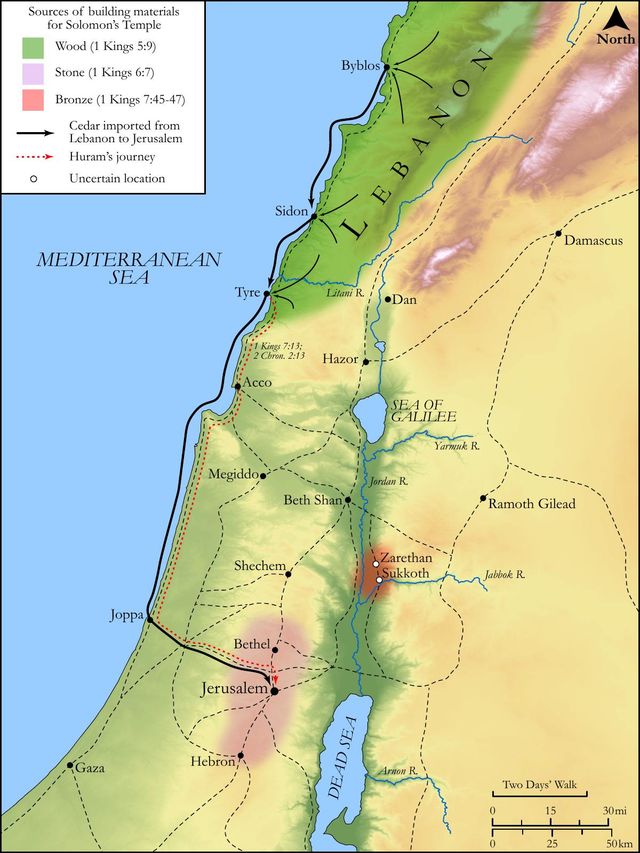
See on the biblical-era map
Study this verse
Public-domain commentary
Matthew Henry
From his Commentary on the Whole Bible. Henry comments on passages, not single verses — this entry covers 2 Chronicles 2:11–18.
Here we have, I. The return which Huram made to Solomon's embassy, in which he shows a great respect for Solomon and a readiness to serve him. Meaner people may learn of these great ones to be neighbourly and complaisant. 1. He congratulates Israel on having such a king as Solomon was (Ch2 2:11): Because the Lord loved his people, he has made thee king. Note, A wise and good government is a great blessing to a people, and may well be accounted a singular token of God's favour. He does not say, Because he loved thee (though that was true, Sa2 12:24) he made thee king, but because he loved his people. Princes must look upon themselves as preferred for the public good, not for their own personal satisfaction, and should rule so as to prove that they were given in love and not in anger. 2. He blesses God for raising up such a successor to David, Ch2 2:12. It should seem that Huram was not only very well affected to the Jewish nation, and well pleased with their prosperity, but that he was proselyted to the Jewish religion, and worshipped Jehovah, the God of Israel (who was now known by that name to the neighbouring nations), as the God that made heaven and earth, and as the fountain of power as well as being; for he sets up kings. Now that the people of Israel kept close to the law and worship of God, and so preserved their honour, the neighbouring nations were as willing to be instructed by them in the true religion as Israel had been, in the days of their apostasy, to be infected with the idolatries and superstitions of their neighbours. This made them high, that they lent to many nations and did not borrow, lent truth to them, and did not borrow error from them; as when they did the contrary it was their shame. 3. He sent him a very ingenious curious workman, that would not fail to answer his expectations in every thing, one that had both Jewish and Gentile blood meeting in him; for his mother was an Israelite (Huram though she was of the tribe of Dan, and therefore says so here, Ch2 2:14, but it seems she was of the tribe of Naphtali, Kg1 7:14), but his father was a Tyrian - a good omen of uniting Jew and Gentile in the gospel temple, as it was afterwards when the building of the second temple was greatly furthered by Darius (Ezra 6), who is supposed to have been the son of Esther - an Israelite by the mother's side. 4. He engaged for the timber, as much as he would have occasion for, and undertook to deliver it at Joppa, and withal signified his dependence upon Solomon for the maintenance of the workmen as he had promised, v. 15, 16. This agreement we had, Kg1 5:8, Kg1 5:9.
II.The orders which Solomon gave about the workmen.
He would not employ the free-born Israelites in the drudgery work of the temple itself, not so much as to be overseers of it. In this he employed the strangers who were proselyted to the Jewish religion, who had not lands of inheritance in Canaan as the Israelites had, and therefore applied to trades, and got their living by their ingenuity and industry. There were, at this time, vast numbers of them in the land (Ch2 2:17), who, if they were of any of the devoted nations, perhaps fell within the case, and therefore fell under the law, of the Gibeonites, to be hewers of wood for the congregation: if not, yet being in many respects well provided for by the law of Moses, and put upon an equal footing with the native Israelites, they were bound in gratitude to do what they could for the service of the temple. Yet, no doubt, they were well paid in money or money's worth: the law was, Thou shalt not oppress a stranger. The distribution of them we have here (Ch2 2:2, and again Ch2 2:18), in all 150,000. Canaan was a fruitful land, that found meat for so many mouths more than the numerous natives; and the temple was a vast building, that found work for so many bands. Mr. Fuller suggests that the expedient peculiar to this structure, of framing all beforehand, must needs increase the work. I think it rather left so much the more room for this vast multitude of hands to be employed in it; for in the forest of Lebanon they might all be at work together, without crowding one another, which they could not have been upon Mount Sion. And, if there had not been such vast numbers employed, so large and curious a fabric, which was begun and ended in seven years, might, for aught I know, have been as long in building as St. Paul's.
Continue studying 2 Chronicles 2:13 across the web’s major study libraries — every link below opens this exact verse, chapter, or book on the destination site.
Read & Compare
 BibleGatewayThis verse in more than 200 translations and 70 languages.
 Bible.comThe YouVersion reader — hundreds of translations, reading plans, and highlights.
 ESV.orgCrossway's official English Standard Version reader.
 NET BibleThe NET translation with 60,000+ translators' notes on every rendering decision.
 STEP BibleTyndale House's free study tool — original text, vocabulary, and scholarly resources.
 BibliaLogos Bible Software's free web reader.
 USCCBThe New American Bible (Revised Edition) with the U.S. bishops' study notes.
Commentaries
 BibleHub CommentariesDozens of classic commentaries on this verse, gathered on one page.
 StudyLightMore than 100 commentary sets — the largest collection on the web.
 BibleRefPlain-English commentary on what this verse means, verse by verse.
 Enduring WordDavid Guzik's free commentary on this chapter, widely used by Bible teachers.
 Bible Study ToolsVerse commentary alongside Greek and Hebrew study aids.
Original Language & Research
- BibleHub InterlinearThe verse word by word — original language, transliteration, and English.
- BibleHub LexiconEvery word's original-language definition and Strong's entry.
 Blue Letter BibleDeep-study tools — Strong's numbers, concordance, and word studies.
 SefariaThe Hebrew text with Rashi and centuries of Jewish commentary.
Sermons, Hymns & Audio


TrulyRandomVerse is not affiliated with these sites and doesn’t control their content. They’re linked because they’re genuinely useful.
Summary
In 2 Chronicles 2:13, King Huram of Tyre responds to King Solomon's request for assistance in constructing the First Temple, announcing the dispatch of a preeminent master craftsman. This verse introduces a highly skilled individual, described as "cunning" and "endued with understanding," presented as a valuable contribution from Huram. It signifies the vital international collaboration and divine provision of specialized expertise essential for the monumental sacred project.
Context
ShowHideLiterary Context
This verse is an integral part of the diplomatic exchange between King Solomon of Israel and King Huram of Tyre, initiated by Solomon's ambitious vision for building the Temple of the Lord. Solomon's detailed request for specialized labor, particularly for workers in precious materials and those adept at carving and dyeing, is outlined in 2 Chronicles 2:3-10. Huram's enthusiastic response, beginning in 2 Chronicles 2:11, expresses his delight and willingness to assist. Verse 13 specifically introduces the chief artisan, Huram-abi (also known as Hiram-abi), whose extensive and diverse skills are further elaborated in 2 Chronicles 2:14. This introduction sets the stage for the detailed accounts of the Temple's construction found in subsequent chapters, such as 2 Chronicles 3 and 1 Kings 6-7. The immediate literary flow emphasizes Huram's commitment to fulfilling Solomon's request by providing the highest caliber of craftsmanship available to his kingdom.
Historical & Cultural Context
The construction of the First Temple in Jerusalem was a monumental undertaking, reflecting Israel's burgeoning national identity and theological centrality. During this period, Tyre, a prominent Phoenician city-state, was renowned throughout the ancient Near East for its maritime trade, advanced metallurgy, and exceptional craftsmanship, particularly in timber, stone, and intricate metalwork. The alliance between Solomon and Huram was a strategic political and economic partnership, leveraging Tyre's specialized expertise and resources, which Israel largely lacked, for a project of immense national and religious significance. The concept of a "cunning man" or master craftsman (Hebrew: ḥākām) held high esteem in ancient societies, as these individuals possessed rare and vital skills essential for large-scale architectural and artistic endeavors, often considered divinely inspired. This exchange highlights the interconnectedness of ancient kingdoms and the practical necessity of international cooperation for projects beyond a single nation's immediate capabilities.
Key Themes
ShowHideThis verse powerfully contributes to several overarching themes within 2 Chronicles and the broader biblical narrative. Firstly, it underscores the theme of Divine Provision, demonstrating how God orchestrates the availability of necessary resources and gifted individuals, even from outside the Israelite covenant community, to accomplish His purposes in building His dwelling place. Secondly, it highlights the Value of Expertise and Craftsmanship, recognizing specialized human skill and artistic ability as essential and consecrated for sacred undertakings. God often works through and elevates human talent, as seen in the commissioning of Bezalel and Oholiab for the tabernacle in Exodus 31:1-6. Thirdly, the verse exemplifies International Cooperation and Alliance, showcasing the importance of collaboration and mutual assistance between nations for shared goals, even when those goals are primarily religious in nature. This partnership between Solomon and Huram reflects a period of peace and prosperity, where the nations could contribute to a project that ultimately glorified God, as Solomon himself acknowledged God's greatness in 2 Chronicles 2:5-6.
Exposition and Analysis
ShowHideKey Word Analysis
ShowHideIn KJV English, "cunning" (from Old English cunnan, "to know") does not imply deceit or trickery, but rather denotes exceptional skill, ingenuity, and expert knowledge. The Hebrew word ḥākām (H2450) refers to one who is wise, skillful, or a master craftsman. It signifies not merely intellectual wisdom, but practical wisdom applied to a craft or art, indicating a person highly proficient and adept in their field. This man was a master artisan, possessing a deep understanding of his trade.
This word (H998) complements "cunning," emphasizing not just technical skill but also discernment, insight, and intelligence. Bîynâh suggests the ability to comprehend, differentiate, and apply knowledge effectively. It implies a capacity for problem-solving, creative design, and the ability to grasp complex instructions, making this craftsman not just a laborer but a visionary and an executor of intricate designs. The phrase "endued with" comes from the root yâdaʻ (H3045), meaning "to know," reinforcing the idea of being filled with or possessing this deep knowledge.
The word ʼâb (H1) means "father" in a literal or figurative sense. In the context "of Huram my father's," it most likely signifies that the master craftsman had served King Huram's father (the previous king of Tyre), establishing his long-standing reputation, proven expertise, and perhaps even his advanced age and experience within the Tyrian royal court. It signifies that the craftsman was a trusted and highly valued asset within the Tyrian kingdom, not merely a common laborer, and was likely part of a legacy of skilled service to the Tyrian monarchy.
Verse Breakdown
ShowHide"And now I have sent a cunning man,"
This opening clause marks Huram's direct and decisive action in response to Solomon's request. The phrase "And now" (Hebrew: wĕ‘attāh) indicates a transition from Huram's general affirmation of help to the specific fulfillment of Solomon's need for skilled labor. The active verb "sent" (Hebrew: shâlach, H7971) underscores Huram's commitment and the immediate provision of the required expertise, emphasizing the prompt and effective nature of his assistance.
"endued with understanding,"
This descriptive phrase immediately follows, qualifying the nature of the "cunning man." It highlights that the individual is not merely skilled in a physical sense but possesses profound intellectual and perceptive abilities. This "understanding" (Hebrew: bîynâh, H998) is crucial for the complex and precise work required for the Temple, implying an individual capable of both executing and conceptualizing intricate designs, a true master of his craft.
"of Huram my father's,"
This final clause identifies the master craftsman's origin and connection. It emphasizes that this individual comes from a lineage or association with King Huram's own royal house, specifically his father's reign. This detail serves to vouch for the craftsman's credentials, experience, and the high regard in which he is held, assuring Solomon of the quality and reliability of the expert being provided. It also suggests a generational commitment to excellence and a deep-rooted connection to the Tyrian monarchy.
Literary Devices
ShowHideThe verse employs several literary devices to convey its meaning and significance. Emphasis is placed on the quality of the craftsman through the dual descriptors "cunning man" and "endued with understanding," highlighting his exceptional skill and profound intellect. This dual description serves to underscore the high value placed on his abilities and the critical role he will play in the Temple's construction. The phrase "of Huram my father's" can be seen as a form of Metonymy, where "Huram my father's" stands for the established reputation, skilled lineage, and trusted service associated with the Tyrian royal court, lending authority and credibility to the craftsman. Furthermore, the introduction of this specific individual serves as a subtle Foreshadowing of the detailed description of Huram-abi's diverse talents that immediately follows in 2 Chronicles 2:14, building anticipation for the full scope of his contribution. The selection of such a highly qualified individual also implicitly conveys the Symbolism of the best being offered for God's work, reflecting the reverence and importance attached to the Temple project.
Theological and Thematic Connections
ShowHideThis verse beautifully illustrates God's providential care, demonstrating that He often uses diverse means and people, even from outside the covenant community, to accomplish His divine purposes. Just as God equipped Bezalel and Oholiab with divine wisdom and skill for the Tabernacle, here He provides a master craftsman through a foreign king for the Temple. This highlights that all true skill and wisdom ultimately originate from God, and He can grant them to anyone He chooses for His glory. It teaches us that God's kingdom work is not limited by human boundaries or national affiliations, but transcends them, bringing together various talents for a singular, sacred objective. The collaboration between Israel and Tyre, facilitated by this skilled individual, serves as a testament to God's ability to unite disparate entities for His grand design, emphasizing that the building of His dwelling place requires both divine anointing and human excellence.
Reflection and Application
ShowHideThe sending of a "cunning man, endued with understanding" for the Temple's construction holds profound implications for believers today. It reminds us that God values excellence and specialized skill, not just piety, in the service of His kingdom. Just as Huram-abi was essential for the physical Temple, God continues to provide individuals with diverse talents—whether in leadership, teaching, administration, creative arts, or practical service—to build His spiritual house, the Church. We are called to recognize, appreciate, and utilize the unique gifts and expertise that God has given to individuals within and outside our immediate circles, understanding that these talents, when consecrated, become powerful tools for divine purposes. This verse encourages us to be open to collaboration, seeking assistance from others who possess skills we lack, and conversely, to be willing to offer our own "cunning" (skilled) abilities to serve others and God's purposes, trusting that God will provide all necessary resources and people to accomplish His will.
Questions for Reflection
ShowHideFAQ
ShowHideWho was this "cunning man" and why was he so important?
ShowHideThe "cunning man" referred to in 2 Chronicles 2:13 is Huram-abi (also known as Hiram-abi in 1 Kings 7:13). He was a master craftsman of unparalleled skill and understanding, specifically in working with gold, silver, bronze, iron, stone, wood, and various dyes and fabrics, as well as in engraving and devising intricate designs. His importance stemmed from the fact that Israel, despite its wealth, lacked the specialized expertise required for the highly technical and artistic aspects of Temple construction, particularly in metallurgy and elaborate ornamentation. Huram-abi's mixed heritage—his mother was from the tribe of Dan (or Naphtali, depending on the account), and his father was a Tyrian—likely contributed to his unique blend of skills and knowledge, making him the ideal individual to lead the artistic and technical aspects of the Temple's construction, as detailed in 2 Chronicles 2:14.
Christ-Centered Fulfillment
ShowHideWhile 2 Chronicles 2:13 speaks of a human master craftsman building a physical temple, it profoundly foreshadows the ultimate Master Builder, Jesus Christ. Just as Huram-abi was "cunning" and "endued with understanding," Christ is the very embodiment of divine wisdom and skill, the one "in whom are hidden all the treasures of wisdom and knowledge" (Colossians 2:3). He is the true architect and builder of God's spiritual house, the Church, which is not made with human hands but is a living temple composed of believers (1 Peter 2:5). Christ Himself is the chief cornerstone upon which this spiritual edifice is built (Ephesians 2:20), perfectly joining together diverse individuals—Jew and Gentile, skilled and unskilled—into one unified structure for God's dwelling place by the Spirit (Ephesians 2:21-22). The provision of Huram-abi by King Huram, a Gentile king, for the physical Temple, subtly points to God's broader plan to include all nations in His redemptive work through Christ, who breaks down dividing walls and unites humanity in Himself (Ephesians 2:14). Ultimately, the wisdom and understanding embodied in Huram-abi find their perfect and eternal fulfillment in Christ, through whom God's ultimate dwelling place, His redeemed people, is being meticulously and divinely constructed.