


2 Chronicles 4:16
Bible text: King James Version (1769 Blayney text) · Public domain
Bible text: King James Version with Strong's numbers · Public domain
Bible text: Berean Standard Bible · Public domain
Bible text: American Standard Version (1901) · Public domain
Bible text: World English Bible, Messianic edition · Public domain
Bible text: Geneva Bible (1599) · Public domain
Bible text: Young's Literal Translation · Public domain
- וְאֶתve·'Etand <obj.>H853Conj-w ¦ DirObjMParticle Object Indicatorוְandאֶת<obj.>
- הַסִּירוֹתHa·si·rotthe potsH5518Art ¦ N-fpNoun Plural Feminine Absoluteהַtheסִּירוֹתpots
- וְאֶתve·'Etand <obj.>H853Conj-w ¦ DirObjMParticle Object Indicatorוְandאֶת<obj.>
- הַיָּעִיםhai·ya·'Imthe shovelsH3257Art ¦ N-mpNoun Plural Masculine Absoluteהַtheיָּעִיםshovels
- וְאֶתve·'Etand <obj.>H853Conj-w ¦ DirObjMParticle Object Indicatorוְandאֶת<obj.>
- הַמִּזְלָגוֹתha·miz·la·goyTthe forksH4207Art ¦ N-fpNoun Plural Feminine Absoluteהַtheמִּזְלָגוֹתforks
- וְאֶתve·'Etand <obj.>H853Conj-w ¦ DirObjMParticle Object Indicatorוְandאֶת<obj.>
- כָּלkolallH3605N-mscNoun Singular Masculine Construct
- כְּלֵיהֶםke·lei·Hemtheir articlesH3627N-mpc ¦ 3mpNoun Plural Masculine Constructכְּלֵיarticlesהֶםtheir
- עָשָׂה'a·Sahhe madeH6213V-Qal-Perf-3msVerb Qal Perfect 3rd Singular Masculine
- חוּרָםchu·RamHuramH2361N-proper-mNoun Proper Masculine
- אָבִיו'a·VivAbiH1N-proper-mNoun Proper Masculine
- לַמֶּלֶךְla·Me·lekhfor the kingH4428Prep-l ¦ N-msNoun Singular Masculine Absoluteלַfor theמֶּלֶךְking
- שְׁלֹמֹהshe·lo·MohSolomonH8010N-proper-mNoun Proper Masculine
- לְבֵיתle·Veitfor [the] house ofH1004Prep-l ¦ N-mscNoun Singular Masculine Constructלְforבֵית[the] house of
- יְהוָהYah·wehYahwehH3068N-properNoun Proper Title
- נְחֹשֶׁתne·Cho·shetbronzeH5178N-fsNoun Singular Feminine Absolute
- מָרוּקma·RukpolishedH4838V-Qal-PassPrtcpl-msVerb Qal Participle Passive Singular Masculine Absolute
English is a literal word-by-word gloss of the Hebrew, not the KJV's wording. Why?
This is the original text the KJV's translators worked from — each Hebrew word with its own literal English meaning in this verse, prepared by scholars at Tyndale House, Cambridge. The KJV translates whole sentences, not word by word, so its wording differs: one Hebrew word can become several English words, and the KJV may choose “the LORD” where the gloss reads “Yahweh”. Both are faithful — they answer different questions. For the KJV's own rendering, switch to the KJV text.
Details
See on the biblical-era maps
Study this verse
Public-domain commentary
Matthew Henry
From his Commentary on the Whole Bible. Henry comments on passages, not single verses — this entry covers 2 Chronicles 4:11–22.
We have here such a summary both of the brass-work and the gold-work of the temple as we had before (Kg1 7:13, etc.), in which we have nothing more to observe than, 1. That Huram the workman was very punctual: He finished all that he was to make (Ch2 4:11), and left no part of his work undone. Huram, his father, he is called, Ch2 4:16. Probably it was a sort of nickname by which he was commonly known, Father Huram; for the king of Tyre called him Huram Abi, my father, in compliance with whom Solomon called him his, he being a great artist and father of the artificers in brass and iron. He acquitted himself well both for ingenuity and industry. 2. Solomon was very generous. He made all the vessels in great abundance (Ch2 4:18), many of a sort, that many hands might be employed, and so the work might go on with expedition, or that some might be laid up for use when others were worn out. Freely he has received, and he will freely give. When he had made vessels enough for the present he could not convert the remainder of the brass to his own use; it is devoted to God, and it shall be used for him.
Continue studying 2 Chronicles 4:16 across the web’s major study libraries — every link below opens this exact verse, chapter, or book on the destination site.
Read & Compare
 BibleGatewayThis verse in more than 200 translations and 70 languages.
 Bible.comThe YouVersion reader — hundreds of translations, reading plans, and highlights.
 ESV.orgCrossway's official English Standard Version reader.
 NET BibleThe NET translation with 60,000+ translators' notes on every rendering decision.
 STEP BibleTyndale House's free study tool — original text, vocabulary, and scholarly resources.
 BibliaLogos Bible Software's free web reader.
 USCCBThe New American Bible (Revised Edition) with the U.S. bishops' study notes.
Commentaries
 BibleHub CommentariesDozens of classic commentaries on this verse, gathered on one page.
 StudyLightMore than 100 commentary sets — the largest collection on the web.
 BibleRefPlain-English commentary on what this verse means, verse by verse.
 Enduring WordDavid Guzik's free commentary on this chapter, widely used by Bible teachers.
 Bible Study ToolsVerse commentary alongside Greek and Hebrew study aids.
Original Language & Research
- BibleHub InterlinearThe verse word by word — original language, transliteration, and English.
- BibleHub LexiconEvery word's original-language definition and Strong's entry.
 Blue Letter BibleDeep-study tools — Strong's numbers, concordance, and word studies.
 SefariaThe Hebrew text with Rashi and centuries of Jewish commentary.
Sermons, Hymns & Audio


TrulyRandomVerse is not affiliated with these sites and doesn’t control their content. They’re linked because they’re genuinely useful.
Summary
This verse meticulously details the crafting of essential bronze implements—pots, shovels, and fleshhooks—along with all other instruments, by the master artisan Huram for King Solomon's Temple. It underscores the comprehensive and precise nature of the Temple's construction and furnishing, highlighting that even the seemingly smaller, utilitarian items were made with exceptional skill and high-quality materials, specifically "bright brass," for the sacred services of the House of the LORD.
Context
ShowHideLiterary Context
2 Chronicles 4:16 is situated within a broader section (2 Chronicles 3-5) that meticulously describes the construction and furnishing of Solomon's Temple in Jerusalem. Preceding this verse, the text details larger, more prominent bronze elements like the great bronze altar, the Molten Sea, and the ten lavers (see 2 Chronicles 4:1-14). Verse 16 then transitions to the smaller, yet equally indispensable, tools required for the daily sacrificial rituals and maintenance within the Temple precincts. This enumeration of items, from the grand to the minute, emphasizes the exhaustive nature of the Temple's preparation, ensuring every aspect of worship was provided for according to divine instruction and human dedication. It serves as a testament to the thoroughness with which God's dwelling place was equipped, reinforcing the narrative's focus on the establishment of proper worship in Israel.
Historical & Cultural Context
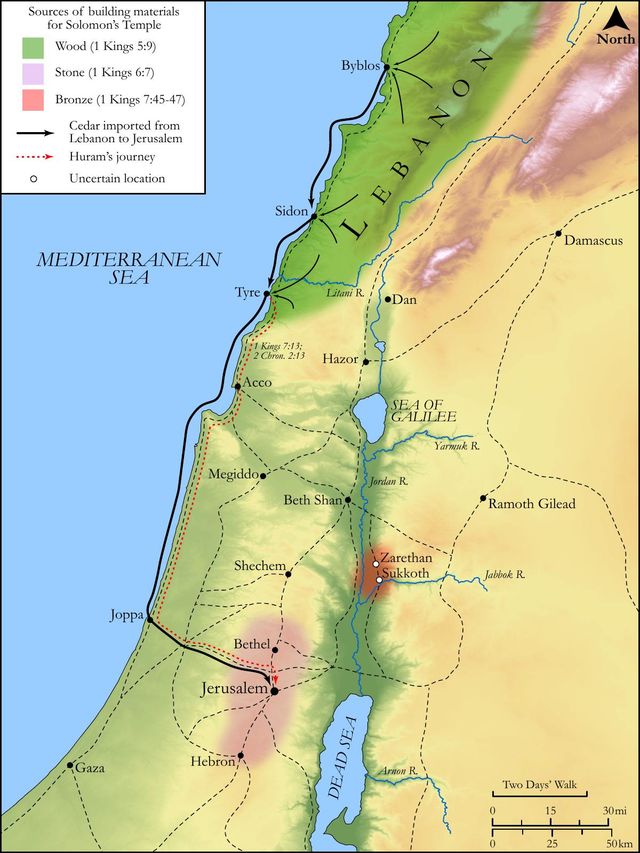
The construction of Solomon's Temple was a monumental undertaking, reflecting the peak of Israel's wealth and power during the United Monarchy. This project involved significant international collaboration, notably with King Hiram of Tyre, who supplied timber, gold, and, crucially, skilled artisans like Huram (also known as Hiram-abi in 1 Kings 7:13-14 and 2 Chronicles 2:13-14). Phoenician craftsmen were renowned among the nations of that day for their expertise in metalwork, particularly bronze casting. The use of "bright brass" (polished bronze) signifies not only the durability and functionality of these instruments but also their aesthetic quality and value, befitting the sacred space dedicated to Yahweh. The detailed inventory reflects the practice, begun with the Tabernacle, of meticulously documenting the furnishings of the sanctuary, underscoring their importance for ritual purity and proper worship, and highlighting the immense resources invested in the worship of the Lord.
Key Themes
ShowHideThis verse contributes significantly to several overarching themes within 2 Chronicles and the broader biblical narrative. Firstly, it highlights the meticulous preparation for worship, emphasizing that every detail, no matter how small, was deemed essential for the proper functioning of the sacred services. This reflects a profound reverence for God and the sanctity of the sacrificial system. Secondly, it underscores the dedication of resources and skill to God's house. King Solomon spared no expense, and Huram dedicated his exceptional talent to crafting these instruments, illustrating the principle of offering one's absolute best in service to the divine, a theme echoed in Proverbs 3:9. Finally, the verse speaks to the functionality for sacred purpose. These instruments were not merely decorative but vital tools for carrying out the various prescribed rituals, from handling the ashes of burnt offerings to managing the sacrificial flesh, demonstrating the practical demands of the elaborate worship system established by God, as seen in the detailed instructions for the Tabernacle in Exodus 27:3.
Exposition and Analysis
ShowHideKey Word Analysis
ShowHideThis individual, also referred to as Hiram-abi in 1 Kings 7:13 and 2 Chronicles 2:13, was a master craftsman from Tyre, skilled in all kinds of bronze work. The phrase "Huram his father" (כְּאָבִיו חִירָם, k'aviv Hīrām) does not denote a biological relationship but is an honorific title. In Scripture, where Jubal is called the father of all such as handle the harp and organ, "father" (H1, ʼâb') could signify a master artisan, a chief advisor, or a highly respected mentor, indicating Huram's supreme skill, authoritative role, and esteemed position in the metalworking for the Temple. It is a testament to his expertise being recognized and highly valued by King Solomon.
This general term (H3627) encompasses a wide range of tools and vessels. In the context of the Temple, these kᵉlîy were specifically designed for the various aspects of sacrificial worship and maintenance. "Pots" (H5518, çîyr') were likely for collecting ashes or handling sacrificial portions; "shovels" (H3257, yâʻ') for removing ashes from the altar; and "fleshhooks" (H4207, mazlêg') for handling and arranging the sacrificial meat. The inclusion of "all their instruments" indicates a comprehensive provision for every practical need within the sacred space, leaving nothing to chance or improvisation.
This word (H4838) is a primitive root meaning "to polish; by implication, to sharpen; also to rinse." When applied to "brass" (H5178, nᵉchôsheth'), it refers to a highly polished or burnished finish, resulting in a gleaming, reflective surface. This detail emphasizes the exceptional quality and aesthetic brilliance of the finished articles, designed not just for utility but also for beauty and dignity befitting God's sanctuary. The use of bronze was common for durable and functional items in ancient temples, but the specification of "bright" highlights an extra level of craftsmanship and dedication to excellence.
Verse Breakdown
ShowHide"The pots also, and the shovels, and the fleshhooks, and all their instruments"
This clause enumerates the specific types of utilitarian items crafted for the Temple. These were not ornamental but essential tools for the daily operations of the sacrificial system. The "pots" were likely for collecting ashes or for boiling sacrificial meat, the "shovels" for clearing the altar of ashes, and the "fleshhooks" for handling the portions of the sacrifices. The phrase "all their instruments" signifies a complete set of tools, indicating thoroughness and attention to every practical detail required for the sacred rituals.
"did Huram his father make"
This identifies the master craftsman responsible for these intricate bronze items. As discussed in the Key Word Analysis, "his father" is an honorific, underscoring Huram's unparalleled skill and respected position as a leading expert in metalworking. His involvement highlights the dedication of the finest available talent to the Temple project, signifying the high value placed on craftsmanship for God's house.
"to king Solomon for the house of the LORD"
This specifies the recipient of these crafted items and their ultimate destination and purpose. They were commissioned by King Solomon, the visionary builder of the Temple, and were intended exclusively for the "house of the LORD" (H1004, bayith'), emphasizing their sacred function and dedication to divine worship. This phrase reinforces the Temple's identity as God's dwelling place and the center of Israelite worship, highlighting the divine authority behind its construction.
"of bright brass"
This final phrase describes the material from which these instruments were made. "Bright brass" (polished bronze) indicates a material of high quality, durability, and aesthetic appeal. The meticulous finishing of these items, even the utilitarian ones, speaks to the reverence and excellence demanded for everything associated with God's sanctuary. It suggests that even the most practical tools were to reflect the glory and majesty of the God they served, signifying the sacredness of all aspects of Temple service.
Literary Devices
ShowHideThe verse primarily employs Enumeration or Cataloging, listing specific items ("pots," "shovels," "fleshhooks") to provide a detailed account of the Temple's furnishings. This technique emphasizes the comprehensive nature of the preparations and the meticulous attention paid to every aspect of the sacred space. The inclusion of "all their instruments" further extends this sense of thoroughness, indicating that no detail was overlooked. There is also an element of Synecdoche, where these specific, seemingly minor instruments represent the vast and intricate array of all the Temple's bronze work and, indeed, the entire project's dedication to perfection. By focusing on these smaller, functional items, the text subtly uses Emphasis through Detail, highlighting that even the most practical and often overlooked elements of worship were crafted with the highest quality and skill, underscoring the profound reverence for God and the sanctity of His dwelling place.
Theological and Thematic Connections
ShowHideThe meticulous detail concerning the Temple's furnishings, even down to the "pots, shovels, and fleshhooks," reveals a profound theological truth: God's demand for excellence and thoroughness in all matters pertaining to His worship. Every item, no matter how seemingly mundane, was consecrated and crafted with the highest skill and finest materials, reflecting the holiness of God and the sacredness of His presence. This principle extends beyond the physical Temple to the spiritual worship of believers today, reminding us that our service, gifts, and lives are to be offered to God with intentionality, integrity, and the best of our abilities. The fact that Huram, a non-Israelite, contributed his exceptional skill to the House of the LORD also subtly points to a broader vision of God's work, where diverse talents are consecrated for His glory, foreshadowing the inclusion of Gentiles in God's redemptive plan.
Reflection and Application
ShowHideThe detailed account of the Temple's instruments in 2 Chronicles 4:16 offers profound lessons for contemporary believers. Just as every pot, shovel, and fleshhook was meticulously crafted and essential for the Temple's sacred functions, so too are all aspects of our lives and service to God to be offered with excellence and purpose. This verse challenges us to consider the quality of our "behind-the-scenes" contributions, the seemingly small or ordinary tasks that are nevertheless vital to the functioning of God's kingdom. It reminds us that true worship encompasses not only grand gestures but also the faithful execution of practical duties, all done with a heart of dedication and an aim for perfection, reflecting the glory of God. Our skills, talents, and resources, like Huram's "bright brass," are to be consecrated and utilized for God's purposes, recognizing that even the most utilitarian aspects of our lives can become instruments of worship when offered with intentionality and reverence. This passage calls us to a holistic discipleship where every part of our being and every action contributes to God's glory.
Questions for Reflection
ShowHideFAQ
ShowHideWho was Huram, and why is he called "his father"?
ShowHideHuram (H2361, Chûwrâm'), also known as Hiram-abi, was a highly skilled master craftsman from Tyre, renowned for his expertise in bronze work. He was sent by King Hiram of Tyre to assist King Solomon with the construction and furnishing of the Temple. The phrase "his father" (H1, ʼâb') is an honorific title, not an indication of biological paternity. In Scripture, "father" could be used to denote a master craftsman, a chief advisor, or a highly respected and authoritative figure in a particular trade or field. This title highlights Huram's supreme skill, experience, and the high regard in which he was held by King Solomon and his contemporaries. He was effectively the "father" or master of his craft, a testament to his unparalleled ability in metalworking for the House of the LORD.
What were these specific instruments—pots, shovels, and fleshhooks—used for in the Temple?
ShowHideThese instruments were essential utilitarian tools for the daily operation of the sacrificial system within the Temple. The "pots" (H5518, çîyr') were likely used for collecting ashes from the altar, for cooking portions of the sacrificial offerings, or for carrying water. The "shovels" (H3257, yâʻ') were primarily for removing ashes from the altar of burnt offering, maintaining cleanliness and order within the sacred space. The "fleshhooks" (H4207, mazlêg') were used by the priests to handle and arrange the sacrificial meat on the altar or to retrieve portions for consumption, ensuring proper handling in accordance with ritual purity laws. Together with "all their instruments" (H3627, kᵉlîy'), they formed a complete set of tools necessary for the practical, yet sacred, duties of the priests in the House of the LORD.
Why does the Bible include such seemingly minor details about Temple furnishings?
ShowHideThe inclusion of such meticulous details, even concerning seemingly minor items like pots and shovels, serves several significant purposes. Firstly, it underscores the holiness and sacredness of God's presence and the space dedicated to His worship. Every detail, no matter how small, was important because it pertained to the Lord, reflecting His perfect and holy character. Secondly, it emphasizes God's demand for excellence and precision in all matters of worship and service, reflecting His own perfect character and the honor due to Him. Thirdly, it highlights the comprehensive nature of God's instructions and the thoroughness with which they were to be carried out, leaving nothing to chance or human improvisation. Finally, these details often serve as types and shadows pointing to deeper spiritual realities, foreshadowing the perfect and complete provision for worship found in Christ, as suggested in Hebrews 9:1-5.
Christ-Centered Fulfillment
ShowHideWhile 2 Chronicles 4:16 describes the physical implements of the Old Testament Temple, its underlying principles find profound fulfillment in Christ. The "bright brass" instruments, crafted with meticulous care for the House of the LORD, foreshadow the perfect and complete provision for worship offered through Jesus. Just as those tools enabled the priests to perform the sacrificial rituals, so Christ, as our great High Priest (Hebrews 4:14), perfectly fulfills all the requirements of the Law and the sacrificial system. He is the ultimate "instrument" of God's salvation, the Lamb of God who takes away the sin of the world (John 1:29). Furthermore, the Temple itself, with all its furnishings, was a shadow of Christ's body (John 2:19-21), and through His sacrifice, believers become living stones in a spiritual house (1 Peter 2:5), a new Temple where worship is offered in spirit and truth (John 4:23-24). The perfection and dedication seen in Huram's craftsmanship for the earthly Temple are ultimately surpassed by the flawless work of Christ, who, by His one perfect sacrifice, has made us holy and brought us into the presence of God forever (Hebrews 10:10-14). He is the true and eternal "bright brass," reflecting the unblemished glory of God.