


2 Chronicles 4:15
Bible text: King James Version (1769 Blayney text) · Public domain
Bible text: Berean Standard Bible · Public domain
Bible text: American Standard Version (1901) · Public domain
Bible text: World English Bible, Messianic edition · Public domain
Bible text: Geneva Bible (1599) · Public domain
Bible text: Young's Literal Translation · Public domain
- אֶת'et<obj.>H853DirObjMParticle Object Indicator
- הַיָּםhai·Yamthe seaH3220Art ¦ N-msNoun Singular Masculine Absoluteהַtheיָּםsea
- אֶחָד'e·ChadoneH259N-fsNoun Singular Feminine Absolute
- וְאֶתve·'Etand <obj.>H853Conj-w ¦ DirObjMParticle Object Indicatorוְandאֶת<obj.>
- הַבָּקָרha·ba·Karthe cattleH1241Art ¦ N-csNoun Singular common gender Absoluteהַtheבָּקָרcattle
- שְׁנֵיםshe·neimtwo [plus]H8147N-cdNoun Dual common gender Absolute
- עָשָׂר'a·SartenH6240N-csNoun Singular common gender Absolute
- תַּחְתָּיוtach·Tavunder itH8478N-mpc ¦ 3msNoun Plural Masculine Constructתַּחְתָּיunderוit
English is a literal word-by-word gloss of the Hebrew, not the KJV's wording. Why?
This is the original text the KJV's translators worked from — each Hebrew word with its own literal English meaning in this verse, prepared by scholars at Tyndale House, Cambridge. The KJV translates whole sentences, not word by word, so its wording differs: one Hebrew word can become several English words, and the KJV may choose “the LORD” where the gloss reads “Yahweh”. Both are faithful — they answer different questions. For the KJV's own rendering, switch to the KJV text.
Details
See on the biblical-era maps
Study this verse
Public-domain commentary
Matthew Henry
From his Commentary on the Whole Bible. Henry comments on passages, not single verses — this entry covers 2 Chronicles 4:11–22.
We have here such a summary both of the brass-work and the gold-work of the temple as we had before (Kg1 7:13, etc.), in which we have nothing more to observe than, 1. That Huram the workman was very punctual: He finished all that he was to make (Ch2 4:11), and left no part of his work undone. Huram, his father, he is called, Ch2 4:16. Probably it was a sort of nickname by which he was commonly known, Father Huram; for the king of Tyre called him Huram Abi, my father, in compliance with whom Solomon called him his, he being a great artist and father of the artificers in brass and iron. He acquitted himself well both for ingenuity and industry. 2. Solomon was very generous. He made all the vessels in great abundance (Ch2 4:18), many of a sort, that many hands might be employed, and so the work might go on with expedition, or that some might be laid up for use when others were worn out. Freely he has received, and he will freely give. When he had made vessels enough for the present he could not convert the remainder of the brass to his own use; it is devoted to God, and it shall be used for him.
Continue studying 2 Chronicles 4:15 across the web’s major study libraries — every link below opens this exact verse, chapter, or book on the destination site.
Read & Compare
 BibleGatewayThis verse in more than 200 translations and 70 languages.
 Bible.comThe YouVersion reader — hundreds of translations, reading plans, and highlights.
 ESV.orgCrossway's official English Standard Version reader.
 NET BibleThe NET translation with 60,000+ translators' notes on every rendering decision.
 STEP BibleTyndale House's free study tool — original text, vocabulary, and scholarly resources.
 BibliaLogos Bible Software's free web reader.
 USCCBThe New American Bible (Revised Edition) with the U.S. bishops' study notes.
Commentaries
 BibleHub CommentariesDozens of classic commentaries on this verse, gathered on one page.
 StudyLightMore than 100 commentary sets — the largest collection on the web.
 BibleRefPlain-English commentary on what this verse means, verse by verse.
 Enduring WordDavid Guzik's free commentary on this chapter, widely used by Bible teachers.
 Bible Study ToolsVerse commentary alongside Greek and Hebrew study aids.
Original Language & Research
- BibleHub InterlinearThe verse word by word — original language, transliteration, and English.
- BibleHub LexiconEvery word's original-language definition and Strong's entry.
 Blue Letter BibleDeep-study tools — Strong's numbers, concordance, and word studies.
 SefariaThe Hebrew text with Rashi and centuries of Jewish commentary.
Sermons, Hymns & Audio


TrulyRandomVerse is not affiliated with these sites and doesn’t control their content. They’re linked because they’re genuinely useful.
Summary
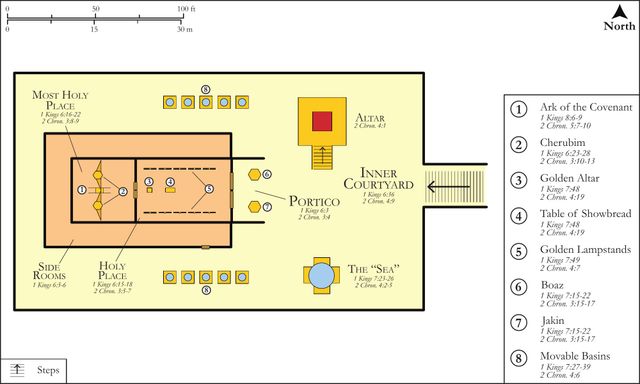
Second Chronicles 4:15 offers a succinct yet profound description of a pivotal furnishing in Solomon's Temple: the Molten Sea. This immense bronze basin, singular in its presence, was majestically supported by twelve cast bronze oxen. The verse highlights the meticulous detail and symbolic richness embedded in the Temple's construction, underscoring both the practical provisions for priestly purification and the deep theological significance of its design, all integral to the divinely ordained worship system in ancient Israel.
Context
ShowHideLiterary Context
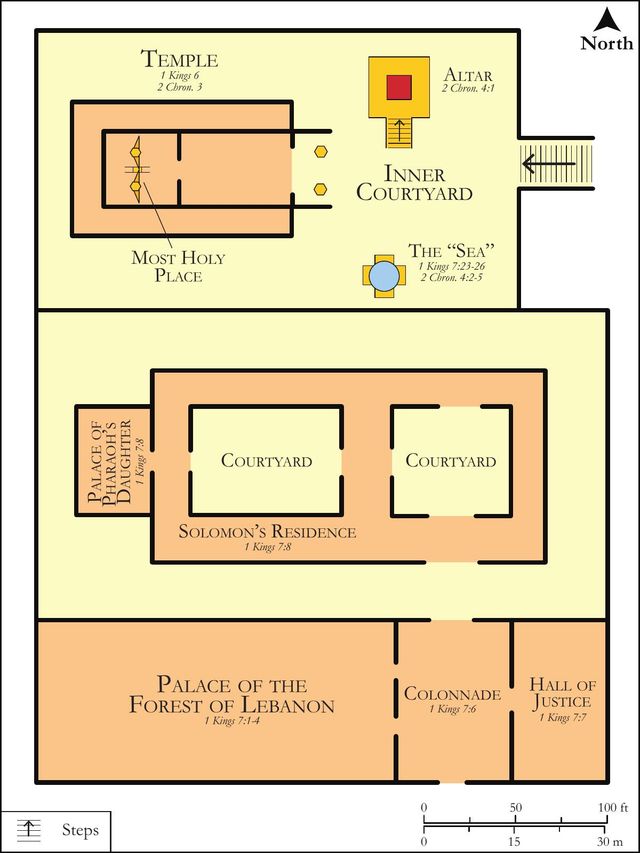
This verse is situated within the Chronicler's detailed account of the construction and furnishing of Solomon's Temple, immediately following the completion of the main architectural structures described in 2 Chronicles 3. Chapters 2 Chronicles 4 and 2 Chronicles 5 meticulously catalog the various sacred vessels, altars, and implements crafted for the sanctuary. The description of the Molten Sea, its precise dimensions, and its distinctive supports in 2 Chronicles 4:2-5 is paralleled in 1 Kings 7:23-26. The Chronicler, known for emphasizing the grandeur of the Temple and the divine instruction behind its every element, uses these details to underscore the Temple's central role as the consecrated place of worship and God's dwelling among His people.
Historical & Cultural Context
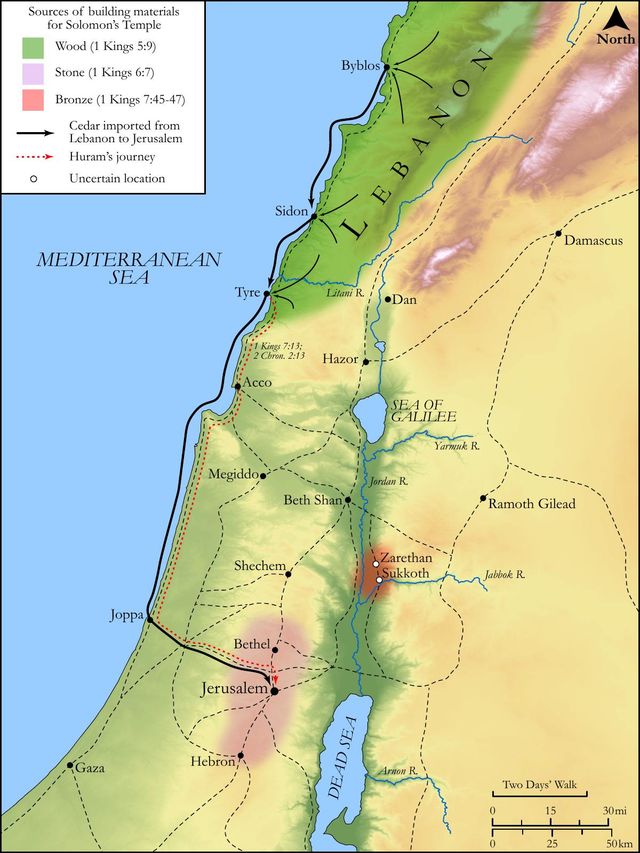
The construction of Solomon's Temple represented a zenith of Israelite national and religious identity, showcasing the immense wealth, power, and architectural prowess of the Solomonic era. The creation of such a colossal bronze basin like the Molten Sea was a monumental undertaking, demanding advanced metallurgical skills, likely facilitated by Hiram of Tyre, a master craftsman renowned for his work in bronze (as detailed in 2 Chronicles 2:13-14). While the Tabernacle already had its bronze laver for ritual purification, the sheer scale and specific design of the Molten Sea, particularly its unique support by twelve oxen, distinguished it as uniquely Israelite. The paramount importance of ritual purity in Israelite worship, as extensively outlined in the Pentateuchal laws, made the Molten Sea an indispensable functional and symbolic element for the priests.
Key Themes
ShowHideThis verse contributes significantly to several overarching themes within the book of 2 Chronicles and the broader biblical narrative. Firstly, it underscores the theme of Divine Instruction and Excellence, as the meticulous specifications for the Temple furnishings, including the Molten Sea, were understood to be divinely revealed. This demanded the highest quality craftsmanship and materials, reflecting the honor due to God (a theme echoed in the detailed instructions for the tabernacle in Exodus 25-31). Secondly, the Molten Sea highlights the theme of Priestly Purity and Atonement, serving as the primary means for the priests to ritually cleanse themselves before performing their sacred duties. This emphasized the profound holiness required to approach a holy God (as seen in Exodus 30:17-21). Finally, the "twelve oxen" supporting the sea powerfully symbolize the Unity and Strength of the Twelve Tribes of Israel, indicating that the entire nation, represented by its tribes, collectively supported the worship and sacred practices centered at the Temple. This imagery reinforces the covenant relationship God had with His people, akin to the twelve stones on the high priest's breastplate representing the tribes in Exodus 28:21.
Exposition and Analysis
ShowHideKey Word Analysis
ShowHideFrom the root meaning "united," this numeral emphasizes the singularity and uniqueness of the Molten Sea. It was the primary, unparalleled basin for purification in the Temple complex, signifying a central, unified provision for ritual cleansing. This highlights its monumental importance and distinct role.
This term, typically referring to a vast natural body of water, is applied here to the colossal bronze basin. Its use underscores the immense size and capacity of the Molten Sea, far exceeding that of a mere laver. The "sea" evokes a sense of boundless provision and depth, symbolizing the abundant means for cleansing available within the Temple.
This word denotes beef cattle, particularly oxen, which were highly prized in ancient agricultural societies for their strength, endurance in labor, and sacrificial value. In this context, the twelve oxen serve as the foundational supports for the Molten Sea, symbolizing not only physical strength and stability but also the enduring power, service, and collective responsibility of the united tribes of Israel in sustaining the worship of God.
Verse Breakdown
ShowHide"One sea"
This phrase identifies the singular, massive bronze basin known as the Molten Sea. The emphasis on "one" highlights its unique status and immense scale, indicating it was the central and most significant washing vessel in the Temple courtyard. Its singularity suggests a unified and comprehensive provision for priestly purification, essential for all who served in the sanctuary.
"and twelve oxen under it"
This clause describes the distinctive and symbolic base upon which the Molten Sea rested. The twelve oxen, cast in bronze and arranged in groups of three facing the four cardinal directions (north, south, east, west), appeared to bear the immense weight of the basin. This detail is rich in symbolism, with the twelve oxen representing the twelve tribes of Israel, signifying their collective strength, unity, and foundational support for the Temple's functions and the worship of God. Their presence underscored the idea that the entire nation was involved in and upheld the sacred activities of the sanctuary.
Literary Devices
ShowHideThe verse employs significant Symbolism. The "sea" itself symbolizes the abundant provision for cleansing and purification, which was essential for approaching a holy God. Its vastness suggests the thoroughness and comprehensive nature of the required purity. The "twelve oxen" are powerful symbols of the Twelve Tribes of Israel, representing their collective strength, unity, and foundational role in supporting the worship of God. Their arrangement, facing the four cardinal directions, also subtly implies the universality of God's reach and the ultimate worldwide scope of His kingdom. The concise nature of the description, "One sea, and twelve oxen under it," also functions as a form of Merism, where two key, distinct elements are presented to represent the whole intricate structure and its underlying theological significance, embodying both the cleansing provision and the corporate support for it.
Theological and Thematic Connections
ShowHideThe Molten Sea, with its immense capacity and the imagery of the twelve oxen, powerfully communicates the theological necessity of purity and the corporate nature of worship. Its function for priestly cleansing prefigures the spiritual purification required for all who approach God. The strength and unity symbolized by the oxen underscore that worship is not merely an individual act but a collective endeavor, supported by the entire community of faith. This Old Testament emphasis on ritual cleansing points forward to the ultimate and perfect purification provided through Christ, making a way for all believers to draw near to God.
Reflection and Application
ShowHideWhile the physical Molten Sea no longer exists, its spiritual lessons resonate deeply with believers today. The need for the priests to wash themselves before ministering reminds us of the absolute necessity of spiritual purity for those who serve God. This purity is not achieved through ritualistic washing but through the cleansing power of Christ's atoning work. As a "royal priesthood" (1 Peter 2:9), we are called to live lives of holiness, continually seeking purification from sin through repentance and faith in Christ. Furthermore, the twelve oxen supporting the sea serve as a powerful reminder of the corporate nature of faith. Just as the tribes collectively supported the Temple's functions, so too are believers called to stand together, supporting one another and the mission of the church. Our individual purity contributes to the collective holiness of the body of Christ, enabling us to offer acceptable worship and service to God in unity and strength. We are not isolated individuals, but interconnected members of a spiritual house, built together for God's glory.
Questions for Reflection
ShowHideFAQ
ShowHideWhat was the primary purpose of the Molten Sea in Solomon's Temple?
ShowHideThe primary purpose of the Molten Sea was to provide water for the ceremonial washing and purification of the priests. Before performing their sacred duties, offering sacrifices, or entering the holy places, the Levitical priests were required to cleanse their hands and feet in this massive basin. This ritual washing underscored the absolute necessity of holiness and purity for those who ministered in the presence of God, as detailed in passages like Exodus 30:17-21. It was a practical and symbolic means of maintaining ritual cleanliness in the Temple service, ensuring that those who drew near to God did so with the required reverence and purity.
Why were there twelve oxen supporting the Molten Sea?
ShowHideThe twelve oxen supporting the Molten Sea were profoundly symbolic. They represented the twelve tribes of Israel, signifying the unity, strength, and foundational support of the entire nation for the worship of God centered at the Temple. Arranged in groups of three facing the four cardinal directions, they also implied the comprehensive and all-encompassing nature of Israel's role in God's covenant, extending symbolically to all corners of the earth. Oxen were known for their strength, endurance, and service, making them fitting symbols for the robust and enduring support provided by the united tribes for the sacred functions of the sanctuary. This imagery reinforces the idea that the entire community was invested in and upheld the purity and practices of the Temple, reflecting the blessings and identity of the tribes throughout Genesis 49.
Christ-Centered Fulfillment
ShowHideThe Molten Sea, with its vital function of ritual cleansing for the priests, finds its ultimate and perfect fulfillment in Jesus Christ. The vast quantity of water in the basin symbolized the abundant provision for purification, yet it could only offer external, temporary, and repeated cleansing. Christ, however, is the true and living "sea" of purification, whose precious blood cleanses us from all sin, not merely outwardly but inwardly, completely, and eternally. He is the Lamb of God who takes away the sin of the world, providing a once-for-all sacrifice that makes us truly holy and acceptable before God. Through His atoning work, we are given direct and confident access to God, no longer needing ceremonial washings or a physical temple. As the writer of Hebrews declares, we can now "draw near with a true heart in full assurance of faith, with our hearts sprinkled clean from an evil conscience and our bodies washed with pure water" (Hebrews 10:22). The unity of the twelve oxen supporting the sea also powerfully points to Christ, who gathers all believers—from every tribe and nation—into one body, the Church, which He Himself cleanses and sanctifies to be presented as a radiant bride, "without stain or wrinkle or any other blemish, but holy and blameless" (Ephesians 5:25-27). Thus, the ancient symbol of the Molten Sea beautifully foreshadows the complete and perfect cleansing, unity, and unhindered access to God made possible only through our Lord Jesus Christ.