


2 Chronicles 2:2
- וַיִּסְפֹּרvai·yis·Porand he countedH5608Conj-w ¦ V-Qal-ConsecImperf-3msVerb Qal Consecutive Imperfect 3rd Singular Masculineוַandיִּסְפֹּרhe counted
- שְׁלֹמֹהshe·lo·MohSolomonH8010N-proper-mNoun Proper Masculine
- שִׁבְעִיםshiv·'ImseventyH7657N-mpNoun Plural Masculine Absolute
- אֶלֶף'e·lefthousandH505N-csNoun Singular common gender Absolute
- אִישׁ'ishmanH376N-msNoun Singular Masculine Absolute
- סַבָּלsa·Balburden-bearer[s]H5449N-msNoun Singular Masculine Absolute
- וּשְׁמוֹנִיםu·she·mo·Nimand eightyH8084Conj-w ¦ N-mpNoun Plural Masculine Absoluteוּandשְׁמוֹנִיםeighty
- אֶלֶף'E·lefthousandH505N-csNoun Singular common gender Absolute
- אִישׁ'ishmanH376N-msNoun Singular Masculine Absolute
- חֹצֵבcho·Tzevstone-cutter[s]H2672V-Qal-Prtcpl-msVerb Qal Participle Singular Masculine Absolute
- בָּהָרba·Harin the hill countryH2022Prep-b ¦ N-msNoun Singular Masculine Absoluteבָּin theהָרhill country
- וּמְנַצְּחִיםu·me·na·tze·Chimand overseersH5329Conj-w ¦ V-Piel-Prtcpl-mpVerb Piel Participle Plural Masculine Absoluteוּandמְנַצְּחִיםoverseers
- עֲלֵיהֶם'a·lei·Hemover themH5921Prep ¦ 3mpPrepositionעֲלֵיoverהֶםthem
- שְׁלֹשֶׁתshe·Lo·shetthreeH7969N-cscNoun Singular common gender Construct
- אֲלָפִים'a·la·Fimthousand<s>H505N-cpNoun Plural common gender Absolute
- וְשֵׁשׁve·Sheshand sixH8337Conj-w ¦ N-csNoun Singular common gender Absoluteוְandשֵׁשׁsix
- מֵאוֹתme·'othundred<s>H3967N-fpNoun Plural Feminine Absolute
English is a literal word-by-word gloss of the Hebrew, not the KJV's wording. Why?
This is the original text the KJV's translators worked from — each Hebrew word with its own literal English meaning in this verse, prepared by scholars at Tyndale House, Cambridge. The KJV translates whole sentences, not word by word, so its wording differs: one Hebrew word can become several English words, and the KJV may choose “the LORD” where the gloss reads “Yahweh”. Both are faithful — they answer different questions. For the KJV's own rendering, switch to the KJV text.
Details
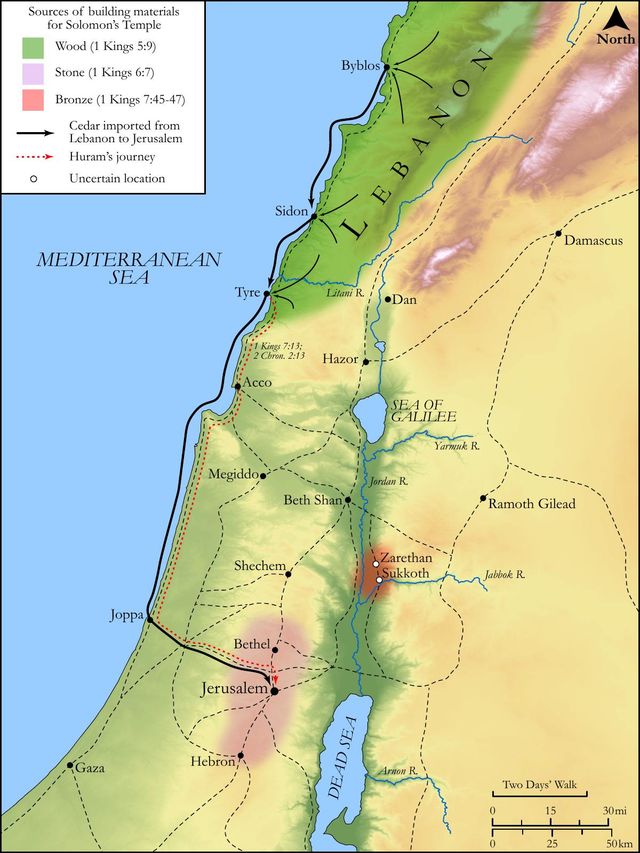
See on the biblical-era map
Study this verse
Public-domain commentary
Matthew Henry
From his Commentary on the Whole Bible. Henry comments on passages, not single verses — this entry covers 2 Chronicles 2:1–10. His three-level outline is real structure in the source text, so it is rendered as structure.
Solomon's wisdom was given him, not merely for speculation, to entertain himself (though it is indeed a princely entertainment), nor merely for conversation, to entertain his friends, but for action; and therefore to action he immediately applies himself. Observe,
I.His resolution within himself concerning his business (Ch2 2:1):
He determined to build, in the first place, a house for the name of the Lord. It is fit that he who is the first should be served - first a temple and then a palace, a house not so much for himself, or his own convenience and magnitude, as for the kingdom, for the honour of it among its neighbours and for the decent reception of the people whenever they had occasion to apply to their prince; so that in both he aimed at the public good. Those are the wisest men that lay out themselves most for the honour of the name of the Lord and the welfare of communities. We are not born for ourselves, but for God and our country.
II.His embassy to Huram, king of Tyre, to engage his assistance in the prosecution of his designs.
The purport of his errand to him is much the same here as we had it Kg1 5:2, etc., only here it is more largely set forth.
1.The reasons why he makes this application to Huram are here more fully represented, for information to Huram as well as for inducement.
(1.)He pleads his father's interest in Huram, and the kindness he had received from him (Ch2 2:3): As thou didst deal with David, so deal with me. As we must show kindness to, so we may expect kindness from, our fathers' friends, and with them should cultivate a correspondence.
(2.)He represents his design in building the temple: he intended it for a place of religious worship (Ch2 2:4), that all the offerings which God had appointed for the honour of his name might be offered up there. The house was built that it might be dedicated to God and used in his service. This we should aim at in all our business, that our havings and doings may be all to the glory of God. He mentions various particular services that were there to be performed, for the instruction of Huram. The mysteries of the true religion, unlike those of the Gentile superstition, coveted not concealment.
(3.)He endeavors to inspire Huram with very great and high thoughts of the God of Israel, by expressing the mighty veneration he had for his holy name: Great is our God above all gods, above all idols, above all princes. Idols are nothing, princes are little, and both under the control of the God of Israel; and therefore, [1.] "The house must be great; not in proportion to the greatness of that God to whom it is to be dedicated (for between finite and infinite there can be no proportion), but in some proportion to the great value and esteem we have for this God." [2.] "Yet, be it ever so great, it cannot be a habitation for the great God. Let not Huram think that the God of Israel, like the gods of the nations, dwells in temples made with hands, Act 17:24. No, the heaven of heavens cannot contain him. It is intended only for the convenience of his priests and worshippers, that they may have a fit place wherein to burn sacrifice before him." [3.] He looked upon himself, though a mighty prince, as unworthy the honour of being employed in this great work: Who am I that I should build him a house? It becomes us to go about every work for God with a due sense of our utter insufficiency for it and our incapacity to do any thing adequate to the divine perfections. It is part of the wisdom wherein we ought to walk towards those that are without carefully to guard against all misapprehension which any thing we say or do may occasion concerning God; so Solomon does here in his treaty with Huram.
2.The requests he makes to him are more particularly set down here. (1.) He desired Huram would furnish him with a good hand to work (Ch2 2:7): Send me a man. He had cunning men with him in Jerusalem and Judah, whom David provided, Ch1 22:15. Let them not think but that Jews had some among them that were artists. But "send me a man to direct them. There are ingenious men in Jerusalem, but not such engravers as are in Tyre; and therefore, since temple-work must be the best in its kind, let me have the best workmen that can be got." (2.) With good materials to work on (Ch2 2:8), cedar and other timber in abundance (Ch2 2:8, Ch2 2:9); for the house must be wonderfully great, that is, very stately and magnificent, no cost must be spared, nor any contrivance wanting in it.
3.Here is Solomon's engagement to maintain the workmen (Ch2 2:10), to give them so much wheat and barley, so much wine and oil. He did not feed his workmen with bread and water, but with plenty, and every thing of the best. Those that employ labourers ought to take care they be not only well paid, but well provided for with sufficient of that which is wholesome and fit for them. Let the rich masters do for their poor workmen as they would be done by if the tables were turned.
Continue studying 2 Chronicles 2:2 across the web’s major study libraries — every link below opens this exact verse, chapter, or book on the destination site.
Read & Compare
 BibleGatewayThis verse in more than 200 translations and 70 languages.
 Bible.comThe YouVersion reader — hundreds of translations, reading plans, and highlights.
 ESV.orgCrossway's official English Standard Version reader.
 NET BibleThe NET translation with 60,000+ translators' notes on every rendering decision.
 STEP BibleTyndale House's free study tool — original text, vocabulary, and scholarly resources.
 BibliaLogos Bible Software's free web reader.
 USCCBThe New American Bible (Revised Edition) with the U.S. bishops' study notes.
Commentaries
 BibleHub CommentariesDozens of classic commentaries on this verse, gathered on one page.
 StudyLightMore than 100 commentary sets — the largest collection on the web.
 BibleRefPlain-English commentary on what this verse means, verse by verse.
 Enduring WordDavid Guzik's free commentary on this chapter, widely used by Bible teachers.
 Bible Study ToolsVerse commentary alongside Greek and Hebrew study aids.
Original Language & Research
- BibleHub InterlinearThe verse word by word — original language, transliteration, and English.
- BibleHub LexiconEvery word's original-language definition and Strong's entry.
 Blue Letter BibleDeep-study tools — Strong's numbers, concordance, and word studies.
 SefariaThe Hebrew text with Rashi and centuries of Jewish commentary.
Sermons, Hymns & Audio


TrulyRandomVerse is not affiliated with these sites and doesn’t control their content. They’re linked because they’re genuinely useful.
Summary
2 Chronicles 2:2 meticulously details King Solomon's initial logistical preparations for constructing the First Temple in Jerusalem, highlighting the monumental scale of the undertaking. This verse precisely enumerates the vast human resources mobilized: seventy thousand men designated to transport heavy materials, eighty thousand assigned to quarry stone and fell timber in the mountainous regions, and three thousand six hundred overseers appointed to manage and direct this colossal workforce, underscoring the unprecedented scope and sophisticated planning involved in erecting God's sacred dwelling place.
Context
ShowHideLiterary Context
This verse immediately follows Solomon's profound declaration of his intent to build a house for the Lord, a "very great" house, and a house for his own kingdom, as recorded in 2 Chronicles 2:1. It serves as the practical initiation of that grand vision, detailing the essential first step in assembling the necessary human resources. The Chronicler, known for his meticulous attention to detail regarding the Temple and the Davidic dynasty, records these precise numbers to underscore both the magnitude and the divine significance of the project. This account finds a close parallel in 1 Kings 5:13-18, though with slight numerical variations in the number of overseers, which scholars often reconcile by understanding different categories or phases of supervision. The verses that follow describe Solomon's diplomatic outreach to King Hiram of Tyre to secure skilled labor and exotic materials, further illustrating the comprehensive nature of the preparations before the actual construction begins in 2 Chronicles 3.
Historical & Cultural Context
Large-scale building projects were a hallmark of powerful ancient Near Eastern empires, frequently employing vast numbers of laborers through systems of conscription or corvée labor (compulsory public service). Solomon's organization of such a massive workforce for the Temple was consistent with the administrative capabilities of a dominant monarch of his era. While the text in 2 Chronicles 2:2 does not explicitly differentiate, other passages (e.g., 1 Kings 9:20-22) indicate that Solomon primarily utilized the descendants of the non-Israelite peoples who remained in the land for such heavy manual labor, while Israelites typically served in administrative, military, and supervisory roles. The "mountains" likely refer to the stone quarries in the Judean hills and the vast forests of Lebanon, from which immense quantities of stone and cedar timber, respectively, would be extracted and transported to Jerusalem. The sheer numbers reflect the immense undertaking of constructing a permanent, magnificent structure like the Temple, which was designed to be the spiritual and architectural centerpiece of the kingdom and a testament to God's presence among His people.
Key Themes
ShowHideThis verse contributes significantly to several key themes within 2 Chronicles and the broader biblical narrative. Firstly, it highlights the Divine Mandate and Human Execution, demonstrating how God's will for a dwelling place (first revealed to David in 2 Samuel 7) is brought to fruition through immense human effort and strategic planning. Secondly, the Scale and Scope of God's Work is powerfully emphasized; the monumental numbers underscore that building for the Lord is a national, all-encompassing endeavor requiring unprecedented resources and collective dedication. Thirdly, it showcases Order, Organization, and Leadership, as Solomon's meticulous census and allocation of tasks, along with the appointment of numerous overseers, reflect sophisticated administrative skills essential for successful large-scale projects. Finally, it speaks to the Dedication and Priority of Worship, as the willingness to mobilize such vast human and material resources for years of labor signifies the profound value and commitment placed on establishing a permanent, glorious place for the worship of Yahweh, central to Israel's identity and covenant relationship with God.
Exposition and Analysis
ShowHideKey Word Analysis
ShowHideThis verb (H5608) means "to count," "to number," or "to enumerate." In this context, it implies a careful and precise census and allocation of manpower, not merely a rough estimate. Solomon meticulously organized and assigned the workforce, demonstrating a high degree of administrative control and strategic planning for the Temple project, ensuring every role was accounted for.
This noun (H5449) refers to a "porter" or "bearer of burdens." It describes the arduous task of transporting heavy raw materials—such as quarried stone, massive timber, and other supplies—from their source to the construction site in Jerusalem. This was a physically demanding and continuous effort, essential for the progress of the building, requiring immense strength and endurance.
This verb (H2672) means "to cut," "to quarry," or "to carve." It specifically describes the work of extracting stone from the mountains and felling and shaping timber from forests. These were skilled and laborious tasks, producing the foundational and structural elements for the Temple, requiring precision and expertise.
Verse Breakdown
ShowHide"And Solomon told out threescore and ten thousand men to bear burdens"
King Solomon initiated the Temple construction by meticulously counting and assigning 70,000 men specifically for the arduous task of transporting building materials. This highlights the sheer volume of raw materials required and the extensive logistical planning involved in moving them from distant quarries and forests to the construction site in Jerusalem.
"and fourscore thousand to hew in the mountain"
In addition to the burden-bearers, Solomon designated a massive contingent of 80,000 men to work in the quarries and forests. Their role was to cut and shape stone from the mountains and fell timber, preparing the foundational and structural components for the Temple, underscoring the monumental effort required to extract and prepare these raw materials.
"and three thousand and six hundred to oversee them"
To manage and direct this colossal workforce of 150,000 laborers, Solomon appointed a substantial number of 3,600 overseers. This significant supervisory contingent demonstrates Solomon's commitment to efficient management, accountability, and ensuring the smooth, orderly, and productive progress of the immense construction project, reflecting a highly organized administrative structure.
Literary Devices
ShowHideThe primary literary device employed in 2 Chronicles 2:2 is Enumeration. The precise listing of specific, large numbers (70,000, 80,000, 3,600) serves to emphasize the sheer scale, meticulous organization, and monumental nature of Solomon's undertaking. This detailed accounting is characteristic of the Chronicler's historical writing, which often highlights the magnitude of Israel's resources and the glory of God's work through impressive statistics. While some scholars debate the exact literalness of such large numbers in ancient texts, their function here is undoubtedly to convey the unprecedented national mobilization for this sacred purpose, lending an air of historical accuracy and underscoring the profound dedication of human effort to building the Lord's house. The use of these figures reinforces the theme of God's blessing upon Solomon's reign, enabling such a grand project.
Theological and Thematic Connections
ShowHideThis verse powerfully illustrates the principle that God often chooses to work through human agency and collective effort to accomplish His divine purposes. While the Temple was divinely ordained and its design revealed by God, its construction required immense human planning, labor, and dedication. The mobilization of such a vast workforce signifies the deep commitment of the nation to building a dwelling place for the Lord, reflecting a spiritual priority that transcends mere architectural ambition. It reminds us that even the most sacred endeavors require practical organization, diligent work, and the coordinated efforts of many individuals, each contributing their part. The Temple, though built by human hands, was consecrated as a place where God's presence would dwell among His people, bridging the gap between the divine and the human and serving as a tangible focal point for worship and covenant relationship.
Reflection and Application
ShowHideThe meticulous organization and immense dedication displayed in 2 Chronicles 2:2 offer profound lessons for believers today. Just as Solomon mobilized vast resources and manpower for a physical temple, we are called to dedicate our lives, talents, and resources to building God's spiritual kingdom. This verse reminds us that grand visions for God's glory require not only fervent prayer and divine inspiration but also diligent planning, strategic allocation of resources, and disciplined execution. Every individual, from the burden-bearer to the hewer to the overseer, played an indispensable role in the Temple's construction. Similarly, within the body of Christ, every member is vital, possessing unique gifts and callings that contribute to the overall health and growth of the church. We are challenged to recognize the significance of every task, no matter how seemingly mundane, when done for the glory of God, and to work together in unity and order, under wise leadership, to fulfill the Great Commission and build up the spiritual house of God, which is the church. This passage encourages us to embrace our specific roles with diligence and to appreciate the collective effort required for God's purposes to flourish.
Questions for Reflection
ShowHideFAQ
ShowHideWere these men forced laborers or volunteers?
ShowHideThe text itself does not explicitly state whether the men were volunteers or conscripted. However, the parallel account in 1 Kings 5:13-18 refers to a "levy" or "forced labor" (Hebrew: mas). This indicates a system of compulsory public service, often for a limited duration, which was common in ancient Near Eastern kingdoms. While distinct from chattel slavery, it involved mandatory service to the state. 1 Kings 9:20-22 further clarifies that Solomon did not enslave Israelites for this labor but rather utilized the descendants of the non-Israelite peoples whom the Israelites had not utterly destroyed. Israelites typically served in administrative, military, and supervisory roles, with the 3,600 overseers likely falling into this category. Thus, it was a highly organized, state-mandated system, primarily utilizing non-Israelite populations for the heavy manual labor, reflecting the administrative power of Solomon's reign.
Why are the numbers so high?
ShowHideThe high numbers (70,000 burden-bearers, 80,000 hewers, 3,600 overseers) serve to underscore the monumental scale and national importance of building the Temple. This was not just a local construction project but a central undertaking for all Israel, designed to be the magnificent dwelling place for God's presence among His people. Such vast figures demonstrate the immense resources and manpower Solomon commanded during his reign, reflecting the glory and prosperity of his kingdom. More profoundly, the Chronicler often uses large numbers to emphasize the magnitude of God's blessings and the vastness of the endeavors undertaken for His glory. The sheer scale highlights the profound dedication and value placed on establishing a permanent, glorious house for the Lord, signifying its central role in Israel's spiritual and national identity and demonstrating the fulfillment of God's promises of prosperity to the Davidic line.
Christ-Centered Fulfillment
ShowHideThe immense human effort and meticulous organization detailed in 2 Chronicles 2:2, dedicated to building a physical dwelling for God, finds its ultimate fulfillment in Jesus Christ. The Temple, for all its glory and the vast resources poured into its construction, was merely a shadow and a type of the true and greater reality to come. Christ himself declared, "Destroy this temple, and in three days I will raise it up," referring to the temple of His body (John 2:19-21). He is the ultimate "builder" of a spiritual house, the Church, not made with human hands, but eternal and perfect (Hebrews 9:11). Just as Solomon's laborers prepared stones, Christ is the chief cornerstone upon whom the entire spiritual edifice is built. We, as believers, are called to be living stones, individually and collectively forming this new, eternal Temple where God's Spirit truly dwells (1 Corinthians 3:16). The "bearing of burdens" and "hewing" for the physical Temple foreshadow the costly sacrifice and diligent work of Christ, who bore the burden of sin (Isaiah 53:4) and was "hewn" on the cross, to establish the new covenant and build a people for God's own possession, a spiritual house consecrated by His blood and indwelt by His Spirit.