


1 Kings 5:16
- לְבַדLe·vad<to> apartH905Prep-l ¦ N-mscNoun Singular Masculine Constructלְ<to>בַדapart
- מִשָּׂרֵיmi·sa·Reifrom [the] leaders ofH8269Prep-m ¦ N-mpcNoun Plural Masculine Constructמִfromשָּׂרֵי[the] leaders of
- הַנִּצָּבִיםha·ni·tza·Vimthe overseersH5324Art ¦ V-Niphal-Prtcpl-mpVerb Niphal Participle Plural Masculine Absoluteהַtheנִּצָּבִיםoverseers
- לִשְׁלֹמֹהlish·lo·Mohof SolomonH8010Prep-l ¦ N-proper-mNoun Proper MasculineלִofשְׁלֹמֹהSolomon
- אֲשֶׁר'a·SherwhoH834RelParticle Relative
- עַל'al[were] overH5921PrepPreposition
- הַמְּלָאכָהha·me·la·Khahthe workH4399Art ¦ N-fsNoun Singular Feminine Absoluteהַtheמְּלָאכָהwork
- שְׁלֹשֶׁתshe·Lo·shetthreeH7969N-cscNoun Singular common gender Construct
- אֲלָפִים'a·la·Fimthousand<s>H505N-cpNoun Plural common gender Absolute
- וּשְׁלֹשׁu·she·Loshand threeH7969Conj-w ¦ N-cscNoun Singular common gender Constructוּandשְׁלֹשׁthree
- מֵאוֹתme·'othundred<s>H3967N-fpNoun Plural Feminine Absolute
- הָרֹדִיםha·ro·Dimwho ruledH7287Art ¦ V-Qal-Prtcpl-mpVerb Qal Participle Plural Masculine Absoluteהָwhoרֹדִיםruled
- בָּעָםba·'Amover the peopleH5971Prep-b ¦ N-msNoun Singular Masculine Absoluteבָּover theעָםpeople
- הָעֹשִׂיםha·'o·Simwho were doingH6213Art ¦ V-Qal-Prtcpl-mpVerb Qal Participle Plural Masculine Absoluteהָwhoעֹשִׂיםwere doing
- בַּמְּלָאכָהba·me·la·Khah<in> the workH4399Prep-b ¦ N-fsNoun Singular Feminine Absoluteבַּ<in> theמְּלָאכָהwork
English is a literal word-by-word gloss of the Hebrew, not the KJV's wording. Why?
This is the original text the KJV's translators worked from — each Hebrew word with its own literal English meaning in this verse, prepared by scholars at Tyndale House, Cambridge. The KJV translates whole sentences, not word by word, so its wording differs: one Hebrew word can become several English words, and the KJV may choose “the LORD” where the gloss reads “Yahweh”. Both are faithful — they answer different questions. For the KJV's own rendering, switch to the KJV text.
Details
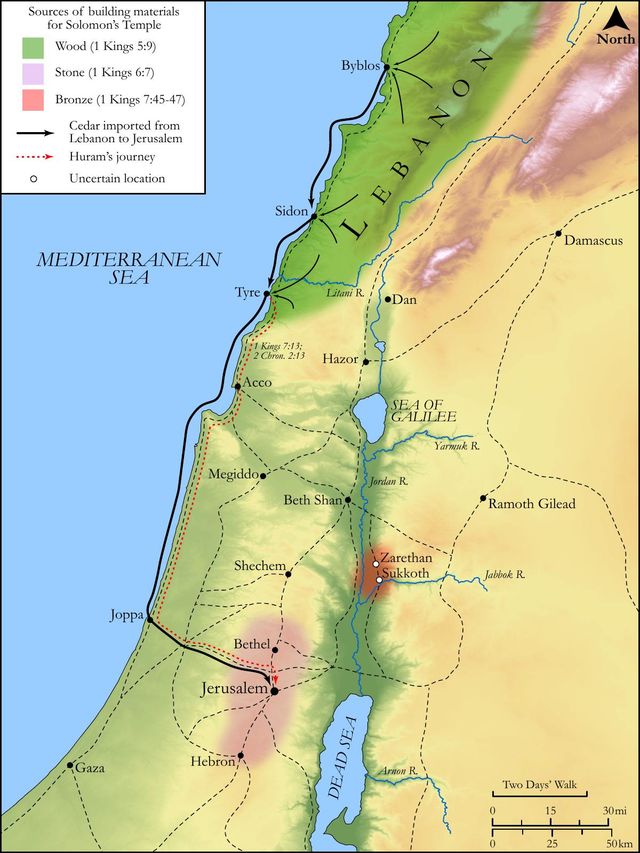
See on the biblical-era map

Study this verse
Public-domain commentary
Matthew Henry
From his Commentary on the Whole Bible. Henry comments on passages, not single verses — this entry covers 1 Kings 5:10–18. His two-level outline is real structure in the source text, so it is rendered as structure.
Here is, I. The performance of the agreement between Solomon and Hiram. Each of the parties made good his engagement. 1. Hiram delivered Solomon the timber, according to his bargain, Kg1 5:10. The trees were Solomon's, but perhaps - Materiam superabat opus - The workmanship was of more value than the article. Hiram is therefore said to deliver the trees. 2. Solomon conveyed to Hiram the corn which he had promised him, Kg1 5:11. Thus let justice be followed (as the expression is, Deu 16:20), justice on both sides, in every bargain.
II.The confirmation of the friendship that was between them hereby.
God gave Solomon wisdom (Kg1 5:12), which was more and better than any thing Hiram did or could give him; but this made Hiram love him, and enabled Solomon to improve his kindness, so that they were both willing to ripen their mutual love into a mutual league, that it might be lasting. It is wisdom to strengthen our friendship with those whom we find to be honest and fair, lest new friends prove not so firm and so kind as old ones.
III.The labourers whom Solomon employed in preparing materials for the temple.
1.Some were Israelites, who were employed in the more easy and honourable part of the work, felling trees and helping to square them, in conjunction with Hiram's servants; for this he appointed 30,000, but employed only 10,000 at a time, so that for one month's work they had two months' vacation, both for rest and for the despatch of their own affairs at home, Kg1 5:13, Kg1 5:14. It was temple service, yet Solomon takes care that they shall not be over-worked. Great men ought to consider that their servants must rest as well as they.
2.Others were captives of other nations, who were to bear burdens and to hew stone (Kg1 5:15), and we read not that these had their resting times as the other had, for they were doomed to servitude.
3.There were some employed as directors and overseers (Kg1 5:16), 3300 that ruled over the people, and they were as necessary and useful in their place as the labourers in theirs; here were many hands and many eyes employed, for preparation was now to be made, not only for the temple, but for all the rest of Solomon's buildings, at Jerusalem, and here in the forest of Lebanon, and in other places of his dominion, of which see Kg1 9:17-19. He speaks of the vastness of his undertakings (Ecc 2:4, I made me great works), which required this vast number of workmen.
IV.The laying of the foundation of the temple; for that is the building his heart is chiefly upon, and therefore he begins with that, Kg1 5:17, Kg1 5:18. It should seem, Solomon was himself present, and president, at the founding of the temple, and that the first stone (as has been usual in famous buildings) was laid with some solemnity. Solomon commanded and they brought costly stones for the foundation; he would do every thing like himself, generously, and therefore would have some of the costliest stones laid, or buried rather, in the foundation, though, being out of sight, worse might have served. Christ, who is laid for a foundation, is an elect and precious stone (Isa 28:16), and the foundations of the church are said to be laid with sapphires, Isa 54:11, compare Rev 21:19. That sincerity which is our gospel perfection obliges us to lay our foundation firm and to bestow most pains on that part of our religion which lies out of the sight of men.
Historical interpretation
Historical reception
2 surviving comments on this verse. Each one is dated, so this reads as a timeline rather than a list.
Select a marker to jump to its quote. Markers stagger vertically where authors wrote within a few decades of each other.
These thousands of men employed in the cutting and transportation of the wooden beams and the stones signify the thousands of thousands of assistant spirits sent for our salvation. In the first place, [we see that] God ordered his angels to cut from the rock of the world and to polish and direct accurately the souls of the saints.… Second, in this same symbol, we can observe the toils of the saints for the conversion and salvation of souls, either when they endeavor to drive human beings away from the love of the world or when, after they have accomplished that, they begin to polish the stones cut from the rock until they provide them with luster by a thorough polishing and make them worthy of the heavenly building. Then they are taken and employed by the supreme builder.… Finally we can interpret the workers of Solomon to be the angels sent to accomplish their ministry, as well as the prophets and the apostles chosen from the old people to build the church.… The builders sent by the king of Tyre symbolize those strong in doctrine and holiness, whom the nation of the Gentiles abundantly supplied for the same purpose.
Listen to even greater mysteries. At the time when Solomon built the temple, it was our peacemaker who says, “Peace I leave with you, my peace I give to you,” “for he himself is our peace,” “the peace of God that surpasses all understanding,” who himself built the temple for God. Observe what Scripture says about the building of the temple by Solomon: “And there were seventy thousand quarrymen and eighty thousand carriers.” Mark the number. The masons who were cutting stones, who were preparing, as it were, the foundations of the buildings, who were taking up stones from the ground to build the temple of God, are reckoned in the number seven, in the prophets, in the patriarchs, for while they seemingly were driving the human race from off the earth, they were making preparations for the temple of the Lord. The latter, the eighty thousand, symbolize the apostolic preaching and the Gospels; these are they who with the Lord Savior and Solomon were carrying the heavy burden of the nations. This surely is the height of mystery, but hear of even deeper mysteries! “And the overseers over the works and the temple were three thousand.” They cannot be greater, not even the overseers in charge of the work, except that they proclaim the Trinity.
Continue studying 1 Kings 5:16 across the web’s major study libraries — every link below opens this exact verse, chapter, or book on the destination site.
Read & Compare
 BibleGatewayThis verse in more than 200 translations and 70 languages.
 Bible.comThe YouVersion reader — hundreds of translations, reading plans, and highlights.
 ESV.orgCrossway's official English Standard Version reader.
 NET BibleThe NET translation with 60,000+ translators' notes on every rendering decision.
 STEP BibleTyndale House's free study tool — original text, vocabulary, and scholarly resources.
 BibliaLogos Bible Software's free web reader.
 USCCBThe New American Bible (Revised Edition) with the U.S. bishops' study notes.
Commentaries
 BibleHub CommentariesDozens of classic commentaries on this verse, gathered on one page.
 StudyLightMore than 100 commentary sets — the largest collection on the web.
 BibleRefPlain-English commentary on what this verse means, verse by verse.
 Enduring WordDavid Guzik's free commentary on this chapter, widely used by Bible teachers.
 Bible Study ToolsVerse commentary alongside Greek and Hebrew study aids.
Original Language & Research
- BibleHub InterlinearThe verse word by word — original language, transliteration, and English.
- BibleHub LexiconEvery word's original-language definition and Strong's entry.
 Blue Letter BibleDeep-study tools — Strong's numbers, concordance, and word studies.
 SefariaThe Hebrew text with Rashi and centuries of Jewish commentary.
Sermons, Hymns & Audio


TrulyRandomVerse is not affiliated with these sites and doesn’t control their content. They’re linked because they’re genuinely useful.
Summary
1 Kings 5:16 provides a crucial administrative detail regarding the vast workforce assembled for the construction of Solomon's magnificent Temple. This verse precisely enumerates three thousand and three hundred lower-tier supervisors, distinct from the higher-ranking chief officers, whose direct responsibility was to oversee the daily labor of the people. This specific numerical insight not only underscores the monumental scale of the Temple project but also highlights King Solomon's exceptional organizational prowess, meticulous planning, and the sophisticated administrative infrastructure required to manage such a divinely ordained and nationally significant undertaking.
Context
ShowHideLiterary Context
This verse is strategically placed within the narrative of 1 Kings 5, which meticulously details King Solomon's extensive preparations for building the First Temple in Jerusalem. Following his secure establishment on the throne and the formation of a peaceful alliance with Hiram, King of Tyre (1 Kings 5:1-12), the text shifts to the mobilization of resources and manpower. The preceding verses describe the initial levy of thirty thousand Israelite laborers (1 Kings 5:13) and the appointment of chief officers over the entire operation (1 Kings 5:15). Verse 16 then introduces a further, more numerous tier of supervision, clarifying the intricate hierarchical structure designed to manage the immense day-to-day operations. This granular detailing emphasizes the transition from grand vision and resource acquisition to the practical, on-the-ground execution of the Temple project, underscoring its national, economic, and spiritual significance.
Historical & Cultural Context
The construction of the Temple was arguably the most ambitious and complex building project in ancient Israel's history, reflecting the unparalleled political stability and economic prosperity of Solomon's reign, a golden age for the united monarchy. Large-scale construction endeavors in the ancient Near East, such as those in Egypt or Mesopotamia, invariably involved vast numbers of laborers, typically organized into highly structured hierarchies to ensure efficiency, accountability, and control. While the Israelite levy involved rotational service, suggesting a form of national corvée labor (1 Kings 5:13-14), foreign residents were explicitly subjected to more direct forced labor or "bondservice" (1 Kings 9:20-21). The administrative challenge of coordinating quarrying, timber felling, transport over long distances, and precise on-site construction for a project of this magnitude, all without modern technology, necessitated an exceptionally robust and multi-layered supervisory system. The mention of precise numbers like 3,300 speaks to the sophisticated record-keeping and administrative capabilities of Solomon's kingdom, indicating a level of governmental organization comparable to other major empires of the era.
Key Themes
ShowHideThe meticulous administrative detail presented in 1 Kings 5:16 contributes significantly to several overarching themes developed throughout the book of 1 Kings:
Organizational Prowess and Divine Wisdom
The sheer number of overseers—three thousand and three hundred—underscores the immense scale of the Temple project and Solomon's sophisticated administrative capabilities. This level of detail highlights the critical importance of structure, delegation, and effective management in orchestrating a large workforce. It implicitly links back to Solomon's divinely granted wisdom, which extended beyond judicial discernment to encompass practical leadership, governance, and the efficient execution of grand national projects.
Scale and Significance of the Temple Project
The verse implicitly conveys the monumental scale of labor required for constructing the Temple. Such a large number of supervisors points to tens of thousands of laborers under their charge, reflecting the national effort and vast resources dedicated to building God's house, which was to become the central edifice for Israel's worship, national identity, and covenant relationship with Yahweh.
Order and Structure in God's Work
The detailed enumeration of administrative tiers suggests that God's work, even when divinely inspired and commanded, often proceeds through human organization, diligent planning, and meticulous oversight. This reflects a broader biblical principle that God is a God of order, not of confusion (1 Corinthians 14:33), and that excellence in execution is a form of worship.
Exposition and Analysis
ShowHideKey Word Analysis
ShowHideThis primitive root means "to station," "to appoint," or "to set over." In this context, it refers to individuals who were officially appointed or established in positions of authority. These "officers" were not merely general supervisors but specifically designated administrators, indicating a formal and structured hierarchy within Solomon's workforce. Their role was to ensure order and progress in the monumental undertaking of building the Temple.
This primitive root signifies "to tread down" or "to subjugate," but more broadly "to have dominion," "to prevail against," or "to rule." Here, it denotes the direct oversight and managerial authority these 3,300 individuals exercised over the laborers. They were the immediate foremen or taskmasters, responsible for directing, coordinating, and ensuring the productivity of the workers on the ground, embodying the practical application of Solomon's administrative control.
This term refers to "employment," "work" (abstractly or concretely), or "ministry." It encompasses the entire scope of the Temple construction project—from quarrying and timber felling to the actual erection of the edifice. The use of this word emphasizes that the 3,300 officers were directly involved in the practical, day-to-day execution of the physical labor, ensuring that all aspects of the "work" were carried out efficiently and according to plan.
Verse Breakdown
ShowHide"Beside the chief of Solomon's officers which [were] over the work"
This opening phrase establishes the hierarchical context. It indicates that the 3,300 supervisors mentioned here were distinct from and subordinate to a higher echelon of "chief officers" (likely the 550 mentioned in 1 Kings 9:23). This implies a multi-tiered administrative structure, where authority was delegated from the highest levels down to the immediate supervisors, ensuring comprehensive oversight of the vast construction project.
"three thousand and three hundred"
This precise numerical figure is highly significant. It is not a rounded estimate but a specific count, suggesting meticulous record-keeping and a highly organized bureaucratic system within Solomon's administration. This large number emphasizes the sheer scale of the Temple construction, requiring an extensive network of direct supervisors to manage the tens of thousands of laborers involved.
"which ruled over the people that wrought in the work"
This clause defines the specific function and scope of authority of these 3,300 individuals. They were the immediate, on-the-ground managers, directly "ruling over" (i.e., overseeing, directing, and managing) the common laborers involved in the physical "work" of building the Temple. Their role was crucial for the efficient and orderly execution of tasks, ensuring that the grand vision translated into tangible progress.
Literary Devices
ShowHideThe primary literary device employed in 1 Kings 5:16 is Precision and Numerical Detail. The exact figure of "three thousand and three hundred" is not merely a historical record; it serves to underscore the meticulous planning, administrative order, and immense scale that characterized Solomon's reign, particularly concerning the sacred project of the Temple. This precise detail contributes to the overall sense of Grandeur and Magnitude associated with the Temple's construction, implicitly conveying the vast resources—both human and material—devoted to it. The number itself can be seen as a form of Synecdoche, where a specific, large number represents the broader concept of an immensely organized and extensive workforce. It also functions as a form of Verisimilitude, lending credibility and historical weight to the narrative by providing concrete, verifiable-sounding data, thereby enhancing the reader's perception of the historical reality and the impressive capabilities of Solomon's kingdom.
Theological and Thematic Connections
ShowHideThe seemingly mundane administrative detail of numbers in 1 Kings 5:16 carries profound theological weight, demonstrating that even the most sacred undertakings, such as constructing a dwelling place for God, require human organization, diligent planning, and effective leadership. God, who is inherently a God of order and not of confusion (1 Corinthians 14:33), works through structured human effort and wise stewardship. Solomon's administrative genius, divinely enabled, ensured that the vast resources and manpower were stewarded effectively for a sacred purpose. This verse reminds us that practical administration, efficient management, and clear delegation are not antithetical to spiritual work but are often vital components of fulfilling God's grand vision, reflecting a commitment to excellence and faithfulness in all endeavors undertaken for His glory. It highlights that divine blessing often manifests through human diligence and well-ordered execution.
Reflection and Application
ShowHideThe administrative precision highlighted in 1 Kings 5:16 offers profound insights for contemporary leadership, project management, and even personal stewardship. It powerfully teaches us that great visions, particularly those imbued with spiritual significance, rarely come to fruition without meticulous planning, clear delegation of responsibilities, and diligent oversight. Solomon's example demonstrates that true wisdom is not merely abstract knowledge but also practical competence in organizing people and resources effectively for a common, divinely inspired goal. For us, this means embracing the value of structure, order, and accountability in our endeavors, whether in ministry, professional life, or family management. It encourages us to identify, empower, and support those who can effectively "rule over the work" at various levels, recognizing that every role, from the grand visionary to the ground-level supervisor, is crucial for collective success. Ultimately, it calls us to steward our gifts, time, and resources with the same intentionality, excellence, and dedication that characterized the building of God's first Temple, always aiming for maximum impact and fruitfulness for His glory.
Questions for Reflection
ShowHideFAQ
ShowHideWhat is the difference between the 3,300 officers mentioned here and the 550 mentioned in 1 Kings 9:23?
ShowHideThe numbers refer to distinct tiers within Solomon's vast administrative structure for the Temple construction. 1 Kings 5:16 specifies "three thousand and three hundred" officers who "ruled over the people that wrought in the work." These were the lower-level supervisors, often referred to as foremen or taskmasters, directly overseeing the daily labor of the tens of thousands of workers. In contrast, 1 Kings 9:23 (and 2 Chronicles 8:10) mentions "five hundred and fifty" chief officers. These 550 were the higher-ranking officials, likely overseeing larger divisions, districts, or specific aspects of the project, with the 3,300 reporting directly to them. This demonstrates a sophisticated, multi-layered hierarchy designed to manage a project of unprecedented scale and complexity.
Does this verse imply forced labor or slavery for all involved in the Temple construction?
ShowHideThe verse itself focuses on the administrative structure of the supervisors rather than the nature of the labor. However, other passages in 1 Kings clarify the composition of the workforce. 1 Kings 5:13 states that Solomon raised a levy of 30,000 Israelites, who served in Lebanon in rotational shifts (one month on, two months off), suggesting a form of national service or corvée labor, likely compensated or part of their civic duty. In contrast, 1 Kings 9:20-21 explicitly states that Solomon "made to pay tribute of bondservice" those non-Israelites (Amorites, Hittites, Perizzites, Hivites, and Jebusites) who remained in the land after the conquest. Therefore, while foreign residents were indeed subjected to forced labor, the Israelite contribution was a levy, and the 3,300 supervisors likely oversaw both groups, ensuring the efficient execution of the work.
Christ-Centered Fulfillment
ShowHideThe meticulous organization and vast resources dedicated to building Solomon's physical Temple, as powerfully highlighted in 1 Kings 5:16, find their ultimate fulfillment and spiritual transformation in the construction of God's spiritual Temple: the Church. While Solomon built a magnificent earthly dwelling for God's presence, Jesus Christ declared Himself to be the greater Temple, whose body would be destroyed and raised in three days (John 2:19-21). Through His sacrificial death and glorious resurrection, Christ became the foundational cornerstone upon which a new, living temple is being built (Ephesians 2:20). Believers are now the "living stones" being built into a spiritual house, a holy priesthood, offering spiritual sacrifices acceptable to God (1 Peter 2:5), with the Holy Spirit Himself dwelling within them individually and corporately (1 Corinthians 3:16). Just as Solomon's project required immense human organization and supervisory oversight, the building of the Church, both locally and universally, relies on the divinely gifted leadership and ordered efforts of its members, as seen in the appointment of deacons in the early church to manage practical needs and ensure the apostles could focus on prayer and the ministry of the word (Acts 6:1-7). The detailed administration in 1 Kings 5:16 thus foreshadows the divine intentionality, perfect order, and comprehensive plan with which Christ, the ultimate Master Builder, is constructing His eternal kingdom, culminating in the New Jerusalem where God's presence is so complete that no physical temple is needed, for the Lord God Almighty and the Lamb are its temple (Revelation 21:22).