


1 Kings 9:23
Bible text: King James Version (1769 Blayney text) · Public domain
Bible text: King James Version with Strong's numbers · Public domain
Bible text: Berean Standard Bible · Public domain
Bible text: American Standard Version (1901) · Public domain
Bible text: World English Bible, Messianic edition · Public domain
Bible text: Geneva Bible (1599) · Public domain
Bible text: Young's Literal Translation · Public domain
- אֵלֶּה'E·lehtheseH428PrtParticle Demonstrative
- שָׂרֵיsa·Rei[were] [the] leaders ofH8269N-mpcNoun Plural Masculine Construct
- הַנִּצָּבִיםha·ni·tza·Vimthe overseersH5324Art ¦ V-Niphal-Prtcpl-mpVerb Niphal Participle Plural Masculine Absoluteהַtheנִּצָּבִיםoverseers
- אֲשֶׁר'a·SherwhoH834RelParticle Relative
- עַל'al[were] overH5921PrepPreposition
- הַמְּלָאכָהha·me·la·Khahthe workH4399Art ¦ N-fsNoun Singular Feminine Absoluteהַtheמְּלָאכָהwork
- לִשְׁלֹמֹהlish·lo·Mohof SolomonH8010Prep-l ¦ N-proper-mNoun Proper MasculineלִofשְׁלֹמֹהSolomon
- חֲמִשִּׁיםcha·mi·ShimfiftyH2572N-mpNoun Plural Masculine Absolute
- וַחֲמֵשׁva·cha·Meshand fiveH2568Conj-w ¦ N-cscNoun Singular common gender Constructוַandחֲמֵשׁfive
- מֵאוֹתme·'othundred<s>H3967N-fpNoun Plural Feminine Absolute
- הָרֹדִיםha·ro·Dimwho ruledH7287Art ¦ V-Qal-Prtcpl-mpVerb Qal Participle Plural Masculine Absoluteהָwhoרֹדִיםruled
- בָּעָםba·'Amover the peopleH5971Prep-b ¦ N-msNoun Singular Masculine Absoluteבָּover theעָםpeople
- הָעֹשִׂיםha·'o·Simwho were doingH6213Art ¦ V-Qal-Prtcpl-mpVerb Qal Participle Plural Masculine Absoluteהָwhoעֹשִׂיםwere doing
- בַּמְּלָאכָהba·me·la·Khah<in> the workH4399Prep-b ¦ N-fsNoun Singular Feminine Absoluteבַּ<in> theמְּלָאכָהwork
English is a literal word-by-word gloss of the Hebrew, not the KJV's wording. Why?
This is the original text the KJV's translators worked from — each Hebrew word with its own literal English meaning in this verse, prepared by scholars at Tyndale House, Cambridge. The KJV translates whole sentences, not word by word, so its wording differs: one Hebrew word can become several English words, and the KJV may choose “the LORD” where the gloss reads “Yahweh”. Both are faithful — they answer different questions. For the KJV's own rendering, switch to the KJV text.
Details
See on the biblical-era maps
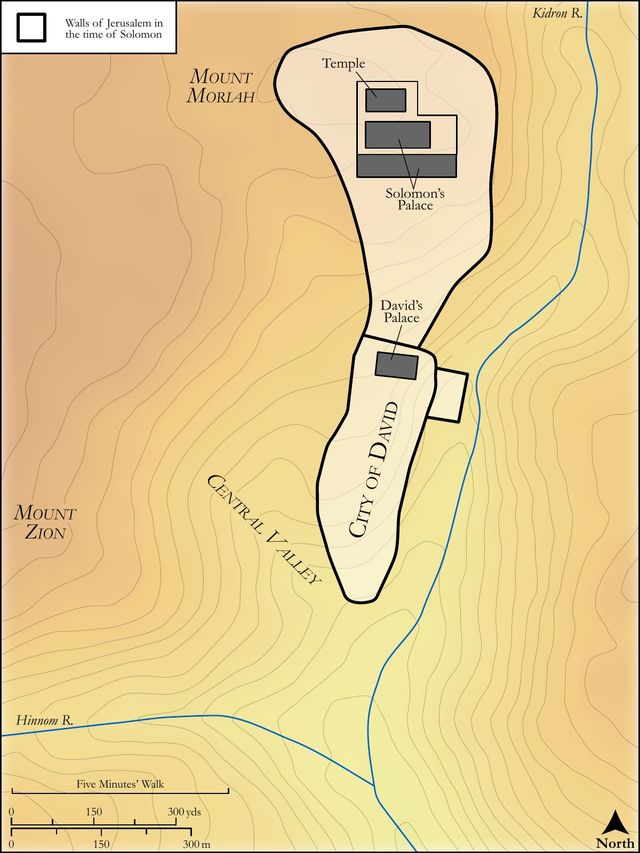
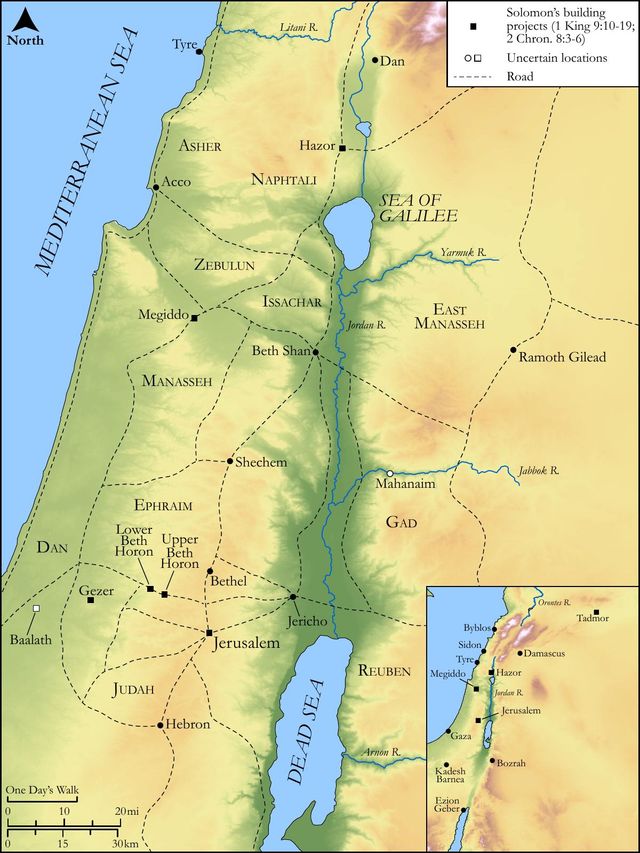
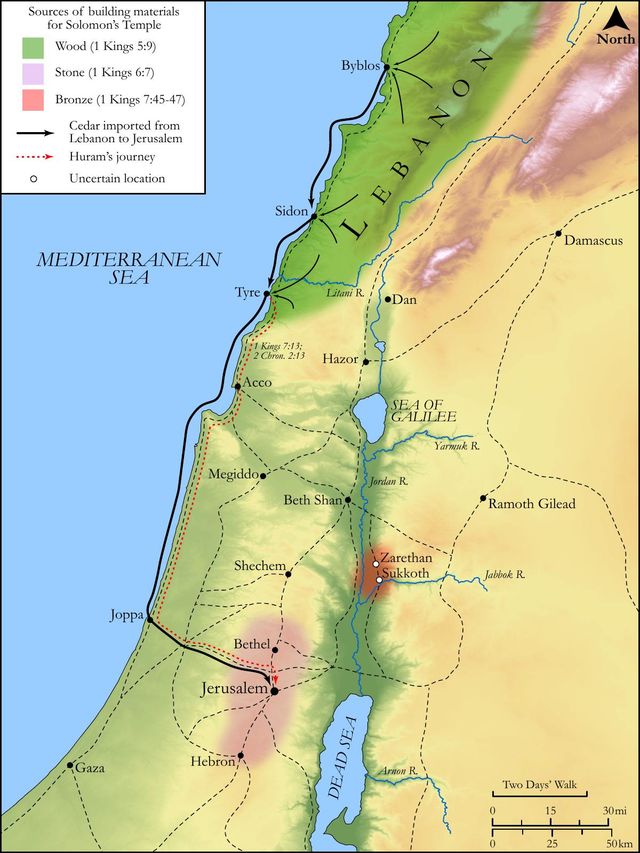
Study this verse
Public-domain commentary
Matthew Henry
From his Commentary on the Whole Bible. Henry comments on passages, not single verses — this entry covers 1 Kings 9:15–28. His two-level outline is real structure in the source text, so it is rendered as structure.
We have here a further account of Solomon's greatness.
I.His buildings.
He raised a great levy both of men and money, because he projected a great deal of building, which would both employ many hands and put him to a vast expense, Kg1 9:15. And he was a wise builder, who sat down first, and counted the cost, and would not begin to build till he found himself able to finish. Perhaps there was some complaint of the heaviness of the taxes, which the historian excuses from the greatness of his undertakings. He raised it, not for war (as other princes), which would spend the blood of his subjects, but for building, which would require only their labour and purses. Perhaps David observed Solomon's genius to lie towards building, and foresaw he would have his head and hands full of it, when he penned that song of degrees for Solomon, which begins, Except the Lord build the house, those labour in vain that build it (Psa 127:1), directing him to acknowledge God in all his ways, and, by prayer and faith in his providence, to take him along with him in all his designs of this kind. And Solomon verily began his work at the right end, for he built God's house first, and finished that before he began his own; and then God blessed him, and he prospered in all his other buildings. If we begin with God, he will go on with us. Let the first-fruits be his, and the after-fruits will the more comfortably be ours, Mat 6:33. Solomon built a church first and then he was enabled to build houses, and cities, and walls. Those consult not their own interest that defer to the last what they design for pious uses. The further order in Solomon's buildings is observable. God's house first for religion, then his own for his own convenience, then a house for his wife, to which she removed as soon as it was ready for her (Kg1 9:24), then Millo, the town-house or guild-hall, then the wall of Jerusalem, the royal city, then some cities of note and strength in the country, which were decayed and unfortified, Hazor, Megiddo, etc. As he rebuilt these at his own charge, the inhabitants would be not only his subjects, but his tenants, which would increase the revenues of the crown for the benefit of his successors. Among the rest, he built Gezer, which Pharaoh took out of the hands of the Canaanites, and made a present of to his daughter, Solomon's wife, Kg1 9:16. See how God maketh the earth to help the woman. Solomon was not himself a warlike prince, but the king of Egypt, who was, took cities for him to build. Then he built cities for convenience, for store, for his chariots, and for his horsemen, Kg1 9:19. And, lastly, he built for pleasure in Lebanon, for his hunting perhaps, or other diversions there. Let piety begin, and profit proceed, and leave pleasure to the last.
II.His workmen and servants.
In doing such great works, he must needs employ abundance of workmen. The honour of great men is borrowed from their inferiors, who do that which they have the credit of.
1.Solomon employed those who remained of the conquered and devoted nations in all the slavish work, Kg1 9:20, Kg1 9:21. We may suppose that they renounced their idolatry and submitted to Solomon's government, so that he could not, in honour, utterly destroy them, and they were so poor that he could not levy money on them; therefore he served himself of their labour. Herein he observed God's law (Lev 25:44, Thy bondmen shall be of the heathen), and fulfilled Noah's curse upon Canaan, A servant of servants shall he be unto his brethren, Gen 9:25.
2.He employed Israelites in the more creditable services (Kg1 9:22, Kg1 9:23): Of them he made no bondmen, for they were God's freemen, but he made them soldiers and courtiers, and gave them offices, as he saw them qualified, among his chariots and horsemen, appointing some to support the service of the inferior labourers. Thus he preserved the dignity and liberty of Israel and honoured their relation to God as a kingdom of priests.
III.His piety and devotion (Kg1 9:25):
Three times in a year he offered burnt-offerings extraordinary (namely, at the three yearly feasts, the passover, pentecost, and feast of tabernacles) in honour of the divine institution, besides what he offered at other times, both statedly and upon special occasions. With his sacrifices he burnt incense, not himself (that was king Uzziah's crime), but the priest for him, at his charge, and for his particular use. It is said, He offered on the altar which he himself built. He took care to build it, and then,
1.He himself made use of it. Many will assist the devotions of others that neglect their own. Solomon did not think his building an altar would excuse him from sacrificing, but rather engage him the more to it.
2.He himself had the benefit and comfort of it. Whatever pains we take, for the support of religion, to the glory of God and the edification of others, we ourselves are likely to have the advantage of it.
IV.His merchandise.
He built a fleet of trading ships at Ezion-geber (Kg1 9:26), a port on the coast of the Red Sea, the furthest stage of the Israelites when they wandered in the wilderness, Num 33:35. Probably that wilderness now began to be peopled by the Edomites, which it was not then. To them this port had belonged, but, David having subdued the Edomites, it now pertained to the crown of Judah. The fleet traded to Ophir in the East Indies, supposed to be that which is now called Ceylon. Gold was the commodity traded for, substantial wealth. It should seem, Solomon had before been Hiram's partner, or put a venture into his ships, which made him a rich return of 120 talents (Kg1 9:14), which encouraged him to build a fleet of his own. The success of others in any employment should quicken our industry; for in all labour there is profit. Solomon sent his own servants as factors, and merchants, and super-cargoes, but hired Tyrians for sailors, for they had knowledge of the sea, Kg1 9:27. Thus one nation needs another, Providence so ordering it that there may be mutual commerce and assistance; for not only as Christians, but as men, we are members one of another. The fleet brought home to Solomon 420 talents of gold, Kg1 9:28. Canaan, the holy land, the glory of all lands, had no gold in it, which teaches us that that part of the wealth of this world which is for hoarding and trading is not the best part of it, but that which is more immediately for the present support and comfort of life, our own and others'; such were the productions of Canaan. Solomon got much by his merchandise, but, it should seem, David got much more by his conquests. What were Solomon's 420 talents to David's 100,000 talents of gold? Ch1 22:14; Ch1 29:4. Solomon got much by his merchandise, and yet has directed us to a better trade, within reach of the poorest, having assured us from his own experience of both that the merchandise of wisdom is better than the merchandise of silver and the gain thereof than fine gold, Pro 3:14.
Continue studying 1 Kings 9:23 across the web’s major study libraries — every link below opens this exact verse, chapter, or book on the destination site.
Read & Compare
 BibleGatewayThis verse in more than 200 translations and 70 languages.
 Bible.comThe YouVersion reader — hundreds of translations, reading plans, and highlights.
 ESV.orgCrossway's official English Standard Version reader.
 NET BibleThe NET translation with 60,000+ translators' notes on every rendering decision.
 STEP BibleTyndale House's free study tool — original text, vocabulary, and scholarly resources.
 BibliaLogos Bible Software's free web reader.
 USCCBThe New American Bible (Revised Edition) with the U.S. bishops' study notes.
Commentaries
 BibleHub CommentariesDozens of classic commentaries on this verse, gathered on one page.
 StudyLightMore than 100 commentary sets — the largest collection on the web.
 BibleRefPlain-English commentary on what this verse means, verse by verse.
 Enduring WordDavid Guzik's free commentary on this chapter, widely used by Bible teachers.
 Bible Study ToolsVerse commentary alongside Greek and Hebrew study aids.
Original Language & Research
- BibleHub InterlinearThe verse word by word — original language, transliteration, and English.
- BibleHub LexiconEvery word's original-language definition and Strong's entry.
 Blue Letter BibleDeep-study tools — Strong's numbers, concordance, and word studies.
 SefariaThe Hebrew text with Rashi and centuries of Jewish commentary.
Sermons, Hymns & Audio


TrulyRandomVerse is not affiliated with these sites and doesn’t control their content. They’re linked because they’re genuinely useful.
Summary
1 Kings 9:23 provides a precise administrative detail concerning King Solomon's vast building initiatives, specifically identifying 550 chief officers who were entrusted with significant authority over the non-Israelite labor force. This verse illuminates the monumental scale of Solomon's kingdom-wide projects, such as the Temple and his palace, and underscores the sophisticated organizational hierarchy and delegated authority essential for managing such extensive undertakings.
Context
ShowHideLiterary Context
This verse is situated within a summary section (1 Kings 9:10-28) detailing Solomon's achievements over a twenty-year period following the completion of the Temple and his royal palace. Preceding verses (20-21) clarify that the massive construction projects relied on conscripted labor from the descendants of non-Israelite peoples whom the Israelites had not fully dispossessed. Verse 22 explicitly states that no Israelites were enslaved for this work, being reserved for military and administrative roles. Thus, 1 Kings 9:23 logically follows by specifying the number and role of the highest-ranking supervisors for this foreign labor force. It distinguishes these 550 chief officers from the larger body of overseers mentioned elsewhere, such as the 3,300 in 1 Kings 5:16 or the 3,600 in 2 Chronicles 2:18, indicating they represent a specific, elite echelon of management.
Historical & Cultural Context
Solomon's reign (c. 970-931 BC) was a period of unprecedented peace, prosperity, and monumental construction in ancient Israel. Projects like the magnificent Temple in Jerusalem, his royal palace, fortifications, and store cities required immense resources and a vast labor pool. The practice of conscripting conquered or subjugated peoples for public works was a common and accepted norm among the great kings of that day, evident in Egypt, where Israel itself had built treasure cities for Pharaoh. Solomon's utilization of non-Israelite forced labor, while viewed differently through a modern ethical lens, was standard for large-scale state enterprises of his era. The establishment of a stratified bureaucracy with various levels of officers and supervisors was crucial for managing the complex logistics, material resources, and human capital involved in a kingdom of Solomon's size and ambition.
Key Themes
ShowHide1 Kings 9:23 contributes to several overarching themes within the book of 1 Kings. Firstly, it highlights Solomon's effective administration and organizational prowess, demonstrating his remarkable ability to govern a vast kingdom and execute monumental projects. The sheer number of high-ranking officers underscores the colossal scale of his building programs and the immense labor force involved, reflecting the unprecedented wealth and power that characterized his reign, a fulfillment of divine promises and blessings (2 Samuel 7). Secondly, the verse emphasizes the theme of leadership and oversight, illustrating that successful large-scale endeavors necessitate clear lines of authority and diligent supervision. These "chief officers" were not passive administrators but actively "bare rule over the people," ensuring the efficient execution of Solomon's grand vision, a principle echoed in the wisdom literature often attributed to him (e.g., Proverbs 11:14).
Exposition and Analysis
ShowHideKey Word Analysis
ShowHideThis term (H8269) denotes a head person or leader of any rank or class, often translated as prince, ruler, or captain. In this context, it signifies their preeminent position within the administrative hierarchy. These 550 individuals were not merely officers but the highest-ranking, most important leaders directly responsible for the overall management and direction of the labor force. Their designation as "chief" underscores their significant authority and the critical nature of their supervisory role in Solomon's vast enterprises.
This verb (H7287) means to tread down, subjugate, or to have dominion. It implies more than simple oversight; it signifies active control, authority, and mastery. Often used in the Old Testament to describe ruling or reigning (e.g., Genesis 1:26), here it indicates that these officers exercised direct power, direction, and discipline over the workers. They were managers with true executive power, ensuring compliance and productivity.
Verse Breakdown
ShowHide"These [were] the chief of the officers that [were] over Solomon's work"
This opening clause introduces the specific group of administrators central to the verse. It clearly identifies them as the "chief" or highest-ranking officers, indicating a structured and hierarchical system within Solomon's extensive bureaucracy. Their primary responsibility was "Solomon's work," a comprehensive term encompassing the immense building projects—including the Temple, his royal palace, fortifications, and other infrastructure—that defined his prosperous reign and demanded meticulous coordination.
"five hundred and fifty"
This precise numerical detail provides the exact count of these elite supervisors. The specificity of the number suggests meticulous record-keeping within Solomon's administration and highlights the substantial number of top-tier managers required for the unprecedented scale of his operations. This figure is understood by scholars to refer to a distinct, high-level echelon of leadership, separate from other larger numbers of overseers mentioned in parallel or related accounts.
"which bare rule over the people that wrought in the work"
This concluding clause clarifies the specific function and extensive scope of authority of these 550 officers. They were not merely administrators but actively "bare rule" (exercised dominion, control, and governance) over "the people that wrought in the work"—referring to the large, conscripted foreign labor force. This emphasizes their direct involvement in managing, directing, and ensuring the productivity of the thousands of laborers engaged in Solomon's monumental construction efforts.
Literary Devices
ShowHideThe verse employs Precision through the specific numerical detail "five hundred and fifty," which lends a sense of historical accuracy and meticulous record-keeping to the biblical account of Solomon's administration. This exact figure contrasts with more general descriptions, underscoring the highly organized nature of his kingdom. Emphasis is achieved through the phrase "chief of the officers," highlighting the elite status and significant authority of this particular group within the broader administrative structure. Furthermore, the use of the verb "bare rule" (Hebrew: râdâh) employs Connotation, as it carries a stronger sense of active dominion, control, and even subjugation than a more neutral term like "supervised," thereby underscoring the substantial power and direct influence these officers wielded over the labor force.
Theological and Thematic Connections
ShowHideThis verse, while seemingly a mundane administrative detail, subtly reinforces the theological theme of divine blessing manifesting in human organization and capability. Solomon's ability to manage such a vast and complex enterprise speaks directly to the extraordinary wisdom God had granted him (1 Kings 3:12). The order and structure evident in his administration reflect a fundamental divine principle: God is a God of order, not of confusion or chaos (1 Corinthians 14:33). The meticulous organization required for building the Temple, God's dwelling place, parallels the divine design and precision evident in creation itself. Moreover, the reliance on a hierarchical structure for efficient work foreshadows the enduring importance of leadership and delegated authority within God's people, both in ancient Israel and in the New Testament church.
Reflection and Application
ShowHide1 Kings 9:23, though brief and focused on an administrative detail, offers profound insights into the principles of effective leadership, management, and the execution of grand visions. Solomon's kingdom, though divinely blessed, still required diligent human administration and a robust organizational structure to translate divine favor into tangible accomplishments. This verse reminds us that even when pursuing God-given goals, practical wisdom, strategic delegation, and clear lines of authority are indispensable. It underscores the vital role of those who manage and direct the efforts of others, ensuring accountability, efficiency, and the successful completion of large-scale projects. In any endeavor—be it a church ministry, a business, a community initiative, or even personal projects—the establishment of capable and authoritative leadership is foundational to achieving significant, impactful work. It encourages us to appreciate the often-unseen work of administration and oversight that underpins successful collective efforts, recognizing it as a form of faithful stewardship.
Questions for Reflection
ShowHideFAQ
ShowHideWhat is the significance of the number 550?
ShowHideThe number 550 in 1 Kings 9:23 specifically refers to the "chief of the officers" who "bare rule over the people that wrought in the work." This figure designates a distinct and higher echelon of supervisors compared to other numbers mentioned in parallel accounts, such as the 3,300 in 1 Kings 5:16 or the 3,600 in 2 Chronicles 2:18. While the exact relationship between these numbers is debated among scholars (e.g., whether 550 is a subset of the larger groups, or represents a separate, elite command structure), its significance lies in highlighting the meticulous organization and the sheer number of high-level managers required for Solomon's massive building projects. It emphasizes the extraordinary scale of his administrative capabilities and the hierarchy necessary to manage a vast, conscripted labor force efficiently.
Christ-Centered Fulfillment
ShowHideWhile 1 Kings 9:23 details the administrative structure of Solomon's earthly kingdom, it subtly points forward to the ultimate, perfectly administered kingdom of God under Christ. Solomon's reign, marked by unparalleled wisdom, wealth, and extensive building, was a significant foreshadowing of the greater King and builder to come. Just as Solomon's 550 chief officers "bare rule over the people" to bring his earthly vision to fruition, Christ, as the King of kings and Lord of lords, establishes and perfectly governs His eternal kingdom. The order and structure seen in Solomon's administration find their ultimate perfection in the divine order of Christ's rule, where every member of His body, the Church, is perfectly placed and empowered by the Holy Spirit to fulfill His divine purposes (Ephesians 4:11-16). Unlike Solomon's kingdom, which relied on conscripted labor, Christ's kingdom is built by willing, Spirit-empowered servants, united under His perfect headship (Colossians 1:18). The meticulous management of Solomon's grand projects ultimately points to the flawless, eternal administration of salvation and redemption orchestrated by Christ, who is both the divine architect and the cornerstone of a spiritual house not made with human hands (1 Peter 2:5).