


2 Chronicles 8:10
Bible text: King James Version (1769 Blayney text) · Public domain
Bible text: Berean Standard Bible · Public domain
Bible text: American Standard Version (1901) · Public domain
Bible text: World English Bible, Messianic edition · Public domain
Bible text: Geneva Bible (1599) · Public domain
Bible text: Young's Literal Translation · Public domain
- וְאֵלֶּהve·'E·lehand theseH428Conj-w ¦ PrtParticle Demonstrativeוְandאֵלֶּהthese
- שָׂרֵיsa·Rei[were] [the] commanders ofH8269N-mpcNoun Plural Masculine Construct
- הַנִּצָּבִיםha·ne·tzi·vimthe overseersH5324Art ¦ V-Niphal-Prtcpl-mpVerb Niphal Participle Plural Masculine Absoluteהַtheנִּצָּבִיםoverseers
- אֲשֶׁר'a·SherwhoH834RelParticle Relative
- לַמֶּלֶךְla·Me·lekh[belonged] to the kingH4428Prep-l ¦ N-msNoun Singular Masculine Absoluteלַ[belonged] to theמֶּלֶךְking
- שְׁלֹמֹהshe·lo·MohSolomonH8010N-proper-mNoun Proper Masculine
- חֲמִשִּׁיםcha·mi·ShimfiftyH2572N-mpNoun Plural Masculine Absolute
- וּמָאתָיִםu·ma·Ta·yimand two hundredH3967Conj-w ¦ N-fdNoun Dual Feminine Absoluteוּandמָאתָיִםtwo hundred
- הָרֹדִיםha·ro·Dimwho ruledH7287Art ¦ V-Qal-Prtcpl-mpVerb Qal Participle Plural Masculine Absoluteהָwhoרֹדִיםruled
- בָּעָםba·'Amover the peopleH5971Prep-b ¦ N-msNoun Singular Masculine Absoluteבָּover theעָםpeople
English is a literal word-by-word gloss of the Hebrew, not the KJV's wording. Why?
This is the original text the KJV's translators worked from — each Hebrew word with its own literal English meaning in this verse, prepared by scholars at Tyndale House, Cambridge. The KJV translates whole sentences, not word by word, so its wording differs: one Hebrew word can become several English words, and the KJV may choose “the LORD” where the gloss reads “Yahweh”. Both are faithful — they answer different questions. For the KJV's own rendering, switch to the KJV text.
Details
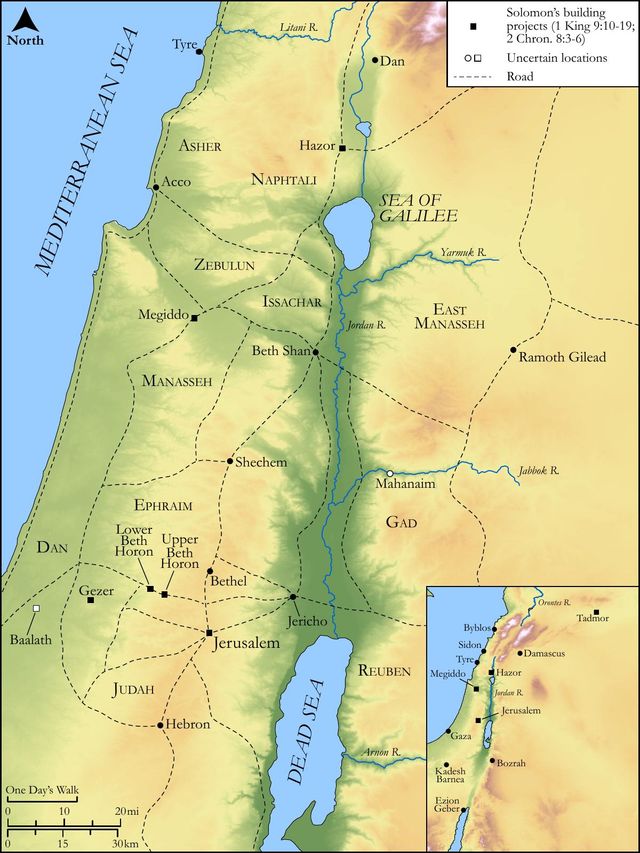
See on the biblical-era map
Study this verse
Public-domain commentary
Matthew Henry
From his Commentary on the Whole Bible. Henry comments on passages, not single verses — this entry covers 2 Chronicles 8:1–11. His two-level outline is real structure in the source text, so it is rendered as structure.
This we had Kg1 9:10-24, and therefore shall only observe here,
I.Though Solomon was a man of great learning and knowledge, yet he spent his days, not in contemplation, but in action, not in his study, but in his country, in building cities and fortifying them, in a time of peace preparing for a time of war, which is as much a man's business as it is in summer to provide food for winter.
II.As he was a man of business himself, and did not consult his own ease, so he employed a great many hands, kept abundance of people to work.
It is the interest of a state by all means possible to promote and encourage industry, and to keep its subjects from idleness. A great many strangers there were in Israel, many that remained of the Canaanites; and they were welcome to live there, but not to live and do nothing. The men of Laish, who had no business, were an easy prey to the invaders, Jdg 18:7.
III.When Solomon had begun with building the house of God, and made good work and quick work of that, he prospered in all his undertakings, so that he built all that he desired to build, Ch2 8:6. Those who have a genius for building find that one project draws on another, and the latter must amend and improve the former. Now observe,
1.How the divine providence gratified even Solomon's humour, and gave him success, not only in all that he needed to build and that it was for his advantage to build, but in all that he had a mind to build. So indulgent a Father God is sometimes to the innocent desires of his children that serve him. Thus he pleased Jacob with that promise, Joseph shall put his hand on thy eyes.
2.Solomon knew how to set bounds to his desires. He was not one of those that enlarge them endlessly, and can never be satisfied, but knew when to draw in; for he finished all he desired, and then he desired no more. He did not sit down and fret that he had not more cities to build, as Alexander did that he had not more worlds to conquer, Hab 2:5.
IV.That one reason why Solomon built a palace on purpose for the queen, and removed her and her court to it, was because he thought it by no means proper that she should dwell in the house of David (Ch2 8:11), considering that that had been a place of great piety, and perhaps her house was a place of great vanity. She was proselyted, it is likely, to the Jewish religion; but it is a question whether all her servants were. Perhaps they had among them the idols of Egypt, and a great deal of profaneness and debauchery. Now, though Solomon had not zeal and courage enough to suppress and punish what was amiss there, yet he so far consulted the honour of his father's memory that he would not suffer that place to be thus profaned where the ark of God had been and where holy David had prayed many a good prayer and sung many a sweet psalm. Not that all the places where the ark had been were so holy as never to be put to a common use; for then the houses of Abinadab and Obed-edom must have been so. But the place where it had been so long, and had been so publicly attended on, was so venerable that it was not fit to be the place of so much gaiety, not to say iniquity, as was to be found, I fear, in the court that Pharaoh's daughter kept. Note, Between things sacred and things common the ancient landmarks ought to be kept up. It was an outer-court of the temple that was the court of the women.
Continue studying 2 Chronicles 8:10 across the web’s major study libraries — every link below opens this exact verse, chapter, or book on the destination site.
Read & Compare
 BibleGatewayThis verse in more than 200 translations and 70 languages.
 Bible.comThe YouVersion reader — hundreds of translations, reading plans, and highlights.
 ESV.orgCrossway's official English Standard Version reader.
 NET BibleThe NET translation with 60,000+ translators' notes on every rendering decision.
 STEP BibleTyndale House's free study tool — original text, vocabulary, and scholarly resources.
 BibliaLogos Bible Software's free web reader.
 USCCBThe New American Bible (Revised Edition) with the U.S. bishops' study notes.
Commentaries
 BibleHub CommentariesDozens of classic commentaries on this verse, gathered on one page.
 StudyLightMore than 100 commentary sets — the largest collection on the web.
 BibleRefPlain-English commentary on what this verse means, verse by verse.
 Enduring WordDavid Guzik's free commentary on this chapter, widely used by Bible teachers.
 Bible Study ToolsVerse commentary alongside Greek and Hebrew study aids.
Original Language & Research
- BibleHub InterlinearThe verse word by word — original language, transliteration, and English.
- BibleHub LexiconEvery word's original-language definition and Strong's entry.
 Blue Letter BibleDeep-study tools — Strong's numbers, concordance, and word studies.
 SefariaThe Hebrew text with Rashi and centuries of Jewish commentary.
Sermons, Hymns & Audio


TrulyRandomVerse is not affiliated with these sites and doesn’t control their content. They’re linked because they’re genuinely useful.
Summary
Second Chronicles 8:10 offers a precise glimpse into the sophisticated administrative structure of King Solomon's reign, specifically identifying a core group of two hundred and fifty chief officers. These individuals were entrusted with significant authority, directly governing the populace. This verse underscores the practical manifestation of Solomon's divinely granted wisdom in establishing a robust and efficient system of delegated leadership, essential for managing the vast and prosperous kingdom that God had blessed him with, thereby highlighting the importance of structured governance for national order, justice, and effective functioning.
Context
ShowHideLiterary Context
This verse is strategically placed within 2 Chronicles 8, a chapter primarily dedicated to detailing King Solomon's extensive post-Temple and palace construction activities. Following the magnificent dedication of the Temple and the completion of his own royal residence, the narrative shifts to Solomon's efforts to consolidate his kingdom's infrastructure and administrative framework. The preceding verses (2 Chronicles 8:1-9) meticulously describe his various building projects in key cities, his management of foreign labor, and the distinction between Israelite and non-Israelite workforces. Verse 10 specifically transitions from the physical construction of the kingdom to the human organization, identifying a crucial cadre of Israelite leaders responsible for the direct governance of the populace. This emphasis on administrative order is vital for understanding how Solomon maintained stability and managed the complexities of a thriving nation after such monumental undertakings.
Historical & Cultural Context
Solomon's reign (c. 970-931 BC) represented the pinnacle of Israelite power, wealth, and territorial expansion, necessitating an exceptionally sophisticated administrative apparatus. Among the nations, large empires, from Egypt to Assyria, relied heavily on delegated authority to maintain control, collect taxes, administer justice, and mobilize resources across vast regions. Solomon, renowned for his unparalleled wisdom, a gift from God as recorded in 1 Kings 4:29-34, applied this divine endowment not only to judicial matters and international diplomacy but also to the practicalities of governance. The establishment of a clear hierarchy of officers, distinct from military commanders or cultic officials, was a common and necessary practice in well-organized monarchies, ensuring that the king's authority was effectively extended throughout the land and that the diverse population was properly managed. This administrative structure reflects the practical outworking of divinely inspired leadership in a flourishing kingdom.
Key Themes
ShowHideThe presence of these chief officers underscores Solomon's commitment to, and success in, establishing a highly organized and efficient governmental system. This reflects the practical application of his wisdom, demonstrating that divine blessing often manifests through diligent human organization and wise leadership. A well-structured administration was vital for managing the kingdom's vast resources, maintaining internal order, and executing the king's decrees, all contributing to the nation's stability and prosperity. The Chronicler consistently highlights Solomon's reign as a period of unprecedented order and peace, a direct result of God's favor and Solomon's wise implementation of administrative principles, as seen in his early prayer for wisdom to govern God's people in 2 Chronicles 1:10. The mention of "chief of king Solomon's officers" who "bare rule over the people" highlights the critical principle of delegation. Solomon, as the supreme ruler, understood that effective leadership in a large and expanding kingdom required entrusting significant authority and responsibility to capable individuals. These 250 individuals were not mere supervisors but high-ranking administrators empowered to govern various segments of the populace, ensuring that the king's reach extended to every corner of the land. This principle of delegating authority is a recurring theme in biblical leadership, from Moses appointing leaders in Exodus 18 to the apostles appointing deacons in Acts 6. This verse contributes to the Chronicler's broader portrayal of Solomon's reign as an era of unparalleled order, prosperity, and divine favor. The meticulous detail concerning the administrative structure emphasizes the immense scale of Solomon's kingdom and the necessity of a robust, well-organized leadership to manage a thriving nation. This organizational prowess allowed for the smooth functioning of society, the efficient collection of taxes, the administration of justice, and the overall maintenance of the kingdom's well-being, reflecting God's blessing on a people living in ordered community. The Chronicler often emphasizes the prosperity and peace under Solomon, as seen in 2 Chronicles 9:22, which was directly facilitated by such effective administration.
Exposition and Analysis
ShowHideKey Word Analysis
ShowHideThis term (H8269, שָׂר) denotes a person of high rank, authority, and often, administrative or military command. It is frequently translated as "prince," "chief," or "leader." In this context, it signifies that these 250 individuals were not minor functionaries but prominent figures within Solomon's governmental hierarchy, holding positions of significant influence and power directly under the king. Their designation as "chief" indicates their preeminence among the various levels of officers.
The word (H5333, נְצִיב) refers to "something stationary, i.e., a prefect, a military post, a statue." In an administrative context, it implies individuals who have been specifically designated or "stationed" to a position of authority, often over a particular district or function. When combined with sar, "chief officers" indicates a group of highly placed, appointed administrators who were entrusted with specific responsibilities in governing the kingdom, rather than merely overseeing labor or military matters. They were fixed, authoritative points within the kingdom's structure.
This primitive root (H7287, רָדָה) means "to tread down, i.e., subjugate; specifically, to crumble off." In a governmental context, it translates to "to have dominion, prevail against, reign, (bear, make to) rule." This word clearly defines the active function of these officers: they were not just supervisors, but held genuine authority to govern and exercise control over the people, reflecting the king's delegated power. Their role was one of active administration and oversight, ensuring the king's decrees were implemented and order was maintained.
Verse Breakdown
ShowHide"And these [were] the chief of king Solomon's officers"
This opening clause introduces a specific, elite group of high-ranking officials who served directly under King Solomon. The phrase "chief officers" emphasizes their elevated status and their close association with the monarch's authority, indicating that they were pivotal figures in the royal administration, distinct from other categories of supervisors, foremen, or military personnel. They formed a crucial layer of leadership in the kingdom.
"[even] two hundred and fifty"
This precise numerical detail specifies the exact size of this particular group of administrators. While other biblical texts (e.g., 1 Kings 9:23) mention a larger number of chief officers in Solomon's administration, this figure likely refers to a specific, perhaps higher-ranking, or Israelite-only, subset of officials within Solomon's complex governmental structure, highlighting their distinct and significant role. The specificity lends credibility to the Chronicler's account of Solomon's meticulous organization.
"that bare rule over the people"
This final clause clearly defines the primary function and sphere of authority for these 250 officers. Their role was not merely advisory or supervisory; it involved direct governance and administration over the general populace. This indicates their significant delegated authority in managing the civil affairs of the people, from administering justice to collecting taxes and maintaining public order, ensuring the smooth and effective operation of the kingdom across its territories.
Literary Devices
ShowHideThe Chronicler's inclusion of 2 Chronicles 8:10 employs several potent literary devices. Enumeration is prominently featured through the specific mention of "two hundred and fifty" officers. This precise numerical detail lends a sense of factual accuracy, order, and meticulous organization to the description of Solomon's administration, reinforcing the Chronicler's overall portrayal of Solomon's reign as a period of unparalleled prosperity and divine blessing. Furthermore, the verse serves as a form of Emphasis, highlighting the structured and well-managed nature of Solomon's kingdom. By focusing on this specific group of high-ranking administrators, the Chronicler underscores the crucial role of effective delegation of authority, which was indispensable for governing a realm of such magnitude. Finally, the implied Intertextuality with the parallel account in 1 Kings 9:23, which mentions 550 chief officers, invites the astute reader to engage in a deeper hermeneutical reflection. This apparent numerical difference is not a contradiction but rather suggests different classifications, focuses, or perhaps even a distinction between Israelite and foreign officers within Solomon's extensive and complex bureaucracy, enriching the reader's understanding of the historical accounts.
Theological and Thematic Connections
ShowHideThe administrative structure described in 2 Chronicles 8:10 reflects a profound theological principle: God is a God of order, and wise, delegated governance is a direct manifestation of His character and blessing. Solomon's ability to establish such an efficient system was a direct result of the wisdom God had generously granted him, demonstrating that divine wisdom is not merely for spiritual insight but also for practical, earthly administration and the effective management of human affairs. The delegation of authority, as powerfully illustrated here, is a recurring biblical theme, illustrating that effective leadership often involves empowering others to share in responsibility, thereby extending the reach and impact of governance. This principle ensures that the burdens of leadership are distributed, and the well-being of the people is more effectively managed, reflecting a divine pattern for human organization that promotes flourishing and stability within a community or nation.
Reflection and Application
ShowHideThe detailed account of Solomon's administrative structure in 2 Chronicles 8:10 offers timeless and profound lessons on leadership, organization, and the wise delegation of authority. In any human endeavor, whether it be a family unit, a business enterprise, a community organization, or a local church, the principles of clear structure, empowered leadership, and entrusted responsibility are absolutely vital for achieving collective goals, maintaining harmony, and ensuring the overall well-being of the group. This verse powerfully reminds us that even divinely blessed undertakings require diligent human effort and strategic organization. Effective leadership involves not only casting a compelling vision but also possessing the practical wisdom to identify and select capable individuals, equip them with the necessary tools and training, and then empower them to "bare rule" within their designated spheres of influence. When authority is wisely delegated and responsibilities are clearly defined, it fosters efficiency, promotes accountability, and ultimately leads to the flourishing of the community, reflecting God's own character as a God of order, purpose, and good governance.
Questions for Reflection
ShowHideFAQ
ShowHideWhy does 2 Chronicles 8:10 mention 250 officers, while 1 Kings 9:23 mentions 550?
ShowHideThe apparent numerical difference between 2 Chronicles 8:10, which states there were 250 chief officers, and 1 Kings 9:23, which lists 550 chief officers, is best understood not as a contradiction but as a difference in classification, emphasis, or the specific focus of each biblical author. The Chronicler often provides a particular theological perspective or highlights specific aspects of Solomon's reign that are relevant to his overall message to his post-exilic audience. It is widely believed by scholars that the 250 officers mentioned in 2 Chronicles 8:10 refer to a specific, perhaps higher-ranking, or exclusively Israelite subset of "chief officers" who were directly responsible for "ruling over the people," indicating their administrative authority over the general populace. In contrast, the 550 officers in 1 Kings 9:23 might represent a broader category that includes all chief officers, potentially encompassing those who were foremen over the non-Israelite laborers (as mentioned in 2 Chronicles 8:9 and 1 Kings 9:22), or those overseeing specific building projects and military garrisons. Both accounts are complementary, offering different but consistent insights into the vast and complex administrative structure of King Solomon's kingdom.
Christ-Centered Fulfillment
ShowHideWhile 2 Chronicles 8:10 meticulously details the earthly administration of King Solomon, it subtly yet profoundly points forward to the perfect, eternal, and universal reign of Jesus Christ. Solomon's kingdom, though divinely blessed, meticulously organized, and a historical high point for Israel, was ultimately temporary, limited by human imperfections, and destined for eventual division. It serves as a powerful shadow, a type, of the ultimate, perfectly ordered, and everlasting kingdom of God, administered by the true and greater King, Jesus Christ. Just as Solomon delegated authority to his chief officers to "bare rule over the people," so too does Christ, the supreme head of the Church, delegate authority to His disciples and to those He calls to lead within His spiritual kingdom, commissioning them to make disciples of all nations, teaching them to obey all that He has commanded, as seen in Matthew 28:18-20. He is the true "Chief Officer," the ultimate authority, who possesses all authority in heaven and on earth (Ephesians 1:20-23). His rule is not confined to a geographical kingdom but extends sovereignly over all creation and, most intimately, over the hearts and lives of His redeemed people. The order, peace, and prosperity that characterized Solomon's reign, facilitated by his wise administration, foreshadow the perfect justice, righteousness, and eternal peace that characterize Christ's everlasting kingdom, where He will truly "rule over all peoples, nations, and languages" (Daniel 7:14), establishing an administration of grace and truth that will never end (Isaiah 9:6-7).