


2 Chronicles 8:9
Bible text: King James Version (1769 Blayney text) · Public domain
Bible text: King James Version with Strong's numbers · Public domain
Bible text: Berean Standard Bible · Public domain
Bible text: American Standard Version (1901) · Public domain
Bible text: World English Bible, Messianic edition · Public domain
Bible text: Geneva Bible (1599) · Public domain
Bible text: Young's Literal Translation · Public domain
- וּמִןu·minand ofH4480Conj-w ¦ PrepPrepositionוּandמִןof
- בְּנֵיbe·Nei[the] people ofH1121N-mpcNoun Plural Masculine Construct
- יִשְׂרָאֵלYis·ra·'ElIsraelH3478N-properNoun Proper Location
- אֲשֶׁר'a·SherwhomH834RelParticle Relative
- לֹאlo'notH3808NegParticle Negative
- נָתַןna·Tanhe madeH5414V-Qal-Perf-3msVerb Qal Perfect 3rd Singular Masculine
- שְׁלֹמֹהshe·lo·MohSolomonH8010N-proper-mNoun Proper Masculine
- לַעֲבָדִיםla·'a·va·Diminto slavesH5650Prep-l ¦ N-mpNoun Plural Masculine Absoluteלַintoעֲבָדִיםslaves
- לִמְלַאכְתּוֹlim·lakh·Tofor his workH4399Prep-l ¦ N-fsc ¦ 3msNoun Singular Feminine Constructלִforמְלַאכְתּworkוֹhis
- כִּיkiforH3588PrtParticle Conditional
- הֵמָּהHe·mahtheyH1992Pro-3mpPronoun Personal 3rd Plural Masculine
- אַנְשֵׁי'an·Shei[were] men ofH582N-mpcNoun Plural Masculine Construct
- מִלְחָמָהmil·cha·MahwarH4421N-fsNoun Singular Feminine Absolute
- וְשָׂרֵיve·sa·Reiand [the] commanders ofH8269Conj-w ¦ N-mpcNoun Plural Masculine Constructוְandשָׂרֵי[the] commanders of
- שָׁלִישָׁיוsha·li·Shavhis officersH7991N-mpc ¦ 3msNoun Plural Masculine Constructשָׁלִישָׁיofficersוhis
- וְשָׂרֵיve·sa·Reiand [the] commanders ofH8269Conj-w ¦ N-mpcNoun Plural Masculine Constructוְandשָׂרֵי[the] commanders of
- רִכְבּוֹrikh·Bohis chariotryH7393N-msc ¦ 3msNoun Singular Masculine Constructרִכְבּchariotryוֹhis
- וּפָרָשָׁיוu·fa·ra·Shavand his horsemenH6571Conj-w ¦ N-mpc ¦ 3msNoun Plural Masculine Constructוּandפָרָשָׁיhorsemenוhis
English is a literal word-by-word gloss of the Hebrew, not the KJV's wording. Why?
This is the original text the KJV's translators worked from — each Hebrew word with its own literal English meaning in this verse, prepared by scholars at Tyndale House, Cambridge. The KJV translates whole sentences, not word by word, so its wording differs: one Hebrew word can become several English words, and the KJV may choose “the LORD” where the gloss reads “Yahweh”. Both are faithful — they answer different questions. For the KJV's own rendering, switch to the KJV text.
Details
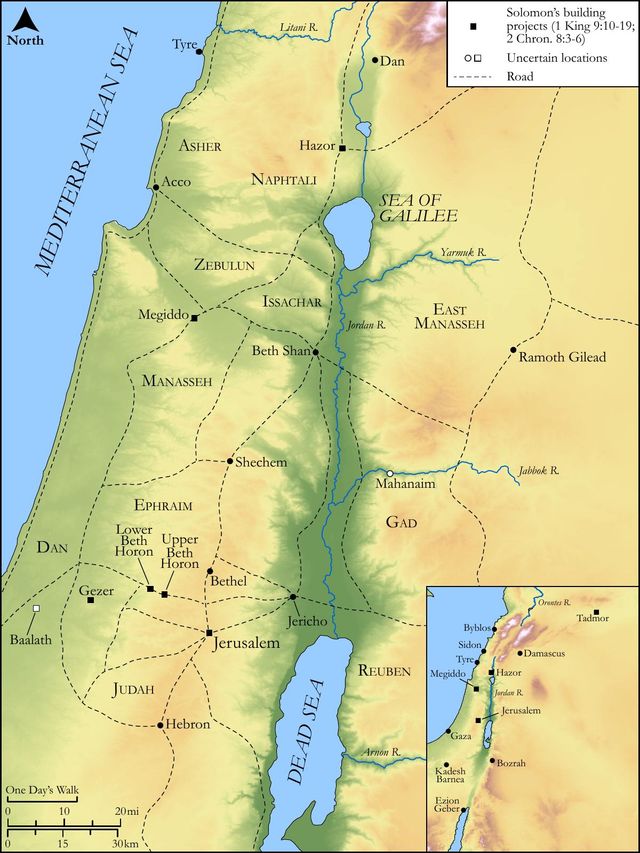
See on the biblical-era map
Study this verse
Public-domain commentary
Matthew Henry
From his Commentary on the Whole Bible. Henry comments on passages, not single verses — this entry covers 2 Chronicles 8:1–11. His two-level outline is real structure in the source text, so it is rendered as structure.
This we had Kg1 9:10-24, and therefore shall only observe here,
I.Though Solomon was a man of great learning and knowledge, yet he spent his days, not in contemplation, but in action, not in his study, but in his country, in building cities and fortifying them, in a time of peace preparing for a time of war, which is as much a man's business as it is in summer to provide food for winter.
II.As he was a man of business himself, and did not consult his own ease, so he employed a great many hands, kept abundance of people to work.
It is the interest of a state by all means possible to promote and encourage industry, and to keep its subjects from idleness. A great many strangers there were in Israel, many that remained of the Canaanites; and they were welcome to live there, but not to live and do nothing. The men of Laish, who had no business, were an easy prey to the invaders, Jdg 18:7.
III.When Solomon had begun with building the house of God, and made good work and quick work of that, he prospered in all his undertakings, so that he built all that he desired to build, Ch2 8:6. Those who have a genius for building find that one project draws on another, and the latter must amend and improve the former. Now observe,
1.How the divine providence gratified even Solomon's humour, and gave him success, not only in all that he needed to build and that it was for his advantage to build, but in all that he had a mind to build. So indulgent a Father God is sometimes to the innocent desires of his children that serve him. Thus he pleased Jacob with that promise, Joseph shall put his hand on thy eyes.
2.Solomon knew how to set bounds to his desires. He was not one of those that enlarge them endlessly, and can never be satisfied, but knew when to draw in; for he finished all he desired, and then he desired no more. He did not sit down and fret that he had not more cities to build, as Alexander did that he had not more worlds to conquer, Hab 2:5.
IV.That one reason why Solomon built a palace on purpose for the queen, and removed her and her court to it, was because he thought it by no means proper that she should dwell in the house of David (Ch2 8:11), considering that that had been a place of great piety, and perhaps her house was a place of great vanity. She was proselyted, it is likely, to the Jewish religion; but it is a question whether all her servants were. Perhaps they had among them the idols of Egypt, and a great deal of profaneness and debauchery. Now, though Solomon had not zeal and courage enough to suppress and punish what was amiss there, yet he so far consulted the honour of his father's memory that he would not suffer that place to be thus profaned where the ark of God had been and where holy David had prayed many a good prayer and sung many a sweet psalm. Not that all the places where the ark had been were so holy as never to be put to a common use; for then the houses of Abinadab and Obed-edom must have been so. But the place where it had been so long, and had been so publicly attended on, was so venerable that it was not fit to be the place of so much gaiety, not to say iniquity, as was to be found, I fear, in the court that Pharaoh's daughter kept. Note, Between things sacred and things common the ancient landmarks ought to be kept up. It was an outer-court of the temple that was the court of the women.
Continue studying 2 Chronicles 8:9 across the web’s major study libraries — every link below opens this exact verse, chapter, or book on the destination site.
Read & Compare
 BibleGatewayThis verse in more than 200 translations and 70 languages.
 Bible.comThe YouVersion reader — hundreds of translations, reading plans, and highlights.
 ESV.orgCrossway's official English Standard Version reader.
 NET BibleThe NET translation with 60,000+ translators' notes on every rendering decision.
 STEP BibleTyndale House's free study tool — original text, vocabulary, and scholarly resources.
 BibliaLogos Bible Software's free web reader.
 USCCBThe New American Bible (Revised Edition) with the U.S. bishops' study notes.
Commentaries
 BibleHub CommentariesDozens of classic commentaries on this verse, gathered on one page.
 StudyLightMore than 100 commentary sets — the largest collection on the web.
 BibleRefPlain-English commentary on what this verse means, verse by verse.
 Enduring WordDavid Guzik's free commentary on this chapter, widely used by Bible teachers.
 Bible Study ToolsVerse commentary alongside Greek and Hebrew study aids.
Original Language & Research
- BibleHub InterlinearThe verse word by word — original language, transliteration, and English.
- BibleHub LexiconEvery word's original-language definition and Strong's entry.
 Blue Letter BibleDeep-study tools — Strong's numbers, concordance, and word studies.
 SefariaThe Hebrew text with Rashi and centuries of Jewish commentary.
Sermons, Hymns & Audio


TrulyRandomVerse is not affiliated with these sites and doesn’t control their content. They’re linked because they’re genuinely useful.
Summary
2 Chronicles 8:9 provides critical insight into King Solomon's labor policies, distinctly separating the native Israelites from the subjugated non-Israelite populations. While foreign peoples were conscripted for forced labor in his extensive building projects, the children of Israel were explicitly exempted from such service, instead occupying esteemed roles as military personnel, high-ranking officers, and leaders within the kingdom's defense and administration, thereby underscoring their unique covenantal status and dignity.
Context
ShowHideLiterary Context
This verse is strategically placed within the Chronicler's detailed account of Solomon's vast construction endeavors and administrative organization. Immediately preceding it, 2 Chronicles 8:7-8 explicitly states that Solomon conscripted the remaining non-Israelite peoples—Hittites, Amorites, Perizzites, Hivites, and Jebusites—into forced labor, making them "tributary unto this day." Verse 9 then serves as a direct and emphatic contrast, clarifying that the Israelites were entirely excluded from this oppressive service. This juxtaposition completes the picture of Solomon's labor force by highlighting the distinct treatment of the native population versus the conquered peoples, emphasizing the unique status of Israel within their own land.
Historical & Cultural Context
Solomon's reign (circa 970-931 BC) marked a golden age of prosperity, peace, and monumental construction in Israel, including the magnificent Temple, his royal palace, and numerous fortified cities. Such ambitious projects necessitated an immense labor force, often acquired through corvée (forced) labor, a common practice among the empires of that day. However, the Mosaic Law, particularly as articulated in passages like Leviticus 25:39-43, prohibited Israelites from being subjected to permanent, oppressive servitude by their own brethren. Solomon's policy, as described in this verse, therefore reflects an adherence to this foundational legal tradition, distinguishing Israelite citizens, as God's covenant people, from the remnants of the Canaanite populations who had not been fully dispossessed during the conquest.
Key Themes
ShowHide2 Chronicles 8:9 contributes significantly to several overarching themes within the book of Chronicles and the broader biblical narrative. Firstly, it powerfully underscores the privileged status and unique identity of Israel as God's chosen people, set apart from the nations. Their exemption from forced labor highlights a divinely ordained distinction and protection, reinforcing their dignity. Secondly, the verse demonstrates Solomon's adherence to certain aspects of the Mosaic Law, specifically concerning the treatment of Israelites, even amidst his immense royal power and despite his later deviations from God's commands, such as those detailed in 1 Kings 11:1-8. Thirdly, the passage emphasizes the roles of leadership and military service assigned to the Israelites, indicating their integral participation in the kingdom's administration and defense, rather than being mere laborers. This reinforces the theme of Israel's internal strength, organization, and honorable engagement under a divinely appointed king.
Exposition and Analysis
ShowHideKey Word Analysis
ShowHideFrom the root עָבַד, this term specifically denotes "a servant," encompassing meanings like "bondage" or "bondman." In the context of Solomon's work, it refers to those subjected to a form of servitude or forced labor. The verse's assertion that Solomon "made no ʻebed" of the children of Israel highlights their exemption from this subservient and demanding form of service.
Derived from the same root as מֲלְאָךְ (messenger), this word properly signifies "deputyship" or "ministry," but generally refers to "employment" or "work," whether abstractly or concretely. Crucially, the definition notes it is "never servile." When paired with "servants" (ʻebed) in the phrase "servants for his work," it refers to the specific, often arduous, tasks involved in large-scale construction projects, from which the Israelites were exempt.
From the root לָחַם (to fight), this term refers to "a battle" or, more broadly, "warfare." The contrast drawn in the verse is significant: while others were engaged in laborious building "work," the Israelites were positioned as "men of war," indicating their honorable and vital role in the kingdom's defense and military operations.
Verse Breakdown
ShowHide"But of the children of Israel did Solomon make no servants for his work;"
This initial clause establishes the fundamental distinction in Solomon's labor policies. It emphatically states that no native Israelites were conscripted for the forced, burdensome labor (often referred to as mas in other texts, though the specific Strong's numbers here refer to 'servant' and 'work') that characterized his massive building projects. This exemption underscores their unique covenantal status and reflects, at least in this aspect, an adherence to the Mosaic Law, which protected Israelites from such servitude by their own kin.
"but they [were] men of war, and chief of his captains, and captains of his chariots and horsemen."
This second clause provides the positive counterpart, detailing the honorable and responsible roles that Israelites did fulfill in Solomon's administration. Instead of performing manual labor, they served in positions of military and administrative authority. "Men of war" refers to the general soldiery, while "chief of his captains" and "captains of his chariots and horsemen" denote high-ranking officers and leaders within the military structure. This demonstrates their integral and respected participation in the kingdom's defense and governance, underscoring their status as free, contributing members of society.
Literary Devices
ShowHideThe primary literary device employed in 2 Chronicles 8:9 is Contrast. The verse sharply juxtaposes the treatment of the Israelites with that of the non-Israelite populations described in the preceding verses (2 Chronicles 8:7-8). While the latter were subjected to forced labor, the Israelites were explicitly exempted. This contrast serves to Emphasize the privileged status of God's chosen people and highlight Solomon's adherence to Mosaic Law in this regard. Furthermore, there is a clear Juxtaposition of roles: non-Israelites performed manual, forced labor, whereas Israelites served in positions of military and administrative leadership, highlighting their dignity and responsibility within the kingdom. This structural and thematic contrast underscores the chronicler's theological point about Israel's unique identity and divine protection.
Theological and Thematic Connections
ShowHide2 Chronicles 8:9 beautifully illustrates the concept of a covenant people's unique standing before God and within their own land. The exemption of Israelites from forced labor was not merely a pragmatic policy but a profound reflection of Mosaic Law, which sought to protect the dignity and freedom of God's chosen nation. This principle underscores that God desires His people to serve Him and His purposes out of willing obedience and love, not to be enslaved by human systems or oppressive labor. Their roles as "men of war" and "captains" signify honorable service, leadership, and protection, reflecting a divine calling to stewardship and responsibility within the kingdom. This distinction foreshadows a deeper spiritual truth: God calls His people to freedom and meaningful service, not bondage.
Reflection and Application
ShowHide2 Chronicles 8:9 offers a powerful reminder of the importance of recognizing and honoring the unique dignity and calling of individuals within any community, especially within the body of Christ. Just as ancient Israel was set apart for a distinct purpose and protected from oppressive servitude, believers today are called to a glorious freedom in Christ, not to be enslaved by sin or worldly systems. Our service to God and others should flow from a place of freedom, love, and spiritual gifting, not compulsion or oppression. This verse encourages us to consider the roles of leadership, protection, and responsible stewardship that God calls His people to, recognizing that true service often involves utilizing our unique gifts for the common good and the advancement of God's kingdom, rather than being subjected to demeaning or exploitative labor. It challenges us to uphold justice and dignity in our interactions and to value the diverse contributions of every member, ensuring that all serve in roles that honor their God-given identity and purpose.
Questions for Reflection
ShowHideFAQ
ShowHideWhy was it important for the Chronicler to highlight this distinction in Solomon's labor force?
ShowHideThe Chronicler, writing to a post-exilic audience, meticulously emphasized aspects of Israel's history that would encourage faithfulness to God and highlight the blessings of obedience. By stressing that Solomon did not subject Israelites to forced labor, the Chronicler underscored Solomon's adherence, at least in this regard, to the Mosaic Law, which explicitly protected Israelites from oppressive servitude by their own brethren, as seen in Leviticus 25:39-43. This served to reinforce the unique covenantal status of Israel as God's chosen people, set apart and protected by divine decree. It also contrasted Solomon's practices with those of other monarchs of that day who routinely enslaved their own populations, presenting a picture of a king who, in this instance, governed justly according to divine principles and honored the dignity of his covenant people.
Christ-Centered Fulfillment
ShowHideWhile 2 Chronicles 8:9 describes a historical policy under King Solomon, it subtly foreshadows the ultimate freedom and service found in Christ. Solomon, as a type of king, preserved the physical freedom of his people from oppressive labor. Yet, Jesus Christ, the true and greater King, liberates His people from a far deeper and more pervasive bondage: the slavery of sin and death (John 8:34-36). He does not conscript us into forced labor but calls us into a relationship of loving sonship and willing service, transforming us from slaves to heirs (Galatians 4:7). Instead of being "servants for his work" in a burdensome, compulsory sense, believers are made "men of war" in a spiritual sense, equipped to fight against spiritual forces of evil with the full armor of God (Ephesians 6:10-17) and to serve as "captains" in the advancement of His kingdom through the Great Commission (Matthew 28:18-20). Our service in the New Covenant is not out of compulsion but out of gratitude, love, and empowerment by the Holy Spirit, reflecting the ultimate dignity and purposeful freedom God has for His redeemed people.